Electrical GMC SIERRA DENALI 2004 User Guide
[x] Cancel search | Manufacturer: GMC, Model Year: 2004, Model line: SIERRA DENALI, Model: GMC SIERRA DENALI 2004Pages: 452, PDF Size: 3.02 MB
Page 289 of 452
Trailer Wiring Harness
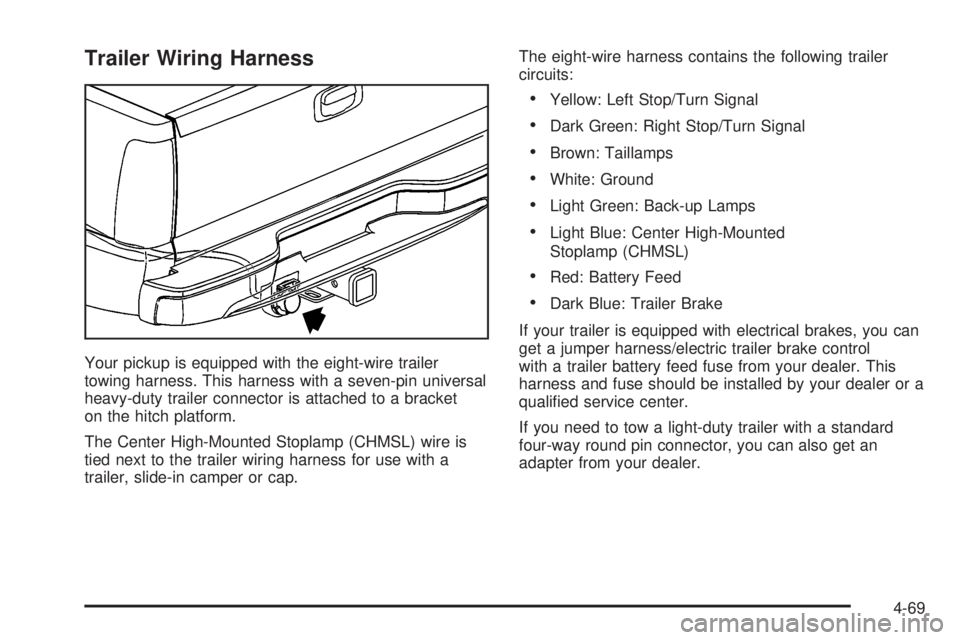
Your pickup is equipped with the eight-wire trailer
towing harness. This harness with a seven-pin universal
heavy-duty trailer connector is attached to a bracket
on the hitch platform.
The Center High-Mounted Stoplamp (CHMSL) wire is
tied next to the trailer wiring harness for use with a
trailer, slide-in camper or cap.The eight-wire harness contains the following trailer
circuits:
·Yellow: Left Stop/Turn Signal
·Dark Green: Right Stop/Turn Signal
·Brown: Taillamps
·White: Ground
·Light Green: Back-up Lamps
·Light Blue: Center High-Mounted
Stoplamp (CHMSL)
·Red: Battery Feed
·Dark Blue: Trailer Brake
If your trailer is equipped with electrical brakes, you can
get a jumper harness/electric trailer brake control
with a trailer battery feed fuse from your dealer. This
harness and fuse should be installed by your dealer or a
quali®ed service center.
If you need to tow a light-duty trailer with a standard
four-way round pin connector, you can also get an
adapter from your dealer.
4-69
Page 294 of 452
Windshield Wiper Blade Replacement..............5-58
Tires..............................................................5-59
In¯ation - Tire Pressure.................................5-67
Tire Inspection and Rotation...........................5-68
When It Is Time for New Tires.......................5-69
Buying New Tires.........................................5-70
Uniform Tire Quality Grading..........................5-71
Wheel Alignment and Tire Balance..................5-72
Wheel Replacement......................................5-73
Tire Chains..................................................5-74
If a Tire Goes Flat........................................5-75
Changing a Flat Tire.....................................5-76
Spare Tire...................................................5-95
Appearance Care............................................5-96
Cleaning the Inside of Your Vehicle.................5-96
Care of Safety Belts......................................5-98
Weatherstrips...............................................5-98Cleaning the Outside of Your Vehicle..............5-99
Sheet Metal Damage...................................5-101
Finish Damage...........................................5-102
Underbody Maintenance...............................5-102
Chemical Paint Spotting...............................5-102
Vehicle Care/Appearance Materials................5-103
Vehicle Identi®cation.....................................5-104
Vehicle Identi®cation Number (VIN)................5-104
Service Parts Identi®cation Label...................5-104
Electrical System..........................................5-105
Windshield Wiper Fuses...............................5-105
Power Windows and Other Power Options......5-105
Fuses and Circuit Breakers..........................5-105
Capacities and Speci®cations........................5-114
Section 5 Service and Appearance Care
5-2
Page 333 of 452
Jump Starting
If your battery (or batteries) has run down, you may
want to use another vehicle and some jumper cables to
start your vehicle. Be sure to follow the steps below
to do it safely.
{CAUTION:
Batteries can hurt you. They can be dangerous
because:
·They contain acid that can burn you.
·They contain gas that can explode or
ignite.
·They contain enough electricity to
burn you.
If you do not follow these steps exactly, some
or all of these things can hurt you.
Notice:Ignoring these steps could result in costly
damage to your vehicle that would not be covered
by your warranty.
Trying to start your vehicle by pushing or pulling it
will not work, and it could damage your vehicle.
1. Check the other vehicle. It must have a 12-volt
battery with a negative ground system.
Notice:If the other vehicle's system is not a 12-volt
system with a negative ground, both vehicles can
be damaged. Only use vehicles with 12-volt systems
with negative grounds to jump start your vehicle.
2. Get the vehicles close enough so the jumper cables
can reach, but be sure the vehicles aren't touching
each other. If they are, it could cause a ground
connection you don't want. You wouldn't be able to
start your vehicle, and the bad grounding could
damage the electrical systems.
To avoid the possibility of the vehicles rolling, set
the parking brake ®rmly on both vehicles involved in
the jump start procedure. Put the automatic
transmission in PARK (P) before setting the parking
brake. If you have a four-wheel-drive vehicle, be
sure the transfer case is in a drive gear not in
NEUTRAL.
5-41
Page 337 of 452
Notice:If the jumper cables are removed in the
wrong order, electrical shorting may occur and
damage the vehicle. The repairs would not be
covered by your warranty. Remove the jumper
cables in the correct order, making sure that the
cables do not touch each other or other metal.
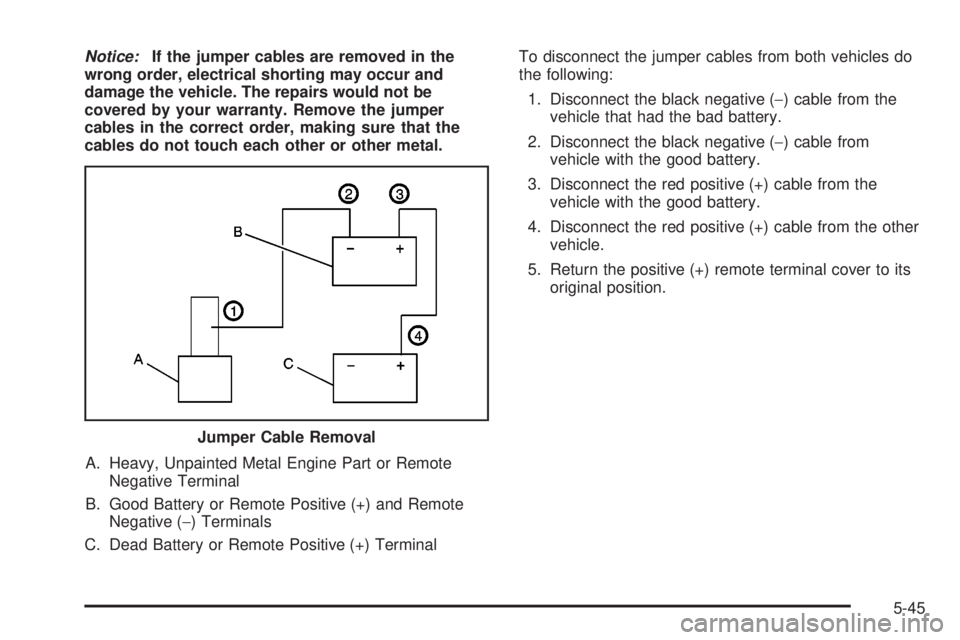
A. Heavy, Unpainted Metal Engine Part or Remote
Negative Terminal
B. Good Battery or Remote Positive (+) and Remote
Negative (-) Terminals
C. Dead Battery or Remote Positive (+) TerminalTo disconnect the jumper cables from both vehicles do
the following:
1. Disconnect the black negative (-) cable from the
vehicle that had the bad battery.
2. Disconnect the black negative (-) cable from
vehicle with the good battery.
3. Disconnect the red positive (+) cable from the
vehicle with the good battery.
4. Disconnect the red positive (+) cable from the other
vehicle.
5. Return the positive (+) remote terminal cover to its
original position.
Jumper Cable Removal
5-45
Page 342 of 452
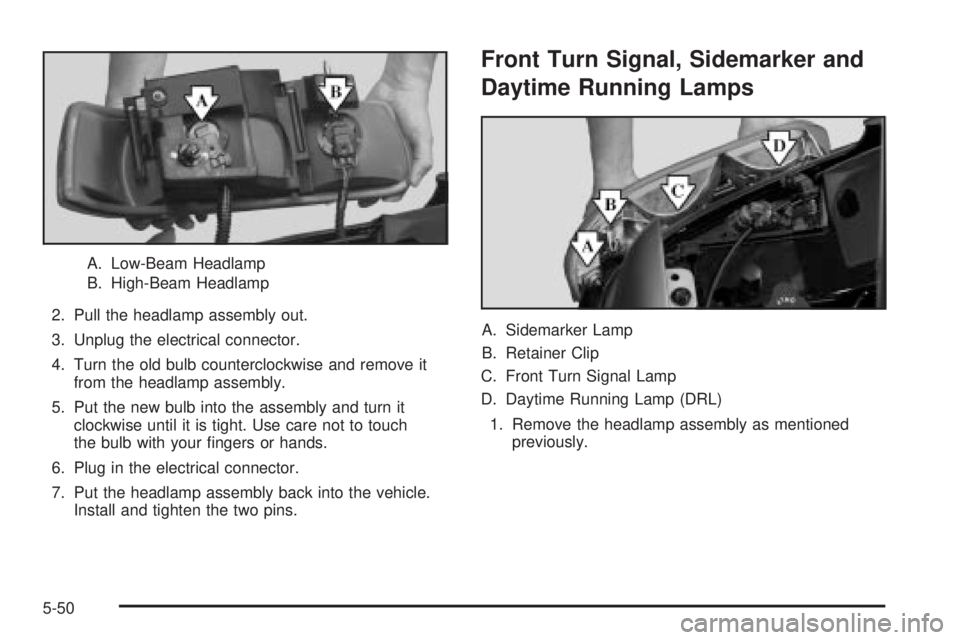
A. Low-Beam Headlamp
B. High-Beam Headlamp
2. Pull the headlamp assembly out.
3. Unplug the electrical connector.
4. Turn the old bulb counterclockwise and remove it
from the headlamp assembly.
5. Put the new bulb into the assembly and turn it
clockwise until it is tight. Use care not to touch
the bulb with your ®ngers or hands.
6. Plug in the electrical connector.
7. Put the headlamp assembly back into the vehicle.
Install and tighten the two pins.
Front Turn Signal, Sidemarker and
Daytime Running Lamps
A. Sidemarker Lamp
B. Retainer Clip
C. Front Turn Signal Lamp
D. Daytime Running Lamp (DRL)
1. Remove the headlamp assembly as mentioned
previously.
5-50
Page 397 of 452
Electrical System
Windshield Wiper Fuses
The windshield wiper motor is protected by an internal
circuit breaker and a fuse. If the motor overheats due to
heavy snow, etc., the wiper will stop until the motor
cools. If the overload is caused by some electrical
problem and not snow, etc., be sure to get it ®xed.
Power Windows and Other Power
Options
Circuit breakers protect the power windows and other
power accessories. When the current load is too heavy,
the circuit breaker opens and closes, protecting the
circuit until the problem is ®xed or goes away.
Fuses and Circuit Breakers
The wiring circuits in your vehicle are protected from
short circuits by a combination of fuses, circuit breakers
and fusible thermal links. This greatly reduces the
chance of ®res caused by electrical problems.
Look at the silver-colored band inside the fuse. If the
band is broken or melted, replace the fuse. Be sure you
replace a bad fuse with a new one of the identical
size and rating.
If you ever have a problem on the road and don't have
a spare fuse, you can borrow one that has the same
amperage. Just pick some feature of your vehicle
that you can get along without ± like the radio or
cigarette lighter ± and use its fuse, if it is the correct
amperage. Replace it as soon as you can.
5-105
Page 403 of 452
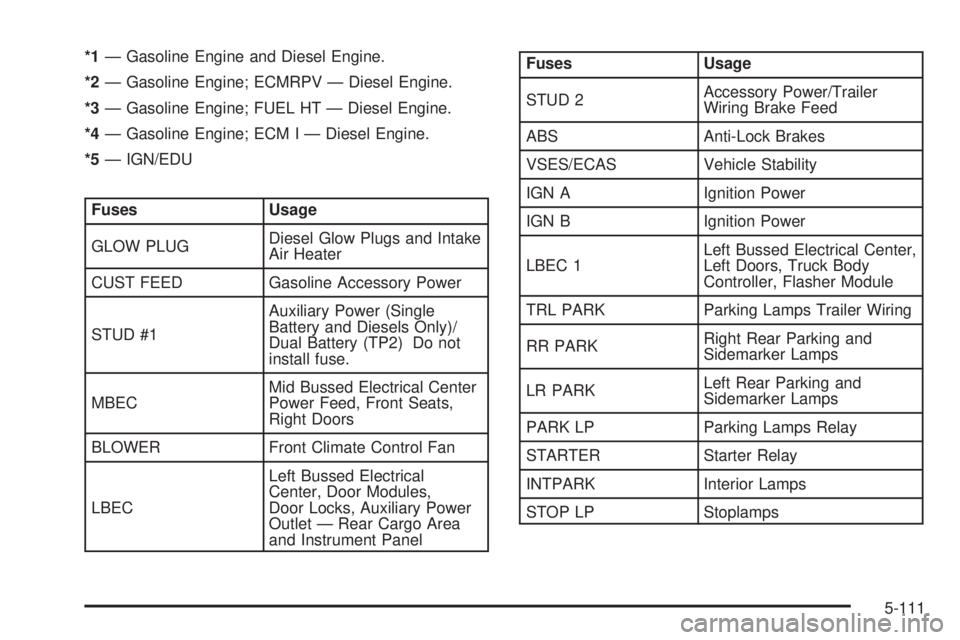
*1Ð Gasoline Engine and Diesel Engine.
*2Ð Gasoline Engine; ECMRPV Ð Diesel Engine.
*3Ð Gasoline Engine; FUEL HT Ð Diesel Engine.
*4Ð Gasoline Engine; ECM I Ð Diesel Engine.
*5Ð IGN/EDU
Fuses Usage
GLOW PLUGDiesel Glow Plugs and Intake
Air Heater
CUST FEED Gasoline Accessory Power
STUD #1Auxiliary Power (Single
Battery and Diesels Only)/
Dual Battery (TP2) Do not
install fuse.
MBECMid Bussed Electrical Center
Power Feed, Front Seats,
Right Doors
BLOWER Front Climate Control Fan
LBECLeft Bussed Electrical
Center, Door Modules,
Door Locks, Auxiliary Power
Outlet Ð Rear Cargo Area
and Instrument Panel
Fuses Usage
STUD 2Accessory Power/Trailer
Wiring Brake Feed
ABS Anti-Lock Brakes
VSES/ECAS Vehicle Stability
IGN A Ignition Power
IGN B Ignition Power
LBEC 1Left Bussed Electrical Center,
Left Doors, Truck Body
Controller, Flasher Module
TRL PARK Parking Lamps Trailer Wiring
RR PARKRight Rear Parking and
Sidemarker Lamps
LR PARKLeft Rear Parking and
Sidemarker Lamps
PARK LP Parking Lamps Relay
STARTER Starter Relay
INTPARK Interior Lamps
STOP LP Stoplamps
5-111
Page 405 of 452
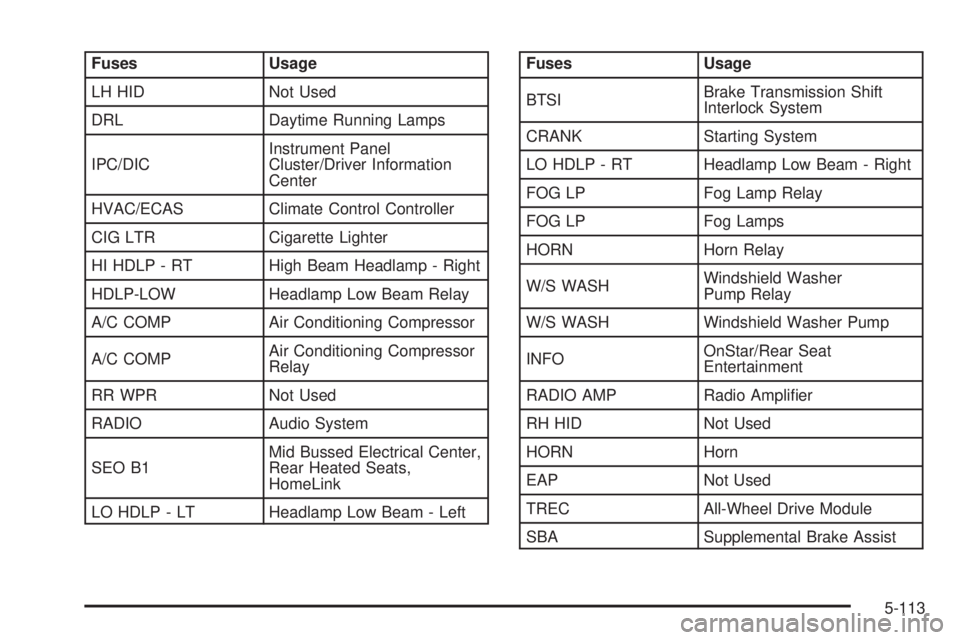
Fuses Usage
LH HID Not Used
DRL Daytime Running Lamps
IPC/DICInstrument Panel
Cluster/Driver Information
Center
HVAC/ECAS Climate Control Controller
CIG LTR Cigarette Lighter
HI HDLP - RT High Beam Headlamp - Right
HDLP-LOW Headlamp Low Beam Relay
A/C COMP Air Conditioning Compressor
A/C COMPAir Conditioning Compressor
Relay
RR WPR Not Used
RADIO Audio System
SEO B1Mid Bussed Electrical Center,
Rear Heated Seats,
HomeLink
LO HDLP - LT Headlamp Low Beam - LeftFuses Usage
BTSIBrake Transmission Shift
Interlock System
CRANK Starting System
LO HDLP - RT Headlamp Low Beam - Right
FOG LP Fog Lamp Relay
FOG LP Fog Lamps
HORN Horn Relay
W/S WASHWindshield Washer
Pump Relay
W/S WASH Windshield Washer Pump
INFOOnStar/Rear Seat
Entertainment
RADIO AMP Radio Ampli®er
RH HID Not Used
HORN Horn
EAP Not Used
TREC All-Wheel Drive Module
SBA Supplemental Brake Assist
5-113
Page 435 of 452
Reporting Safety Defects to the
Canadian Government
If you live in Canada, and you believe that your vehicle
has a safety defect, you should immediately notify
Transport Canada, in addition to notifying General
Motors of Canada Limited. You may write to:
Transport Canada
330 Sparks Street
Tower C
Ottawa, Ontario K1A 0N5
Reporting Safety Defects to General
Motors
In addition to notifying NHTSA (or Transport Canada) in
a situation like this, we certainly hope you'll notify us.
Please call us at 1-800-GMC-8782 (1-800-462-8782),
or write:
Pontiac-GMC Customer Assistance Center
P.O. Box 33172
Detroit, MI 48232-5172In Canada, please call us at 1-800-263-3777 (English)
or 1-800-263-7854 (French). Or, write:
General Motors of Canada Limited
Customer Communication Centre, 163-005
1908 Colonel Sam Drive
Oshawa, Ontario L1H 8P7
Service Publications Ordering
Information
Service Manuals
Service Manuals have the diagnosis and repair
information on engines, transmission, axle, suspension,
brakes, electrical, steering, body, etc.
RETAIL SELL PRICE: $120.00
Transmission, Transaxle, Transfer
Case Unit Repair Manual
This manual provides information on unit repair service
procedures, adjustments, and speci®cations for GM
transmissions, transaxles, and transfer cases.
RETAIL SELL PRICE: $50.00
7-11
Page 441 of 452
D
Daytime Running Lamps..................................3-14
Defensive Driving............................................. 4-2
Defogging and Defrosting.................................3-25
Delayed Locking............................................... 2-8
Doing Your Own Service Work........................... 5-3
Dome Lamps.................................................3-17
Door
Delayed Locking........................................... 2-8
Locks.......................................................... 2-6
Power Door Locks......................................... 2-7
Programmable Automatic Door Locks............... 2-8
Rear Doors.................................................2-11
Driver
Position, Safety Belt.....................................1-14
DRIVER DOOR AJAR.....................................3-59
Driver Information Center (DIC).........................3-46
DIC Operation and Displays..........................3-46
DIC Warnings and Messages........................3-57
Driving
At Night.....................................................4-32
City...........................................................4-36
Defensive..................................................... 4-2
Drunken....................................................... 4-2
Freeway.....................................................4-37
Hill and Mountain Roads..............................4-40
In Rain and on Wet Roads...........................4-33
Winter........................................................4-42
Driving Across an Incline..................................4-28Driving Downhill..............................................4-26
Driving in Mud, Sand, Snow or Ice....................4-29
Driving in Water..............................................4-30
Driving On Grades..........................................4-67
Driving on Off-Road Hills.................................4-22
Driving on Snow or Ice....................................4-43
Driving Through Deep Standing Water...............4-35
Driving Through Flowing Water.........................4-35
Driving Uphill..................................................4-24
Driving with a Trailer.......................................4-65
Dual Automatic Climate Control System.............3-19
E
Easy Exit Seat...............................................2-46
Electrical System
Fuses and Circuit Breakers.........................5-105
Power Windows and Other Power
Options.................................................5-105
Windshield Wiper Fuses.............................5-105
Emissions Inspection and Maintenance
Programs...................................................3-42
Engine
Air Cleaner/Filter.........................................5-16
Battery.......................................................5-40
Check and Service Engine Soon Light............3-40
Coolant......................................................5-21
Coolant Heater............................................2-20
Coolant Temperature Gage...........................3-38
5