light GMC YUKON DENALI 2003 Manual Online
[x] Cancel search | Manufacturer: GMC, Model Year: 2003, Model line: YUKON DENALI, Model: GMC YUKON DENALI 2003Pages: 447, PDF Size: 21.97 MB
Page 273 of 447
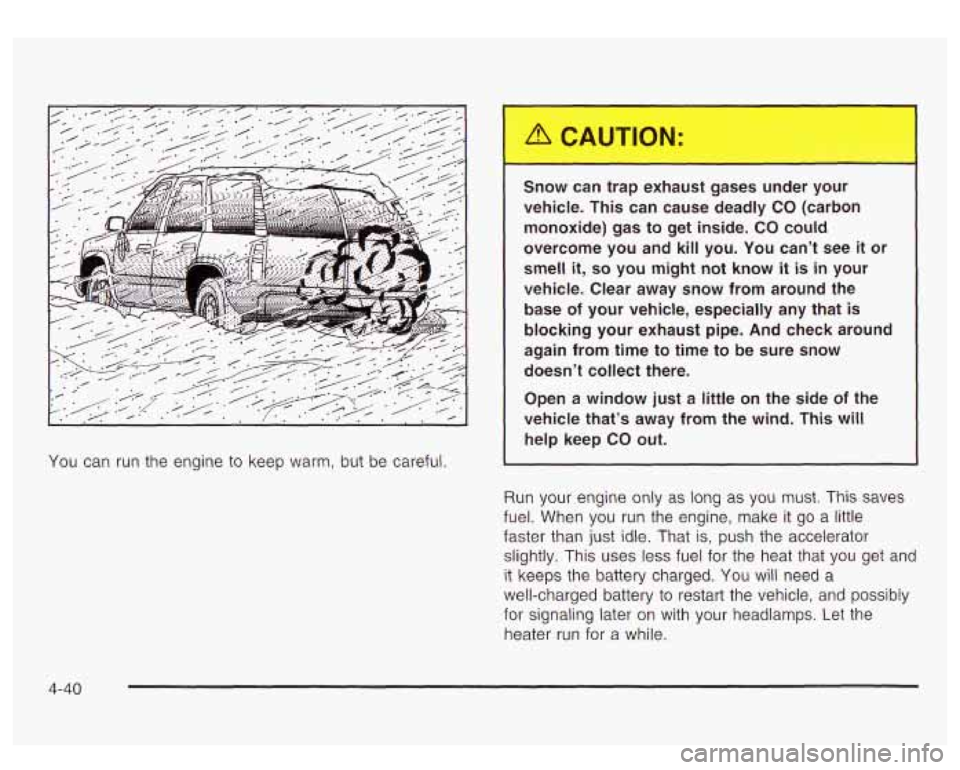
You can run the engine to keep warm, but be careful.
L..Jw can trap exhaust gases ,..der your
vehicle. This can cause deadly CO (carbon
monoxide) gas to get inside.
CO could
overcome you and kill you. You can’t see
it or
smell it, so you might not know it is in your
vehicle. Clear away snow from around the base of your vehicle, especially any that is
blocking your exhaust pipe. And check around
again from time to time to be sure snow
doesn’t collect there.
Open a window just
a little on the side of the
vehicle that’s away from the wind. This will
help keep
CO out.
Run your engine only
as long as you must. This saves
fuel. When
you run the engine, make it go a little
faster than just idle. That
is, push the accelerator
slightly. This uses less fuel for the heat that
you get and
it keeps the battery charged. You will need a
well-charged battery
to restart the vehicle, and possibly
for signaling later
on with your headlamps. Let the
heater run for
a while.
4-40
Page 275 of 447
Rocking Your Vehicle To Get It Out
First, turn your steering wheel left and right. That will
clear the area around your front wheels. If your vehicle
has the Stabilitrak@System, turn the system off by
pressing the Stabilitrak@button
so that the STABILITY
SYS DISABLED message and the traction off light
are illuminated on the instrument panel cluster. Then
shift back and forth between REVERSE (R) and
a
forward gear, spinning the wheels as little as possible.
Release the accelerator pedal while you shift, and press
lightly on the accelerator pedal when the transmission
is in gear. By slowly spinning your wheels in the forward
and reverse directions, you will cause a rocking
motion that may free your vehicle.
If that doesn’t get
you out after a few tries, you may need to be towed out.
Or, you can use your recovery hooks
if your vehicle
has them. If you do need to be towed out, see Towing
Your Vehicle on page 4-44.
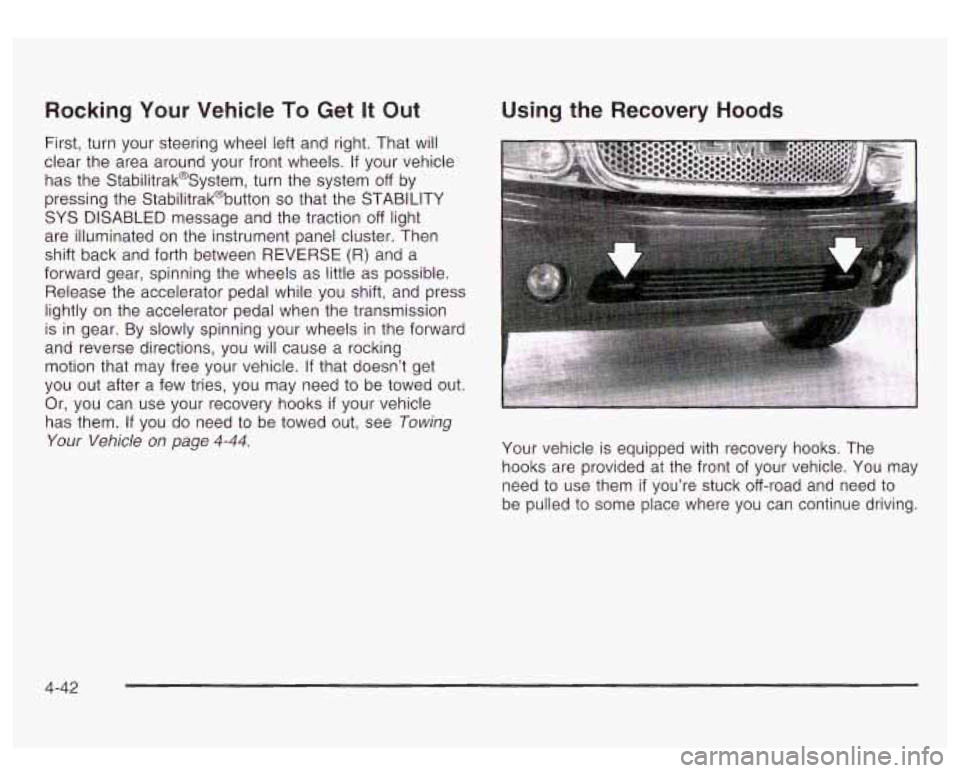
Using the Recovery Hoods
Your vehicle is equipped with recovery hooks. The
hooks are provided at the front
of your vehicle. You may
need to use them
if you’re stuck off-road and need to
be pulled to some place where you can continue driving.
4-42
Page 282 of 447
Tow/Haul Mode
The tow/haul feature assists when pulling a heavy trailer
or a large or heavy load. The purpose
of the tow/haul
mode
is to:
Reduce the frequency and improve the predictability
of transmission shifts when pulling a heavy trailer or
a large or heavy load.
Provide the same solid shift feel when pulling a
heavy trailer or a large or heavy load as when
the vehicle is unloaded.
Improve control of vehicle speed while requiring
less throttle pedal activity when pulling a heavy
trailer or a large or heavy load.
Your vehicle is provided with a button at the end of the
shift lever which when pressed enables tow/haul.
When the button is pressed, a light on the instrument
panel will illuminate
to indicate that tow/haul has
been selected. Tow/haul may be turned
off by pressing
the button again, at which time the indicator light on
the instrument panel will turn off. The vehicle will
automatically turn off tow/haul every time it is started. Tow/haul
is designed
to be most effective when the
vehicle and trailer combined weight is at least
75 percent
of the vehicle’s Gross Combination Weight Rating
(GCWR). See Weight
of the Trailer later in this section.
Tovdhaul is mcst useful wder the f~l!~~ing driving
conditions:
When pulling a heavy trailer or a large or heavy
0 When pulling a heavy trailer or a large or heavy
load through rolling terrain.
load
in stop and go traffic.
When pulling a heavy trailer or a large or heavy
load in busy parking
lots where improved low
speed control of the vehicle is desired.
Operating the vehicle in tow/haul when lightly loaded or
with no trailer at all will not cause damage. However,
there is no benefit
to the selection of tow/haul when the
vehicle is unloaded. Such a selection when unloaded may result in unpleasant engine and transmission driving
characteristics and reduced fuel economy. Tow/haul
is recommended only when pulling a heavy trailer or a
large or heavy load.
4-49
Page 289 of 447
Trailer Wiring Harness
Heavy-Duty Trailer Wiring Package
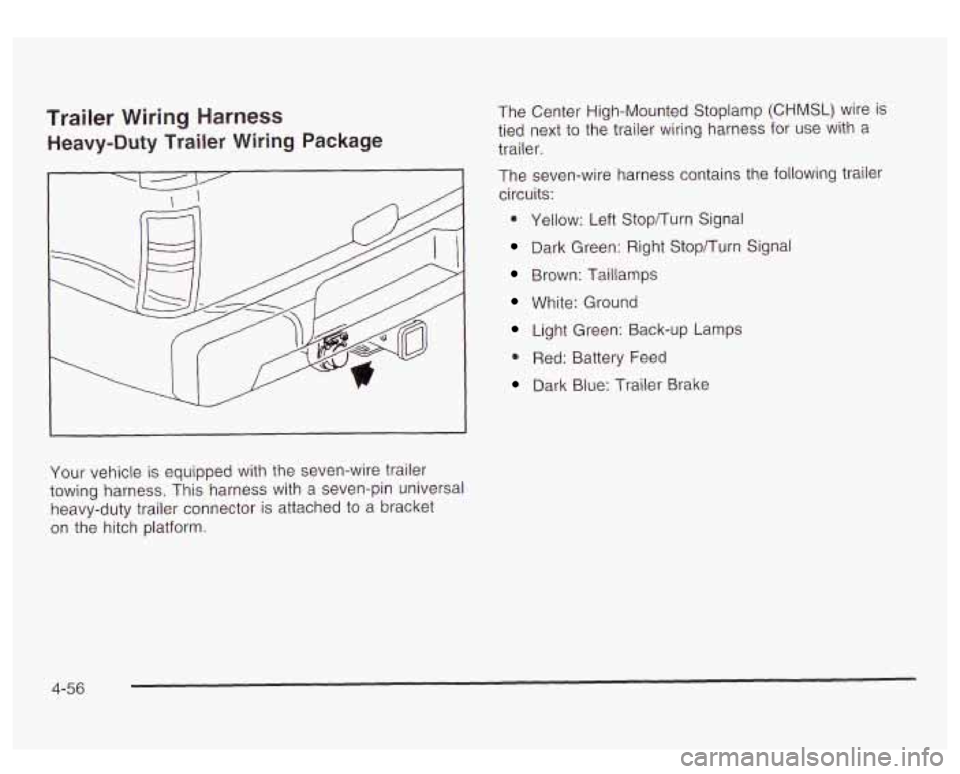
Your vehicle is equipped with the seven-wire trailer
towing harness. This harness with a seven-pin universal heavy-duty trailer connector
is attached to a bracket
on the hitch platform. The Center High-Mounted Stoplamp
(CHMSL) wire is
tied next
to the trailer wiring harness for use with a
trailer.
The seven-wire harness contains the following trailer
circuits:
0 Yellow: Left Stop/Turn Signal
Dark Green: Right Stop/Turn Signal
Brown: Taillamps
White: Ground
Light Green: Back-up Lamps
0 Red: Battery Feed
Dark Blue: Trailer Brake
4-56
Page 298 of 447
When you put the fuel cap back on, turn it to the right
(clockwise) until you hear a clicking sound. Make
sure you fully install the cap. The diagnostic system can
determine
if the fuel cap has been left off or improperly
installed. this would allow fuel
to evaporate into the
atmosphere. See Malfunction
indicator Lamp on
page 3-38.
Notice: If you need a new fuel cap, be sure to get
the right type. Your dealer can get one for you.
If you get the wrong type, it may not fit properly.
This may cause your malfunction indicator lamp to
light and may damage your fuel tank and emissions
system. See “Malfunction Indicator Lamp”
in the
Index.
Cillinc a Dortable Fun’ Container
~~ ~
Never fill a portable fuel container while it is in
your vehicle. Static electricity discharge from
the container can ignite
the gasoline vapor.
You can
be badly burned and your vehicle
damaged
if this occurs. To help avoid injury to
you and others:
Dispense gasoline only into approved
containers.
@ Do not fill a container while it is inside a
vehicle, in a vehicle’s trunk, pickup bed or on any surface other than the ground.
@ Bring the fill nozzle in contact with the
inside of the fill opening before operating
the nozzle. Contact should be maintained until the filling is complete.
Don’t smoke while pumping gasoline.
5-9
Page 312 of 447
The following explains your cooling system and how to
add coolant when it is low. If you have a problem
with engine overheating, see Engine Overheating
on
page 5-25.
A 50/50 mixture of clean, drinkable water and
DEX-COOL@ coolant will:
Give freezing protection down to -34°F (-37°C).
Give boiling protection up to 265°F (129°C).
Protect against rust and corrosion.
Help keep the proper engine temperature.
e Let the warning lights and gages work as they
should.
Notice: When adding coolant, it is important that
you use only
DEX-COOL@ (silicate-free) coolant.
If coolant other than DEX-COOL@ is added to the
system, premature engine, heater core or radiator
corrosion may result. In addition, the engine coolant
will require change sooner
-- at 30,000 miles
(50,000 km) or 24 months, whichever occurs first.
Damage caused by the use of coolant other than
DEX-COQL.@ is not covered by your new vehicle
warranty.
What to Use
Use a mixture of one-half clean, drinkable water and
one-half DEX-COOL@ coolant which won’t damage
aluminum parts.
!f YOU uss this coolant mixture,
you don’t need
to add anything else.
Adding c..ly
c water to your cooling
system can be dangerous. Plain water, or
some other liquid such as alcohol, can boil before the proper coolant mixture will. Your
vehicle’s coolant warning system
is set for the
proper coolant mixture. With plain water or the
wrong mixture, your engine could get too hot
but you wouldn’t get the overheat warning.
Your engine could catch fire and you or others
could be burned. Use a
50/50 mixture of clean,
drinkable water and DEX-COQL@ coolant.
Notice: If you use an improper coolant mixture,
your engine could overheat and be badly damaged.
The repair cost wouldn’t be covered by your
warranty. Too much water
in the mixture can freeze
and crack the engine, radiator, heater core and
other parts.
5-23
Page 327 of 447
Notice;
Using the wrong fluid can badly damage brake
system parts. For example, just a few drops of mineral-based oil, such as engine oil, in your
brake system can damage brake system
parts
so badly that they’ll have to be replaced.
Don’t let someone put
in the wrong kind of fluid.
If you spill brake fluid on your vehicle’s painted
surfaces,
the paint finish can be damaged. Be
careful not to spill brake fluid on your vehicle. If
you do, wash
it off immediately. See
“Appearance Care’’ in the Index.
Brake Wear
Your vehicle has four-wheel disc brakes.
Disc brake pads have built-in wear indicators that make
a high-pitched warning sound when the brake pads
are worn and new pads are needed. The sound
may come and go or be heard all the time your vehicle
is moving (except when you are pushing on the
brake pedal firmly).
~ The brake wea rarl -g sou.-_. ... eans that
soon your brakes won’t work well. That could
lead to an accident. When you hear the brake
wear warning sound, have your vehicle
serviced.
Notice: Continuing to drive with worn-out brake
pads could result in costly brake repair.
Some driving conditions or climates may cause a brake
squeal when the brakes are first applied or lightly
applied. This does not mean something is wrong with
your brakes.
Properly torqued wheel nuts are necessary
to help
prevent brake pulsation. When tires are rotated, inspect
brake pads for wear and evenly tighten wheel nuts in
the proper sequence to
GM torque specifications.
Brake linings should always be replaced as complete
axle sets.
See
Brake System Inspection on page 6-14.
5-38
Page 330 of 447
Notice: If the other system isn’t a 12-volt system
with a negative ground, both vehicles can be
damaged.
2.
Get the vehicles close enough so the jumper cables
can reach, but be sure the vehicles aren’t touching
each other.
If they are, it could cause a ground
connection you don’t want. You wouldn’t be able
to
start your vehicle, and the bad grounding could
damage the electrical systems.
To avoid the possibility of the vehicles rolling, set
the parking brake firmly on both vehicles involved in
the jump start procedure. Put an automatic
transmission in PARK (P) or a manual transmission
in NEUTRAL before setting the parking brake.
Notice: If you leave your radio on, it could be badly
damaged. The repairs wouldn’t be covered by
your warranty.
3. Turn off the ignition on both vehicles. Unplug
unnecessary accessories plugged into the cigarette
lighter or accessory power outlets. Turn
off the
radio and all lamps that aren’t needed. This
will avoid sparks and help save both batteries.
And it could save your radio!
4. Open the hoods and locate the positive (+) and
negative
(-) terminal locations of the other vehicle.
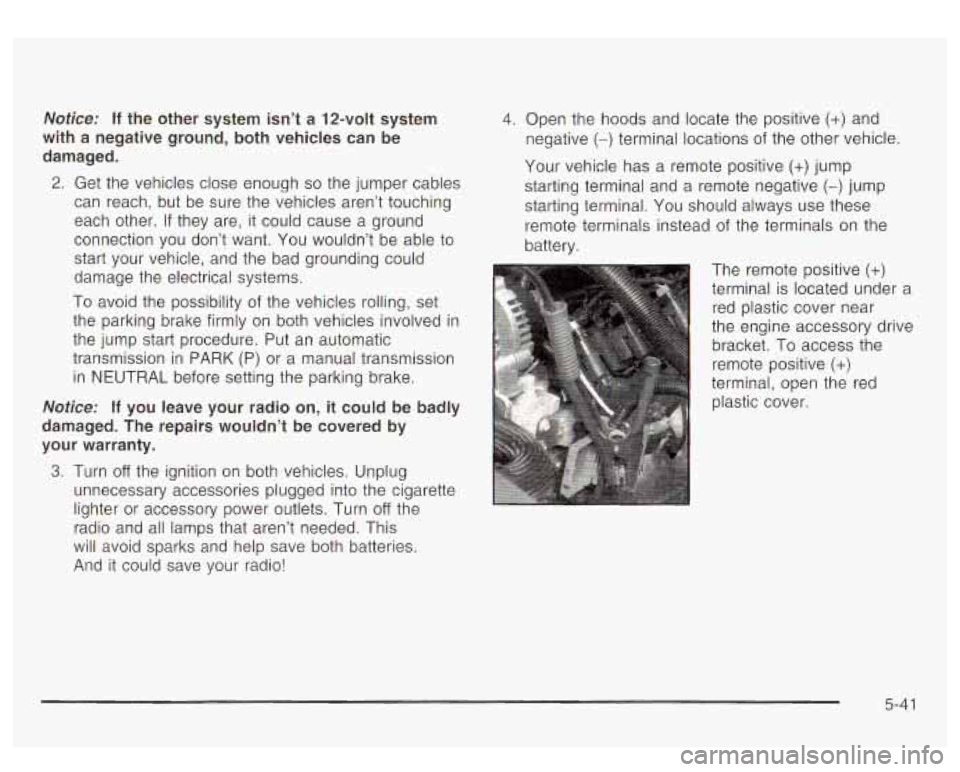
Your vehicle has a remote positive
(+) jump
starting terminal and a remote negative
(-) jump
starting terminal.
You should always use these
remote terminals instead
of the terminals on the
battery.
The remote positive
(+)
terminal is located under a red plastic cover near
the engine accessory drive
bracket.
To access the
remote positive
(+)
terminal, open the red
plastic cover.
5-41
Page 331 of 447
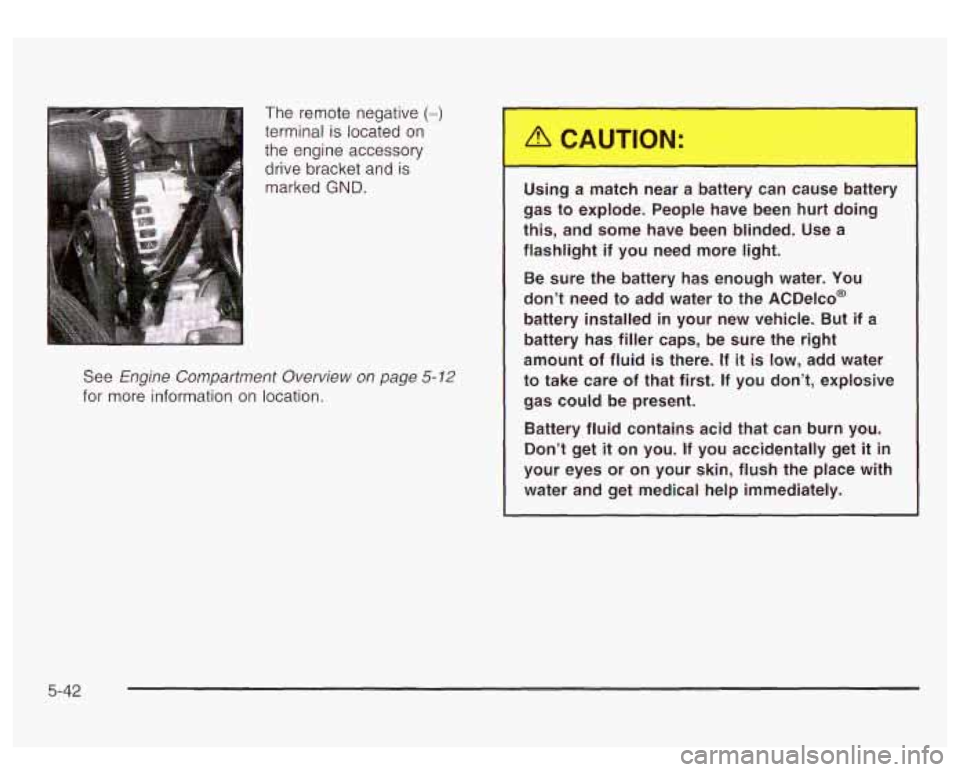
The remote negative (-)
terminal is located on
the engine accessory
drive bracket and
is
marked GND.
See Engine Compartment Overview on page 5-12
for more information on location. Using a match
near
a battery can cause battery
gas to explode. People have been hurt doing
this, and some have been blinded. Use a
flashlight
if you need more light.
Be sure the battery has enough water. You
don’t need to add water to the ACDelco@
battery installed in your new vehicle. But
if a
battery has filler caps, be sure the right
amount of fluid is there.
If it is low, add water
to take care of that first. If you don’t, explosive
gas could be present.
Battery fluid contains acid that can burn you.
Don’t get
it on you. If you accidentally get it in
your eyes or on your skin, flush the place with
water and get medical help immediately.
J
5-42
Page 349 of 447
While the tires available on General Motors passenger
cars and light trucks may vary with respect
to these
grades, they must also conform
to federal safety
requirements and additional General Motors Tire
Performance Criteria (TPC) standards.
Treadwear
The treadwear grade is a comparative rating based on
the wear rate of the tire when tested under controlled
conditions on a specified government test course.
For example, a tire graded
150 would wear one and
a half
(1.5) times as well on the government course as
a tire graded
100. The relative performance of tires
depends upon the actual conditions of their use,
however, and may depart significantly from the norm
due
to variations in driving habits, service practices and
differences
in road characteristics and climate.
Traction - AA, A, 6, C
The traction grades, from highest to lowest, are AA, A,
B, and C. Those grades represent the tire’s ability
to stop on wet pavement as measured under controlled
conditions on specified government test surfaces of
asphalt and concrete.
A tire marked C may have poor
traction performance. Warning: The traction grade assigned
to this tire is based
on straight-ahead braking
traction tests, and does not include acceleration,
cornering, hydroplaning, or peak traction characteristics.
Temperature - A, B, C
The temperature grades are A (the highest), B, and C,
representing the tire’s resistance
to the generation
of heat and its ability
to dissipate heat when tested
under controlled conditions on a specified indoor
laboratory test wheel. Sustained high temperature can
cause the material
of the tire to degenerate and
reduce tire life, and excessive temperature can lead
to
sudden tire failure. The grade C corresponds to a
level of performance which all passenger car tires must
meet under the Federal Motor Vehicle Safety Standard
No. 109. Grades B and A represent higher levels of
performance on the laboratory test wheel than the
minimum required
by law.
Warning: The temperature grade for this tire is
established for a tire that is properly inflated and not
overloaded. Excessive speed, underinflation, or
excessive loading, either separately or in combination,
can cause heat buildup and possible tire failure.
5-60