lock GMC YUKON DENALI 2010 Owner's Manual
[x] Cancel search | Manufacturer: GMC, Model Year: 2010, Model line: YUKON DENALI, Model: GMC YUKON DENALI 2010Pages: 560, PDF Size: 4.32 MB
Page 53 of 560
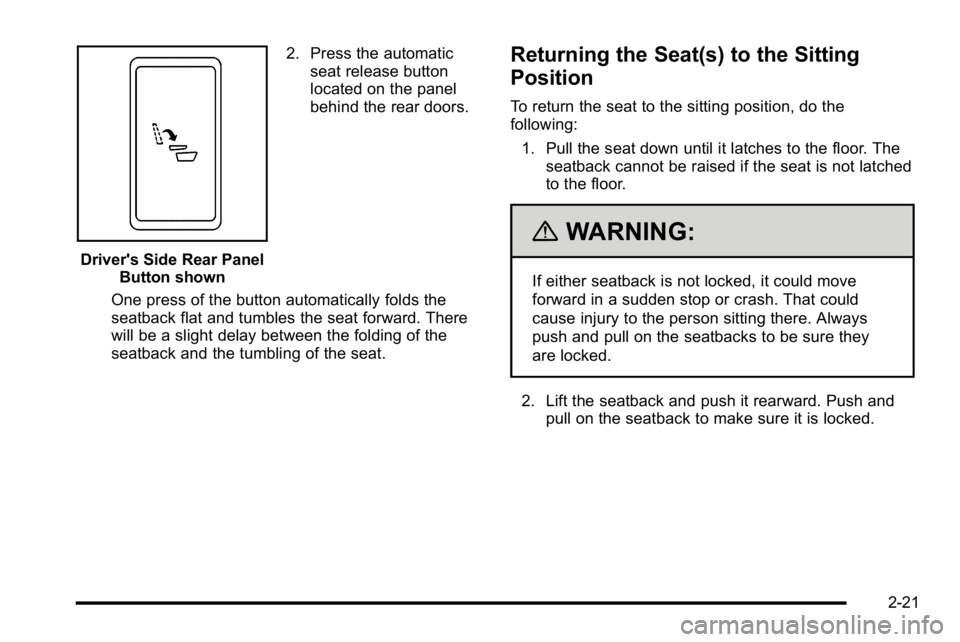
Driver's Side Rear PanelButton shown 2. Press the automatic
seat release button
located on the panel
behind the rear doors.
One press of the button automatically folds the
seatback flat and tumbles the seat forward. There
will be a slight delay between the folding of the
seatback and the tumbling of the seat.
Returning the Seat(s) to the Sitting
Position
To return the seat to the sitting position, do the
following: 1. Pull the seat down until it latches to the floor. The seatback cannot be raised if the seat is not latched
to the floor.
{WARNING:
If either seatback is not locked, it could move
forward in a sudden stop or crash. That could
cause injury to the person sitting there. Always
push and pull on the seatbacks to be sure they
are locked.
2. Lift the seatback and push it rearward. Push and pull on the seatback to make sure it is locked.
2-21
Page 55 of 560
Returning the Seatback(s) to the
Upright Position
To return the seatback to the upright position, do the
following:1. Open the liftgate to access the controls for the seat.
2. Pull up on the seatback until it locks into the upright position.
{WARNING:
If either seatback is not locked, it could move
forward in a sudden stop or crash. That could
cause injury to the person sitting there. Always
push and pull on the seatbacks to be sure they
are locked.
3. Push and pull on the seatback to make sure it is locked.
Tumbling the Third Row Seat
The seat can be tumbled forward for additional cargo
space.
To tumble the seat, do the following:
1. Open the liftgate to access the controls for the seat.
2. Make sure the head rests are completely lowered and there is nothing under, in front of, or on
the seat.
3. Fold the seatbacks forward using the instructions previously listed under “Folding the Seatbacks”.
You will not be able to unlatch the seat from the
floor unless the seatback is folded down.
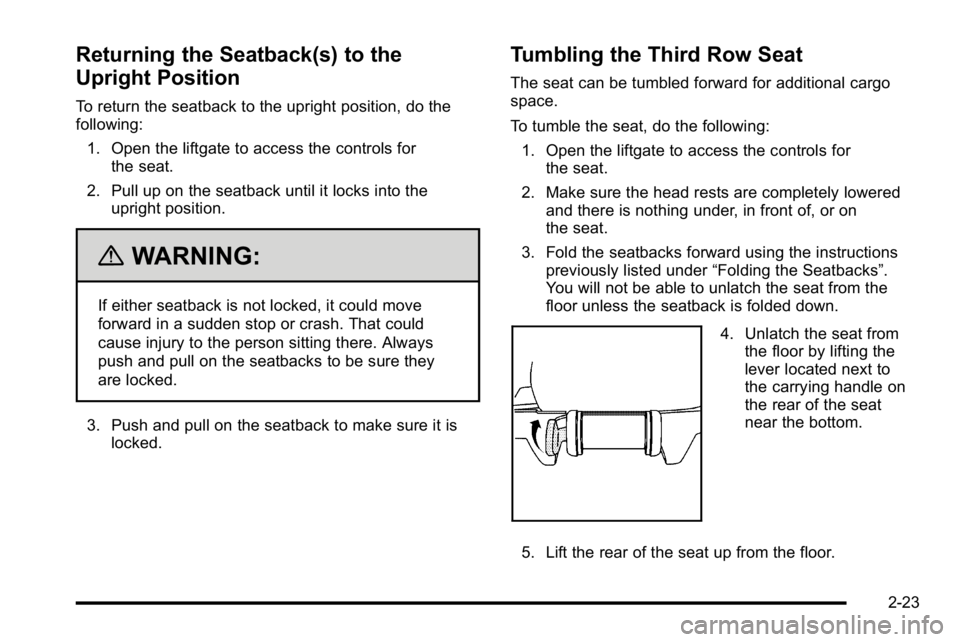
4. Unlatch the seat from the floor by lifting the
lever located next to
the carrying handle on
the rear of the seat
near the bottom.
5. Lift the rear of the seat up from the floor.
2-23
Page 56 of 560

6. Tilt the seat fully forward to lock it into place.
7. Push and pull on the seat to make sure it is locked.
Put the seat in this position only when necessary for
additional cargo space.
Returning the Third Row Seat from a
Tumbled Position
To return the seat to the normal seating position, do the
following: 1. Open the liftgate to access the controls for the seat.
2. Make sure there is nothing that could become trapped under the seat.
3. Release the seat from the tumbled position by lifting the lever located next to the carrying handle
at the bottom rear of the seat.
4. Pull the seat down until it latches to the floor. The seatback cannot be raised if the seat is not latched
to the floor.
5. Pull up on the seatback until it locks into the upright position.
{WARNING:
If either seatback is not locked, it could move
forward in a sudden stop or crash. That could
cause injury to the person sitting there. Always
push and pull on the seatbacks to be sure they
are locked.
6. Push and pull on the seatback to make sure it is locked.
Removing the Third Row Seat
To remove the seat, do the following:
1. Open the liftgate to access the controls for the seat.
2. Fold the seatback forward using the instructions listed under “Folding the Seatbacks” previously.
The seat cannot be removed unless the seatback
is folded.
2-24
Page 57 of 560
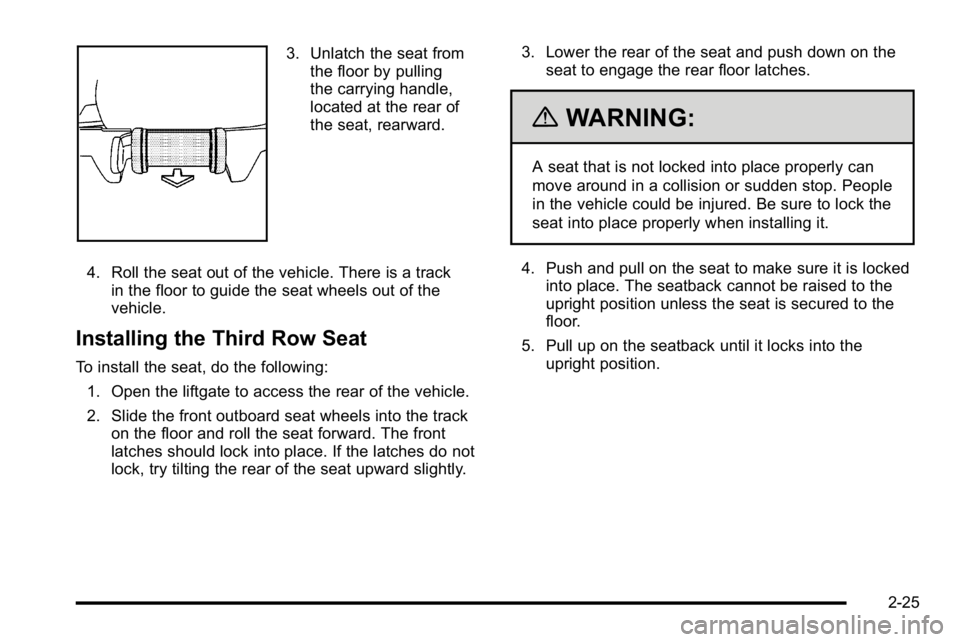
3. Unlatch the seat fromthe floor by pulling
the carrying handle,
located at the rear of
the seat, rearward.
4. Roll the seat out of the vehicle. There is a track in the floor to guide the seat wheels out of the
vehicle.
Installing the Third Row Seat
To install the seat, do the following:
1. Open the liftgate to access the rear of the vehicle.
2. Slide the front outboard seat wheels into the track on the floor and roll the seat forward. The front
latches should lock into place. If the latches do not
lock, try tilting the rear of the seat upward slightly. 3. Lower the rear of the seat and push down on the
seat to engage the rear floor latches.
{WARNING:
A seat that is not locked into place properly can
move around in a collision or sudden stop. People
in the vehicle could be injured. Be sure to lock the
seat into place properly when installing it.
4. Push and pull on the seat to make sure it is locked into place. The seatback cannot be raised to the
upright position unless the seat is secured to the
floor.
5. Pull up on the seatback until it locks into the upright position.
2-25
Page 58 of 560

{WARNING:
If either seatback is not locked, it could move
forward in a sudden stop or crash. That could
cause injury to the person sitting there. Always
push and pull on the seatbacks to be sure they
are locked.
6. Push and pull on the seatback to make sure it is locked.
{WARNING:
A safety belt that is improperly routed, not
properly attached, or twisted will not provide the
protection needed in a crash. The person wearing
the belt could be seriously injured. After raising
the rear seatback, always check to be sure that
the safety belts are properly routed and attached,
and are not twisted.
7. Make sure the safety belts are returned to the original position over the seatbacks.
Safety Belts
Safety Belts: They Are for Everyone
This section of the manual describes how to use safety
belts properly. It also describes some things not to do
with safety belts.
{WARNING:
Do not let anyone ride where a safety belt cannot
be worn properly. In a crash, if you or your
passenger(s) are not wearing safety belts, the
injuries can be much worse. You can hit things
inside the vehicle harder or be ejected from the
vehicle. You and your passenger(s) can be
seriously injured or killed. In the same crash, you
might not be, if you are buckled up. Always fasten
your safety belt, and check that your passenger(s)
are restrained properly too.
2-26
Page 64 of 560
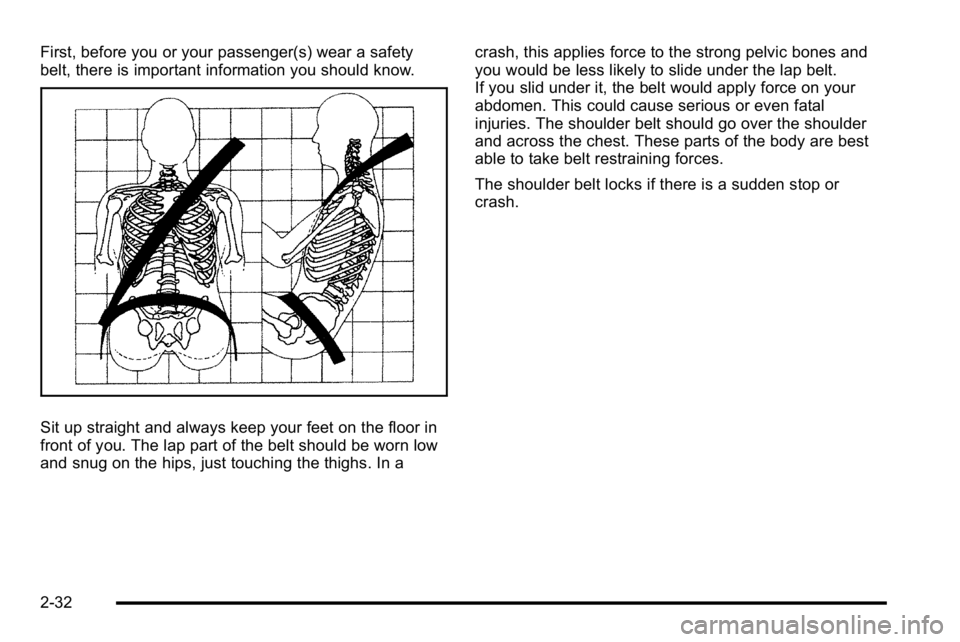
First, before you or your passenger(s) wear a safety
belt, there is important information you should know.
Sit up straight and always keep your feet on the floor in
front of you. The lap part of the belt should be worn low
and snug on the hips, just touching the thighs. In acrash, this applies force to the strong pelvic bones and
you would be less likely to slide under the lap belt.
If you slid under it, the belt would apply force on your
abdomen. This could cause serious or even fatal
injuries. The shoulder belt should go over the shoulder
and across the chest. These parts of the body are best
able to take belt restraining forces.
The shoulder belt locks if there is a sudden stop or
crash.
2-32
Page 72 of 560
Lap-Shoulder Belt
All seating positions in the vehicle have a lap-shoulder
belt except for the center front passenger position,
if equipped, which has a lap belt. SeeLap Belt
on
page 2‑47for more information.
The lap‐shoulder belts for the first and second row
seating positions are equipped with free‐falling latch
plates. If the vehicle has a third row, the lap‐shoulder
belts have either free‐falling or cinching latch plates.
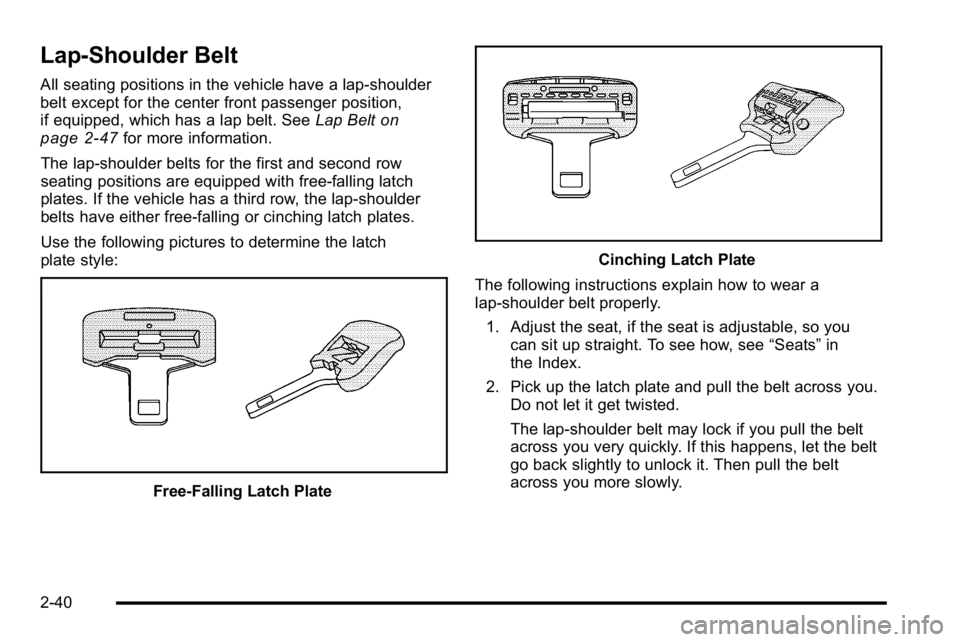
Use the following pictures to determine the latch
plate style:
Free-Falling Latch Plate
Cinching Latch Plate
The following instructions explain how to wear a
lap-shoulder belt properly. 1. Adjust the seat, if the seat is adjustable, so you can sit up straight. To see how, see “Seats”in
the Index.
2. Pick up the latch plate and pull the belt across you. Do not let it get twisted.
The lap-shoulder belt may lock if you pull the belt
across you very quickly. If this happens, let the belt
go back slightly to unlock it. Then pull the belt
across you more slowly.
2-40
Page 73 of 560
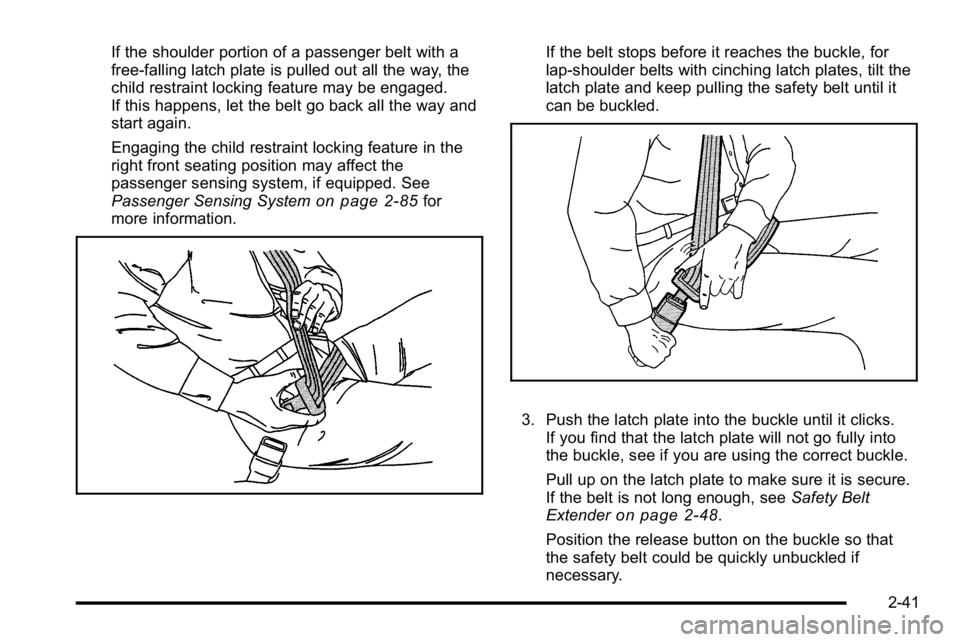
If the shoulder portion of a passenger belt with a
free‐falling latch plate is pulled out all the way, the
child restraint locking feature may be engaged.
If this happens, let the belt go back all the way and
start again.
Engaging the child restraint locking feature in the
right front seating position may affect the
passenger sensing system, if equipped. See
Passenger Sensing System
on page 2‑85for
more information.
If the belt stops before it reaches the buckle, for
lap‐shoulder belts with cinching latch plates, tilt the
latch plate and keep pulling the safety belt until it
can be buckled.
3. Push the latch plate into the buckle until it clicks. If you find that the latch plate will not go fully into
the buckle, see if you are using the correct buckle.
Pull up on the latch plate to make sure it is secure.
If the belt is not long enough, see Safety Belt
Extender
on page 2‑48.
Position the release button on the buckle so that
the safety belt could be quickly unbuckled if
necessary.
2-41
Page 75 of 560
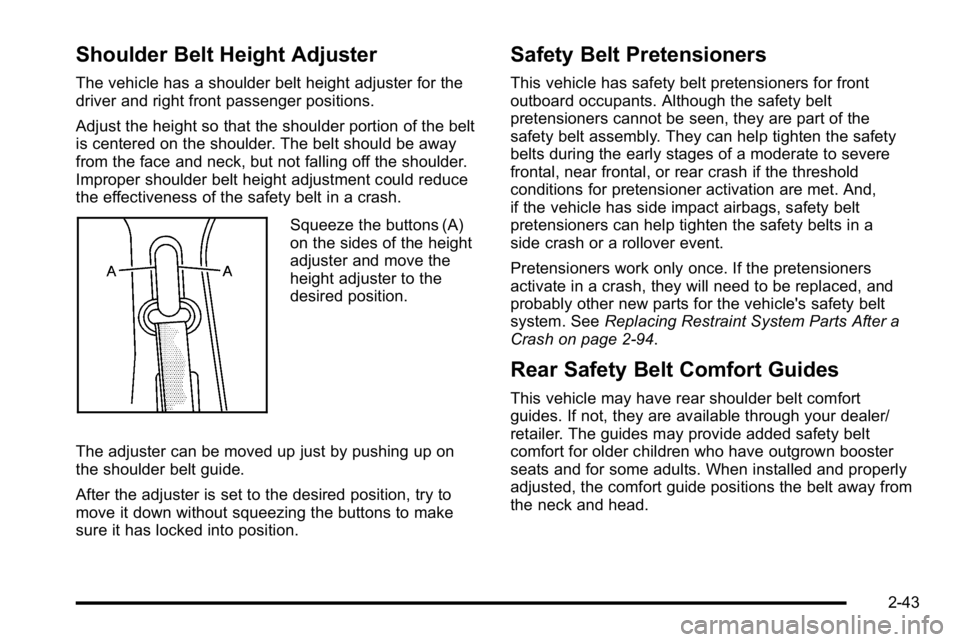
Shoulder Belt Height Adjuster
The vehicle has a shoulder belt height adjuster for the
driver and right front passenger positions.
Adjust the height so that the shoulder portion of the belt
is centered on the shoulder. The belt should be away
from the face and neck, but not falling off the shoulder.
Improper shoulder belt height adjustment could reduce
the effectiveness of the safety belt in a crash.
Squeeze the buttons (A)
on the sides of the height
adjuster and move the
height adjuster to the
desired position.
The adjuster can be moved up just by pushing up on
the shoulder belt guide.
After the adjuster is set to the desired position, try to
move it down without squeezing the buttons to make
sure it has locked into position.
Safety Belt Pretensioners
This vehicle has safety belt pretensioners for front
outboard occupants. Although the safety belt
pretensioners cannot be seen, they are part of the
safety belt assembly. They can help tighten the safety
belts during the early stages of a moderate to severe
frontal, near frontal, or rear crash if the threshold
conditions for pretensioner activation are met. And,
if the vehicle has side impact airbags, safety belt
pretensioners can help tighten the safety belts in a
side crash or a rollover event.
Pretensioners work only once. If the pretensioners
activate in a crash, they will need to be replaced, and
probably other new parts for the vehicle's safety belt
system. See Replacing Restraint System Parts After a
Crash on page 2‑94.
Rear Safety Belt Comfort Guides
This vehicle may have rear shoulder belt comfort
guides. If not, they are available through your dealer/
retailer. The guides may provide added safety belt
comfort for older children who have outgrown booster
seats and for some adults. When installed and properly
adjusted, the comfort guide positions the belt away from
the neck and head.
2-43
Page 96 of 560
According to accident statistics, children and infants
are safer when properly restrained in a child restraint
system or infant restraint system secured in a rear
seating position. SeeWhere to Put the Restraint
on
page 2‑58for additional information.
Securing a Child Restraint Designed for the
LATCH System
{WARNING:
If a LATCH-type child restraint is not attached to
anchors, the child restraint will not be able to
protect the child correctly. In a crash, the child
could be seriously injured or killed. Install a
LATCH-type child restraint properly using the
anchors, or use the vehicle's safety belts to
secure the restraint, following the instructions that
came with the child restraint and the instructions
in this manual.
{WARNING:
Do not attach more than one child restraint to a
single anchor. Attaching more than one child
restraint to a single anchor could cause the
anchor or attachment to come loose or even
break during a crash. A child or others could be
injured. To reduce the risk of serious or fatal
injuries during a crash, attach only one child
restraint per anchor.
{WARNING:
Children can be seriously injured or strangled if a
shoulder belt is wrapped around their neck and
the safety belt continues to tighten. Buckle any
unused safety belts behind the child restraint so
children cannot reach them. Pull the shoulder belt
all the way out of the retractor to set the lock,
if your vehicle has one, after the child restraint
has been installed.
2-64