automatic transmission GMC YUKON HYBRID 2010 Owners Manual
[x] Cancel search | Manufacturer: GMC, Model Year: 2010, Model line: YUKON HYBRID, Model: GMC YUKON HYBRID 2010Pages: 120, PDF Size: 1.03 MB
Page 5 of 120
Section 1 In Brief
Initial Drive Information. . . . . . . . . . . . . . . . . . . . . . . . . . . 1-2
Transmission . . . . . . . . . . . . . . . . . . . . . . . . . . . . . . . . . . . . 1-2
Four-Wheel Drive . . . . . . . . . . . . . . . . . . . . . . . . . . . . . . . 1-2
Hybrid Features . . . . . . . . . . . . . . . . . . . . . . . . . . . . . . . . . . . . 1-3
Hybrid Safety Information . . . . . . . . . . . . . . . . . . . . . . 1-3
Fuel Economy Gage . . . . . . . . . . . . . . . . . . . . . . . . . . . . 1-4 Automatic Engine Start/Stop Feature . . . . . . . . . . . . 1-4
Regenerative Braking . . . . . . . . . . . . . . . . . . . . . . . . . . . 1-5
Battery . . . . . . . . . . . . . . . . . . . . . . . . . . . . . . . . . . . . . . . . . . 1-6
Service . . . . . . . . . . . . . . . . . . . . . . . . . . . . . . . . . . . . . . . . . 1-6
Performance and Maintenance . . . . . . . . . . . . . . . . . . . .1-6
Tire Sealant and Compressor Kit . . . . . . . . . . . . . . . . 1-6
1-1
Page 6 of 120
Initial Drive Information
Transmission
Range Selection Mode
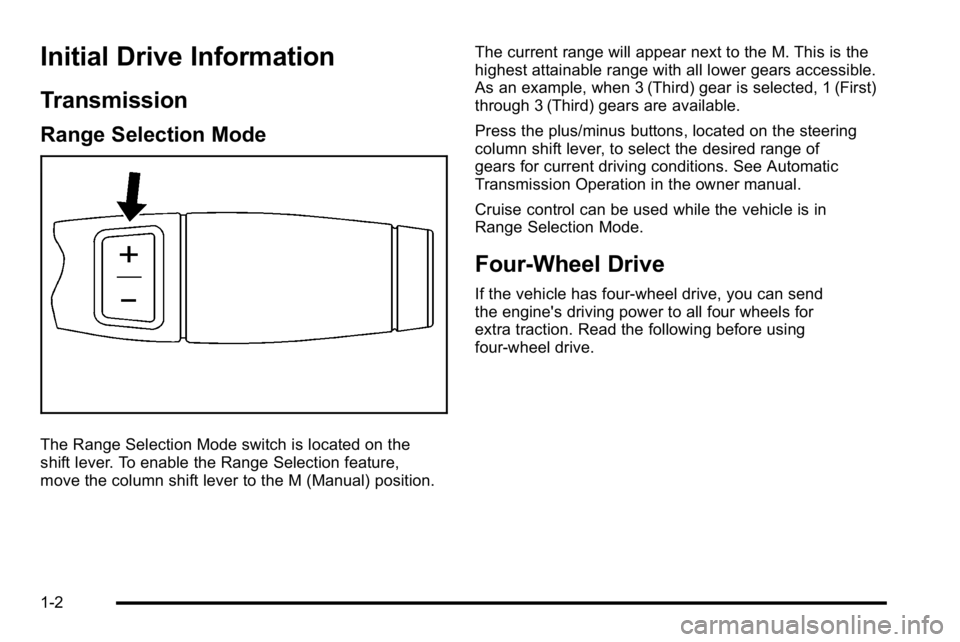
The Range Selection Mode switch is located on the
shift lever. To enable the Range Selection feature,
move the column shift lever to the M (Manual) position.The current range will appear next to the M. This is the
highest attainable range with all lower gears accessible.
As an example, when 3 (Third) gear is selected, 1 (First)
through 3 (Third) gears are available.
Press the plus/minus buttons, located on the steering
column shift lever, to select the desired range of
gears for current driving conditions. See Automatic
Transmission Operation in the owner manual.
Cruise control can be used while the vehicle is in
Range Selection Mode.
Four-Wheel Drive
If the vehicle has four-wheel drive, you can send
the engine's driving power to all four wheels for
extra traction. Read the following before using
four-wheel drive.
1-2
Page 15 of 120
Section 3 Features and Controls
Storage Areas. . . . . . . . . . . . . . . . . . . . . . . . . . . . . . . . . . . . . . 3-2
Power Outlet Alternating Current . . . . . . . . . . . . . . . . 3-2
Starting and Operating Your Vehicle . . . . . . . . . . . . . .3-3
Starting the Vehicle . . . . . . . . . . . . . . . . . . . . . . . . . . . . . 3-3
Automatic Transmission Operation . . . . . . . . . . . . . . 3-6 Four-Wheel Drive . . . . . . . . . . . . . . . . . . . . . . . . . . . . . . 3-10
Shifting Into Park . . . . . . . . . . . . . . . . . . . . . . . . . . . . . . 3-15
Engine Coolant Heater . . . . . . . . . . . . . . . . . . . . . . . . . 3-17
Regenerative Braking . . . . . . . . . . . . . . . . . . . . . . . . . . 3-18
Running the Vehicle While Parked . . . . . . . . . . . . . 3-18
3-1
Page 19 of 120
Auto Start
The vehicle also has an Auto Start feature. The engine
will remain off while in Auto Stop mode until vehicle
conditions require the engine to run. The near-instant
starting of the engine from Auto Stop mode is called
Auto Start. Some of the vehicle conditions that may
cause the engine to Auto Start are:
.The hood is opened.
.The gear selector is in M (Manual Mode).
.The hybrid battery state of charge is too low.
.The hybrid battery voltage, temperature or power
limits are exceeded.
.A remote vehicle start has been requested.
.The engine is not at operating temperature.
.Acceleration demands require the use of the
engine.
EV Mode
The vehicle also has an Electric Vehicle (EV) mode
which uses only the electric motor to move the vehicle.
With light acceleration, the vehicle will drive in EV
mode. EV mode is unavailable when the vehicle is
out of fuel.
If increased acceleration is required, or the vehicle
reaches approximately 40 km/h (30 mph), the engine will
start automatically. The engine shuts off at speeds
below 40 km/h (25 mph) unless the transmission is in
M (Manual Mode) or Auto Stop is disabled.
During heavy acceleration, both the engine and
hybrid electric motors supply power. A sensation
similar to a transmission gear change can be felt as
the transmission changes modes. Engine RPM may
remain above 4,000 RPM for a longer period during
hard acceleration.
3-5
Page 20 of 120
Automatic Transmission Operation
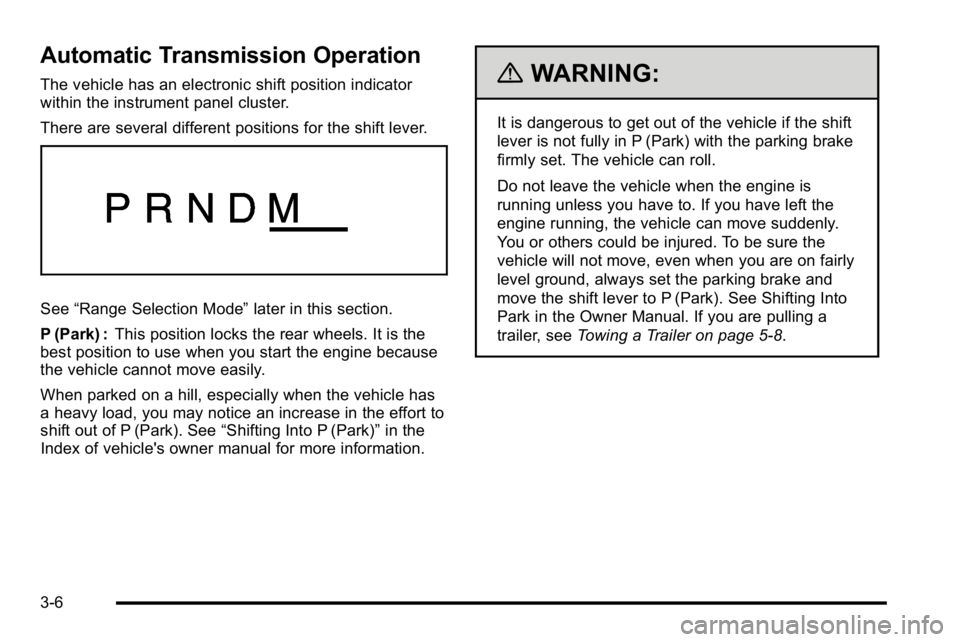
The vehicle has an electronic shift position indicator
within the instrument panel cluster.
There are several different positions for the shift lever.
See“Range Selection Mode” later in this section.
P (Park) : This position locks the rear wheels. It is the
best position to use when you start the engine because
the vehicle cannot move easily.
When parked on a hill, especially when the vehicle has
a heavy load, you may notice an increase in the effort to
shift out of P (Park). See “Shifting Into P (Park)”in the
Index of vehicle's owner manual for more information.
{WARNING:
It is dangerous to get out of the vehicle if the shift
lever is not fully in P (Park) with the parking brake
firmly set. The vehicle can roll.
Do not leave the vehicle when the engine is
running unless you have to. If you have left the
engine running, the vehicle can move suddenly.
You or others could be injured. To be sure the
vehicle will not move, even when you are on fairly
level ground, always set the parking brake and
move the shift lever to P (Park). See Shifting Into
Park in the Owner Manual. If you are pulling a
trailer, see Towing a Trailer on page 5‑8.
3-6
Page 23 of 120
Range Selection Mode
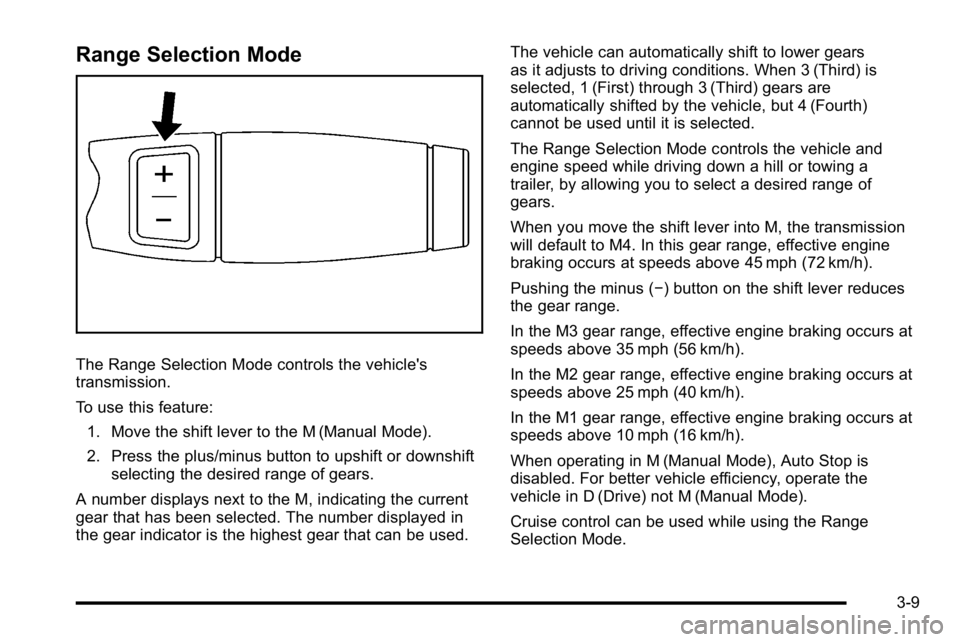
The Range Selection Mode controls the vehicle's
transmission.
To use this feature:1. Move the shift lever to the M (Manual Mode).
2. Press the plus/minus button to upshift or downshift selecting the desired range of gears.
A number displays next to the M, indicating the current
gear that has been selected. The number displayed in
the gear indicator is the highest gear that can be used. The vehicle can automatically shift to lower gears
as it adjusts to driving conditions. When 3 (Third) is
selected, 1 (First) through 3 (Third) gears are
automatically shifted by the vehicle, but 4 (Fourth)
cannot be used until it is selected.
The Range Selection Mode controls the vehicle and
engine speed while driving down a hill or towing a
trailer, by allowing you to select a desired range of
gears.
When you move the shift lever into M, the transmission
will default to M4. In this gear range, effective engine
braking occurs at speeds above 45 mph (72 km/h).
Pushing the minus (−) button on the shift lever reduces
the gear range.
In the M3 gear range, effective engine braking occurs at
speeds above 35 mph (56 km/h).
In the M2 gear range, effective engine braking occurs at
speeds above 25 mph (40 km/h).
In the M1 gear range, effective engine braking occurs at
speeds above 10 mph (16 km/h).
When operating in M (Manual Mode), Auto Stop is
disabled. For better vehicle efficiency, operate the
vehicle in D (Drive) not M (Manual Mode).
Cruise control can be used while using the Range
Selection Mode.
3-9
Page 25 of 120
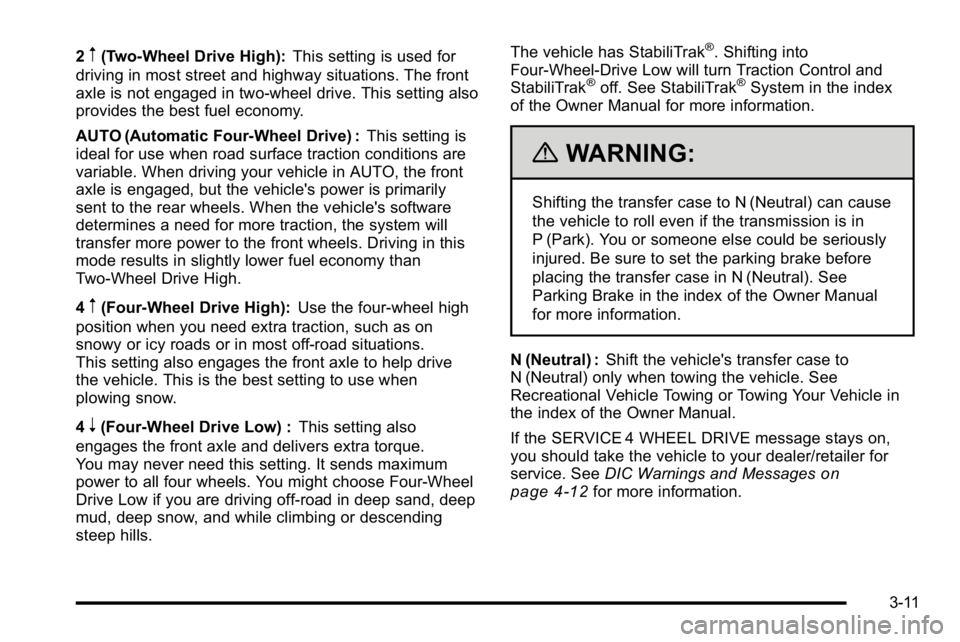
2m(Two-Wheel Drive High):This setting is used for
driving in most street and highway situations. The front
axle is not engaged in two-wheel drive. This setting also
provides the best fuel economy.
AUTO (Automatic Four-Wheel Drive) : This setting is
ideal for use when road surface traction conditions are
variable. When driving your vehicle in AUTO, the front
axle is engaged, but the vehicle's power is primarily
sent to the rear wheels. When the vehicle's software
determines a need for more traction, the system will
transfer more power to the front wheels. Driving in this
mode results in slightly lower fuel economy than
Two-Wheel Drive High.
4
m(Four-Wheel Drive High): Use the four-wheel high
position when you need extra traction, such as on
snowy or icy roads or in most off-road situations.
This setting also engages the front axle to help drive
the vehicle. This is the best setting to use when
plowing snow.
4
n(Four-Wheel Drive Low) : This setting also
engages the front axle and delivers extra torque.
You may never need this setting. It sends maximum
power to all four wheels. You might choose Four-Wheel
Drive Low if you are driving off-road in deep sand, deep
mud, deep snow, and while climbing or descending
steep hills. The vehicle has StabiliTrak
®. Shifting into
Four-Wheel-Drive Low will turn Traction Control and
StabiliTrak
®off. See StabiliTrak®System in the index
of the Owner Manual for more information.
{WARNING:
Shifting the transfer case to N (Neutral) can cause
the vehicle to roll even if the transmission is in
P (Park). You or someone else could be seriously
injured. Be sure to set the parking brake before
placing the transfer case in N (Neutral). See
Parking Brake in the index of the Owner Manual
for more information.
N (Neutral) : Shift the vehicle's transfer case to
N (Neutral) only when towing the vehicle. See
Recreational Vehicle Towing or Towing Your Vehicle in
the index of the Owner Manual.
If the SERVICE 4 WHEEL DRIVE message stays on,
you should take the vehicle to your dealer/retailer for
service. See DIC Warnings and Messages
on
page 4‑12for more information.
3-11
Page 26 of 120
Shifting Into Four-Wheel Drive High or
AUTO (Automatic Four-Wheel Drive)
Turn the knob to the Four-Wheel High or AUTO
position. This can be done at any speed, except when
shifting from Four-Wheel Drive Low. The indicator light
will flash while shifting. It will remain on when the shift is
completed.
Shifting Into Two-Wheel Drive High
Turn the knob to the Two-Wheel High position. This can
be done at any speed, except when shifting from
Four-Wheel Drive Low.
See“Shifting Out of Four-Wheel Drive Low” later in this
section for more information.
Shifting Into Four-Wheel Drive Low
When Four-Wheel Low is engaged, vehicle speed
should be kept below 40 mph (64 km/h). Extended
high-speed operation in 4L may damage or shorten the
life of the drivetrain.
To shift to the Four-Wheel Drive Low position, the
ignition must be in ON/RUN and the vehicle must be
stopped or moving less than 3 mph (5 km/h) with the
transmission in N (Neutral). The preferred method for shifting into Four-Wheel Drive Low is to have the
vehicle moving 1 to 2 mph (1.6 to 3.2 km/h). Turn the
knob to the Four-Wheel Drive Low position. You must
wait for the Four-Wheel Drive Low indicator light to stop
flashing and remain on before shifting the transmission
into gear.
Notice:
Shifting the transmission into gear before
the Four-Wheel Drive Low indicator light has
stopped flashing could damage the transfer case.
To help avoid damaging the vehicle, always wait for
the Four-Wheel Drive Low indicator light to stop
flashing before shifting the transmission into gear.
The vehicle may have significant engagement noise
and bump when shifting between Four-Wheel Drive Low
and Four-Wheel Drive High ranges or from N (Neutral)
while the engine is running.
If the knob is turned to the Four-Wheel Drive Low
position when the vehicle is in gear and/or moving,
the Four-Wheel Drive Low indicator light will flash for
30 seconds and not complete the shift unless the
vehicle is moving less than 3 mph (5 km/h) and the
transmission is in N (Neutral). After 30 seconds the
transfer case will shift to Four-Wheel Drive High mode.
3-12
Page 57 of 120
Section 6 Service and Appearance Care
Service. . . . . . . . . . . . . . . . . . . . . . . . . . . . . . . . . . . . . . . . . . . . . 6-2
Doing Your Own Service Work . . . . . . . . . . . . . . . . . . 6-2
Checking Things Under the Hood . . . . . . . . . . . . . . . . .6-3
High Voltage Devices and Wiring . . . . . . . . . . . . . . . 6-3
Engine Compartment Overview . . . . . . . . . . . . . . . . . 6-4
Automatic Transmission Fluid . . . . . . . . . . . . . . . . . . . 6-5
Drive Motor/Generator Control Module (DMCM) Coolant Surge Tank Pressure Cap . . . . . . . . . . . . 6-8
Drive Motor/Generator Control Module (DMCM) Cooling System . . . . . . . . . . . . . . . . . . . . . . . . . . . . . . . 6-9
Power Steering Fluid . . . . . . . . . . . . . . . . . . . . . . . . . . 6-13
Brakes . . . . . . . . . . . . . . . . . . . . . . . . . . . . . . . . . . . . . . . . . 6-13
Battery . . . . . . . . . . . . . . . . . . . . . . . . . . . . . . . . . . . . . . . . . 6-16
Jump Starting . . . . . . . . . . . . . . . . . . . . . . . . . . . . . . . . . . 6-18
Bulb Replacement . . . . . . . . . . . . . . . . . . . . . . . . . . . . . . . . 6-24
Taillamps, Turn Signal, Stoplamps and Back-up Lamps . . . . . . . . . . . . . . . . . . . . . . . . . . . . . . 6-24
Replacement Bulbs . . . . . . . . . . . . . . . . . . . . . . . . . . . . 6-25 Electrical System
. . . . . . . . . . . . . . . . . . . . . . . . . . . . . . . . . 6-25
High Voltage Devices and Wiring . . . . . . . . . . . . . . 6-25
Fuses and Circuit Breakers . . . . . . . . . . . . . . . . . . . . 6-26
Underhood Fuse Block . . . . . . . . . . . . . . . . . . . . . . . . 6-26
Tires . . . . . . . . . . . . . . . . . . . . . . . . . . . . . . . . . . . . . . . . . . . . . . . 6-28
Inflation - Tire Pressure . . . . . . . . . . . . . . . . . . . . . . . . 6-28
Tire Pressure Monitor Operation . . . . . . . . . . . . . . . 6-29
Tire Inspection and Rotation . . . . . . . . . . . . . . . . . . . 6-33
Tire Chains . . . . . . . . . . . . . . . . . . . . . . . . . . . . . . . . . . . . 6-34
If a Tire Goes Flat . . . . . . . . . . . . . . . . . . . . . . . . . . . . . 6-34
Tire Sealant and Compressor Kit (Without Selector Switch) . . . . . . . . . . . . . . . . . . . . 6-35
Tire Sealant and Compressor Kit (With Selector Switch) . . . . . . . . . . . . . . . . . . . . . . . 6-45
Tire Sealant and Compressor Kit Storage . . . . . . 6-55
Appearance Care . . . . . . . . . . . . . . . . . . . . . . . . . . . . . . . . . 6-56
Vehicle Care/Appearance Materials . . . . . . . . . . . . 6-56
Capacities and Specifications . . . . . . . . . . . . . . . . . . .6-57
6-1
Page 61 of 120
A. See“Engine Air Cleaner/Filter” in the owner
manual.
B. Drive Motor/Generator Control Module (DMCM). See Drive Motor/Generator Control Module
(DMCM) Cooling System on page 6‑9.
C. Engine Oil Dipstick. See “Engine Oil”in the owner
manual.
D. Automatic Transmission Fluid Dipstick. See Automatic Transmission Fluid on page 6‑5.
E. Brake Fluid Reservoir. See Brakes on page 6‑13.
F. See “Underhood Fuse Block” in the owner manual.
G. See “Windshield Washer Fluid” in the owner
manual.
H. Hybrid Auxiliary Fuse Block. See Underhood Fuse
Block on page 6‑26.
I. DMCM Coolant Surge Tank Pressure Cap. See Drive Motor/Generator Control Module (DMCM)
Coolant Surge Tank Pressure Cap on page 6‑8.
J. See “Coolant Surge Tank Pressure Cap” in the
owner manual.
K. Engine Oil Fill Cap. See “Engine Oil”in the owner
manual.Automatic Transmission Fluid
When to Check and Change Automatic
Transmission Fluid
It is usually not necessary to check the transmission
fluid level. The only reason for fluid loss is a
transmission leak or overheating the transmission.
If you suspect a small leak, then use the following
checking procedures to check the fluid level. However,
if there is a large leak, then it may be necessary to have
the vehicle towed to a dealer/retailer service department
and have it repaired before driving the vehicle further.
Notice: Use of the incorrect automatic transmission
fluid may damage the vehicle, and the damages may
not be covered by the vehicle's warranty. Always
use the automatic transmission fluid listed in
Recommended Fluids and Lubricants on page 7‑2.
Change the fluid and filter at the intervals listed in the
Maintenance Schedule. See Scheduled Maintenance in
the owner manual. Be sure to use the transmission fluid
listed in Recommended Fluids and Lubricants
on
page 7‑2.
6-5