lock GMC YUKON XL 2007 Owners Manual
[x] Cancel search | Manufacturer: GMC, Model Year: 2007, Model line: YUKON XL, Model: GMC YUKON XL 2007Pages: 608, PDF Size: 3.01 MB
Page 345 of 608
If you keep pace with the traffic and allow realistic
following distances, you will eliminate a lot of
unnecessary braking. That means better braking
and longer brake life.
If your engine ever stops while you are driving,
brake normally but do not pump your brakes.
If you do, the pedal may get harder to push down.
If your engine stops, you will still have some
power brake assist. But you will use it when you
brake. Once the power assist is used up, it
may take longer to stop and the brake pedal will
be harder to push.
Adding non-GM accessories can affect your
vehicle’s performance. SeeAccessories and
Modications on page 426.Anti-Lock Brake System (ABS)
Your vehicle has the Anti-Lock Brake System
(ABS), an advanced electronic braking system that
will help prevent a braking skid.
When you start your engine and begin to drive
away, ABS will check itself. You may hear a
momentary motor or clicking noise while this test
is going on. This is normal.
If there is a problem
with ABS, this warning
light will stay on.
SeeAnti-Lock Brake
System Warning
Light on page 233.
Along with ABS, your vehicle has a Dynamic Rear
Proportioning (DRP) system. If there is a DRP
problem, both the brake and ABS warning lights will
come on accompanied by a 10-second chime. The
lights and chime will come on each time the ignition
is turned on until the problem is repaired. See your
dealer for service.
345
Page 347 of 608
As you brake, your computer keeps receiving
updates on wheel speed and controls braking
pressure accordingly.
Remember: ABS does not change the time you
need to get your foot up to the brake pedal or
always decrease stopping distance. If you get too
close to the vehicle in front of you, you will not have
time to apply your brakes if that vehicle suddenly
slows or stops. Always leave enough room up
ahead to stop, even though you have ABS.
Using ABS
Do not pump the brakes. Just hold the brake
pedal down rmly and let anti-lock work for you.
You may feel the brakes vibrate, or you may notice
some noise, but this is normal.
Braking in Emergencies
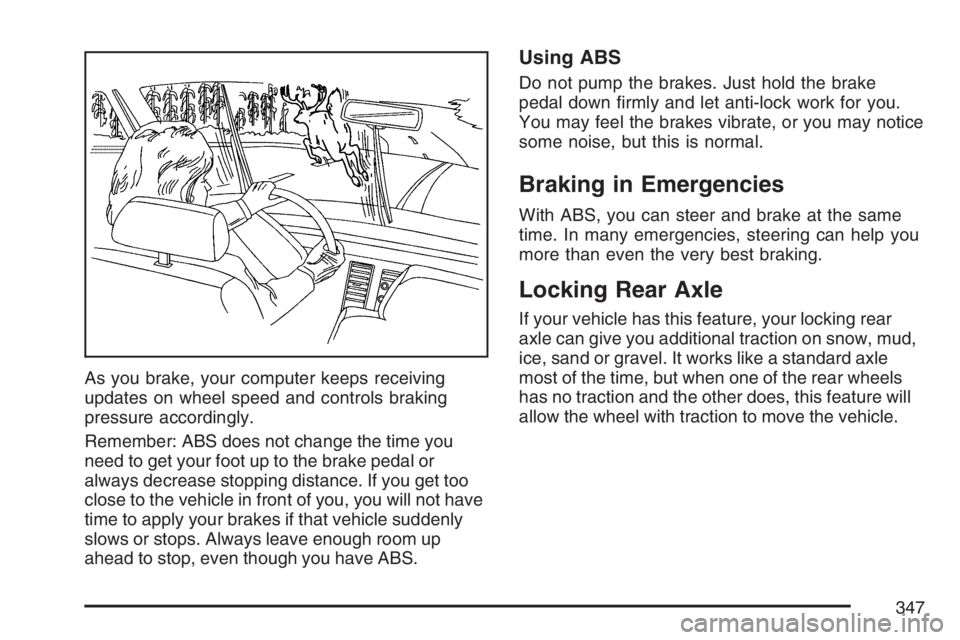
With ABS, you can steer and brake at the same
time. In many emergencies, steering can help you
more than even the very best braking.
Locking Rear Axle
If your vehicle has this feature, your locking rear
axle can give you additional traction on snow, mud,
ice, sand or gravel. It works like a standard axle
most of the time, but when one of the rear wheels
has no traction and the other does, this feature will
allow the wheel with traction to move the vehicle.
347
Page 348 of 608
StabiliTrak®System
Your vehicle may be equipped with the
StabiliTrak®system which combines antilock
brake, traction and stability control systems and
helps the driver maintain directional control of the
vehicle in most driving conditions.
When you rst start your vehicle and begin to drive
away, the system performs several diagnostic
checks to ensure there are no problems. You may
hear or feel the system working. This is normal and
does not mean there is a problem with your vehicle.
The system should initialize before the vehicle
reaches 20 mph (32 km/h). In some cases, it may
take approximately two miles of driving before the
system initializes.
If the system fails to turn on or activate, the
StabiliTrak
®light along with one of the following
messages will be displayed on the Driver
Information Center (DIC) (TRACTION CONTROL
OFF, SERVICE TRACTION CONTROL,
STABILITRAK OFF, SERVICE STABILITRAK).
For 2500 series vehicles, if the vehicle has gone
through heavy acceleration or braking during
the rst 2 miles (3.2 km) after starting your vehicle,
these messages may also appear.For 1500 series vehicles, if these DIC messages
appear, make sure the StabiliTrack
®system
has not been turned off, then turn the steering
wheel through either the ten or two o’clock
positions. If this does not clear the message(s),
take your vehicle to the dealer for service. If this is
the case, your vehicle does not need servicing.
Turn your vehicle off and back on again to
reset the system. If any of these messages appear
on the Driver Information Center (DIC), and your
vehicle hasn’t gone through hard acceleration
or braking in the rst two miles, your vehicle
should be taken in for service. For more
information on the DIC messages, seeDriver
Information Center (DIC) on page 244.
The StabiliTrak
®light
will ash on the
instrument panel cluster
when the system is
both on and activated.
You may also feel or hear the system working;
this is normal.
348
Page 352 of 608
Try to adjust your speed so you can “drive”
through the curve. Maintain a reasonable, steady
speed. Wait to accelerate until you are out of
the curve, and then accelerate gently into
the straightaway.
Adding non-GM accessories can affect your
vehicle’s performance. SeeAccessories and
Modications on page 426.
Steering in Emergencies
There are times when steering can be more
effective than braking. For example, you come over
a hill and nd a truck stopped in your lane, or a car
suddenly pulls out from nowhere, or a child darts
out from between parked cars and stops right in
front of you. You can avoid these problems by
braking — if you can stop in time. But sometimes
you cannot; there is not room. That is the time for
evasive action — steering around the problem.
Your vehicle can perform very well in emergencies
like these. First apply your brakes.
SeeBraking on page 344. It is better to remove as
much speed as you can from a possible collision.
Then steer around the problem, to the left or
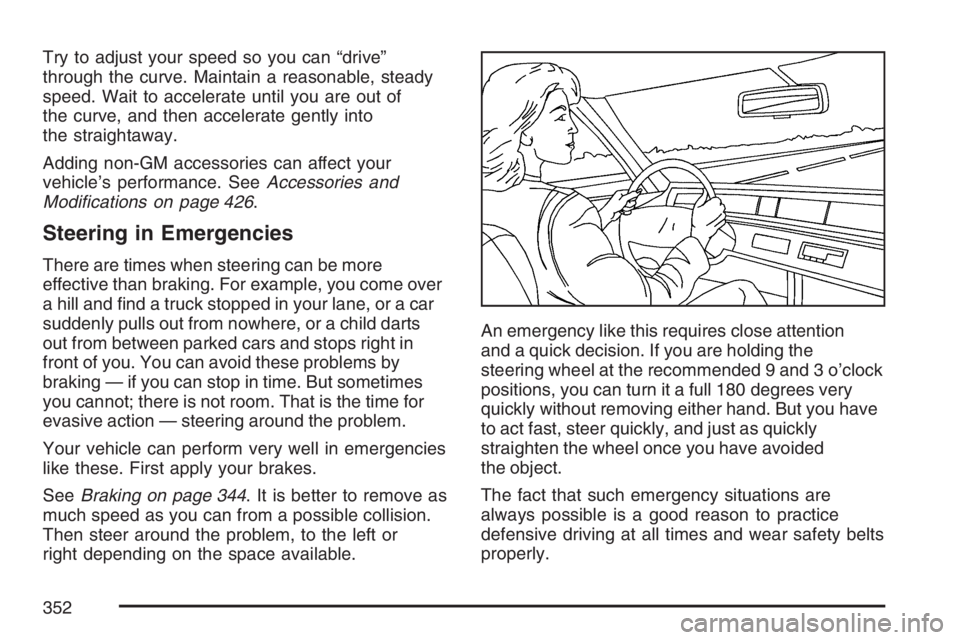
right depending on the space available.An emergency like this requires close attention
and a quick decision. If you are holding the
steering wheel at the recommended 9 and 3 o’clock
positions, you can turn it a full 180 degrees very
quickly without removing either hand. But you have
to act fast, steer quickly, and just as quickly
straighten the wheel once you have avoided
the object.
The fact that such emergency situations are
always possible is a good reason to practice
defensive driving at all times and wear safety belts
properly.
352
Page 356 of 608
Remember: StabiliTrak®helps avoid only the
acceleration skid. SeeStabiliTrak®System
on page 348. If the StabiliTrak®System is off,
then an acceleration skid is also best handled by
easing your foot off the accelerator pedal.
If your vehicle starts to slide, ease your foot off
the accelerator pedal and quickly steer the
way you want the vehicle to go. If you start
steering quickly enough, your vehicle may
straighten out. Always be ready for a second skid
if it occurs.
Of course, traction is reduced when water, snow,
ice, gravel, or other material is on the road.
For safety, you will want to slow down and adjust
your driving to these conditions. It is important
to slow down on slippery surfaces because
stopping distance will be longer and vehicle control
more limited.
While driving on a surface with reduced traction,
try your best to avoid sudden steering,
acceleration, or braking, including reducing vehicle
speed by shifting to a lower gear. Any sudden
changes could cause the tires to slide.You may not realize the surface is slippery until
your vehicle is skidding. Learn to recognize
warning clues — such as enough water, ice, or
packed snow on the road to make a mirrored
surface — and slow down when you have
any doubt.
Remember: Any Anti-Lock Brake System (ABS)
helps avoid only the braking skid.
Off-Road Driving
This off-road guide is for vehicles that have
four-wheel drive or all-wheel drive. Also, see
Braking on page 344. If your vehicle does not have
four-wheel drive or all-wheel drive, you should
not drive off-road unless you are on a level, solid
surface.
Off-road driving can be great fun. But it does have
some denite hazards. The greatest of these is
the terrain itself.
“Off-roading” means you have left the great North
American road system behind. Traffic lanes
are not marked. Curves are not banked. There are
no road signs. Surfaces can be slippery, rough,
uphill or downhill. In short, you have gone
right back to nature.
356
Page 359 of 608
Environmental Concerns
Off-road driving can provide wholesome and
satisfying recreation. However, it also raises
environmental concerns. We recognize these
concerns and urge every off-roader to follow these
basic rules for protecting the environment:
Always use established trails, roads, and areas
that have been specially set aside for public
off-road recreational driving; obey all
posted regulations.
Avoid any driving practice that could damage
the environment — shrubs, owers, trees,
grasses — or disturb wildlife. This includes
wheel-spinning, breaking down trees, or
unnecessary driving through streams or over
soft ground.
Always carry a litter bag — make sure all
refuse is removed from any campsite
before leaving.
Take extreme care with open res (where
permitted), camp stoves and lanterns.
Never park your vehicle over dry grass or
other combustible materials that could
catch re from the heat of the vehicle’s
exhaust system.
Traveling to Remote Areas
It makes sense to plan your trip, especially when
going to a remote area. Know the terrain and
plan your route. You are much less likely to get
bad surprises. Get accurate maps of trails
and terrain. Try to learn of any blocked or
closed roads.
It is also a good idea to travel with at least one
other vehicle. If something happens to one
of them, the other can help quickly.
Does your vehicle have a winch? If so, be sure to
read the winch instructions. In a remote area, a
winch can be handy if you get stuck. But you will
want to know how to use it properly.
359
Page 363 of 608
Approaching a Hill
When you approach a hill, you need to decide if it
is one of those hills that is just too steep to
climb, descend, or cross. Steepness can be hard
to judge. On a very small hill, for example,
there may be a smooth, constant incline with only
a small change in elevation where you can
easily see all the way to the top. On a large hill,
the incline may get steeper as you near the
top, but you may not see this because the crest of
the hill is hidden by bushes, grass or shrubs.Here are some other things to consider as you
approach a hill.Is there a constant incline, or does the hill get
sharply steeper in places?
Is there good traction on the hillside, or will
the surface cause tire slipping?
Is there a straight path up or down the hill so
you will not have to make turning maneuvers?
Are there obstructions on the hill that can block
your path, such as boulders, trees, logs, or
ruts?
What is beyond the hill? Is there a cliff, an
embankment, a drop-off, a fence? Get out
and walk the hill if you do not know. It is the
smart way to nd out.
Is the hill simply too rough? Steep hills often
have ruts, gullies, troughs and exposed
rocks because they are more susceptible to
the effects of erosion.
363
Page 365 of 608
Q:What should I do if my vehicle stalls, or is
about to stall, and I cannot make it up
the hill?
A:If this happens, there are some things you
should do, and there are some things you
must not do. First, here is what youshoulddo:
Push the brake pedal to stop the vehicle
and keep it from rolling backwards. Also, apply
the parking brake.
If your engine is still running, shift the
transmission to REVERSE (R), release the
parking brake, and slowly back down the hill in
REVERSE (R).
If your engine has stopped running, you will
need to restart it. With the brake pedal
pressed and the parking brake still applied,
shift the transmission to PARK (P) and restart
the engine. Then, shift to REVERSE (R),
release the parking brake, and slowly back
down the hill as straight as possible in
REVERSE (R).
As you are backing down the hill, put your left
hand on the steering wheel at the 12 o’clock
position. This way, you will be able to tell if your
wheels are straight and maneuver as you back
down. It is best that you back down the hill with
your wheels straight rather than in the left or
right direction. Turning the wheel too far to the
left or right will increase the possibility of a
rollover.
365
Page 385 of 608
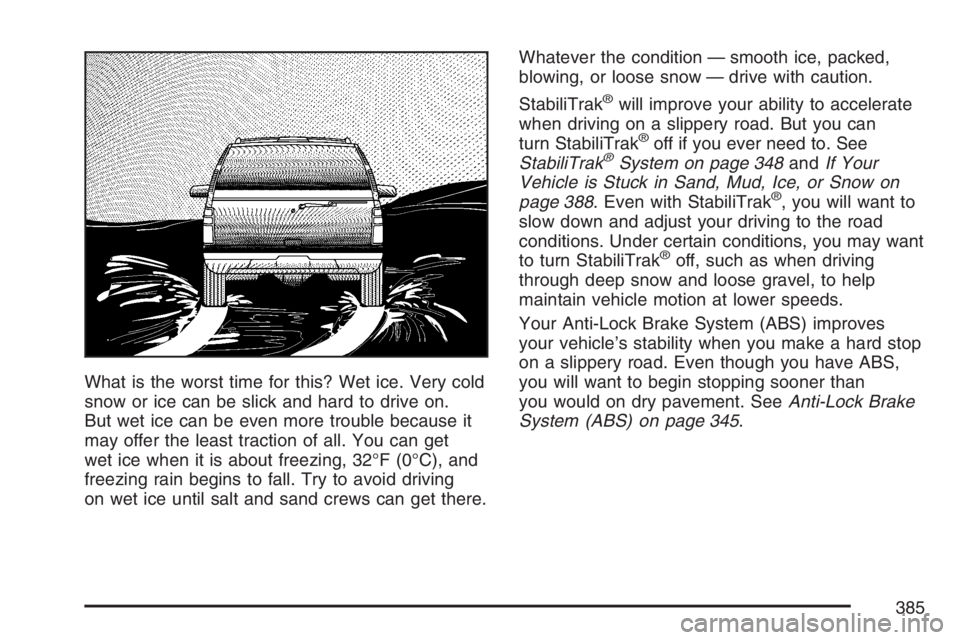
What is the worst time for this? Wet ice. Very cold
snow or ice can be slick and hard to drive on.
But wet ice can be even more trouble because it
may offer the least traction of all. You can get
wet ice when it is about freezing, 32°F (0°C), and
freezing rain begins to fall. Try to avoid driving
on wet ice until salt and sand crews can get there.Whatever the condition — smooth ice, packed,
blowing, or loose snow — drive with caution.
StabiliTrak
®will improve your ability to accelerate
when driving on a slippery road. But you can
turn StabiliTrak
®off if you ever need to. See
StabiliTrak®System on page 348andIf Your
Vehicle is Stuck in Sand, Mud, Ice, or Snow on
page 388. Even with StabiliTrak
®, you will want to
slow down and adjust your driving to the road
conditions. Under certain conditions, you may want
to turn StabiliTrak
®off, such as when driving
through deep snow and loose gravel, to help
maintain vehicle motion at lower speeds.
Your Anti-Lock Brake System (ABS) improves
your vehicle’s stability when you make a hard stop
on a slippery road. Even though you have ABS,
you will want to begin stopping sooner than
you would on dry pavement. SeeAnti-Lock Brake
System (ABS) on page 345.
385
Page 387 of 608
{CAUTION:
Snow can trap exhaust gases under your
vehicle. This can cause deadly CO
(carbon monoxide) gas to get inside.
CO could overcome you and kill you.
You cannot see it or smell it, so you might
not know it is in your vehicle. Clear away
snow from around the base of your
vehicle, especially any that is blocking
your exhaust pipe. And check around
again from time to time to be sure snow
does not collect there.
Open a window just a little on the side of
the vehicle that is away from the wind.
This will help keep CO out.Run your engine only as long as you must. This
saves fuel. When you run the engine, make it go a
little faster than just idle. That is, push the
accelerator slightly. This uses less fuel for the
heat that you get and it keeps the battery charged.
You will need a well-charged battery to restart
the vehicle, and possibly for signaling later on with
your headlamps. Let the heater run for a while.
Then, shut the engine off and close the window
almost all the way to preserve the heat. Start
the engine again and repeat this only when you
feel really uncomfortable from the cold. But do it as
little as possible. Preserve the fuel as long as
you can. To help keep warm, you can get out of
the vehicle and do some fairly vigorous exercises
every half hour or so until help comes.
387