maintenance GREAT WALL FLORID 2008 Owner's Manual
[x] Cancel search | Manufacturer: GREAT WALL, Model Year: 2008, Model line: FLORID, Model: GREAT WALL FLORID 2008Pages: 281, PDF Size: 43.97 MB
Page 35 of 281
Downloaded from www.Manualslib.com manuals search engine GWFLORID Maintenance Manual28
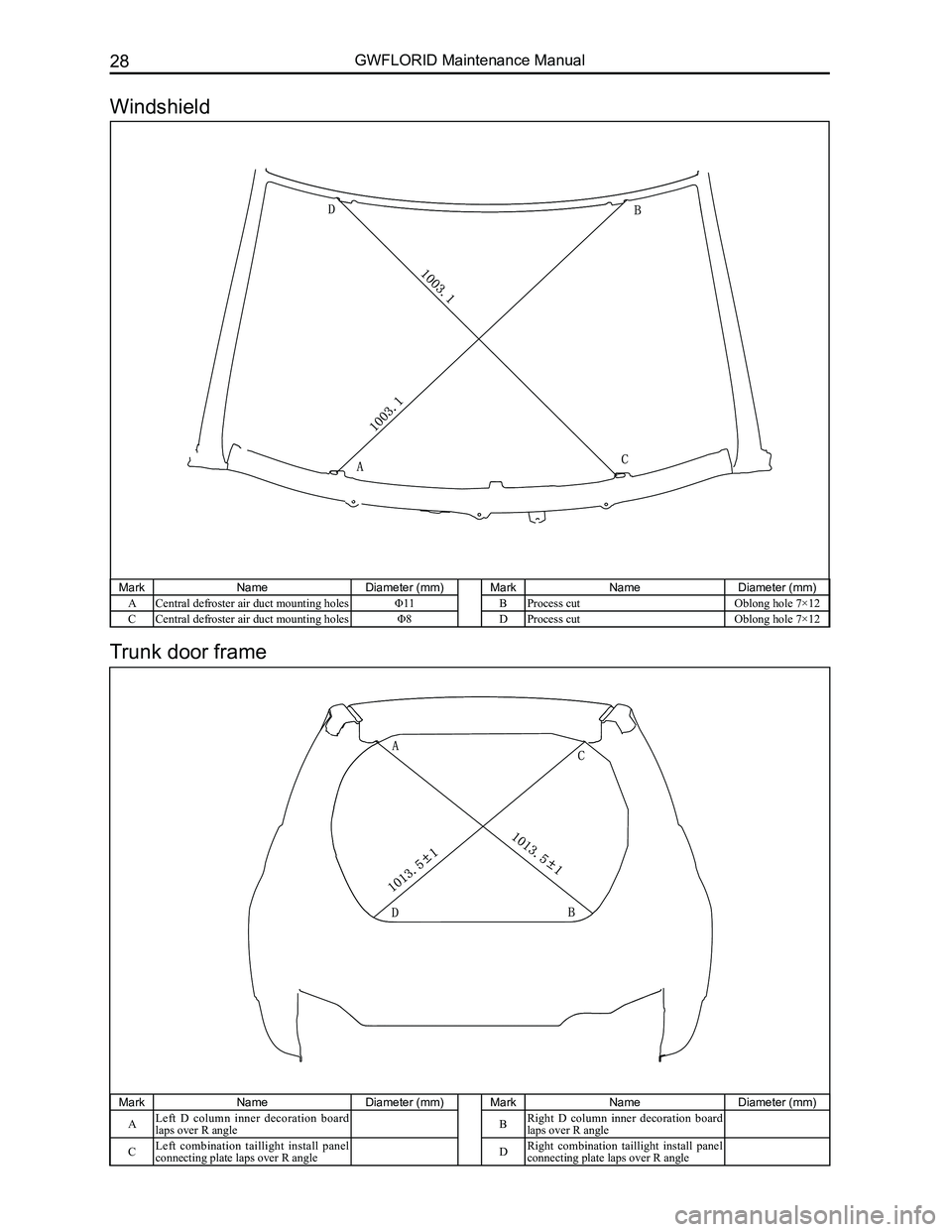
MarkNameDiameter (mm)MarkNameDiameter (mm)
ACentral defroster air duct mounting holesΦ11BProcess cutOblong hole 7×12
CCentral defroster air duct mounting holesΦ8DProcess cutOblong hole 7×12
MarkNameDiameter (mm)MarkNameDiameter (mm)
ALeft D column inner decoration board laps over R angleBRight D column inner decoration board laps over R angle
CLeft combination taillight install panel connecting plate laps over R angleDRight combination taillight install panel connecting plate laps over R angle
Trunk door frame
Windshield
Page 37 of 281
Downloaded from www.Manualslib.com manuals search engine 30GWFLORID Maintenance Manual
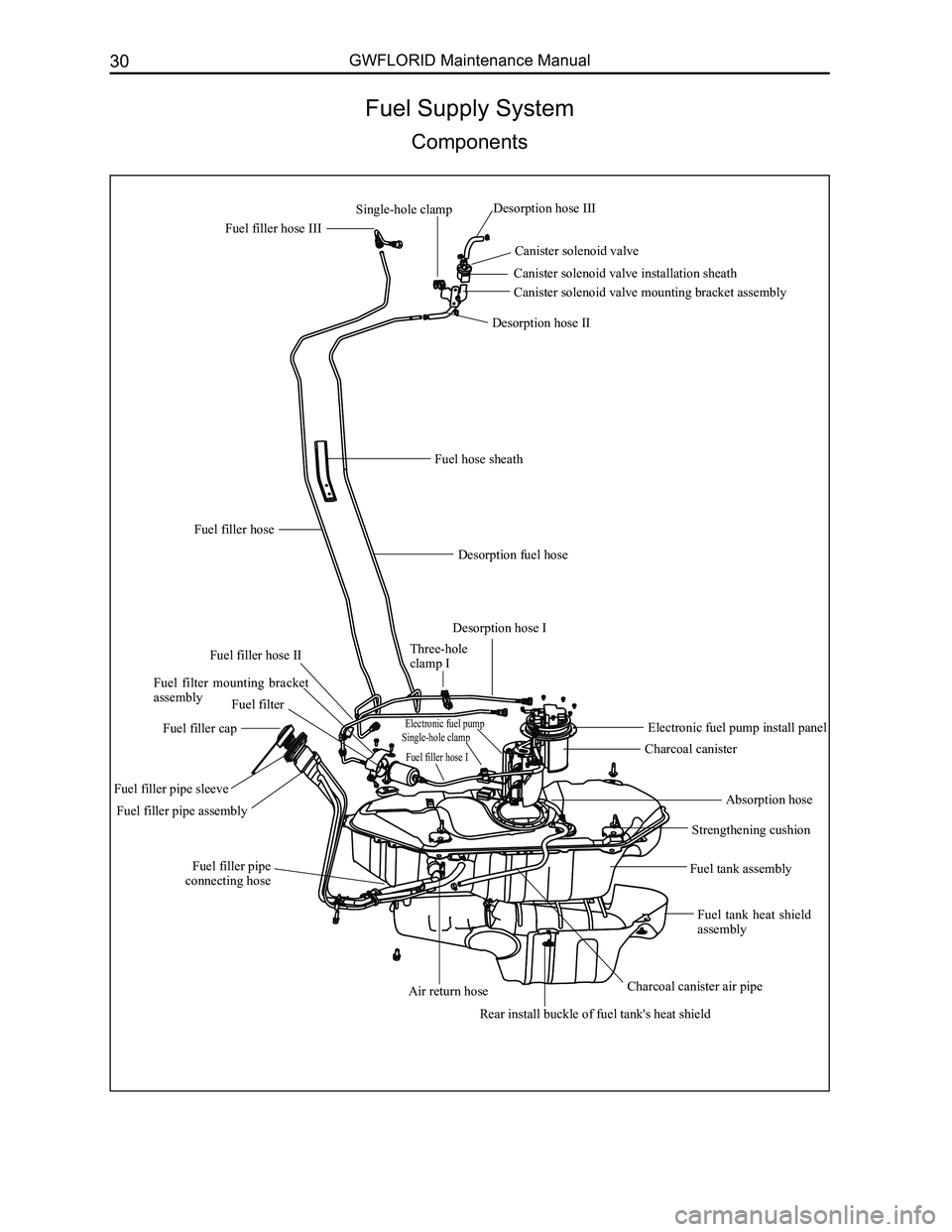
Fuel Supply System
Components
Fuel filler hose III
Canister solenoid valve
Canister solenoid valve installation sheath
Canister solenoid valve mounting bracket assembly
Fuel hose sheath
Desorption fuel hose
Fuel filler hose
Desorption hose I
Fuel filler hose IIThree-hole clamp I
Charcoal canister
Fuel tank assembly
Fuel tank heat shield assembly
Charcoal canister air pipeAir return hose
Fuel filler pipe assembly
Electronic fuel pumpSingle-hole clampElectronic fuel pump install panel
Strengthening cushion
Fuel filler pipe connecting hose
Absorption hoseFuel filler pipe sleeve
Single-hole clamp
Fuel filter
Rear install buckle of fuel tank's heat shield
Fuel filler cap
Fuel filler hose I
Desorption hose III
Desorption hose II
Fuel filter mounting bracket assembly
Page 38 of 281
Downloaded from www.Manualslib.com manuals search engine 31Fuel Supply and Exhaust System
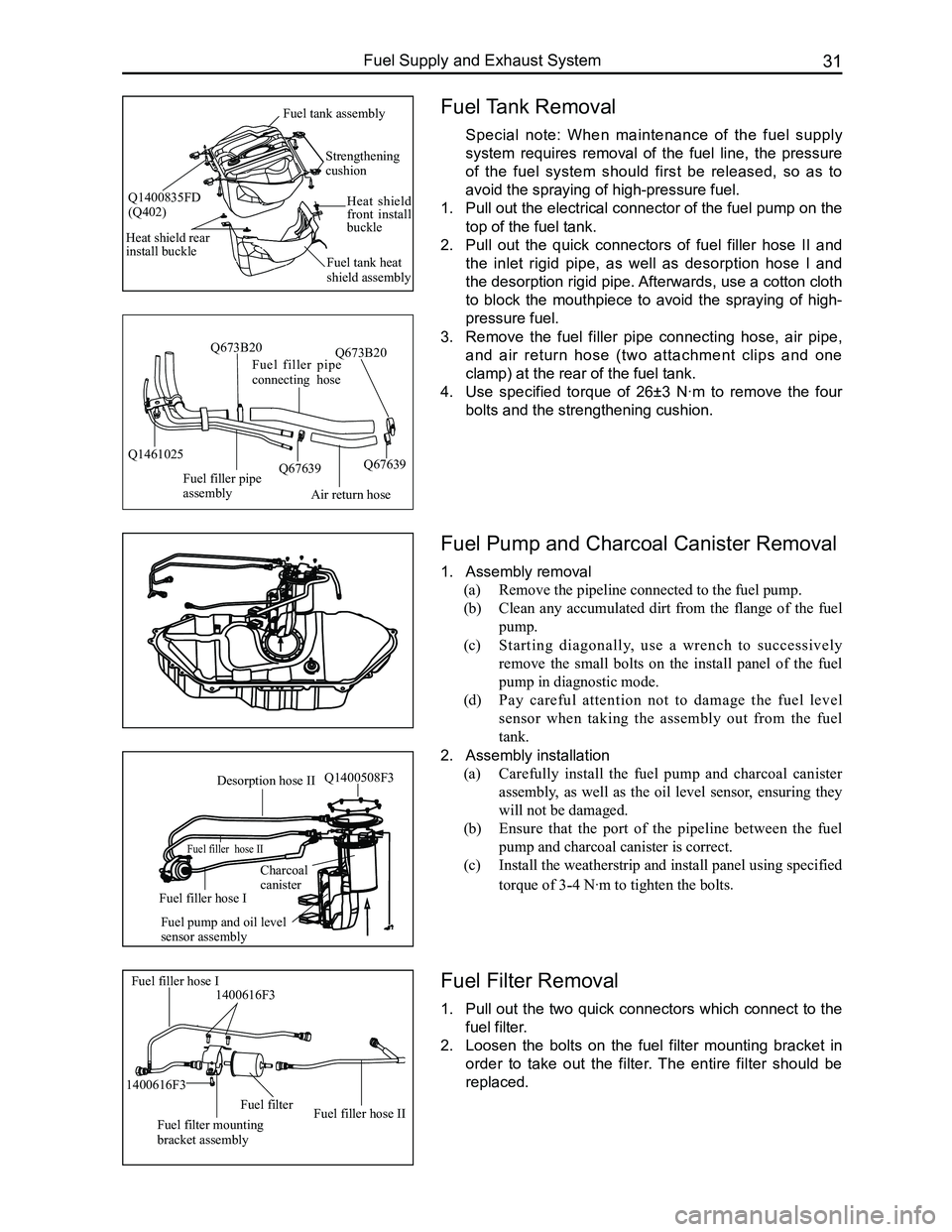
Fuel Tank Removal
Special note: When maintenance of the fuel supply
system requires removal of the fuel line, the pressure
of the fuel system should first be released, so as to
avoid the spraying of high-pressure fuel.
1. Pull out the electrical connector of the fuel pump on the
top of the fuel tank.
2. Pull out the quick connectors of fuel filler hose II and
the inlet rigid pipe, as well as desorption hose I and
the desorption rigid pipe. Afterwards, use a cotton cloth
to block the mouthpiece to avoid the spraying of high-
pressure fuel.
3. Remove the fuel filler pipe connecting hose, air pipe,
and air return hose (two attachment clips and one
clamp) at the rear of the fuel tank.
4. Use specified torque of 26±3 N·m to remove the four
bolts and the strengthening cushion.
Fuel Pump and Charcoal Canister Removal
1. Assembly removal
(a) Remove the pipeline connected to the fuel pump.
(b) Clean any accumulated dirt from the flange of the fuel
pump.
(c) Starting diagonally, use a wrench to successively
remove the small bolts on the install panel of the fuel
pump in diagnostic mode.
(d) Pay careful attention not to damage the fuel level
sensor when taking the assembly out from the fuel
tank.
2. Assembly installation
(a) Carefully install the fuel pump and charcoal canister
assembly, as well as the oil level sensor, ensuring they
will not be damaged.
(b) Ensure that the port of the pipeline between the fuel
pump and charcoal canister is correct.
(c) Install the weatherstrip and install panel using specified
torque of 3-4 N·m to tighten the bolts.
Fuel Filter Removal
1. Pull out the two quick connectors which connect to the
fuel filter.
2. Loosen the bolts on the fuel filter mounting bracket in
order to take out the filter. The entire filter should be
replaced.
Air return hose
Fuel filler pipe connecting hose
Fuel filler pipe assembly
Q1461025Q67639
Q673B20
Q67639
Q673B20
Fuel filler hose I1400616F3
Fuel filter mounting bracket assembly
Fuel filterFuel filler hose II
1400616F3
Desorption hose II
Fuel filler hose II
Fuel filler hose I
Charcoalcanister
Fuel pump and oil level sensor assembly
Q1400508F3
Strengthening cushion
Heat shield front install buckle
Fuel tank heat shield assembly
Heat shield rear install buckle
Fuel tank assembly
Q1400835FD(Q402)
Page 39 of 281
Downloaded from www.Manualslib.com manuals search engine GWFLORID Maintenance Manual32
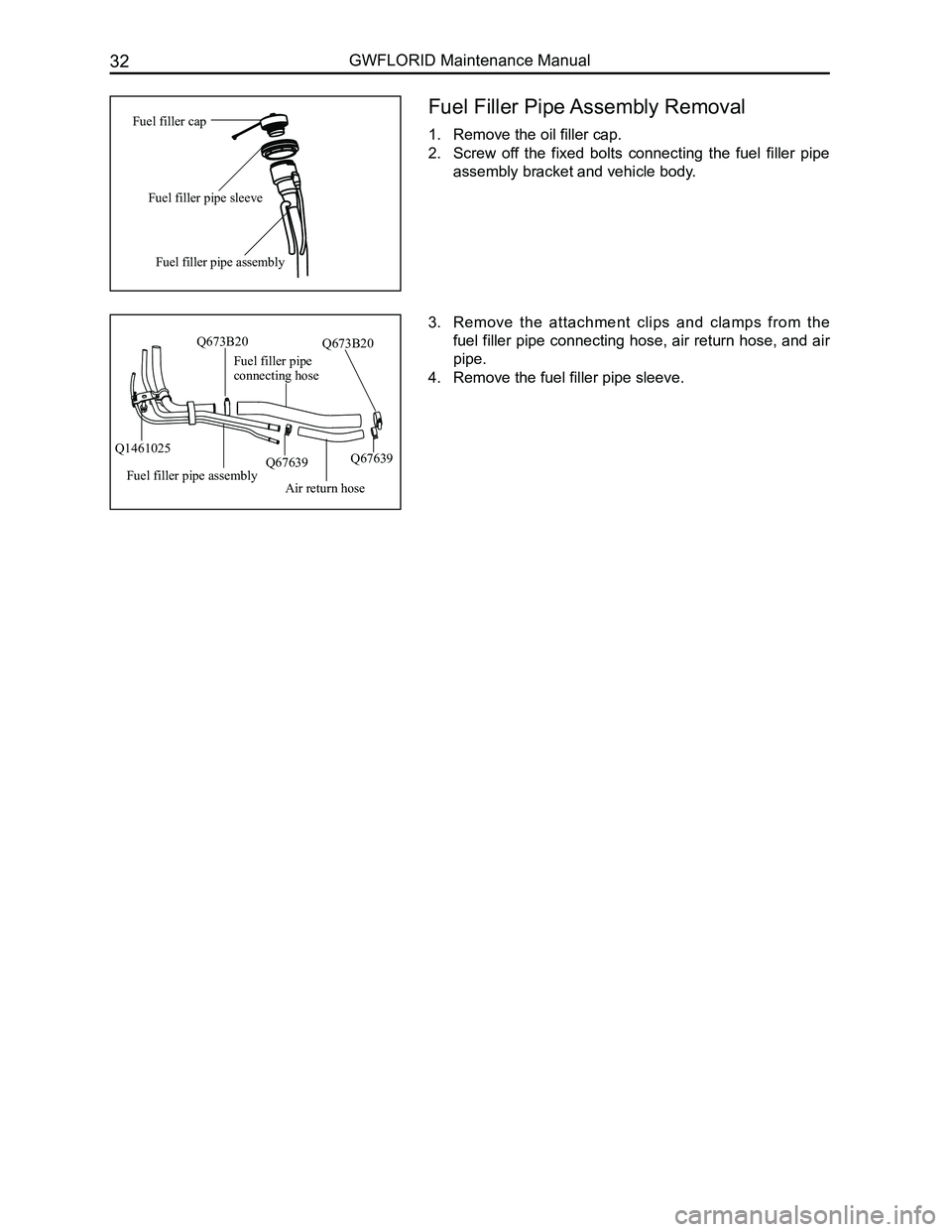
Fuel Filler Pipe Assembly Removal
1. Remove the oil filler cap.
2. Screw off the fixed bolts connecting the fuel filler pipe
assembly bracket and vehicle body.
Air return hose
Fuel filler pipe connecting hose
Fuel filler pipe assembly
Q1461025Q67639
Q673B20
Q67639
Q673B20
Fuel filler pipe assembly
Fuel filler pipe sleeve
Fuel filler cap
3. Remove the attachment clips and clamps from the
fuel filler pipe connecting hose, air return hose, and air
pipe.
4. Remove the fuel filler pipe sleeve.
Page 41 of 281
Downloaded from www.Manualslib.com manuals search engine GWFLORID Maintenance Manual34
Exhaust System Removal
Caution: Wait at least 30 minutes between the engine
being turned off and the actual removal of any component
of the exhaust system, as to avoid personnel injury due to
hot components.
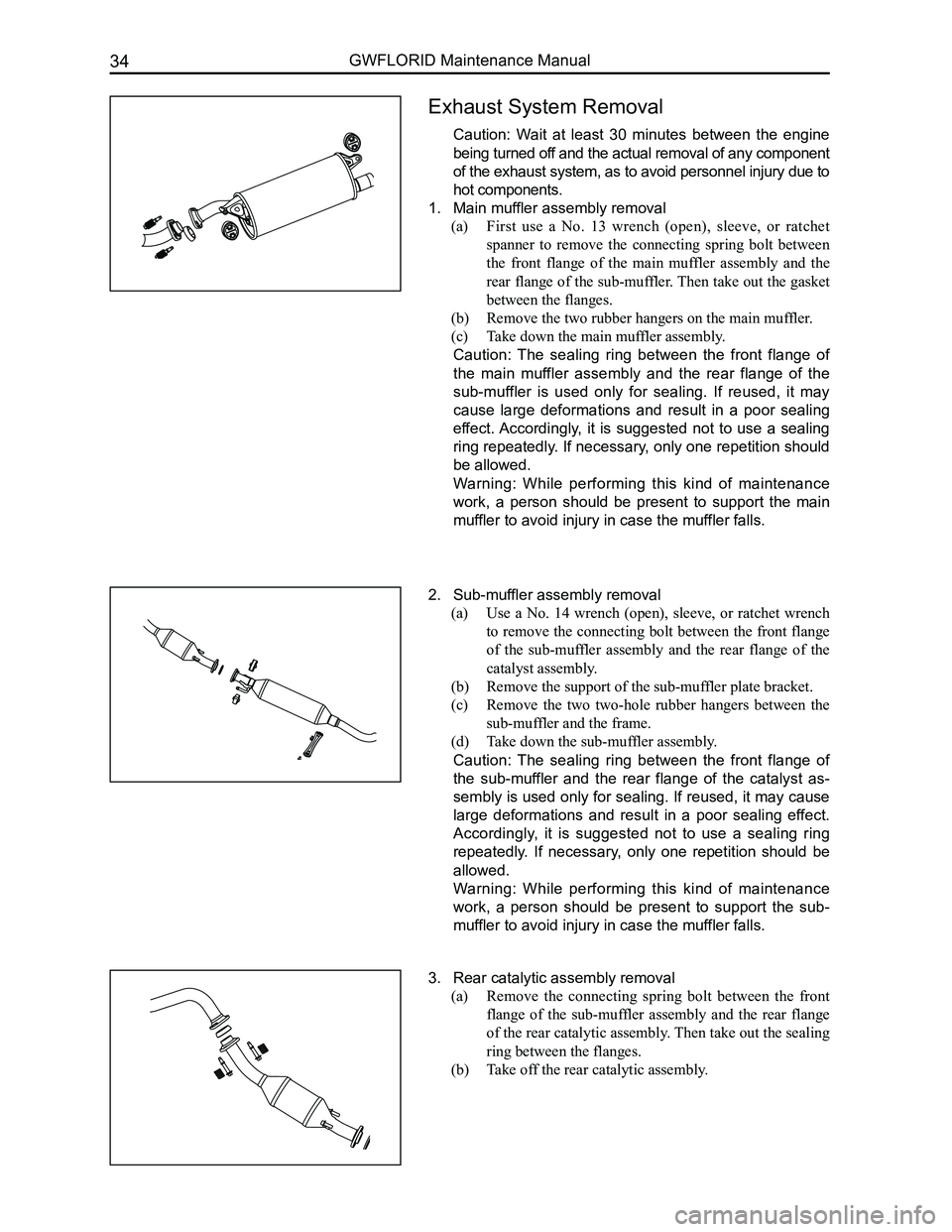
1. Main muffler assembly removal
(a) First use a No. 13 wrench (open), sleeve, or ratchet
spanner to remove the connecting spring bolt between
the front flange of the main muffler assembly and the
rear flange of the sub-muffler. Then take out the gasket
between the flanges.
(b) Remove the two rubber hangers on the main muffler.
(c) Take down the main muffler assembly.
Caution: The sealing ring between the front flange of
the main muffler assembly and the rear flange of the
sub-muffler is used only for sealing. If reused, it may
cause large deformations and result in a poor sealing
effect. Accordingly, it is suggested not to use a sealing
ring repeatedly. If necessary, only one repetition should
be allowed.
Warning: While performing this kind of maintenance
work, a person should be present to support the main
muffler to avoid injury in case the muffler falls.
2. Sub-muffler assembly removal
(a) Use a No. 14 wrench (open), sleeve, or ratchet wrench
to remove the connecting bolt between the front flange
of the sub-muffler assembly and the rear flange of the
catalyst assembly.
(b) Remove the support of the sub-muffler plate bracket.
(c) Remove the two two-hole rubber hangers between the
sub-muffler and the frame.
(d) Take down the sub-muffler assembly.
Caution: The sealing ring between the front flange of
the sub-muffler and the rear flange of the catalyst as-
sembly is used only for sealing. If reused, it may cause
large deformations and result in a poor sealing effect.
Accordingly, it is suggested not to use a sealing ring
repeatedly. If necessary, only one repetition should be
allowed.
Warning: While performing this kind of maintenance
work, a person should be present to support the sub-
muffler to avoid injury in case the muffler falls.
3. Rear catalytic assembly removal
(a) Remove the connecting spring bolt between the front
flange of the sub-muffler assembly and the rear flange
of the rear catalytic assembly. Then take out the sealing
ring between the flanges.
(b) Take off the rear catalytic assembly.
Page 43 of 281
Downloaded from www.Manualslib.com manuals search engine GWFLORID Maintenance Manual36
Clutch Operational System
Areas of Importance ...........................................................37
Troubleshooting ..................................................................37
Clutch Operational System .................................................38
Components .....................................................................38
Clutch Master Cylinder Removal ......................................38
Clutch Master Cylinder Installation ...................................40
Clutch Pedal Removal ......................................................40
Clutch Pedal Installation ...................................................40
Clutch Pedal Examination and Adjustment.......................41
Page 45 of 281
Downloaded from www.Manualslib.com manuals search engine GWFLORID Maintenance Manual38
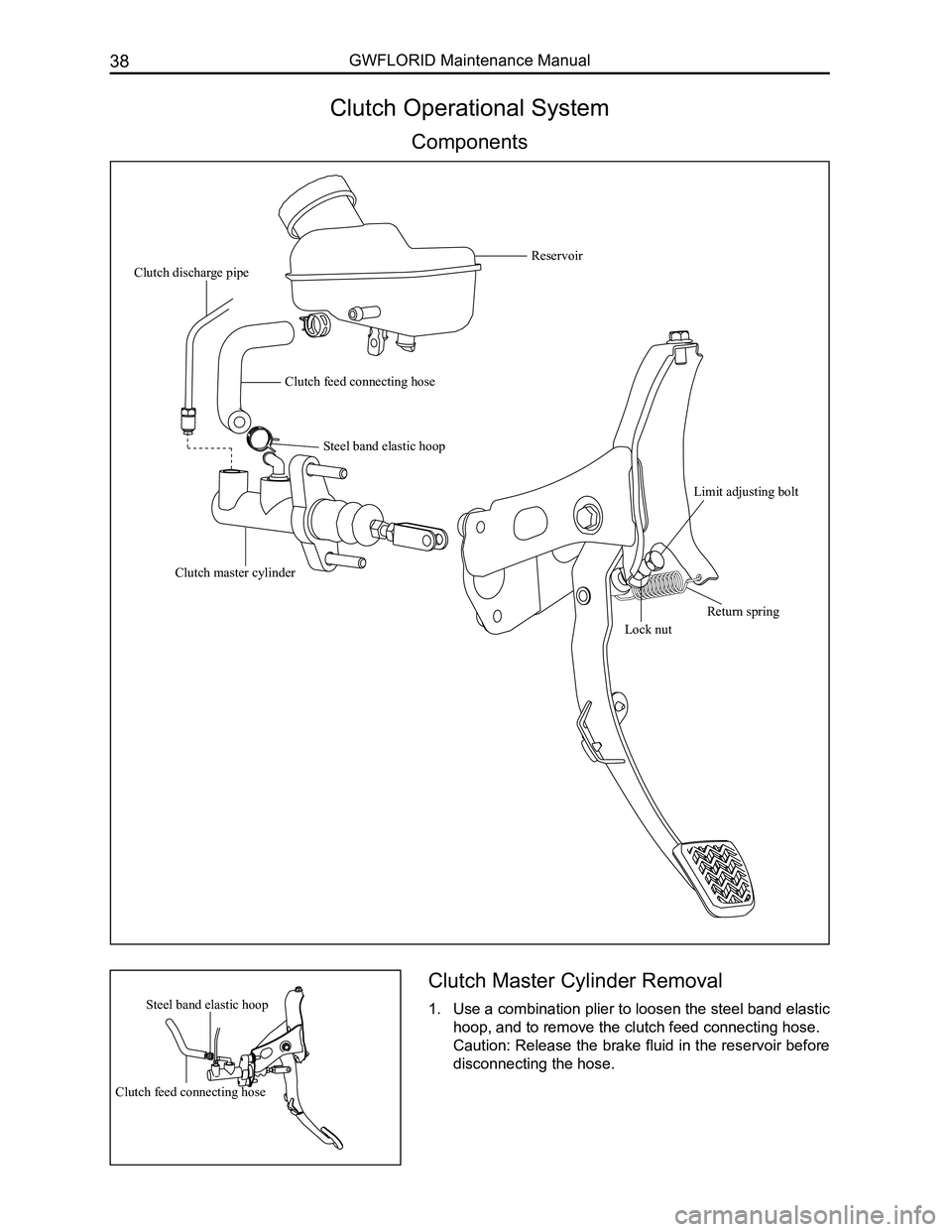
Clutch Operational System
Components
Clutch Master Cylinder Removal
1. Use a combination plier to loosen the steel band elastic
hoop, and to remove the clutch feed connecting hose.
Caution: Release the brake fluid in the reservoir before
disconnecting the hose.
Steel band elastic hoop
Clutch feed connecting hose
Reservoir
Steel band elastic hoop
Clutch feed connecting hose
Clutch discharge pipe
Clutch master cylinder
Limit adjusting bolt
Return spring
Lock nut
Page 47 of 281
Downloaded from www.Manualslib.com manuals search engine GWFLORID Maintenance Manual40
Clutch Master Cylinder Installation
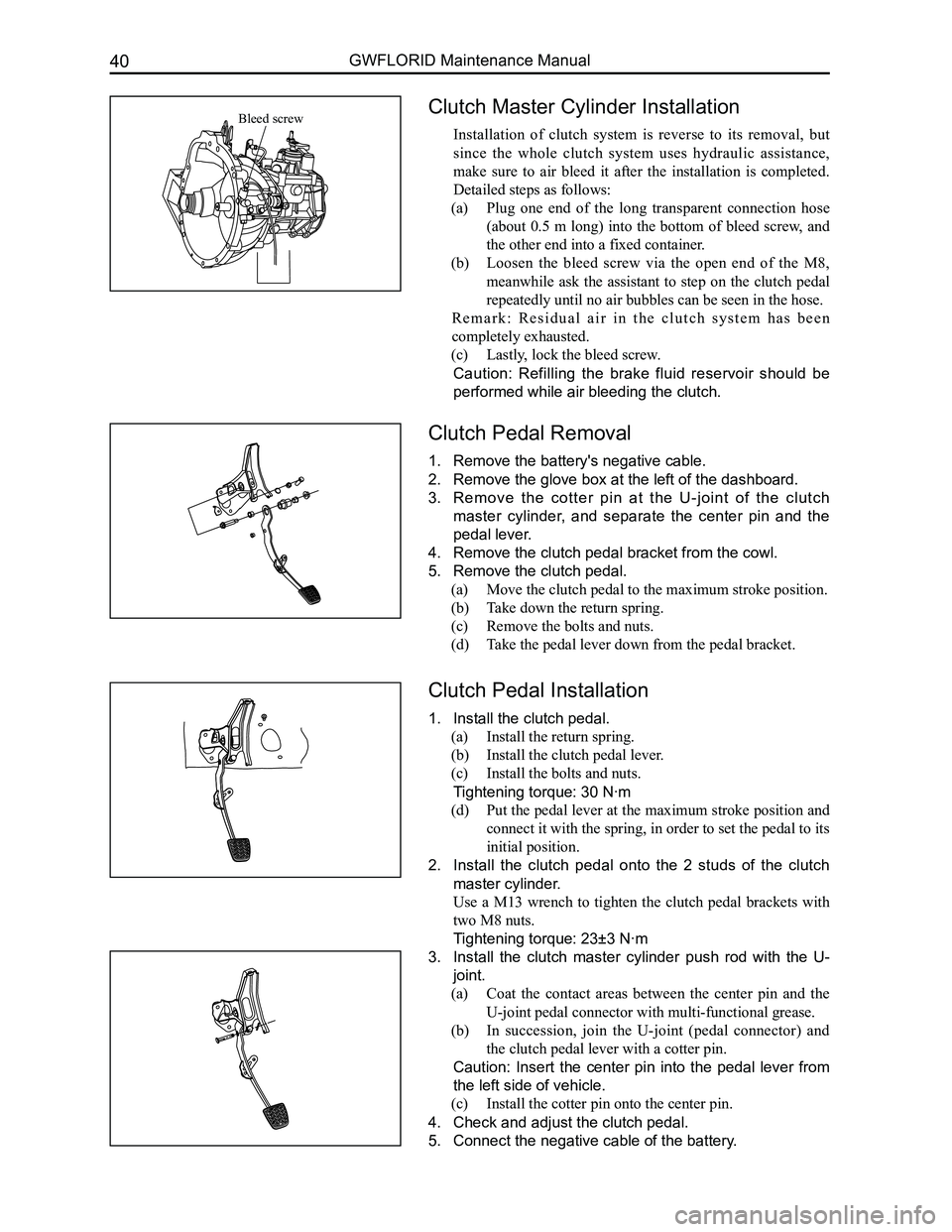
Installation of clutch system is reverse to its removal, but
since the whole clutch system uses hydraulic assistance,
make sure to air bleed it after the installation is completed.
Detailed steps as follows:
(a) Plug one end of the long transparent connection hose
(about 0.5 m long) into the bottom of bleed screw, and
the other end into a fixed container.
(b) Loosen the bleed screw via the open end of the M8,
meanwhile ask the assistant to step on the clutch pedal
repeatedly until no air bubbles can be seen in the hose.
R e m a r k : R e s i d u a l a i r i n t h e c l u t c h s y s t e m h a s b e e n
completely exhausted.
(c) Lastly, lock the bleed screw.
Caution: Refilling the brake fluid reservoir should be
performed while air bleeding the clutch.
Clutch Pedal Removal
1. Remove the battery's negative cable.
2. Remove the glove box at the left of the dashboard.
3. Remove the cotter pin at the U-joint of the clutch
master cylinder, and separate the center pin and the
pedal lever.
4. Remove the clutch pedal bracket from the cowl.
5. Remove the clutch pedal.
(a) Move the clutch pedal to the maximum stroke position.
(b) Take down the return spring.
(c) Remove the bolts and nuts.
(d) Take the pedal lever down from the pedal bracket.
Clutch Pedal Installation
1. Install the clutch pedal.
(a) Install the return spring.
(b) Install the clutch pedal lever.
(c) Install the bolts and nuts.
Tightening torque: 30 N·m
(d) Put the pedal lever at the maximum stroke position and
connect it with the spring, in order to set the pedal to its
initial position.
2. Install the clutch pedal onto the 2 studs of the clutch
master cylinder.
Use a M13 wrench to tighten the clutch pedal brackets with
two M8 nuts.
Tightening torque: 23±3 N·m
3. Install the clutch master cylinder push rod with the U-
joint.
(a) Coat the contact areas between the center pin and the
U-joint pedal connector with multi-functional grease.
(b) In succession, join the U-joint (pedal connector) and
the clutch pedal lever with a cotter pin.
Caution: Insert the center pin into the pedal lever from
the left side of vehicle.
(c) Install the cotter pin onto the center pin.
4. Check and adjust the clutch pedal.
5. Connect the negative cable of the battery.
Bleed screw
Page 49 of 281
Downloaded from www.Manualslib.com manuals search engine GWFLORID Maintenance Manual42
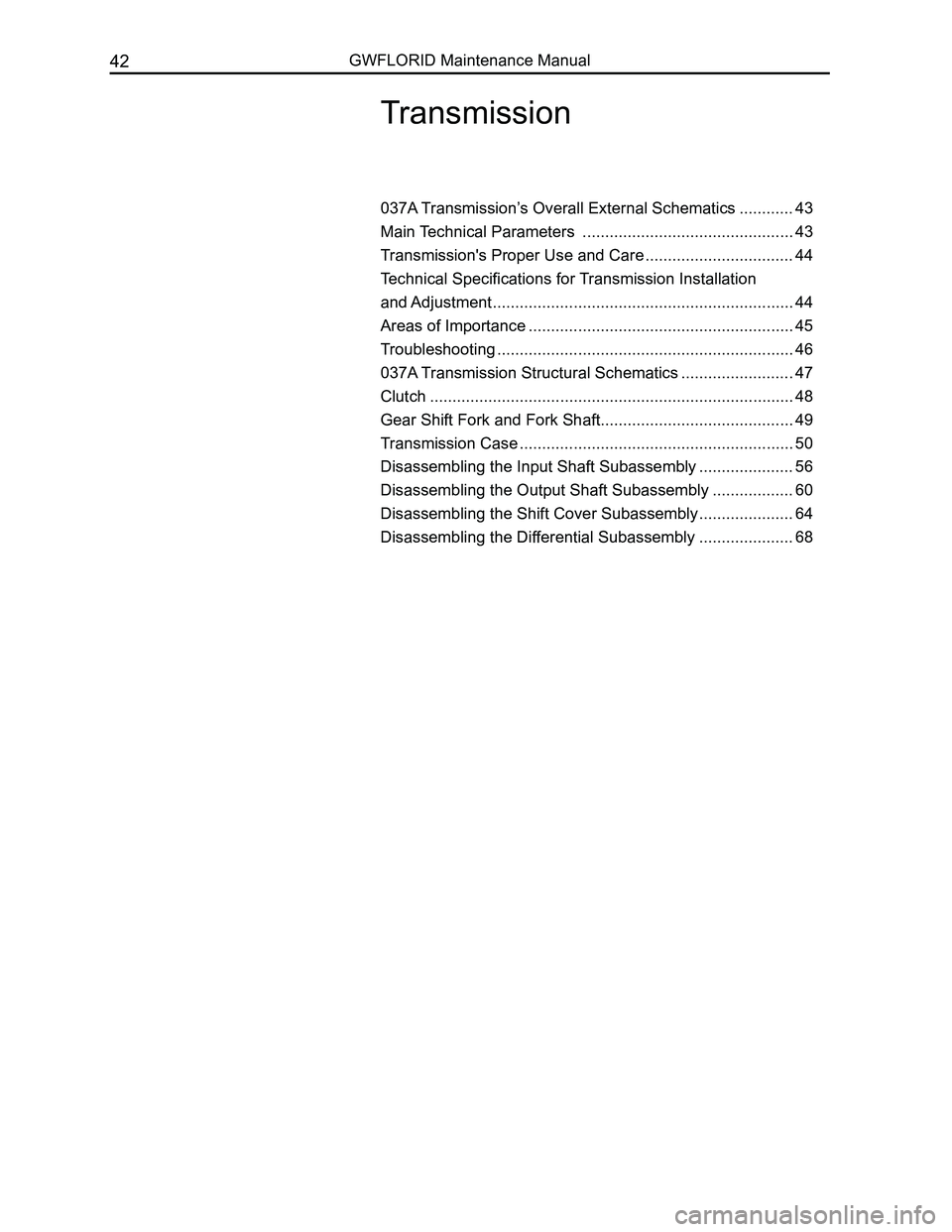
Transmission
037A Transmission’s Overall External Schematics ............43
Main Technical Parameters ...............................................43
Transmission's Proper Use and Care .................................44
Technical Specifications for Transmission Installation
and Adjustment ...................................................................44
Areas of Importance ...........................................................45
Troubleshooting ..................................................................46
037A Transmission Structural Schematics .........................47
Clutch ........................................................................\
.........48
Gear Shift Fork and Fork Shaft...........................................49
Transmission Case .............................................................50
Disassembling the Input Shaft Subassembly .....................56
Disassembling the Output Shaft Subassembly ..................60
Disassembling the Shift Cover Subassembly .....................64
Disassembling the Differential Subassembly .....................68
Page 51 of 281
Downloaded from www.Manualslib.com manuals search engine GWFLORID Maintenance Manual44
Transmission's Proper Use and Care
1. Transmission's proper operation
1.1 Shift the gear gently, not excessively.
1.2 Do not start with high speed.
1.3 To avoid premature abrasion of the gear shift fork, do not rest your hand on the \
gear lever while driving.
2. Model number of the lubricant to be used:
GL-4 80W-90 (For China domestic model)
GL-4 75W-90 (For alpine region model)
GL-5 140 (For high-temperature region model)
Caution: Please only use the lubricant with model numbers specified by t\
he Great Wall Motor Co., Ltd.
Do not mix lubricants with different model numbers. Only fill with clean lubricant.
3. Areas of importance for new vehicle usage:
3.1 Before using a new vehicle, be sure to check the transmission and all exposed connectors and fastening
pieces, so as to avoid failure due to faulty installation or loose conne\
ctions.
3.2 Since the new vehicle is still in the run-in period, the transmission's lubricant should be replaced after 5000 km
distance.
4. Transmission three-level maintenance:
4.1 Transmission level-one maintenance: During the first level of maintenance, the liquid level of the lubricant
should be checked to ensure that it is up to the oil-filling mouth. Add more if insufficient. Excessive low
oil level can lead to ineffective lubrication, as well as burning of the bearings and gears. Excessive high oil
level, however, can overheat the transmission or cause oil to leak. In addition, during the first level of main-
tenance, the breather plug should be checked and cleaned. If the breather plug is clogged, internal pressure
will build up and oil will leak from the transmission.
4.2 Transmission level-two maintenance: The transmission's lubricant should be replaced the first time that the
vehicle undergoes the second level of maintenance. Clean the transmission with kerosene. The quality of the
lubricant should be inspected during the future second level of maintenance practises. The lubricant should
be replaced if diluted, gummy, or dirty.
4.3 Transmission level-three maintenance: During the third level of maintenance, it should be removed for in-
spection, cleaning, and oil changing.
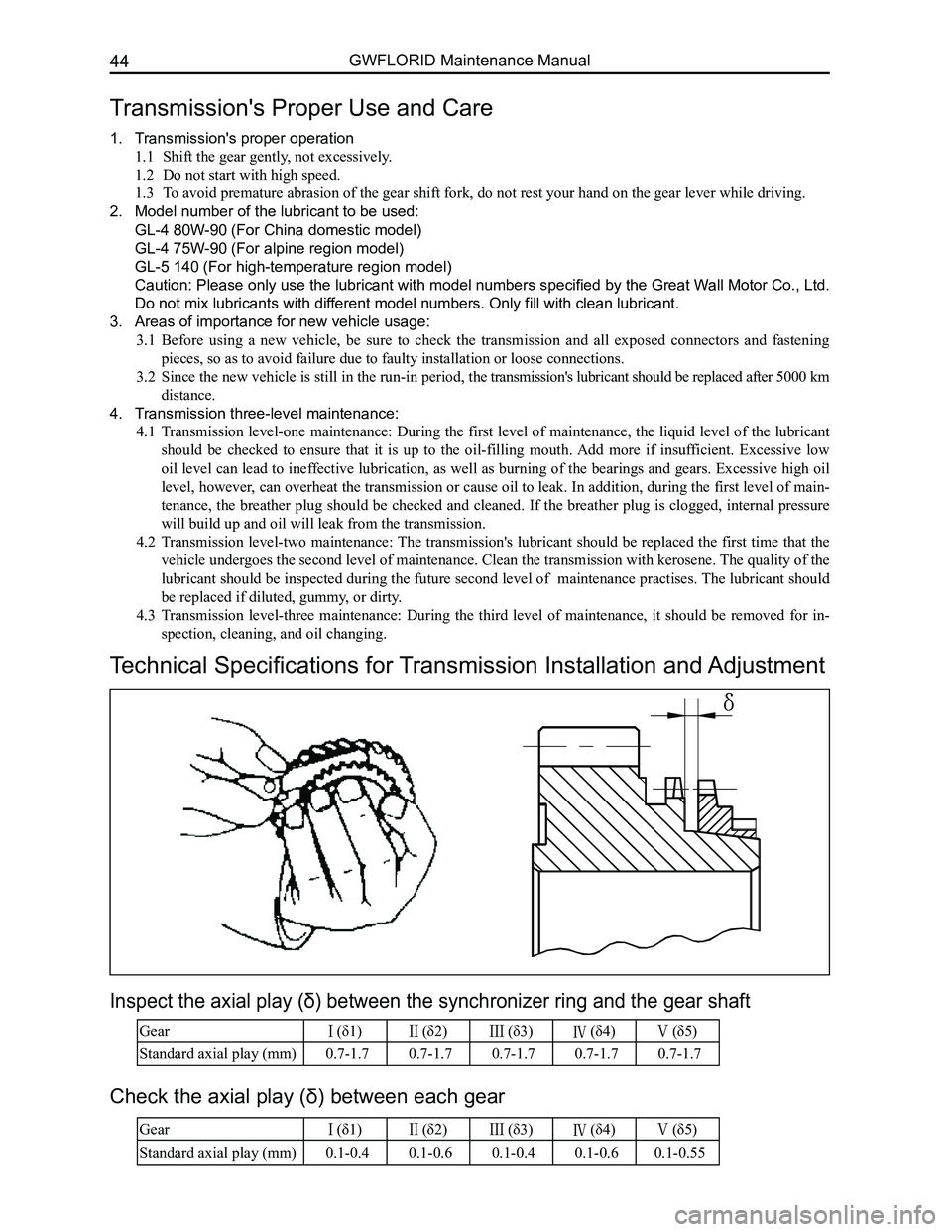
Technical Specifications for Transmission Installation and Adjustment
Inspect the axial play (δ) between the synchronizer ring and the gear shaft
Gear (δ1) (δ2) (δ3) (δ4) (δ5)
Standard axial play (mm)0.7-1.70.7-1.70.7-1.70.7-1.70.7-1.7
Gear (δ1) (δ2) (δ3) (δ4) (δ5)
Standard axial play (mm)0.1-0.40.1-0.60.1-0.40.1-0.60.1-0.55
Check the axial play (δ) between each gear