torque GREAT WALL HOVER 2006 Service Owners Manual
[x] Cancel search | Manufacturer: GREAT WALL, Model Year: 2006, Model line: HOVER, Model: GREAT WALL HOVER 2006Pages: 425, PDF Size: 26.05 MB
Page 210 of 425
clip
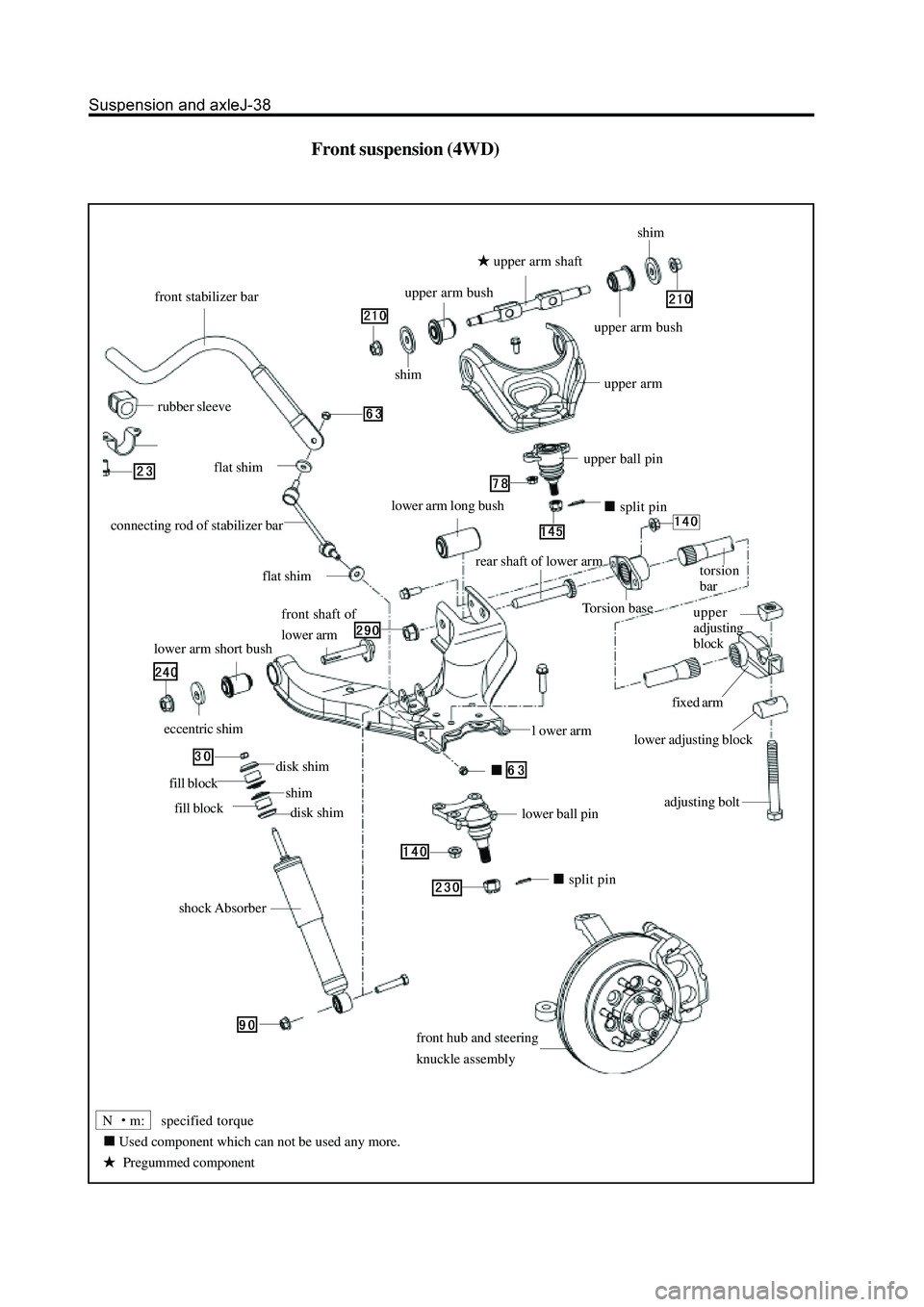
Front suspension (4WD)
N m: specified torque
Used component which can not be used any more.
Pregummed component
rubber sleeve
front shaft of
lower arm
disk shim
fill blockshimfill blockdisk shim
shock Absorber
front hub and steering
knuckle assembly
split pin
lower ball pinadjusting bolt
lower adjusting block
fixed arm
upper
adjusting
block
l ower arm
rear shaft of lower arm
Torsion base
torsion
bar
lower arm long bushsplit pin
upper ball pin
upper arm
shim
upper arm bush
upper arm shaft
upper arm bush
shim
front stabilizer bar
flat shim
connecting rod of stabilizer bar
flat shim
lower arm short bush
eccentric shim
Page 211 of 425
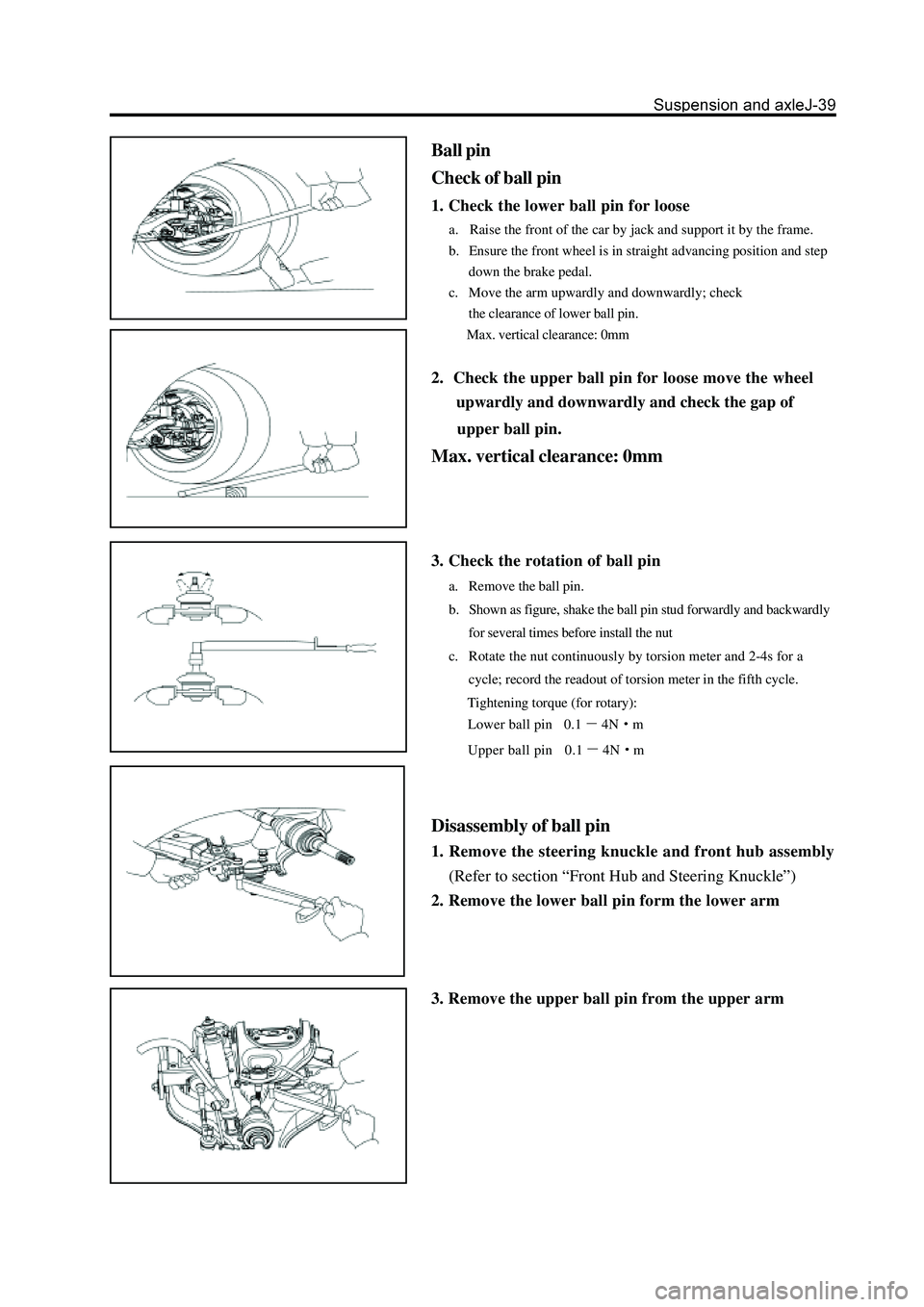
Ball pin
Check of ball pin
1. Check the lower ball pin for loose
a. Raise the front of the car by jack and support it by the frame.
b. Ensure the front wheel is in straight advancing position and step
down the brake pedal.
c. Move the arm upwardly and downwardly; check
the clearance of lower ball pin.
Max. vertical clearance: 0mm
2. Check the upper ball pin for loose move the wheel
upwardly and downwardly and check the gap of
upper ball pin.
Max. vertical clearance: 0mm
3. Check the rotation of ball pin
a. Remove the ball pin.
b. Shown as figure, shake the ball pin stud forwardly and backwardly
for several times before install the nut
c. Rotate the nut continuously by torsion meter and 2-4s for a
cycle; record the readout of torsion meter in the fifth cycle.
Tightening torque (for rotary):
Lower ball pin 0.1
4Nm
Upper ball pin 0.1
4Nm
Disassembly of ball pin
1. Remove the steering knuckle and front hub assembly
(Refer to section “Front Hub and Steering Knuckle”)
2. Remove the lower ball pin form the lower arm
3. Remove the upper ball pin from the upper arm
Page 214 of 425
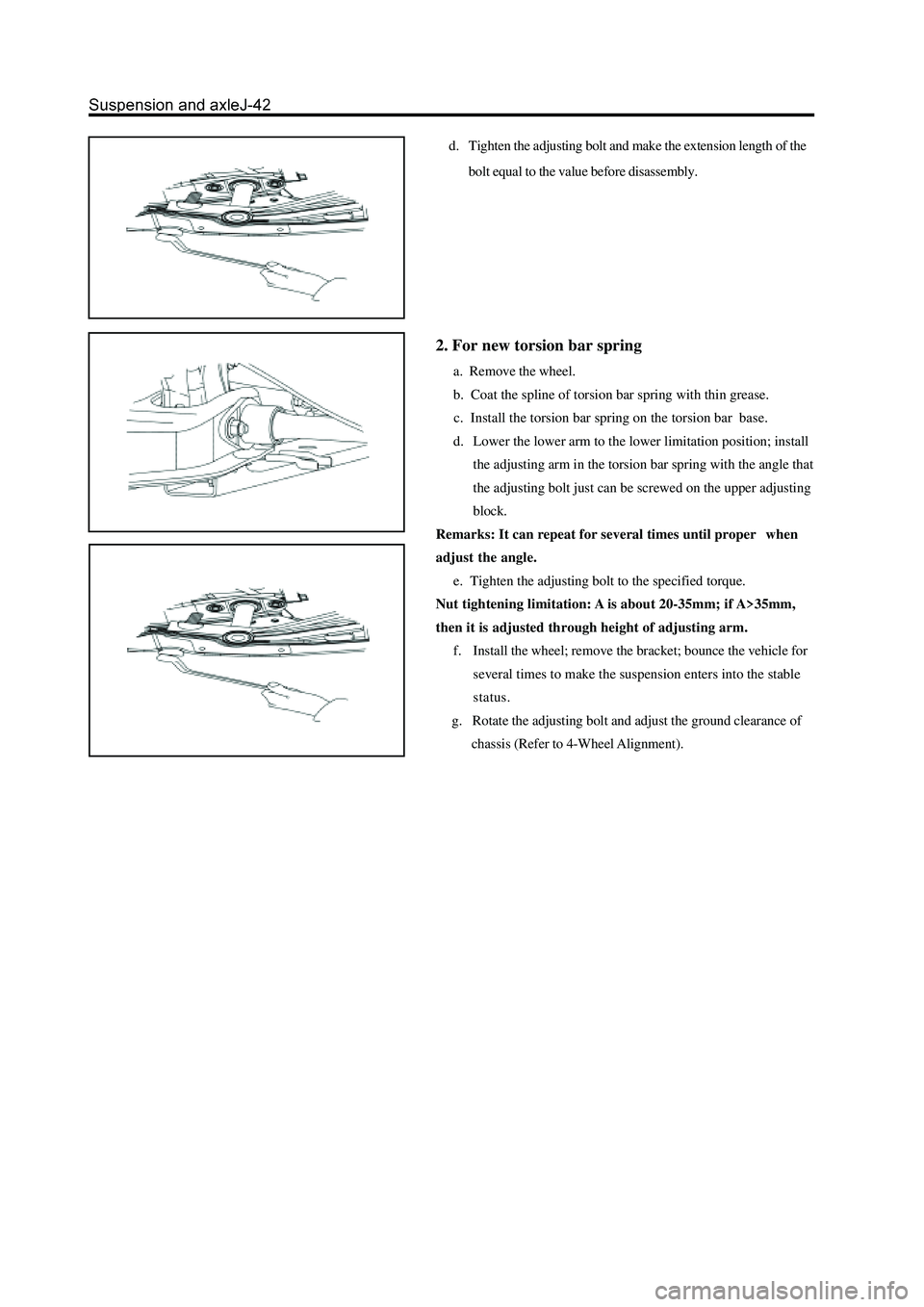
d. Tighten the adjusting bolt and make the extension length of the
bolt equal to the value before disassembly.
2. For new torsion bar spring
a. Remove the wheel.
b. Coat the spline of torsion bar spring with thin grease.
c. Install the torsion bar spring on the torsion bar base.
d. Lower the lower arm to the lower limitation position; install
the adjusting arm in the torsion bar spring with the angle that
the adjusting bolt just can be screwed on the upper adjusting
block.
Remarks: It can repeat for several times until proper when
adjust the angle.
e. Tighten the adjusting bolt to the specified torque.
Nut tightening limitation: A is about 20-35mm; if A>35mm,
then it is adjusted through height of adjusting arm.
f. Install the wheel; remove the bracket; bounce the vehicle for
several times to make the suspension enters into the stable
status.
g. Rotate the adjusting bolt and adjust the ground clearance of
chassis (Refer to 4-Wheel Alignment).
Page 217 of 425
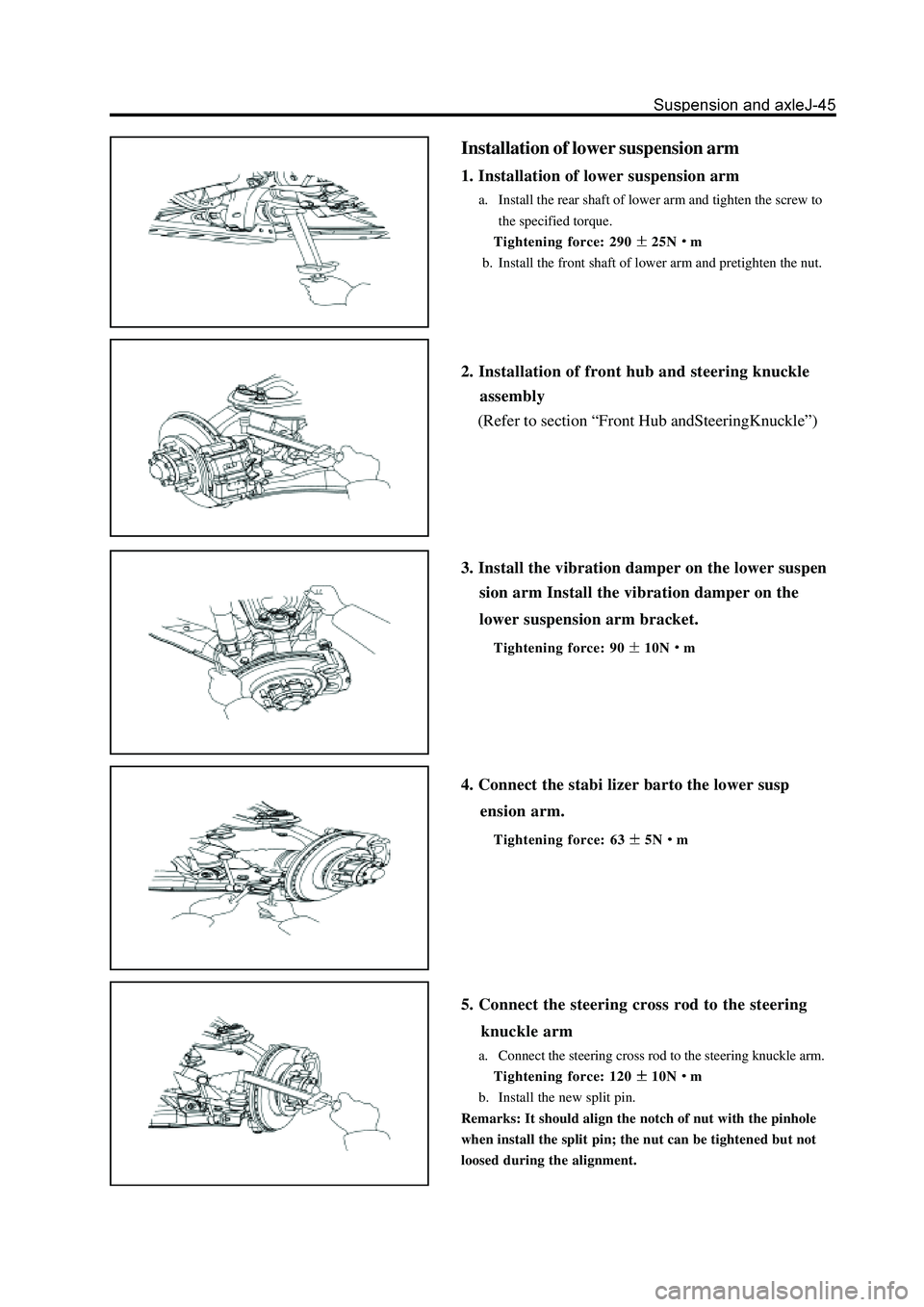
Installation of lower suspension arm
1. Installation of lower suspension arm
a. Install the rear shaft of lower arm and tighten the screw to
the specified torque.
Tightening force: 290
25Nm
b. Install the front shaft of lower arm and pretighten the nut.
2. Installation of front hub and steering knuckle
assembly
(Refer to section “Front Hub andSteeringKnuckle”)
3. Install the vibration damper on the lower suspen
sion arm Install the vibration damper on the
lower suspension arm bracket.
Tightening force: 9010Nm
4. Connect the stabi lizer barto the lower susp
ension arm.
Tightening force: 635Nm
5. Connect the steering cross rod to the steering
knuckle arm
a. Connect the steering cross rod to the steering knuckle arm.
Tightening force: 120
10Nm
b. Install the new split pin.
Remarks: It should align the notch of nut with the pinhole
when install the split pin; the nut can be tightened but not
loosed during the alignment.
Page 218 of 425
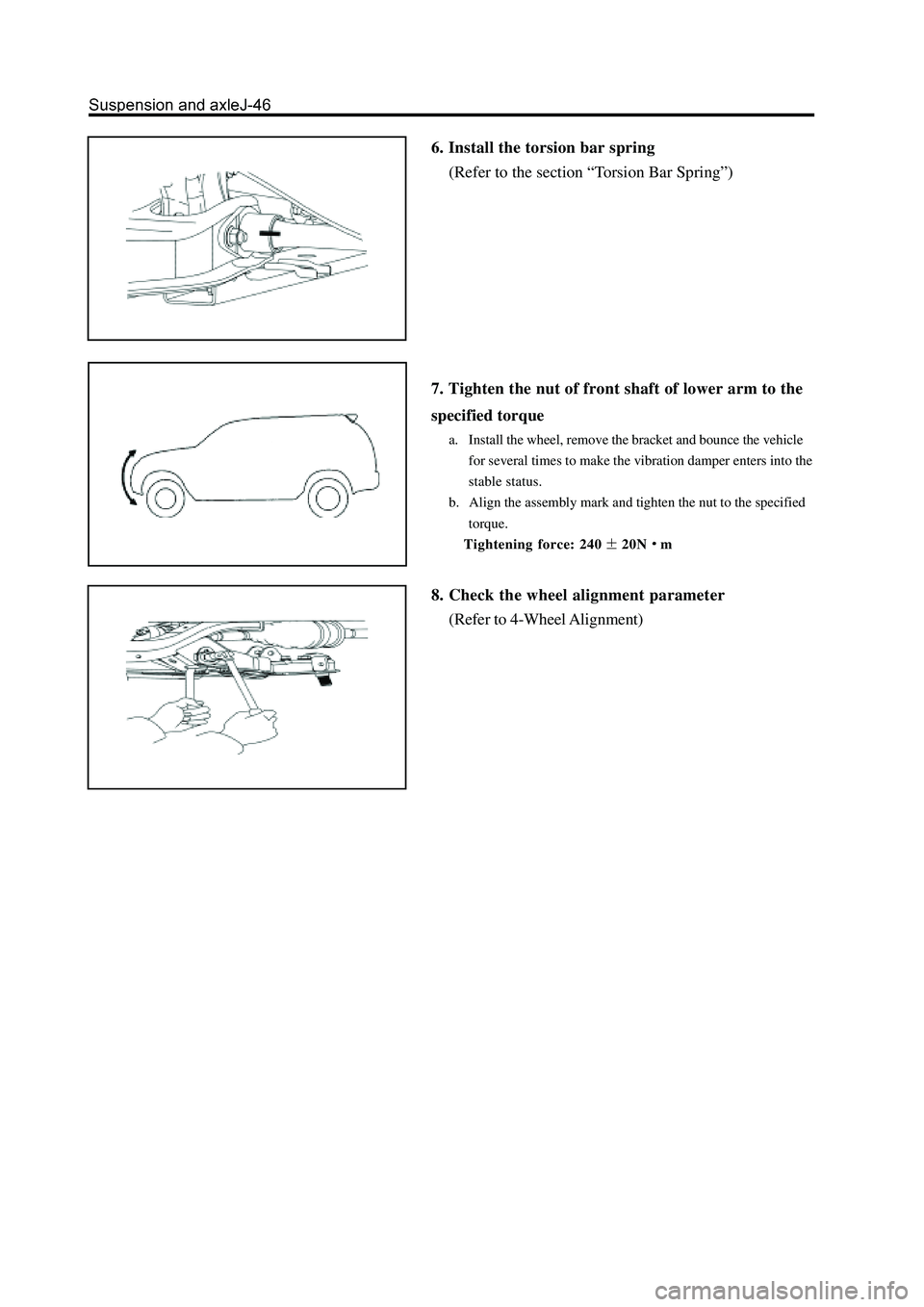
6. Install the torsion bar spring
(Refer to the section “Torsion Bar Spring”)
7. Tighten the nut of front shaft of lower arm to the
specified torque
a. Install the wheel, remove the bracket and bounce the vehicle
for several times to make the vibration damper enters into the
stable status.
b. Align the assembly mark and tighten the nut to the specified
torque.
Tightening force: 240
20Nm
8. Check the wheel alignment parameter
(Refer to 4-Wheel Alignment)
Page 220 of 425
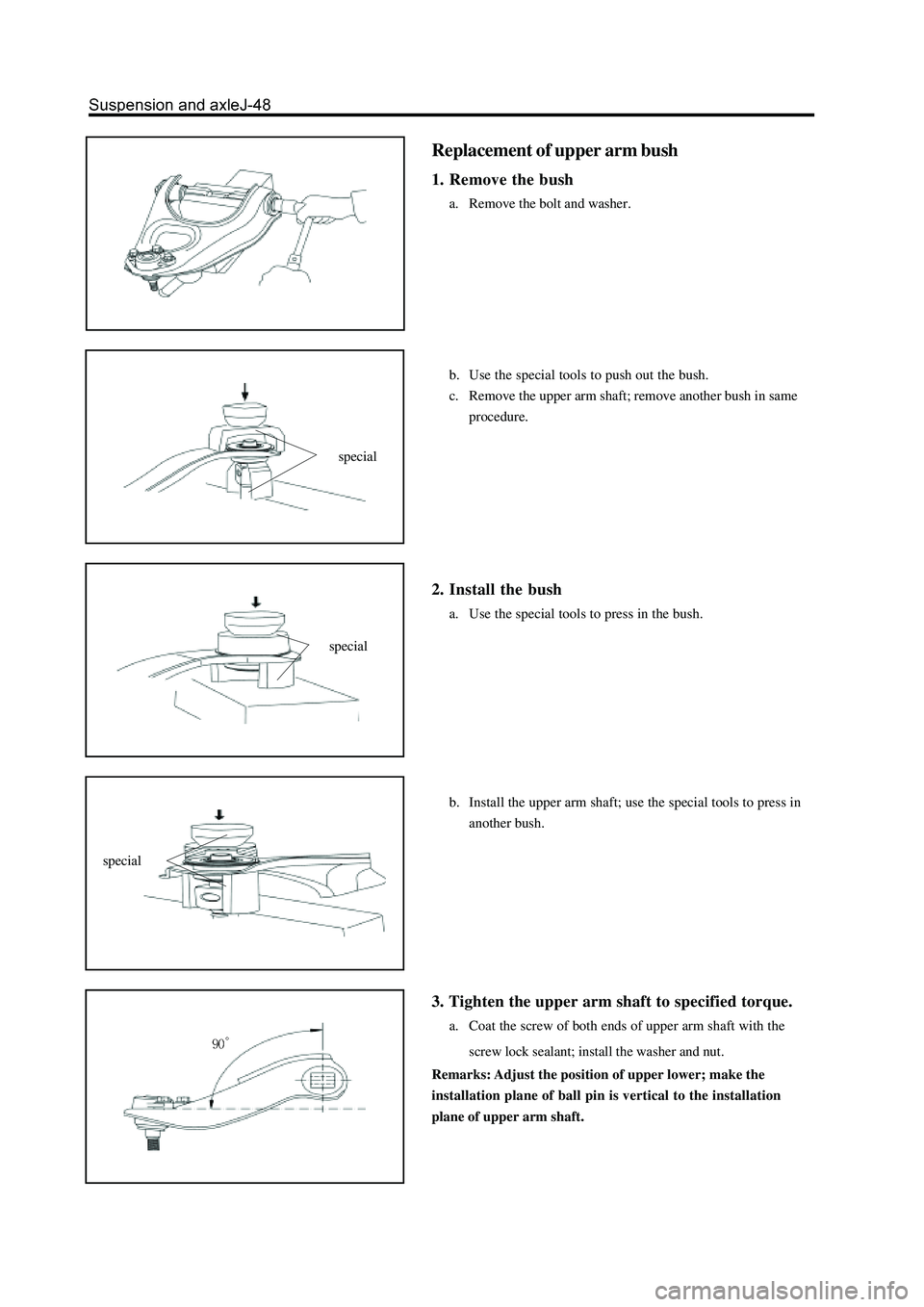
Replacement of upper arm bush
1. Remove the bush
a. Remove the bolt and washer.
b. Use the special tools to push out the bush.
c. Remove the upper arm shaft; remove another bush in same
procedure.
2. Install the bush
a. Use the special tools to press in the bush.
b. Install the upper arm shaft; use the special tools to press in
another bush.
3. Tighten the upper arm shaft to specified torque.
a. Coat the screw of both ends of upper arm shaft with the
screw lock sealant; install the washer and nut.
Remarks: Adjust the position of upper lower; make the
installation plane of ball pin is vertical to the installation
plane of upper arm shaft.
special
special
special
Page 221 of 425
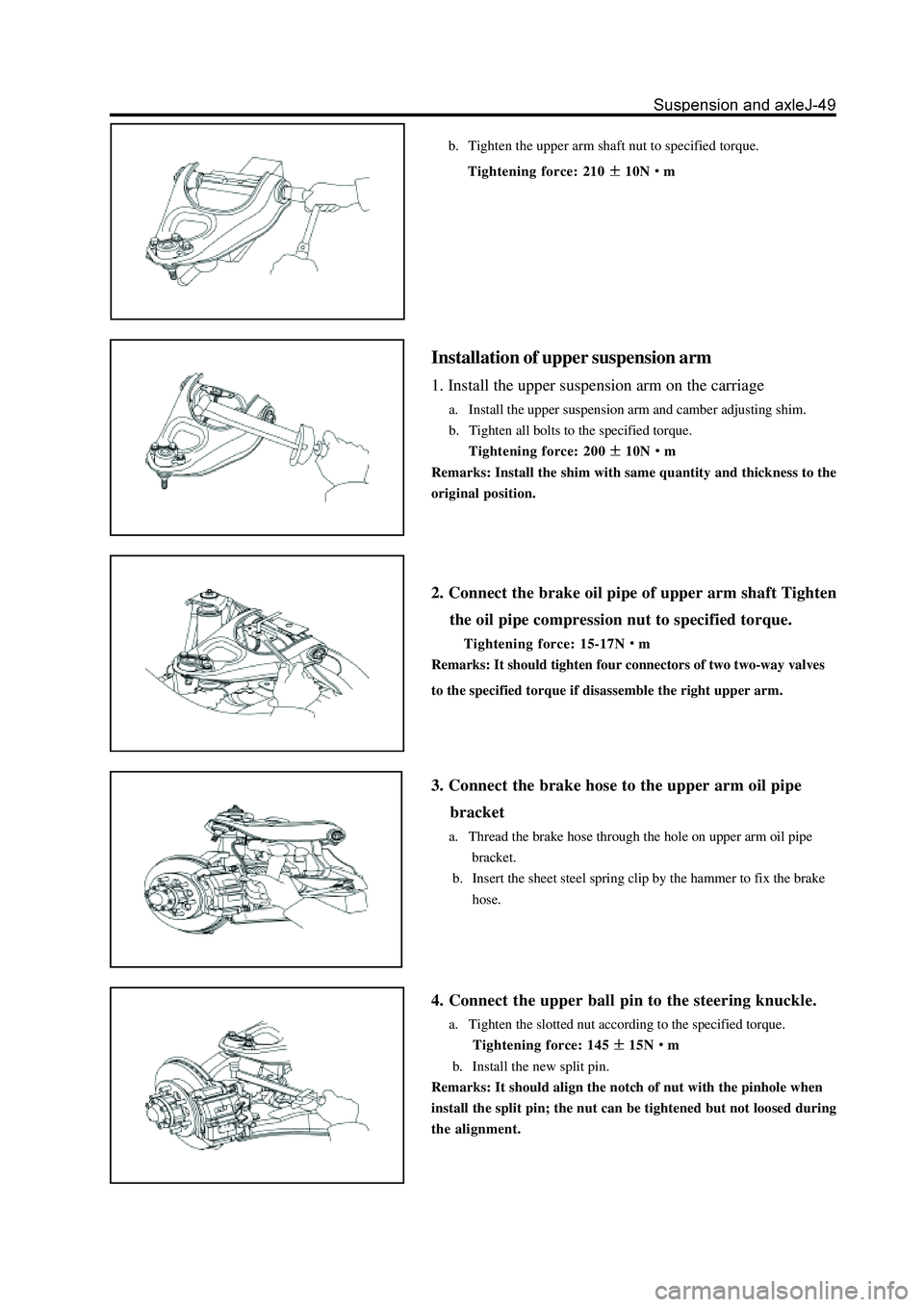
b. Tighten the upper arm shaft nut to specified torque.
Tightening force: 210
10Nm
Installation of upper suspension arm
1. Install the upper suspension arm on the carriage
a. Install the upper suspension arm and camber adjusting shim.
b. Tighten all bolts to the specified torque.
Tightening force: 200
10Nm
Remarks: Install the shim with same quantity and thickness to the
original position.
2. Connect the brake oil pipe of upper arm shaft Tighten
the oil pipe compression nut to specified torque.
Tightening force: 15-17Nm
Remarks: It should tighten four connectors of two two-way valves
to the specified torque if disassemble the right upper arm.
3. Connect the brake hose to the upper arm oil pipe
bracket
a. Thread the brake hose through the hole on upper arm oil pipe
bracket.
b. Insert the sheet steel spring clip by the hammer to fix the brake
hose.
4. Connect the upper ball pin to the steering knuckle.
a. Tighten the slotted nut according to the specified torque.
Tightening force: 145
15Nm
b. Install the new split pin.
Remarks: It should align the notch of nut with the pinhole when
install the split pin; the nut can be tightened but not loosed during
the alignment.
Page 222 of 425
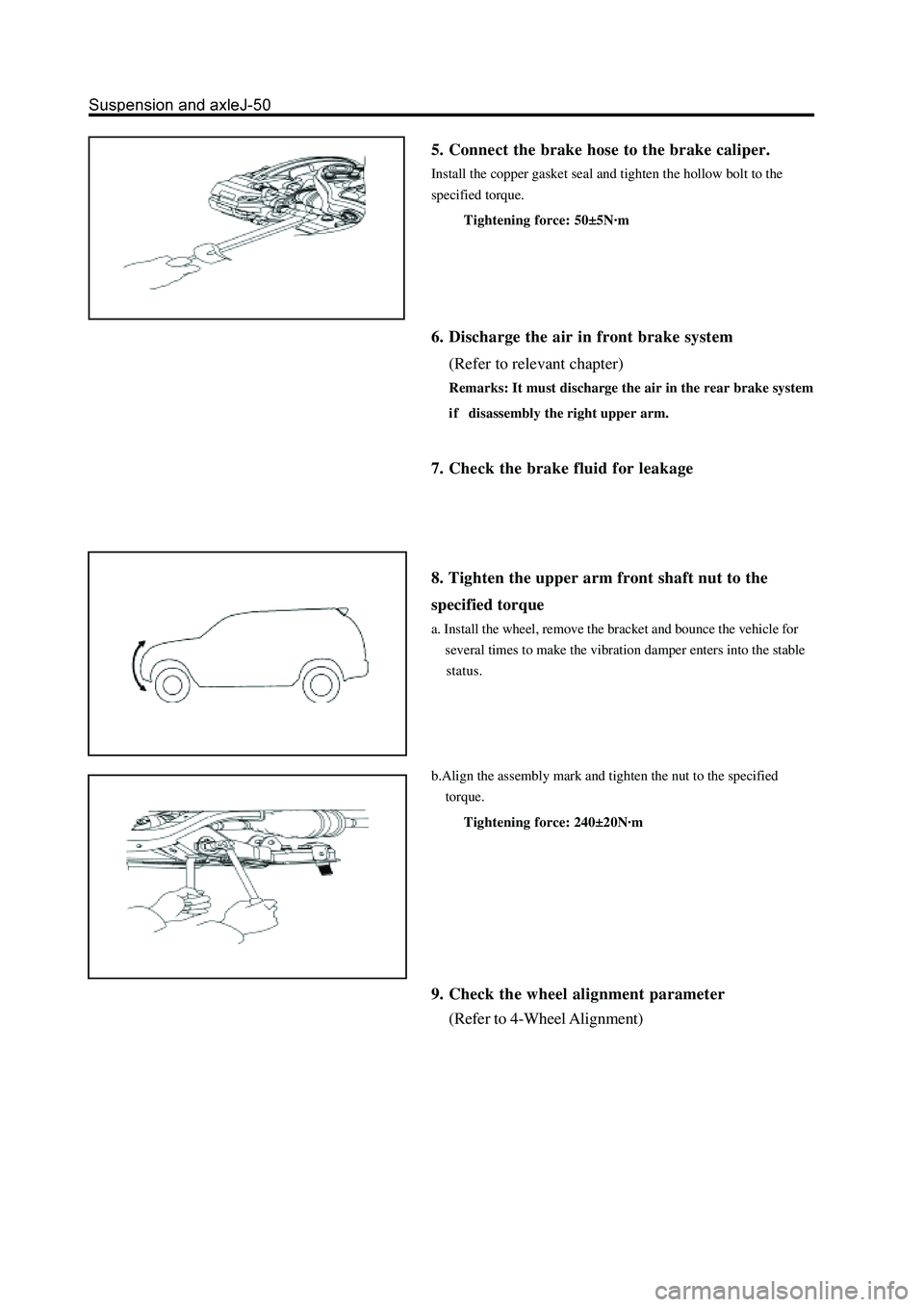
5. Connect the brake hose to the brake caliper.
Install the copper gasket seal and tighten the hollow bolt to the
specified torque.
Tightening force: 50±5N·m
6. Discharge the air in front brake system
(Refer to relevant chapter)
Remarks: It must discharge the air in the rear brake system
i f disassembly the right upper arm.
7. Check the brake fluid for leakage
8. Tighten the upper arm front shaft nut to the
specified torque
a. Install the wheel, remove the bracket and bounce the vehicle for
several times to make the vibration damper enters into the stable
status.
b.Align the assembly mark and tighten the nut to the specified
torque.
Tightening force: 240±20N·m
9. Check the wheel alignment parameter
(Refer to 4-Wheel Alignment)
Page 223 of 425
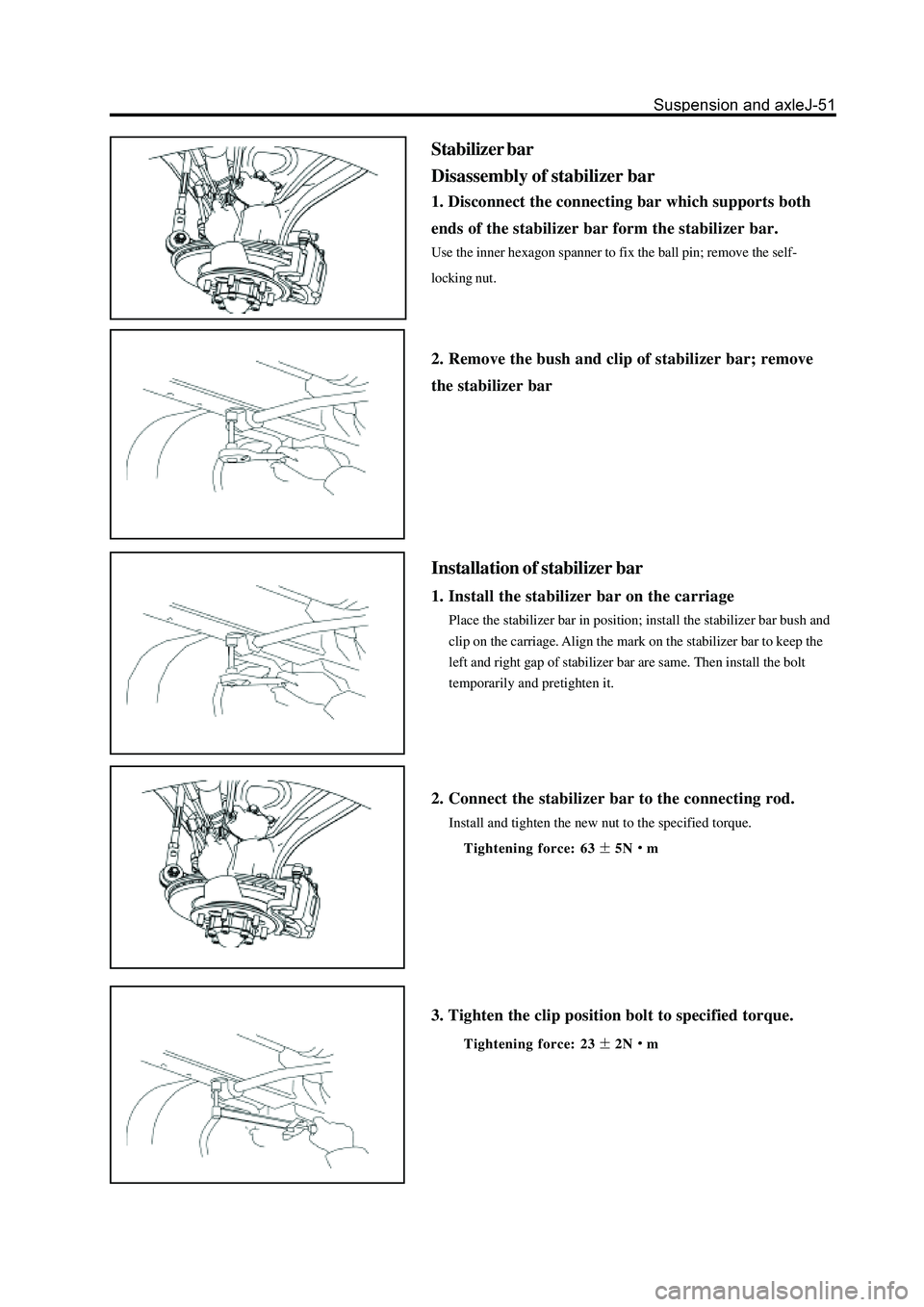
Stabilizer bar
Disassembly of stabilizer bar
1. Disconnect the connecting bar which supports both
ends of the stabilizer bar form the stabilizer bar.
Use the inner hexagon spanner to fix the ball pin; remove the self-
locking nut.
2. Remove the bush and clip of stabilizer bar; remove
the stabilizer bar
Installation of stabilizer bar
1. Install the stabilizer bar on the carriage
Place the stabilizer bar in position; install the stabilizer bar bush and
clip on the carriage. Align the mark on the stabilizer bar to keep the
left and right gap of stabilizer bar are same. Then install the bolt
temporarily and pretighten it.
2. Connect the stabilizer bar to the connecting rod.
Install and tighten the new nut to the specified torque.
Tightening force: 63
5Nm
3. Tighten the clip position bolt to specified torque.
Tightening force: 232Nm
Page 224 of 425
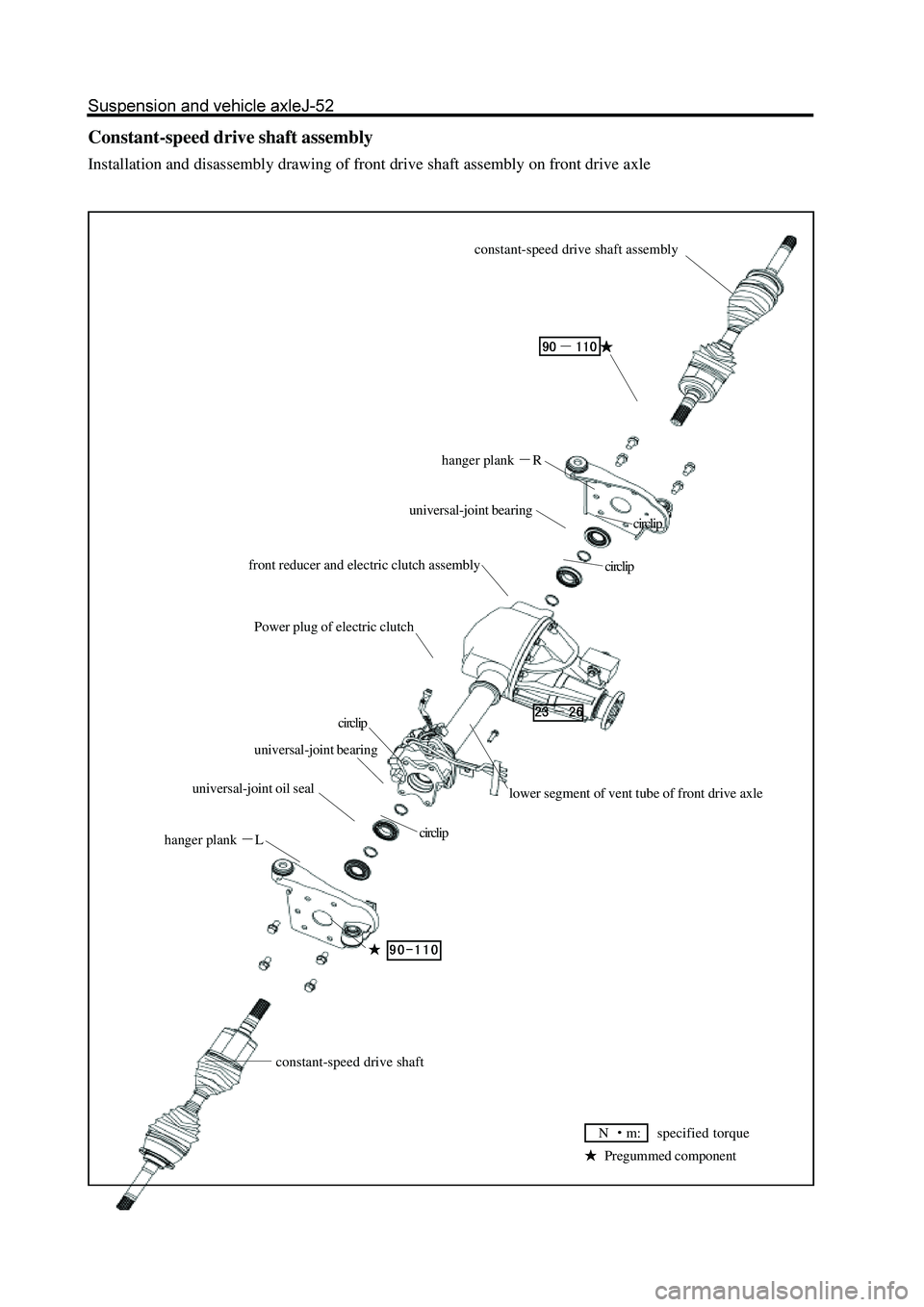
Constant-speed drive shaft assembly
Installation and disassembly drawing of front drive shaft assembly on front drive axle
hanger plank R
universal-joint bearing
front reducer and electric clutch assembly
Power plug of electric clutch
circlip
hanger plank L
constant-speed drive shaft
circlip
lower segment of vent tube of front drive axle
circlip
circlip
Pregummed component
N m: specified torque
universal-joint oil sealuniversal-joint bearingconstant-speed drive shaft assembly