lock GREAT WALL HOVER 2006 Service Repair Manual
[x] Cancel search | Manufacturer: GREAT WALL, Model Year: 2006, Model line: HOVER, Model: GREAT WALL HOVER 2006Pages: 425, PDF Size: 26.05 MB
Page 269 of 425
limitationlimitationCheck and repair of rear axle components
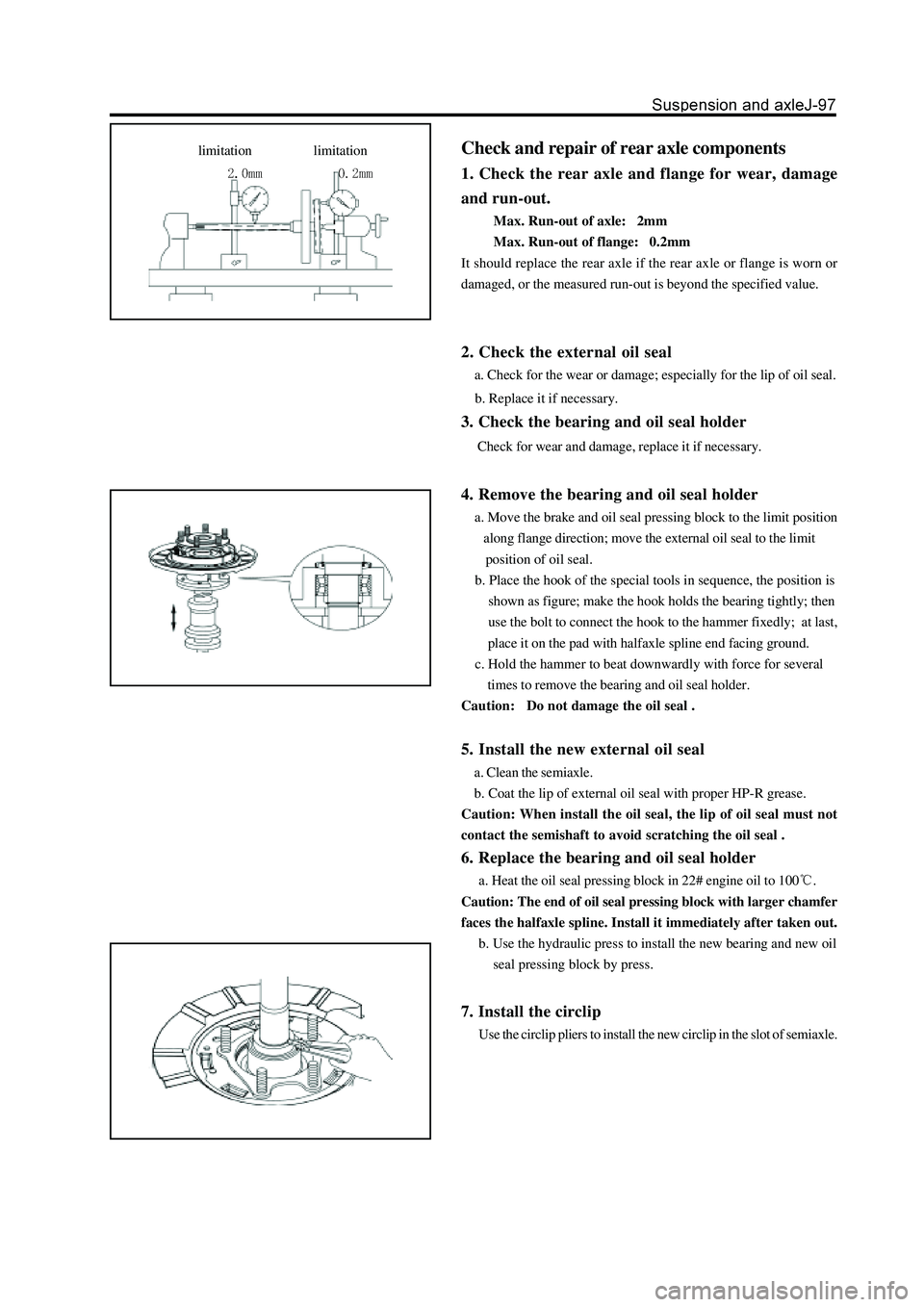
1. Check the rear axle and flange for wear, damage
and run-out.
Max. Run-out of axle: 2mm
Max. Run-out of flange: 0.2mm
It should replace the rear axle if the rear axle or flange is worn or
damaged, or the measured run-out is beyond the specified value.
2. Check the external oil seal
a. Check for the wear or damage; especially for the lip of oil seal.
b. Replace it if necessary.
3. Check the bearing and oil seal holder
Check for wear and damage, replace it if necessary.
4. Remove the bearing and oil seal holder
a. Move the brake and oil seal pressing block to the limit position
along flange direction; move the external oil seal to the limit
position of oil seal.
b. Place the hook of the special tools in sequence, the position is
shown as figure; make the hook holds the bearing tightly; then
use the bolt to connect the hook to the hammer fixedly; at last,
place it on the pad with halfaxle spline end facing ground.
c. Hold the hammer to beat downwardly with force for several
times to remove the bearing and oil seal holder.
Caution: Do not damage the oil seal .
5. Install the new external oil seal
a. Clean the semiaxle.
b. Coat the lip of external oil seal with proper HP-R grease.
Caution: When install the oil seal, the lip of oil seal must not
contact the semishaft to avoid scratching the oil seal .
6. Replace the bearing and oil seal holder
a. Heat the oil seal pressing block in 22# engine oil to 100.
Caution: The end of oil seal pressing block with larger chamfer
faces the halfaxle spline. Install it immediately after taken out.
b. Use the hydraulic press to install the new bearing and new oil
seal pressing block by press.
7. Install the circlip
Use the circlip pliers to install the new circlip in the slot of semiaxle.
Page 271 of 425
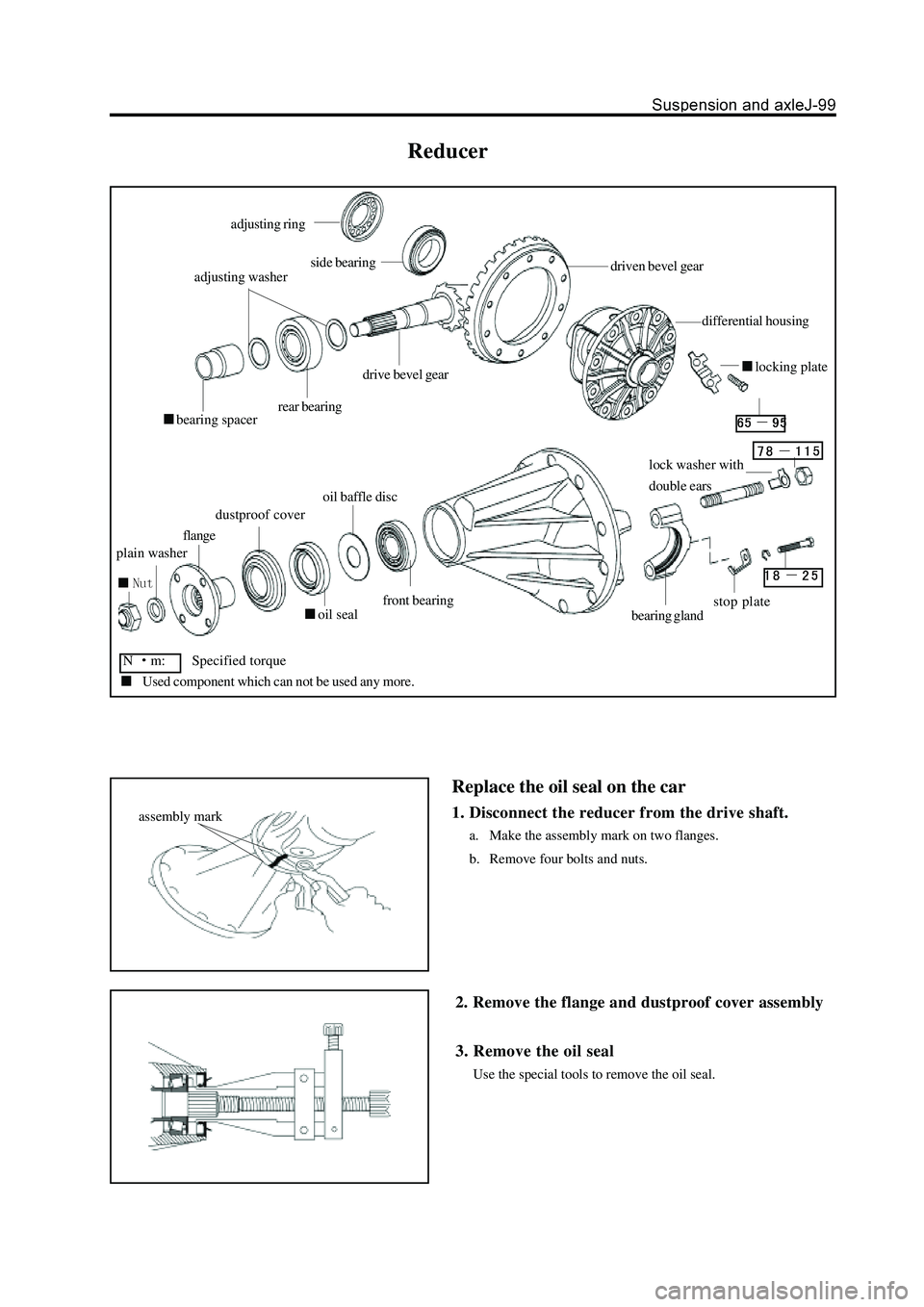
Reducer
Replace the oil seal on the car
1. Disconnect the reducer from the drive shaft.
a. Make the assembly mark on two flanges.
b. Remove four bolts and nuts.
2. Remove the flange and dustproof cover assembly
3. Remove the oil seal
Use the special tools to remove the oil seal.
bearing spacer
adjusting washer
rear bearing
drive bevel gear
adjusting ring
side bearingdriven bevel gear
differential housing
locking plate
plain washer
flange
dustproof cover
oil seal
oil baffle disc
front bearingbearing glandstop plate
lock washer with
double ears
N m: Specified torque
Used component which can not be used any more.
assembly mark
Page 275 of 425
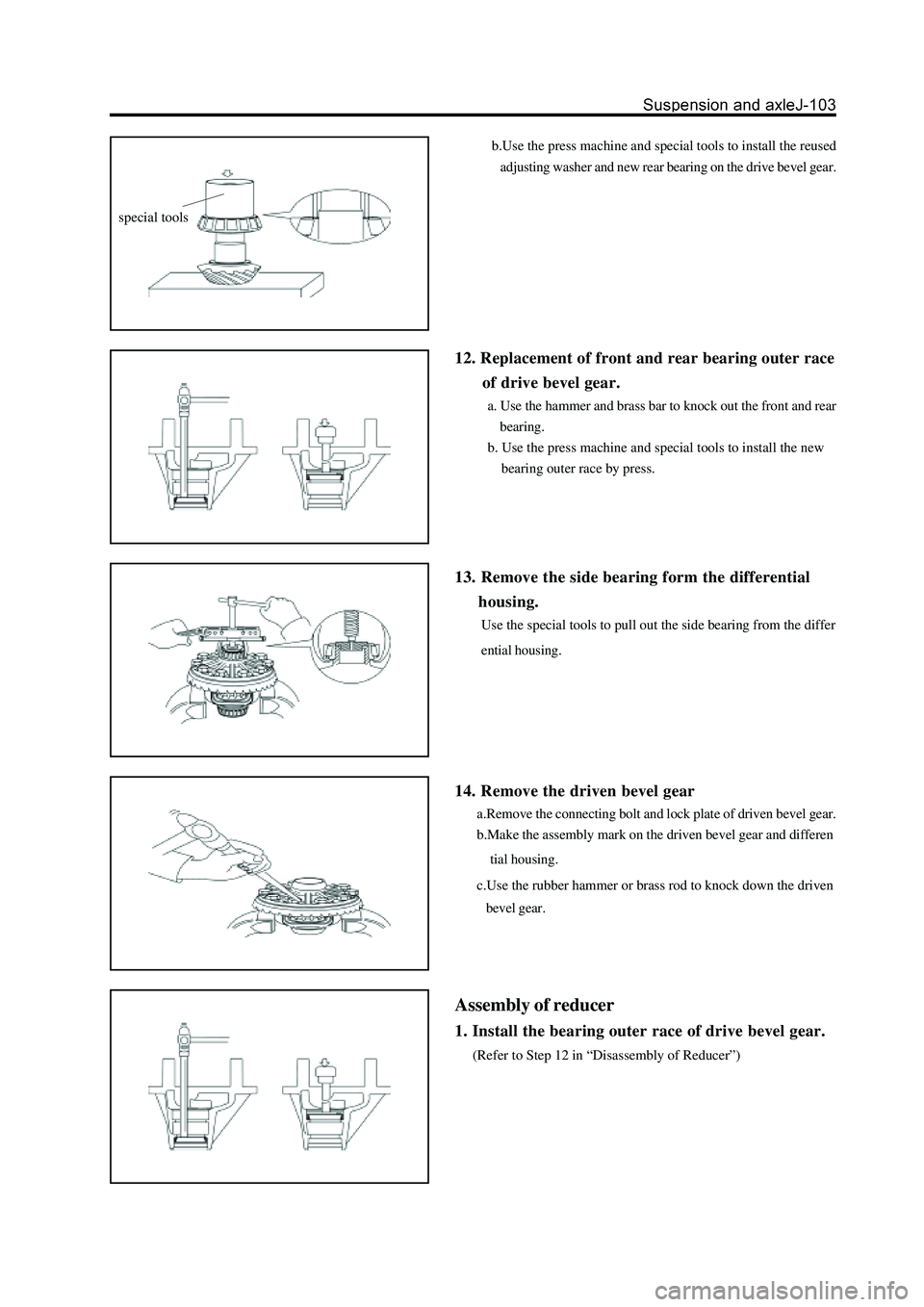
b.Use the press machine and special tools to install the reused
adjusting washer and new rear bearing on the drive bevel gear.
12. Replacement of front and rear bearing outer race
of drive bevel gear.
a. Use the hammer and brass bar to knock out the front and rear
bearing.
b. Use the press machine and special tools to install the new
bearing outer race by press.
13. Remove the side bearing form the differential
housing.
Use the special tools to pull out the side bearing from the differ
ential housing.
14. Remove the driven bevel gear
a.Remove the connecting bolt and lock plate of driven bevel gear.
b.Make the assembly mark on the driven bevel gear and differen
tial housing.
c.Use the rubber hammer or brass rod to knock down the driven
bevel gear.
Assembly of reducer
1. Install the bearing outer race of drive bevel gear.
(Refer to Step 12 in “Disassembly of Reducer”)
special tools
Page 277 of 425
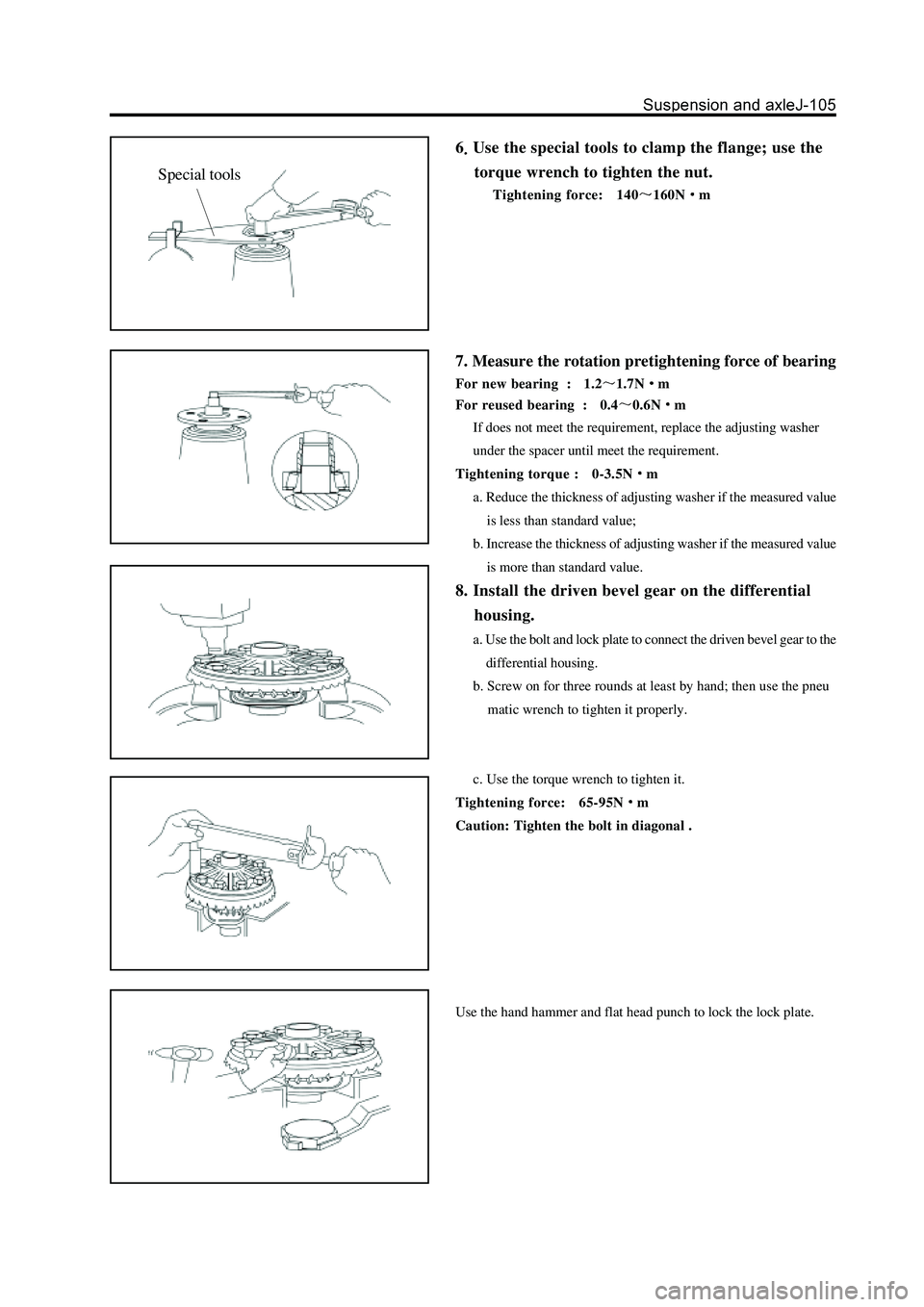
6Use the special tools to clamp the flange; use the
torque wrench to tighten the nut.
Tightening force: 140160Nm
7. Measure the rotation pretightening force of bearing
For new bearing : 1.21.7Nm
For reused bearing : 0.4
0.6Nm
If does not meet the requirement, replace the adjusting washer
under the spacer until meet the requirement.
Tightening torque : 0-3.5N
m
a. Reduce the thickness of adjusting washer if the measured value
is less than standard value;
b. Increase the thickness of adjusting washer if the measured value
is more than standard value.
8. Install the driven bevel gear on the differential
housing.
a. Use the bolt and lock plate to connect the driven bevel gear to the
differential housing.
b. Screw on for three rounds at least by hand; then use the pneu
matic wrench to tighten it properly.
c. Use the torque wrench to tighten it.
Tightening force: 65-95N
m
Caution: Tighten the bolt in diagonal .
Use the hand hammer and flat head punch to lock the lock plate.
Special tools
Page 278 of 425
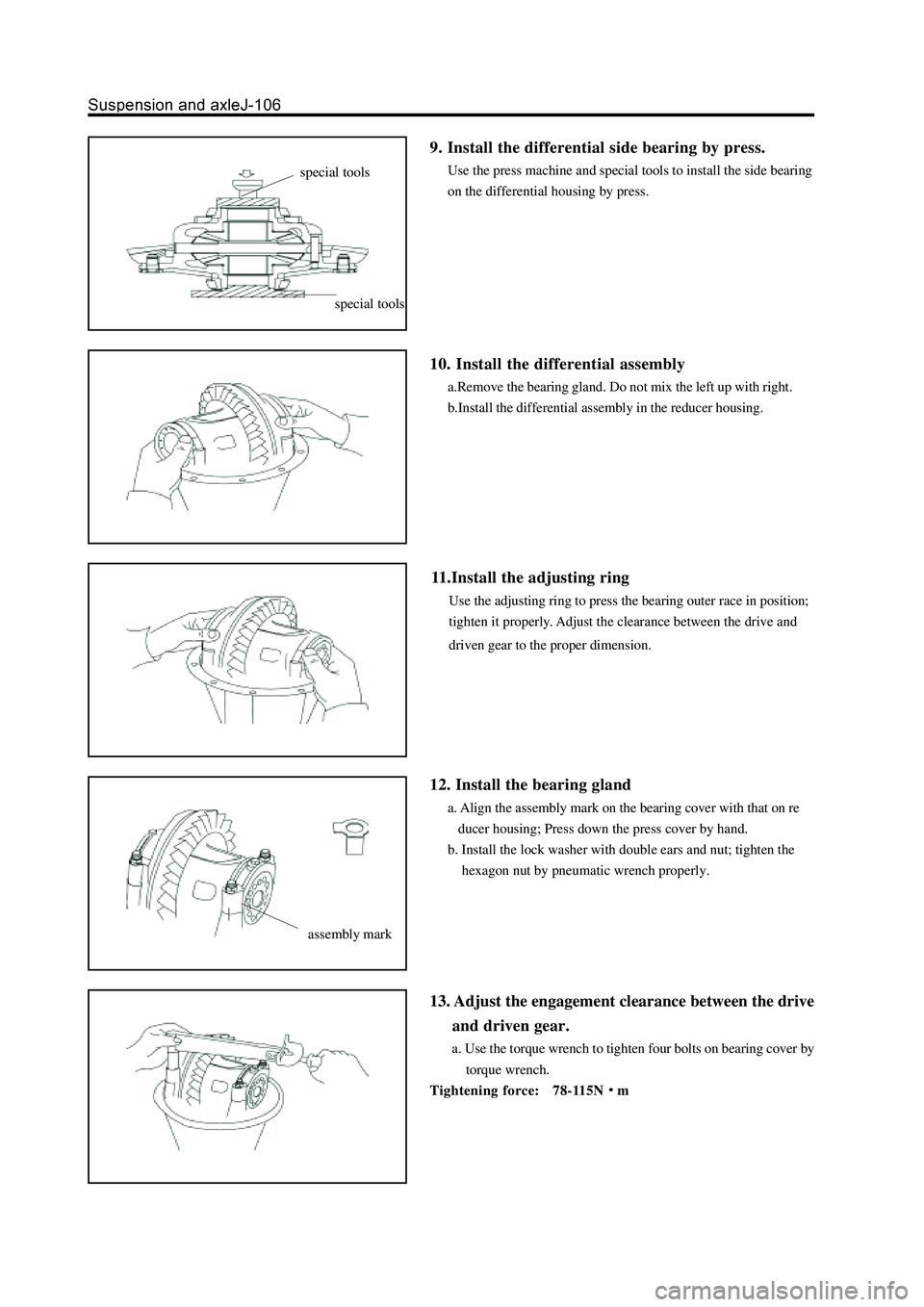
9. Install the differential side bearing by press.
Use the press machine and special tools to install the side bearing
on the differential housing by press.
10. Install the differential assembly
a.Remove the bearing gland. Do not mix the left up with right.
b.Install the differential assembly in the reducer housing.
11.Install the adjusting ring
Use the adjusting ring to press the bearing outer race in position;
tighten it properly. Adjust the clearance between the drive and
driven gear to the proper dimension.
12. Install the bearing gland
a. Align the assembly mark on the bearing cover with that on re
ducer housing; Press down the press cover by hand.
b. Install the lock washer with double ears and nut; tighten the
hexagon nut by pneumatic wrench properly.
13. Adjust the engagement clearance between the drive
and driven gear.
a. Use the torque wrench to tighten four bolts on bearing cover by
torque wrench.
Tightening force: 78-115N
m
special tools
special tools
assembly mark
Page 279 of 425
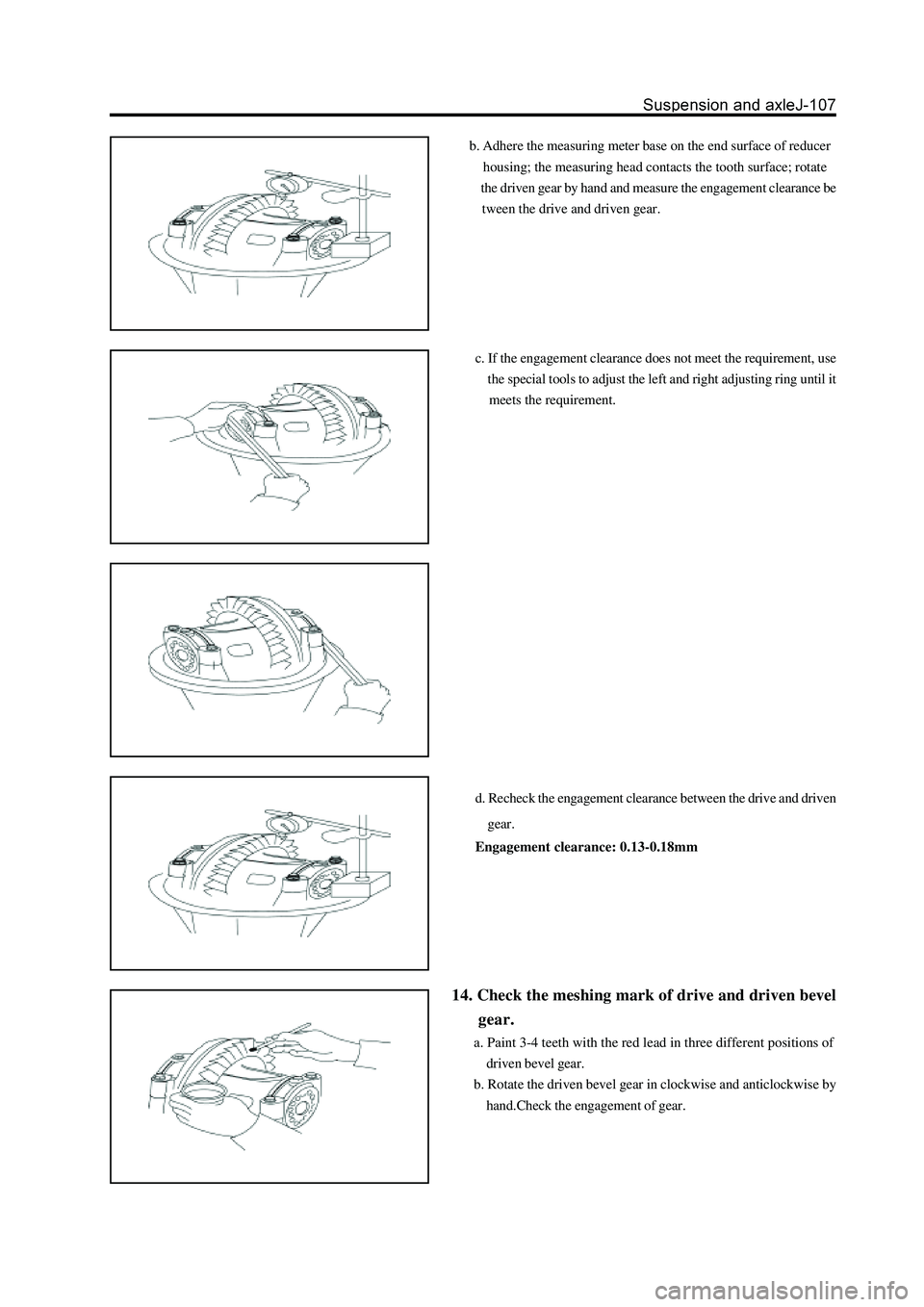
b. Adhere the measuring meter base on the end surface of reducer
housing; the measuring head contacts the tooth surface; rotate
the driven gear by hand and measure the engagement clearance be
tween the drive and driven gear.
c. If the engagement clearance does not meet the requirement, use
the special tools to adjust the left and right adjusting ring until it
meets the requirement.
d. Recheck the engagement clearance between the drive and driven
gear.
Engagement clearance: 0.13-0.18mm
14. Check the meshing mark of drive and driven bevel
gear.
a. Paint 3-4 teeth with the red lead in three different positions of
driven bevel gear.
b. Rotate the driven bevel gear in clockwise and anticlockwise by
hand.Check the engagement of gear.
Page 280 of 425
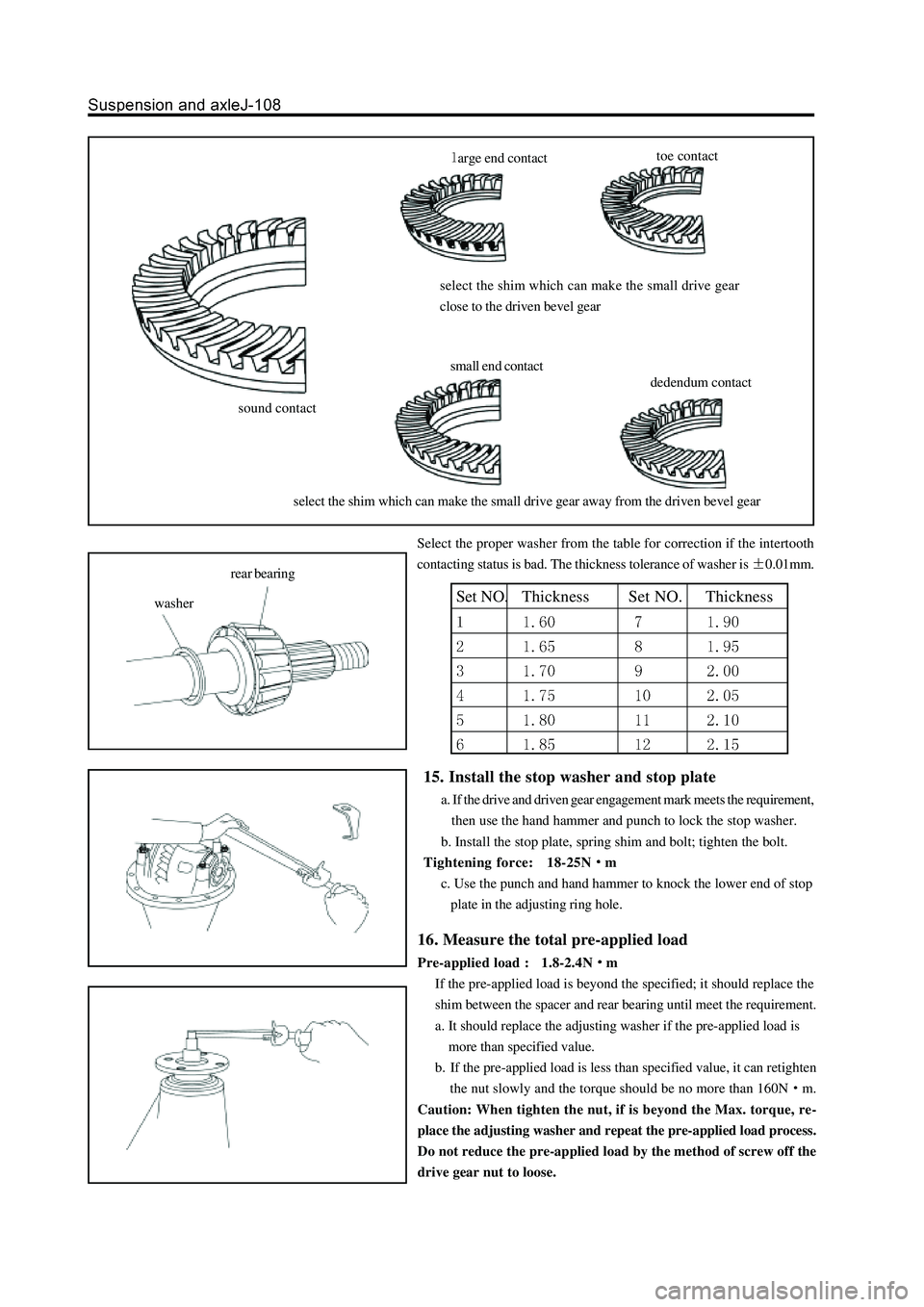
sound contacttoe contact
dedendum contact
arge end contact
small end contact select the shim which can make the small drive gear
close to the driven bevel gear
select the shim which can make the small drive gear away from the driven bevel gear
Select the proper washer from the table for correction if the intertooth
contacting status is bad. The thickness tolerance of washer is
0.01mm.
15. Install the stop washer and stop plate
a. If the drive and driven gear engagement mark meets the requirement,
then use the hand hammer and punch to lock the stop washer.
b. Install the stop plate, spring shim and bolt; tighten the bolt.
Tightening force: 18-25N
m
c. Use the punch and hand hammer to knock the lower end of stop
plate in the adjusting ring hole.
Set NO. Thickness Set NO. Thickness
16. Measure the total pre-applied load
Pre-applied load : 1.8-2.4Nm
If the pre-applied load is beyond the specified; it should replace the
shim between the spacer and rear bearing until meet the requirement.
a. It should replace the adjusting washer if the pre-applied load is
more than specified value.
b. If the pre-applied load is less than specified value, it can retighten
the nut slowly and the torque should be no more than 160N
m.
Caution: When tighten the nut, if is beyond the Max. torque, re-
place the adjusting washer and repeat the pre-applied load process.
Do not reduce the pre-applied load by the method of screw off the
drive gear nut to loose.
washerrear bearing
Page 282 of 425
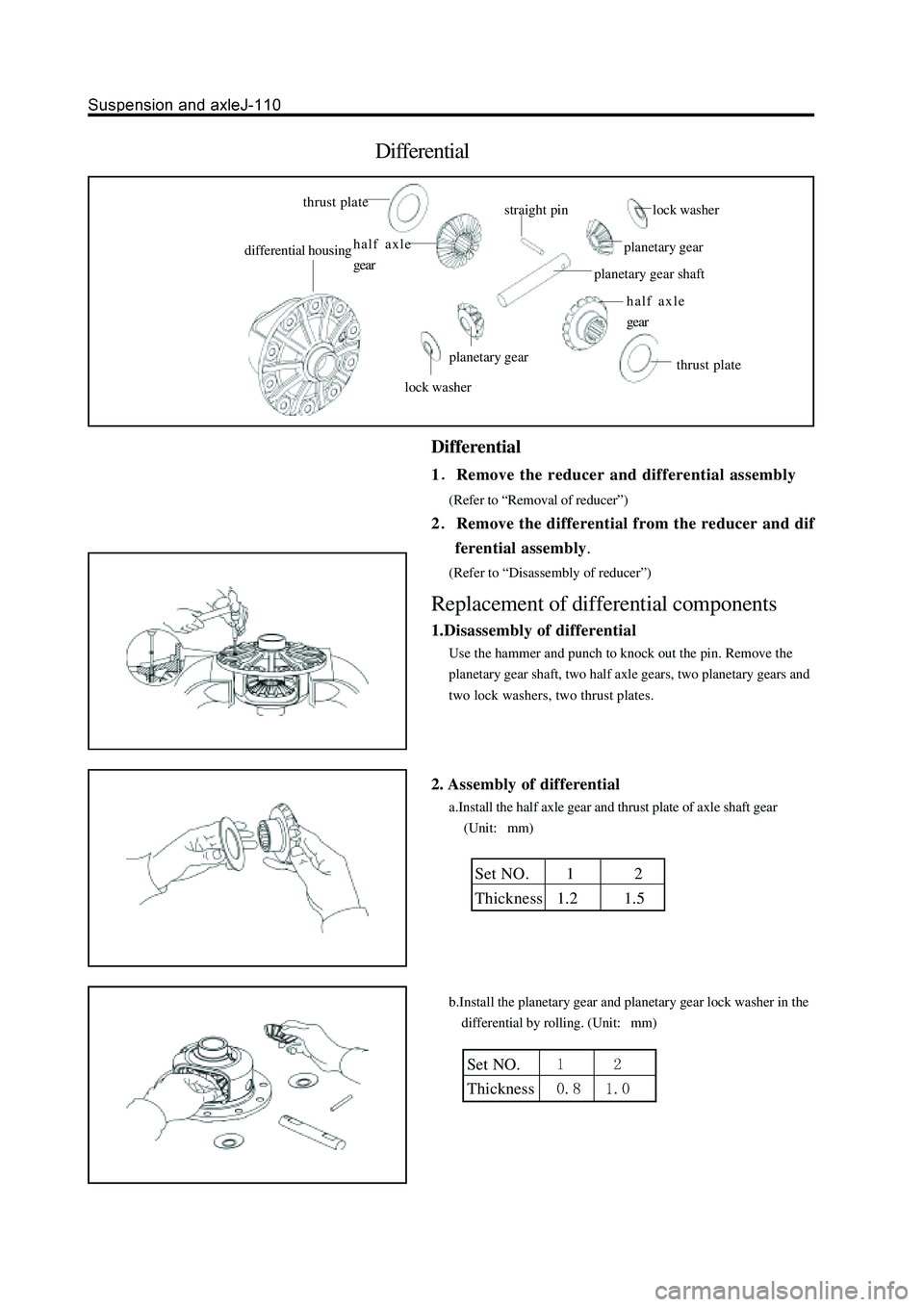
Differential
Differential
1Remove the reducer and differential assembly
(Refer to “Removal of reducer”)
2Remove the differential from the reducer and dif
ferential assembly.
(Refer to “Disassembly of reducer”)
Replacement of differential components
1.Disassembly of differential
Use the hammer and punch to knock out the pin. Remove the
planetary gear shaft, two half axle gears, two planetary gears and
two lock washers, two thrust plates.
2. Assembly of differential
a.Install the half axle gear and thrust plate of axle shaft gear
(Unit: mm)
b.Install the planetary gear and planetary gear lock washer in the
differential by rolling. (Unit: mm)
differential housing
thrust plate
half axle
gear
straight pin
planetary gear
lock washer
half axle
gear
thrust plateplanetary gear
lock washer
planetary gear shaft
Set NO. 1 2
Thickness 1.2 1.5
Set NO.
Thickness
Page 285 of 425
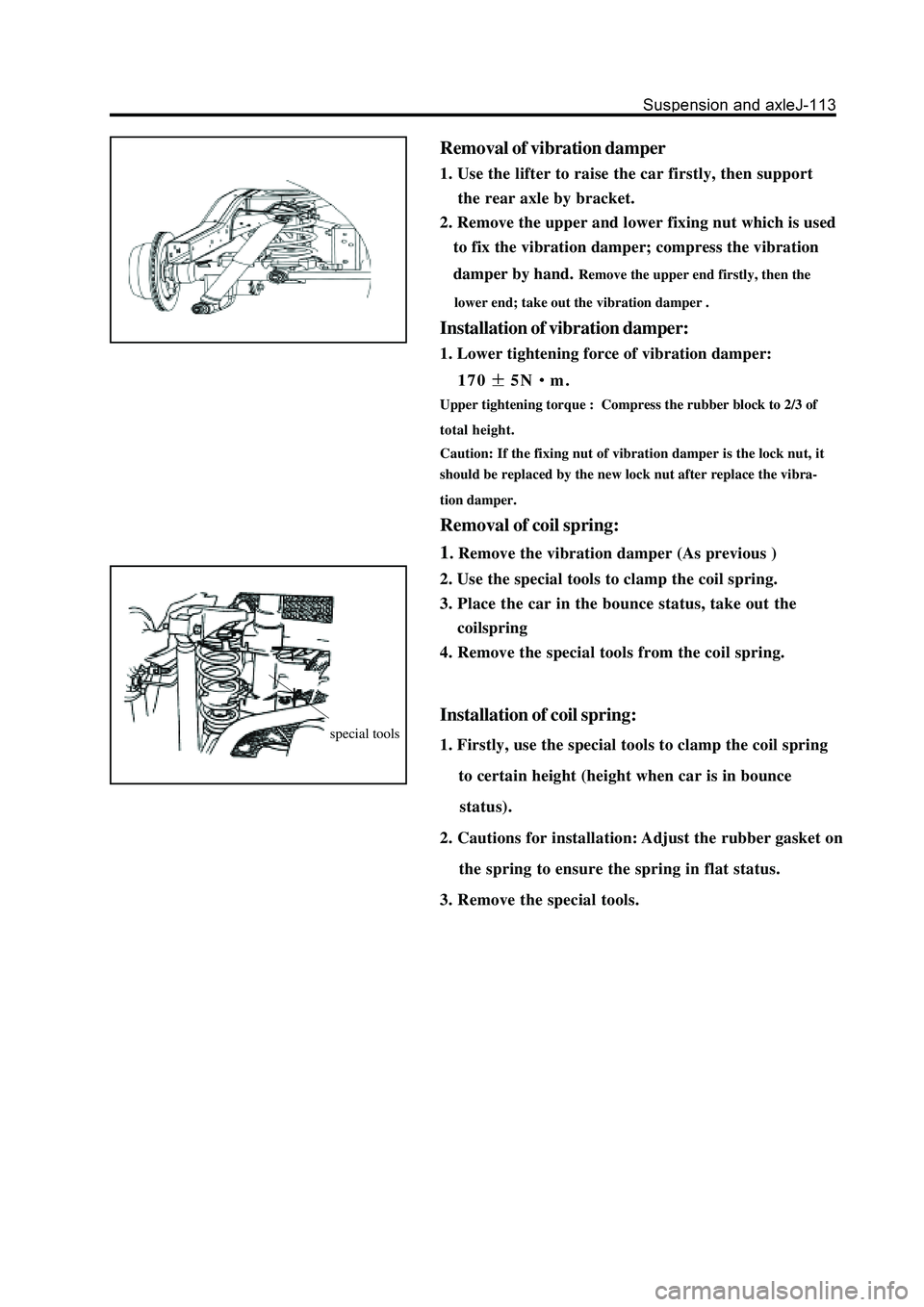
Removal of vibration damper
1. Use the lifter to raise the car firstly, then support
the rear axle by bracket.
2. Remove the upper and lower fixing nut which is used
to fix the vibration damper; compress the vibration
damper by hand.
Remove the upper end firstly, then the
lower end; take out the vibration damper .
Installation of vibration damper:
1. Lower tightening force of vibration damper:
170
5Nm.
Upper tightening torque : Compress the rubber block to 2/3 of
total height.
Caution: If the fixing nut of vibration damper is the lock nut, it
should be replaced by the new lock nut after replace the vibra-
tion damper.
Removal of coil spring:
1
. Remove the vibration damper (As previous )
2. Use the special tools to clamp the coil spring.
3. Place the car in the bounce status, take out the
coilspring
4. Remove the special tools from the coil spring.
Installation of coil spring:
1. Firstly, use the special tools to clamp the coil spring
to certain height (height when car is in bounce
status).
2. Cautions for installation: Adjust the rubber gasket on
the spring to ensure the spring in flat status.
3. Remove the special tools.special tools
Page 287 of 425

Brake-1
Chapter 8
Brake
Cautions...................................................................................... 2
Troubleshooting............................................................................2
Check and adjustment..................................................................5
Brake pedal..................................................................................7
Parking brake...............................................................................8
Front brake...................................................................................9
Rear brake...................................................................................16
Rear parking brake......................................................................22
Sensor load proportional valve.....................................................29
Antilock Braking System (ABS)..................................................31