brake HONDA CIVIC 1991 User Guide
[x] Cancel search | Manufacturer: HONDA, Model Year: 1991, Model line: CIVIC, Model: HONDA CIVIC 1991Pages: 136, PDF Size: 1.33 MB
Page 65 of 136
Shifting the Automatic
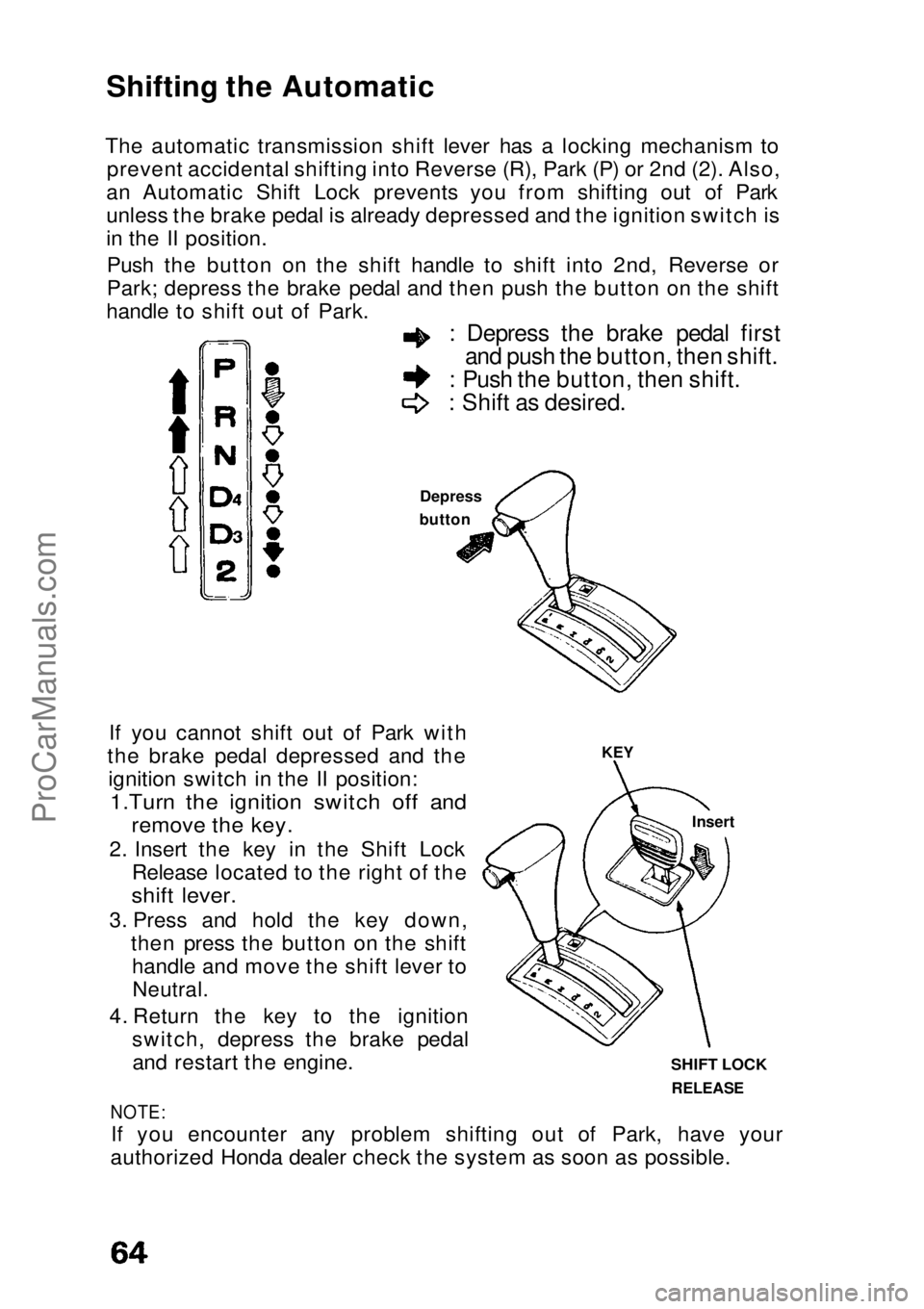
The automatic transmission shift lever has a locking mechanism to prevent accidental shifting into Reverse (R), Park (P) or 2nd (2). Also,
an Automatic Shift Lock prevents you from shifting out of Park
unless the brake pedal is already depressed and the ignition switch is
in the II position.
Push the button on the shift handle to shift into 2nd, Reverse or
Park; depress the brake pedal and then push the button on the shift
handle to shift out of Park. : Depress the brake pedal first
and push the button, then shift.
: Push the button, then shift.
: Shift as desired.
Depress
button
SHIFT LOCK
RELEASE
KEY
Insert
If you cannot shift out of Park with
the brake pedal depressed and the ignition switch in the II position:
1.Turn the ignition switch off and
remove the key.
2. Insert the key in the Shift Lock Release located to the right of the
shift lever.
3. Press and hold the key down, then press the button on the shifthandle and move the shift lever to
Neutral.
4. Return the key to the ignition switch, depress the brake pedaland restart the engine.
NOTE:
If you encounter any problem shifting out of Park, have your
authorized Honda dealer check the system as soon as possible.ProCarManuals.comMain Menu s t
Page 66 of 136
Operating Tips
For smoother operation, apply the brakes when shifting from
Neutral or Park to a forward or reverse gear.
When parking: bring the car to a stop with the foot brake, hold the brake on and shift into Park, set the hand brake and then turn off
the engine.
NOTE:
Your 4 speed automatic transmission is equipped with a torque
converter lock-up clutch. Because of this, you may notice what
feels like an extra shift as the clutch engages.
CAUTION:
Shift into P only after the car has come to a complete stop.
Shift into or out of R only after the car has come to a complete
stop.
Do not "rev-up" the engine when the brake is on and the shift
lever is in D4, D3, 2 or R.
When stopped on a hill, use the brakes to hold your position, not
the accelerator pedal.
Do not shift from N or P into D4, D3, 2 or R when the engine is
above idle speed. Before shifting into gear, make sure your foot is firmly on the brake pedal. Do not rest your hand on the shift lever or push the shift button
while driving.
(cont'd)ProCarManuals.comMain Menu s t
Page 69 of 136

Check the following items at each fuel stop:
1. Engine oil level.
2. Radiator coolant level.
Check the following items periodically: 1. Brakes: for braking efficiency, brake pedal travel and hydraulic
fluid level.
2. Lights: for operation of headlights, taillights, side marker lights, stoplights, turn signals and back-up lights.
3. Tires: for correct pressures (including spare); inspect for cuts and uneven or excessive wear. Rotate every 7,500 miles (12,000 km)
in the pattern shown on page 97.
4. Steering: for excessive play or vibration while driving. 5. Exhaust system: for leaks or loose mounts.
6. Wipers: for operation of windshield wipers and washer, and condition of wiper blades.
7. Seat belts: for condition of fabric and buckles, and operation of the restraint mechanism.
8. Battery condition.
9. Clutch adjustment (clutch pedal free travel).
(cont'd)ProCarManuals.comMain Menu s t
Page 74 of 136
Fluid Locations
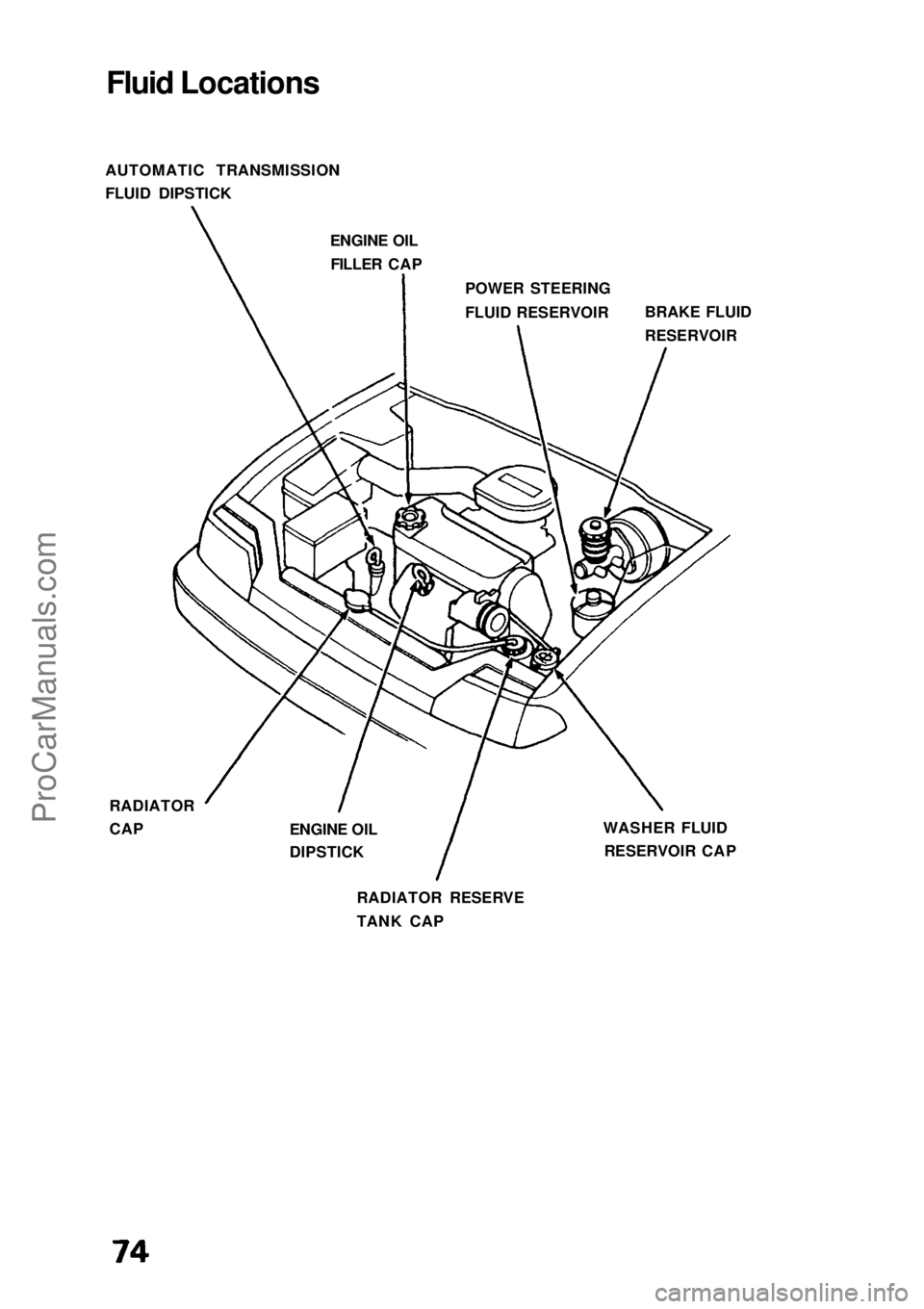
AUTOMATIC TRANSMISSION
FLUID DIPSTICK ENGINE OILFILLER CAP
POWER STEERING
FLUID RESERVOIR
RADIATOR
CAP WASHER FLUID
RESERVOIR CAP
RADIATOR RESERVE
TANK CAP BRAKE FLUID
RESERVOIR
ENGINE OIL
DIPSTICKProCarManuals.comMain Menu s t
Page 83 of 136
Brakes
Brake System Design
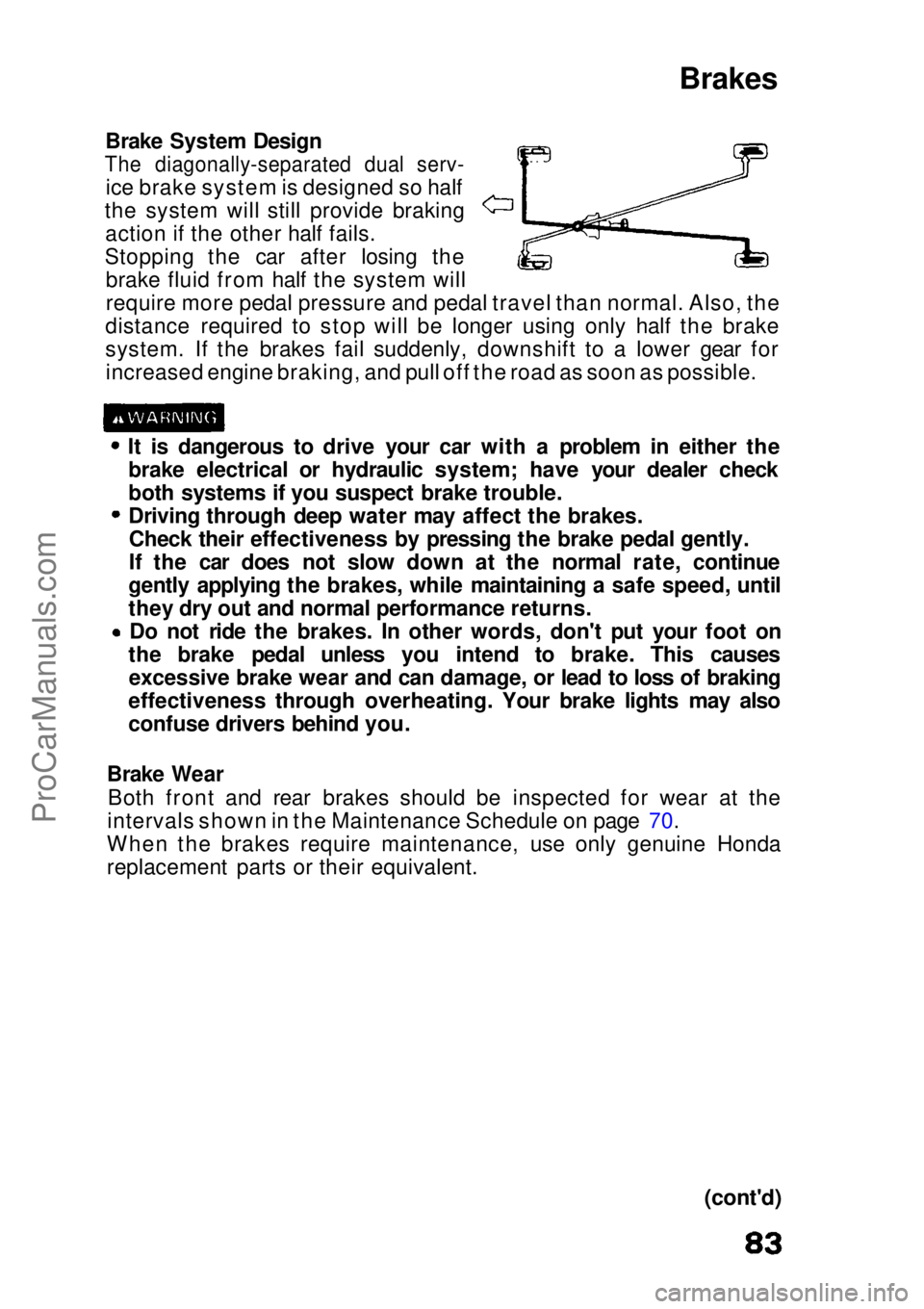
The diagonally-separated dual serv-
ice brake system is designed so half
the system will still provide braking action if the other half fails.
Stopping the car after losing the brake fluid from half the system will
require more pedal pressure and pedal travel than normal. Also, the
distance required to stop will be longer using only half the brake
system. If the brakes fail suddenly, downshift to a lower gear for increased engine braking, and pull off the road as soon as possible.
It is dangerous to drive your car with a problem in either thebrake electrical or hydraulic system; have your dealer check
both systems if you suspect brake trouble.
Driving through deep water may affect the brakes.Check their effectiveness by pressing the brake pedal gently.
If the car does not slow down at the normal rate, continue
gently applying the brakes, while maintaining a safe speed, until
they dry out and normal performance returns. Do not ride the brakes. In other words, don't put your foot on
the brake pedal unless you intend to brake. This causes excessive brake wear and can damage, or lead to loss of braking
effectiveness through overheating. Your brake lights may also
confuse drivers behind you.
Brake Wear Both front and rear brakes should be inspected for wear at the
intervals shown in the Maintenance Schedule on page 70.
When the brakes require maintenance, use only genuine Honda
replacement parts or their equivalent.
(cont'd)ProCarManuals.comMain Menu s t
Page 84 of 136
Brakes (cont'd)
Front Brake Wear Indicators
Your car is equipped with audible front brake wear indicators. When
the brake pads wear to point that they should be replaced, they will make a "screeching" sound when the wheels are rolling and when
the brakes are applied.
NOTE:
Due to some driving habits or climates, brakes may "squeal" when
you first apply them or when you have them partially applied; this is normal, and does not indicate excessive wear. The wear indicator
makes a "screeching" sound while the brakes are applied.
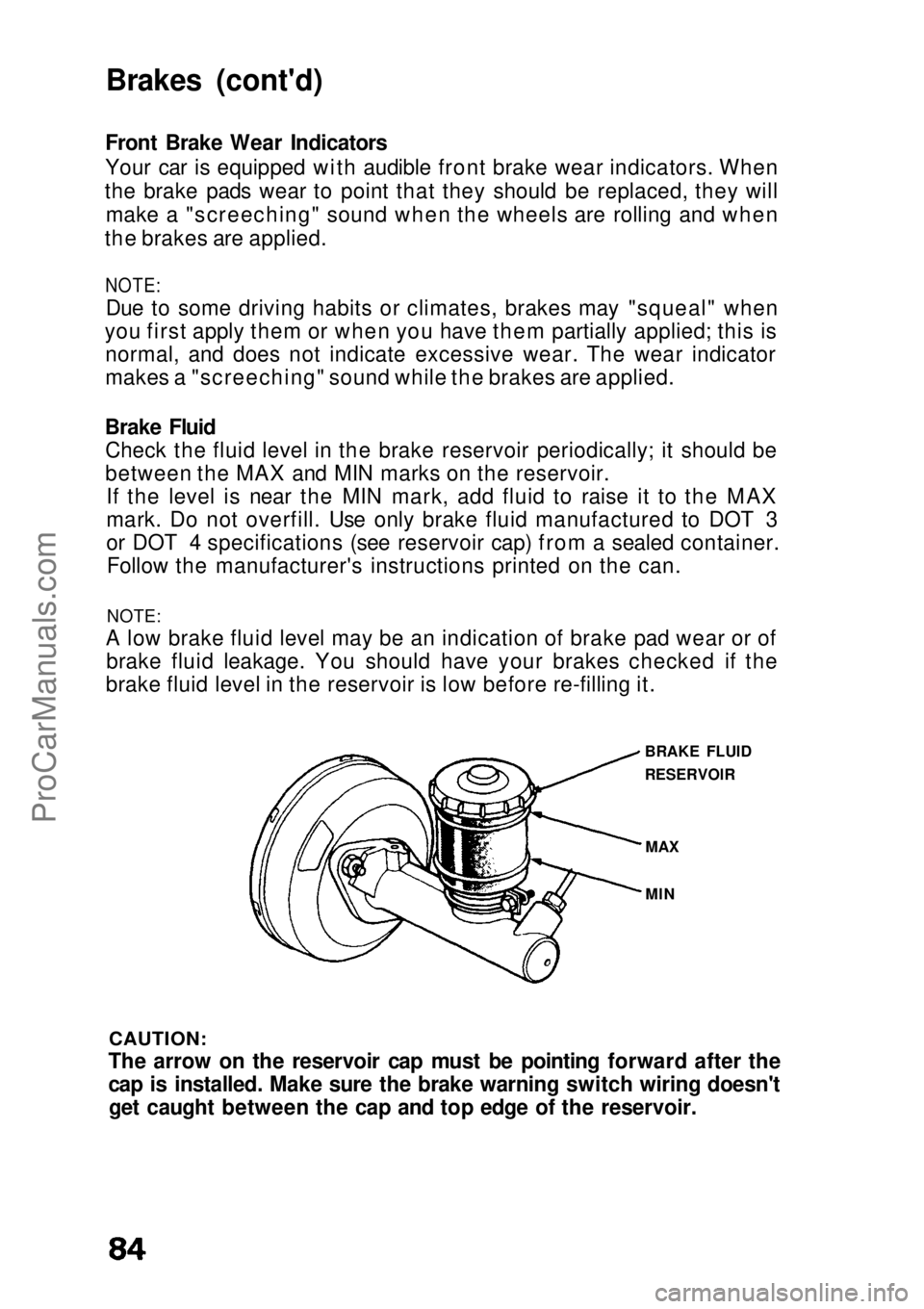
Brake Fluid Check the fluid level in the brake reservoir periodically; it should be
between the MAX and MIN marks on the reservoir. If the level is near the MIN mark, add fluid to raise it to the MAX
mark. Do not overfill. Use only brake fluid manufactured to DOT 3
or DOT 4 specifications (see reservoir cap) from a sealed container.Follow the manufacturer's instructions printed on the can.
NOTE:
A low brake fluid level may be an indication of brake pad wear or of brake fluid leakage. You should have your brakes checked if the
brake fluid level in the reservoir is low before re-filling it.
BRAKE FLUID
RESERVOIR
CAUTION:
The arrow on the reservoir cap must be pointing forward after the
cap is installed. Make sure the brake warning switch wiring doesn't get caught between the cap and top edge of the reservoir. MAX
MINProCarManuals.comMain Menu s t
Page 93 of 136
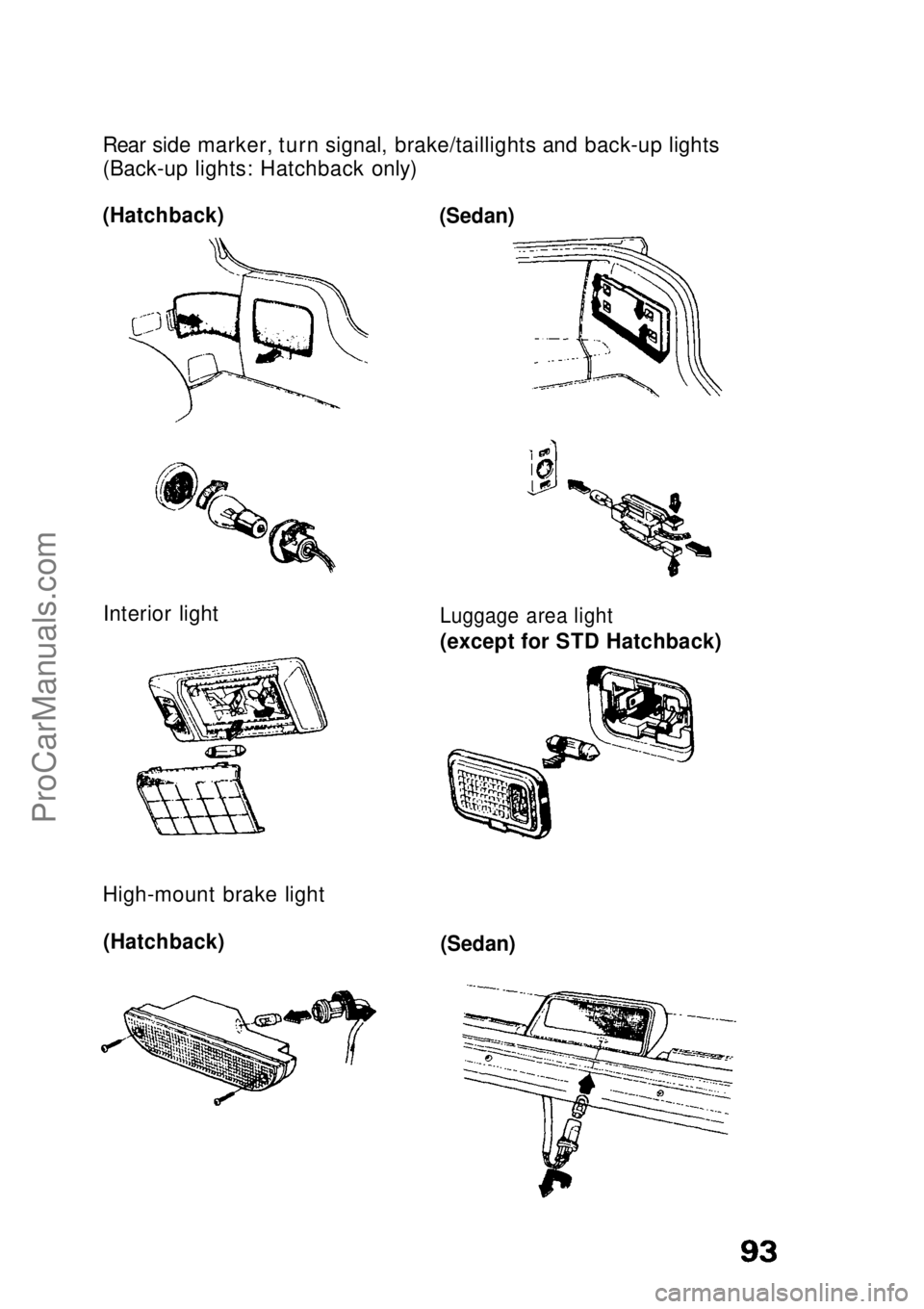
Rear side marker, turn signal, brake/taillights and back-up lights
(Back-up lights: Hatchback only)
(Hatchback)
(Sedan)
Interior light
Luggage area light
(except for STD Hatchback)
(Hatchback)
(Sedan)
High-mount brake lightProCarManuals.comMain Menu s t
Page 96 of 136
Tires (cont'd)
CAUTION:
If the contact continues, slow down until it stops or your car can
be damaged. Chains that are the wrong size or improperly installed can
damage your car's brake lines, suspension, body, and wheels.
If you need further information on tire chains, please see your
Honda dealer.
Remove the chains as soon as the road is clear of ice and snow.
Tire Replacement Honda recommends that you replace tires in sets of four, or in pairs,
front or rear. If you need to replace only one tire, mount the new
tire opposite the tire showing the least amount of wear. For instance, if the left front tire shows the least amount of wear,
mount the new tire on the front right side.
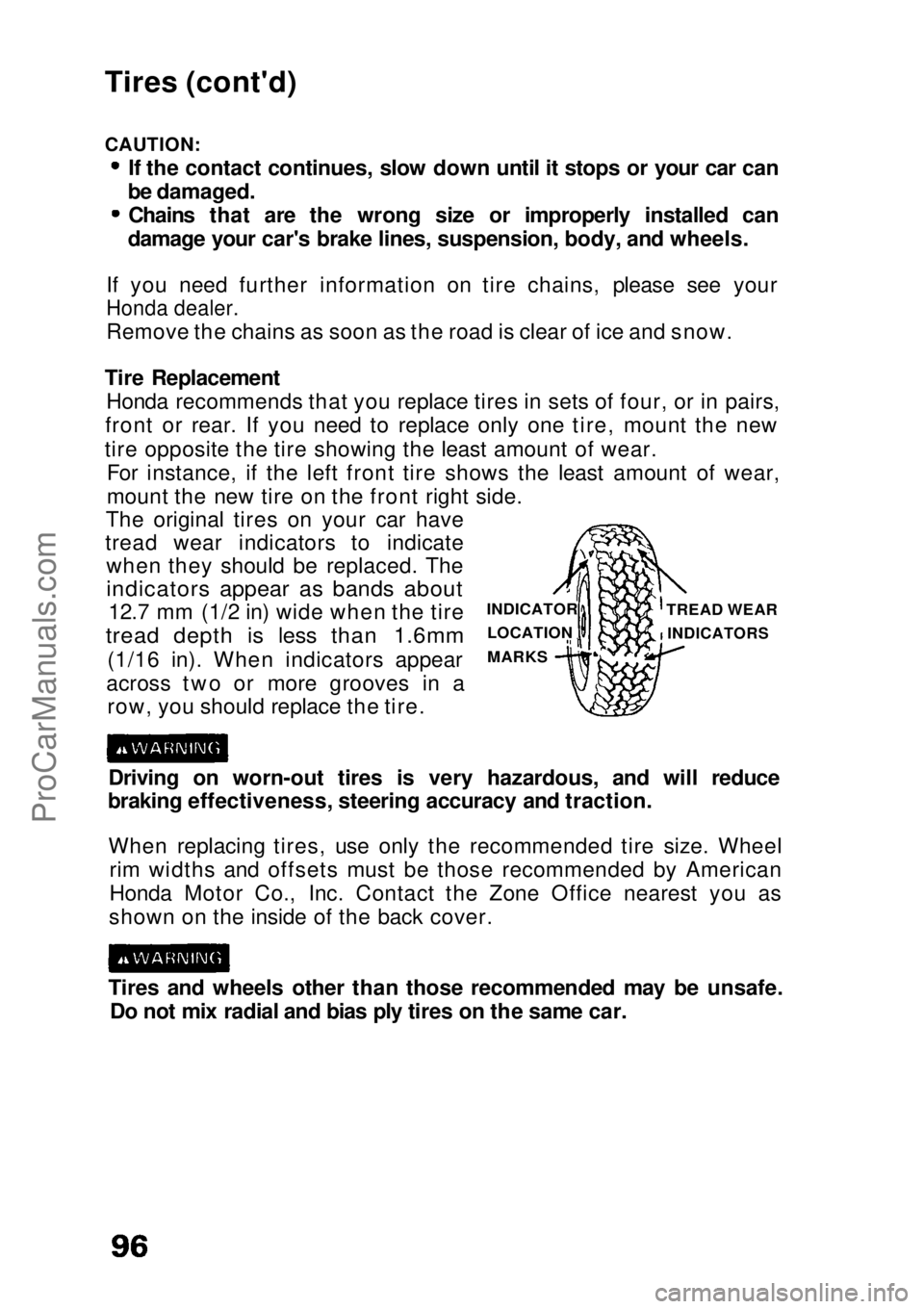
The original tires on your car have
tread wear indicators to indicate when they should be replaced. The
indicators appear as bands about
12.7 mm (1/2 in) wide when the tire
tread depth is less than 1.6mm
(1/16 in). When indicators appear
across two or more grooves in a row, you should replace the tire.
Driving on worn-out tires is very hazardous, and will reduce
braking effectiveness, steering accuracy and traction.
When replacing tires, use only the recommended tire size. Wheel rim widths and offsets must be those recommended by American
Honda Motor Co., Inc. Contact the Zone Office nearest you as
shown on the inside of the back cover.
Tires and wheels other than those recommended may be unsafe. Do not mix radial and bias ply tires on the same car. INDICATOR
LOCATION
MARKS TREAD WEAR
INDICATORSProCarManuals.comMain Menu s t
Page 97 of 136
Tire Balancing
Unbalanced tires may affect handling and tire wear. A tire should
always be rebalanced after it has been dismounted from the wheel.
Your original tires were properly balanced before the car left the
factory, but may need rebalancing at some time during the life of the
tire. Tire balancing for the COMPACT spare is not necessary.
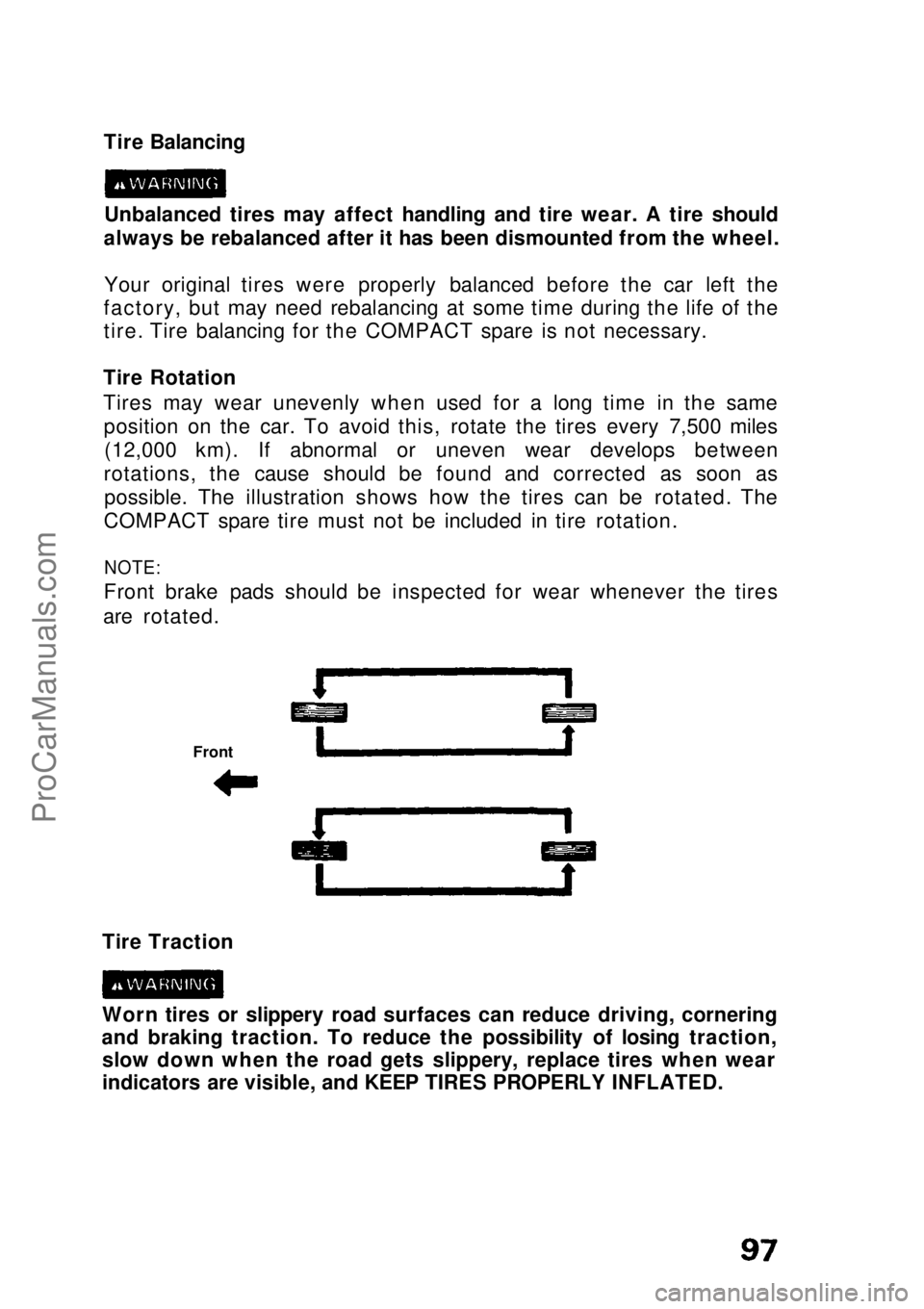
Tire Rotation
Tires may wear unevenly when used for a long time in the same position on the car. To avoid this, rotate the tires every 7,500 miles(12,000 km). If abnormal or uneven wear develops between
rotations, the cause should be found and corrected as soon as possible. The illustration shows how the tires can be rotated. The
COMPACT spare tire must not be included in tire rotation.
NOTE:
Front brake pads should be inspected for wear whenever the tires
are rotated.
Tire Traction
Worn tires or slippery road surfaces can reduce driving, cornering
and braking traction. To reduce the possibility of losing traction, slow down when the road gets slippery, replace tires when wear
indicators are visible, and KEEP TIRES PROPERLY INFLATED. FrontProCarManuals.comMain Menu s t
Page 106 of 136
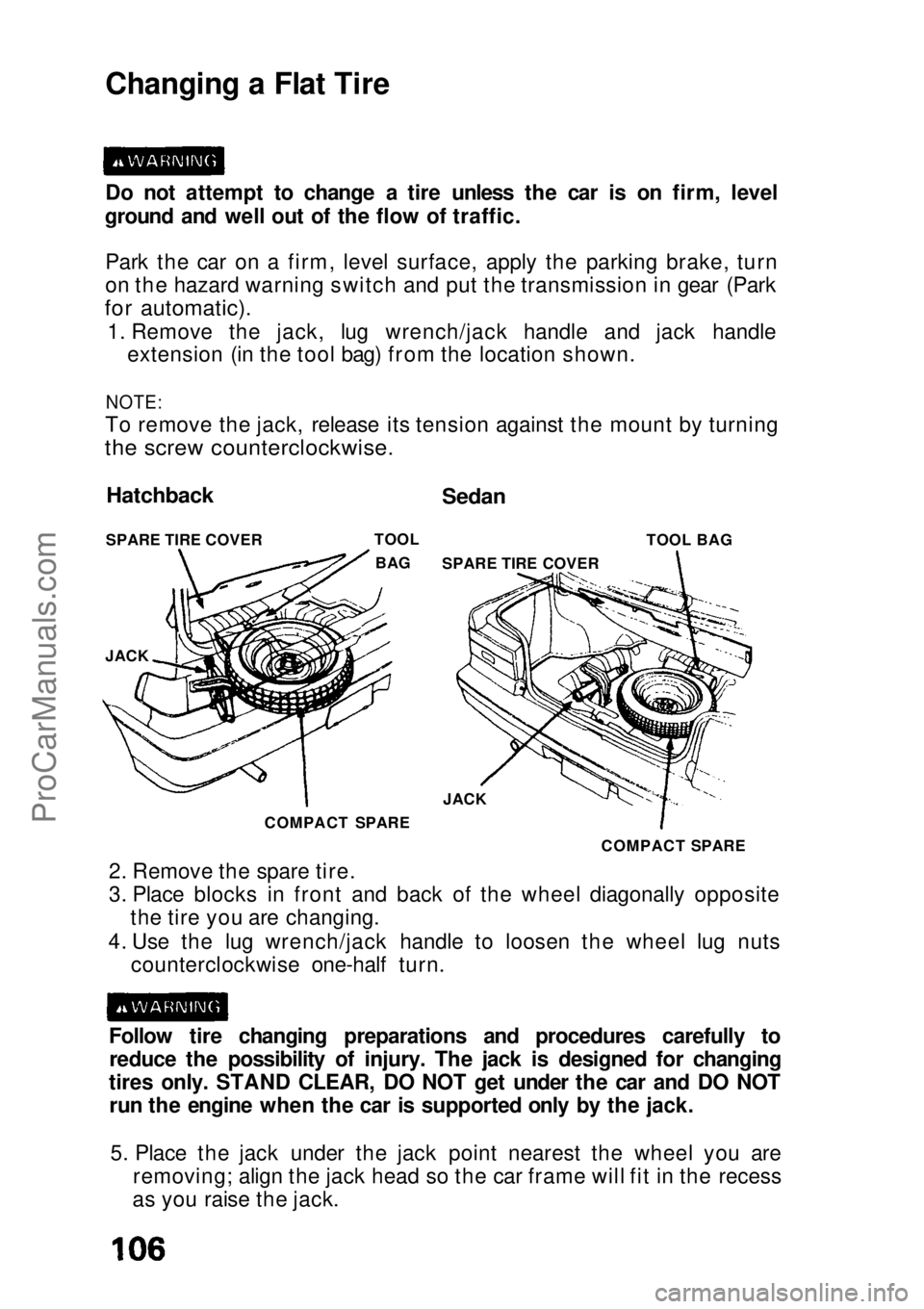
Changing a Flat Tire
Do not attempt to change a tire unless the car is on firm, level
ground and well out of the flow of traffic.
Park the car on a firm, level surface, apply the parking brake, turn
on the hazard warning switch and put the transmission in gear (Park
for automatic).
1. Remove the jack, lug wrench/jack handle and jack handle extension (in the tool bag) from the location shown.
NOTE:
To remove the jack, release its tension against the mount by turning
the screw counterclockwise.
JACK TOOL BAG
Follow tire changing preparations and procedures carefully to reduce the possibility of injury. The jack is designed for changing
tires only. STAND CLEAR, DO NOT get under the car and DO NOT run the engine when the car is supported only by the jack.
5. Place the jack under the jack point nearest the wheel you are removing; align the jack head so the car frame will fit in the recess
as you raise the jack.
Hatchback
SPARE TIRE COVER
Sedan
TOOL BAG SPARE TIRE COVER
JACK
COMPACT SPARE COMPACT SPARE
2. Remove the spare tire.
3. Place blocks in front and back of the wheel diagonally opposite the tire you are changing.
4. Use the lug wrench/jack handle to loosen the wheel lug nuts counterclockwise one-half turn.ProCarManuals.comMain Menu s t