radio HONDA CIVIC COUPE 1999 User Guide
[x] Cancel search | Manufacturer: HONDA, Model Year: 1999, Model line: CIVIC COUPE, Model: HONDA CIVIC COUPE 1999Pages: 269, PDF Size: 2.42 MB
Page 119 of 269
Audio System
Caring for the Cassette Player
The cassette player picks up dirt and oxides from the tape. This contami-
nation builds up over time and
causes the sound quality to degrade.
To prevent this, you should clean the player after every 30 hours of use.
Your dealer has a cleaning kit
available.
If you do not clean the cassette
player regularly, it may eventually
become impossible to remove the contamination with a normal
cleaning kit.
Use 100-minute or shorter cassettes.Cassettes longer than that use
thinner tape that may break or jam
the drive. Look at the cassette before you
insert it. If the tape is loose, tighten
it by turning a hub with a pencil or
your finger. If the label is peeling off, remove it
from the cassette or it could cause the cassette to jam in the player.
Never try to insert a warped ordamaged cassette in the player.
When they are not in use, store cassettes in their cases to protect
them from dust and moisture. Never
place cassettes where they will be exposed to direct sunlight, high heat,
or high humidity. If a cassette is
exposed to extreme heat or cold, letit reach a moderate temperature
before inserting it in the player.
Never try to insert foreign objects
into the cassette player. If you see the error indication (except U.S. EX)/
(U.S.
EX) on the
display, press the EJECT button and
remove the cassette from the unit. Make sure the tape is not damaged.
If the cassette will not eject or the error indication stays on after the
cassette ejects, take the vehicle to
your Honda dealer.
If a problem develops in the connec-
tion between the cassette player and the radio, you will see in
the display. Take the vehicle to your
Honda dealer.
Comfort and Convenience FeaturesMain Menu Table of Contents s t
Page 120 of 269
Audio System
Theft Protection
On U.S. EX and Si models
Your car's audio system will disable itself if it is disconnected fromelectrical power for any reason. To
make it work again, the user must enter a specific five-digit code in the
Preset buttons. Because there are
hundreds of number combinations
possible from five digits, making the system work without knowing the
exact code is nearly impossible.
You should have received a card that lists your audio system's codenumber and serial number. It is best
to store this card in a safe place at
home. In addition, you should write
the audio system's serial number in
this Owner's Manual. If you should
happen to lose the card, you must obtain the code number from your
Honda dealer. To do this, you will
need the system's serial number. If your car's battery is disconnected
or goes dead, the audio system will
disable itself. If this happens, you will see in the frequency
display the next time you turn on the
system. Use the Preset buttons toenter the five-digit code. If it is
entered correctly, the radio will start
playing.
If you make a mistake entering the
code, do not start over or try to
correct your mistake. Complete the
five-digit sequence, then enter the correct code. You have ten tries toenter the correct code. If you are
unsuccessful in ten attempts, you
must then leave the system on for one hour before trying again. You will have to store your favorite
stations in the Preset buttons after
the system begins working. Your
original settings were lost when
power was disconnected.
Comfort and Convenience FeaturesMain Menu Table of Contents s t
Page 121 of 269
Audio System
Radio Frequencies
Your Honda's radio can receive the complete AM and FM bands.
Those bands cover these frequen-
cies:
AM band: 530 to 1,710 kilohertz
FM band:
87.7 to 107.9 megahertz
Radio stations on the AM band are
assigned frequencies at least ten
kilohertz apart (530, 540, 550). Stations on the FM band are
assigned frequencies at least 0.2
megahertz apart (87.9, 88.1, 88.3).
Stations must use these exact
frequencies. It is fairly common for stations to round-off the frequency in
their advertising, so your radio could display a frequency of 100.9 even
though the announcer may identify
the station as "FM101." Radio Reception
How well your Honda's radio
receives stations is dependent on
many factors, such as the distance
from the station's transmitter, nearby large objects, and atmos-
pheric conditions.
A radio station's signal gets weaker as you get farther away from its
transmitter. If you are listening to an
AM station, you will notice the sound
volume becoming weaker, and the station drifting in and out. If you are
listening to an FM station, you will see the stereo indicator flickering off
and on as the signal weakens.
Eventually, the stereo indicator will
go off and the sound will fade
completely as you get out of range of
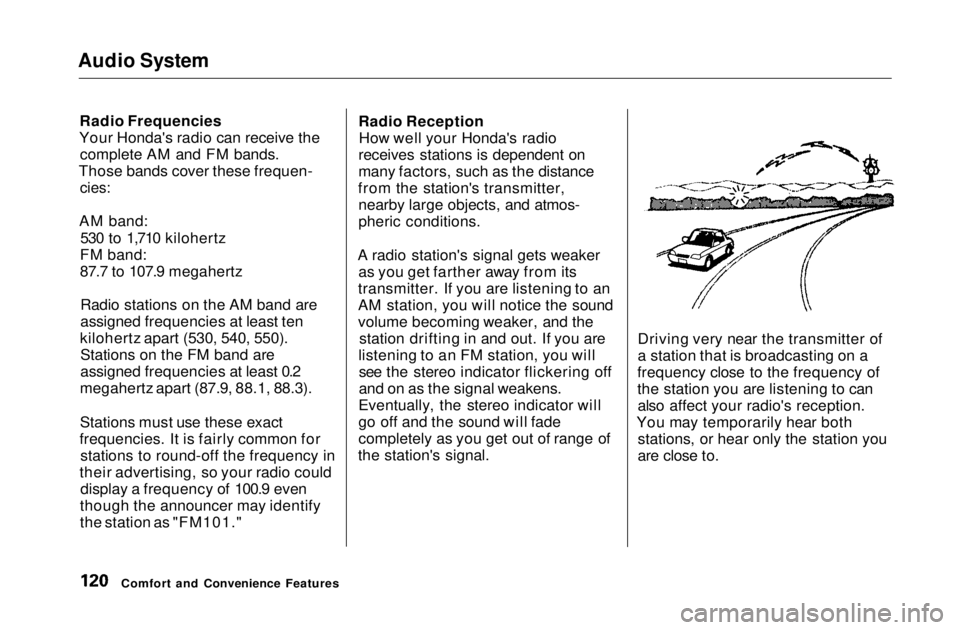
the station's signal. Driving very near the transmitter of
a station that is broadcasting on a
frequency close to the frequency of
the station you are listening to can also affect your radio's reception.
You may temporarily hear both stations, or hear only the station you
are close to.
Comfort and Convenience FeaturesMain Menu Table of Contents s t
Page 122 of 269
Audio System
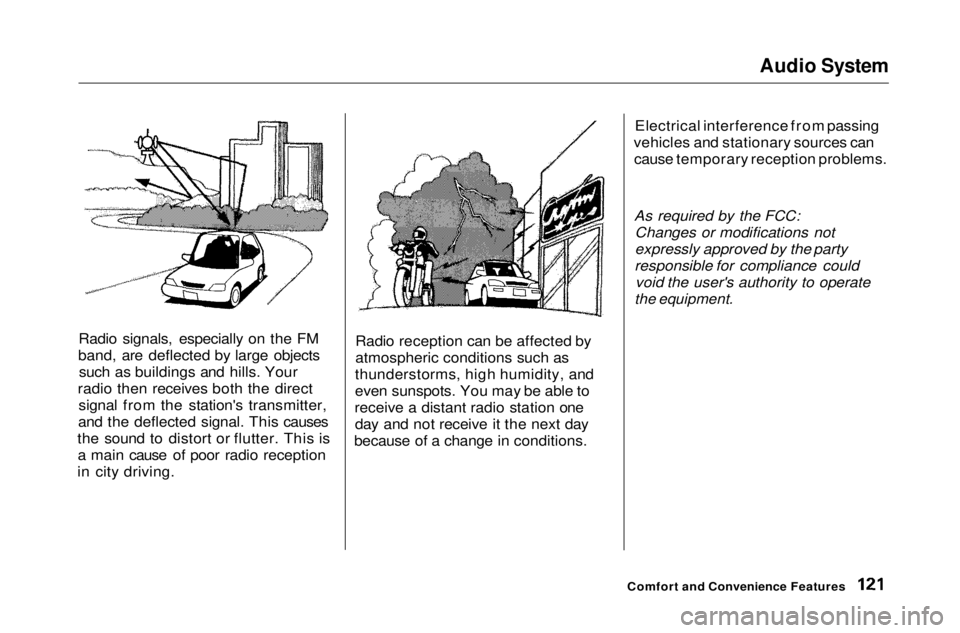
Radio signals, especially on the FM
band, are deflected by large objects such as buildings and hills. Your
radio then receives both the direct signal from the station's transmitter,
and the deflected signal. This causes
the sound to distort or flutter. This is a main cause of poor radio reception
in city driving. Radio reception can be affected by
atmospheric conditions such as
thunderstorms, high humidity, and
even sunspots. You may be able to
receive a distant radio station one day and not receive it the next day
because of a change in conditions. Electrical interference from passing
vehicles and stationary sources can cause temporary reception problems.
As required by the FCC: Changes or modifications not
expressly approved by the party
responsible for compliance could void the user's authority to operate
the equipment.
Comfort and Convenience FeaturesMain Menu Table of Contents s t
Page 130 of 269
Accessories and Modifications
Modifying your car, or installingsome non-Honda accessories, can
make your car unsafe. Before you make any modifications or add anyaccessories, be sure to read the
following information.
Accessories
Your dealer has Genuine Honda accessories that allow you to
personalize your car. These accessories have been designed and
approved for your car, and are
covered by warranty.
Non-Honda accessories are usually designed for universal applications.
Although aftermarket accessories may fit on your car, they may not
meet factory specifications, and
could adversely affect your car's
handling and stability. (See "Modifications" on the page 131 for
additional information.) When properly installed, cellular
phones, alarms, two-way radios, and
low-powered audio systems shouldnot interfere with your car's
computer-controlled systems, such as the SRS and anti-lock brake
system.
However, if electronic accessories
are improperly installed, or exceed
your car's electrical system capacity, they can interfere with the operation of your car, or even cause the
airbags to deploy.
Before installing any accessory:
Make sure the accessory does notobscure any lights, or interfere
with proper car operation or
performance.
Be sure electronic accessories do
not overload electrical circuits (see page 239). Have the installer contact your
Honda dealer for assistance before
installing any electronic accessory.
If possible, have your dealer inspect
the final installation.
Before Driving
Improper accessories or
modifications can affect your
car's handling, stability and performance, and cause a
crash in which you can be hurt
or killed.
Follow all instructions in this
owner's manual regarding accessories and modifications.Main Menu Table of Contents s t
Page 231 of 269
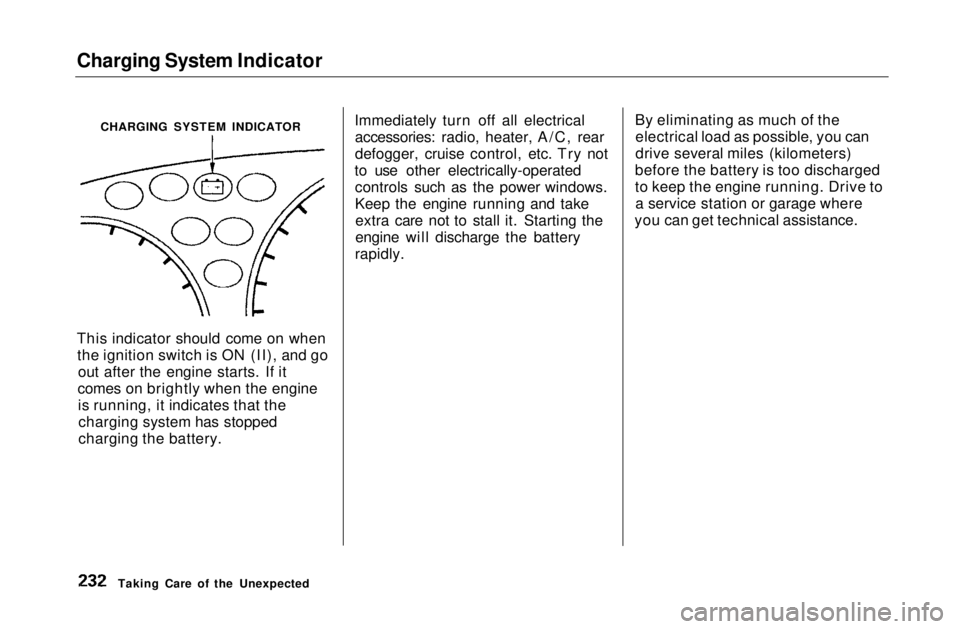
Charging System Indicator
This indicator should come on when
the ignition switch is ON (II), and go out after the engine starts. If it
comes on brightly when the engine is running, it indicates that thecharging system has stopped
charging the battery. Immediately turn off all electrical
accessories: radio, heater, A/C, rear
defogger, cruise control, etc. Try not
to use other electrically-operated controls such as the power windows.
Keep the engine running and takeextra care not to stall it. Starting the
engine will discharge the battery
rapidly. By eliminating as much of the
electrical load as possible, you can
drive several miles (kilometers)
before the battery is too discharged
to keep the engine running. Drive to a service station or garage where
you can get technical assistance.
Taking Care of the Unexpected
CHARGING SYSTEM INDICATORMain Menu Table of Contents s t
Page 237 of 269
Fuses
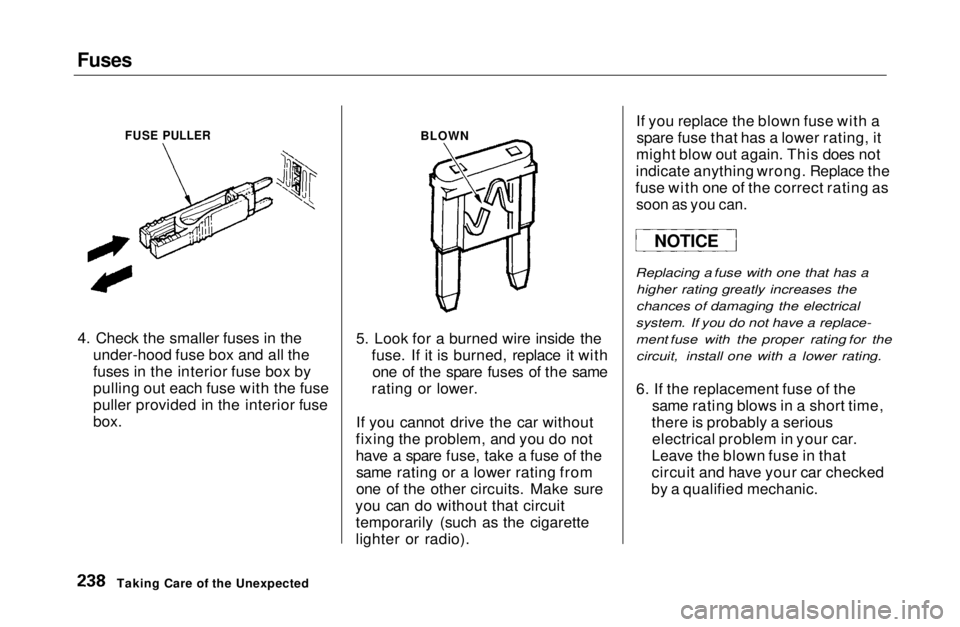
4. Check the smaller fuses in the under-hood fuse box and all the
fuses in the interior fuse box by
pulling out each fuse with the fuse
puller provided in the interior fuse
box. 5. Look for a burned wire inside the
fuse. If it is burned, replace it withone of the spare fuses of the same
rating or lower.
If you cannot drive the car without
fixing the problem, and you do not
have a spare fuse, take a fuse of the same rating or a lower rating from
one of the other circuits. Make sure
you can do without that circuit temporarily (such as the cigarette
lighter or radio). If you replace the blown fuse with a
spare fuse that has a lower rating, it
might blow out again. This does not
indicate anything wrong. Replace the
fuse with one of the correct rating as
soon as you can.
Replacing a fuse with one that has a higher rating greatly increases the
chances of damaging the electrical
system. If you do not have a replace-
ment fuse with the proper rating for the circuit, install one with a lower rating.
6. If the replacement fuse of the same rating blows in a short time,
there is probably a serious electrical problem in your car.
Leave the blown fuse in that
circuit and have your car checked
by a qualified mechanic.
Taking Care of the Unexpected
FUSE PULLER
NOTICE
BLOWNMain Menu Table of Contents s t
Page 240 of 269
Emergency Towing
If your vehicle needs to be towed,
call a professional towing service or, if you belong to one, an
organization that provides roadside
assistance. Never tow your vehicle
behind another vehicle with just a rope or chain. It is very dangerous.
There are three popular types of
professional towing equipment.
Flat-bed Equipment — The operator loads your vehicle on the back of a
truck. This is the best way to
transport your Honda.
Wheel-Lift Equipment — The tow
truck uses two pivoting arms that
go under the tires (front or rear) and
lift them off the ground. The other
two tires remain on the ground. This is an acceptable way to tow
your Honda.
Sling-type Equipment — The tow truck uses metal cables with hooks on the ends. These hooks go around
parts of the frame or suspension and
the cables lift that end of the vehicle
off the ground. Your vehicle's suspension and body can beseriously damaged. This method of
towing is unacceptable.
If your Honda cannot be transported
by flat-bed, it should be towed by
wheel-lift equipment with the front
wheels off the ground. If due to
damage, your vehicle must be towed with the front wheels on the ground,
do the following.
5-speed Manual Transmission Release the parking brake.
Shift the transmission to Neutral.
Automatic Transmission Release the parking brake.
Start the engine.
Shift to D4, then to N.
Turn off the engine. Improper towing preparation will
damage the transmission. Followthe above procedure exactly. If youcannot shift the transmission or
start the engine (automatictransmission), your vehicle must be
transported with the front wheels
off the ground.
With the front wheels on the ground, it is best to tow the vehicleno farther than 50 miles (80 km),
and keep the speed below 35 mph
(55 km/h).
If you decide to tow your vehicle
with all four wheels on the ground,
make sure you use a properly-
designed and attached tow bar. Prepare the vehicle for towing as
described above, and leave theignition switch in Accessory (I) so
the steering wheel does not lock.
Make sure the radio and any items
Taking Care of the Unexpected
NOTICEMain Menu Table of Contents s t
Page 263 of 269
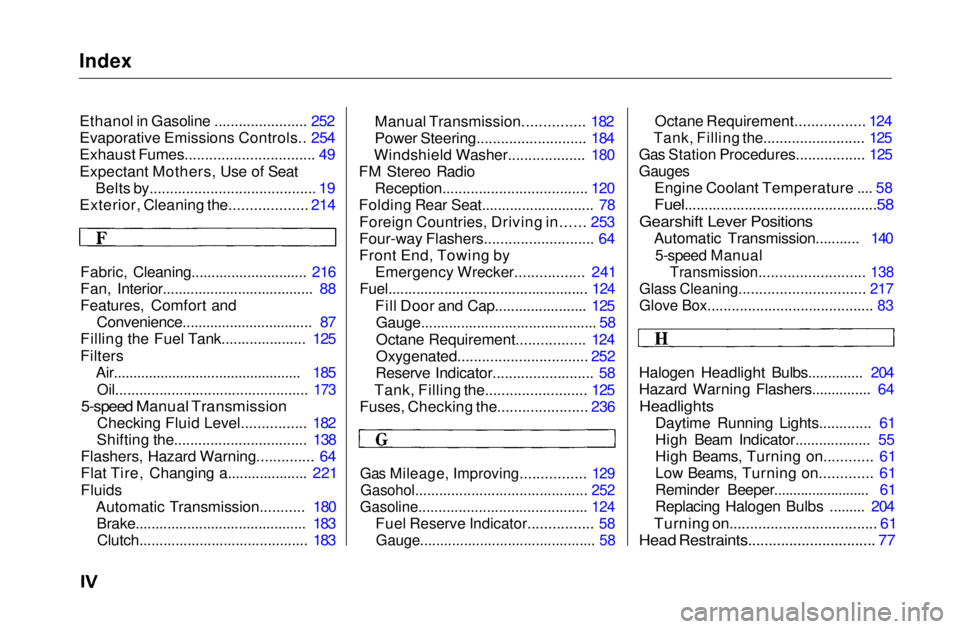
Index
Ethanol in Gasoline ....................... 252
Evaporative Emissions Controls.. 254
Exhaust Fumes................................ 49
Expectant Mothers, Use of Seat Belts by......................................... 19
Exterior, Cleaning the................... 214
Fabric, Cleaning............................. 216
Fan, Interior...................................... 88
Features, Comfort and Convenience................................. 87
Filling the Fuel Tank..................... 125
Filters Air................................................ 185
Oil................................................ 173
5-speed Manual Transmission
Checking Fluid Level................ 182
Shifting the................................. 138
Flashers, Hazard Warning.............. 64
Flat Tire, Changing a.................... 221
Fluids Automatic Transmission........... 180Brake........................................... 183Clutch.......................................... 183 Manual Transmission............... 182
Power Steering........................... 184
Windshield Washer................... 180
FM Stereo Radio Reception.................................... 120
Folding Rear Seat............................ 78
Foreign Countries, Driving in...... 253
Four-way Flashers........................... 64
Front End, Towing by Emergency Wrecker................. 241
Fuel.................................................. 124
Fill Door and Cap....................... 125Gauge............................................ 58
Octane Requirement................. 124
Oxygenated................................ 252
Reserve Indicator......................... 58
Tank, Filling the......................... 125
Fuses, Checking the...................... 236
Gas Mileage, Improving................ 129
Gasohol........................................... 252
Gasoline.......................................... 124
Fuel Reserve Indicator................ 58
Gauge............................................ 58
Octane Requirement................. 124
Tank, Filling the......................... 125
Gas Station Procedures................. 125
Gauges
Engine Coolant Temperature .... 58
Fuel................................................58
Gearshift Lever Positions
Automatic Transmission........... 140
5-speed Manual
Transmission.......................... 138
Glass Cleaning............................... 217
Glove Box......................................... 83
Halogen Headlight Bulbs.............. 204
Hazard Warning Flashers............... 64
Headlights
Daytime Running Lights............. 61
High Beam Indicator................... 55
High Beams, Turning on............ 61
Low Beams, Turning on............. 61
Reminder Beeper......................... 61
Replacing Halogen Bulbs ......... 204
Turning on.................................... 61
Head Restraints............................... 77Main Menu s t
Page 265 of 269
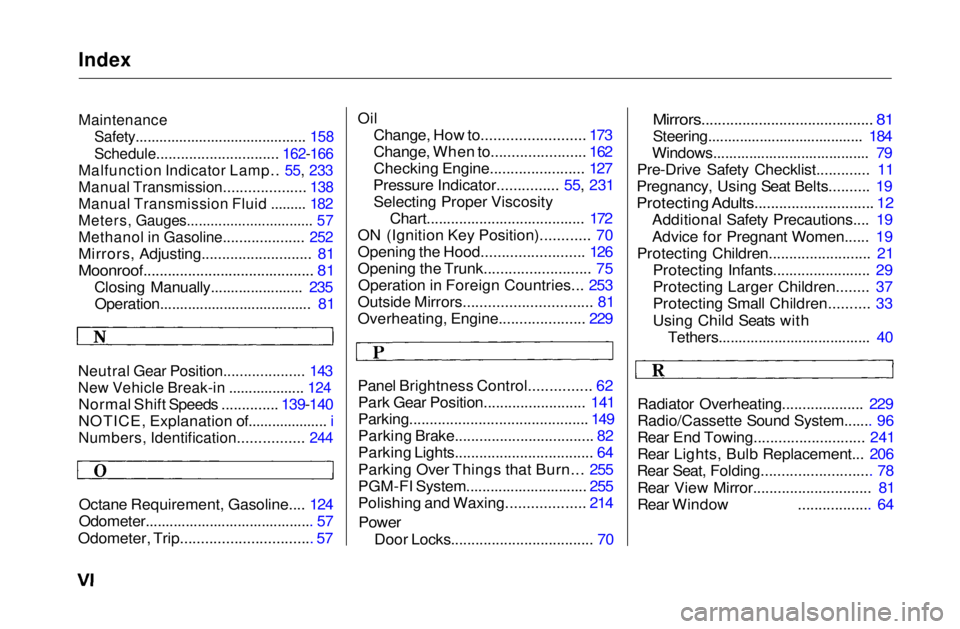
Index
Maintenance
Safety........................................... 158
Schedule.............................. 162-166
Malfunction Indicator Lamp.. 55, 233
Manual Transmission.................... 138
Manual Transmission Fluid ......... 182
Meters, Gauges................................ 57
Methanol in Gasoline.................... 252
Mirrors, Adjusting........................... 81
Moonroof.......................................... 81
Closing Manually....................... 235Operation...................................... 81
Neutral Gear Position.................... 143
New Vehicle Break-in ................... 124
Normal Shift Speeds .............. 139-140
NOTICE, Explanation of.................... i
Numbers, Identification................ 244
Octane Requirement, Gasoline.... 124
Odometer.......................................... 57
Odometer, Trip................................ 57
Oil
Change, How to......................... 173
Change, When to....................... 162
Checking Engine....................... 127
Pressure Indicator............... 55, 231 Selecting Proper Viscosity Chart....................................... 172
ON (Ignition Key Position)............ 70
Opening the Hood......................... 126
Opening the Trunk.......................... 75 Operation in Foreign Countries... 253
Outside Mirrors............................... 81
Overheating, Engine..................... 229
Panel Brightness Control............... 62 Park Gear Position......................... 141
Parking............................................ 149
Parking Brake.................................. 82
Parking Lights.................................. 64
Parking Over Things that Burn... 255
PGM-FI System.............................. 255
Polishing and Waxing................... 214
Power
Door Locks................................... 70
Mirrors.......................................... 81
Steering....................................... 184
Windows....................................... 79
Pre-Drive Safety Checklist............. 11
Pregnancy, Using Seat Belts.......... 19
Protecting Adults............................. 12
Additional Safety Precautions.... 19
Advice for Pregnant Women...... 19
Protecting Children......................... 21 Protecting Infants........................ 29
Protecting Larger Children........ 37
Protecting Small Children.......... 33
Using Child Seats withTethers...................................... 40
Radiator Overheating.................... 229
Radio/Cassette Sound System....... 96
Rear End Towing........................... 241
Rear Lights, Bulb Replacement... 206
Rear Seat, Folding........................... 78
Rear View Mirror............................. 81
Rear Window .................. 64Main Menu s t