light HONDA CR-Z 2013 1.G Manual PDF
[x] Cancel search | Manufacturer: HONDA, Model Year: 2013, Model line: CR-Z, Model: HONDA CR-Z 2013 1.GPages: 325, PDF Size: 11.73 MB
Page 287 of 325
286
Handling the Unexpected
Engine Does Not Start
Checking the Engine
If the engine does not start, turn the ignition switch to START
(e and check the
starter.
Starter conditionChecklist
Starter doesn’t turn or turns over slowly.
The 12 volt battery may be dead.
Check each of the items on the
right and respond accordingly.Check brightness of the interior light.
Turn on interior lights and check brightness. ● If the interior lights are dim or do not come on at all
2Checking the 12 Volt Battery P. 262
● If the interior lights come on normally 2
Inspecting and Changing Fuses P. 300
The starter turns over normally
but the engine doesn’t start.
There may be a problem with the
fuse. Check each of the items on
the right and respond accordingly.Review the engine start procedure.
Follow its instructions, and try to start the engine again. 2Starting the Engine P. 178
Check the immobilizer system indicator.
When the immobilizer system indicator is blinking, the engine cannot be started.
2Immobilizer System P. 106
Check the fuel level. There should be enough fuel in the tank. 2Fuel Gauge P. 81
Check the fuse.
Check all fuses, or have the vehicle checked by a dealer.
2Inspecting and Changing Fuses P. 300
If the problem continues:
2 Emergency Towing P. 301
1Checking the Engine
If you must start the vehicle immediately, use an assisting vehicle to jump start it.
2 Jump Starting P. 287
Main MenuTable of Contents
Page 288 of 325
287
Continued
Handling the Unexpected
Jump Starting
Turn off the power to electric devices, such as audio and lights. Turn off the engine,
then open the hood.
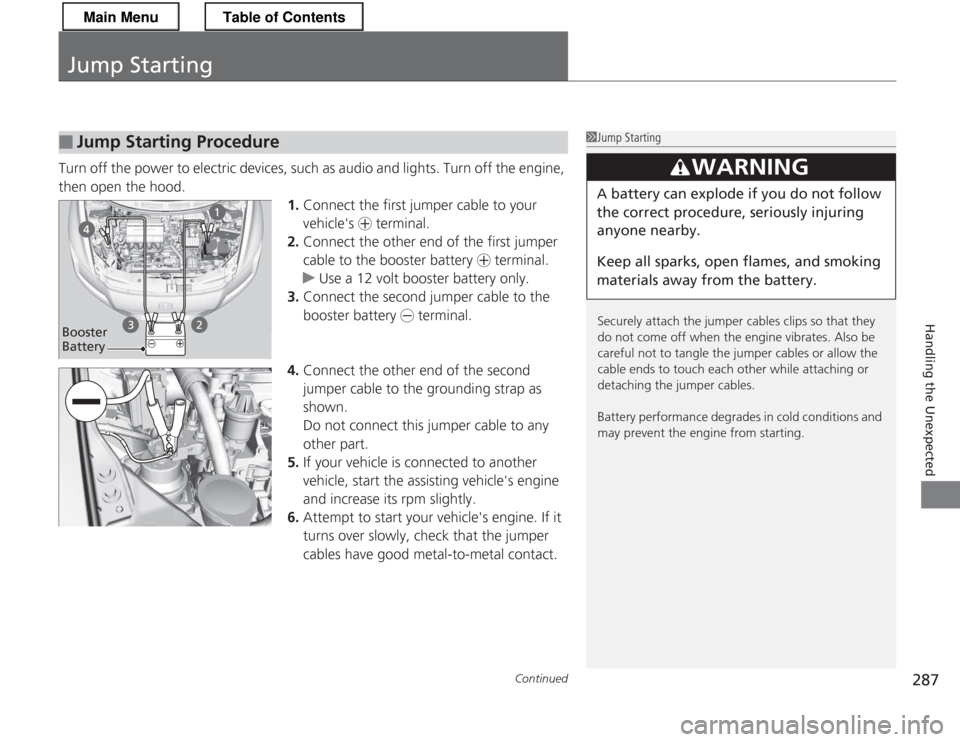
1.Connect the first jumper cable to your
vehicle's + terminal.
2. Connect the other end of the first jumper
cable to the booster battery + terminal.
uUse a 12 volt booster battery only.
3. Connect the second jumper cable to the booster battery - terminal.
4. Connect the other end of the second
jumper cable to the grounding strap as
shown.
Do not connect this jumper cable to any other part.
5. If your vehicle is co nnected to another
vehicle, start the assisting vehicle's engine
and increase its rpm slightly.
6. Attempt to start your vehicle's engine. If it
turns over slowly, check that the jumper cables have good metal-to-metal contact.
■Jump Starting Procedure1Jump Starting
Securely attach the jumper cables clips so that they
do not come off when the engine vibrates. Also be
careful not to tangle the jumper cables or allow the
cable ends to touch each other while attaching or
detaching the jumper cables.
Battery performance degrades in cold conditions and
may prevent the engine from starting.
3WARNING
A battery can explode if you do not follow the correct procedure, seriously injuring anyone nearby.
Keep all sparks, open flames, and smoking
materials away from the battery.
Booster
Battery
Main MenuTable of Contents
Page 291 of 325
290
Handling the Unexpected
Overheating
How to Handle Overheating
Overheating symptoms are as follows: •The high temperature indicator comes on or the engine suddenly loses power.
• Steam or spray comes out of the engine compartment.
■ First thing to do
1. Immediately park the vehicle in a safe place.
2. Turn off all accessories and turn on the hazard warning lights.
uNo steam or spray present: Keep the engine running and open the hood.
uSteam or spray is present: Turn off the engine and wait until it subsides.
Then open the hood.
1How to Handle Overheating
NOTICE
Continuing to drive with the high temperature
indicator on may damage the engine.
3WARNING
Steam and spray from an overheated
engine can seriously scald you.
Do not open the ho od if steam is coming
out.
Main MenuTable of Contents
Page 293 of 325
292
Handling the Unexpected
Indicator, Coming On/Blinking
If the Low Oil Pressure Indicator Comes On■Reasons for the indicator to come on
Comes on when the engine oil pressure is low. ■ What to do as soon as the indicator comes on
1. Immediately park the vehicle on level ground in a safe place.
2. If necessary, turn the hazard warning lights on.
■ What to do after parking the vehicle
1. Stop the engine and let it sit for about three minutes.
2. Open the hood and check the oil level.
uAdd oil as necessary.
2 Oil Check P. 232
3. Start the engine and check the low oil pressure indicator.
uThe light goes out: Start driving again.
uThe light does not go out within 10 seconds: Stop the engine and
contact a dealer for repairs immediately.
1If the Low Oil Pressure Indicator Comes On
NOTICE
Running the engine with low oil pressure can cause
serious mechanical damage almost immediately.
Main MenuTable of Contents
Page 296 of 325
295
uuIndicator, Coming On/BlinkinguIf the Brake System Indicator (Red) Comes On
Handling the Unexpected
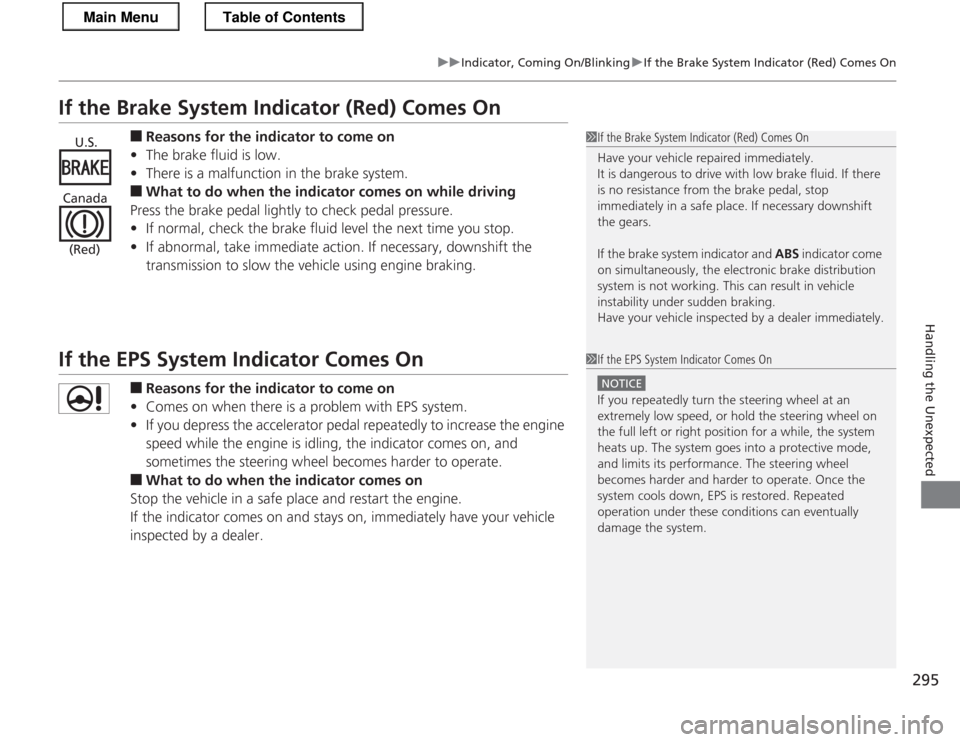
If the Brake System Indicator (Red) Comes On■Reasons for the indicator to come on
• The brake fluid is low.
• There is a malfunction in the brake system.
■ What to do when the indicator comes on while driving
Press the brake pedal lightly to check pedal pressure. • If normal, check the brake fluid level the next time you stop.
• If abnormal, take immediate action. If necessary, downshift the
transmission to slow the vehic le using engine braking.
If the EPS System Indicator Comes On
■Reasons for the indicator to come on
• Comes on when there is a problem with EPS system.
• If you depress the accelerator pedal repeatedly to increase the engine
speed while the engine is idling, the indicator comes on, and
sometimes the steering wheel becomes harder to operate.
■ What to do when the indicator comes on
Stop the vehicle in a safe place and restart the engine.
If the indicator comes on and stays on, immediately have your vehicle
inspected by a dealer.
1If the Brake System Indicator (Red) Comes On
Have your vehicle repaired immediately.
It is dangerous to drive with low brake fluid. If there
is no resistance from the brake pedal, stop immediately in a safe place. If necessary downshift
the gears.
If the brake system indicator and ABS indicator come
on simultaneously, the electronic brake distribution
system is not working. This can result in vehicle
instability under sudden braking.
Have your vehicle inspected by a dealer immediately.U.S.
Canada (Red)
1If the EPS System Indicator Comes On
NOTICE
If you repeatedly turn the steering wheel at an
extremely low speed, or hold the steering wheel on
the full left or right position for a while, the system
heats up. The system goes into a protective mode,
and limits its performance. The steering wheel
becomes harder and harder to operate. Once the
system cools down, EPS is restored. Repeated operation under these conditions can eventually damage the system.
Main MenuTable of Contents
Page 299 of 325
298
uuFusesuFuse Locations
Handling the Unexpected
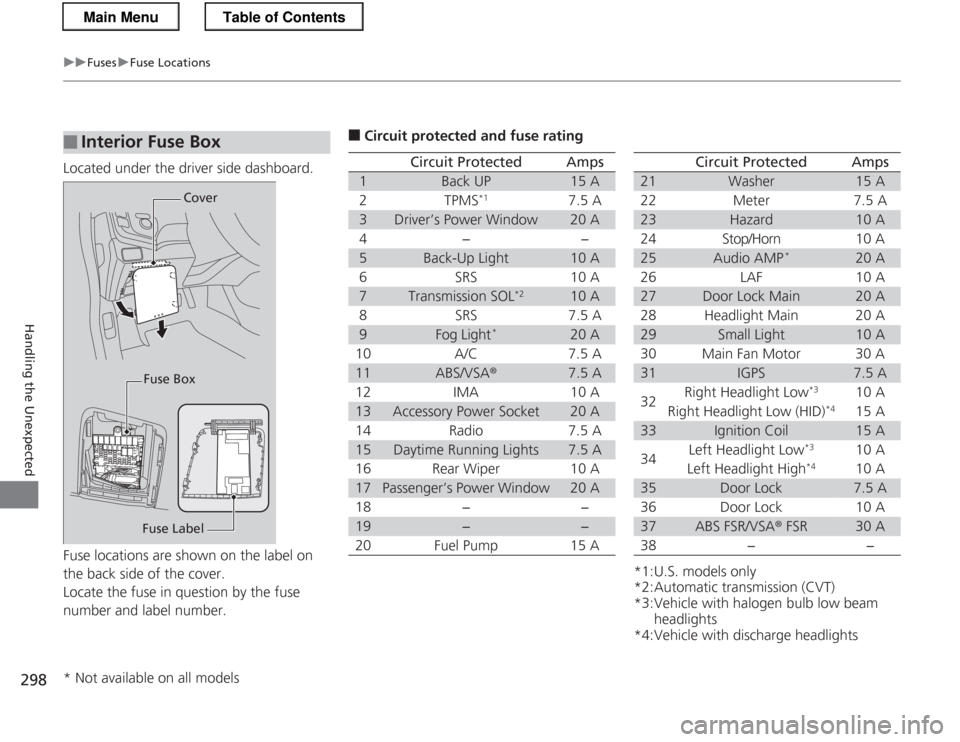
Located under the driver side dashboard.
Fuse locations are shown on the label on
the back side of the cover.
Locate the fuse in question by the fuse
number and label number.
■Interior Fuse Box
Fuse LabelCover
Fuse Box
■ Circuit protected and fuse rating
Circuit ProtectedAmps
1Back UP15 A
2TPMS *17.5 A
3Driver’s Power Window20 A
4−−
5Back-Up Light10 A
6SRS10 A
7Transmission SOL *210 A
8SRS7.5 A
9Fog Light*20 A
10 A/C 7.5 A
11ABS/VSA ®7.5 A
12 IMA 10 A
13Accessory Power Socket20 A
14 Radio 7.5 A
15Daytime Running Lights7.5 A
16 Rear Wiper 10 A
17Passenger’s Power Window20 A
18 − −
19−−
20 Fuel Pump 15 A
*1:U.S. models only
*2:Automatic transmission (CVT)
*3:Vehicle with halogen bulb low beam headlights
*4:Vehicle with discharge headlights
Circuit ProtectedAmps
21Washer15 A
22 Meter 7.5 A
23Hazard10 A
24 Stop/Horn 10 A
25Audio AMP *20 A
26 LAF 10 A
27Door Lock Main20 A
28 Headlight Main 20 A
29Small Light10 A
30 Main Fan Motor 30 A
31IGPS7.5 A
32 Right Headlight Low
*3
10 A
Right Headlight Low (HID) *4
15 A
33Ignition Coil15 A
34 Left Headlight Low
*3
10 A
Left Headlight High *4
10 A
35Door Lock7.5 A
36 Door Lock 10 A
37ABS FSR/VSA ® FSR30 A
38 − −
* Not available on all models
Main MenuTable of Contents
Page 300 of 325
299
uuFusesuFuse Locations
Handling the Unexpected
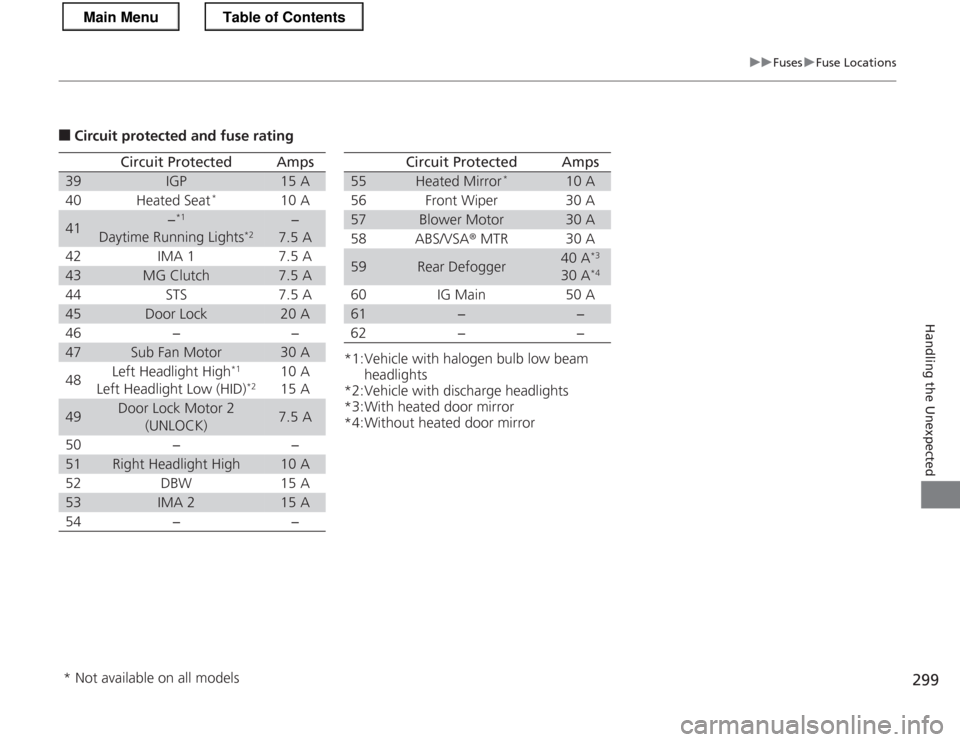
■Circuit protec ted and fuse rating
Circuit ProtectedAmps
39IGP15 A
40 Heated Seat *
10 A
41−*1
Daytime Running Lights *2−
7.5 A
42 IMA 1 7.5 A
43MG Clutch7.5 A
44 STS 7.5 A
45Door Lock20 A
46 − −
47Sub Fan Motor30 A
48 Left Headlight High
*1
Left Headlight Low (HID) *210 A 15 A
49Door Lock Motor 2
(UNLOCK)7.5 A
50 − −
51Right Headlight High10 A
52 DBW 15 A
53IMA 215 A
54 − −
*1:Vehicle with halogen bulb low beam headlights
*2:Vehicle with discharge headlights
*3:With heated door mirror
*4:Without heated door mirror
Circuit ProtectedAmps
55Heated Mirror *10 A
56 Front Wiper 30 A
57Blower Motor30 A
58 ABS/VSA ® MTR 30 A
59Rear Defogger40 A *3
30 A *4
60 IG Main 50 A
61−−
62 − −
* Not available on all models
Main MenuTable of Contents
Page 301 of 325
300
uuFusesuInspecting and Changing Fuses
Handling the Unexpected
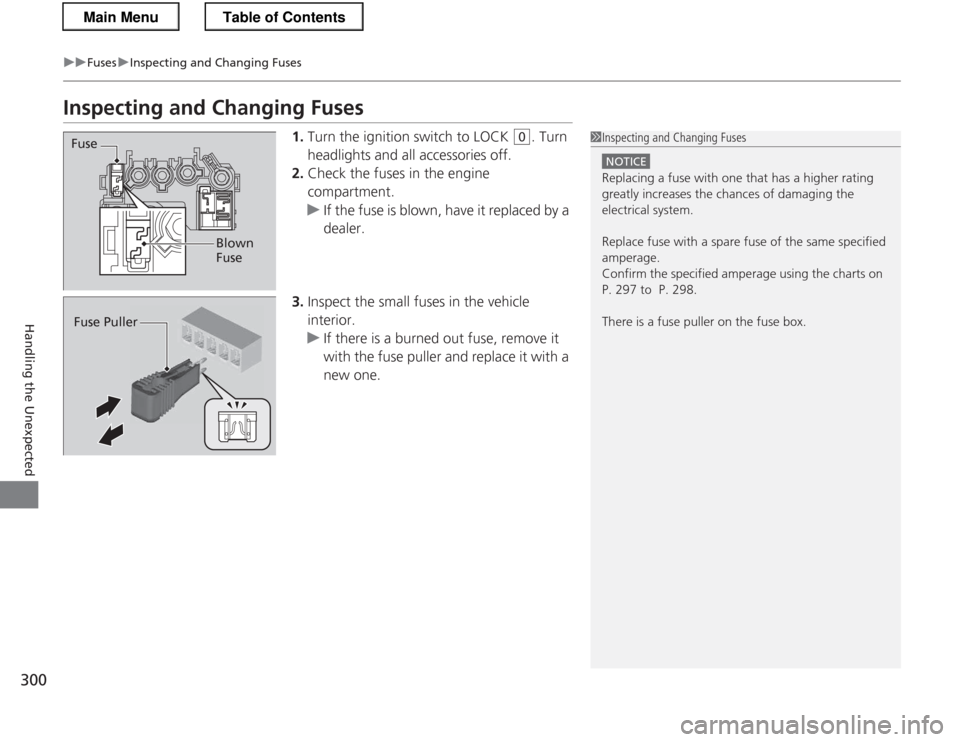
Inspecting and Changing Fuses1.Turn the ignition switch to LOCK
(0 . Turn
headlights and all accessories off.
2. Check the fuses in the engine
compartment.
uIf the fuse is blown, have it replaced by a dealer.
3. Inspect the small fuses in the vehicle
interior.
uIf there is a burned out fuse, remove it with the fuse puller and replace it with a
new one.
1Inspecting and Changing Fuses
NOTICE
Replacing a fuse with one that has a higher rating
greatly increases the chances of damaging the
electrical system.
Replace fuse with a spare fuse of the same specified
amperage.
Confirm the specified amperage using the charts on
P. 297 to P. 298.
There is a fuse puller on the fuse box.
Fuse
Blown Fuse
Fuse Puller
Main MenuTable of Contents
Page 307 of 325
306
Information
Specifications
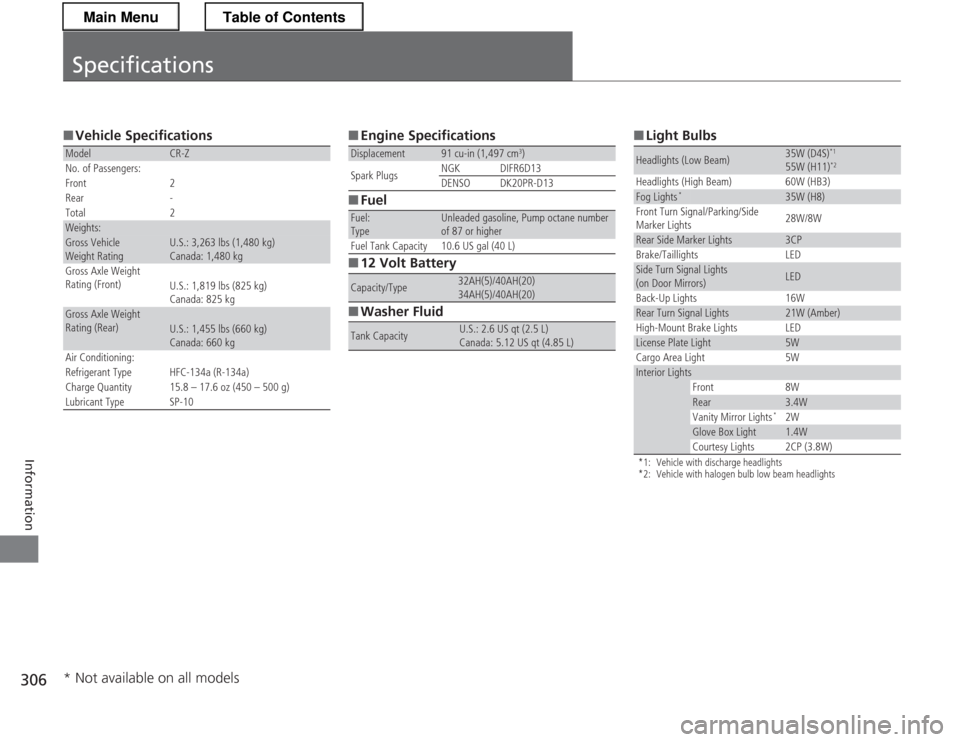
■Vehicle Specifications
ModelCR-Z
No. of Passengers:
Front 2
Rear -
Total 2
Weights:
Gross Vehicle
Weight Rating U.S.: 3,263 lbs (1,480 kg)
Canada: 1,480 kg
Gross Axle Weight
Rating (Front)
U.S.: 1,819 lbs (825 kg)
Canada: 825 kg
Gross Axle Weight
Rating (Rear)
U.S.: 1,455 lbs (660 kg)
Canada: 660 kg
Air Conditioning:
Refrigerant Type HFC-134a (R-134a)
Charge Quantity 15.8 – 17.6 oz (450 – 500 g)
Lubricant Type SP-10
■Engine Specifications
■Fuel
■12 Volt Battery
■Washer Fluid
Displacement91 cu-in (1,497 cm 3
)
Spark Plugs NGK DIFR6D13
DENSO DK20PR-D13
Fuel: TypeUnleaded gasoline, Pump octane number
of 87 or higher
Fuel Tank Capacity 10.6 US gal (40 L)
Capacity/Type32AH(5)/40AH(20)
34AH(5)/40AH(20)
Tank CapacityU.S.: 2.6 US qt (2.5 L)
Canada: 5.12 US qt (4.85 L)
■Light Bulbs
*1: Vehicle with discharge headlights
*2: Vehicle with halogen bulb low beam headlights
Headlights (Low Beam)35W (D4S) *1
55W (H11) *2
Headlights (High Beam) 60W (HB3)
Fog Lights *35W (H8)
Front Turn Signal/Parking/Side
Marker Lights 28W/8W
Rear Side Marker Lights3CP
Brake/Taillights LED
Side Turn Signal Lights
(on Door Mirrors)LED
Back-Up Lights 16W
Rear Turn Signal Lights21W (Amber)
High-Mount Brake Lights LED
License Plate Light5W
Cargo Area Light 5W
Interior Lights
Front 8W
Rear3.4W
Vanity Mirror Lights *
2W
Glove Box Light1.4W
Courtesy Lights 2CP (3.8W)
* Not available on all models
Main MenuTable of Contents
Page 313 of 325
312
uuEmissions TestinguTesting of Readiness Codes
Information
7.Select a nearby, lightly traveled major highway where you can maintain a speed
of 50 to 60 mph (80 to 97 km/h) for at least 20 minutes. Drive on the highway in
(D (automatic) or 5th (manual). Do not use cruise control. When traffic allows,
drive for 90 seconds without moving the accelerator pedal. (Vehicle speed may
vary slightly; this is okay.) If you cannot do this for a continuous 90 seconds
because of traffic conditions, drive for at least 30 seconds, then repeat it two
more times (for a total of 90 seconds).
8. Drive in city/suburban traffic for at least 10 minutes. When traffic conditions
allow, let the vehicle coast for several seconds without using the accelerator pedal
or the brake pedal.
9. Park the vehicle and leave the engine off for 30 minutes.
Main MenuTable of Contents