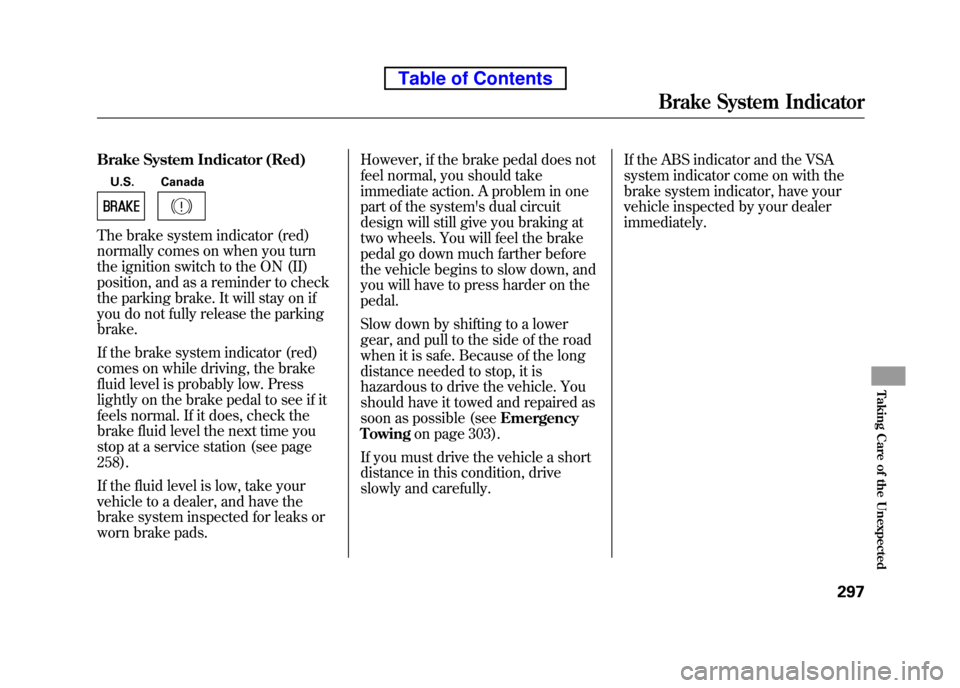
Brake System Indicator (Red)U.S. Canada
The brake system indicator (red)
normally comes on when you turn
the ignition switch to the ON (II)
position, and as a reminder to check
the parking brake. It will stay on if
you do not fully release the parkingbrake.
If the brake system indicator (red)
comes on while driving, the brake
fluid level is probably low. Press
lightly on the brake pedal to see if it
feels normal. If it does, check the
brake fluid level the next time you
stop at a service station (see page258).
If the fluid level is low, take your
vehicle to a dealer, and have the
brake system inspected for leaks or
worn brake pads. However, if the brake pedal does not
feel normal, you should take
immediate action. A problem in one
part of the system's dual circuit
design will still give you braking at
two wheels. You will feel the brake
pedal go down much farther before
the vehicle begins to slow down, and
you will have to press harder on thepedal.
Slow down by shifting to a lower
gear, and pull to the side of the road
when it is safe. Because of the long
distance needed to stop, it is
hazardous to drive the vehicle. You
should have it towed and repaired as
soon as possible (see
Emergency
Towing on page 303).
If you must drive the vehicle a short
distance in this condition, drive
slowly and carefully. If the ABS indicator and the VSA
system indicator come on with the
brake system indicator, have your
vehicle inspected by your dealer immediately.
Brake System Indicator
297
Taking Care of the Unexpected
Table of Contents
Gasoline:
Unleaded gasoline, pump octane
number of 87 or higher.
Fuel Tank Capacity:
15.9 US gal (60 L)
Recommended Engine Oil:
API Premium grade 5W-20
detergent oil (see page 251).
Oil change capacity (including filter):
4.4 US qt (4.2 L)
Automatic Transmission Fluid:
Honda Genuine ATF-Z1
(Automatic Transmission Fluid)
(see page 256).Manual Transmission Fluid:
Honda Manual Transmission Fluid
preferred, or an SAE 10W-30 or
10W-40 motor oil as a temporary
replacement (see page 257).
Capacity (including differential):
2.0 US qt (1.9 L)
4WD models only
Rear Differential Fluid:
Honda Dual Pump Fluid II. Do not
use ATF. Capacity:
1.1 US qt (1.0 L)
Power Steering Fluid:
Honda Power Steering Fluid
preferred, or another brand of
power steering fluid as a
temporary replacement. Do not
use ATF (see page 260).Brake Fluid:
Honda Heavy Duty Brake Fluid
DOT 3 preferred, or a DOT 3 or
DOT 4 brake fluid as a temporary
replacement (see page 258).
Tire Pressure (measured cold):
All models except SC
Front:
33 psi (230 kPa, 2.3 kgf/cm2)
Rear: 35 psi (240 kPa, 2.4 kgf/cm
2)
SC model
Front/Rear: 32 psi (220 kPa, 2.2 kgf/cm2)
Spare Tire Pressure: 60 psi (420 kPa, 4.2 kgf/cm
2)
Service Information Summary