flat tire HONDA FIT 2010 2.G Owner's Guide
[x] Cancel search | Manufacturer: HONDA, Model Year: 2010, Model line: FIT, Model: HONDA FIT 2010 2.GPages: 351, PDF Size: 5.67 MB
Page 312 of 351
If the pressure is lower than 32 psi
(220 kPa) and higher than 19 psi
(130 kPa), use the air pump to
bring air to the desired level as
described in step 11. Then drive to
the nearest service station at no
more than 50 mph (80 km/h).
If the pressure is below 19 psi, do
not continue. Have the vehicle
towed (see page 311).
In any case, be sure to have the
damaged tire permanently repaired
as soon as possible.
Remember to return the tire sealant
bottle to your Honda service center
for proper disposal. If the Engine Won't Start
Diagnosing why the engine won't
start falls into two areas, depending
on what you hear when you turn the
ignition switch to the START (III)position:
● You hear nothing, or almost
nothing. The engine's starter
motor does not operate at all, or
operates very slowly.
● You can hear the starter motor
operating normally, or the starter
motor sounds like it is spinning
faster than normal, but the engine
does not start up and run. Nothing Happens or the Starter
Motor Operates Very Slowly
When you turn the ignition switch to
the START (III) position, you do not
hear the normal noise of the engine
trying to start. You may hear a
clicking sound, a series of clicks, or
nothing at all.
Check these things:
● Check the transmission interlock.
If you have a manual transmission,
the clutch pedal must be pushed
all the way to the floor or the
starter will not operate. With an
automatic transmission, it must be
in Park or neutral.
● Turn the ignition switch to the ON
(II) position. Turn on the
headlights, and check their
brightness. If the headlights are
very dim or do not come on at all,
the battery is discharged. See
Jump Starting on page 299.
CONTINUED
Temporarily Repairing a Flat Tire, If the Engine Won't Start
297
Taking Care of the Unexpected
Table of Contents
Page 326 of 351
If your vehicle needs to be towed,
call a professional towing service or
organization. Never tow your vehicle
with just a rope or chain. It is verydangerous.
There are two ways to tow your vehicle:
Flat-bed Equipment-The operator
loads your vehicle on the back of atruck. This is the best way to
transport your vehicle.
Wheel-lift Equipment- The tow
truck uses two pivoting arms that go
under the front tires and lift them off
the ground. The rear tires remain on
the ground. This is an acceptable
way to tow your vehicle. If, due to damage, your vehicle must
be towed with the front wheels on
the ground, do this:
Manual transmission:
●
Release the parking brake.
● Shift the transmission to neutral.
● Leave the ignition switch in the
ACCESSORY (I) position so the
steering wheel does not lock.
Automatic transmission:
●Release the parking brake.
● Start the engine.
● Shift to D position and hold for 5
seconds, then to N. Let the engine
run for 3 minutes, then turn it off.
● Turn off the engine.
● Leave the ignition switch in the
ACCESSORY (I) position so the
steering wheel does not lock.
Improper towing preparation will
damage the transmission. Follow the
above procedure exactly. If you cannot
shift the transmission or start the
engine (automatic transmission), your
vehicle must be transported with the
front wheels off the ground.
With the front wheels on the ground,
it is best to tow the vehicle no farther
than 50 miles (80 km), and keep the
speed below 35 mph (55 km/h).
CONTINUED
Emergency Towing
311
Taking Care of the Unexpected
Table of Contents
Page 337 of 351
Temperature
The temperature grades are A (the
highest), B, and C, representing the
tire's resistance to the generation of
heat and its ability to dissipate heat
when tested under controlled
conditions on a specified indoor
laboratory test wheel. Sustained high
temperature can cause the material
of the tire to degenerate and reduce
tire life, and excessive temperature
can lead to sudden tire failure. The
grade C corresponds to a level of
performance which all passenger car
tires must meet under the Federal
Motor Vehicle Safety Standard No.
109. Grades B and A represent
higher levels of performance on the
laboratory test wheel than the
minimum required by law.Warning: The temperature grade for
this tire is established for a tire that
is properly inflated and not
overloaded. Excessive speed,
underinflation, or excessive loading,
either separately or in combination,
can cause heat buildup and possible
tire failure.
DOT Tire Quality Grading (U.S. Vehicles)
322
Table of Contents
Page 339 of 351
Glossary of Tire Terminology
Cold Tire Pressure - The tire air
pressure when the vehicle has been
parked for at least three hours or
driven less than 1 mile (1.6km).
Load Rating - Means the maximum
load that a tire is rated to carry for a
given inflation presure.
Maximum Inflation Pressure - the
maximum tire air pressure that the
tire can hold.
Maximum Load Rating - Means the
load rating for a tire at the maximum
permissible inflation pressure for thattire.
Recommended Inflation Pressure -
The cold tire inflation pressure
recommended by the manufacturer.
Treadwear Indicators (TWI) - Means
the projections within the principal
grooves designed to give a visual
indication of the degrees of wear of
the tread.Tire Pressure Monitoring System(TPMS)
-Required Federal
Explanation
U.S. models only
Each tire, including the spare (if
provided), should be checked
monthly when cold and inflated to
the inflation pressure recommended
by the vehicle manufacturer on the
vehicle placard or tire inflation
pressure label.
(If your vehicle has tires of a different
size than the size indicated on the
vehicle placard or tire inflation
pressure label, you should determine
the proper tire inflation pressure for
those tires.) As an added safety feature, your
vehicle has been equipped with a tire
pressure monitoring system (TPMS)
that illuminates a low tire pressuretelltale
when one or more of your tires is
significantly under-inflated.
Accordingly, when the low tire
pressure telltale illuminates, you
should stop and check your tires as
soon as possible, and inflate them to
the proper pressure.
Tire Labeling, Tire Pressure Monitoring System (TPMS)
-Required Federal Explanation
324
Table of Contents
Page 340 of 351
Driving on a significantly under-
inflated tire causes the tire to
overheat and can lead to tire failure.
Under-inflation also reduces fuel
efficiency and tire tread life, and may
affect the vehicle's handling and
stopping ability.
Please note that the TPMS is not a
substitute for proper tire
maintenance, and it is the driver's
responsibility to maintain correct tire
pressure, even if under-inflation has
not reached the level to trigger
illumination of the TPMS low tire
pressure telltale.Your vehicle has also been equipped
with a TPMS malfunction indicator to
indicate when the system is not
operating properly. The TPMS
malfunction indicator is provided by
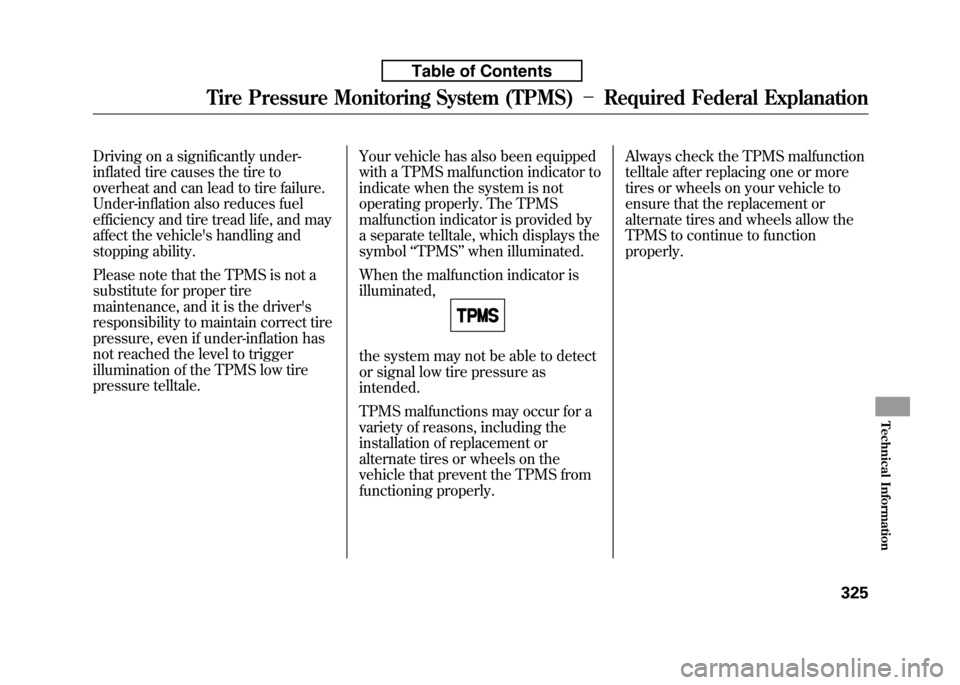
a separate telltale, which displays thesymbol
‘‘TPMS ’’when illuminated.
When the malfunction indicator isilluminated,
the system may not be able to detect
or signal low tire pressure asintended.
TPMS malfunctions may occur for a
variety of reasons, including the
installation of replacement or
alternate tires or wheels on the
vehicle that prevent the TPMS from
functioning properly. Always check the TPMS malfunction
telltale after replacing one or more
tires or wheels on your vehicle to
ensure that the replacement or
alternate tires and wheels allow the
TPMS to continue to functionproperly.
Tire Pressure Monitoring System (TPMS)
-Required Federal Explanation
325
Technical Information
Table of Contents