fuel HONDA FIT 2010 2.G Service Manual
[x] Cancel search | Manufacturer: HONDA, Model Year: 2010, Model line: FIT, Model: HONDA FIT 2010 2.GPages: 351, PDF Size: 5.67 MB
Page 296 of 351

If you need to park your vehicle for
an extended period (more than 1
month), there are several things you
should do to prepare it for storage.
Proper preparation helps prevent
deterioration and makes it easier to
get your vehicle back on the road. If
possible, store your vehicle indoors.● Fill the fuel tank.
● Wash and dry the exteriorcompletely.
● Clean the interior. Make sure the
carpeting, floor mats, etc., are
completely dry.
● Leave the parking brake off. Put
the transmission in reverse
(manual) or Park (automatic).
● Block the rear wheels. ●
If the vehicle is to be stored for a
longer period, it should be
supported on jackstands so the
tires are off the ground.
● Leave one window open slightly (if
the vehicle is being storedindoors).
● Disconnect the battery.
● Support the front and rear wiper
blade arms with a folded towel or
rag so they do not touch thewindshield.
● To minimize sticking, apply a
silicone spray lubricant to all door
and tailgate seals. Also, apply a
vehicle body wax to the painted
surfaces that mate with the door
and tailgate seals. ●
Cover the vehicle with a‘‘breathable ’’cover, one made from
a porous material such as cotton.
Non-porous materials, such as
plastic sheeting, trap moisture,
which can damage the paint.
● If possible, periodically run the
engine until it reaches full
operating temperature (the cooling
fans cycle on and off twice).
Preferably, do this once a month.
Vehicle Storage
281
Maintenance
Table of Contents
Page 313 of 351

●Turn the ignition switch to the
START (III) position. If the
headlights do not dim, check the
condition of the fuses. If the fuses
are OK, there is probably
something wrong with the
electrical circuit for the ignition
switch or starter motor. You will
need a qualified technician to
determine the problem. See
Emergency Towing on page 311.
If the headlights dim noticeably or go
out when you try to start the engine,
either the battery is discharged or
the connections are corroded. Check
the condition of the battery and
terminal connections (see page 279).
You can then try jump starting the
vehicle from a booster battery (see
page 299). The Starter Operates Normally
In this case, the starter motor's speed
sounds normal, or even faster than
normal, when you turn the ignition
switch to the START (III) position,
but the engine does not run.
● Are you using a properly coded
key? An improperly coded key will
cause the immobilizer system
indicator in the instrument panel
to blink rapidly (see page 79).
● Are you using the proper starting
procedure? Refer to Starting the
Engine on page 216. ●
Do you have fuel? Check the fuel
gauge; the low fuel indicator may
not be working.
● There may be an electrical
problem, such as no power to the
fuel pump. Check all the fuses (see
page 306).
If you find nothing wrong, you will
need a qualified technician to find the
problem. See Emergency Towing on
page 311.
If the Engine Won't Start
298
Table of Contents
Page 319 of 351
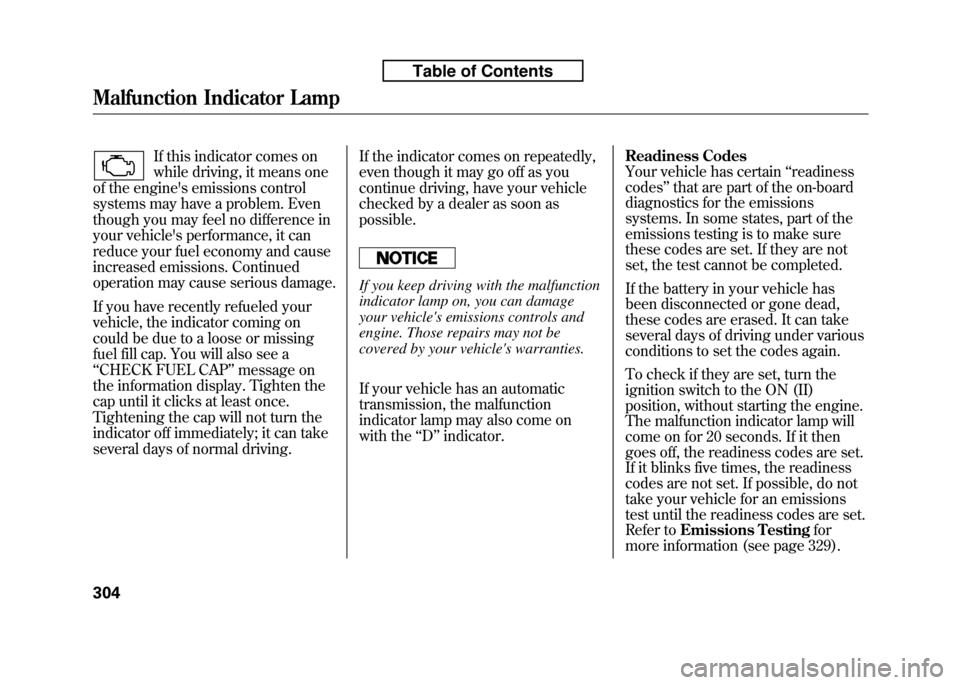
If this indicator comes on
while driving, it means one
of the engine's emissions control
systems may have a problem. Even
though you may feel no difference in
your vehicle's performance, it can
reduce your fuel economy and cause
increased emissions. Continued
operation may cause serious damage.
If you have recently refueled your
vehicle, the indicator coming on
could be due to a loose or missing
fuel fill cap. You will also see a‘‘ CHECK FUEL CAP ’’message on
the information display. Tighten the
cap until it clicks at least once.
Tightening the cap will not turn the
indicator off immediately; it can take
several days of normal driving. If the indicator comes on repeatedly,
even though it may go off as you
continue driving, have your vehicle
checked by a dealer as soon aspossible.
If you keep driving with the malfunction
indicator lamp on, you can damage
your vehicle's emissions controls and
engine. Those repairs may not be
covered by your vehicle's warranties.
If your vehicle has an automatic
transmission, the malfunction
indicator lamp may also come on
with the
‘‘D ’’indicator. Readiness Codes
Your vehicle has certain
‘‘readiness
codes ’’that are part of the on-board
diagnostics for the emissions
systems. In some states, part of the
emissions testing is to make sure
these codes are set. If they are not
set, the test cannot be completed.
If the battery in your vehicle has
been disconnected or gone dead,
these codes are erased. It can take
several days of driving under various
conditions to set the codes again.
To check if they are set, turn the
ignition switch to the ON (II)
position, without starting the engine.
The malfunction indicator lamp will
come on for 20 seconds. If it then
goes off, the readiness codes are set.
If it blinks five times, the readiness
codes are not set. If possible, do not
take your vehicle for an emissions
test until the readiness codes are set.
Refer to Emissions Testing for
more information (see page 329).
Malfunction Indicator Lamp
304
Table of Contents
Page 324 of 351
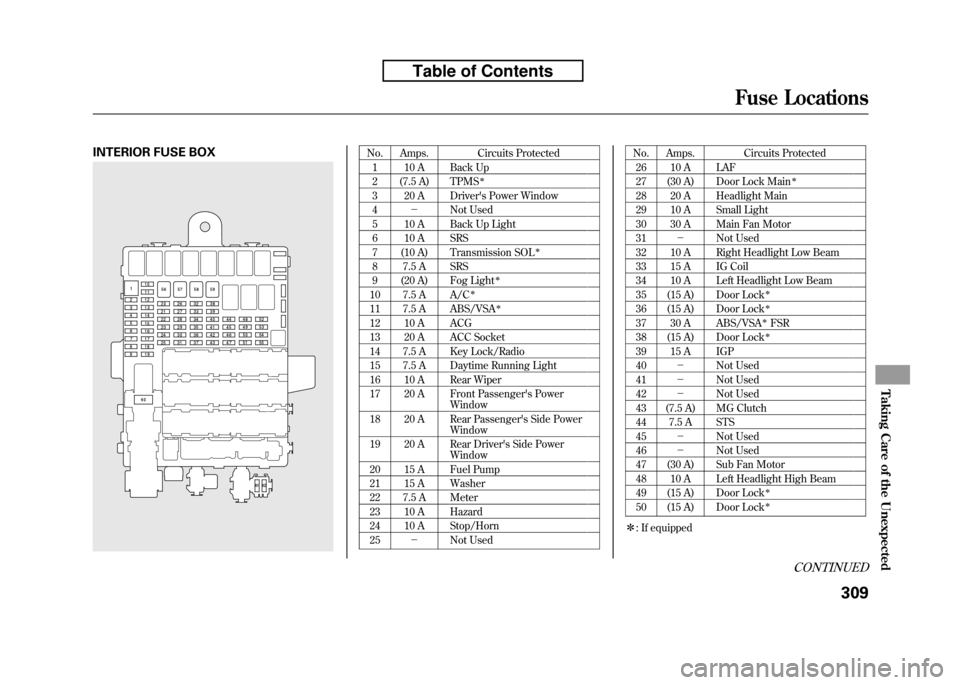
INTERIOR FUSE BOXNo. Amps. Circuits Protected1 10 A Back Up
2 (7.5 A) TPMS
ꭧ
3 20 A Driver's Power Window 4 - Not Used
5 10 A Back Up Light
6 10 A SRS
7 (10 A) Transmission SOL
ꭧ
8 7.5 A SRS
9 (20 A) Fog Lightꭧ
10 7.5 A A/Cꭧ
11 7.5 A ABS/VSAꭧ
12 10 A ACG
13 20 A ACC Socket
14 7.5 A Key Lock/Radio
15 7.5 A Daytime Running Light
16 10 A Rear Wiper
17 20 A Front Passenger's Power Window
18 20 A Rear Passenger's Side Power Window
19 20 A Rear Driver's Side Power Window
20 15 A Fuel Pump
21 15 A Washer
22 7.5 A Meter
23 10 A Hazard
24 10 A Stop/Horn25 - Not Used No. Amps. Circuits Protected
26 10 A LAF
27 (30 A) Door Lock Main
ꭧ
28 20 A Headlight Main
29 10 A Small Light
30 30 A Main Fan Motor31 - Not Used
32 10 A Right Headlight Low Beam
33 15 A IG Coil
34 10 A Left Headlight Low Beam
35 (15 A) Door Lock
ꭧ
36 (15 A) Door Lockꭧ
37 30 A ABS/VSAꭧFSR
38 (15 A) Door Lockꭧ
39 15 A IGP40 - Not Used
41 - Not Used
42 - Not Used
43 (7.5 A) MG Clutch
44 7.5 A STS45 - Not Used
46 - Not Used
47 (30 A) Sub Fan Motor
48 10 A Left Headlight High Beam
49 (15 A) Door Lock
ꭧ
50 (15 A) Door Lockꭧ
ꭧ : If equipped
CONTINUED
Fuse Locations
309
Taking Care of the Unexpected
Table of Contents
Page 330 of 351
The diagrams in this section give you
the dimensions and capacities of
your vehicle and the locations of the
identification numbers. It also
includes information you should
know about your vehicle's tires and
emissions control systems.Identification Numbers...............
316
Specifications ..............................
318
DOT Tire Quality Grading (U.S. Vehicles) .............................
321
Uniform Tire Quality Grading ...............................
321
Treadwear ...............................
321
Traction ..................................
321
Temperature ...........................
322
Tire Labeling ..............................
323
Tire Pressure Monitoring System (TPMS) -Required Federal
Explanation .........................
324
Emissions Controls .....................
326
The Clean Air Act ....................
326
Crankcase Emissions Control System ................................
326
Evaporative Emissions Control System ................................
326
Onboard Refueling Vapor
Recovery .............................
326
Exhaust Emissions Controls ..............................
327
Replacement Parts ..................
327Three Way Catalytic
Converter ................................
328
Emissions Testing .......................
329
Technical Information
315
Technical Information
Page 334 of 351

CapacitiesFuel tank Approx.
10.6 US gal (40 L)
Engine oil Change
ꭧ 1
Including filter 3.8 US qt (3.6 L)
Withoutfilter 3.6 US qt (3.4 L)
Total 4.4 US qt (4.2 L)
Engine
coolant Automatic
transmission
Change
ꭧ21.19 US gal (4.5 L)
Total 1.32 US gal (5.0 L)
Manual
transmission
Change
ꭧ21.16 US gal (4.4 L)
Total 1.29 US gal (4.9 L)
Automatic
transmissionfluid Change 2.6 US qt (2.5 L)
Total 6.18 US qt (5.85 L)
Manual
transmissionfluid Change 1.6 US qt (1.5 L)
Total 1.7 US qt (1.6 L)
Windshield
washer
reservoir U.S. Vehicles 2.6 US qt (2.5 L)
Canada Vehicles 4.8 US qt (4.5 L)
ꭧ 1: Excluding the oil remaining in the engine
ꭧ 2: Including the coolant in the reserve tank and that remaining in the
engine
Reserve tank capacity:
0.116 US gal (0.44 L) Air Conditioning
Refrigerant type HFC-134a (R-134a)
Charge quantity 13.1 -14.8 oz
(370 -420 g)
Lubricant type SP-10
Lights Headlights High/Low 12 V -60/55 W (HB2)
Front turn signal lights 12 V -21 W (Amber)
Parking lights/side marker lights 12 V -3.8 W (Amber)
Fog lights
ꭧ12 V -55 W (H11)
Rear turn signal lights 12 V -21 W (Amber)
Stop/Taillights 12 V -21/5 W
Back-up lights 12 V -16 W
License plate lights 12 V -5W
Ceiling light 12 V -8W
Cargo area light 12 V -5W
Map light
ꭧ12 V -8W
High-mount brake light LED
ꭧ : For some types
Specifications
319
Technical Information
Table of Contents
Page 340 of 351

Driving on a significantly under-
inflated tire causes the tire to
overheat and can lead to tire failure.
Under-inflation also reduces fuel
efficiency and tire tread life, and may
affect the vehicle's handling and
stopping ability.
Please note that the TPMS is not a
substitute for proper tire
maintenance, and it is the driver's
responsibility to maintain correct tire
pressure, even if under-inflation has
not reached the level to trigger
illumination of the TPMS low tire
pressure telltale.Your vehicle has also been equipped
with a TPMS malfunction indicator to
indicate when the system is not
operating properly. The TPMS
malfunction indicator is provided by
a separate telltale, which displays thesymbol
‘‘TPMS ’’when illuminated.
When the malfunction indicator isilluminated,
the system may not be able to detect
or signal low tire pressure asintended.
TPMS malfunctions may occur for a
variety of reasons, including the
installation of replacement or
alternate tires or wheels on the
vehicle that prevent the TPMS from
functioning properly. Always check the TPMS malfunction
telltale after replacing one or more
tires or wheels on your vehicle to
ensure that the replacement or
alternate tires and wheels allow the
TPMS to continue to functionproperly.
Tire Pressure Monitoring System (TPMS)
-Required Federal Explanation
325
Technical Information
Table of Contents
Page 341 of 351

The burning of gasoline in your
vehicle's engine produces several
byproducts. Some of these are
carbon monoxide (CO), oxides of
nitrogen (NOx), and hydrocarbons
(HC). Gasoline evaporating from the
tank also produces hydrocarbons.
Controlling the production of NOx,
CO, and HC is important to the
environment. Under certain
conditions of sunlight and climate,
NOx and HC react to formphotochemical‘‘smog. ’’Carbon
monoxide does not contribute to
smog creation, but it is a poisonousgas.
The Clean Air Act
The United States Clean Air Act
ꭧ
sets standards for automobile
emissions. It also requires that
automobile manufacturers explain to
owners how their emissions controls
work and what to do to maintain
them. This section summarizes how
the emissions controls work.
ꭧIn Canada, Honda vehicles comply
with the Canadian emission
requirements, as specified in an
agreement with Environment
Canada, at the time they are
manufactured.
Crankcase Emissions Control System
Your vehicle has a positive crankcase
ventilation system. This keeps
gasses that build up in the engine's
crankcase from going into the
atmosphere. The positive crankcase
ventilation valve routes them from
the crankcase back to the intake
manifold. They are then drawn into
the engine and burned. Evaporative Emissions ControlSystem
As gasoline evaporates in the fuel
tank, an evaporative emissions
control canister filled with charcoal
adsorbs the vapor. It is stored in this
canister while the engine is off. After
the engine is started and warmed up,
the vapor is drawn into the engine
and burned during driving.
Onboard Refueling Vapor Recovery
The onboard refueling vapor
recovery (ORVR) system captures
the fuel vapors during refueling. The
vapors are adsorbed in a canister
filled with activated carbon. While
driving, the fuel vapors are drawn
into the engine and burned off.
Emissions Controls
326
Table of Contents
Page 342 of 351

Exhaust Emissions Controls
The exhaust emissions controls
include four systems: PGM-FI,
ignition timing control, exhaust gas
recirculation, and three way catalytic
converter. These four systems work
together to control the engine's
combustion and minimize the
amount of HC, CO, and NOx that
come out the tailpipe. The exhaust
emissions control systems are
separate from the crankcase and
evaporative emissions controlsystems.PGM-FI System
The PGM-FI system uses sequential
multiport fuel injection. It has three
subsystems: air intake, engine
control, and fuel control. The
powertrain control module (PCM) in
automatic transmission vehicles or
the engine control module (ECM) in
manual transmission vehicles uses
various sensors to determine how
much air is going into the engine. It
then controls how much fuel to inject
under all operating conditions.
Ignition Timing Control System
This system constantly adjusts the
ignition timing, reducing the amount
of HC, CO, and NOx produced.
Exhaust Gas Recirculation (EGR)System
The exhaust gas recirculation (EGR)
system takes some of the exhaust gas
and routes it back into the intake
manifold. Adding exhaust gas to the
air/fuel mixture reduces the amount
of NOx produced when the fuel is burned.
Three Way Catalytic Converter
The three way catalytic converter is
in the exhaust system. Through
chemical reactions, it converts HC,
CO, and NOx in the engine's exhaust
to carbon dioxide (CO 2), nitrogen
(N 2), and water vapor.
Replacement Parts
The emissions control systems are
designed and certified to work
together in reducing emissions to
levels that comply with the Clean Air
Act. To make sure the emissions
remain low, you should use only new
Honda replacement parts or their
equivalent for repairs. Using lower
quality parts may increase the
emissions from your vehicle.
The emissions control systems are
covered by warranties separate from
the rest of your vehicle. Read your
warranty manual for moreinformation.
Emissions Controls
327
Technical Information
Table of Contents
Page 351 of 351

Gasoline:
Unleaded gasoline, pump octane
number of 87 or higher.
Fuel Tank Capacity:
10.6 US gal (40 L)
Recommended Engine Oil:
API Premium grade 5W-20
detergent oil (see page 253).
Oil change capacity (including filter):3.8 US qt (3.6 L)
Automatic Transmission Fluid:
Honda Genuine ATF-Z1
(automatic transmission fluid)
(see page 259). Manual Transmission Fluid:
Honda Manual Transmission Fluid
preferred, or an SAE 10W-30 or
10W-40 motor oil as a temporary
replacement (see page 260).
Capacity (including differential):
1.6 US qt (1.5 L)
Brake Fluid:
Honda Heavy Duty Brake Fluid
DOT 3 preferred, or a DOT 3 or
DOT 4 brake fluid as a temporary
replacement (see page 261).
Tire Pressure (measured cold): Front/Rear:
All models except Sport
32 psi (220 kPa, 2.2 kgf/cm
2)
Sport model 33 psi (230 kPa, 2.3 kgf/cm
2)
Spare Tire Pressure: 60 psi (420 kPa, 4.2 kgf/cm
2)
Service Information Summary