Minutes HONDA INTEGRA 1994 4.G User Guide
[x] Cancel search | Manufacturer: HONDA, Model Year: 1994, Model line: INTEGRA, Model: HONDA INTEGRA 1994 4.GPages: 1413, PDF Size: 37.94 MB
Page 242 of 1413
PGM-FI System
rj-t
--t-.
Fuel Supply System
-+-lt@t- -t 13 |- ' "- - --i--
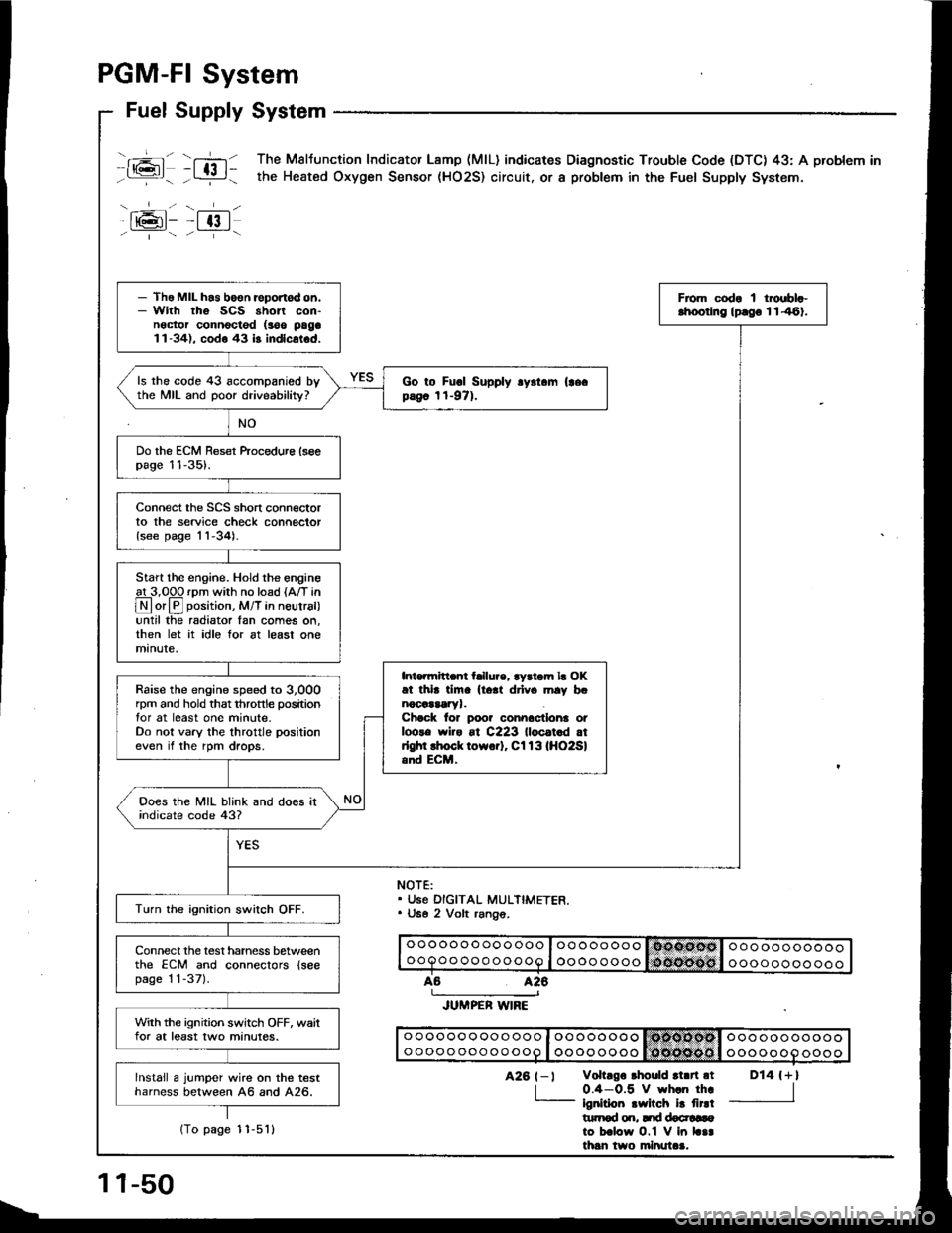
T,-n The Maltunction Indicator Lamp (MlL) indicares Diagnostic Trouble Code (DTC) 43: A problem in
- L:!-i - the Heated Oxygen Sensor (HO2S) circuit. or a probtem in the Fuel Supply System.
NOTE:. Use DIGITAL MULTIMETER.. U6e 2 Volt rang6.
o oooooo oooooo I oo oooooooooooooooooooQoo ooo ooooo I oooo ooooooooooooooo
426
JUMPER WIRE
o ooooo oooo ooo I oo oooooo Isdtcllodsl ooo ooooooooo oooo ooo oo ooo I oooo ooooooooooooooo
D14 {+l
I
426 t-l vohrgo rhould rl.n.t
| 0.4-0.5 V wh.n th..- ignirioo .wilch i! firdt|rtrod o.r, Itd docr!6ato b.low O.1 V in L..th6n two minutaa.
- Tho MIL h.s boen reportod on.- With rhe SCS short con-noctor connocted (soo paga1l-34), codo 43 b indlcat.d,
From codr I troebl.-lhoorlng lprgo 1146).
ls the code 43 accompanied bythe MIL and poor driveability?Go to Fuol Supply .y.t.m (|ecpag6 1t-971.
Do the ECM Reset ftocedure lseepage 11-35).
Connect the SCS short connectorto the service check connector{see page 'l1-34).
Start the engine. Hold the engineat 3,00O rDm with no load {A/T in
@or@ position, M/T in neutral)until the radiator Ian comes on,then let it idle for at least onemanute,
Intonnitl.nt t llure, tydom lr OKat thi. tim. lto.t drlv. mly b.nocaararyr.Chock lor poo? connactlona otloots wiro at C223 lloc.t.d atrlghl lhock towo.]. Cl13lHO2Sland ECM,
Raise the engine speed to 3,000rpm and hold that throttle positiontor at least one minute.Do not vary the throttle positioneven if the rpm drops.
Ooes the MIL blink and does itindicate code 43?
Turn the ignition swilch OFF.
Connect the test harness betweenthe ECM and conneclors {seepage 1 1-371.
With the ignition switch OFF, waitfor at least two minutes.
lnstall a jumper wire on the testharness between A6 and A26.
11-50
1To page 1 1-5'l l
Page 385 of 1413
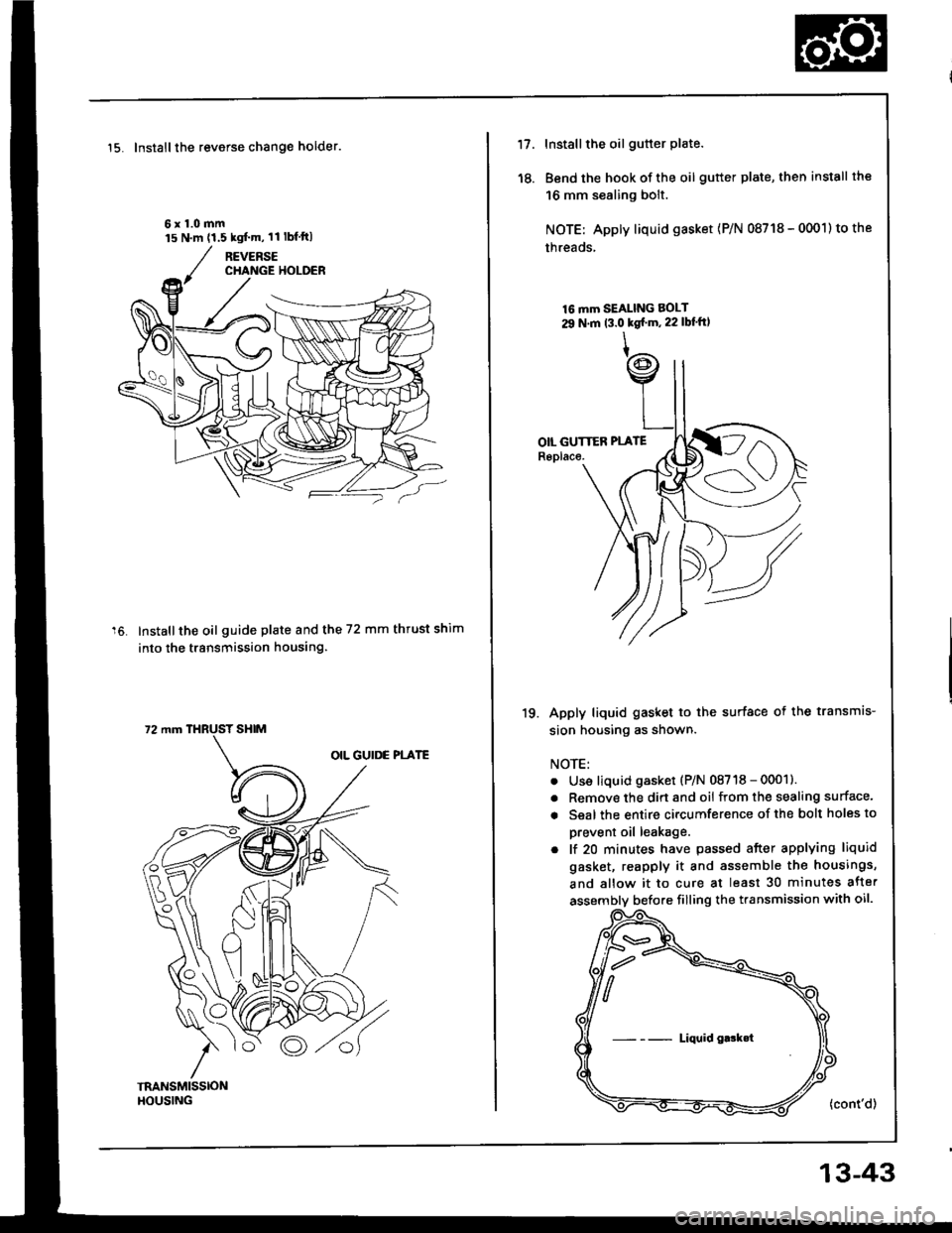
15. Installthe reverse change holder.
6x1.0mm
Installthe oil guide plate and the 72 mm thrust shim
into the transmission housing.
15 N.m (1.5 kgt'm,11 lbfftl
72 mm THRUST SHIM
'18.
Installthe oil gutter plate.
Bend the hook of the oil gutter plate, then install the
16 mm sealing bolt.
NOTE: Apply liquid gasket {P/N 08718 - 0001) to the
threads,
16 mm SEAI-ING BOLT
29 N.m t3.0 kgf m, 22 lbl'ftt
Apply liquid gasket to the surface ot the transmis-
sion housing as shown.
NOTE:
Use liquid gasket (P/N 08718 - 0001)
Remove the dirt and oil from the sealing surface'
Seal the entire circumference of the bolt holes to
prevent oil leakage.
lf 20 minutes have passed after applying liquid
gasket, reapply it and assemble the housings,
and allow it to cure at least 30 minutes after
assembly before filling the transmission with oil.
(cont'd)
19.
a
a
Liquid g.!k.t
13-43
Page 443 of 1413
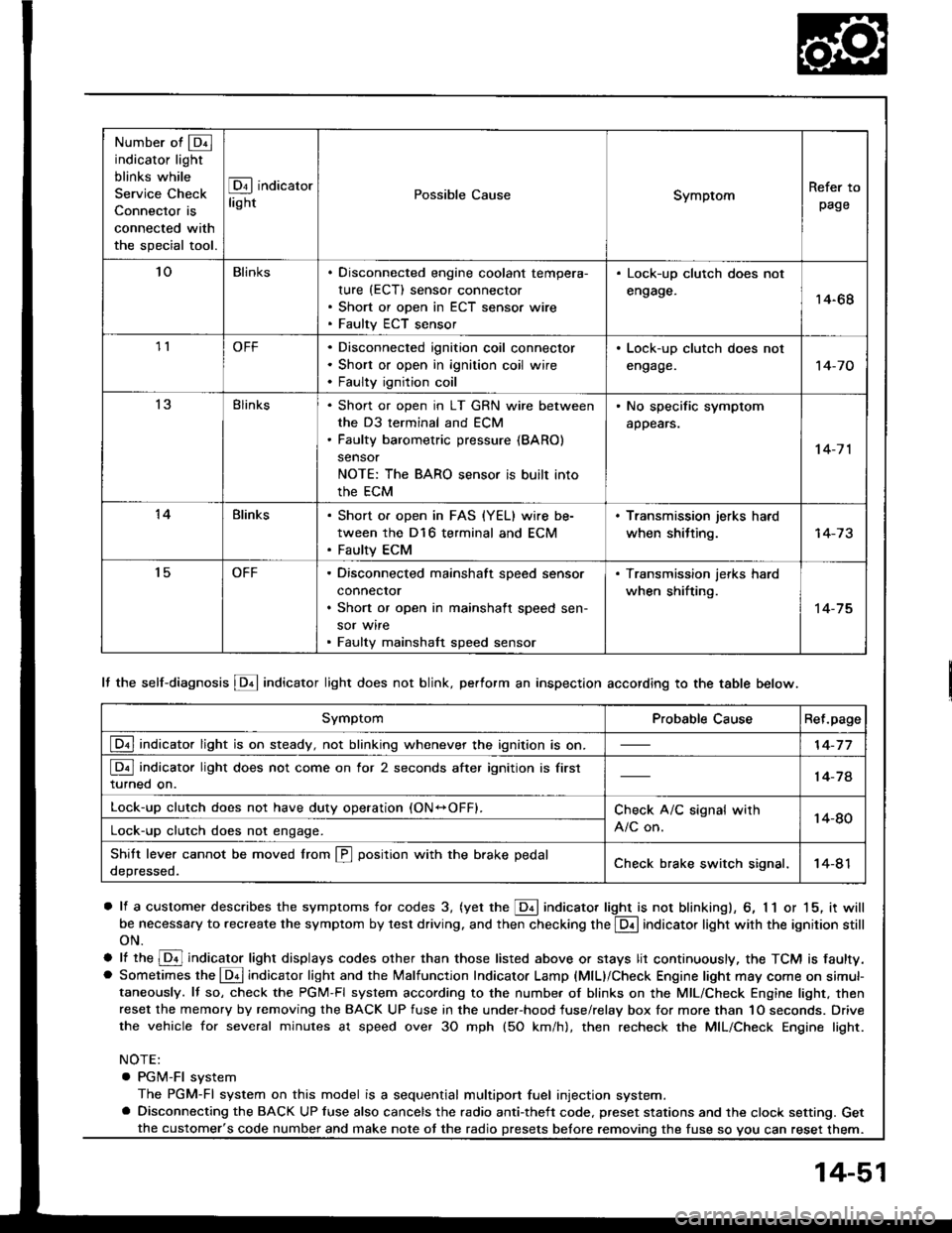
Number of @indicator light
blinks while
Service Check
Connector is
connected with
the special tool.
@ indicator
lightPossible CauseSymptomRefer to
page
'loBlinksDisconnected engine coolant tempera-
rure (ECT) sensor connector
Short or open in ECT sensor wire
Faulty ECT sensor
Lock-up clutch does not
engage.14-68
1lOFFDisconnected ignition coil connector
Short or open in ignition coil wire
Faulty ignition coil
. Lock-up clutch does not
engage.'t 4-7 0
13Blinks. Shon or open in LT GRN wire between
the D3 terminal and ECM. Faulty barometric pressure {BARO)
sensor
NOTE: The BARO sensor is built into
the ECM
. No specific symptom
appears.
14-7 1
14Blinks. Short of open in FAS {YEL} wire be-
tween the D16 terminal and ECM. Faulty ECM
. Transmission jerks hard
when shitting.
't5OFFDisconnected mainshaft speed sensor
connecror
Short or open in mainshaft speed sen-
sor wire
Faulty mainshaft speed sensor
. Transmission jerks hard
when shifting.
14-75
SymptomProbable CauseRet.page
LQ! indicator light is on steady, not blinking whenever the ignition is on.14-77
[Q3] indicator light does not come on for 2 seconds after ignition is first
turned on.14-78
Lock-up clutch does not have duty operation (ON-OFFI.Check A/C signal with
A/C on.14-80Lock-up clutch does not engage.
Shitt leve. cannot be moved lrom @ position with the brake pedal
depressed.Check brake switch signal,14-41
It the self-diagnosis LQ4 indicator light does not blink, perform an inspection according to the table below.
a lf a customer describes the symptoms for codes 3, (yet the LQ! indicator light is not blinkingl, 6, 1 1 or 15, it will
be necessa.y to recreate the symptom by test driving. and then checking the @ indicator light with the ignition still
oN.
e lt ttre @ indicator light displays codes olher than those listed above or stays lit continuously, the TCM is faulty.. Sometimes the Lqd indicator light and the Malfunction Indicator Lamp (MlL)/Check Engine light may come on simul-taneously. lf so, check the PGM-Fl system according to the numbe. of blinks on the MIL/Check Engine light. thenreset the memory by removing the BACK UP fuse in the unde.-hood fuse/relay box for more than 1O seconds. Drive
the vehicle for several minutes at speed over 30 mph (5O km/h), then recheck the MIL/Check Engine light.
NOTE:
. PGM-FI system
The PGM-Fl system on this model is a sequential multiport fuel injection system.a Disconnecting the BACK UP luse also cancels the radio anti-theft code. preset stations and the clock setting. Get
the fuse so vou can reset them.the customer's code number and make note ot the radio
14-51
Page 484 of 1413
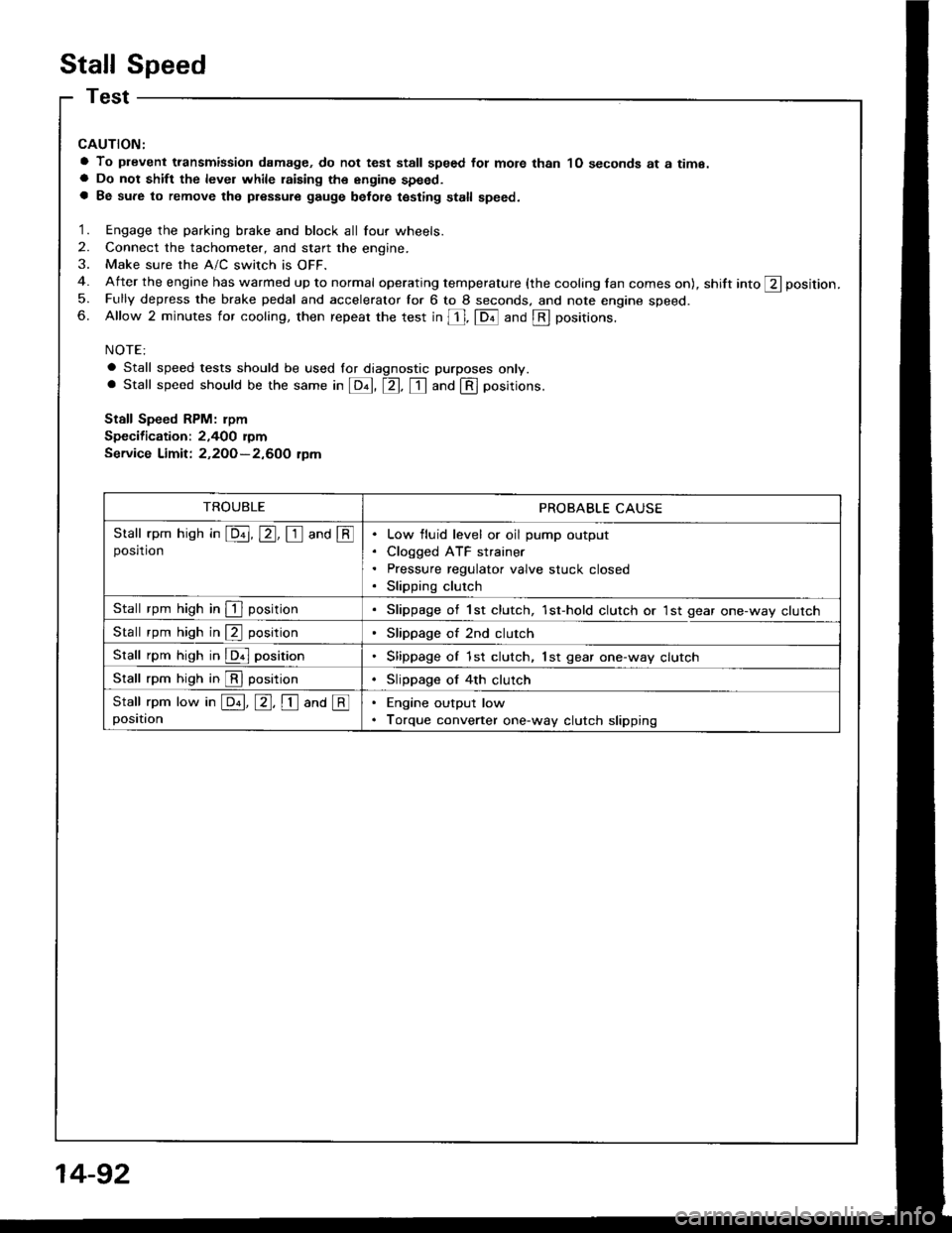
Stall Speed
CAUTION:
a To plevent transmission damage, do not test stall speed fot mote than 1O seconds at a time.a Do not shift the level while raising th€ engine speed.a Be sure to remove the pressure gauge belot€ testing stall speed.
1. Engage the parking brake and block all four wheels.
2. Connect the tachometer, and start the engine.
3. Make sure the A/C switch is OFF.
4. After the engine has warmed up to normal operating temperature (the cooling lan comes on), shift into ft position.
5. Fully depress the brake pedal and accelerator for 6 to 8 seconds. and note engine speed.6. Allow 2 minutes for cooling, then repeat the test in [, fDil and @ positions.
NOTE:
a Stall speed tests should be used lor diagnostic purposes only.. Stall speed should be the same in E, tr. tr and @ positions.
Stall Speed RPM: rpm
Specification: 2,400 rymService Limit: 2,2OO-2,600 tpm
TROUBLEPROBABLE CAUSE
Stall rpm hish in E, E, I and @posrtronLow fluid level or oil pump output
Cloqged ATF strainer
Pressure regulator valve stuck closed
Slipping clutch
Stall rpm high in I positionSlippage of 1st clutch, 1st-hold clutch or 1st gear one-way clutch
Stall rpm high in @ positionSlippage of 2nd clutch
Stall rpm high in @ positionSlippage of 1st clutch, lst gear one-way clutch
Stall rpm high in @ positionSlippage of 4th clutch
Stall rpm low in E, E, I ana @positionEngine output low
Torque converter one-way clutch slipping
14-92
Page 508 of 1413
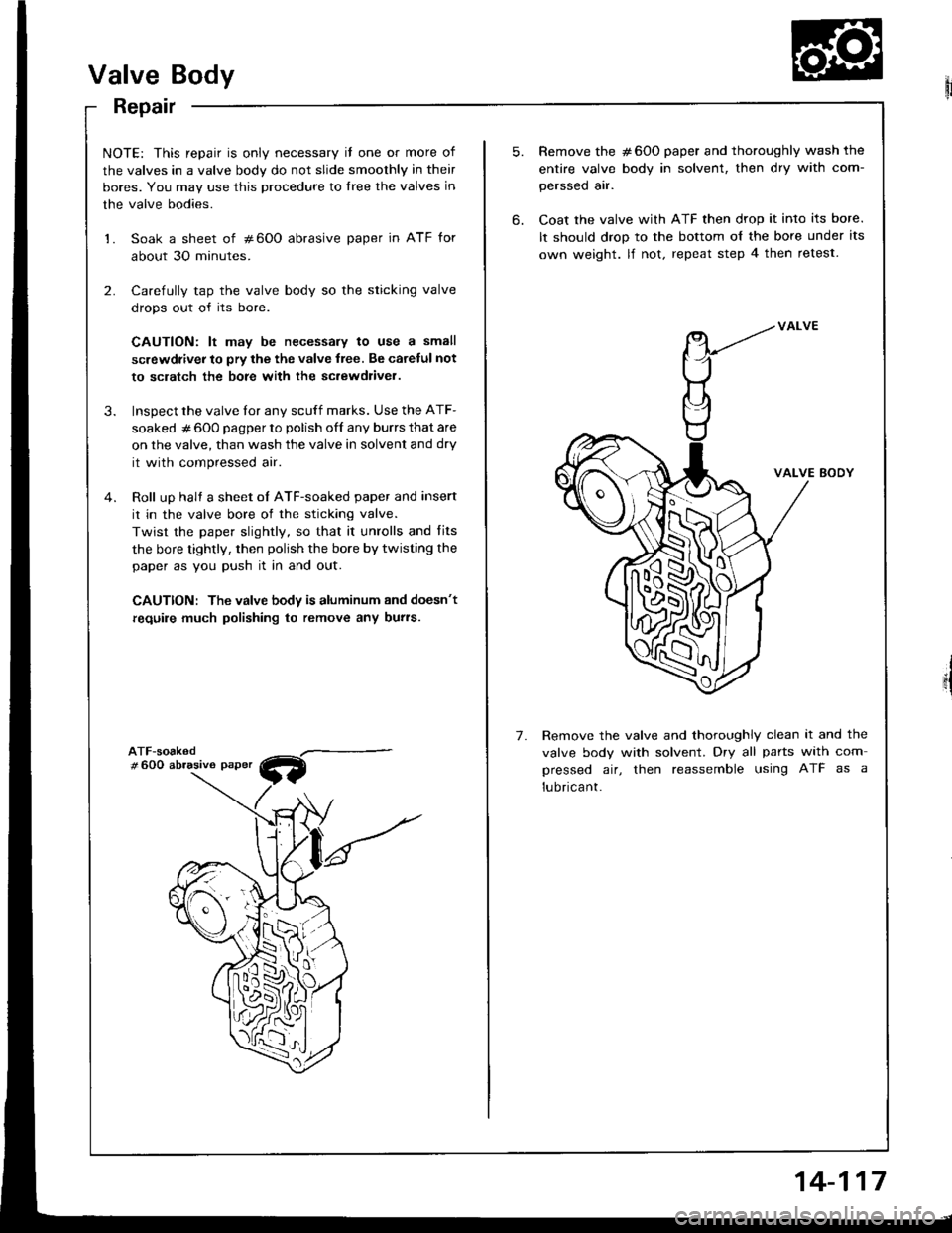
Valve Body
Repair
NOTE: This repair is only necessary il one or more of
the valves in a valve body do not slide smoothly in their
bores. You may use this procedure to lree the valves in
the valve bodies.
1. Soak a sheet of #600 abrasive paper in ATF for
about 30 minutes.
2. Carefully tap the valve body so the sticking valve
drops out of its bore.
CAUTION: lt may be necessary to use a small
screwdiiver to pry the the valve lree. Be carelul not
to sclatch the bore with ihe sc.ewdliver.
3. Inspect the valve tor any scuff marks. Use the ATF-
soaked # 600 pagper to polish off any burrs that are
on the valve, than wash the valve in solvent and dry
it with compressed air.
4. Roll up halt a sheet oI ATF-soaked paper and insert
it in the valve bore of the sticking valve.
Twist the paper slightly, so that it unrolls and fits
the bore tightly, then polish the bore by twisting the
paper as you push it in and out.
CAUTION: The valve body is aluminum and doesn't
require much polishing to remove any burs.
W
5.
6.
7.
Remove the #600 paper and thoroughly wash the
entire valve body in solvent, then dry with com-
perssed air.
Coat the valve with ATF then drop it into its bore.
It should drop to the bottom o{ the bore under its
own weight. lf not. repeat step 4 then retest.
VALVE BODY
Remove the valve and thoroughly clean it and the
valve body with solvent. Dry all parts with com
pressed air, then reassemble using ATF as a
lubricant.
14-117
Page 539 of 1413

7. Install the snap ring.
Remove the special tools.
Install the disc spring.
NOTE: Installthe disc spring in the direction shown.
SNAP RING
DISC SPRING
.\
):ll
14-148
1ST, 3")
Clutch
Reassembly (cont'd)
7. Install the snap ring.
Remove the special tools.
Install the disc spring.
NOTE: Installthe disc spring in the direction shown.
SNAP RING
DISC SPRING
.\
):ll
14-148
1ST, 3RD, 4TH andl ST.HOLD CLUTCH
1O. Soak the clutch discs thoroughly in ATF for a mini-mum of 30 minutes.
11. Starting with a clutch plate, alrernately install theclutch plates and discs. Install the clutch end plate
with flat side toward the disc.
NOTE: Before insralling the plates and discs, makesure the inside of the clutch drum is free ot dirt orother toreign matter.
CLUTCH END PLAT€Install in this direction
12. Install the snap ring.
SNAP RING
SCREWDRIVER
Page 558 of 1413
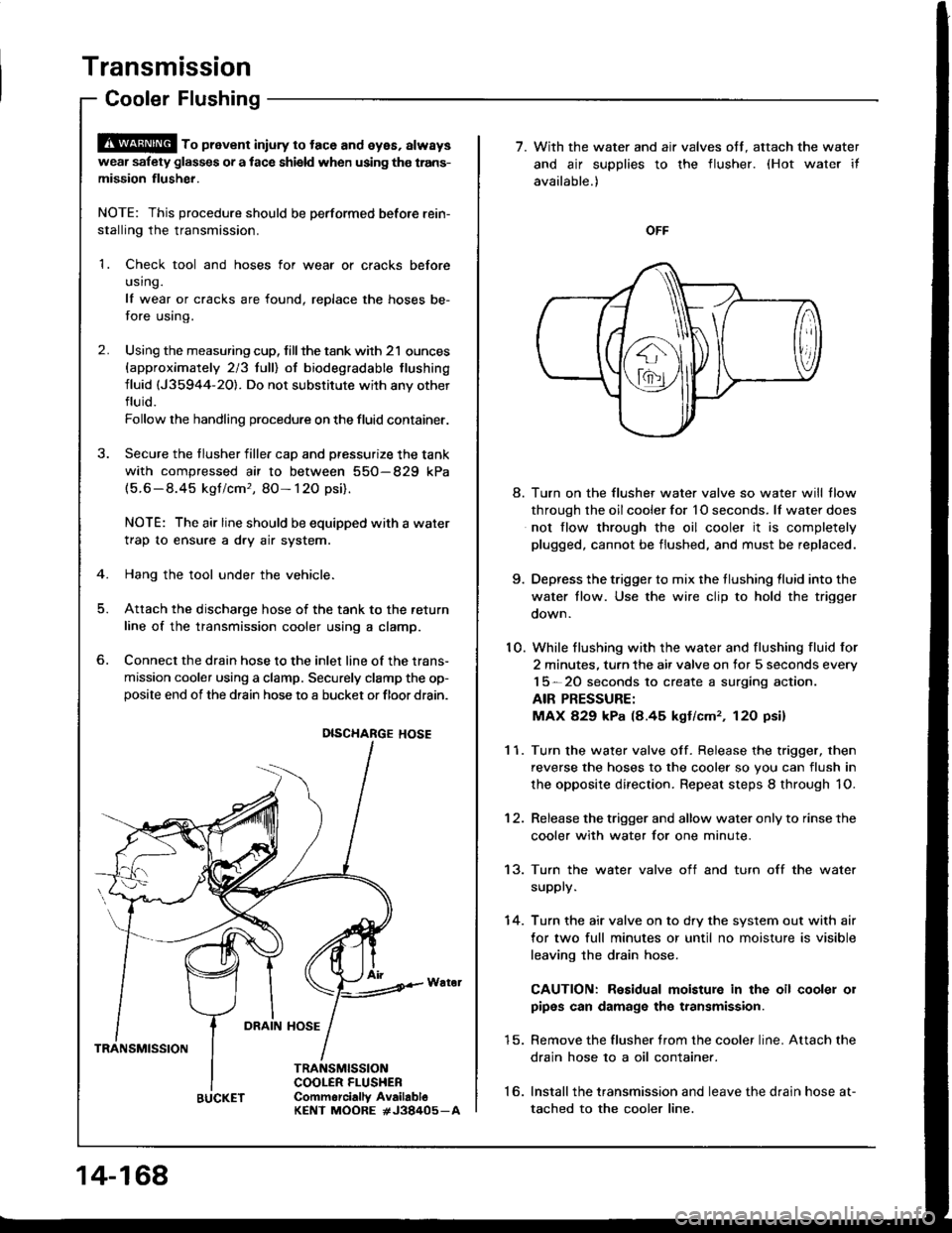
Transmission
Cooler Flushing
S!@ ro prevent iniury to tace and eyes, always
wear safety glas$es or a tace shield when using the trans-
mission flusher.
NOTE: This procedure should be performed before rein-
stalling the transmission.
1. Check tool and hoses for wear or cracks before
using.
lf wear or cracks are found, replace the hoses be-
fore using.
2. Using the measuring cup, tillthe tank with 21 ounces
{approximately 213 lulll of biodegradable tlushing
fluid (J35944-20). Do not substitute with any other
fluid.
Follow rhe handling procedure on the fluid container.
Secure the tlusher filler cap and pressurize the tank
with compressed air to between 550-829 kPa(5.6-8.45 kgt/cm,, 80- 120 psi),
NOTE: The air line should be equipped with a water
trap to ensure a dry air system.
Hang the tool under the vehicle.
Attach the discharge hose of the tank to the return
line of the transmission cooler using a clamp.
Connect the drain hose to the inlet line of the trans-
mission cooler using a clamp. Securely clamp the op-posite end of the drain hose to a bucket or floor drain.
6.
DRAIN HOSE
TRANSMISSION
TRANSMISSIONCOOLER FLUSHEBCommorcially AvailabloKENT MOORE #J38405_A
DISCHARGE HOSE
14-168
BUCKET
7. With the water and air valves off. attach the water
and air supplies to the flusher. (Hot water it
available.)
OFF
8. Turn on the flusher water valve so water will tlow
through the oil cooler for 1O seconds. lf water does
not flow through the oil cooler it is completely
plugged, cannot be flushed, and must be replaced.
9. Depress the trigger to mix the tlushing lluid into the
water tlow. Use the wire clip to hold the trigger
oown.
10. While flushing with the water and flushing fluid for
2 minutes. turn the air valve on for 5 seconds every
15-20 seconds to create a surging action.
AIR PRESSURE:
MAX 829 kPa (8.45 kgt/cm,, 12O psi)
1 1. Turn the water valve off. Release the trigger, then
reverse the hoses to the cooler so you can flush in
the opposite direction. Repeat steps 8 through 1O.
12. Release the trigger and allow water only to rinse the
cooler with water for one minute.
13. Turn the water valve off and turn off the water
supply.
14. Turn the air valve on to dry the system out with air
for two full minutes or until no moisture is visible
leaving the drain hose.
CAUTION: Residual moisture in the oil cooler 01
pipes can damage the transmission.
15. Remove the flusher trom the cooler line. Attach the
drain hose 10 a oil container.
16. lnstallthe transmission and leave the drain hose at-
tached to the cooler line.
Page 621 of 1413
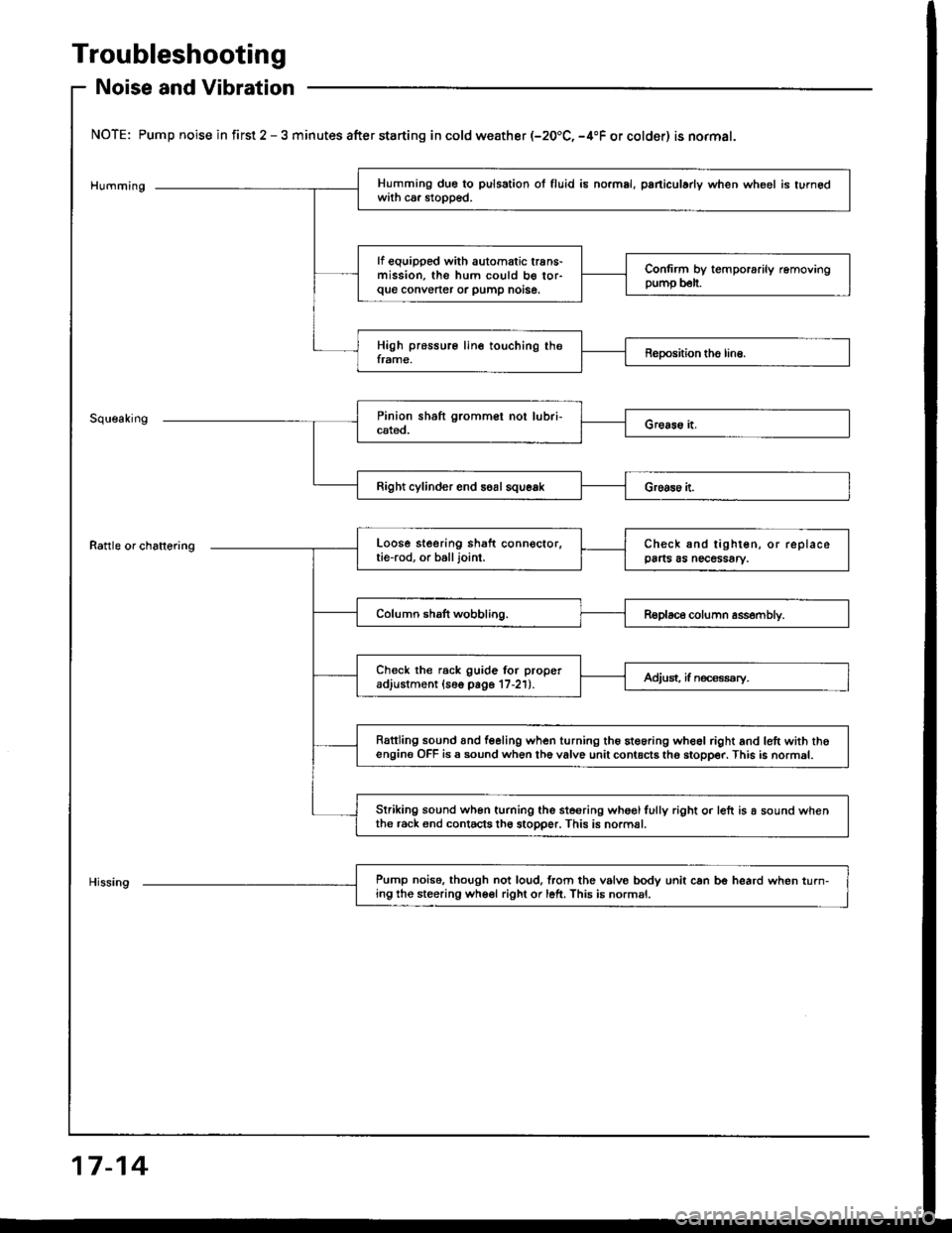
Troubleshooting
Noise and Vibration
NOTE: Pump noise in first 2 - 3 minutes after starting in cold weather (-20.C, -4"F or colder) is normal.
Humming
Rattle or chattering
Right cylinder end soal squeak
Pump noise. though not loud,lrom the vslvo bodv unit can be heard when turn-ing the steering wheel right or left. This is normsl.
Humming due to pulsation ol fluid is no.mal, paniculady when wheel is turnedwith ca. stopped.
lf equipped with automatic trans-mission, the hum could b€ tor-que convener or pump notse.
Confirm by temporarily removingpump b€lt.
High pressure line touching theframe,Reposhion tho line.
Loose steering shaft connector.tie-rod, or balljoint.Check and tighten, or replacepa s as necessary.
Column shaft wobbling.Replace column assembly.
Check the rack guide for properadjustment (16o page 17-21).Adjust, if n€ca€ssry.
Rattling sound and feeling when turning the steoring wheel right and lett with thoengine OFF is a sound when th6 valve unit contacts tho stopper. This is normal.
Striking sound wh6n turning the ste€ring whoglfully right o. left is a sound whenthe r6ck end contacts th6 stopper. This is normal.
17-14
Page 622 of 1413
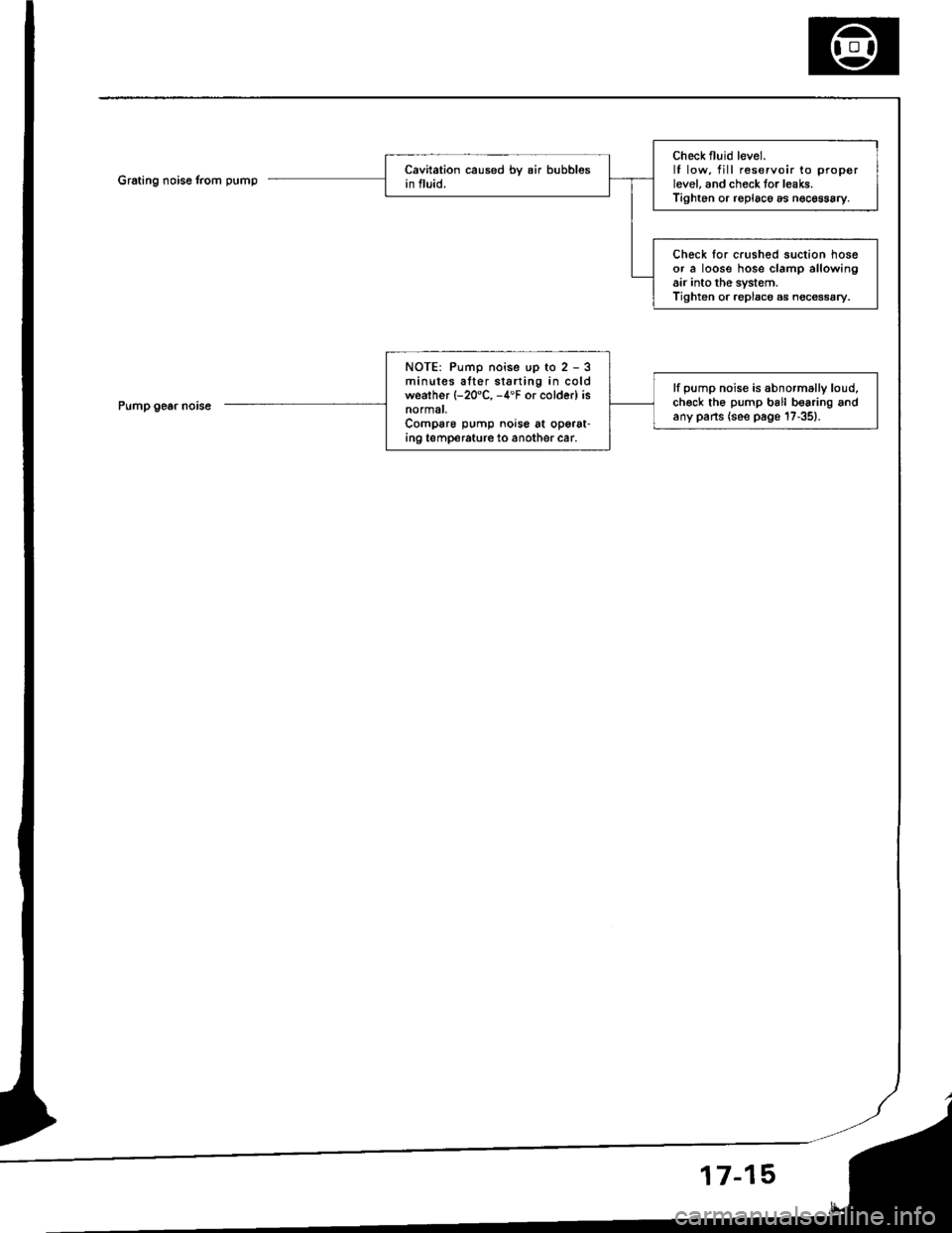
Grating noise from pump
Pump gear noise
Check fluid level.lf low. fill reservoir to properlevel, and check tor l€aks.Tighten or roplac6 as n€cessary.
Check for crushed suction hoseor a loose hose clamp allowingair into the system.Tighten or replace as noce$ary.
NOTE: Pump noise up to 2 - 3minutes alter starting in coldweather (-20'C, -4'F or colder) isnormat,Comparo pump noise at operat-in9 temperature to another car.
lf pump noise is abnormally loud,chgck the pump ball b€aring andany pans (see page 17-351.
17-15
Page 927 of 1413
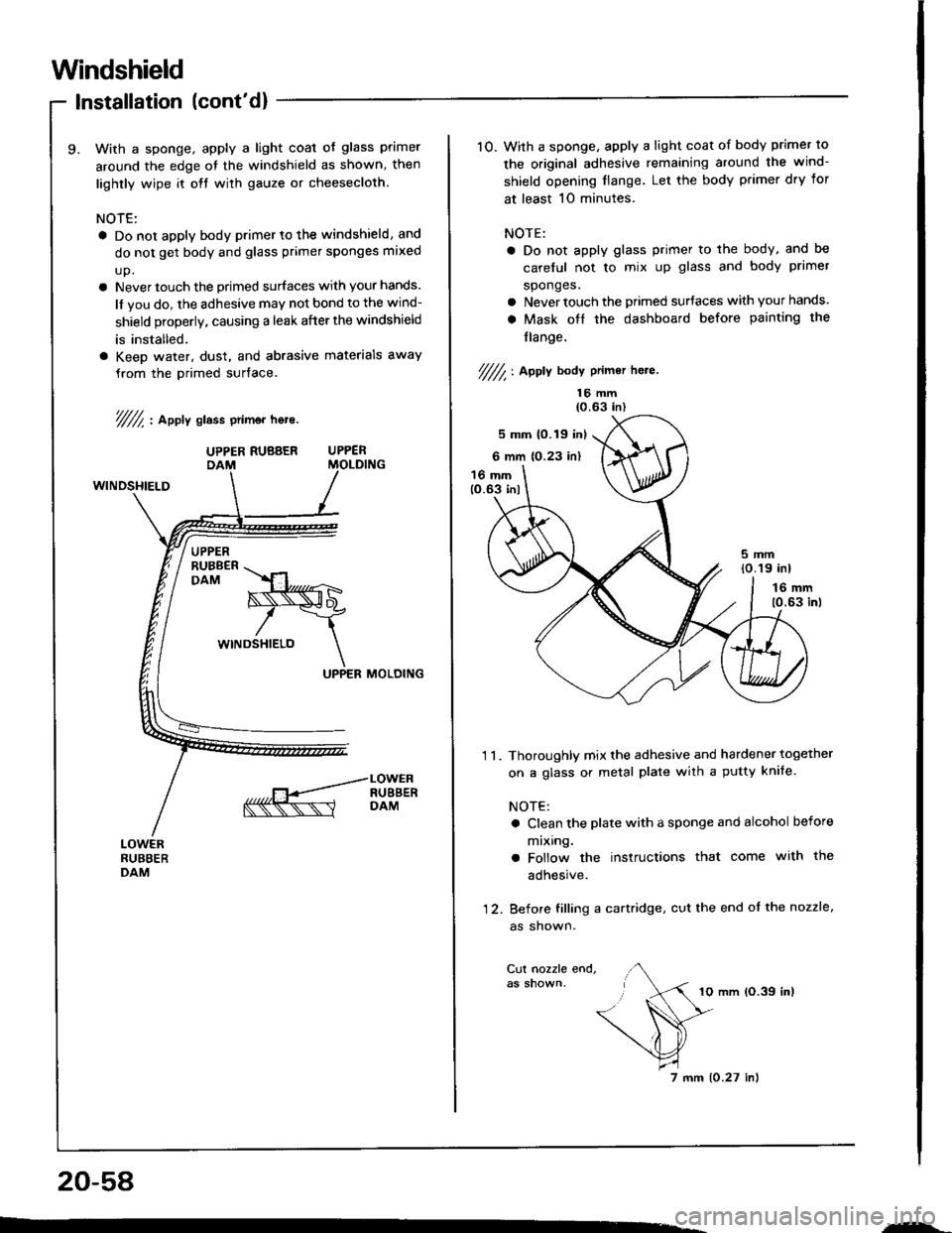
Windshield
Installation (cont'd)
With a sponge. apply a light coal oJ glass primer
around the edge ot the windshield as shown, then
lightly wipe it olt with gauze or cheesecloth.
NOTE:
a Do not apply body primer to the windshield, and
do not get body and glass primer sponges mlxed
up.
a Never touch the primed surfaces with your hands.
ll you do, the adhesive may not bond to the wind-
shield properly, causing a leak afterthe windshield
is installed.
o Keep water, dust, and abrasive materials awaY
from the primed surface.
V//f, : apptv stass ptimer hors.
WINDSHIELD
RUBBER -DAM .YJ * o
>\ast,
/\WINDSHIELD
\UPPER MOLOING
UPPER RUBBER UPPER
10. With a sponge, apply a light coat of body primer to
the original adhesive remaining around the wind-
shield opening flange. Let the bodY primer dry tor
at least 1O minutes.
NOTE:
a Do not apply glass primer to the body, and be
careful not to mix up glass and body primer
sponges,
a Never touch the primed surfaces with your hands.
a Mask otl the dashboard before painting the
flange.
//////, I Aeely bodv Primer h6te.
16 mm{0.63 in)
5 mm {0.19 inl
6 mm (0.23 in)
16 mm1O.63 inl
5mm(O.19 inl
16 mm
10.63 inl
1 1 . Thoroughly mix the adhesive and hardener together
on a glass or metal plate with a putty knife.
NOTE:
a Clean the plate with a sponge and alcohol before
mixlng.
a Follow the instructions that come with the
adhesive.
12. Before filling a cartridge, cut the end ol the nozzle,
as shown.
Cut nozzle end,
10 mm (O.39 inl
20-58
7 mm 10.27 in)
,*-