Idle HONDA INTEGRA 1994 4.G Repair Manual
[x] Cancel search | Manufacturer: HONDA, Model Year: 1994, Model line: INTEGRA, Model: HONDA INTEGRA 1994 4.GPages: 1413, PDF Size: 37.94 MB
Page 481 of 1413
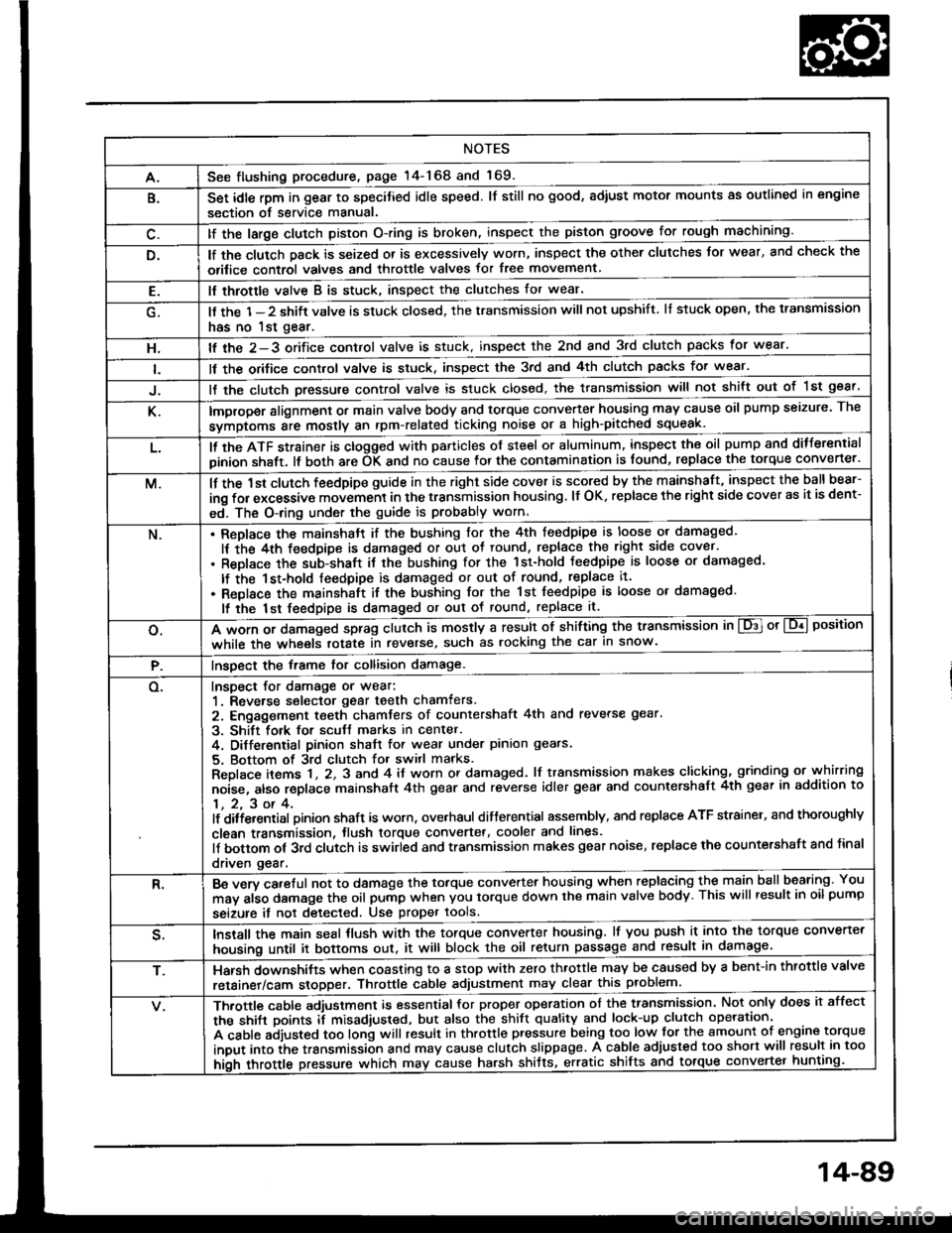
NOTES
A.See flushing procedure, page l4-168 and 169.
B.Set idle rpm in gear to specitied idle speed. lf still no good, adiust motor mounts as outlined in engine
section of service manual.
lf the large clutch piston O-ring is broken, inspect the piston groove for rough machining.
lf the clutch pack is seized or is excessively worn, inspect the other clutches Jor wear, and check the
orifice control valves and throttle valves for free movement.
E.It throttle valve B is stuck, inspect the clutches for wear.
lf the 1-2 shift valve is stuck closed, the transmission will not upshift. lI stuck open, the transmission
has no lst gear.
H.lf the 2-3 orifice control valve is stuck, inspect the 2nd and 3rd clutch packs for wear.
ll the orifice cont.ol valve is stuck, inspect the 3rd and 4th clutch packs for wear.
lf the clutch Dressure control valve is stuck closed, the transmission will not shilt out of 1st gear.
K.improper alignment or main valve body and torque converter housing may cause oil pump seizure. The
symptoms ale mostly an rpm-related ticking noise or a high-pitched squeak.
L.ll the ATF strainer is ctogged with panicles of steel or aluminum, inspect the oil pump and ditferential
pinion shaft. lt both are OK and no cause lor the contamination is found, replace the torque converter.
M.lf the 1st clutch feedpipe guide in the right side cover is scored by the mainshaft, inspect the ball bear-
ing for excessive movement in the transmission housing. lf OK. replace the right side cover as it is dent-
ed. The O-ring under the guide is probably worn.
N.ReDlace the mainshstt if the bushing for the 4th feedpipe is loose or damaged.
It the 4th feedpipe is damaged or out ot tound, replace the right side cover'
Replace the subjshaft it thtbushing for the 1st-hold Jeedpipe is loose or damaged.
lf the 1st-hold feedpipe is damaged or out of round, replace it.
Replace the mainshaft if the bushing lor the 1st feedpipe is loose or damaged.
lf the lst feedpipe is damaged or out ot round, replace it.
o.A *o- r, da."s"d "p-g clutch is mostly a result of shifting the transmission in El or Lq! position
while the wheels rotate in reverse, such as rocking the car in snow.
P.InsDect the frame for collision damage.
o.Inspect for damage or wear:
1. Reverse selector gear teeth chamfers.
2. Engagement teeth chamters of countershaft 4th and reverse gear.
3. Shift fork for scutt marks in center.
4. Differential Dinion shaJt for wear under pinion gears.
5. Bottom of 3rd clutch for switl marks.
Replace items 1 , 2, 3 and 4 it worn or damaged. lf transmission makes clicking, grinding or.whirring
noise, atso replace mainshaft 4th gear and reverse idler gear and countershaft 4th gear in addition to
1,2,3ot4.lf ditiersntial Dinion shaft is worn, overhaul differential assembly, and replace ATF strainel, and thoroughly
clean transmission, tlush torque convertet, cooler and lines.
lf bottom of 3rd clutch is swirled and transmission makes gear noise, replace the countershaft and tinal
driven gear.
R.Be wry careful not to dsmage the torque converter housing when replacing the main ballbearing. You
may al;o damage the oil pump when you torque down the main valve body. This will result in oil pump
seizure it not detected. Use proper tools.
qInstall the main seal tlush with the torque converter housing, lf you push it into the torque converter
housing until it bottoms out. it will block the oil return passage and result in damage.
T,Harsh do\/vnshiJt"\./l,'hen coasting to a stop with zero th.ottle may be caused by a bent-in throttle valve
retainer/cam stopper. Throttle cable adjustment may clear this problem.
ifuitle cable adjustment is essential for proper operation of the transmission. Not only does it affect
the shift points if misad,usted, but also the shift quality and lock-up clutch operation'
A cable adjusted too long will result in throttle pressure being too low for the amount of engine torque
input into ihe trsnsmission and may cause clutch slippage. A cable adjusted too short will result in too
hi;h throttle pressure which may cause harsh shitts, erratic shrfts and torque con
14-89
Page 488 of 1413
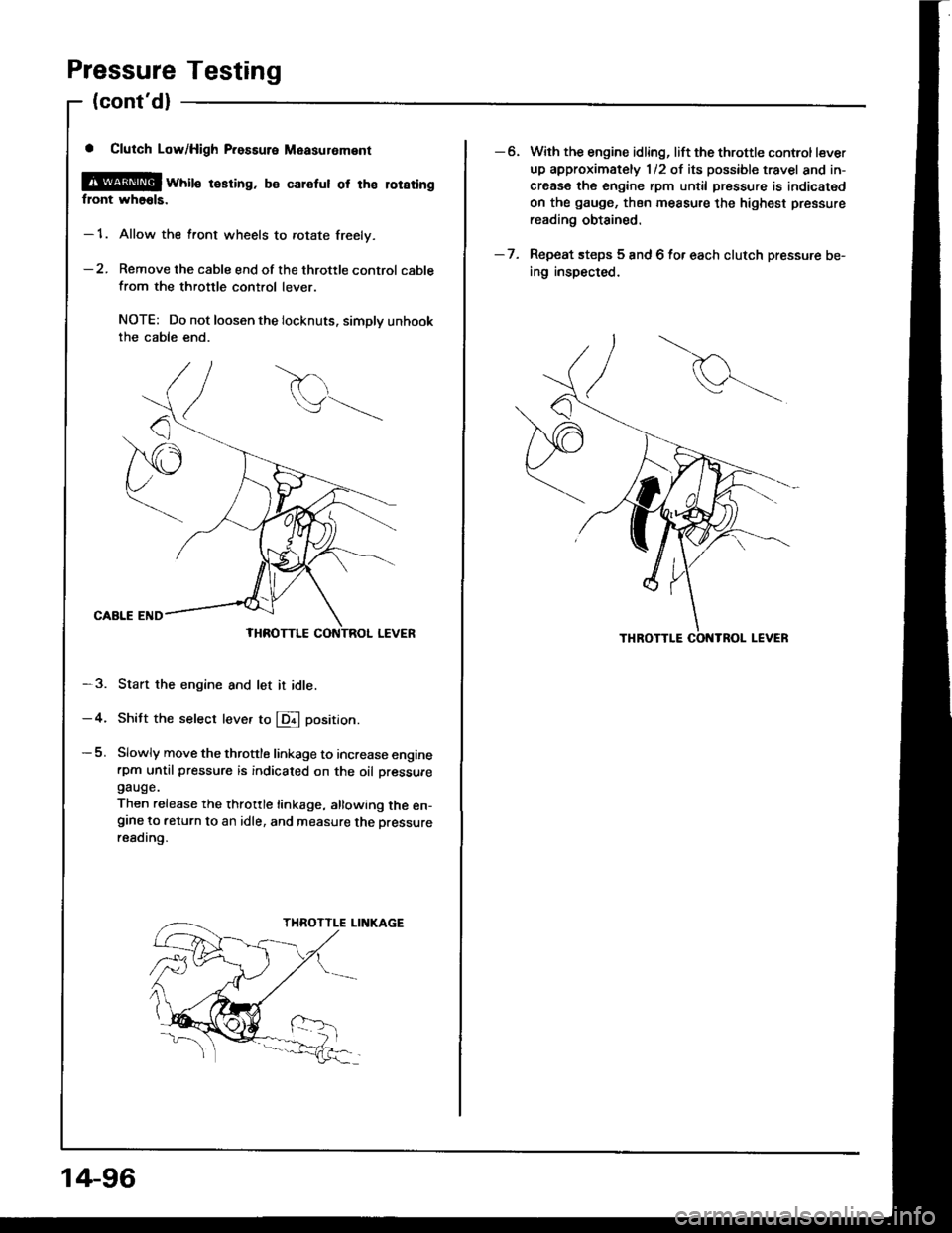
Pressure Testing
(cont'dl
a Clutch Low/High P.essure Measuroment
@[ wtite resring. b€ calefut ot tha loraringflont wh66ls.
- 1. Allow the front wheels to rotate freely.
-2. Remove the cable end of the throttle control cable
from the throttle control lever.
NOTE: Do not loosen the locknuts. simplv unhookthe cable end.
CAALE END
-3. Start the engine and let it idle.
-4. Shitt the select leve. to E position.
-5. Slowly move the throttle linkage to increase enginerpm until pressure is indicaied on the oil oressuregauge.
Then release the throttle linkage, allowing the en-grne to return to an idle, and measure the Dressureresding.
14-96
-6. With the engine idling, lift the throttle control lever
up approximately 1/2 of its possible travel and in-
crease the engine rpm until pressure is indicated
on the gauge, then measure the highest pressure
reading obtained.
- 7. Repeat steps 5 and 6 for each clutch pressure be-
ing inspected.
Page 498 of 1413
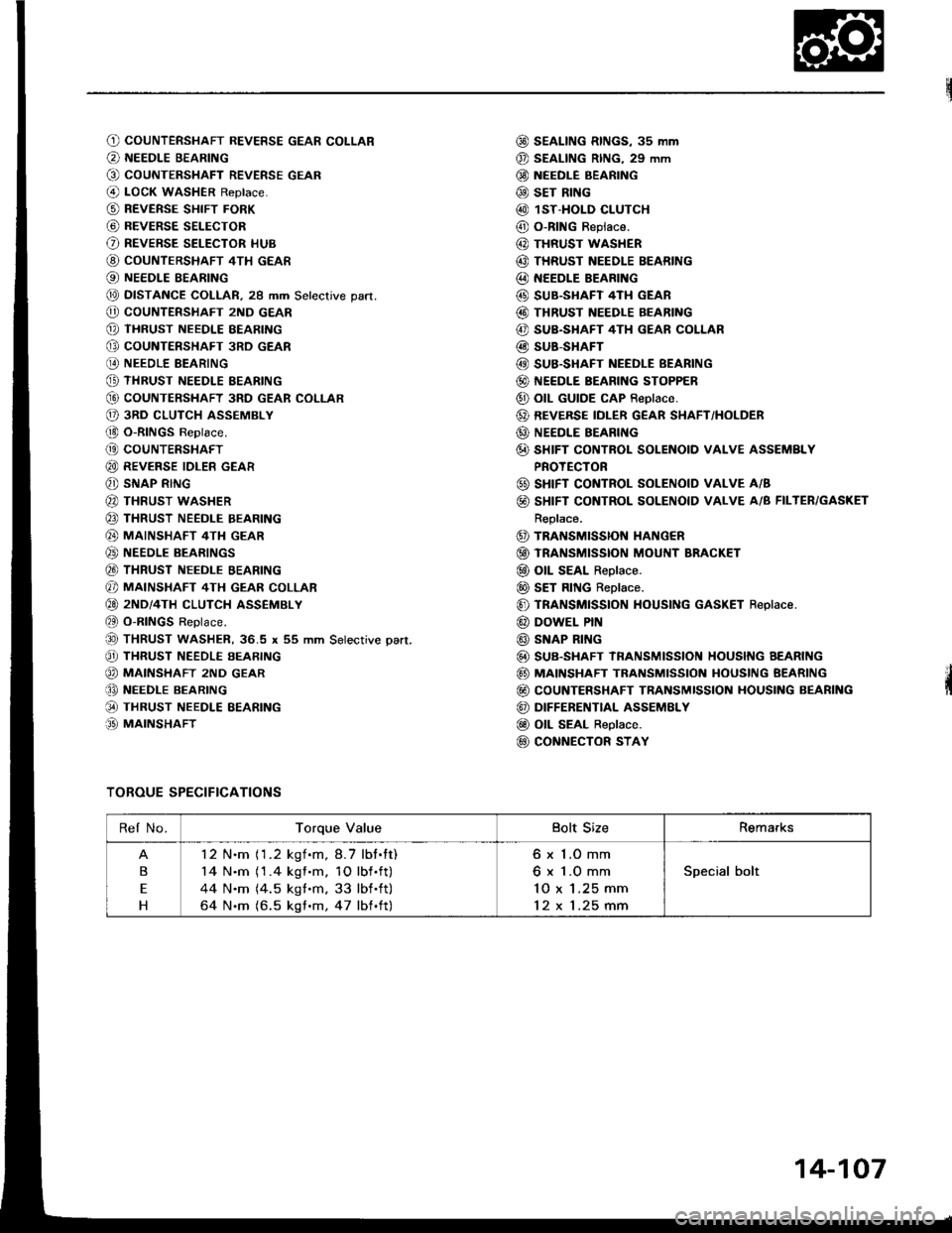
O) COUNTERSHAFT REVERSE GEAR COLLAR
@ NEEDLE BEARING
G) COUNTERSHAFT REVERSE GEAR
@ LOcK WASHER Reptace.
@ REVERSE sHIFT FoRK
@ BEVERSE SELECToR
O REVERSE SELECToR HUB
@ couNTERSHAFT 4TH GEAR
@ NEEDLE BEARING
@ DTSTANCE COLLAR, 29 mm Setecrive part.
@ coUNTERSHAFT 2ND GEAR
@ THRUST NEEDLE BEARING
@ GoUNTERSHAFT 3RD GEAR
@ NEEDLE BEARING
@ THRUST NEEDLE EEARING
G) COUNTERSHAFT 3RD GEAR COLI-AR
O 3RD cLuTcH ASSEMBLY
(!) O-RINGS Replace.
@ coUNTERSHAFT
@ REVERSE IDLER GEAR
@ SNAP RING
@ THRUST WASHER
@ THRUST NEEDLE BEARING
@ MAINSHAFT 4TH GEAR
@) NEEDLE BEARINGS
@ THRUST NEEDLE BEARING
@ MAINSHAFT 4TH GEAR coLLAR
@ 2ND/4TH cLUTcH ASSEMBLY
et O-RINGS Replace.
@ THRUST waSHER, 36.5 x 55 mm Setective pan.
@ THRUST NEEDLE EEARING
@ MA|NSHAFT 2ND GEAR
€, NEEDI.E BEARING
@ THRUST NEEDLE EEARING
.O MAINSHAFT
@ SEAL|NG RtNGs, 3s mm
@ SEAL|NG R|NG, 29 mm
@ NEEDLE BEARING
@ sET RING
@ 1ST-HOLD CLUTCH
@ O-RING Replace.
@ THRUST WASHER
@ THRUST NEEDLE BEARING
@ NEEDLE BEARING
@ SUB.SHAFT 4TH GEAR
@ THRUST NEEDLE BEARING
@ SUB.SHAFT 4TH GEAR COLLAR
@ SUB-SHAFT
@ SUB.SHAFT NEEDLE BEARING
@ NEEDLE BEARING SToPPER
@ otL GUTDE cAP Reptace.
@ REVERSE IDLER G€AR SIIAFT/HOLDER
@ NEEDLE BEARII{G
@ sHIFT GONTROL SOLENOID vAI.vE ASSEMBLY
PROTECTOR
@ sHrFT CONTROL SOLENOTD VALVE A/B
@ SHIFT CONTROL SOLENOID VALVE A/B FILTER/GASKET
Replace.
@ TRANSMISSION HANG€R
@ TRANSMtsstoN MouI{T BRAGKET
@ oll SEAL Replace.
@ sET RING Replace.
@ TRANSMISSION HOUSING GASKET Replace.
@ DOWEL PrN
@ SNAP RI G
@ SUB-SHAFT IRANSMtSStON HOUSNG AEARTNG
@ MAINSHAFT TRANSMISSION HOUSING BEARING
@ coUNTERSHAFT TRANSMISSION HOUSING BEARING
@ DIFFERENTIAL ASSEMELY
@ OtL SEAL Replace.
@ CoNNECTOR STAY
TOROUE SPECIFICATIONS
Rel No.Torque ValueBolt SizeRemarks
B
E
H
12 N.m (1.2 kgf.m,8.7 lbt.tt)
14 N.m (1 .4 kgf .m. 10 lbf .ft)
44 N.m (4.5 kgt.m, 33 lbf .ft)
64 N.m (6.5 kgf .m, 47 lbf .ft)
6 x 1.O mm
6 x 1.O mm'lO x 1.25 mm
12 x 1.25 mm
Special bolt
14-107
Page 545 of 1413
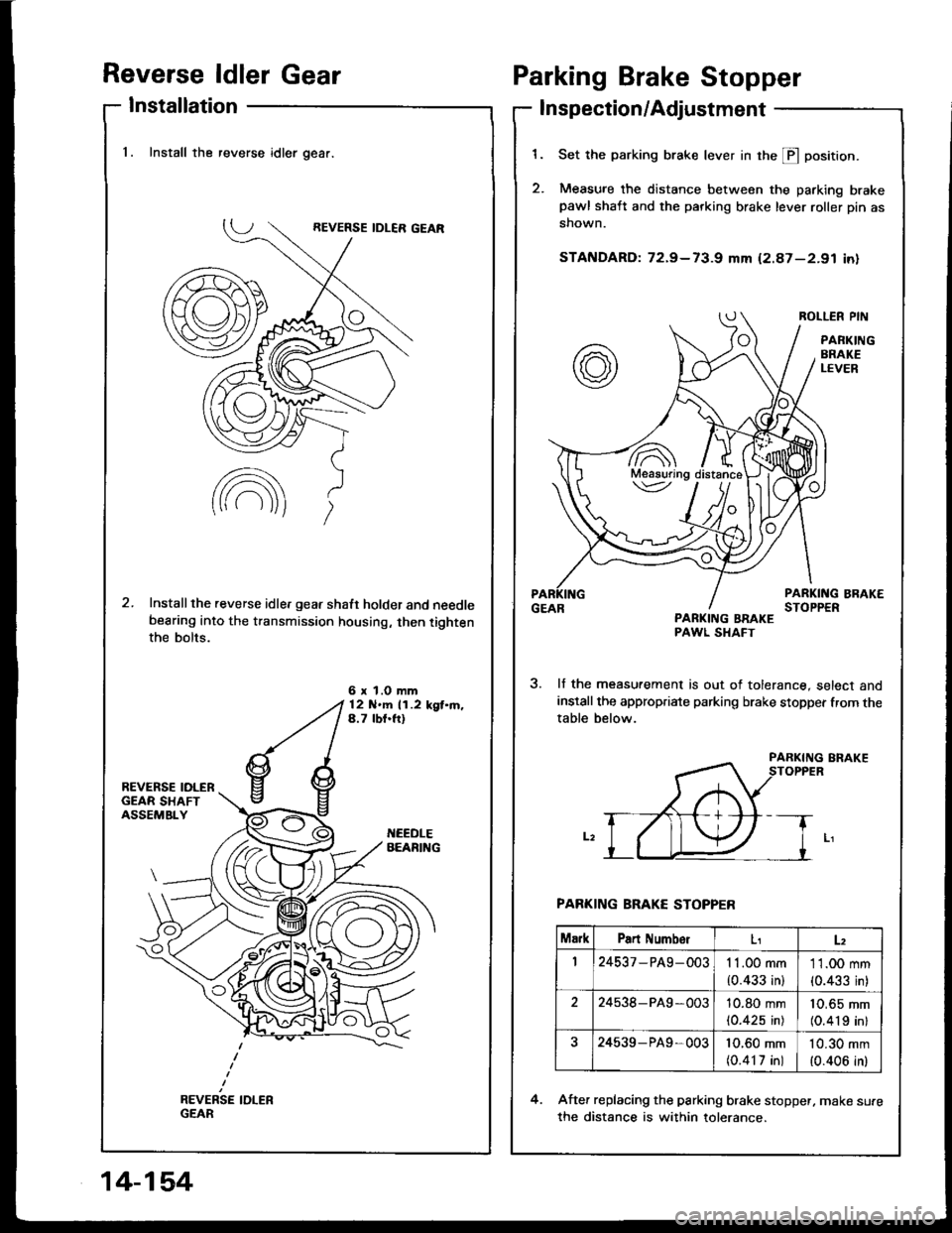
Reverse ldler Gear
Installation
Parking Brake Stopper
Inspection/Adjustment
1.
2.
Set the parking brake lever in the E position.
Measure the distance between the parking brakepawl shaft and the parking brake lever roller pin as
shown.
STANDARD: 72.9-73-g mm (2.87-2.91 in)
ROLLER PIN
PANKINGBRAKELEVER
PARKING BRAKESTOPPERPARKING BBAKEPAWL SHAFT
lf the measurement is out of tolerance, select andinstall the appropriate parking brake stopper from thetable below.
PARKING BRAKE STOPPER
After replacing the parking brake stopper, make su.e
the distance is within tolerance.
4.
7A\Meaauring\v
MarkPart NumbolLz
124537 - PA9- 0031 1.00 mm
{0.433 in}
11.00 mm
{0.433 in)
224538-PA9 -00310.80 mm(0.425 in)
10,65 mm(0.419 inl
24539- P49,00310.60 mm(0.417 in)
10.30 mm
{0.406 in)
1. Install the reverse idler gear.
Installthe reverse idle, gear shaft holder and needlebearing into the transmission housing, then tightenthe bolts.
6 x l.O mm12 N'm 11.2 kgt.m.4.7 lbf.ft)
14-154
Page 549 of 1413
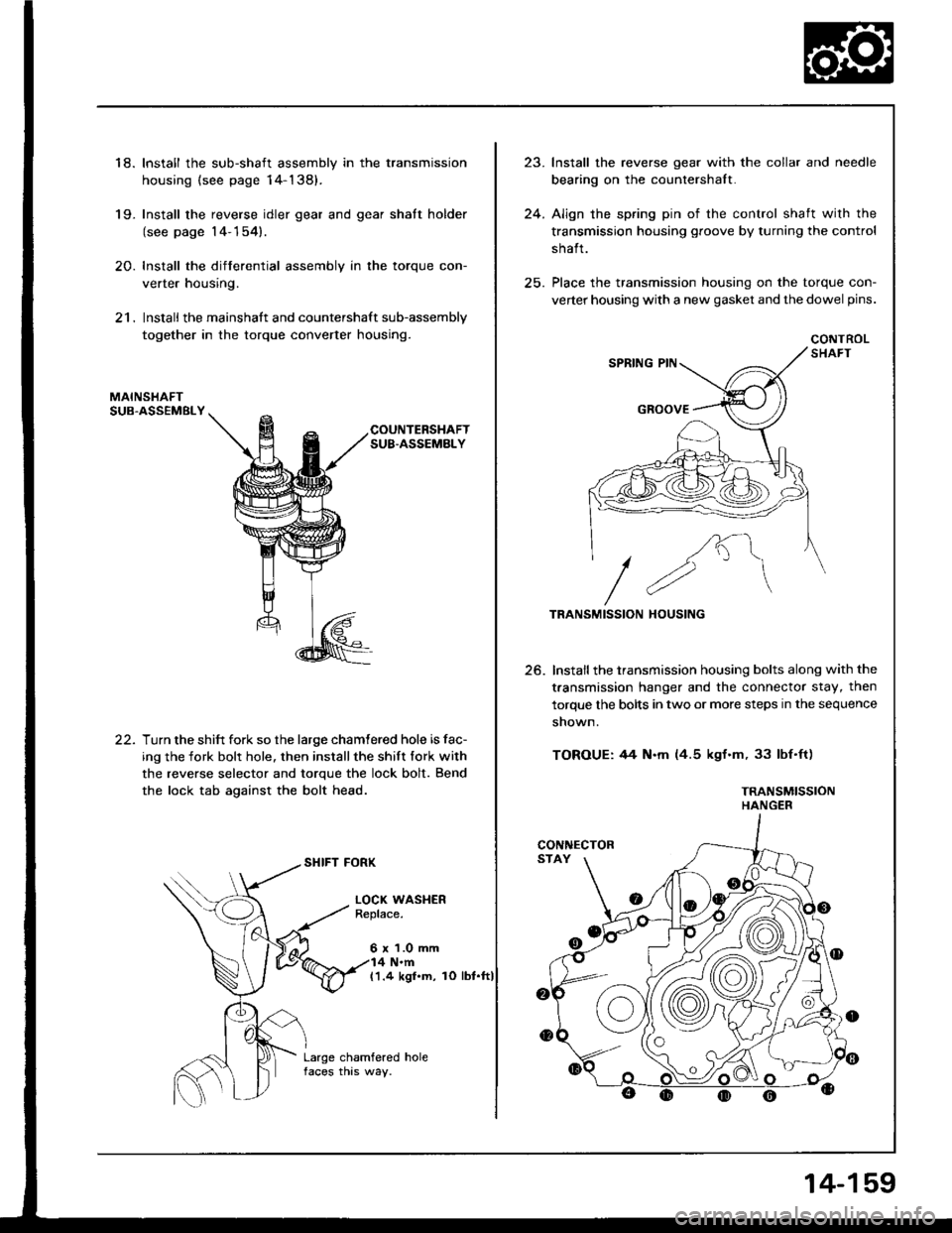
18. Install the sub-shaft assembly in the transmission
housing {see page 14-138).
19- Install the reverse idler gear and gear shatt holder
(see page 14-154).
20. Install the differential assembly in the torque con-
verter housing.
21. Install the mainshaft and countershaft sub-assembly
together in the torque converter housing.
MAINSHAFTSUB.ASSEMBLY
COUNTERSHAFTSUB.ASSEMBLY
22.Turn the shift fork so the large chamtered hole is fac-
ing the fork bolr hole. then installthe shift fork with
the reverse selector and torque the lock bolt. Bend
the lock tab against the bolt head.
SHIFT FORK
LOCI( WASHERReplace.
6 x 1.0 mm4 N.m(1.4 kgl.m, rO lbt.ft)
Large chamfered holefaces this way.
,,1
24.
lnstall the reverse gear with the collar and needle
bearing on the countershalt.
Align the spring pin of the control shaft with the
transmission housing groove by turning the control
shalt.
Place the transmission housing on the torque con-
verter housing with a new gasket and the dowel pins.
CONTROL
/K"\
//2"\TRANSMISSION HOUSING
Install the transmission housing bolts along with the
t.ansmission hanger and the connector stay, then
torque the bolts in two or more steps in the sequence
shown.
TOROUE: 44 N.m (4.5 kgf.m, 33 lbf'ft)
TRANSMISSIONHANGER
25.
CONNECTOR
14-159
Page 613 of 1413
System Description
Steering Pump (cont'dl
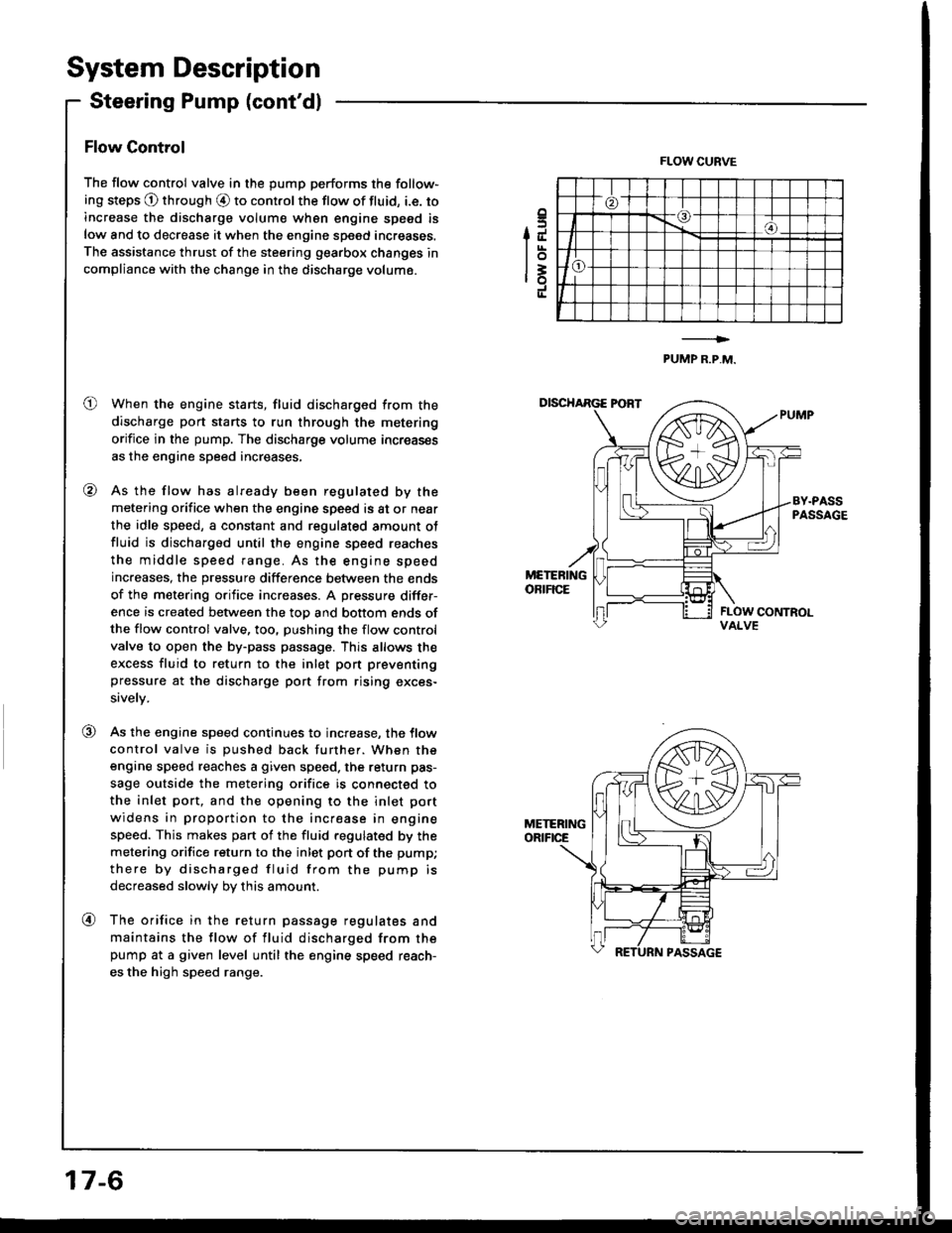
Flow Control
The flow control valve in the pump performs the follow-
ing steps @ through O to control the flow of fluid, i.e. to
increase the discharge volum€ wh6n engine speed is
low and to decrease it when the engine speed increases.
The assistance thrust of the steering gearbox changes in
compliance with the change in the discharge volume.
When the engine starts, fluid discharged from the
discharge port starts to run through the metering
orifice in the pump. The discharge volume increas€s
as the engine speed increases,
As the flow has already been regulated by the
metering orifice when the engine speed is at or near
the idle speed, a constant and regulated amount ot
fluid is discharged until the engine speed reaches
the middle speed range. As the engine speed
increases, the pressure difference between the ends
of the metering orifice increases. A pressure differ-
ence is created between the top and bottom ends ofthe flow control valve, too, pushing the flow control
valve to open the by-pass passage. This allows the
excess fluid to return to the inlet pon preventing
pressure at the discharge port trom rising exces-
sively.
As the engine speed continues to increase, the tlow
control valve is pushed back further. When the
engine speed reaches a given speed. the return pas-
sage outside the metering orifice is connected to
the inlet port, and the opening to the inlet port
widens in proportion to the increase in engine
speed. This makes pan of the fluid regulated by the
metering orifice return to the inlet pon of the pump;
there by discharged fluid from the pump is
decreased slowly by this amount.
The orifice in the return passage regulates and
maintains the flow of fluid discharged from thepump at a given level until the engine speed reach-
es the high speed range.
.5IJ
lot=ro
FLOW CURVE
PUMP R.P,M.
o
@
VALVE
@
@
17-6
Page 617 of 1413
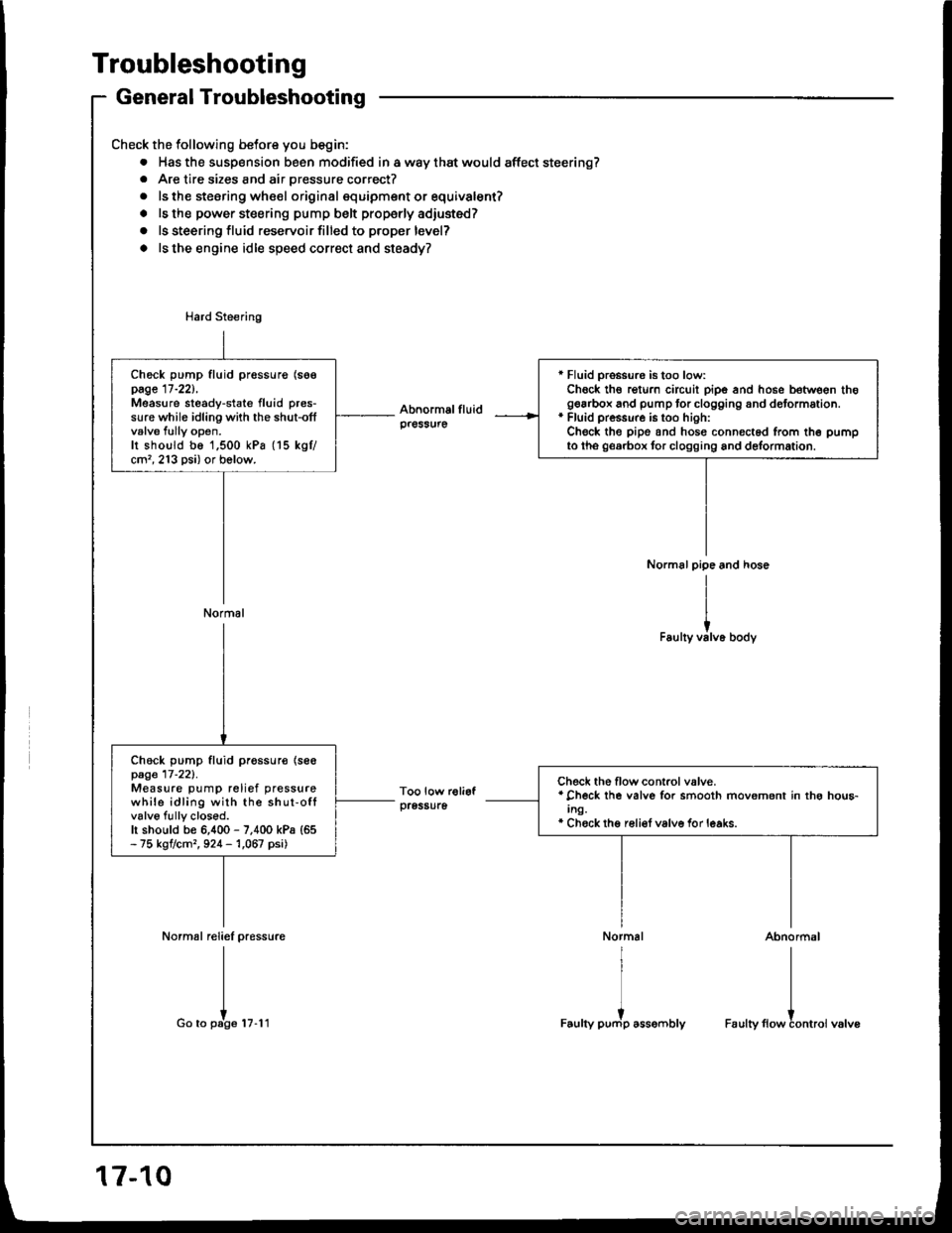
Troubleshooting
General Troubleshooting
Check the following betore you begin:
. Has the susp€nsion been modified in a way that would affect steering?. Are tire sizes and air pressure correct?
. ls the steering whe€l original squipment or equivalent?
. ls the power steering pump belt properly adiusted?
o ls steering fluid reservoir filled to proper level?
o ls the engine idle speed correct and steady?
Normal reliel pressure
I
I
Go to pate tu.l t
r Fluid pro$ure is too low:Chock th€ rgturn circuit pipe and hose between thogearbox and pump tor clogging and dotormation.* Fluid pressure is too hioh:Check the pipe and hosg connected from th6 pumpto tho georbox tor clogging and delormation.
Check pump fluid pressurg (soepage 17-221,Measure steady-state fluid pres-sure while idling with the shut-offvalve fully open.Ir shoutd be 1,500 kPa (15 kgtcm', 213 psi) or bolow.
Normal
Check pump fluid pr€ssur€ {se€page 17-221.Measure pump relief pressurewhile idling with the shut-offvalve fully closod.h should be 6,400 - 7,400 kPa {65- 75 kgtcm,, 924 - 1,067 psi)
Check the flow control valve.* Check lhe valve for smooth movement in thg hou6-Ing.* Chock thg reli€f valve for leaks.
Abnormal
I
I
Faulty flowtontroi valve
17-10
Page 620 of 1413
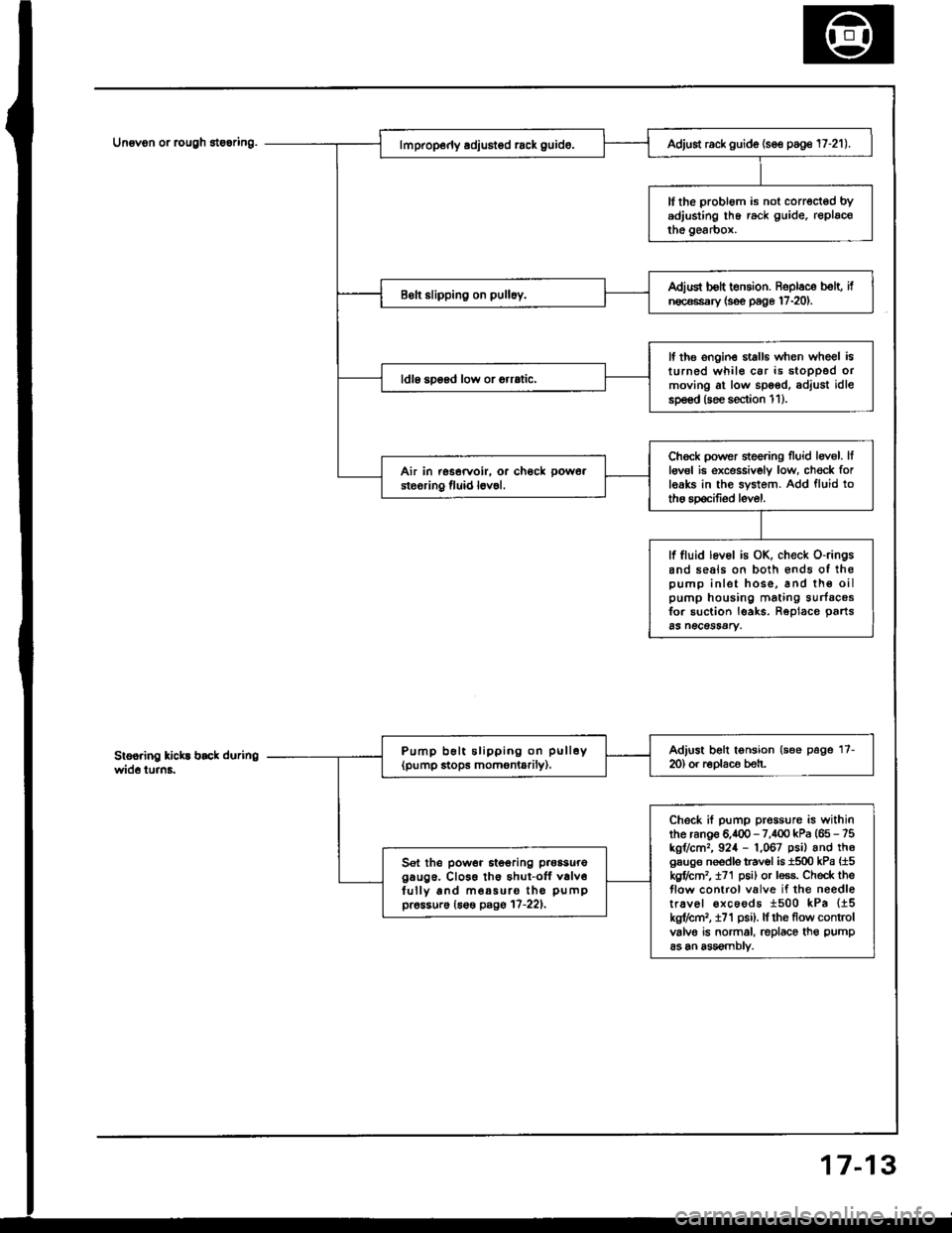
Unovon or rcugh 8te6ring.
3
Adjust rack guide (se€ poge 17-21).
ll the probl6m is not corrected bYadjusting lhe rack guide. replacothe gearbox.
Adiud bolt t€nsion. Roplace b€lt, ifn€c€ssary {s€e page 17-20).
lf the ongin€ stalls when wheel isturned whil€ car is stoDPed ormoving at low spoed, adjust idlesp€€d (soe section 1 1 ).
ldl6 soosd low or orrrtic.
Chock power sieering Iluid levol. Itlgv6l ie excessivoly low, ch€ck forleaks in the system. Add fluid totho spocifiod level.
Air in rssorvoir. or ch€ck pow6a
steoring fluid l6v6l.
lf fluid lev6l is OK, check o-ringsand seals on both €nds of ihopump inlet hose, and th€ oilpump housing mating surfacosfor suction leaks. Reolace oarts65 n€CeSSAry.
Adjust belt tonsion (see page 17-m) or r€Dlaco beh.Pump b6lt slipping on pull6y(pump stops momontarily).
Check if pump prossure is withinthe ranoe 6.400 - 7,100 kPa (65 - 75kgr/cm,, 924 - 1,067 psil and th6gsuge needls travol is 1500 kPa {15kgflctn2, t71 p6i) or less. Check theflow control valve if the needletr.vel €xcoods 1500 kPa {15kg?cm,, i71 psi). lf rhe flow controlvalvo is normal, replace th€ pump
as an assomblv.
Sel the power itooring p.oasuregaug6. Cl066 th€ shut-off v6lv6fully and m€a5uro tho pumppr6ssur6 (6s€ pagg 17-221,
7-1
Page 625 of 1413
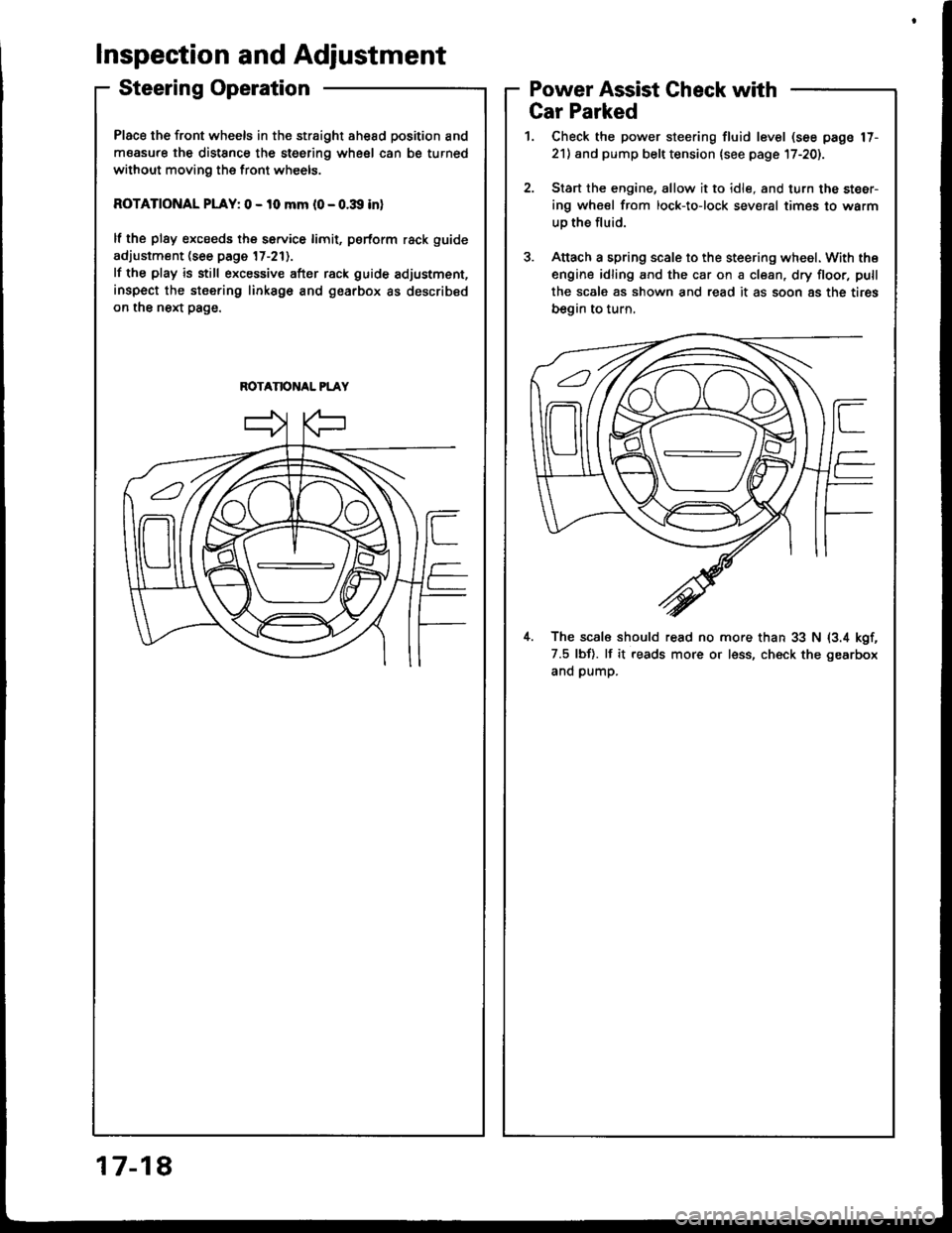
Place the front wheels in the straight ahesd position and
measure the distSnce the steering wheel can be turned
without moving the front wheels.
ROTATIONAL PLAY: 0 - 10 mm l0 - o.:Xl inl
lf the plsy excseds the service limit, psrform rack guide
adjustment (see page 17-211.
lf the play is still excessive after rack guide adjustment,
inspect the stsering linksgo and gearbox as described
on the next page.
ROTANONAL PLAY
Inspection and Adjustment
Steering OperationPower Assist Gheck with
817-1
Gar Parked
1. Check the power steering fluid level (see page 17-
21) and pump belt tension lsee page l7-20).
2.Start the engine, allow it to idle, and turn the steer-
ing wheel from lock-to-lock sev€ral times to warm
uo the fluid.
Attach a spring scale to the steering wheel. With the
engine idling and the car on a clean, dry floor, pull
the scale as shown and read it as soon 8s the tires
begin to turn,
il. The scal6 should read no more than 33 N (3.4 kgf,
7.5 lbf). lf it reads more or less, ch€ck the gearbox
and pump.
Page 628 of 1413
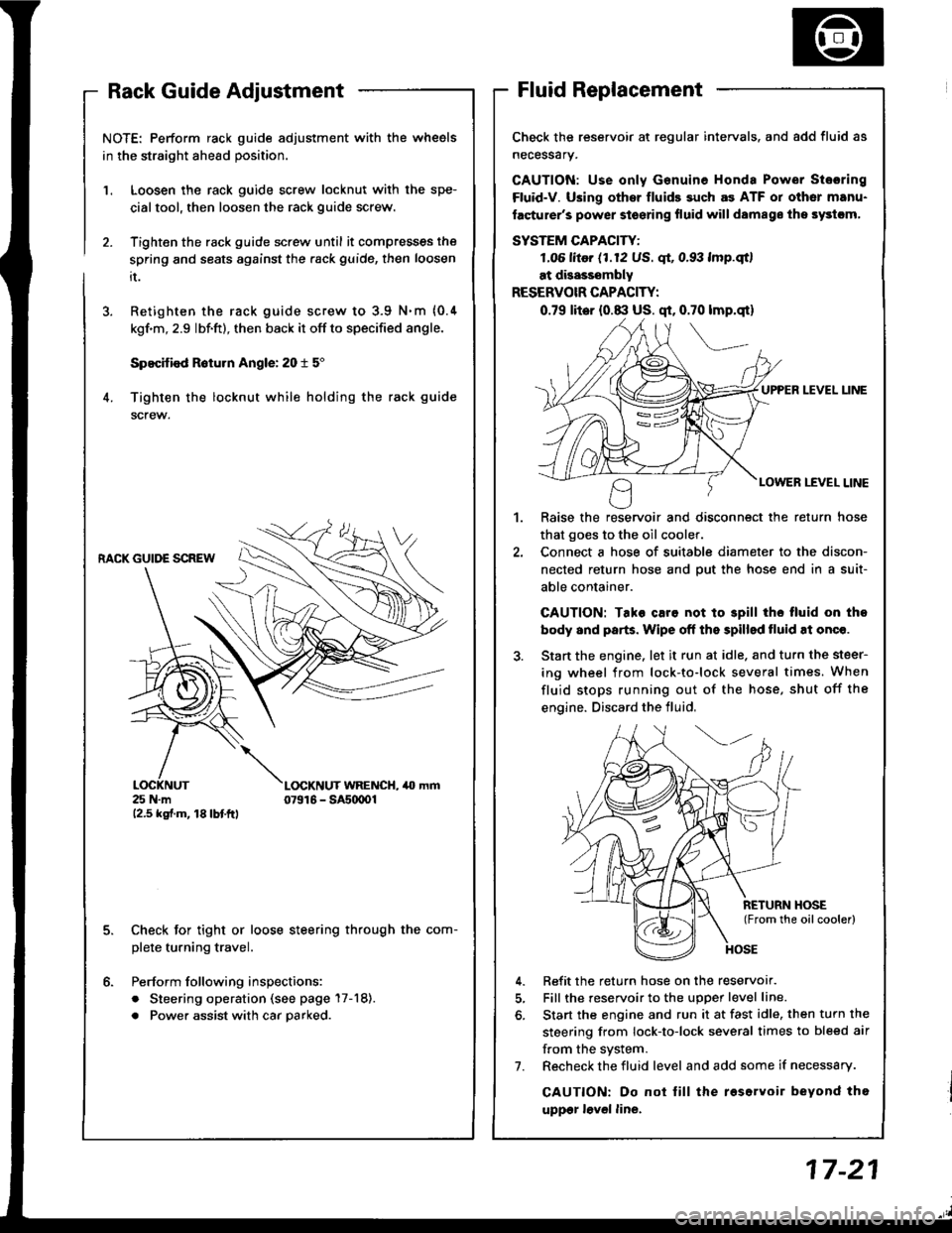
NOTE: Perform rack guide adjustment with the wheels
in the straight ahead position.
Loosen the rack guide screw locknut with the spe-
cialtool, then loosen the rack guide screw.
Tighten the rack guide screw until it compresses the
spring and seats against the .ack guide, then loosen
it.
Retighten the rack guide screw to 3.9 N.m {0.4
kgf'm, 2.9 lbf.ft), then back it off to specified angle.
Specified R6turn Angle: 20 t 5"
Tighten the locknut while holding the rack guide
screw.
1.
6.
RACK GUIDE SCREW
25 N.m12.5 kgf.m, 18lbtftl
L(rcKNUT WRENCH, 40 mm07916 - SAs(xtOl
Check for tight or loose steering through the com-
plete turning travel.
Perform following inspections:
. Steering operation (see page 17-18).
. Power assist with car parked.
Check the reservoir at regular intervals. and add fluid as
necessary.
GAUTION: Use only Genuine Honda Power Stosring
Fluid-V. Using othsr fluids such as ATF or other manu-
facturer's power stoering fluid will damags ths systcm,
SYSTEM CAPACITY:
LO6 litor (1.12 US. qt, 0.93 lmp.qtl
at disasssmbly
RESERVOIR CAPACITY:
0.79 lit6r (0.8:l US. qt, 0.70 lmp.qt)
UPPER LEVEL UNE
LOWER LEVEL LINE
,l
Raise the reservoir and disconnect the return hose
that goes to the oil cooler.
Connect a hose of suitable diameter to the discon-
nected return hose and put the hose end in a suit-
able container.
CAUTION: Tako caro not to 3pill tho tluid on tho
body and parts. Wipe off the spilled tluid at onqe.
Start the engine. let it run at idle. and turn the steer-
ing wheel from lock-to-lock several times. When
fluid stops running out of the hose, shut off the
engine. Discard the fluid,
Refit the return hose on the reservor.
Fill the reservoir to the uDoer level line.
Start the engine and run it at fast idle, then turn the
steering from lock-to-lock several times to bleed air
f.om the system.
Recheck the fluid level and add some if necessary.
CAUTION: Do not lill the roservoir beyond tho
uppgr lovel line.
7.