engine HONDA ODYSSEY 1995 Workshop Manual
[x] Cancel search | Manufacturer: HONDA, Model Year: 1995, Model line: ODYSSEY, Model: HONDA ODYSSEY 1995Pages: 240, PDF Size: 2.44 MB
Page 200 of 240
Jump Starting
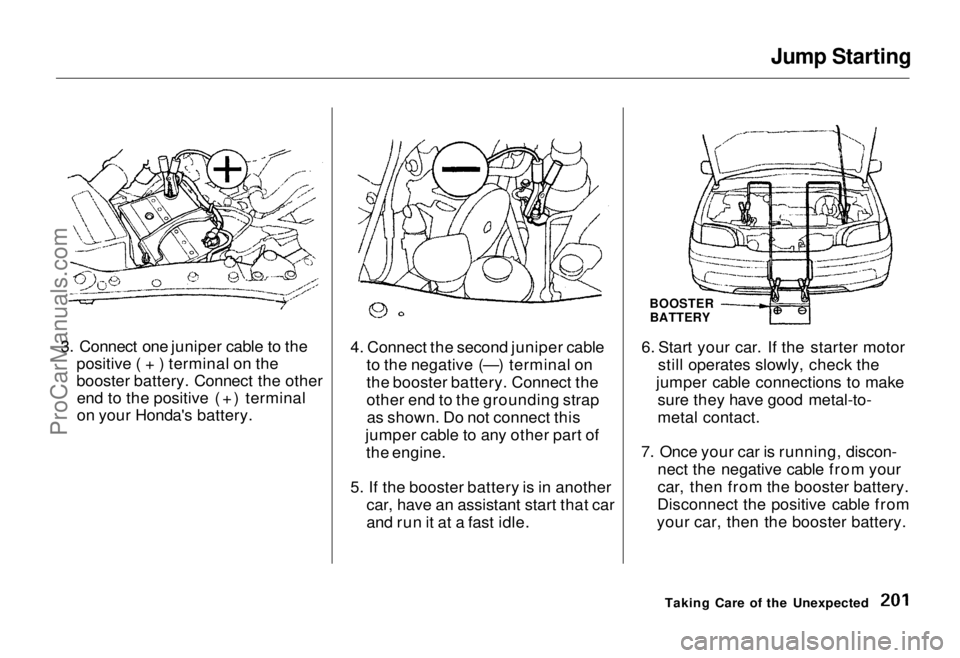
3. Connect one juniper cable to the positive ( + ) terminal on the
booster battery. Connect the otherend to the positive (+) terminal
on your Honda's battery. 4. Connect the second juniper cable
to the negative (—) terminal on
the booster battery. Connect the
other end to the grounding strapas shown. Do not connect this
jumper cable to any other part of the engine.
5. If the booster battery is in another car, have an assistant start that car
and run it at a fast idle. 6. Start your car. If the starter motor
still operates slowly, check the
jumper cable connections to make sure they have good metal-to-
metal contact.
7. Once your car is running, discon- nect the negative cable from your
car, then from the booster battery.
Disconnect the positive cable from
your car, then the booster battery.
Taking Care of the Unexpected
BOOSTER
BATTERYProCarManuals.comMain Menu Table of Contents s t
Page 201 of 240
If Your Engine Overheats
The pointer of your car's tempera- ture gauge should stay in the mid-
range under most conditions. It may
go higher if you are driving up a long steep hill on a very hot day. If it
climbs to the red mark, you should
determine the reason.
Driving with the temperature gauge
pointer at the red mark can cause serious damage to your engine. Your car can overheat for several
reasons, such as lack of coolant or a
mechanical problem. The only
indication may be the temperature
gauge climbing to or above the red mark. Or you may sec steam or
spray coming from under the hood.
In either case, you should take
immediate action.
1. Safely pull to the side of the road.
Put the transmission in neutral or
park and set the parking brake.
Turn off the heating and cooling system and all other accessories.
Turn on the hazard warning indicators.
2. If you see steam and/or spray coming from under the hood, turn
off the engine.
3. If you do not see steam or spray, leave the engine running and
watch the temperature gauge. If the high heat is due to overloading (climbing a long, steep hill on a
hot day with the A/C running, for example), the engine should start
to cool down almost immediately. If it does, wait until the tempera-
ture gauge comes down to the mid-
point then continue driving.
Taking Care of the Unexpected
NOTICE
Steam and spray from an
overheated engine can
seriously scald you.Do not open the hood if steam
is coming out.ProCarManuals.comMain Menu Table of Contents s t
Page 202 of 240
If Your Engine Overheats
4. If the temperature gauge stays at the red mark, turn off the engine.
5. Wait until you see no more signs of steam or spray, then open the
hood.
6. Look for any obvious coolant leaks, such as a split radiator hose.
Everything is still extremely hot, so use caution. If you find a leak, it
must be repaired before you
continue driving (see Towing on
page 213).
7. If you don't find an obvious leak, check the coolant level in the
radiator reserve tank (see page 150). If the level is below the
MIN mark, add coolant to half-way
between the MIN and MAX marks.
8. If there was no coolant in the reserve tank, you may also have to
add coolant to the radiator. Let the
engine cool down until the pointer reaches the middle of the tempera-
ture gauge, or lower, before check-
ing the radiator.
9. Using gloves or a large heavy cloth, turn the radiator cap
counterclockwise, without pushing
down, to the first stop. This
releases any remaining pressure in
the cooling system. After the
pressure releases, push down on
the cap and turn it until it comes
off.
10.Start the engine and set the
temperature control lever to
maximum. Add coolant to the
radiator up to the base of the filler
neck. If you do not have the proper coolant mixture available,
you can add plain water. Remember to have the coolingsystem drained and refilled with
the proper mixture as soon as you
can.
11. Put the radiator cap back on tightly. Run the engine and watch
the temperature gauge. If it goes
back to the red mark, the engine needs repair. (See Towing on
page 213.)
12.If the temperature stays normal, check the coolant level in the
radiator reserve tank. If it has
gone down, add coolant to the MAX mark. Put the cap back on
tightly.
Taking Care of the Unexpected
Removing the radiator cap
while the engine is hot can cause the coolant to spray out,
seriously scalding you.
Always let the engine and radiator cool down before
removing the radiator cap.ProCarManuals.comMain Menu Table of Contents s t
Page 203 of 240
Low Oil Pressure
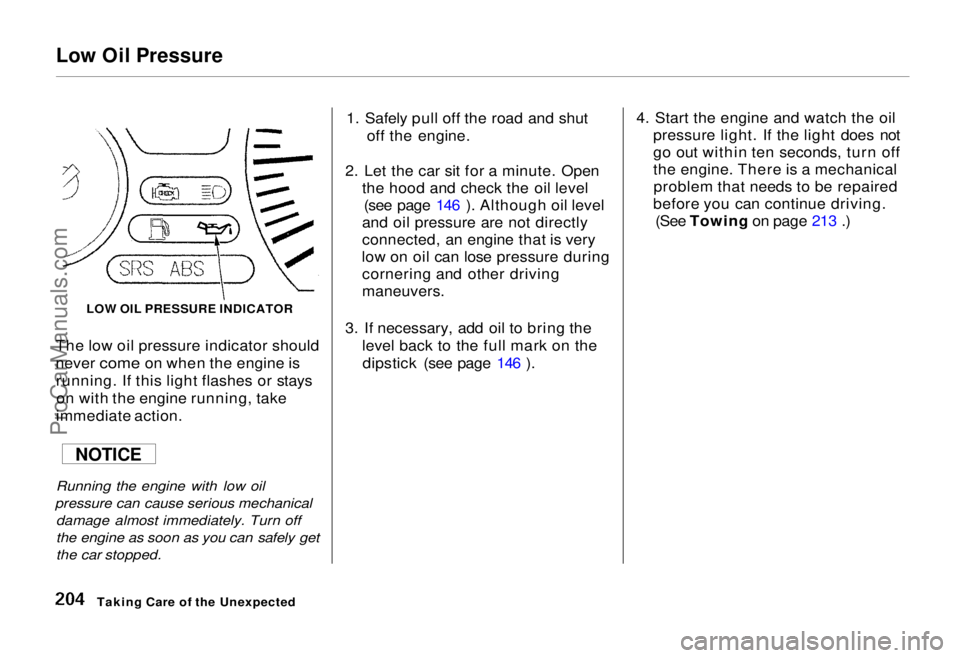
The low oil pressure indicator should
never come on when the engine is
running. If
this light flashes or stays
on with the engine running, take
immediate action.
Running the engine with low oil
pressure can cause serious mechanical
damage almost immediately. Turn off
the engine as soon as you can safely get
the car stopped.
1. Safely pull off the road and shut
off the engine.
2. Let the car sit for a minute. Open the hood and check the oil level(see page 146 ). Although oil level
and oil pressure are not directly
connected, an engine that is very
low on oil can lose pressure during cornering and other driving
maneuvers.
3. If necessary, add oil to bring the level back to the full mark on thedipstick (see page 146 ). 4. Start the engine and watch the oil
pressure light. If the light does not
go out within ten seconds, turn off
the engine. There is a mechanicalproblem that needs to be repaired
before you can continue driving. (See Towing on page 213 .)
Taking Care of the Unexpected
LOW OIL PRESSURE INDICATOR
NOTICEProCarManuals.comMain Menu Table of Contents s t
Page 204 of 240
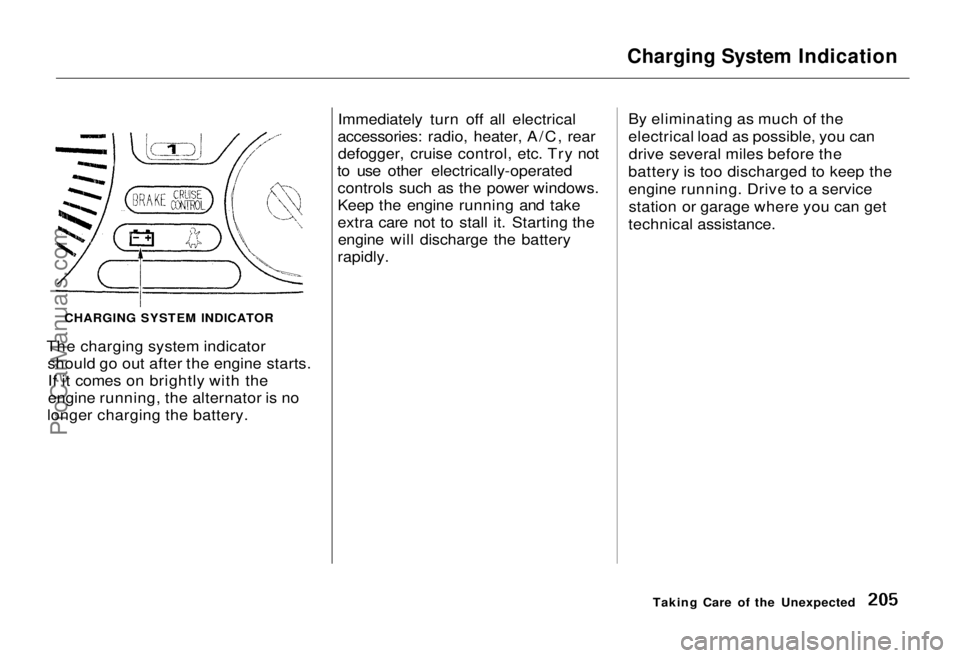
Charging System Indication
The charging system indicator should go out after the engine starts.If it comes on brightly with the
engine running, the alternator is no
longer charging the battery. Immediately turn off all electrical
accessories: radio, heater, A/C, rear defogger, cruise control, etc. Try not
to use other electrically-operated controls such as the power windows.
Keep the engine running and take
extra care not to stall it. Starting theengine will discharge the battery
rapidly. By eliminating as much of the
electrical load as possible, you can
drive several miles before the
battery is too discharged to keep the
engine running. Drive to a service station or garage where you can get
technical assistance.
Taking Care of the Unexpected
CHARGING SYSTEM INDICATORProCarManuals.comMain Menu Table of Contents s t
Page 205 of 240
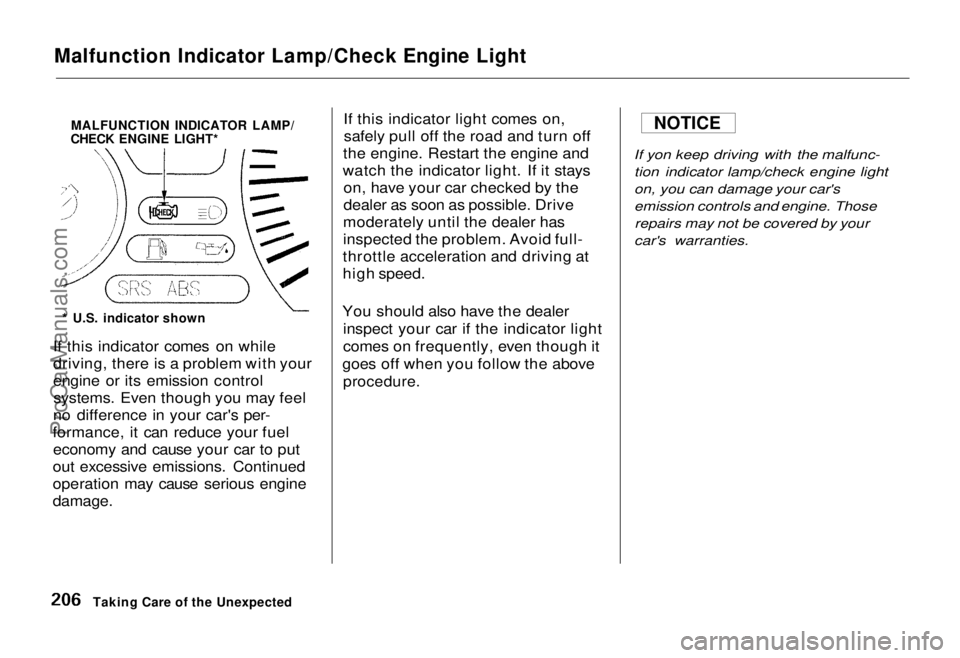
Malfunction Indicator Lamp/Check Engine Light
MALFUNCTION INDICATOR LAMP/
CHECK ENGINE LIGHT*
* U.S. indicator shown
If this indicator comes on while
driving, there is a problem with your
engine or its emission control systems. Even though you may feel
no difference in your car's per-
formance, it can reduce your fuel economy and cause your car to put
out excessive emissions. Continued
operation may cause serious engine
damage.
If this indicator light comes on,
safely pull off the road and turn off
the engine. Restart the engine and
watch the indicator light. If it stays on, have your car checked by the
dealer as soon as possible. Drive
moderately until the dealer has
inspected the problem. Avoid full-
throttle acceleration and driving at
high speed.
You should also have the dealer inspect your car if the indicator light
comes on frequently, even though it
goes off when you follow the above
procedure.
If yon keep driving with the malfunc-
tion indicator lamp/check engine light
on, you can damage your car's
emission controls and engine. Thoserepairs may not be covered by your
car's warranties.
Taking Care of the Unexpected NOTICEProCarManuals.comMain Menu Table of Contents s t
Page 207 of 240
Fuses
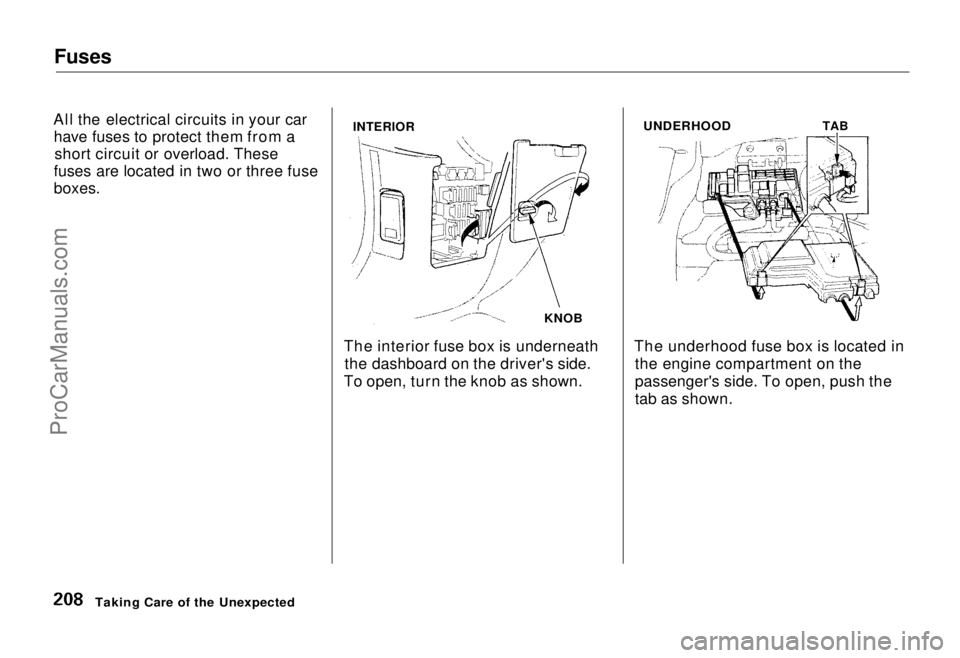
All the electrical circuits in your car have fuses to protect them from a short circuit or overload. These
fuses are located in two or three fuse
boxes.
The interior fuse box is underneaththe dashboard on the driver's side.
To open, turn the knob as shown. The underhood fuse box is located in
the engine compartment on the
passenger's side. To open, push the
tab as shown.
Taking Care of the Unexpected
INTERIOR
KNOB
UNDERHOOD
TABProCarManuals.comMain Menu Table of Contents s t
Page 208 of 240
Fuses
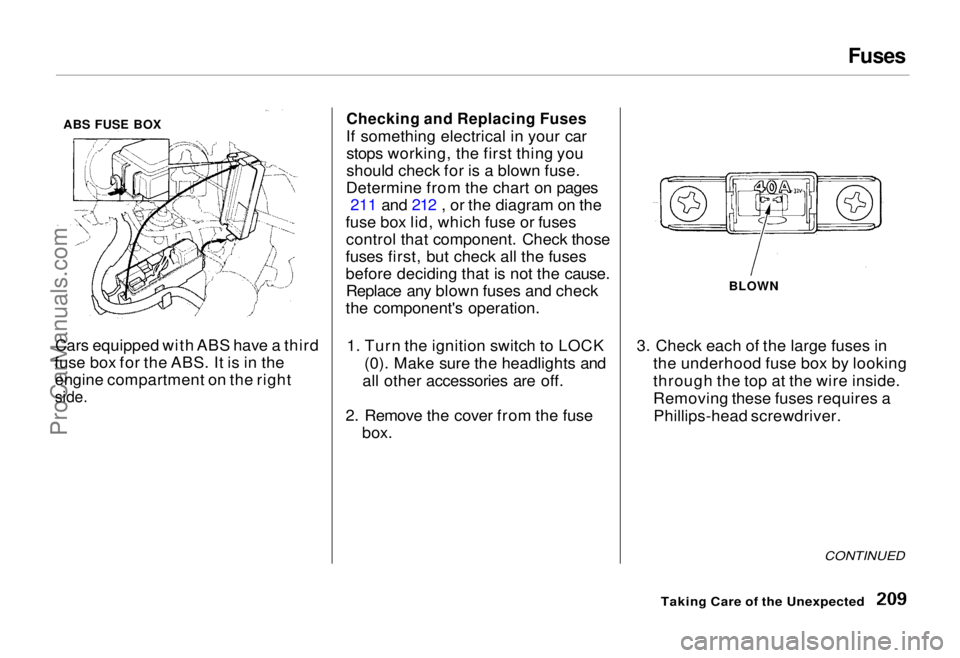
Cars equipped with ABS have a third
fuse box for the ABS. It is in the engine compartment on the right
side.
Checking and Replacing Fuses
If something electrical in your car stops working, the first thing you
should check for is a blown fuse.
Determine from the chart on pages 211 and 212 , or the diagram on the
fuse box lid, which fuse or fuses control that component. Check those
fuses first, but check all the fuses
before deciding that is not the cause. Replace any blown fuses and check
the component's operation.
1. Turn the ignition switch to LOCK (0). Make sure the headlights and
all other accessories are off.
2. Remove the cover from the fuse box. 3. Check each of the large fuses in
the underhood fuse box by looking
through the top at the wire inside.
Removing these fuses requires aPhillips-head screwdriver.
CONTINUED
Taking Care of the Unexpected
BLOWN
ABS FUSE BOXProCarManuals.comMain Menu Table of Contents s t
Page 212 of 240
Towing
If your car needs to be towed, call a
professional towing service or, if you
belong to one, an organization that
provides roadside assistance. Never
tow your car behind another car with
just a rope or chain. It is very
dangerous.
Emergency Towing
There are three popular methods of towing a car:
Flat-bed Equipment — The operator
loads your car on the back of a truck.
This is the best way of trans- porting your Honda.
Wheel Lift Equipment — The tow
truck uses two pivoting arms that go
under the tires (front or rear) and lift
them off the ground. The other two
wheels remain on the ground.
Sling-type Equipment — The tow
truck uses metal cables with hooks on the ends. These hooks go around
parts of the frame or suspension and
the cables lift that end of the car off
the ground. Your car's suspension and body can be seriously damaged
if this method of towing is attempted.
If your Honda cannot be transported
by flat-bed, it should be towed with the front wheels off the ground. If
due to damage, your car must be
towed with the front wheels on the
ground, do the following:
Release the parking brake.Start the engine.
Shift to D4, then to N.
Turn off the engine.
Improper towing preparation will
damage the transmission. Follow the
above procedure exactly. If you cannot
shift the transmission or start the
engine, your car must be transported
on a flat-bed.
It is best to tow the car no farther
than 80 km (50 miles), and keep
the speed below 35 mph (55
km/h).
Trying to lift or
tow your car by the
bumpers will cause serious damage. The bumpers are not designed to
support the car's weight.
Taking Care of the Unexpected
NOTICE
NOTICEProCarManuals.comMain Menu Table of Contents s t
Page 214 of 240
Identification Numbers
Your car has several identifying numbers located in various places.
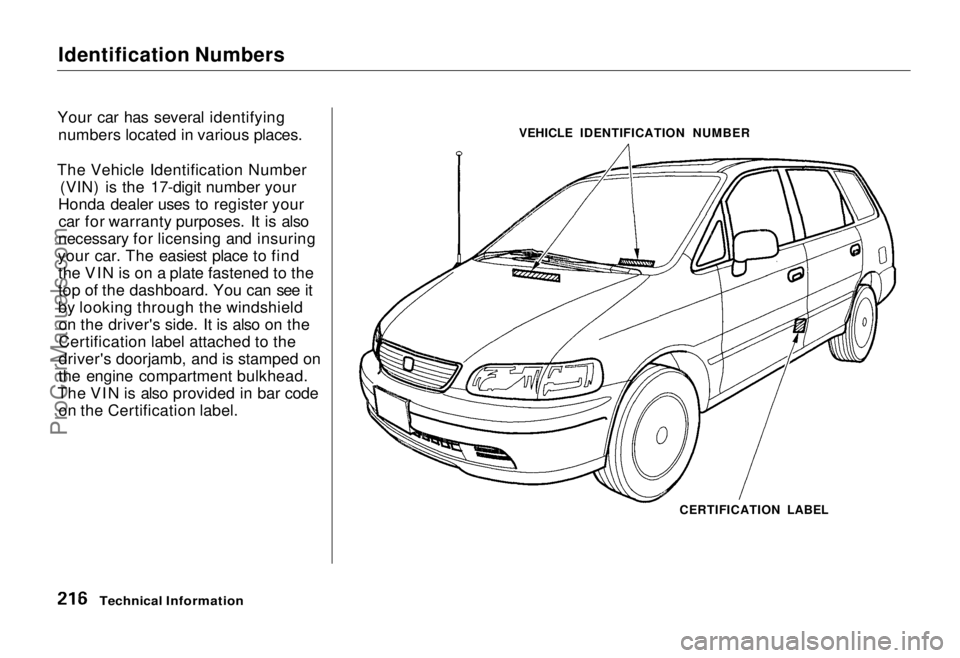
The Vehicle Identification Number (VIN) is the 17-digit number your
Honda dealer uses to register your car for warranty purposes. It is also
necessary for licensing and insuring
your car. The easiest place to find the VIN is on a plate fastened to the
top of the dashboard. You can see it
by looking through the windshieldon the driver's side. It is also on the
Certification label attached to the
driver's doorjamb, and is stamped on
the engine compartment bulkhead.
The VIN is also provided in bar code on the Certification label. VEHICLE IDENTIFICATION NUMBER
CERTIFICATION LABEL
Technical InformationProCarManuals.comMain Menu Table of Contents s t