engine HONDA ODYSSEY 1999 Workshop Manual
[x] Cancel search | Manufacturer: HONDA, Model Year: 1999, Model line: ODYSSEY, Model: HONDA ODYSSEY 1999Pages: 343, PDF Size: 3.73 MB
Page 240 of 343
Cooling System
Replacing Engine Coolant
The cooling system should be completely drained and refilled with
new coolant according to the timeand distance recommendations in
the maintenance schedule. Only use Genuine Honda Antifreeze/Coolant.
Draining the coolant requires access
to the underside of the vehicle. Unless you have the tools and
knowledge, you should have this maintenance done by a skilled
mechanic.
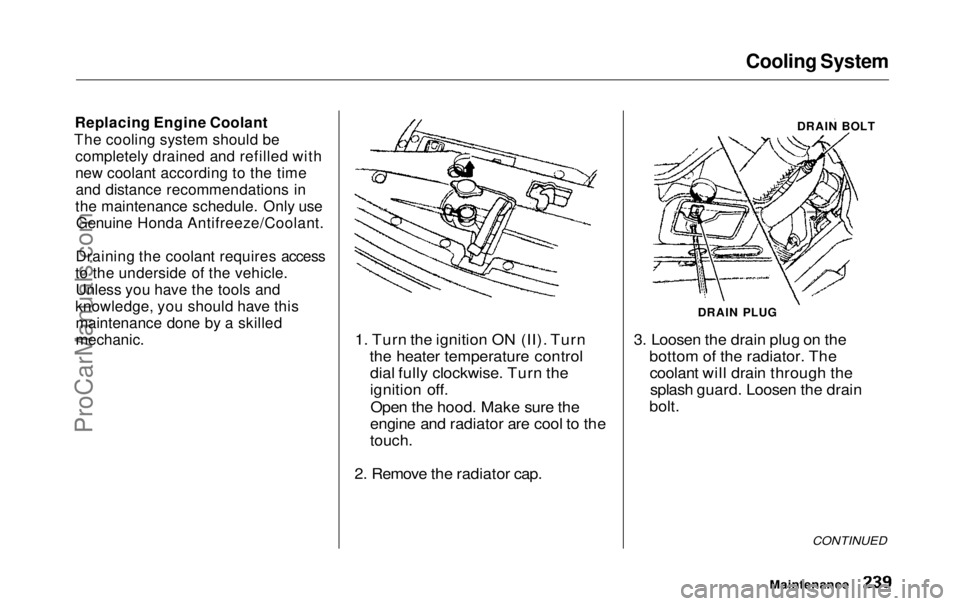
1. Turn the ignition ON (II). Turn
the heater temperature controldial fully clockwise. Turn the
ignition off.
Open the hood. Make sure the
engine and radiator are cool to the
touch.
2. Remove the radiator cap. 3. Loosen the drain plug on the
bottom of the radiator. Thecoolant will drain through thesplash guard. Loosen the drain
bolt.
CONTINUED
Maintenance
DRAIN BOLT
DRAIN PLUGProCarManuals.comMain Menu Table of Contents s t
Page 241 of 343
Cooling System
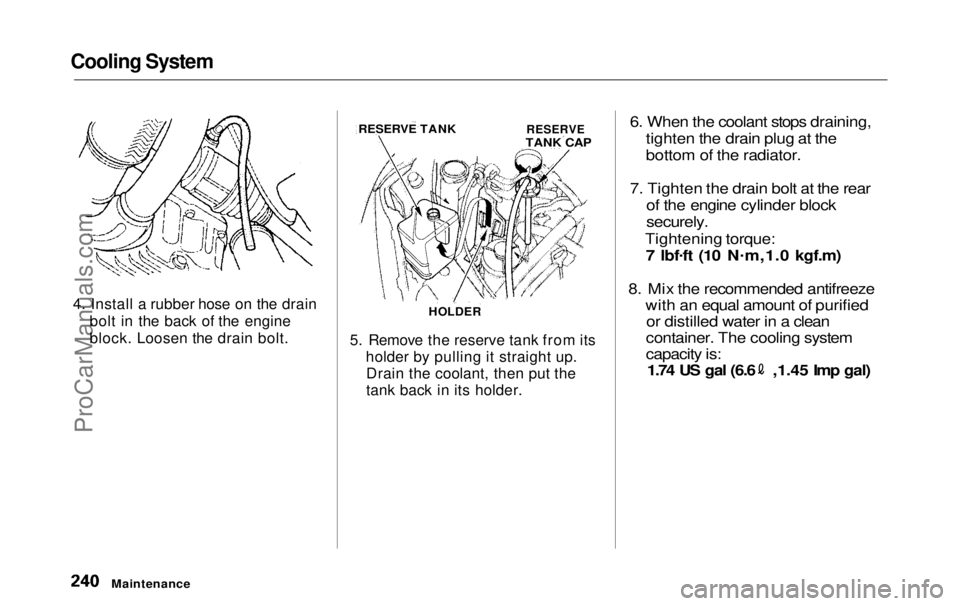
4. Install a rubber hose on the drain bolt in the back of the engine
block. Loosen the drain bolt. 5. Remove the reserve tank from its
holder by pulling it straight up.Drain the coolant, then put the
tank back in its holder.
6. When the coolant stops draining,
tighten the drain plug at the
bottom of the radiator.
7. Tighten the drain bolt at the rear of the engine cylinder block
securely.
Tightening torque: 7 lbf .
ft (10 N .
m,1.0 kgf.m)
8. Mix the recommended antifreeze with an equal amount of purifiedor distilled water in a clean
container. The cooling system
capacity is: 1.74 US gal (6.6 ,1.45 Imp gal)
Maintenance RESERVE TANK
HOLDER
RESERVE
TANK CAPProCarManuals.comMain Menu Table of Contents s t
Page 242 of 343
Cooling System
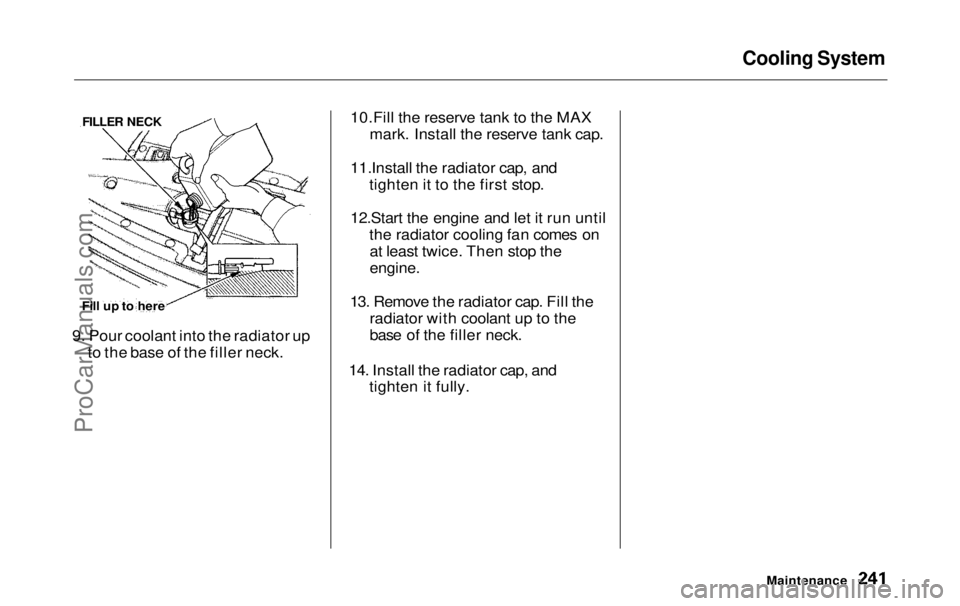
9. Pour coolant into the radiator up to the base of the filler neck. 10.Fill the reserve tank to the MAX
mark. Install the reserve tank cap.
11.Install the radiator cap, and tighten it to the first stop.
12.Start the engine and let it run until the radiator cooling fan comes onat least twice. Then stop the
engine.
13. Remove the radiator cap. Fill the radiator with coolant up to the
base of the filler neck.
14. Install the radiator cap, and tighten it fully.
Maintenance
FILLER NECK
Fill up to hereProCarManuals.comMain Menu Table of Contents s t
Page 243 of 343
Windshield Washers
Check the level in the windshield
washer reservoir at least monthly during normal usage. In bad weather,
when you use the washers often, check the level every time you stop
for fuel. This reservoir supplies the
windshield and rear window washers.
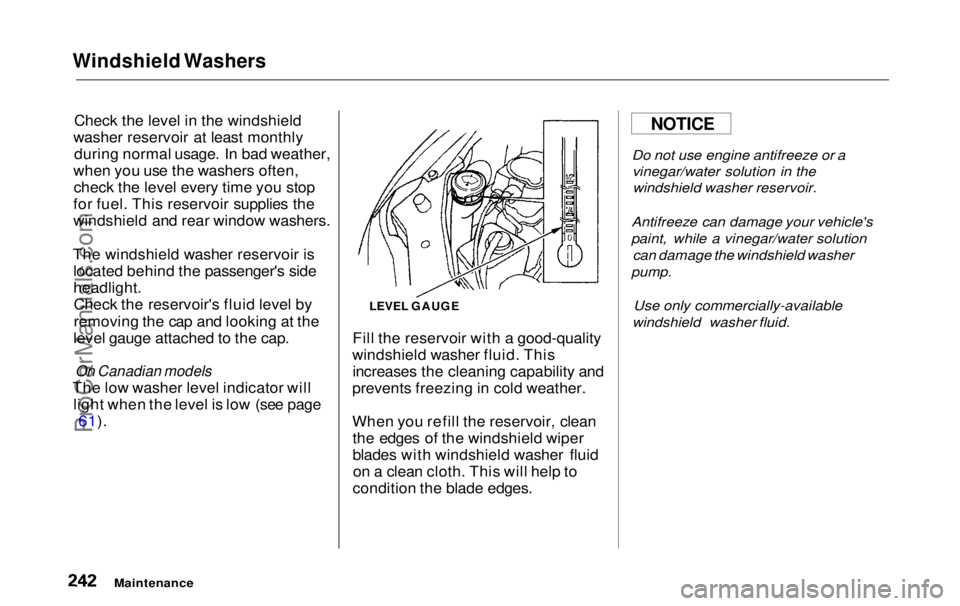
The windshield washer reservoir is located behind the passenger's side
headlight.Check the reservoir's fluid level by
removing the cap and looking at the
level gauge attached to the cap.
On Canadian models
The low washer level indicator will light when the level is low (see page
61).
Fill the reservoir with a good-quality
windshield washer fluid. This increases the cleaning capability and
prevents freezing in cold weather.
When you refill the reservoir, clean the edges of the windshield wiper
blades with windshield washer fluidon a clean cloth. This will help to
condition the blade edges.
Do not use engine antifreeze or a
vinegar/water solution in thewindshield washer reservoir.
Antifreeze can damage your vehicle's
paint, while a vinegar/water solution
can damage the windshield washer
pump.
Use only commercially-available
windshield washer fluid.
Maintenance
LEVEL GAUGE
NOTICEProCarManuals.comMain Menu Table of Contents s t
Page 244 of 343
Automatic Transmission Fluid
Check the fluid level with the engine
at normal operating temperature.
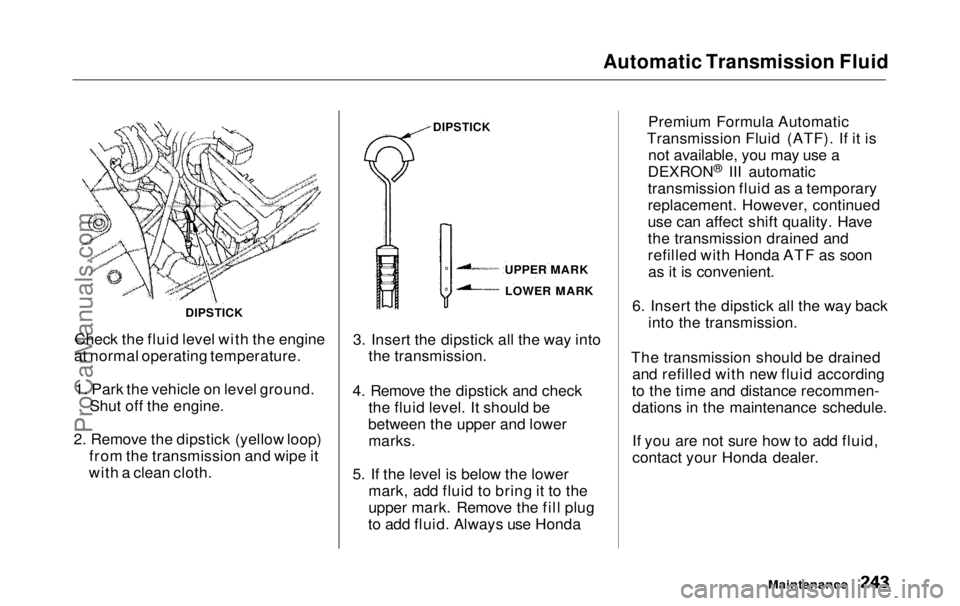
1. Park the vehicle on level ground. Shut off the engine.
2. Remove the dipstick (yellow loop) from the transmission and wipe it
with a clean cloth. 3. Insert the dipstick all the way into
the transmission.
4. Remove the dipstick and check the fluid level. It should be
between the upper and lower marks.
5. If the level is below the lower mark, add fluid to bring it to the
upper mark. Remove the fill plug
to add fluid. Always use Honda Premium Formula Automatic
Transmission Fluid (ATF). If it is not available, you may use a
DEXRON
®
III automatic
transmission flui d
as a temporary
replacement. However, continued
use can affect shift quality. Have
the transmission drained and
refilled with Honda ATF as soon as it is convenient.
6. Insert the dipstick all the way back into the transmission.
The transmission should be drained and refilled with new fluid according
to the time and distance recommen- dations in the maintenance schedule.
If you are not sure how to add fluid,
contact your Honda dealer.
Maintenance
DIPSTICK
DIPSTICK
UPPER MARKLOWER MARKProCarManuals.comMain Menu Table of Contents s t
Page 246 of 343
Power Steering
UPPER LEVEL
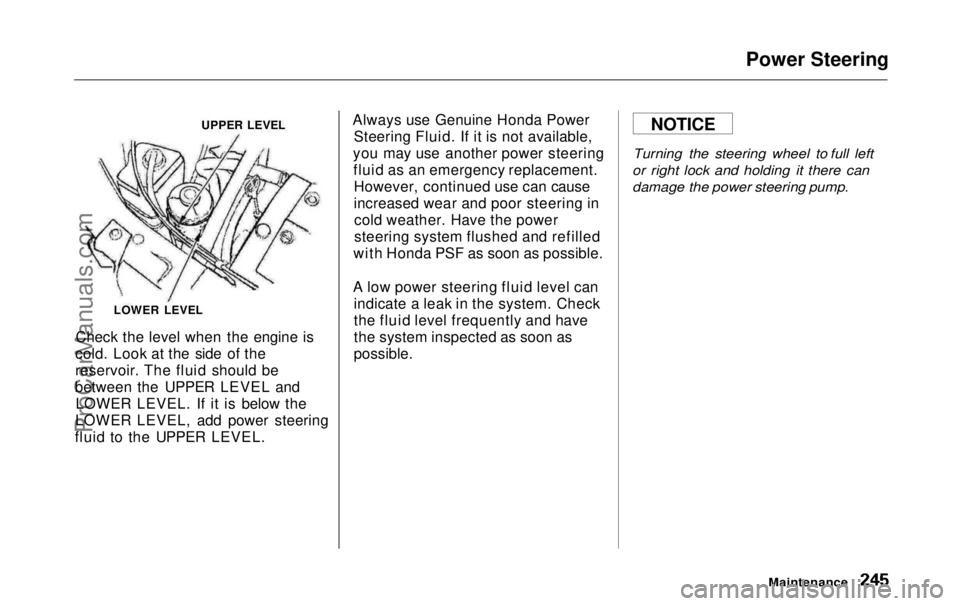
Check the level when the engine is
cold. Look at the side of the
reservoir. The fluid should be
between the UPPER LEVEL and LOWER LEVEL. If it is below the
LOWER LEVEL, add power steering
fluid to the UPPER LEVEL. Always use Genuine Honda Power
Steering Fluid. If it is not available,
you may use another power steering fluid as an emergency replacement.However, continued use can cause
increased wear and poor steering incold weather. Have the power
steering system flushed and refilled
with Honda PSF as soon as possible.
A low power steering fluid level can indicate a leak in the system. Check
the fluid level frequently and have
the system inspected as soon as
possible.
Turning the steering wheel to full left
or right lock and holding it there can
damage the power steering pump.
Maintenance
LOWER LEVEL
NOTICEProCarManuals.comMain Menu Table of Contents s t
Page 247 of 343
Air Cleaner Element
The air cleaner element should be cleaned or replaced according to the
time and distance recommendations in the maintenance schedule.
Cleaning (Severe Conditions)Clean the air cleaner element by
blowing compressed air through it in
the opposite direction to normal air
flow. If you do not have access to compressed air (such as a service
station), ask your Honda dealer to do
this service.
Follow the replacement procedure
for removal and reinstallation. Replacement
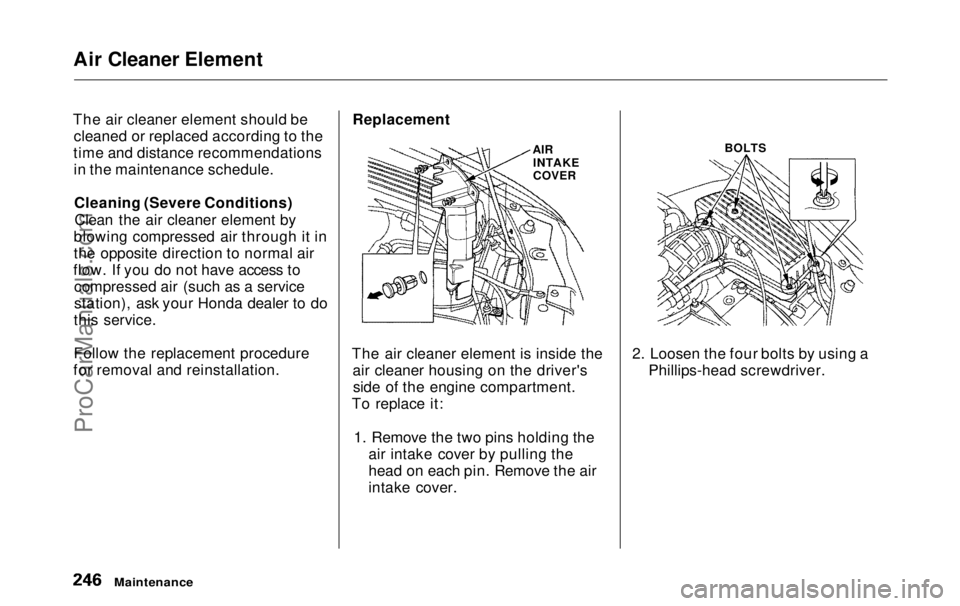
The air cleaner element is inside the air cleaner housing on the driver'sside of the engine compartment.
To replace it:
1. Remove the two pins holding the air intake cover by pulling the
head on each pin. Remove the air
intake cover. 2. Loosen the four bolts by using a
Phillips-head screwdriver.
Maintenance
AIR
INTAKE
COVER BOLTSProCarManuals.comMain Menu Table of Contents s t
Page 251 of 343
Spark Plugs
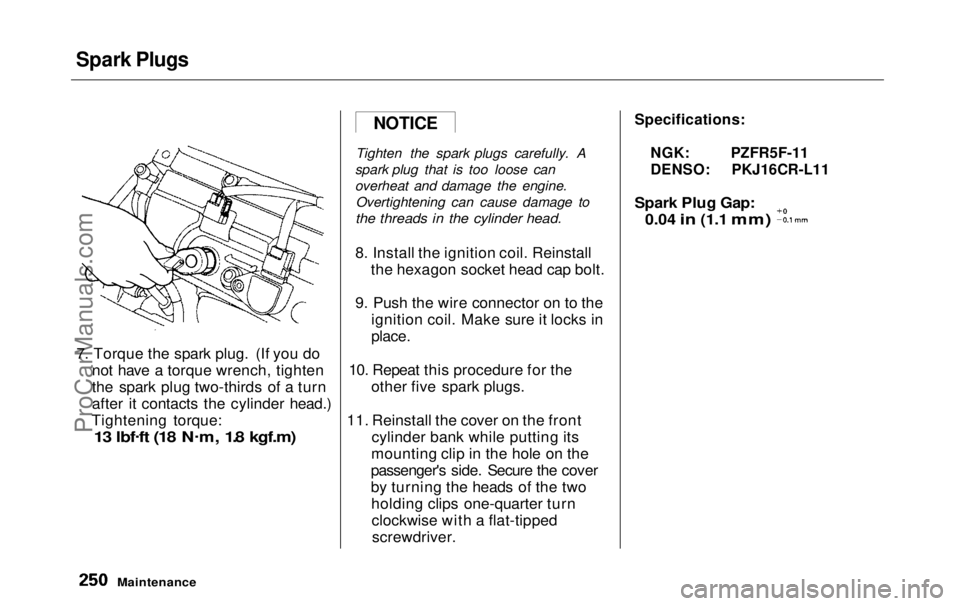
7. Torque the spark plug. (If you do not have a torque wrench, tighten
the spark plug two-thirds of a turn
after it contacts the cylinder head.)
Tightening torque:
13 lbf .
ft (18 N .
m, 1.8 kgf.m)
Tighten the spark plugs carefully. A
spark plug that is too loose can
overheat and damage the engine. Overtightening can cause damage to
the threads in the cylinder head.
8. Install the ignition coil. Reinstall
the hexagon socket head cap bolt.
9. Push the wire connector on to the ignition coil. Make sure it locks in
place.
10. Repeat this procedure for the other five spark plugs.
11. Reinstall the cover on the front cylinder bank while putting its
mounting clip in the hole on the
passenger's side. Secure the cover
by turning the heads of the two holding clips one-quarter turnclockwise with a flat-tippedscrewdriver.
Specifications:
NGK: PZFR5F-11
DENSO: PKJ16CR-L11
Spark Plug Gap:
0.04
in
(1.1
mm)
Maintenance
NOTICE
ProCarManuals.comMain Menu Table of Contents s t
Page 256 of 343
Air Conditioning System
Your vehicle's air conditioning is a sealed system. Any major mainte-
nance, such as recharging, should be
done by a qualified mechanic. You
can do a couple of things to makesure the air conditioning works
efficiently.
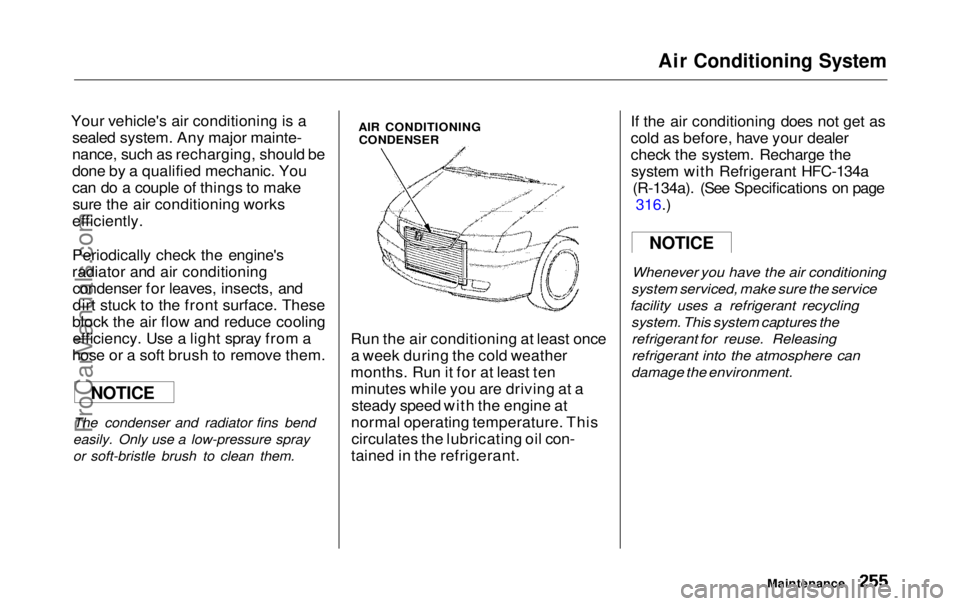
Periodically check the engine's
radiator and air conditioning condenser for leaves, insects, and
dirt stuck to the front surface. These
block the air flow and reduce cooling efficiency. Use a light spray from a
hose or a soft brush to remove them.
The condenser and radiator fins bend
easily. Only use a low-pressure spray
or soft-bristle brush to clean them. AIR CONDITIONING
CONDENSER
Run the air conditioning at least once a week during the cold weather
months. Run it for at least ten minutes while you are driving at asteady speed with the engine at
normal operating temperature. This circulates the lubricating oil con-
tained in the refrigerant. If the air conditioning does not get as
cold as before, have your dealer
check the system. Recharge the
system with Refrigerant HFC-134a (R-134a). (See Specifications on page 316.)
Whenever you have the air conditioning
system serviced, make sure the service
facility uses a refrigerant recycling
system. This system captures the
refrigerant for reuse. Releasing
refrigerant into the atmosphere can
damage the environment.
Maintenance
NOTICE
NOTICEProCarManuals.comMain Menu Table of Contents s t
Page 268 of 343
Lights
5. Insert the new bulb into the hole, making sure the tabs are in theirslots. Pivot the hold-down wire
back in place and clip the end into
the slot.
6. Install the rubber seal over the back of the headlight assembly.
Make sure it is right side up; it is
marked "TOP."
7. Push the electrical connector onto the new bulb.
Turn on the headlights to test the new bulb.
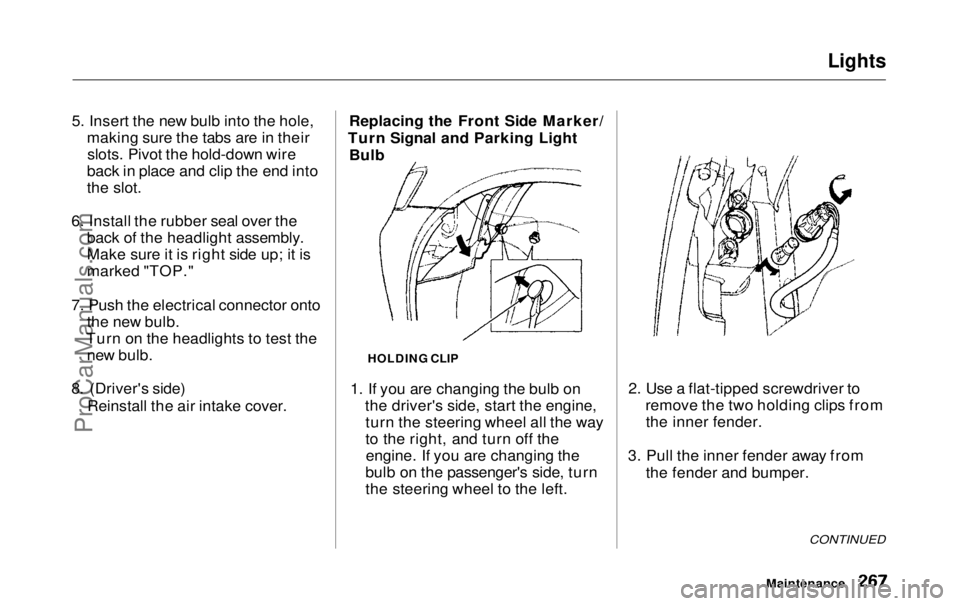
8. (Driver's side) Reinstall the air intake cover. Replacing the Front Side Marker/
Turn Signal and Parking Light Bulb
HOLDING CLIP
1. If you are changing the bulb on the driver's side, start the engine,turn the steering wheel all the way
to the right, and turn off theengine. If you are changing the
bulb on the passenger's side, turn
the steering wheel to the left. 2. Use a flat-tipped screwdriver to
remove the two holding clips fromthe inner fender.
3. Pull the inner fender away from the fender and bumper.
CONTINUED
MaintenanceProCarManuals.comMain Menu Table of Contents s t