maintenance HONDA PASSPORT 2002 2.G User Guide
[x] Cancel search | Manufacturer: HONDA, Model Year: 2002, Model line: PASSPORT, Model: HONDA PASSPORT 2002 2.GPages: 294, PDF Size: 3.97 MB
Page 173 of 294

170Driving Tips
Driving for Best Fuel
Economy
How, where, and when you drive
all affect how many miles/
kilometers you can get from a
gallon/liter of fuel. The careful
attention you give your vehicle as
far as maintenance and repairs
will also help fuel economy.
Fuel Selection
Use only unleaded gasoline
meeting federal government
regulations. The federal
government specifies the
minimum octane rating number of
unleaded gasoline. Unleaded
gasoline must be used for proper
emissions control system
operation. It will also minimize
spark plug fouling. The use of
leaded gasoline can damage the
emissions control system andcould result in loss of warranty
coverage.
“Jackrabbit” Starts
You can save fuel (and prolong
engine and tire life) by avoiding
fast starts away from lights and
stop signs.
Stop-and-Go Driving
Frequent stop-and-go driving
during a trip will cut down on
your miles per gallon (kilometers
per liter). Plan even your short
shopping trips to take advantage
of through streets to avoid traffic
lights. Pace your driving to avoid
unplanned stops.
Excessive Idling
An idling engine uses fuel, too. If
you’re faced with more than a few
minutes wait and you
’re not intraffic, it is better to turn off the
key and start the engine again
later.
Repetitive Harsh Stopping
Harsh stops can also waste fuel;
instead of moving the vehicle, the
energy is wasted as heat in
braking. Energy in the form of
fuel is also needed to accelerate
back to driving speed.
Lubricants
A well-lubricated vehicle means
less friction between moving
parts. This manual lists the proper
lubrication intervals in the
“Care
and Maintenance ” section.
Air Cleaner
Your vehicle gets its power from a
mixture of fuel and air. The air is
taken into the engine through the
Fuel Economy
Page 174 of 294

171Driving Tips
air cleaner, so it’
s important to
replace the air cleaner filter at
required intervals. See “Care and
Maintenance.” A dirty air cleaner
filter reduces engine performance
and can waste fuel.
Air Conditioning
Turn off the air conditioning when
it is not needed. The air
conditioning compressor is not on
in this position and the reduced
engine load can improve fuel
economy.
Tuned Engine
An engine that is properly
maintained will provide better
fuel economy than one that is not.
One misfiring spark plug will cut
fuel economy significantly, and
will make a difference in the
amount of pollution emitted from
your vehicle. Excessive Weight
Fuel economy is related to the
work the engine must do. The
heavier the load, the more fuel it
takes to run your vehicle. Keep
weight to a minimum by removing
unnecessary luggage or cargo.
Tire Inflation
Underinflation not only causes
needless tire wear but can also
waste fuel. It’
s a good idea to
check tire pressure often and keep
your tires inflated to the pressures
shown on the tire placard located
on the driver ’s doorjamb. Wheel Alignment
Improper alignment will cause the
front tires to roll at an angle that
will result in faster tire wear. It
takes power to overcome this
improper alignment, which, in
turn, wastes fuel.
Use of 4-Wheel Drive
In normal driving, put the
4WD-2WD switch in the 2WD
position.
Page 175 of 294
172 Driving Tips
The
three-way catalytic converter
is an emissions control device
added to the exhaust system to
reduce exhaust gas pollutants. The
converter contains a ceramic
material coated with noble metal
catalysts. To prevent
contamination of the catalysts,
unleaded gasoline must be used.
Unleaded gasoline also reduces
combustion chamber deposits and
exhaust system corrosion.
The three-way catalytic converter
requires the use of unleaded
gasoline. Use of leaded gasoline
will cause the converter to lose its
effectiveness.
To Help Prevent Damage
1. Keep your engine properly
maintained. Engine
malfunctions involving the electrical,
electronic fuel
injection or ignition systems
may result in unusually high
converter and exhaust system
temperatures. Do not keep
driving your vehicle if you
detect engine misfire,
noticeable loss of performance,
or other unusual operating
conditions. Have it serviced
promptly. A properly
maintained engine will
minimize malfunctions that
could damage the converter. It
will also help provide good
emissions control and fuel
economy. (See the
Maintenance Schedule on page
204 for info rmation on
inspecting and maintaining the
engine, exhaust system and
other components.) 2. Do not push or tow your
vehicle to start it. This could
damage the converter.
3. Do not park your vehicle over high grass, dry leaves or other
combustible materials. The
catalytic converter gets very
hot and could set fire to these
materials.
Three-Way Catalytic Converter
Page 182 of 294

179Driving Tips
Follow the recommendations in
this manual and ask your Honda
dealer for further details before
you tow a trailer with your
Passport.
Towing a trailer affects vehicle
maintenance requirements due
to the additional load. More
frequent maintenance intervals
will be required to assure
continued satisfaction with
your vehicle. Consult your
Honda dealer for recommended
maintenance and service.
The gross trailer weight (trailer
weight plus cargo load) must
never exceed 4,500 lb.
Additional equipment will be
required, depending on the
specific model/load combination.
See “Trailer Hitches” in this
section.
Exceeding the weight limit will
cause damage to your vehicle and
possibly result in personal injury.
•The Gross Vehicle Weight
Rating (
GVWR) is the
combined weight of the
unloaded vehicle, passengers,
cargo, trailer hitch, trailer
tongue load, and optional
equipment. This value is
indicated on the
F.M.V.S.S.
Certification Label on the
driver ’ s doorjamb.
•The Gross Combined Weight
Rating (
GCWR) equals the
combined weight of your
vehicle (including passengers
and cargo) plus the total trailer
load. The following limits
apply.
2WD: 8,700 lb
4WD: 8,950 lb
•The Gross Axle Weight Rating
(
GAWR) is also indicated on
the Certification Label. The
load on either the front or rear
axle resulting from distribution
of the gross vehicle weight on
both axles must not exceed the
values listed. Remember to
account for additional
equipment and tongue load.
Page 198 of 294
195Care and Maintenance
This section explains why it is
important to keep your vehicle
well maintained and to follow
basic maintenance safety
precautions.
This section also includes
Maintenance Schedules for
normal driving and severe driving
conditions, a Maintenance
Record, and instructions for
simple maintenance tasks you
may want to take care of yourself.
If you have the skills and tools
required
to perform more complex
maintenance tasks on your Honda,
you may want to purchase the
Service Manual. See page 253 for
information on how to obtain a
copy, or see your Honda dealer. Service Station Information
197
.
Fuel Fill Cap 197
. . . . . . . . . .
Fuel Recommendation 198
. . .
Fuel Tank Capacity 198
. . . . .
Engine Oil
Recommendation 198
. . . . . .
Windshield Washer 198
. . . . .
Tire Inflation Pressures 198
. .
Battery 198
. . . . . . . . . . . . . . .
Hood Release 199
. . . . . . . . . .
Engine Oil Dipstick 200
. . . . .
Fuel Requirements 200
. . . . . . . .
Oxygenated Fuels 200
. . . . . .
Maintenance Safety 201
. . . . . . .
Important Safety
Precautions 202
. . . . . . . . . .
Maintenance Schedule 203
. . . . .
Required Maintenance Record 206
Owner Safety Checks 208
. . . . . .
Engine Oil and Filter 211
. . . . . .
Proper Quality Oil 211
. . . . . . Change Interval
211
. . . . . . . .
Oil Change 212
. . . . . . . . . . .
Oil Filter Installation 212
.
Oil Viscosity 213
. . . . . . . . . .
Oil Level Check 213
. . . . . . .
Engine Oil Additives 214
. . .
Air Cleaner Filter 214
. . . . . . . .
Manual Transmission Fluid 215
Automatic Transmission
Fluid 216
. . . . . . . . . . . . . . . . . .
Front (4
WD) and
Rear Axles 216
. . . . . . . . . . . . .
Engine Cooling System 217
. . .
Other Required Maintenance 219
Brake Master Cylinder 219
. .
Shift-on-the-Fly System 220
.
Front Wheel Bearings 220
. . .
Hood Latch and Hinges 221
.
Air Conditioning 221
. . . . . . .
Body Lubrication 221
. . . . . .
Care and Maintenance
Page 199 of 294
196Care and Maintenance
Front (4
WD Only) and
Rear Propeller Shaft 222
. . .
Exhaust System 222
. . . . . . .
Fuel Line and Fuel
Tank/Cap 222
. . . . . . . . . . . .
Drive Belt 222
. . . . . . . . . . . .
Timing Belt 222
. . . . . . . . . . .
Valve Clearance 222
. . . . . . . .
Spark Plugs 223
. . . . . . . . . . .
Clutch 223
. . . . . . . . . . . . . . .
Fluid or Lubricant Levels 223
Power Steering 223
. . . . . . . .
Wheel Alignment 224
. . . . . .
Exterior 224 . . . . . . . . . . . . . . . .
Washing Your Vehicle 224
. .
Polishing and Waxing
Your Vehicle 224
. . . . . . . . .
Protection of Exterior
Bright Metal Parts 224
. . . .
Care of Aluminum Wheels 224Foreign Material Deposits
224
Finish Damage 225
. . . . . . . .
Corrosion Protection 225
. . . .
Sheet Metal Damage 225
. . . .
Underbody Maintenance 225
Interior 226 . . . . . . . . . . . . . . . .
Basic Steps
Before Cleaning 226
. . . . . .
Cleaning Fabric 227
. . . . . . . .
Cleaning General Soilage
or Water Spots From
Fabric Trim 227
. . . . . . . .
Spot Cleaning Fabric
With Solvent Cleaner 227
Removal of
Specific Stains 228
. . . . . .
Cleaning Vinyl
or Leather Trim 229
. . . . . . .
Seat Belt Care 229
. . . . . . . . .
Cleaning Glass Surfaces 230
.
Page 200 of 294
197Care and Maintenance
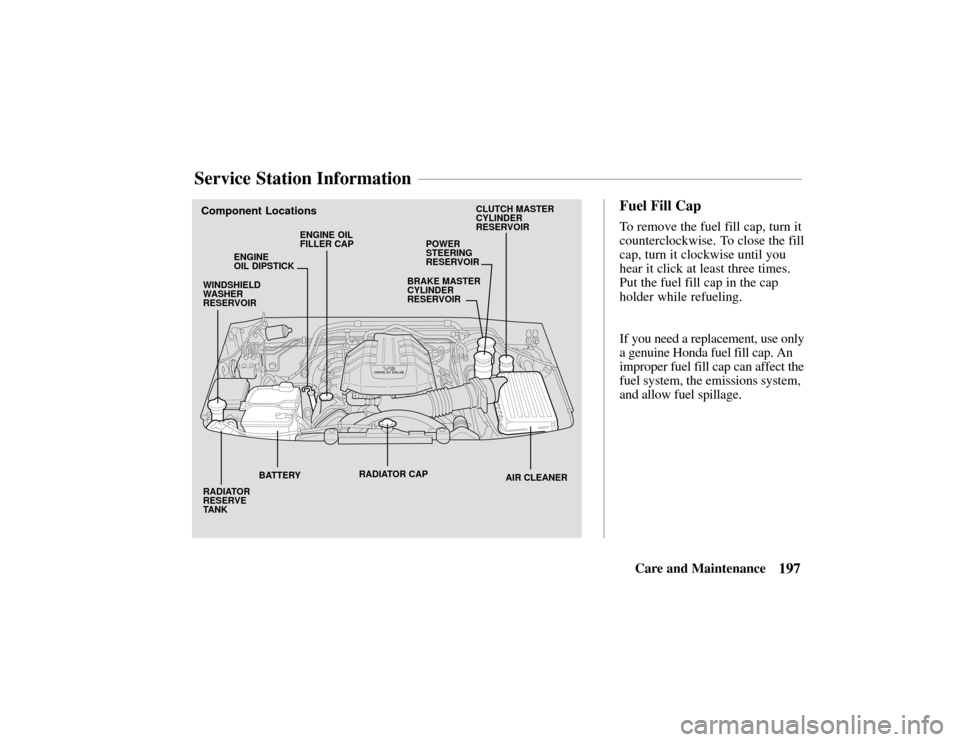
Fuel Fill Cap
To remove the fuel fill cap, turn it
counterclockwise. To close the fill
cap, turn it clockwise until you
hear it click at least three times.
Put the fuel fill cap in the cap
holder while refueling.
If you need a replacement, use only
a genuine Honda fuel fill cap. An
improper fuel fill cap can affect the
fuel system, the emissions system,
and allow fuel spillage.
Component Locations
WINDSHIELD
WASHER
RESERVOIRBATTERY RADIATOR CAP
ENGINE OIL
FILLER CAP
AIR CLEANER
ENGINE
OIL DIPSTICK
BRAKE MASTER
CYLINDER
RESERVOIRPOWER
STEERING
RESERVOIR
RADIATOR
RESERVE
TANK
CLUTCH MASTER
CYLINDER
RESERVOIR
Service Station Information
Page 201 of 294
198Care and Maintenance
Fuel Recommendation
Use only unleaded gasoline. For
additional information see “Fuel
Requirements” in this section.
Fuel Tank Capacity
19.5 U.S. gallons (75 liters)
Engine Oil Recommendation
Use only SJ quality oil.
The chart shown under “Engine
Oil and Filter” in this section will
serve as a guide for choosing the
proper viscosity oil.
Windshield Washer
Check the reservoir fluid level
regularly. Use a commercially
available windshield washer fluid.
The windshield washer reservoir
is located on the front right side of
the engine compartment.
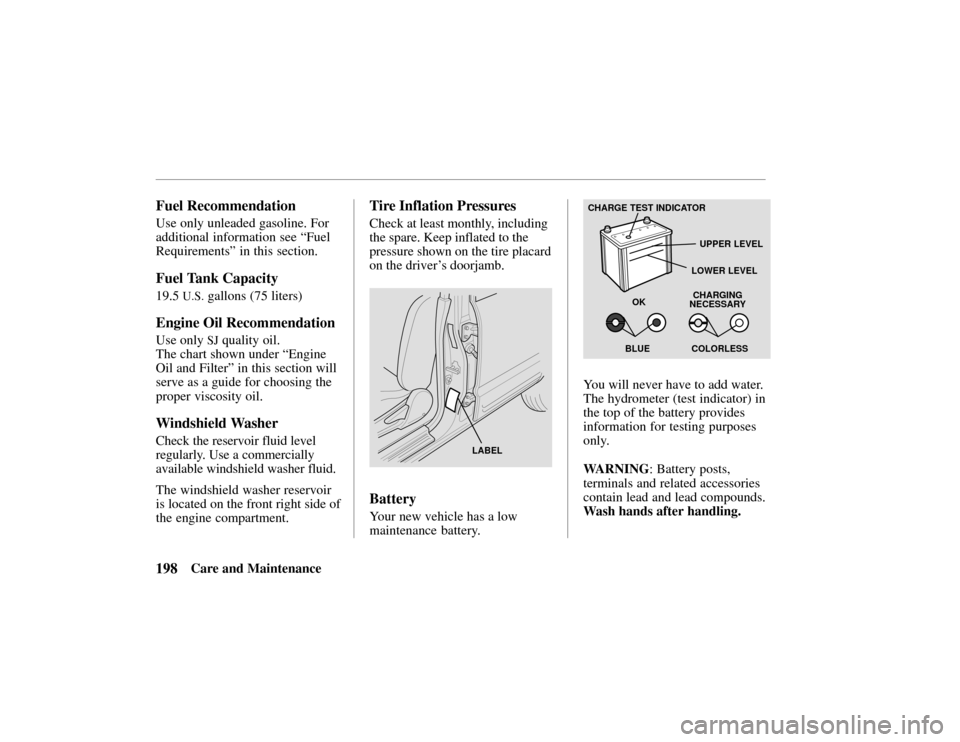
Tire Inflation Pressures
Check at least monthly, including
the spare. Keep inflated to the
pressure shown on the tire placard
on the driver’s doorjamb.
LABEL
Battery
Your new vehicle has a low
maintenance battery.
CHARGE TEST INDICATOR
UPPER LEVEL
LOWER LEVEL CHARGING
NECESSARY
OK
BLUE COLORLESS
You will never have to add water.
The hydrometer (test indicator) in
the top of the battery provides
information for testing purposes
only.
WARNING : Battery posts,
terminals and related accessories
contain lead and lead compounds.
Wash hands after handling.
Page 202 of 294
199Care and Maintenance
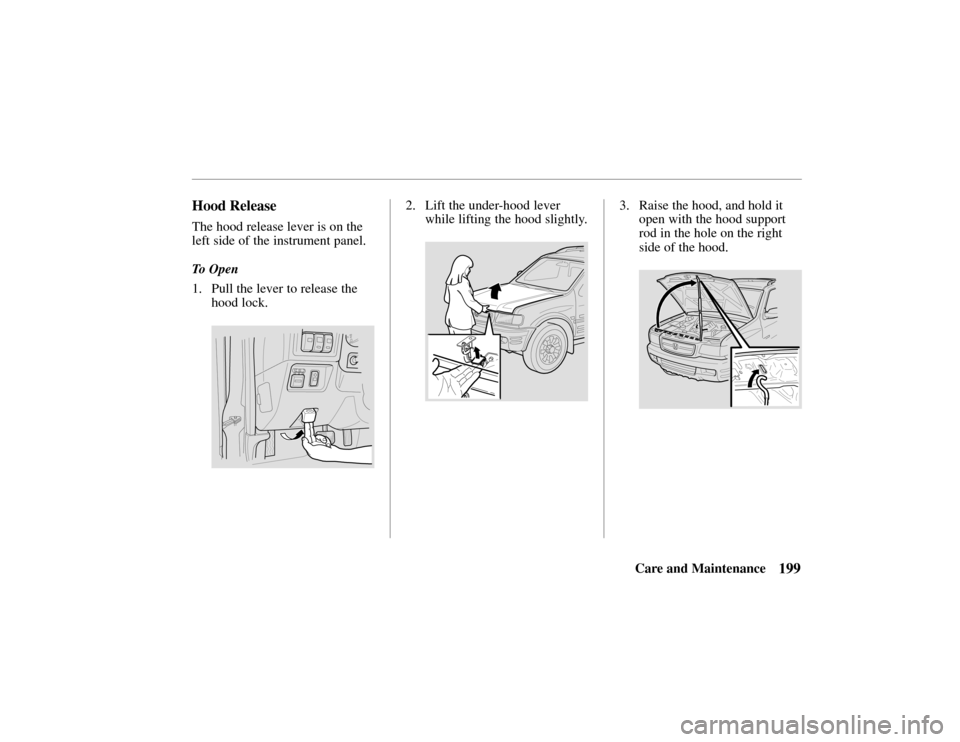
Hood Release
The hood release lever is on the
left side of the instrument panel.
To Open
1. Pull the lever to release thehood lock.
2. Lift the under-hood leverwhile lifting the hood slightly.3. Raise the hood, and hold itopen with the hood support
rod in the hole on the right
side of the hood.
Page 203 of 294
200 Care and Maintenance
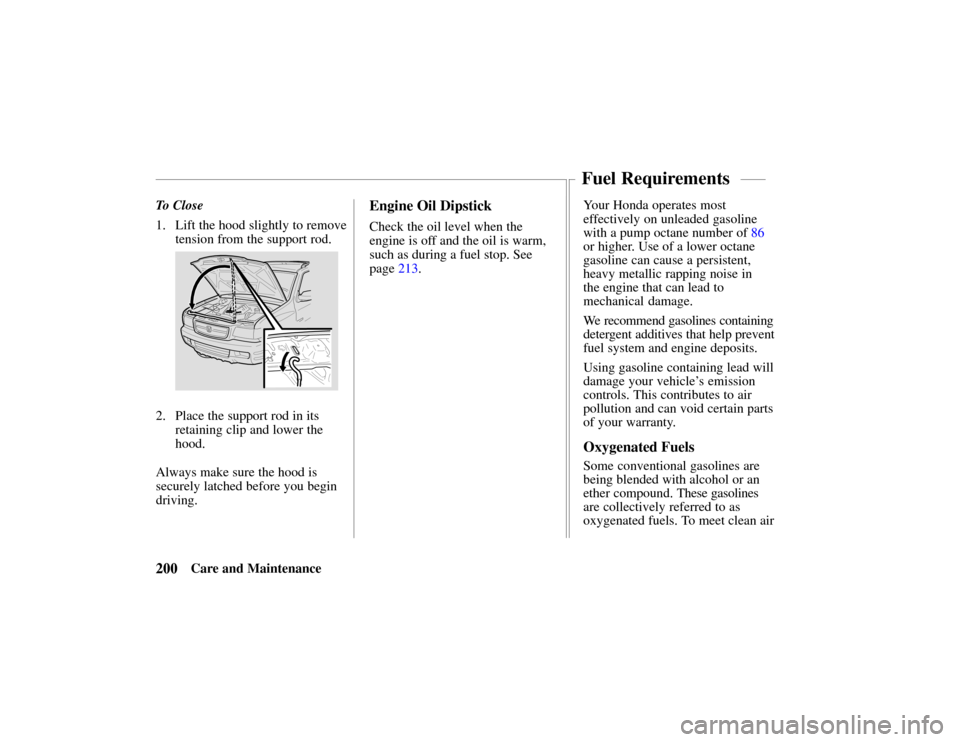
To Close
1.
Lift the hood slightly to remove
tension from the support rod.
2. Place the support rod in its
retaining clip and lower the
hood.
Always make sure the hood is
securely latched before you begin
driving.
Engine Oil Dipstick
Check the oil level when the
engine is off and the oil is warm,
such as during a fuel stop. See
page 213. Your Honda operates most
effectively on unleaded gasoline
with a pump octane number of 86
or higher. Use of a lower octane
gasoline can cause a persistent,
heavy metallic rapping noise in
the engine that can lead to
mechanical damage.
We recommend gasolines containing
detergent additives that help prevent
fuel system and engine deposits.
Using gasoline containing lead will
damage your vehicle
’s emission
controls. This contributes to air
pollution and can void certain parts
of your warranty.
Oxygenated Fuels
Some conventional gasolines are
being blended with alcohol or an
ether compound. These gasolines
are collectively referred to as
oxygenated fuels. To meet clean air
Fuel Requirements