seat HONDA PILOT 2015 2.G Service Manual
[x] Cancel search | Manufacturer: HONDA, Model Year: 2015, Model line: PILOT, Model: HONDA PILOT 2015 2.GPages: 488, PDF Size: 11.34 MB
Page 60 of 488
59
uuChild Safety uSafety of Infants and Small Children
Continued
Safe Driving
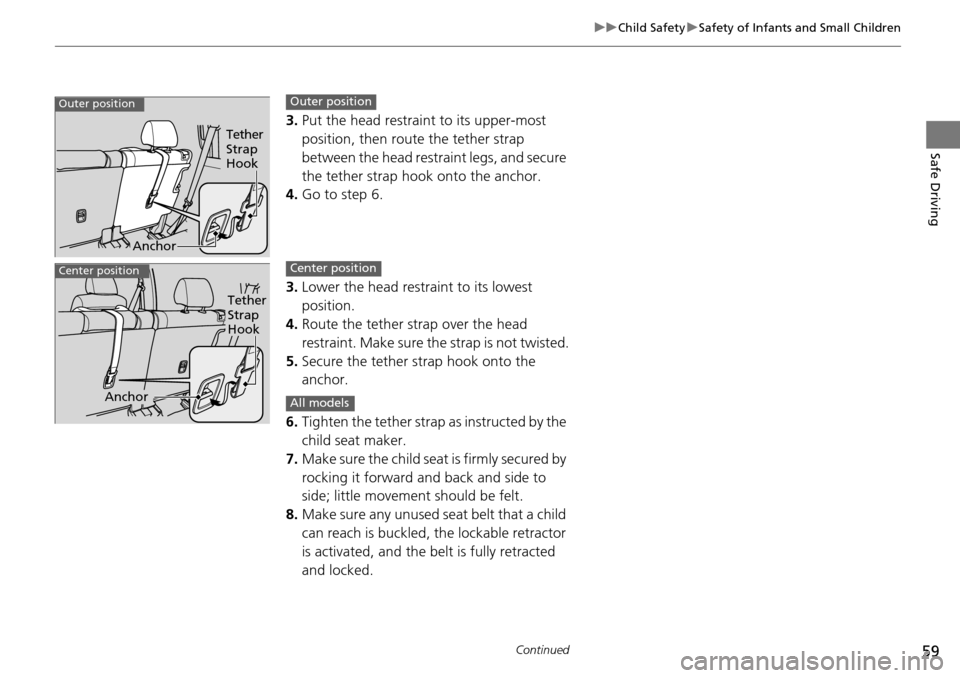
3. Put the head restraint to its upper-most
position, then route the tether strap
between the head restra int legs, and secure
the tether strap hook onto the anchor.
4. Go to step 6.
3. Lower the head restraint to its lowest
position.
4. Route the tether strap over the head
restraint. Make sure the strap is not twisted.
5. Secure the tether strap hook onto the
anchor.
6. Tighten the tether strap as instructed by the
child seat maker.
7. Make sure the child seat is firmly secured by
rocking it forward and back and side to
side; little movement should be felt.
8. Make sure any unused seat belt that a child
can reach is buckled, the lockable retractor
is activated, and the be lt is fully retracted
and locked.Tether
Strap
Hook
Anchor
Outer positionOuter position
Tether
Strap
Hook
Anchor
Center positionCenter position
All models
Page 61 of 488
uuChild Safety uSafety of Infants and Small Children
60
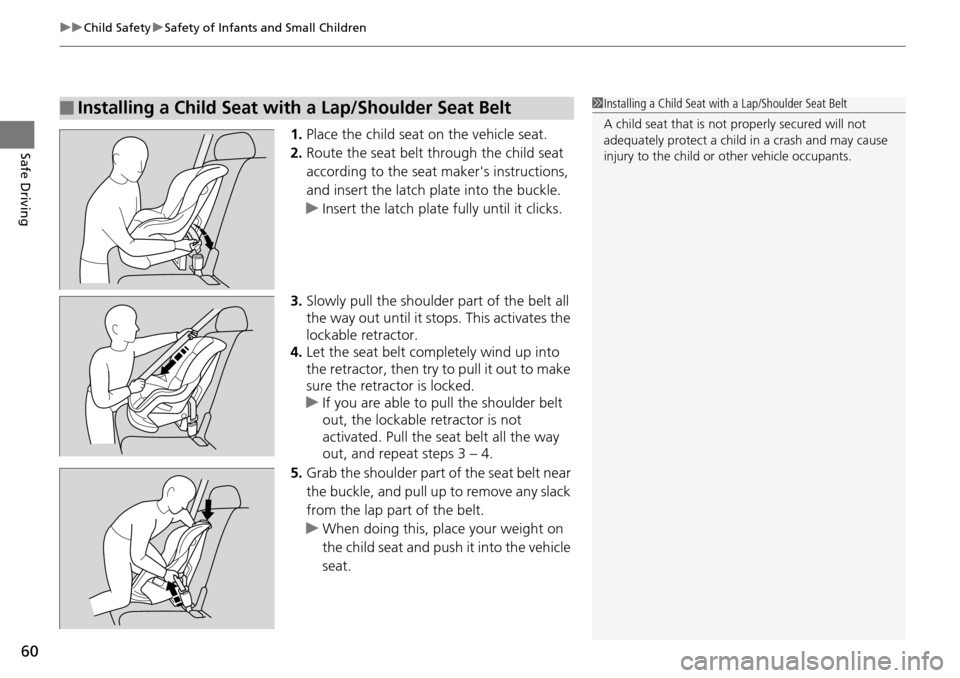
Safe Driving1. Place the child seat on the vehicle seat.
2. Route the seat belt through the child seat
according to the seat maker's instructions,
and insert the latch plate into the buckle.
u Insert the latch plate fully until it clicks.
3. Slowly pull the shoulder part of the belt all
the way out until it stops. This activates the
lockable retractor.
4. Let the seat belt completely wind up into
the retractor, then try to pull it out to make
sure the retractor is locked.
u If you are able to pull the shoulder belt
out, the lockable retractor is not
activated. Pull the seat belt all the way
out, and repeat steps 3 – 4.
5. Grab the shoulder part of the seat belt near
the buckle, and pull up to remove any slack
from the lap part of the belt.
u When doing this, place your weight on
the child seat and push it into the vehicle
seat.
■Installing a Child Seat with a Lap/Shoulder Seat Belt1Installing a Child Seat with a Lap/Shoulder Seat Belt
A child seat that is not properly secured will not
adequately protect a child in a crash and may cause
injury to the child or other vehicle occupants.
Page 62 of 488
Continued61
uuChild Safety uSafety of Infants and Small Children
Safe Driving
6. Make sure the child seat is firmly secured by
rocking it forward and back and side to
side; little movement should be felt.
7. Make sure any unused seat belt that a child
can reach is buckled, the lockable retractor
is activated, and the be lt is fully retracted
and locked.
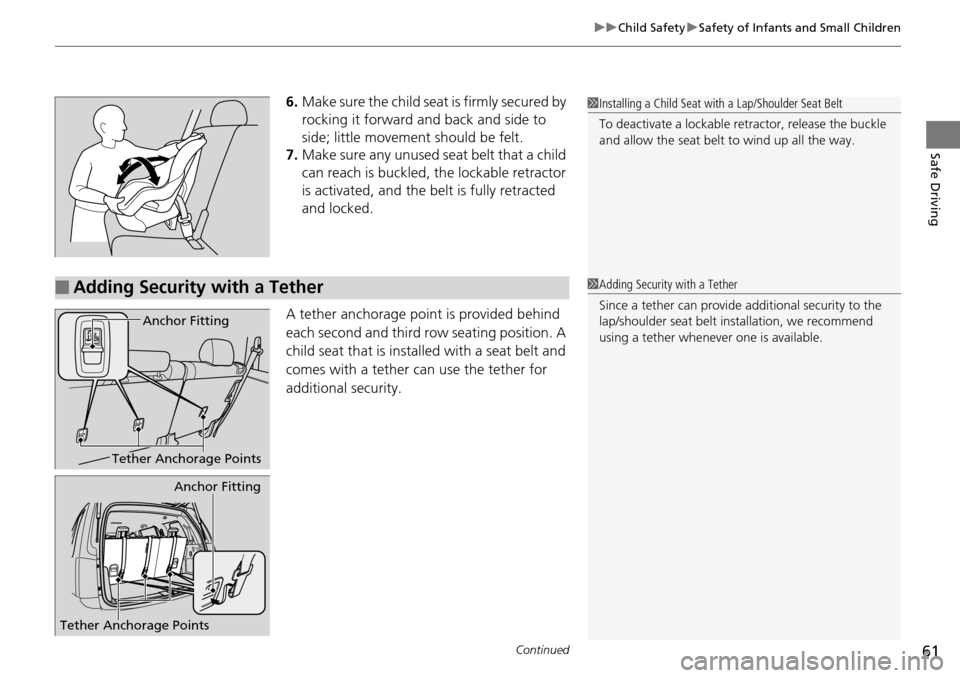
A tether anchorage point is provided behind
each second and third row seating position. A
child seat that is installed with a seat belt and
comes with a tether can use the tether for
additional security.1 Installing a Child Seat with a Lap/Shoulder Seat Belt
To deactivate a lockable retractor, release the buckle
and allow the seat belt to wind up all the way.
■Adding Security with a Tether
Tether Anchorage Points
Anchor Fitting
Tether Anchorage Points
Anchor Fitting
1 Adding Security with a Tether
Since a tether can provide additional security to the
lap/shoulder seat belt in stallation, we recommend
using a tether whenever one is available.
Page 63 of 488
62
uuChild Safety uSafety of Infants and Small Children
Safe Driving
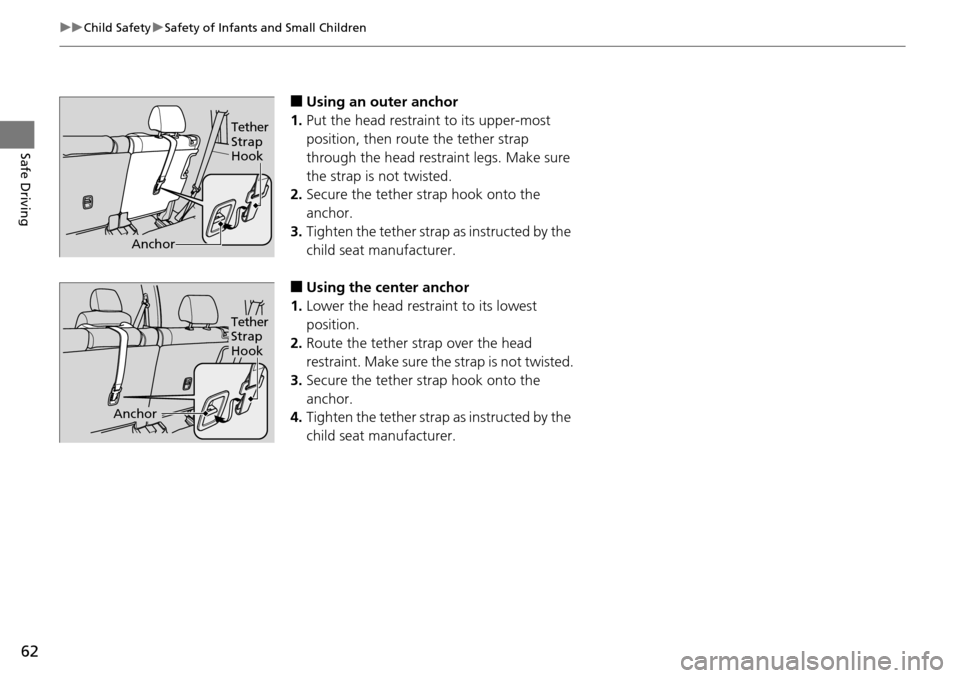
■Using an outer anchor
1. Put the head restraint to its upper-most
position, then rout e the tether strap
through the head restraint legs. Make sure
the strap is not twisted.
2. Secure the tether strap hook onto the
anchor.
3. Tighten the tether strap as instructed by the
child seat manufacturer.
■Using the center anchor
1. Lower the head restra int to its lowest
position.
2. Route the tether strap over the head
restraint. Make sure the strap is not twisted.
3. Secure the tether strap hook onto the
anchor.
4. Tighten the tether strap as instructed by the
child seat manufacturer.
Tether
Strap
Hook
Anchor
Tether
Strap
Hook
Anchor
Page 64 of 488
63
uuChild Safety uSafety of Larger Children
Continued
Safe Driving
Safety of Larger Children
The following pages give instructions on how to check proper seat belt fit, what kind
of booster seat to use if one is needed, and important precautions for a child who
must sit in front.
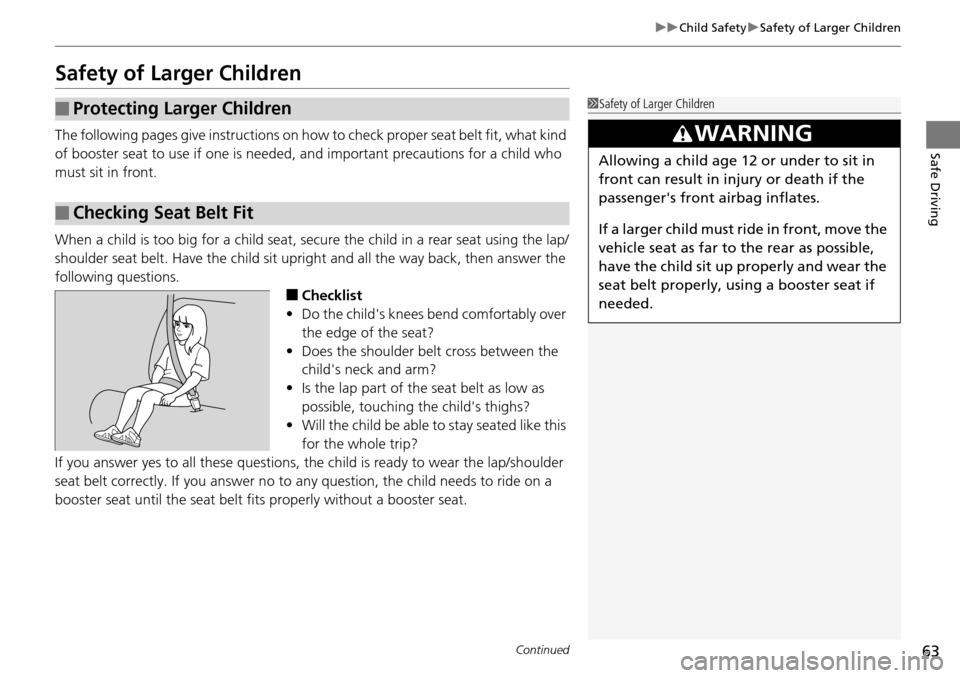
When a child is too big for a child seat, secure the child in a rear seat using the lap/
shoulder seat belt. Have the child sit upri ght and all the way back, then answer the
following questions.
■Checklist
• Do the child's knees bend comfortably over
the edge of the seat?
• Does the shoulder belt cross between the
child's neck and arm?
• Is the lap part of the seat belt as low as
possible, touching the child's thighs?
• Will the child be able to stay seated like this
for the whole trip?
If you answer yes to all these questions, th e child is ready to wear the lap/shoulder
seat belt correctly. If you answer no to any question, the child needs to ride on a
booster seat until the seat belt fits properly without a booster seat.
■Protecting Larger Children
■Checking Seat Belt Fit
1 Safety of Larger Children
3WARNING
Allowing a child age 12 or under to sit in
front can result in injury or death if the
passenger's front airbag inflates.
If a larger child must ri de in front, move the
vehicle seat as far to the rear as possible,
have the child sit up properly and wear the
seat belt properly, us ing a booster seat if
needed.
Page 65 of 488
uuChild Safety uSafety of Larger Children
64
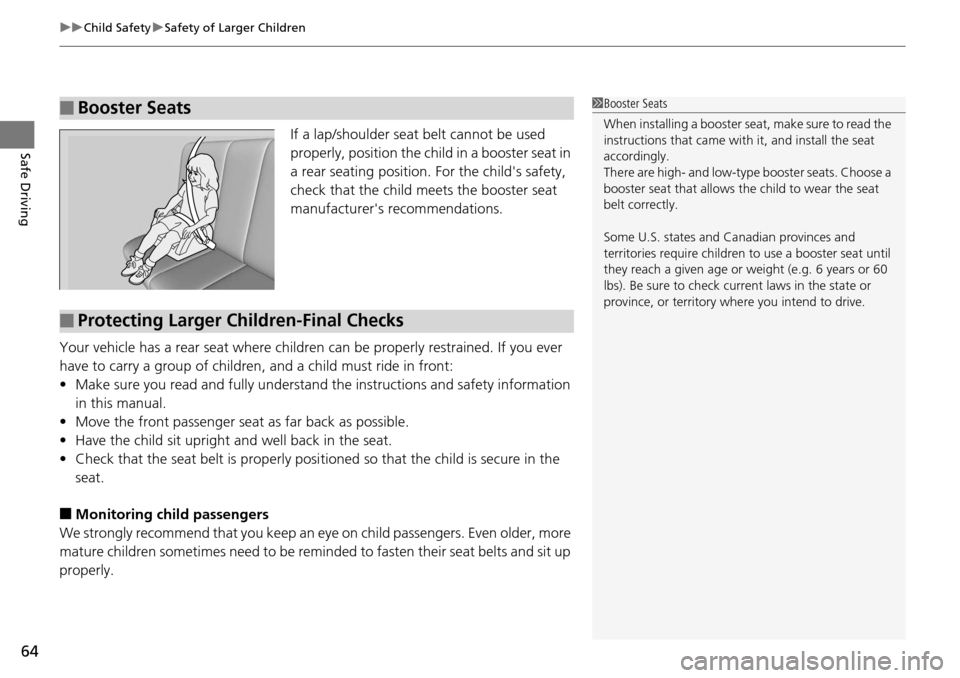
Safe DrivingIf a lap/shoulder seat belt cannot be used
properly, position the child in a booster seat in
a rear seating position. For the child's safety,
check that the child meets the booster seat
manufacturer's recommendations.
Your vehicle has a rear seat where children can be properly restrained. If you ever
have to carry a group of children, and a child must ride in front:
• Make sure you read and full y understand the instructions and safety information
in this manual.
• Move the front passenger seat as far back as possible.
• Have the child sit upright and well back in the seat.
• Check that the seat belt is properly posi tioned so that the child is secure in the
seat.
■Monitoring child passengers
We strongly recommend that you keep an eye on child passengers. Even older, more
mature children sometimes need to be remind ed to fasten their seat belts and sit up
properly.
■Booster Seats1 Booster Seats
When installing a booster seat, make sure to read the
instructions that came with it, and install the seat
accordingly.
There are high- and low-type booster seats. Choose a
booster seat that allows the child to wear the seat
belt correctly.
Some U.S. states and Canadian provinces and
territories require children to use a booster seat until
they reach a given age or weight (e.g. 6 years or 60
lbs). Be sure to check current laws in the state or
province, or territory where you intend to drive.
■Protecting Larger Children-Final Checks
Page 71 of 488
70
uuIndicators u
Instrument Panel
IndicatorNameOn/BlinkingExplanationMessage*
Transmission
Indicator
●Comes on for a few seconds when
you turn the ignition switch to ON
(w, then goes off.●Blinks if the transmission system has a
problem.
●Blinks while driving - Avoid sudden
starts and acceleration and have the
vehicle checked by a dealer immediately.
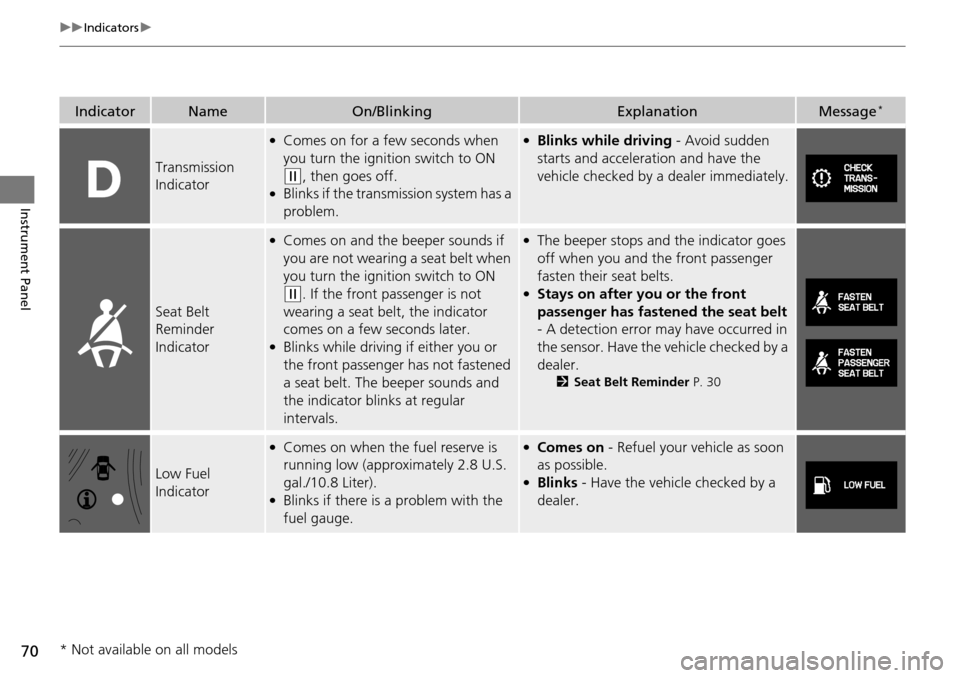
Seat Belt
Reminder
Indicator
●Comes on and the beeper sounds if
you are not wearing a seat belt when
you turn the ignition switch to ON
(w. If the front passenger is not
wearing a seat belt, the indicator
comes on a few seconds later.
●Blinks while driving if either you or
the front passenger has not fastened
a seat belt. The beeper sounds and
the indicator blinks at regular
intervals.
●The beeper stops and the indicator goes
off when you and the front passenger
fasten their seat belts.
●Stays on after you or the front
passenger has fastened the seat belt
- A detection error may have occurred in
the sensor. Have the vehicle checked by a
dealer.
2 Seat Belt Reminder P. 30
Low Fuel
Indicator
●Comes on when the fuel reserve is
running low (approximately 2.8 U.S.
gal./10.8 Liter).
●Blinks if there is a problem with the
fuel gauge.
●Comes on - Refuel your vehicle as soon
as possible.
●Blinks - Have the vehicle checked by a
dealer.
* Not available on all models
Page 72 of 488
71
uuIndicators u
Continued
Instrument Panel
IndicatorNameOn/BlinkingExplanationMessage*
ABS (Anti-lock
Brake System)
Indicator
●Comes on for a few seconds when
you turn the igniti on switch to ON
(w, then goes off.●If it comes on at any other time, there
is a problem with the ABS.
●Stays on constantly - Have the vehicle
checked by a dealer. With this indicator
on, your vehicle still has normal braking
ability but no an ti-lock function.
2ABS (Anti-lock Brake System) P. 362
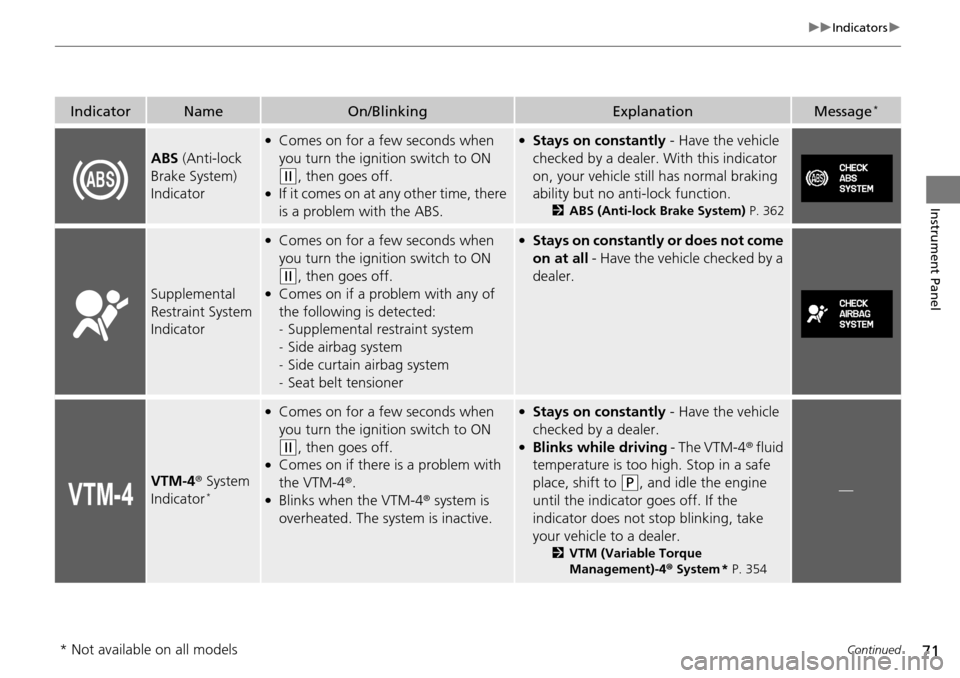
Supplemental
Restraint System
Indicator
●Comes on for a few seconds when
you turn the ignition switch to ON
(w, then goes off.●Comes on if a problem with any of
the following is detected:
-Supplemental restraint system
- Side airbag system
- Side curtain airbag system
- Seat belt tensioner
●Stays on constantly or does not come
on at all - Have the vehicle checked by a
dealer.
VTM-4 ® System
Indicator*
●Comes on for a few seconds when
you turn the igniti on switch to ON
(w, then goes off.●Comes on if there is a problem with
the VTM-4®.
●Blinks when the VTM-4 ® system is
overheated. The system is inactive.
●Stays on constantly - Have the vehicle
checked by a dealer.
●Blinks while driving - The VTM-4® fluid
temperature is too high. Stop in a safe
place, shift to
(P, and idle the engine
until the indicator goes off. If the
indicator does not stop blinking, take
your vehicle to a dealer.
2 VTM (Variable Torque
Management)-4 r System * P. 354
—
* Not available on all models
Page 76 of 488
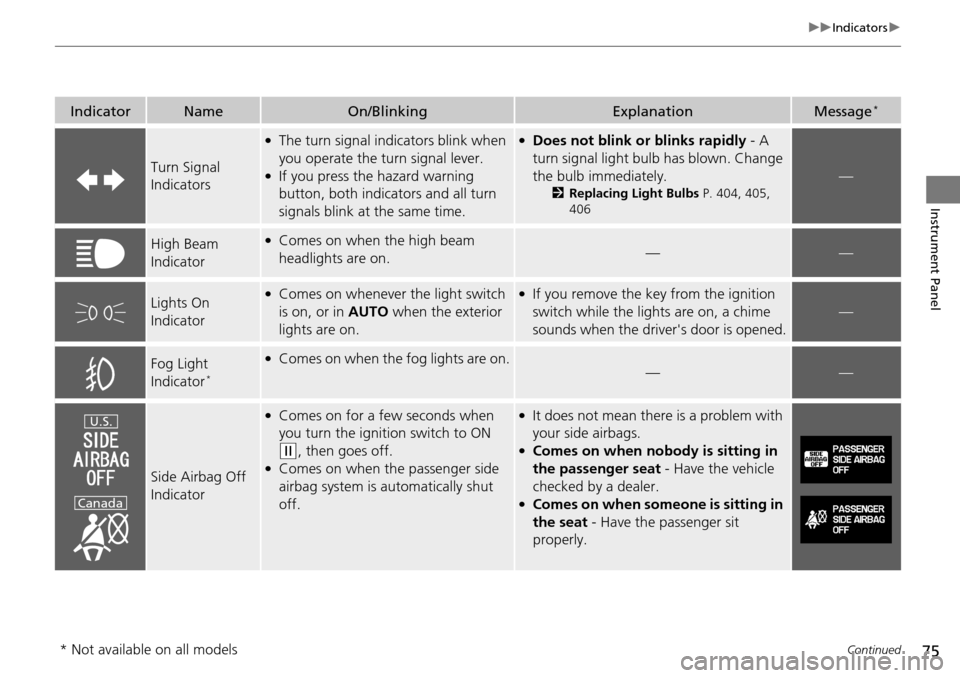
75
uuIndicators u
Continued
Instrument Panel
IndicatorNameOn/BlinkingExplanationMessage*
Turn Signal
Indicators
●The turn signal indi cators blink when
you operate the turn signal lever.
●If you press the hazard warning
button, both indica tors and all turn
signals blink at the same time.
●Does not blink or blinks rapidly - A
turn signal light bulb has blown. Change
the bulb immediately.
2 Replacing Light Bulbs P. 404, 405,
406
—
High Beam
Indicator●Comes on when the high beam
headlights are on.——
Lights On
Indicator●Comes on whenever the light switch
is on, or in AUTO when the exterior
lights are on.●If you remove the key from the ignition
switch while the lights are on, a chime
sounds when the driver's door is opened.
—
Fog Light
Indicator*
●Comes on when the fog lights are on.——
Side Airbag Off
Indicator
●Comes on for a few seconds when
you turn the igniti on switch to ON
(w, then goes off.●Comes on when the passenger side
airbag system is automatically shut
off.
●It does not mean there is a problem with
your side airbags.
●Comes on when nobody is sitting in
the passenger seat - Have the vehicle
checked by a dealer.
●Comes on when some one is sitting in
the seat - Have the passenger sit
properly.
U.S.
Canada
* Not available on all models
Page 93 of 488
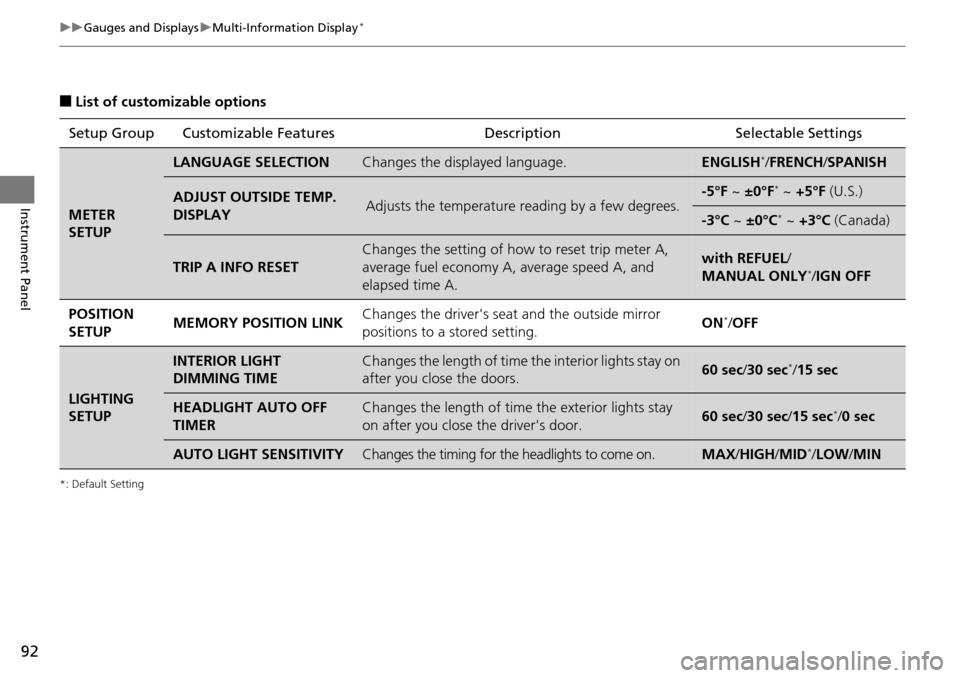
92
uuGauges and Displays uMulti-Information Display*
Instrument Panel
■List of customizable options
*: Default Setting
Setup Group Customizable Features DescriptionSelectable Settings
METER
SETUP
LANGUAGE SELECTIONChanges the displayed language.ENGLISH*/FRENCH /SPANISH
ADJUST OUTSIDE TEMP.
DISPLAYAdjusts the temperature reading by a few degrees.-5°F ~ ±0°F* ~ +5°F (U.S.)
-3°C ~ ±0°C* ~ +3°C (Canada)
TRIP A INFO RESET
Changes the setting of how to reset trip meter A,
average fuel economy A, average speed A, and
elapsed time A.with REFUEL /
MANUAL ONLY*/ IGN OFF
POSITION
SETUP MEMORY POSITION LINK
Changes the driver's seat
and the outside mirror
positions to a stored setting. ON
*/
OFF
LIGHTING
SETUP
INTERIOR LIGHT
DIMMING TIMEChanges the length of time the interior lights stay on
after you close the doors.60 sec/ 30 sec*/15 sec
HEADLIGHT AUTO OFF
TIMERChanges the length of time the exterior lights stay
on after you close the driver's door.60 sec/ 30 sec/15 sec*/0 sec
AUTO LIGHT SENSITIVITYChanges the timing for the headlights to come on.MAX /HIGH /MID*/ LOW /MIN