weight HONDA PRELUDE 1990 Owners Manual
[x] Cancel search | Manufacturer: HONDA, Model Year: 1990, Model line: PRELUDE, Model: HONDA PRELUDE 1990Pages: 143, PDF Size: 2.07 MB
Page 1 of 143
 to navigate through\
this reference.
For a printed owners manual, click on authorized manuals or go")
1990 Prelude Online Reference Owner's Manual
Use these links (and links throughout this manual) to navigate through\
this reference.
For a printed owner's manual, click on authorized manuals or go to www.h\
elminc.com.
Features & Safety ........................................................................\
........................................................ 2
What you should know before driving your car.
Starting & Driving........................................................................\
.....................................................
55
What gas to use, how to change gears, etc.
Maintenance
........................................................................\
............................................................... 76
The Required Maintenance Schedule and some items you can service.
Emergency Service
........................................................................\
................................................ 116
Changing a flat, jump starting, towing.
Specifications
........................................................................\
......................................................... 125
Dimensions, weights and capacities.
Consumer Information
........................................................................\
.......................................... 127
Reporting Safety Detects, warranty service, vehicle identification numbe\
rs, etc.
Index ........................................................................\
....................... .................................................
137
Gas Station Information
Contents
Owner's Identification Form
ProCarManuals.com
Page 4 of 143
Keys and Locks (cont'd)
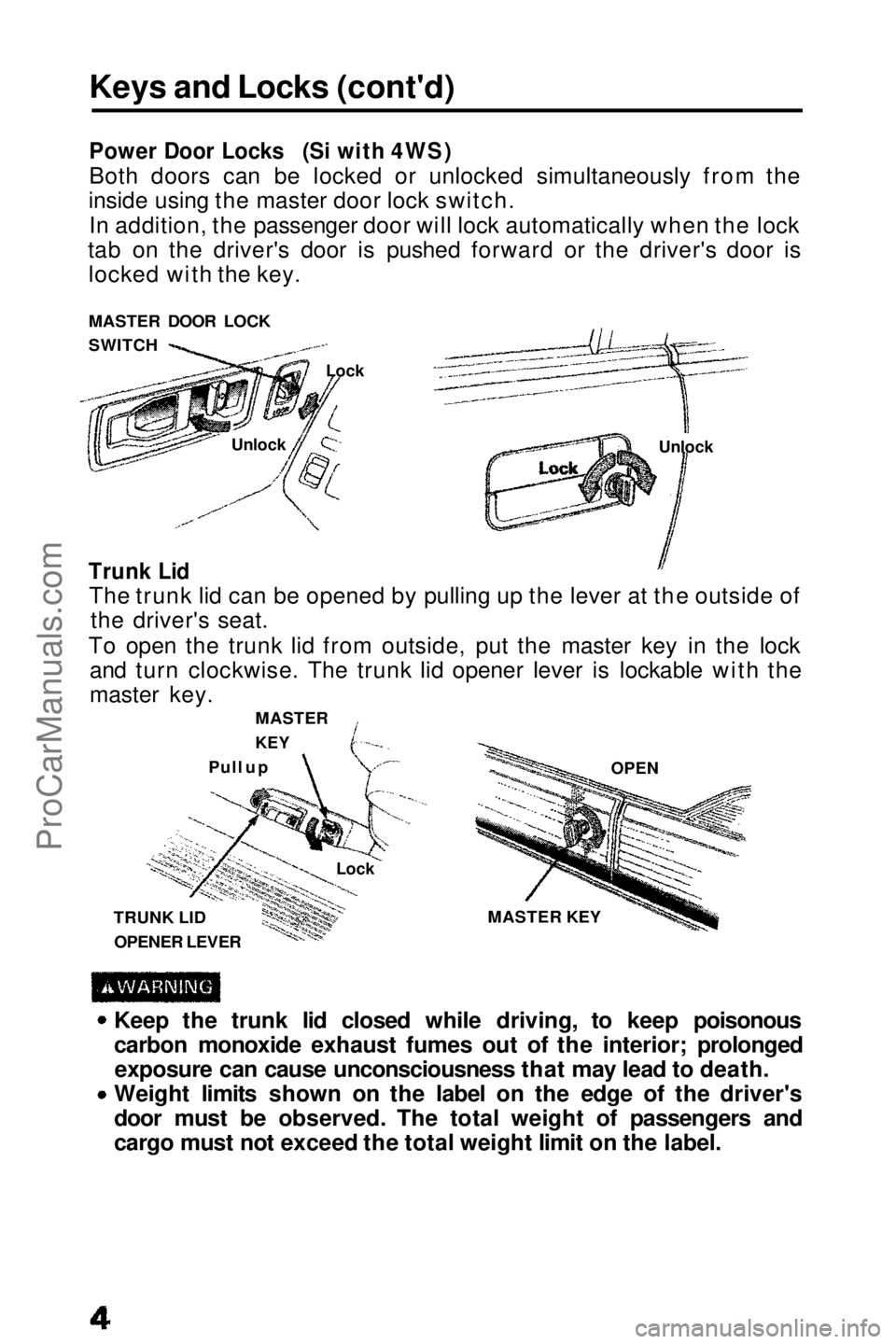
Power Door Locks (Si with 4WS)
Both doors can be locked or unlocked simultaneously from the
inside using the master door lock switch.
In addition, the passenger door will lock automatically when the lock
tab on the driver's door is pushed forward or the driver's door is locked with the key.
MASTER DOOR LOCK
SWITCH
Trunk Lid
The trunk lid can be opened by pulling up the lever at the outside of the driver's seat.
To open the trunk lid from outside, put the master key in the lock and turn clockwise. The trunk lid opener lever is lockable with the
master key.
Keep the trunk lid closed while driving, to keep poisonous
carbon monoxide exhaust fumes out of the interior; prolongedexposure can cause unconsciousness that may lead to death. Weight limits shown on the label on the edge of the driver's
door must be observed. The total weight of passengers and
cargo must not exceed the total weight limit on the label.
Unlock
OPEN
MASTER KEY
MASTER
KEY
Pull up
Lock
TRUNK LID
Lock
Unlock
OPENER LEVERProCarManuals.comMain Menu t s
Page 6 of 143
Seats (cont'd)
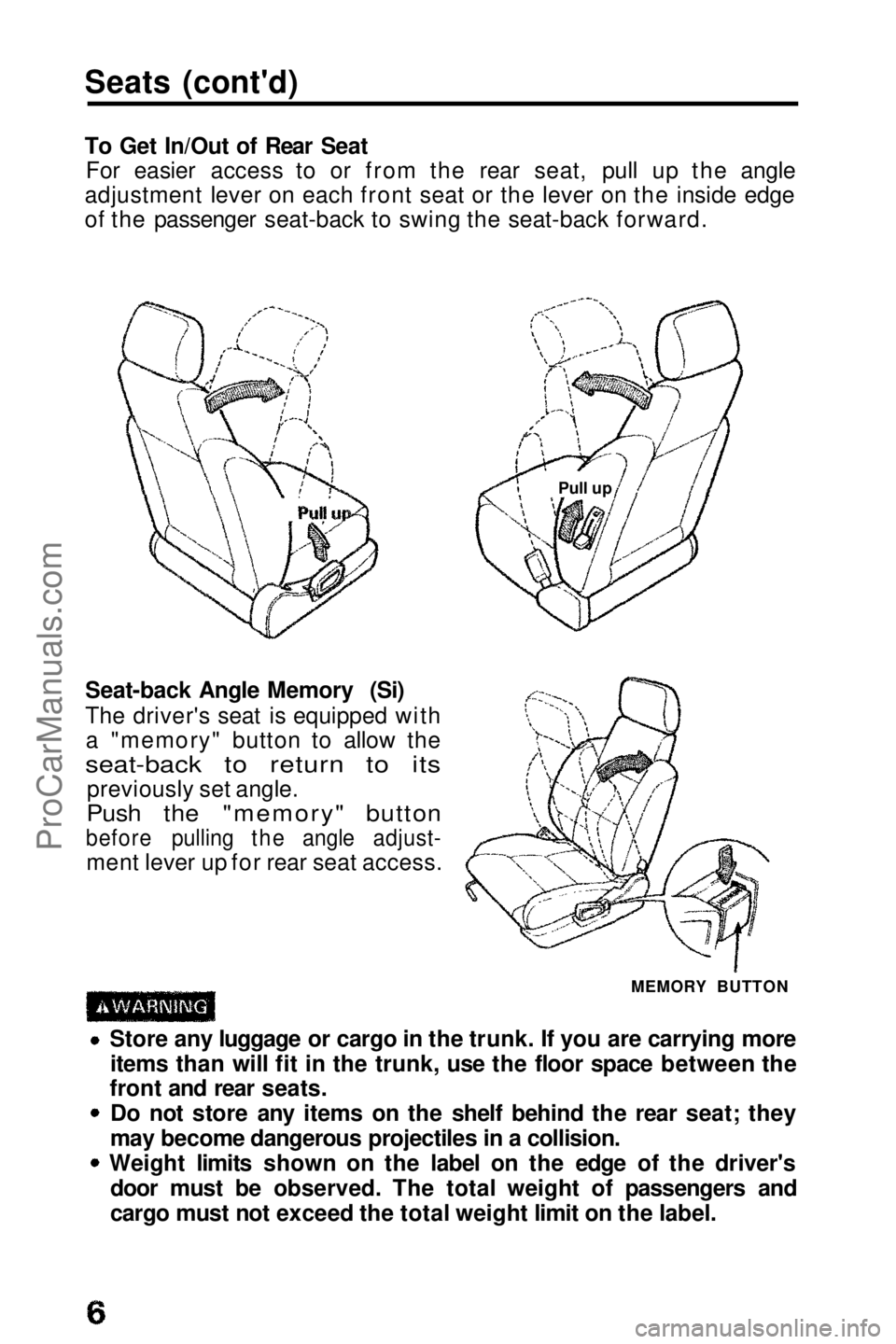
To Get In/Out of Rear Seat
For easier access to or from the rear seat, pull up the angle
adjustment lever on each front seat or the lever on the inside edge
of the passenger seat-back to swing the seat-back forward.
Seat-back Angle Memory (Si)
The driver's seat is equipped witha "memory" button to allow the
seat-back to
return to its
previously set angle.
Push the "memory" button
before pulling the angle adjust-
ment lever up for rear seat access.
MEMORY BUTTON
Store any luggage or cargo in the trunk. If you are carrying more items than will fit in the trunk, use the floor space between the
front and rear seats.
Do not store any items on the shelf behind the rear seat; they
may become dangerous projectiles in a collision.
Weight limits shown on the label on the edge of the driver's door must be observed. The total weight of passengers and
cargo must not exceed the total weight limit on the label. Pull upProCarManuals.comMain Menu t s
Page 54 of 143
Sunroof (cont'd)
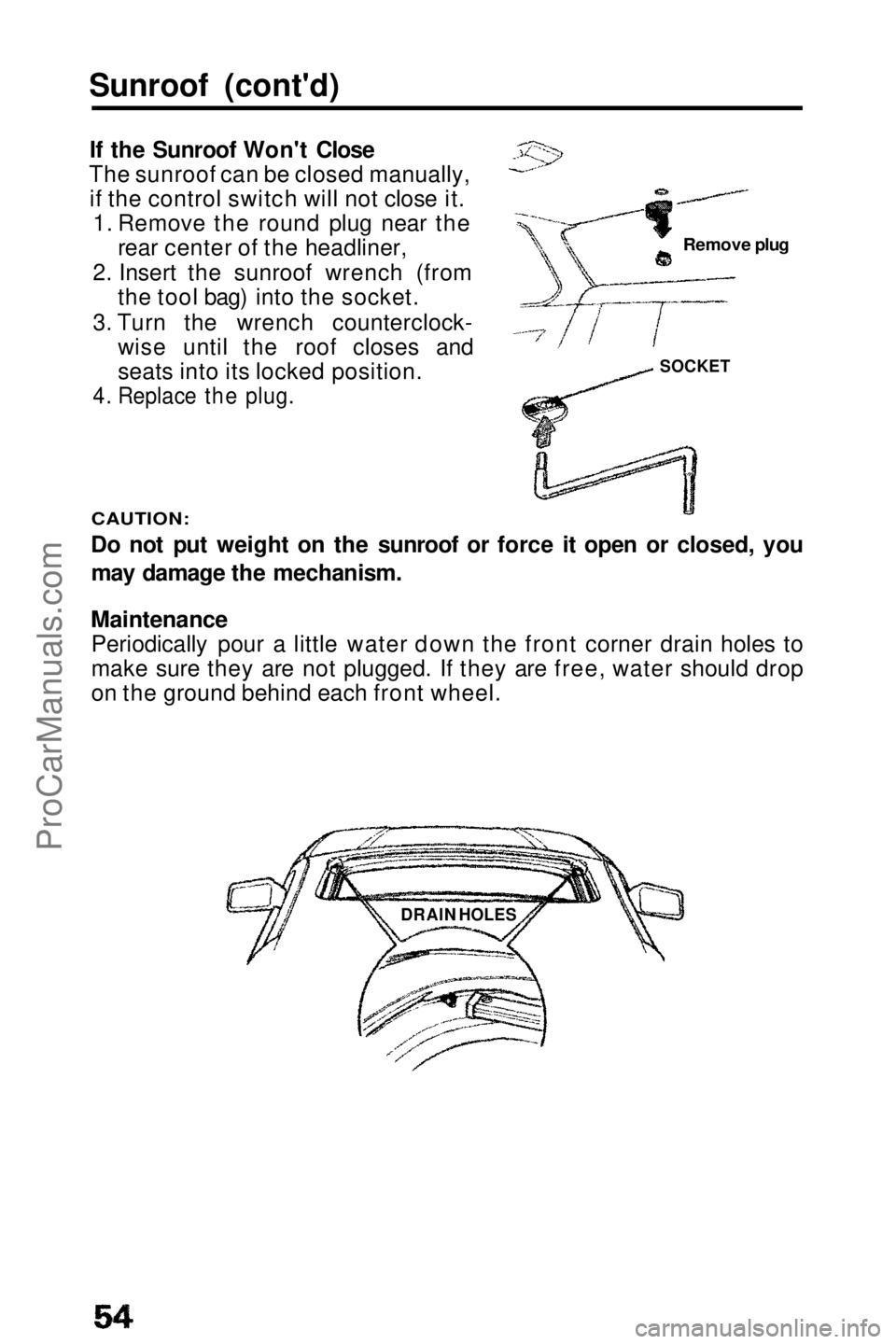
If the Sunroof Won't Close
The sunroof can be closed manually, if the control switch will not close it. 1. Remove the round plug near the rear center of the headliner,
2. Insert the sunroof wrench (from the tool bag) into the socket.
3. Turn the wrench counterclock- wise until the roof closes and
seats into its locked position.
4. Replace the plug.
CAUTION:
Do not put weight on the sunroof or force it open or closed, you
may damage the mechanism.
Maintenance
Periodically pour a little water down the front corner drain holes to
make sure they are not plugged. If they are free, water should drop
on the ground behind each front wheel.
Remove plug
SOCKET
DRAIN HOLESProCarManuals.comMain Menu t s
Page 57 of 143
Open
Close
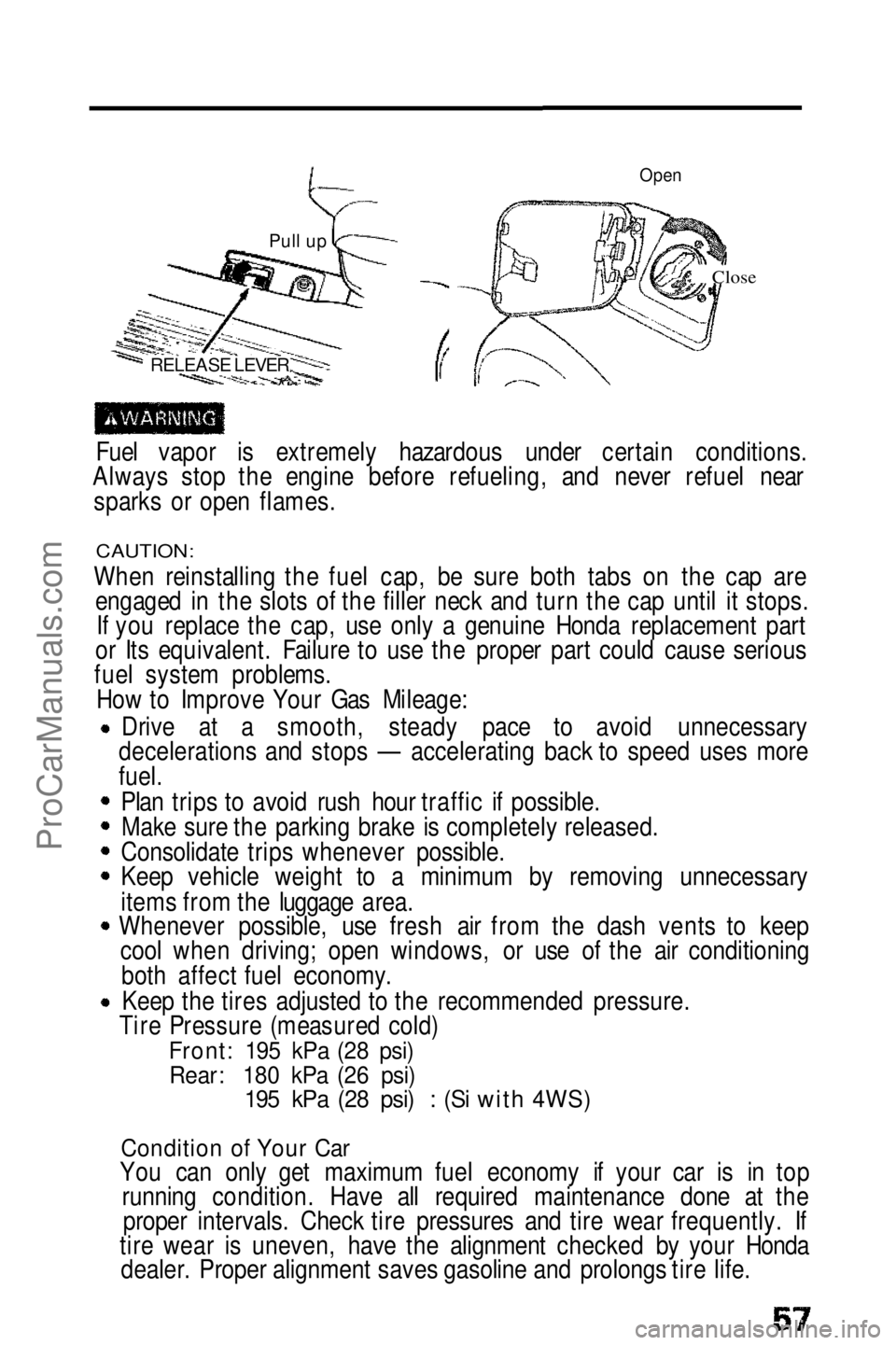
Fuel vapor is extremely hazardous under certain conditions.
Always stop the engine before refueling, and never refuel near
sparks or open flames.
CAUTION:
When reinstalling the fuel cap, be sure both tabs on the cap are engaged in the slots of the filler neck and turn the cap until it stops.
If you replace the cap, use only a genuine Honda replacement part
or Its equivalent. Failure to use the proper part could cause serious
fuel system problems.
How to Improve Your Gas Mileage:
Drive at a smooth, steady pace to avoid unnecessary
decelerations and stops — accelerating back to speed uses more
fuel.
Plan trips to avoid rush hour traffic if possible.Make sure the parking brake is completely released.
Consolidate trips whenever possible.
Keep vehicle weight to a minimum by removing unnecessary
items from the luggage area.
Whenever possible, use fresh air from the dash vents to keep
cool when driving; open windows, or use of the air conditioningboth affect fuel economy.
Keep the tires adjusted to the recommended pressure.
Tire Pressure (measured cold)
Front: 195 kPa (28 psi)
Rear: 180 kPa (26 psi)
195 kPa (28 psi) : (Si with 4WS)
Condition of Your Car
You can only get maximum fuel economy if your car is in top running condition. Have all required maintenance done at theproper intervals. Check tire pressures and tire wear frequently. If
tire wear is uneven, have the alignment checked by your Honda dealer. Proper alignment saves gasoline and prolongs tire life.
RELEASE LEVER
Pull upProCarManuals.comMain Menu t s
Page 71 of 143
Towing a Trailer
Your car is designed primarily to carry passengers and a normal
amount of luggage. Although your car is capable of towing a trailer,
there will be an effect on handling, performance, braking, general
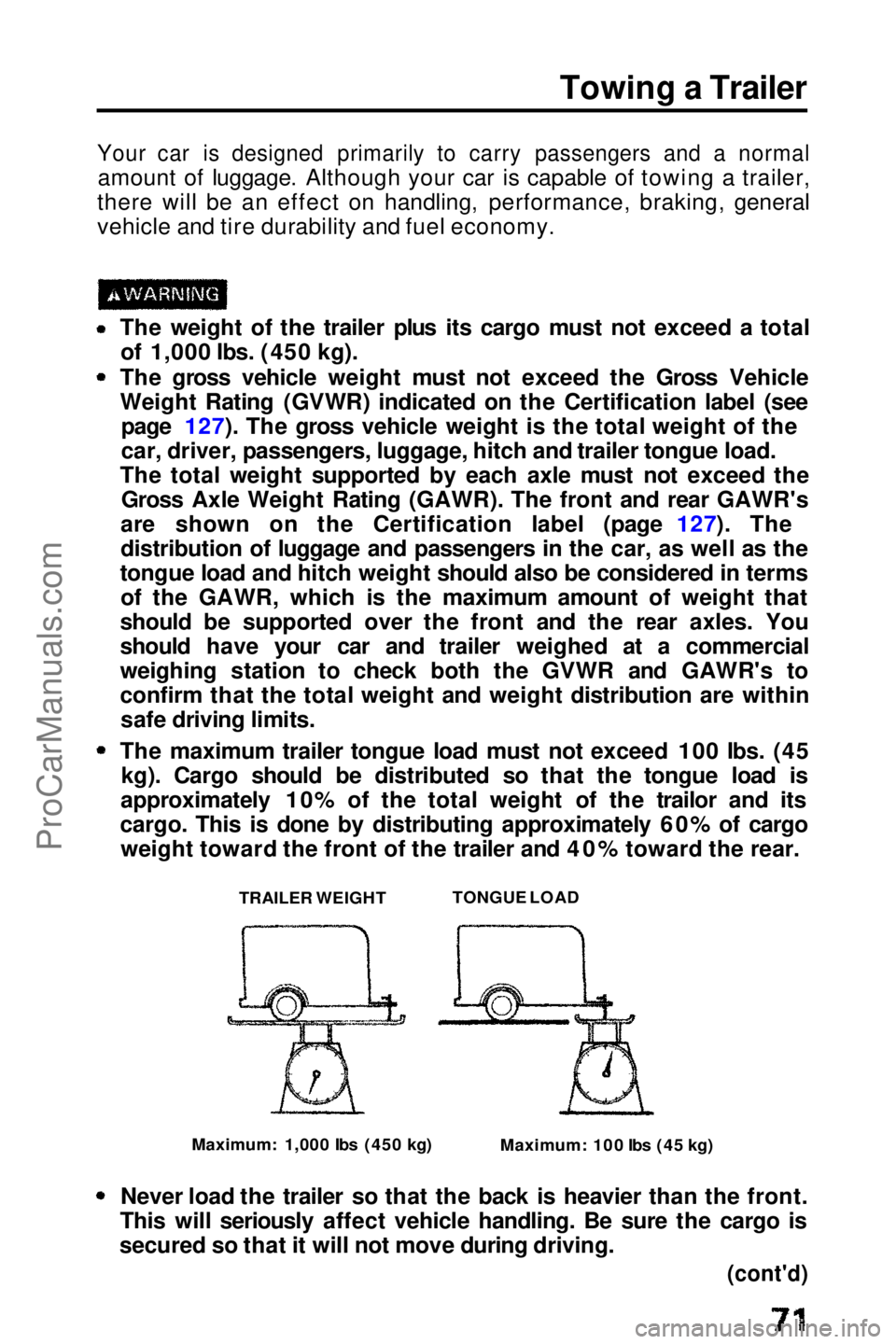
vehicle and tire durability and fuel economy. The weight of the trailer plus its cargo must not exceed a total
of 1,000 Ibs. (450 kg).
The gross vehicle weight must not exceed the Gross Vehicle
Weight Rating (GVWR) indicated on the Certification label (see page 127). The gross vehicle weight is the total weight of the
car, driver, passengers, luggage, hitch and trailer tongue load.
The total weight supported by each axle must not exceed the Gross Axle Weight Rating (GAWR). The front and rear GAWR's
are shown on the Certification label (page 127). The
distribution of luggage and passengers in the car, as well as the
tongue load and hitch weight should also be considered in terms of the GAWR, which is the maximum amount of weight that
should be supported over the front and the rear axles. You
should have your car and trailer weighed at a commercial
weighing station to check both the GVWR and GAWR's to
confirm that the total weight and weight distribution are within safe driving limits.
The maximum trailer tongue load must not exceed 100 Ibs. (45 kg). Cargo should be distributed so that the tongue load is
approximately 10% of the total weight of the trailor and its
cargo. This is done by distributing approximately 60% of cargo weight toward the front of the trailer and 40% toward the rear. Never load the trailer so that the back is heavier than the front.
This will seriously affect vehicle handling. Be sure the cargo is
secured so that it will not move during driving. TONGUE LOAD
TRAILER WEIGHT
Maximum: 100 Ibs (45 kg)
Maximum: 1,000 Ibs (450 kg)
(cont'd)ProCarManuals.comMain Menu t s
Page 73 of 143

Break-in Schedule
Do not tow a trailer during the 600 mile (1,000 km) break-in period:
see page 2.
Maintenance
If you tow a trailer, your vehicle will require more frequent
maintenance due to the additional load. Refer to the "Maintenance
Schedule under severe driving conditions" on page 80 for specific
information.
Before Towing
With the car and trailer completely loaded and parked on a level surface, confirm that the tongue loading is correct. If the car has an
abnormal nose-up or nose-down attitude, check for improper cargo
distribution. Check also for excessive cargo weight, worn
suspension or other causes and correct the problem before driving.
Be sure the cargo is secured so it will not shift while driving. Check
that your rearview mirrors conform to any federal, state, or local regulations. If not, install rearview mirrors designed for towing.Before towing a trailer, practice turning, stopping and reversing with
a trailor in an area away from traffic until you learn the technique.
(cont'd)
ProCarManuals.comMain Menu t s
Page 74 of 143

Towing a Trailer (cont'd)
Towing Safety
Stopping distance will be increased when towing a trailer. For
each 10 mph (16 km/h) of speed, allow at least two car lengths between you and the vehicle ahead. Avoid sudden braking
which may cause trailer jackknifing and loss of control.
Avoid jerky starts and sudden acceleration. If your car has amanual transmission, always start out in first gear and release
the clutch at moderate engine rpm.
Avoid rapid lane changing and sharp turns. The trailer could hit your car in a tight turn. Slow down before making a turn.
Remember, the total length of your car plus trailer will require a
wider turning circle.
Crosswinds may adversely affect handling of your car and
trailer, Use the rearview mirrors frequently to warn you of approaching large vehicles that may pass you causing your car
and trailer to sway. When being passed, firmly grip the steering wheel and be prepared to reduce speed immediately but
gradually. Never increase speed. Steer straight ahead.
Towing a trailer in bad weather will magnify any difficulty in
controlling the car caused by the weather itself. Avoid sudden maneuvers: slow down and use extra caution.
Be careful when passing other vehicles. Passing requires
considerable distance because of the added weight and length
of your trailer.ProCarManuals.comMain Menu t s
Page 106 of 143

Tires (cont'd)
Tire Chains
When required, tire chains should be installed on the front wheels. If
you are using metal type chains, make sure they are designated SAEClass "S". You may also use plastic or cable type "chains". Use
only the correct size chains recommended for your tire size andmake sure they are installed following the chain manufacturer's
instructions.
Once tire chains are installed, drive at less than 19 mph (30km/h) on
roads covered with snow or ice. To minimize tire and chain wear,
avoid driving on cleared roads with chains installed.
CAUTION:
Improper installation or loose tire chains may damage your car's
chassis and fenders.
NOTE:
Keep the manufacturer's installation instructions in your glove box
for future reference.
Tire Balancing
Unbalanced tires may affect handling and tire wear. A tire should
always be rebalanced after it has been dismounted from the wheel.
Your original tires were properly balanced before the car left the
factory, but may need rebalancing at some time during the life of the
tire. Tire balancing for the COMPACT spare is not necessary.
CAUTION:
Use only genuine Honda aluminum wheel weights if your car is
equipped with aluminum wheels. Non-genuine Honda wheel
weights may corrode and damage the aluminum wheel.
Tire Rotation Tires may wear unevenly when used for a long time at the same position on the car. To avoid this, rotate the tires every 7,500 miles
(12,000 km). If abnormal or uneven wear develops between
rotations, the cause should be found and corrected as soon as
possible. The illustration shows how the tires can be rotated. The
COMPACT spare tire must not be included in tire rotation.ProCarManuals.comMain Menu t s
Page 121 of 143

If towing is necessary, contact a professional towing service. Your
authorized Honda dealer can assist you with detailed towing
instructions.
Never use tow chains or rope to tow a car; your ability to safety
control the car may be adversely affected.
We recommend the following:
Flat Bed Equipment — Entire car is winched on a flat bed vehicle.
This is the best way of transporting your Honda.
Wheel Lift Type — Tow with the front wheels off the ground.
If the
car can only be towed with the front wheels on the ground:
make sure the transmission is full of fluid (see page 86 — 87)
and tow with the transmission in neutral (N) and the ignition key in
the I position.
CAUTION:
To avoid serious damage on automatic transmission cars, first start the engine and shift to D, then to N and shut the engine off. If
the engine does not run or the transmission cannot be shifted
while the engine is running, the car must be transported on flatbed equipment.
Check local regulations for towing.
CAUTION:
Do not exceed 35 mph (55 km/h) or tow for distances of more
than 50 miles (80 km). If a Sling Type tow is used, the tow truck driver should position
wood spacer blocks between your car's frame and the chains
and lift straps to avoid damaging the bumper and the body. Do not use the bumpers to lift the car or to support the car's
weight while towing.
When towing a car with 4WS even with the front wheels off the ground, turn the wheels straight ahead and tie the steering wheel in place. TowingProCarManuals.comMain Menu s t