transmission HONDA PRELUDE 1990 User Guide
[x] Cancel search | Manufacturer: HONDA, Model Year: 1990, Model line: PRELUDE, Model: HONDA PRELUDE 1990Pages: 143, PDF Size: 2.07 MB
Page 70 of 143

R-Reverse
2-2nd
Use 2nd gear
for increased engine braking when driving
downhill,
and increased power when driving uphill; also for driving on slippery
roads, and freeing the car from mud or
sand, where 1 st gear could
provide too much power and cause skidding or wheel-spin. The
maximum recommended speed in 2nd gear is:
60 mph (97
km/h)
CAUTION:
Shift into or out of reverse only after the car has come to a
complete stop; the transmission may be damaged if you shift
while the car is moving.
P-Park
CAUTION:
Use this position when starting the engine , or when parking. Shift
into Park only when the car is COMPLETELY stopped.
N — Neutral
Use when starting the engine or during prolonged idling in traffic.
Shifting the Automatic (cont'd)
ProCarManuals.comMain Menu t s
Page 74 of 143

Towing a Trailer (cont'd)
Towing Safety
Stopping distance will be increased when towing a trailer. For
each 10 mph (16 km/h) of speed, allow at least two car lengths between you and the vehicle ahead. Avoid sudden braking
which may cause trailer jackknifing and loss of control.
Avoid jerky starts and sudden acceleration. If your car has amanual transmission, always start out in first gear and release
the clutch at moderate engine rpm.
Avoid rapid lane changing and sharp turns. The trailer could hit your car in a tight turn. Slow down before making a turn.
Remember, the total length of your car plus trailer will require a
wider turning circle.
Crosswinds may adversely affect handling of your car and
trailer, Use the rearview mirrors frequently to warn you of approaching large vehicles that may pass you causing your car
and trailer to sway. When being passed, firmly grip the steering wheel and be prepared to reduce speed immediately but
gradually. Never increase speed. Steer straight ahead.
Towing a trailer in bad weather will magnify any difficulty in
controlling the car caused by the weather itself. Avoid sudden maneuvers: slow down and use extra caution.
Be careful when passing other vehicles. Passing requires
considerable distance because of the added weight and length
of your trailer.ProCarManuals.comMain Menu t s
Page 75 of 143

CAUTION:
Before starting out, check the operation of the lights and all car/
trailer connections. After driving a short distance, stop and
recheck the lights and connections.
Reversing is difficult and requires practice. While backing-up,
the trailer may pivot off-course. To correct for this, grip the bottom of the steering wheel and move your hand to the left to
move the trailer to the left, or to the right to move the trailer to
the right. Turn the steering wheel a little at a time, and keep the
speed very low. Have someon e guide you when backing.
To help
prevent overheating of the brakes, shift into a lower
gear to make use of engine braking before descending steep or
long grades. Do not make sudden downshifts. Pay strict attention to the coolant temperature gauge when
going up hills. Because of the added load of the trailer, your car's
engine may overheat on hot days. Turning off the air conditioner
will reduce the load on the cooling system.
On cars equipped with automatic transmission. —Do not hold the car stationary on an incline by using the accelerator pedal; this can cause the transmission fluid tooverheat. Instead, use the handbrake or footbrake.
—When towing trailers, avoid high transmission fluid temperatures (caused by the transmission frequently shiftingbetween 3rd and 4th gears) by driving in S3.
NOTE:
Be sure to check state and local laws concerning maximum speed or
other driving restrictions for cars towing trailers. If you are driving
across several states, check each state's requirements before
leaving home, because restrictions may vary.
Parking with a Trailer
Whenever parking your car on an incline with a trailer attached, first
place and seat chocks at each wheel of the car and trailer. This is in
addition to the normal parking preparations of firmly applying the parking brake and placing the transmission in first or reverse
(manual transmission) or P (automatic transmission).
CAUTION:
Parking on an incline is not recommended and should be done only
if it cannot be avoided. Follow all precautions mentioned above
and turn the wheels to point towards a curb if facing downhill,
away from a curb if facing uphill. When leaving an inclined parking place, move the car slightly to unseat the chocks. Then while
keeping the foot brakes firmly applied, have an assistant remove
the chocks.ProCarManuals.comMain Menu t s
Page 82 of 143
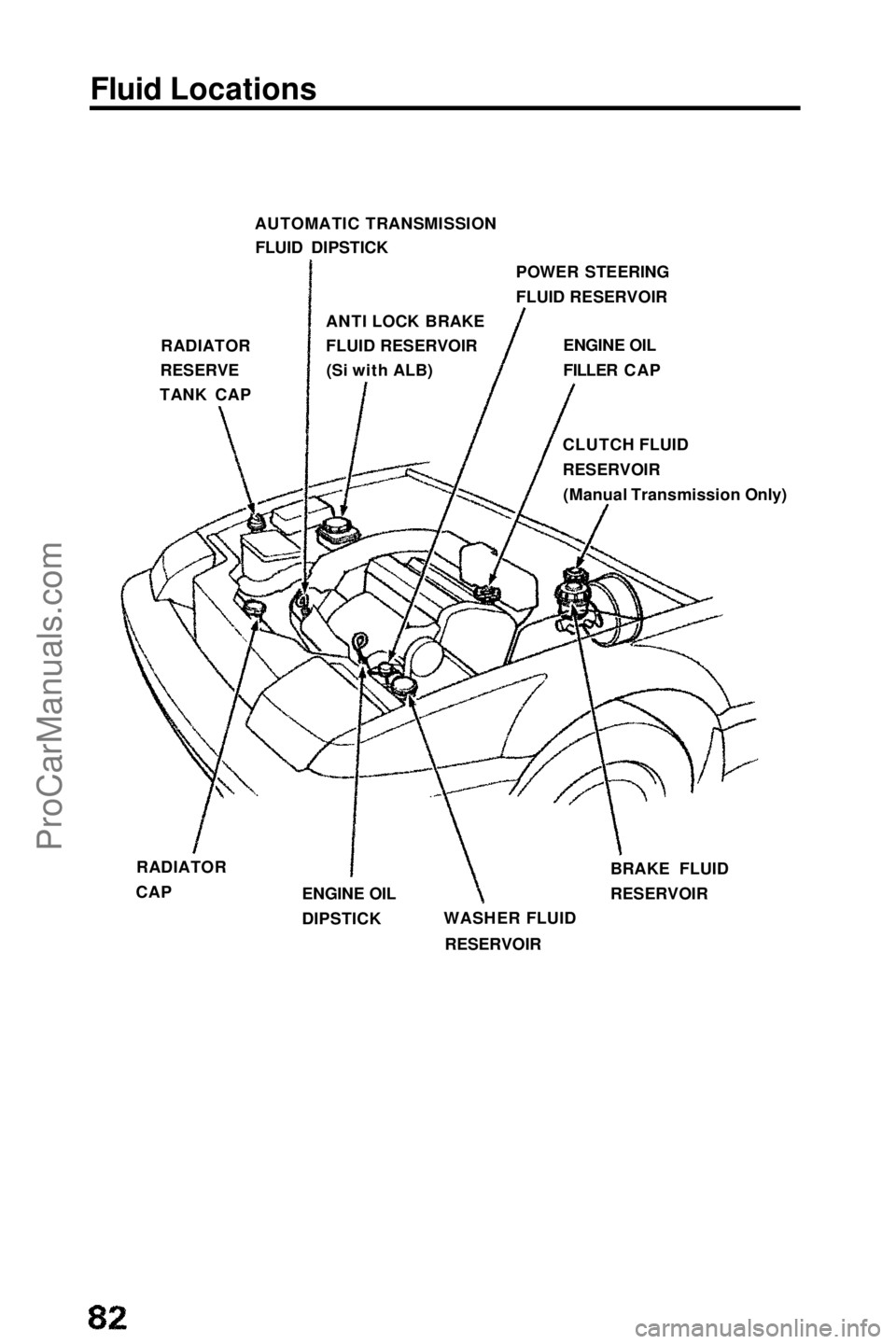
Fluid Locations
AUTOMATIC TRANSMISSIONFLUID DIPSTICK
POWER STEERING
FLUID RESERVOIR
ANTI LOCK BRAKE
FLUID RESERVOIR (Si with ALB) ENGINE OIL
FILLER CAP
CLUTCH FLUID
RESERVOIR (Manual Transmission Only)
RADIATOR
RESERVE
TANK CAP
RADIATOR
CAP ENGINE OIL
DIPSTICK WASHER FLUID
RESERVOIR BRAKE FLUID
RESERVOIRProCarManuals.comMain Menu t s
Page 86 of 143
Transmission Oil/Fluid Check
Transmission oil/fluid must be checked with the engine off and the
car on level ground.
If the engine has been running, some engine components may
be hot enough to burn you. Keep hands away from the radiator fan. The fan may start
automatically without warning and run for up to 15 minutes,
even after the engine is turned off.
CAUTION:
If the oil/fluid level is low, check for possible leaks before adding
oil. Do not overfill.
Since the transmission and differential are in the same housing, you
are actually checking both oil/fluid levels in one procedure. Change
transmission oil/fluid according to the Maintenance Schedule on
page 78 .
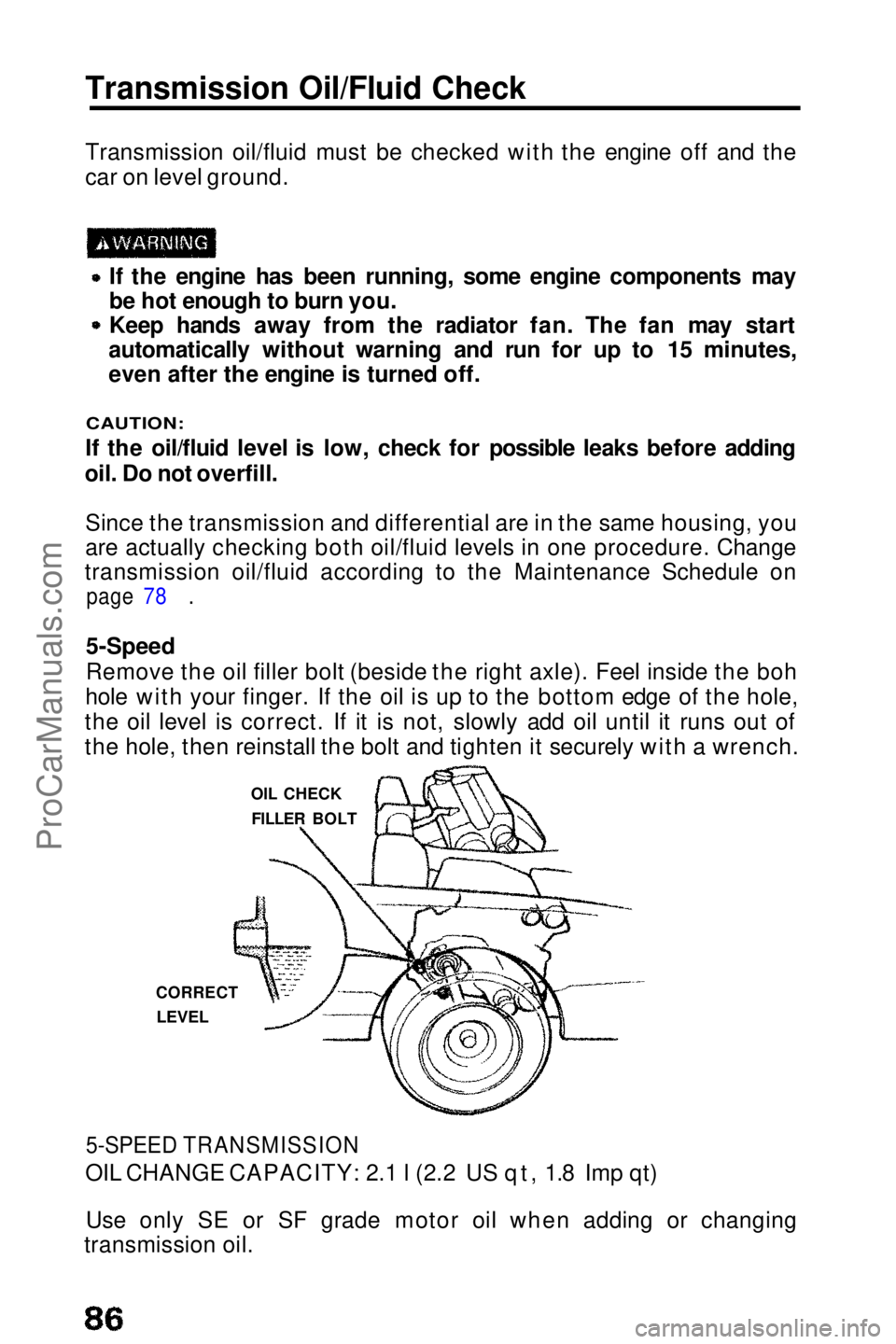
5-Speed
Remove the oil filler bolt (beside the right axle). Feel inside the boh
hole with your finger. If the oil is up to the bottom edge of the hole,
the oil level is correct. If it is not, slowly add oil until it runs out of
the hole, then reinstall the bolt and tighten it securely with a wrench.
CORRECT
LEVEL
5-SPEED TRANSMISSION
OIL CHANGE CAPACITY: 2.1 l (2.2 US qt, 1.8 Imp qt)
Use only SE or SF grade motor oil when adding or changing
transmission oil. OIL CHECK
FILLER BOLTProCarManuals.comMain Menu t s
Page 87 of 143
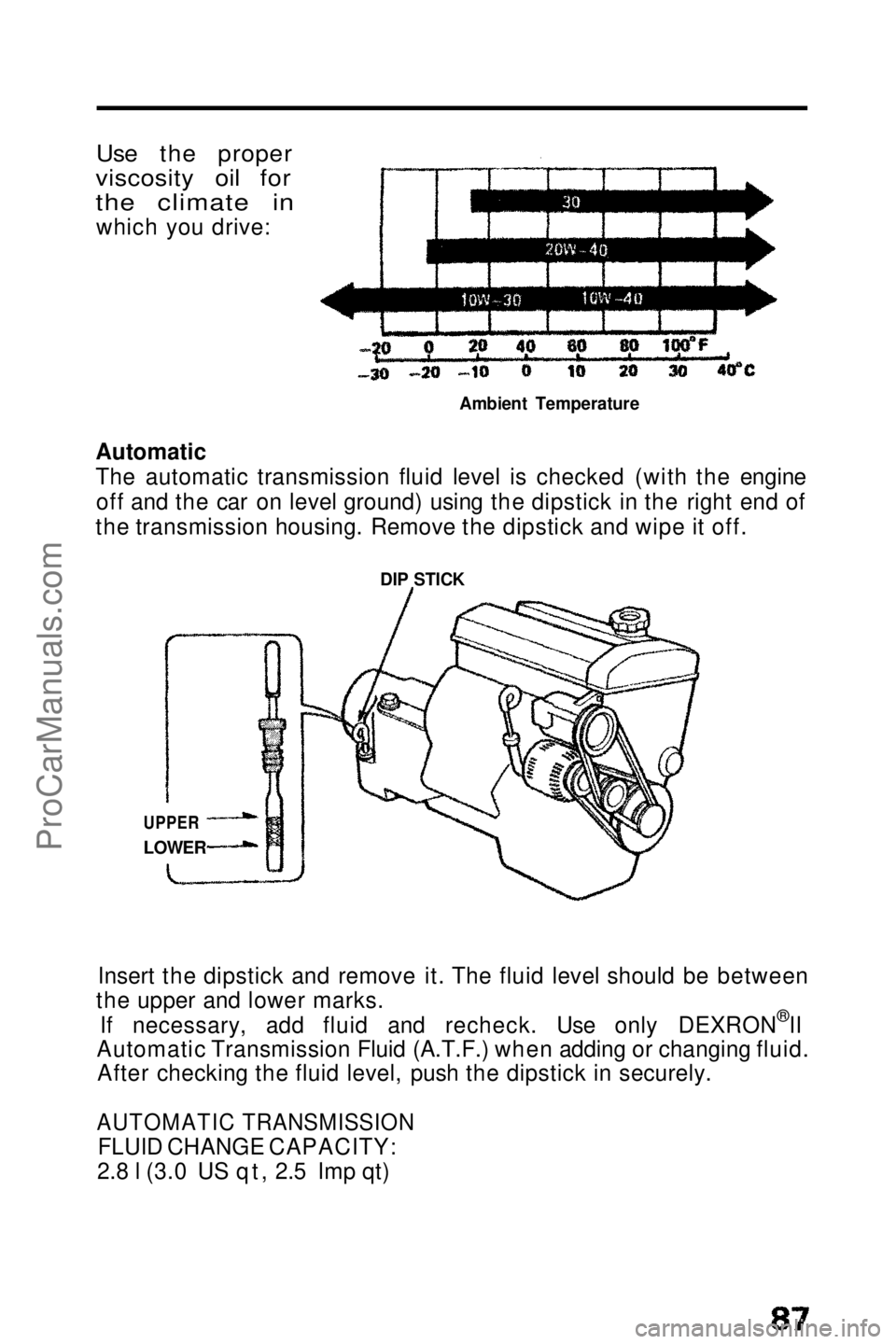
Use the proper
viscosity oil for
the climate in
which you drive:
Ambient Temperature
Automatic
The automatic transmission fluid level is checked (with the engine off and the car on level ground) using the dipstick in the right end of
the transmission housing. Remove the dipstick and wipe it off.
Insert the dipstick and remove it. The fluid level should be between
the upper and lower marks.
If necessary, add fluid and recheck. Use only DEXRON ®
II
Automatic Transmission Fluid (A.T.F.) when adding or changing fluid. After checking the fluid level, push the dipstick in securely.
AUTOMATIC TRANSMISSION
FLUID CHANGE CAPACITY:
2.8 l (3.0 US qt, 2.5 Imp qt) DIP STICK
UPPER
LOWERProCarManuals.comMain Menu t s
Page 90 of 143
Cooling System (cont'd)
Thermostat The thermostat in the cooling system does not need to be changedfor summer or winter operation. However, for extremely cold
climates, an optional thermostat is available from your Honda dealer.
Replacing CoolantReplace coolant at 36 months or 45,000 miles (72,000 km),
whichever comes first. Thereafter, replace every 2 years or 30,000
miles (48,000 km), whichever comes first.
RADIATOR COOLANT
REFILL CAPACITY:
including reserve tank 0.75 l (0.198 US gal, 0.165 Imp gal)
Manual transmission 2.0 S: 5.15 l (1.361 US gal, 1.133 Imp gal)
2.0 Si,Si: 6.15 l (1.625 US gal, 1.353 Imp gal)
Automatic transmission 2.0S:5.85 l (1.546 US gal, 1.287 Imp gal)
2.0 Si,Si: 6.15 l (1.625 US gal, 1.353 Imp gal)
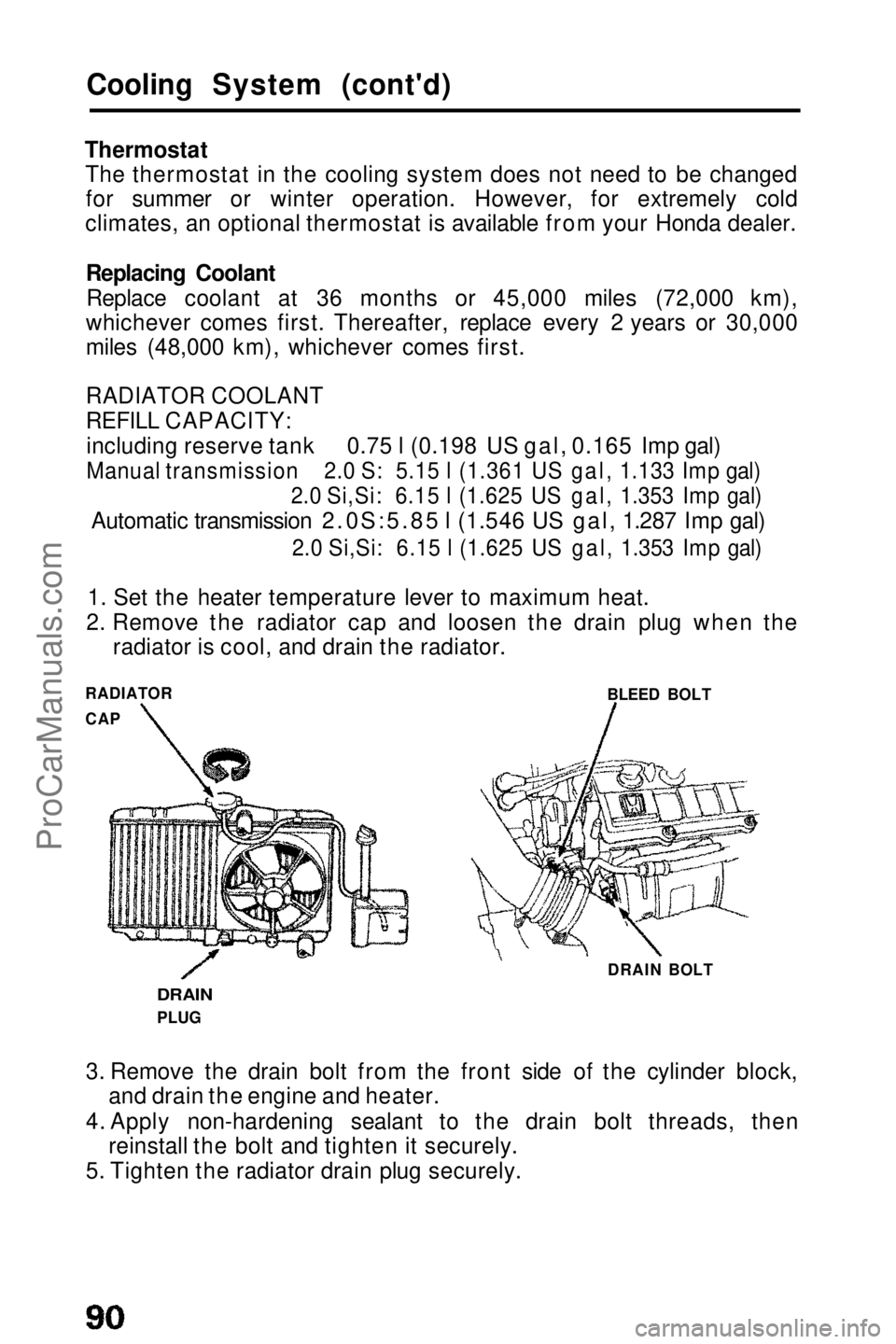
1. Set the heater temperature lever to maximum heat.
2. Remove the radiator cap and loosen the drain plug when the radiator is cool, and drain the radiator.
RADIATOR
CAP BLEED BOLT
DRAIN BOLT
3. Remove the drain bolt from the front side of the cylinder block, and drain the engine and heater.
4. Apply non-hardening sealant to the drain bolt threads, then reinstall the bolt and tighten it securely.
5. Tighten the radiator drain plug securely.
DRAIN
PLUGProCarManuals.comMain Menu t s
Page 116 of 143
Changing a Flat Tire
Do not attempt to change a tire unless the car is on firm, level
ground and well out of the flow of traffic.
Park the car on a firm, level surface, apply the parking brake, turn
on the hazard warning switch and put the transmission in gear (Park
for automatic).
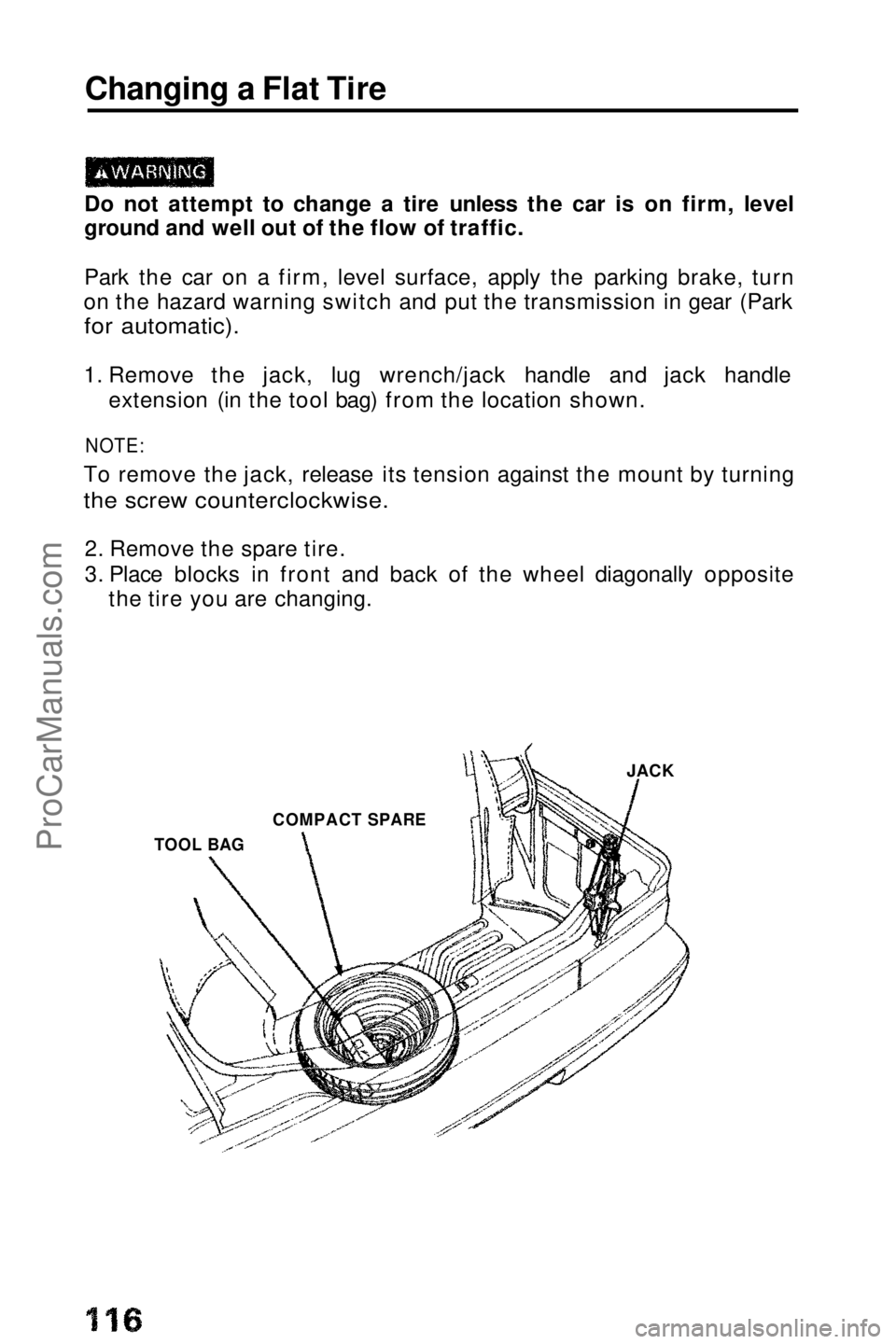
1. Remove the jack, lug wrench/jack handle and jack handle extension (in the tool bag) from the location shown.
NOTE:
To remove the jack, release its tension against the mount by turning
the screw counterclockwise.
2. Remove the spare tire.
3. Place blocks in front and back of the wheel diagonally opposite the tire you are changing.
JACK
COMPACT SPARE
TOOL BAGProCarManuals.comMain Menu t s
Page 119 of 143
Jump Starting
To start a car with a dead battery, use another battery of the same voltage, and the proper jumper cables. Procedures other than those below could cause injury or
damage from battery acid spray, explosion or charging system
overload.
Never connect the jumper cable directly to the negative post of
the "dead" battery.
Never allow the two cars to touch each other.
Never allow the jumper cable clamps to touch each other.
Never lean over the battery when making connections.
Never attempt to jump start a vehicle with a frozen battery. The
battery could rupture and explode. If you suspect a frozen
battery, remove the vent caps and check the fluid. If there
seems to be no fluid, or if you see ice, do not attempt a jump
start until the fluid thaws.
CAUTION:
If jumper cables are connected backwards, the car's main fuse
may blow.
1.Turn off all lights, heater and other electrical loads, set parking
brake, and
shift transmission to Neutral or Park.
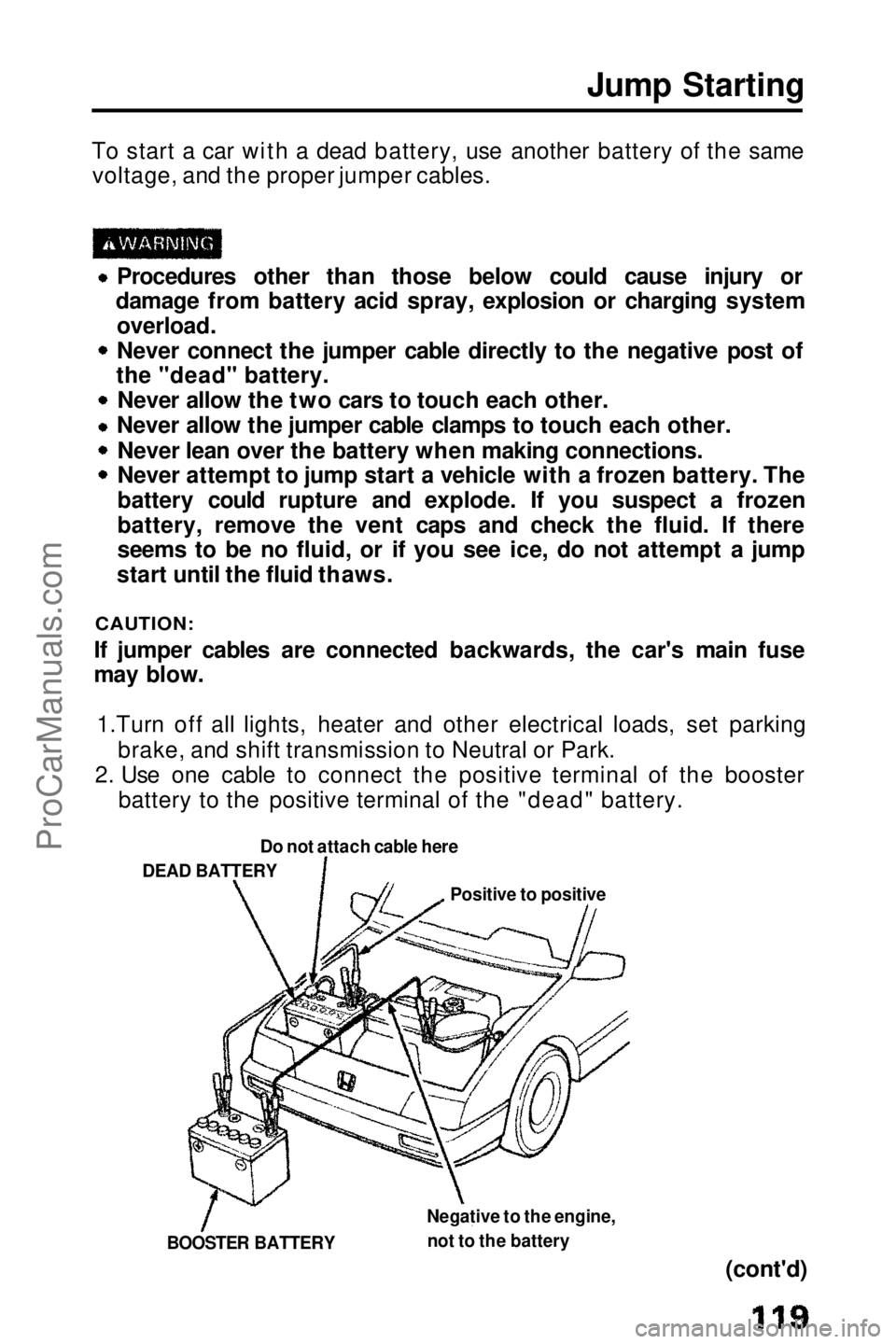
2. Use one cable to connect the positive terminal of the booster battery to the positive terminal of the "dead" battery.
(cont'd)
Do not attach cable here
DEAD BATTERY
Positive to positive
Negative to the engine, not to the battery
BOOSTER BATTERYProCarManuals.comMain Menu t s
Page 120 of 143

Jump Starting (cont'd)
3. Use the other cable to connect the negative terminal of the booster battery to the engine at the ground cable as shown.
4.To remove the cables, reverse the above procedures exactly.
DO NOT push or tow a car to start it. The forward surge when the
engine starts could cause a collision. Also, under some conditions,
the catalytic converter could be damaged. A car equipped with an
automatic transmission cannot be started by pushing or towing.
NOTE:
After jump-starting the car, there is a possibility that the ALB
warning light may come on due to insufficient battery voltage. After
the battery is sufficiently recharged and the engine is turned off and restarted, the ALB warning light should indicate that the ALB
system is OK, by coming on for a few seconds each time the engine is started. If the light remains on after recharging, have it checked
by a Honda dealer.ProCarManuals.comMain Menu t s