lock HONDA PRELUDE 1992 User Guide
[x] Cancel search | Manufacturer: HONDA, Model Year: 1992, Model line: PRELUDE, Model: HONDA PRELUDE 1992Pages: 225, PDF Size: 2.1 MB
Page 29 of 225
Instruments and Controls
This section gives information
about the controls and displays that
contribute to the daily operation of
your Honda. All the essential
controls are within easy reach.
Control Locations......................... 30
Indicator Lights.............................. 31
Gauges............................................. 37
Speedometer
.............................
37
Tachometer................................. 37
Odometer
.................................... 37
Trip Meter................................... 37
Fuel Gauge..................................
38
Temperature Gauge
..................
38
Controls Near the
Steering
Wheel
....................................... 39
Headlights................................... 40
Daytime Running Lights.......... 40
Instrument Panel Brightness... 41
Turn Signals................................ 41
Windshield Wipers.....................
42
Windshield Washers.................
42
Steering Wheel Adjustment ....
. 43
Steering Wheel Controls............... 44
Cruise Control............................ 44
Horn ............................................ 47
Keys and Locks.............................. 47
Keys.............................................. 47
Ignition Switch........................... 47
Door Locks.................................. 48
Power Door Locks ..................... 48
Trunk.......................................... 50
Seat Adjustments........................... 51
Rear Seat Access........................ 52
Additional Driver' s
Seat
Adjustments...........................
53
Seat Heaters.................................... 54
Folding Rea r
Seat.......................... 55
Hazard Warning............................ 56
Rear Window Defogger ................ 56
Power Windows.............................. 57
Sunroof ...........................................
58
Mirrors ........................................... 59
Parking Brake................................ .
61
Glove Box........................................
.
62
Digital Clock..................................
.
63
Center Console Compartment .... 64
Vanity
Mirror
..............................
64
Cigarette Lighter
..........................
.
65
Ashtray........................................... 65
Interior Lights...............................
.
66
Instruments an
d
ControlsProCarManuals.comMain Menu s t
Page 30 of 225
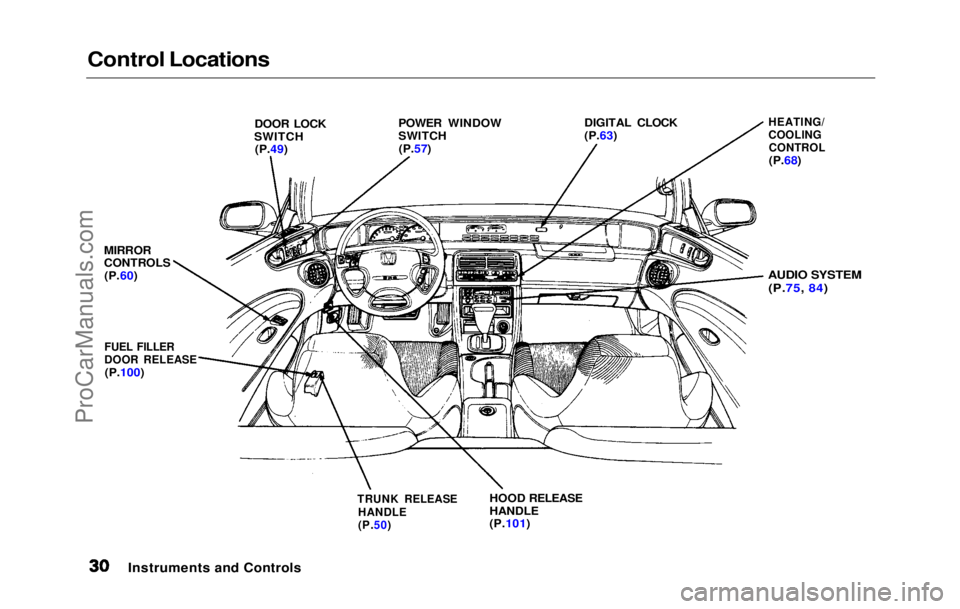
Control Locations
MIRROR
CONTROLS(P.60)
FUEL FILLER
DOOR RELEASE
(P.100) DOOR LOCK
SWITCH (P.49) POWER WINDOW
SWITCH
(P.57) DIGITAL CLOCK
(P.63)
TRUNK RELEASE HANDLE
(P.50)
HOOD RELEASE
HANDLE
(P.101)
HEATING/
COOLING
CONTROL
(P.68)
AUDIO SYSTEM (P.75, 84)
Instruments and ControlsProCarManuals.comMain Menu Table of Contents s t
Page 32 of 225
Indicator Lights
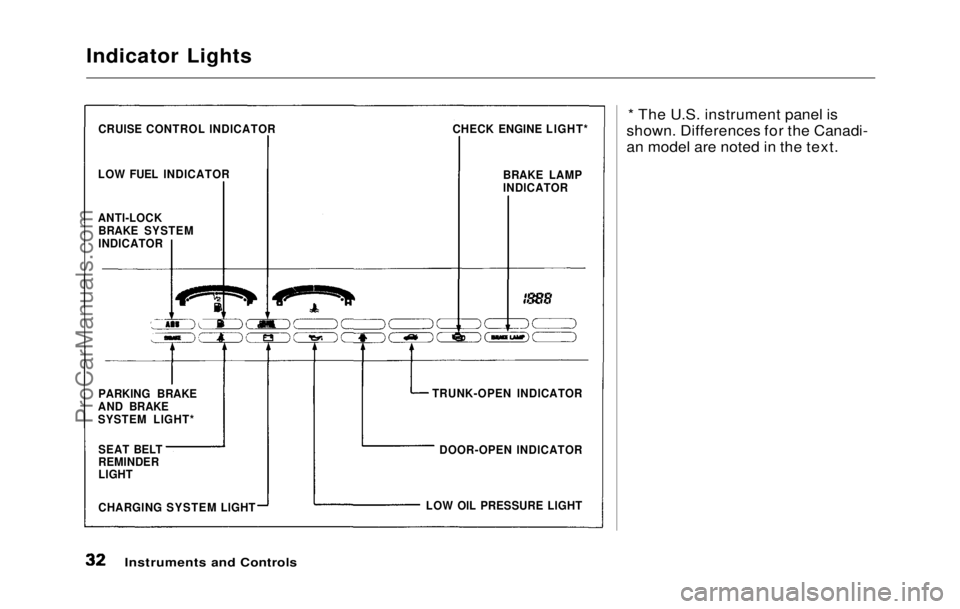
* The U.S. instrument panel is
shown. Differences for the Canadi-
an model are noted in the text.
Instruments and Controls
CRUISE CONTROL INDICATOR
LOW FUEL INDICATOR CHECK ENGINE LIGHT*
BRAKE LAMP
INDICATOR
TRUNK-OPEN INDICATOR DOOR-OPEN INDICATOR
LOW OIL PRESSURE LIGHT
CHARGING SYSTEM LIGHT SEAT BELT
REMINDER
LIGHT PARKING BRAKE
AND BRAKE
SYSTEM LIGHT* ANTI-LOCK BRAKE SYSTEM
INDICATORProCarManuals.comMain Menu Table of Contents s t
Page 33 of 225
Indicator Lights
Seat Belt Reminder
Light
This indicator lights when you turn the ignition ON (II). It is a reminder
to you and your passengers to protect yourselves by fastening the
seat belts. A beeper also sounds if
you have not fastened your seat
belt.
If you do not fasten your seat belt,
the beeper will stop after a few seconds but the light stays on until
you do. Both the light and the
beeper stay off if you fasten your seat belt before turning on the
ignition.
Charging System
Light
This light indicates the battery is not being charged. It should come
on when the ignition is ON (II), and
go out after the engine starts. If
this light comes on while driving,
the battery is not being charged.
Turn to page 196 for information
about what to do.
Low Oil Pressure
Light
This indicator lights when the oil
pressure in the engine drops low
enough to cause damage. It should
light when the ignition is ON (II)
and go out after the engine starts.
If this light comes on when the
engine is running, there is a possi-
bility of serious engine damage. Safely pull to the side of the road
and shut off the engine as soon as
you can. Turn to page 195 for in-
structions and precautions on
checking the engine.
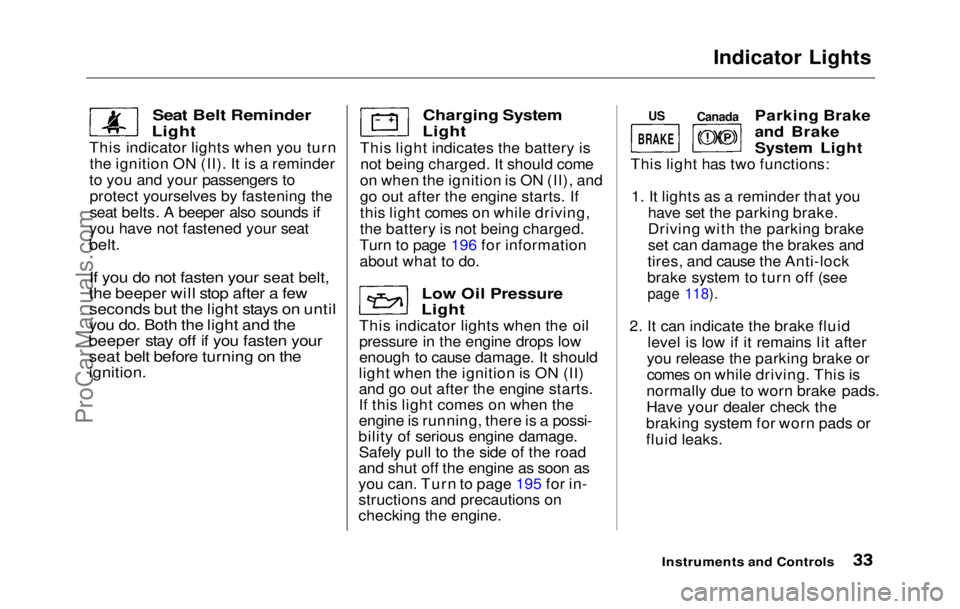
Canada
Parking Brake
and Brake
System Light
This light has two functions:
1. It lights as a reminder that you
have set the parking brake.
Driving with the parking brake
set can damage the brakes and
tires, and cause the Anti-lock
brake system to turn off (see
page 118).
2. I t
can indicate the brake fluid
level is low if it remains lit after
you release the parking brake or
comes on while driving. This is
normally due to worn brake pads.
Have your dealer check the
braking system for worn pads o r
flui d
leaks.
Instruments an d
Controls
US
BRAKEProCarManuals.comMain Menu Table of Contents s t
Page 34 of 225
Indicator Lights
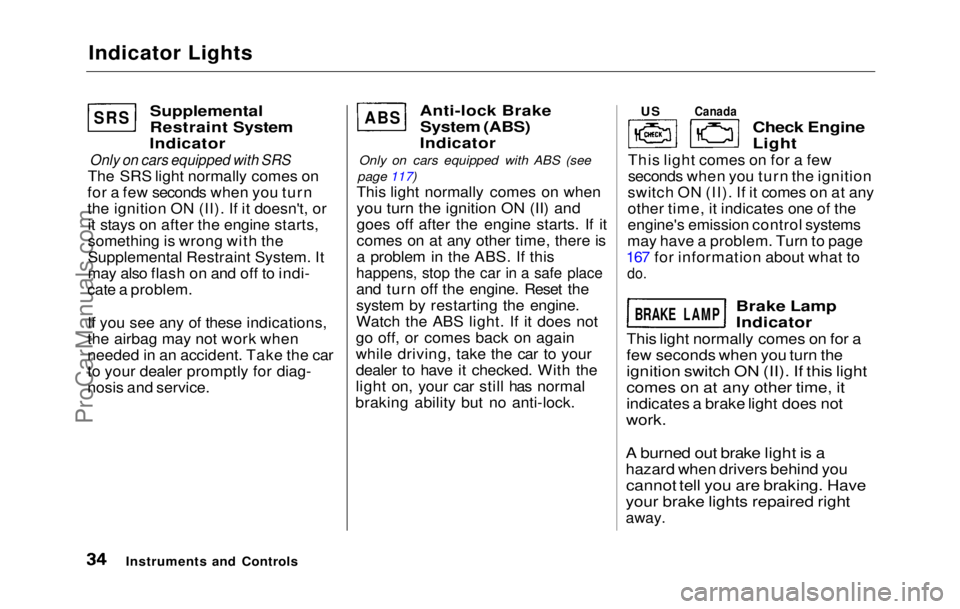
Supplemental
Restraint System
Indicator
Only on cars equipped with SRS
The SRS light normally comes on
for a few seconds when you turn
the ignition ON (II). If it doesn't, or it stays on after the engine starts,
something is wrong with the
Supplemental Restraint System. It
may also flash on and off to indi-
cate a problem.
If you see any of these indications,
the airbag may not work when
needed in an accident. Take the car
to your dealer promptly for diag-
nosis and service.
Anti-lock Brake
System (ABS)
Indicator
Only on cars equipped with ABS (see
page 117)
This light normally comes on whenyou turn the ignition ON (II) and
goes off after the engine starts. If it
comes on a
t any other time, there is
a problem in the ABS. If this
happens, stop the car in a safe place
and tur n
off the engine. Reset the
system by restarting the engine.
Watch the ABS light. If it does not
go off, or comes back on again
while driving, take the car to your
dealer to have it checked. With the
light on, your car still has normal
braking ability but no anti-lock.
Check Engine
Light
This light comes on for a few
seconds when you turn the ignition
switch ON (II). If it comes on at any
other time, it indicates one of the
engine's emission control systems
may have a problem. Turn to page
167 fo r
information about what to
do.
Brake Lam
p
Indicator
This light normally comes on for a
few seconds when you turn the
ignition switc h
ON (II). If this light
comes on at any other time, it
indicates a brake light does not
work.
A burned out brake light is a
hazard when drivers behind you
cannot tell you are braking. Have
your brake lights repaired right
away.
Instruments an d
Controls
SRS ABS US
Canada
BRAKE LAMP
ProCarManuals.comMain Menu Table of Contents s t
Page 35 of 225
Indicator Lights
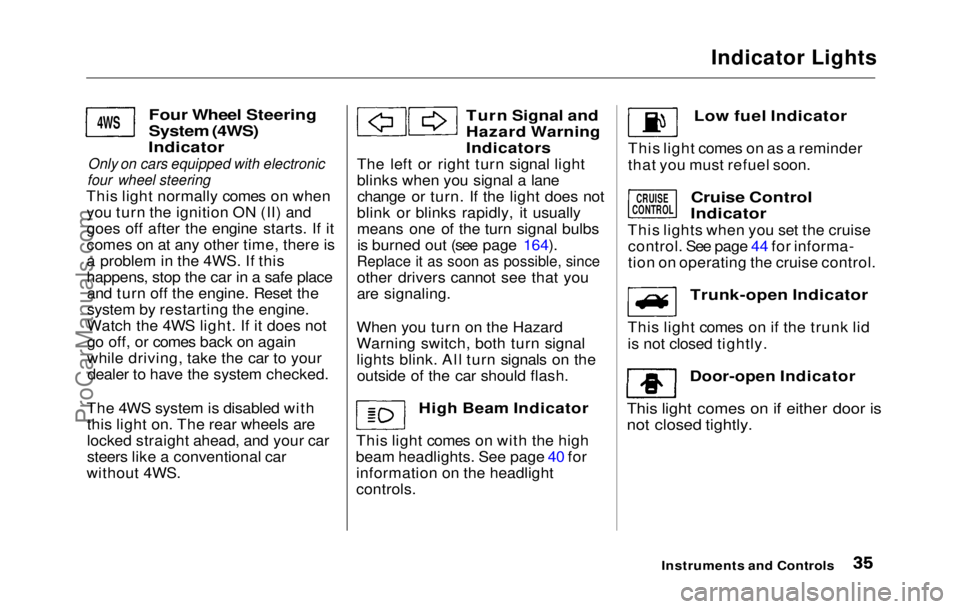
Four Wheel Steering
System (4WS)
Indicator
Only on cars equipped with electronic
four wheel steering
This light normally comes on when you turn the ignition ON (II) and
goes off after the engine starts. If it
comes on at any other time, there is
a problem in the 4WS. If this
happens, stop the car in a safe placeand turn off the engine. Reset the
system by restarting the engine.
Watch the 4WS light. If it does not
go off, or comes back on again
while driving, take the car to yourdealer to have the system checked.
The 4WS system is disabled with this light on. The rear wheels are
locked straight ahead, and your car
steers like a conventional car
without 4WS.
Turn Signal and
Hazard Warning
Indicators
The left or right turn signal light
blinks when you signal a lane change or turn. If the light does not
blink or blinks rapidly, it usually
means one of the turn signal bulbs is burned out (see page 164).Replace it as soon as possible, since
other driver s
cannot see that you
are signaling.
When you turn on the Hazard
Warning switch, both turn signal
lights blink. All turn signals on the outside of the car should flash.
High Beam Indicator
This light comes on with the high
beam headlights. See page 40 for information on the headlight
controls.
Instruments and Controls
4WS
Low fuel Indicator
This light comes on as a reminder
that you must refuel soon.
Cruise Control
Indicator
This lights when you set the cruise control. See page 44 for informa-
tion on operating the cruise control.
Trunk-open Indicator
This light comes on if the trunk lid
is not closed tightly.
Door-open Indicator
This light comes on if either door is
not closed tightly.
CRUISE
CONTROL
ProCarManuals.comMain Menu Table of Contents s t
Page 40 of 225
Controls Near the Steering Wheel
Headlights
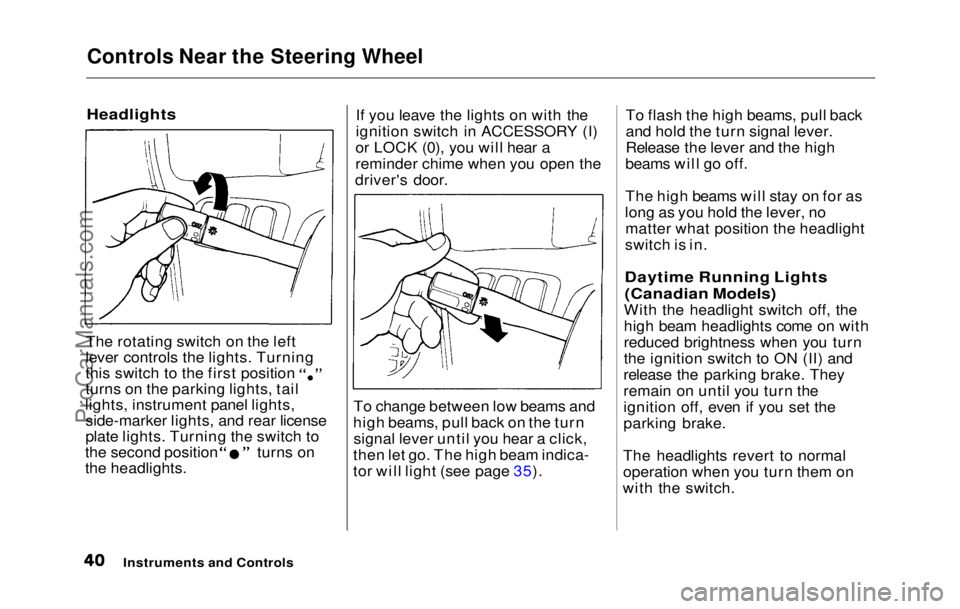
The rotating switch on the left
lever controls the lights. Turning this switch to the first position
turns on the parking lights, tail
lights, instrument panel lights, side-marker lights, and rear license
plate lights. Turning the switch to the second position turns on
the headlights. If you leave the lights on with the
ignition switch in ACCESSORY (I)
or LOCK (0), you will hear a
reminder chime when you open the
driver's door.
To change between low beams and
high beams, pull back on the turn signal lever until you hear a click,
then let go. The high beam indica-
tor will light (see page 35). To flash the high beams, pull back
and hold the turn signal lever.
Release the lever and the high
beams will go off.
The high beams will stay on for as
long as you hold the lever, no matter what position the headlight
switch is in.
Daytime Running Lights
(Canadian Models)
With the headlight switch off, the
high beam headlights come on with
reduced brightness when you turn
the ignition switch to ON (II) and
release the parking brake. They
remain on until you turn the
ignition off, even if you set the
parking brake.
The headlights revert to normal
operation when you turn them on
with the switch.
Instruments and ControlsProCarManuals.comMain Menu Table of Contents s t
Page 43 of 225
Controls Near the Steering Wheel
Steering Wheel Adjustment
You can adjust the steering wheel height to suit your preference. Do
this before you begin driving.
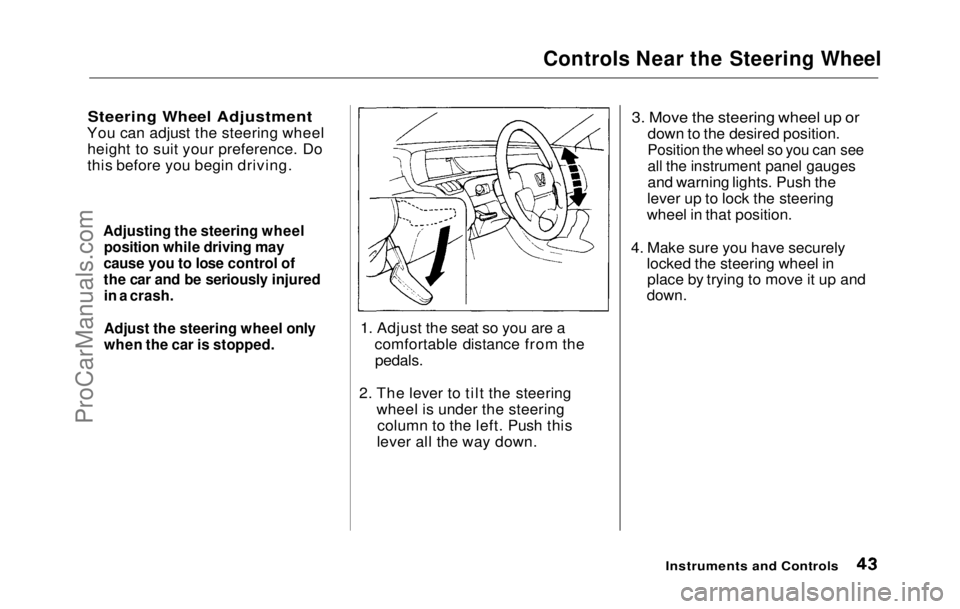
1. Adjust the seat so you are acomfortable distance from the
pedals.
2. The lever to tilt the steering
wheel is under the steering column to the left. Push this
lever all the way down.
3. Move the steering wheel up or
down to the desired position.
Position the wheel so you can see
all the instrument panel gauges
and warning lights. Push the
lever up to lock the steering
wheel in that position.
4. Make sure you have securely locked the steering wheel inplace by trying to move it up and
down.
Instruments an d
Controls
Adjusting the steering wheel
position while driving may
cause you to lose control of
the car and be seriously injured in a crash.
Adjust the steering wheel only
when the car is stopped.ProCarManuals.comMain Menu Table of Contents s t
Page 44 of 225
Steering Wheel Controls
Cruise Control
Cruise control
allows you to
maintain a set speed above 25 mph
(40 km/h) without keeping your
foot on the accelerator pedal. It is
for cruising on straight, open
highways. It is not recommended
for conditions such as city driving,
winding roads, slippery roads,
heavy rain, or bad weather. You should have full control of the car
under those conditions. The cruise control, as it operates,
moves the accelerator pedal. You
can damage your car's accelerator
mechanism by resting your foot
under the pedal and blocking the movement. Using the Cruise Control
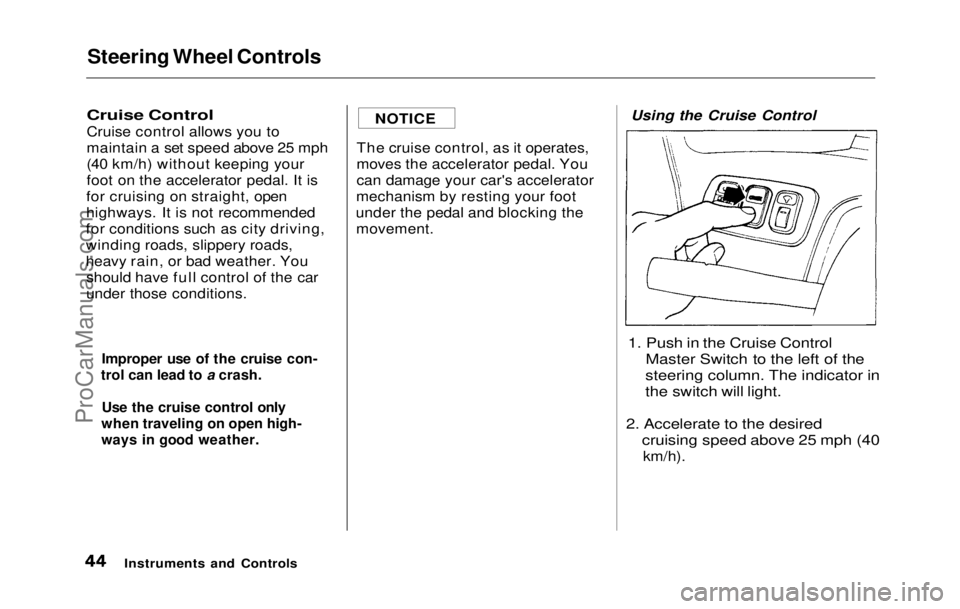
1. Push in the Cruise Control
Master Switch to the left of the
steering column. The indicator in
the switch will light.
2. Accelerate to the
desired
cruising speed above 25 mph (40
km/h).
Instruments an d
Controls
Improper use of the cruise con-
trol can lead to a crash.
Use the cruise control only
when traveling on open high-
ways in good weather.
NOTICEProCarManuals.comMain Menu Table of Contents s t
Page 47 of 225
Steering Wheel Controls, Keys and Locks
Horn
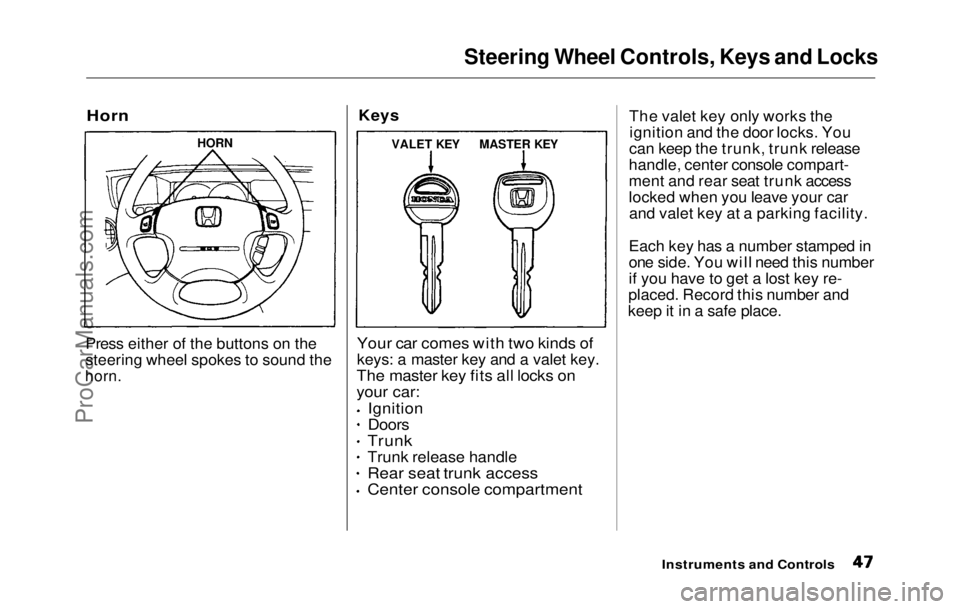
Press either of the buttons on the
steering wheel spokes to sound the
horn.
Key
s
Your
car comes with two kinds of
keys: a master key and a valet key.
The master key fits all locks on
your car: Ignition
Doors
Trunk
Trunk release handle
Rear seat trunk access
Center console compartment
The valet key only works the
ignition and the door locks. You
can keep the trunk, trunk release
handle, center console compart-
ment and rear seat trunk access
locked when you leave your car and valet key at a parking facility.
Each key has a number stamped in
one side. You will need this number
if you have to get a lost key re-
placed. Record this number and
keep it in a safe place.
Instruments and Controls
HORN
VALET KEYMASTER KEY
ProCarManuals.comMain Menu Table of Contents s t