wheel HONDA PRELUDE 1992 Owner's Guide
[x] Cancel search | Manufacturer: HONDA, Model Year: 1992, Model line: PRELUDE, Model: HONDA PRELUDE 1992Pages: 225, PDF Size: 2.1 MB
Page 161 of 225

Tires
Winter Driving
Tires that are marked "M+S" or "All Season" on the sidewall have
an all-weather tread design. They should be suitable for most winter
driving conditions. Tires without
these markings are designed for optimum traction in dry conditions.
They may not provide adequateperformance in winter driving.
For the best performance in snowy
or icy conditions, you should install
snow tires or tire chains. They may
be required by local laws under certain conditions. Snow Tires
If you mount snow tires on your
Honda, make sure they are radial
tires of the same size and load
range as the original tires. Mount snow tires on all four wheels to
balance your car's handling in all
weather conditions. Keep in mind
the traction provided by snow tires on dry roads may not be as high as
your car's original-equipment tires.
You should drive cautiously even
when the roads are clear. Check
with the tire dealer for maximum speed recommendations.
Tire Chains Mount snow chains on your car
when warranted by driving condi-
tions or required by local laws.
Make sure the chains are the cor-
rect size for your tires. Install them
only on the front tires. If metal
chains are used, they must be SAE
class"S". Cable type traction de-
vices can also be used. When installing chains, follow the
manufacturer's instructions and
mount them as tightly as you can.
Drive slowly with chains installed.
If you hear the chains contacting
the body or chassis, stop and
tighten them. If they still make
contact, slow down until it stops.
Remove the chains as soon as you
begin driving on cleared roads.
Chains of the wrong size or that are
improperly installed can damage
your car's brake lines, suspension,
body, and wheels. Stop driving if
you hear the chains hitting any part
of
the car.
Maintenance
NOTICEProCarManuals.comMain Menu Table of Contents s t
Page 171 of 225

Storing Your Car
If you need to park your car for an
extended period (more than 1
month), there are several things
you should do to prepare it for
storage. Proper preparation helps
prevent deterioration and makes it
easier to get your car back on the
road. It is best to store your car indoors if at all possible. Fill the gas tank.
Change the engine oil and filter
(see page 137).
Wash and dry the exterior
completely.
Clean the interior. Make sure the
carpeting, floor mats, etc. are
completely dry.
Leave the parking brake off. Put
the transmission in Reverse (5-
speed) or Park (automatic). Block the rear wheels.
If the car is to be stored for a
longer period, it should be
supported on jackstands so the
tires are off the ground.
Leave one window open slightly
(if the car is being stored indoors).
Disconnect the battery.
Cover the car with a "breathable" car cover, one made
from a porous material such as
cotton. Nonporous materials,
such as plastic sheeting, trap
moisture which can damage the
paint. If possible, run the engine for a
while periodically (preferably once a month). If you store your car for 12 months
or longer, have your Honda dealer
perform the inspections called for
in the 24 months/48,000 km (30,000
miles) maintenance schedule as
soon as you take it out of storage
(see page 133). The replacements
called for in the maintenance
schedule are not needed unless the
car has actually reached that time or mileage.
MaintenanceProCarManuals.comMain Menu Table of Contents s t
Page 172 of 225

Appearance Care
Regular cleaning and polishing of
your Honda helps to keep it "new"
looking. This section gives you
hints on how to clean and preserve
your car's appearance: the paint,
brightwork, wheels and interior. Also included are several things
you can do to help prevent corro-
sion.
Exterior Care................................ 176 Washing..................................... 176
Waxing....................................... 177
Aluminum Wheels................... 177
Paint Touch-up......................... 178
Interior Care.................................. 179 Carpeting................................... 179
Fabric........................................ 179
Vinyl........................................... 179
Seat Belts.................................. 179
Windows..................................... 180
Air Fresheners.......................... 180
Corrosion Protection................... 180
Body Repairs................................. 181
Appearance CareProCarManuals.comMain Menu s t
Page 174 of 225

Exterior Care
Waxing
Always wash and dry the whole car
before waxing it. You should wax your car, including the metal trim,
whenever water sits on the surface in large patches. It should form into
beads or droplets after waxing.
You should use a quality liquid orpaste wax. Apply it according to
the instructions on the container. In
general, there are two types of products:
Waxes — A wax coats the finish and protects it from damage by
exposure to sunlight, air pollution,
etc. You should use a wax on yourHonda when it is new.
Polishes — Polishes and cleaner/
waxes can restore the shine to
paint that has oxidized and lost
some of its shine. They normally
contain mild abrasives and solvents
that remove the top
layer of the
finish. You should use a polish on
your Honda if the finish does not
have its original shine after using a
wax.
Cleaning tar, insects, etc.
with
removers also takes off the wax.
Remember to re-wax those areas,
even if the rest of the car does not
need waxing.
Aluminum
Wheel
s
Clean your Honda's aluminum alloy
wheels as you do the rest of the exterior. Wash them with the same
solution, and rinse them thoroughly.
The wheels have a protective clear-
coat that keeps the aluminum from
corroding and tarnishing. Using
harsh chemicals, including some
commercial wheel cleaners, or stiff
brushes can damage this clear-coat.
Only use a mild detergent and soft
brush or sponge to clean the wheels.
Appearance CareProCarManuals.comMain Menu Table of Contents s t
Page 178 of 225

Corrosion Protection, Body Repairs
Inspect and clean out the drain
holes in the bottom of the doors
and body.
Check the floor coverings for
dampness. Carpeting and floor mats may remain damp for a long
time, especially in winter. This dampness can eventually cause
the floor panels to corrode.
Use a high-pressure spray to
clean the underside of your car.
This is especially important in
areas that use road salt in winter. It is also a good idea in humid
climates and areas subject to salt
air. Cars equipped with ABS
have a sensor and wiring at each
wheel. Be careful not to damage
them.
Have the corrosion-preventive
coatings on the underside of your
car inspected and repaired
periodically.
Body Repairs
Body repairs affect your car's
resistance to corrosion. If your car
needs repairs after a collision, pay
close attention to the parts used in
the repair and the quality of the
work.
Make sure the repair facility uses
genuine Honda replacement body
parts. Some companies make
sheetmetal pieces that seem to
duplicate the original Honda body parts, but are actually inferior in fit,
finish, and quality. Once installed,
they do not give the same high- quality appearance and level of
corrosion resistance. When reporting your collision to
the insurance company, tell them
you want genuine Honda parts
used in the repair. Although most insurers recognize the higherquality of original parts, some may
try to specify that the repairs be
done with the "lowest cost" parts
available. You should investigate
this before any repairs are begun.
Take your car to your authorized Honda dealer for inspection after
the repairs are completed. He can make sure that quality materials
were used, and that corrosion-
preventive coatings were applied to
all repaired and replaced parts.
Appearance Car e
ProCarManuals.comMain Menu Table of Contents s t
Page 180 of 225
Compact Spare Tire
Your car has a compact spare tire
that takes up less space. Use this
spare tire as a temporary replace-
ment only. Get your regular tire
repaired or replaced and put back
on your car as soon as you can.
Check the inflation of the compact
spare tire every time you check the
other tires. It should be inflated to: 415 kPa (4.15 kg/cm2, 60 psi)
Follow these precautions whenever
you are using the compact spare
tire:
Do not exceed 50 mph (80 km/h)
under any circumstances. This tire gives a harsher ride and
less traction on some road sur-
faces than the regular tire. Use
greater caution while driving on
this tire.
Do not mount snow chains on the
compact spare.
The wheel
of the compact spare
tire is designed especially to fit
your car. Do not use your spare
tire on another car unless it is the
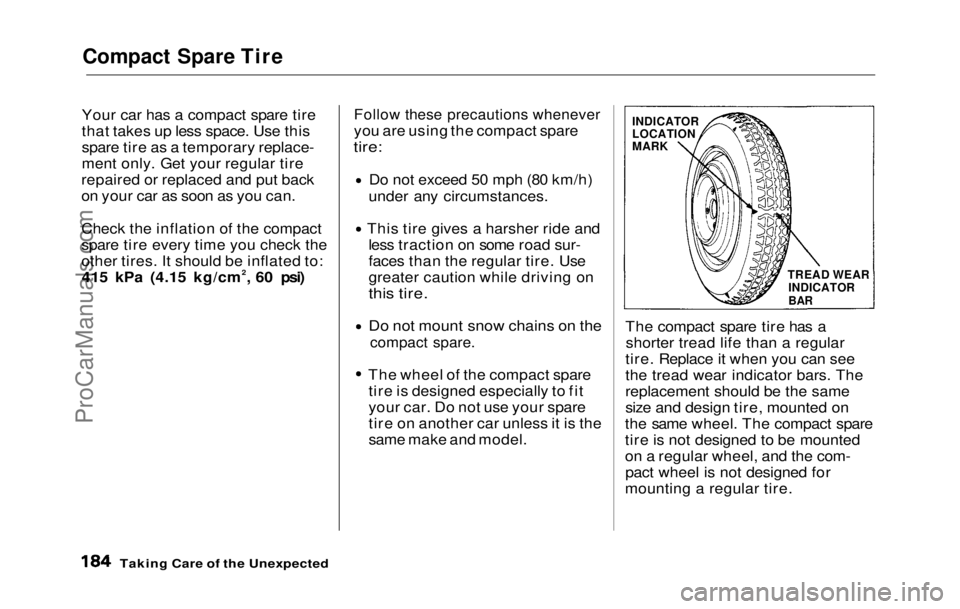
same make and model. The compact spare tire has a
shorter tread life than a regular
tire. Replace it when you can see
the tread wear indicator bars. The
replacement should be the same
size and design tire, mounted on
the same wheel. The compact spare
tire is not designed to be mounted
on a regular wheel, and the com- pact wheel is not designed for
mounting a regular tire.
Taking Care of the Unexpected
INDICATOR
LOCATION
MARK
TREAD WEARINDICATOR
BARProCarManuals.comMain Menu Table of Contents s t
Page 182 of 225
Changing a Flat Tire
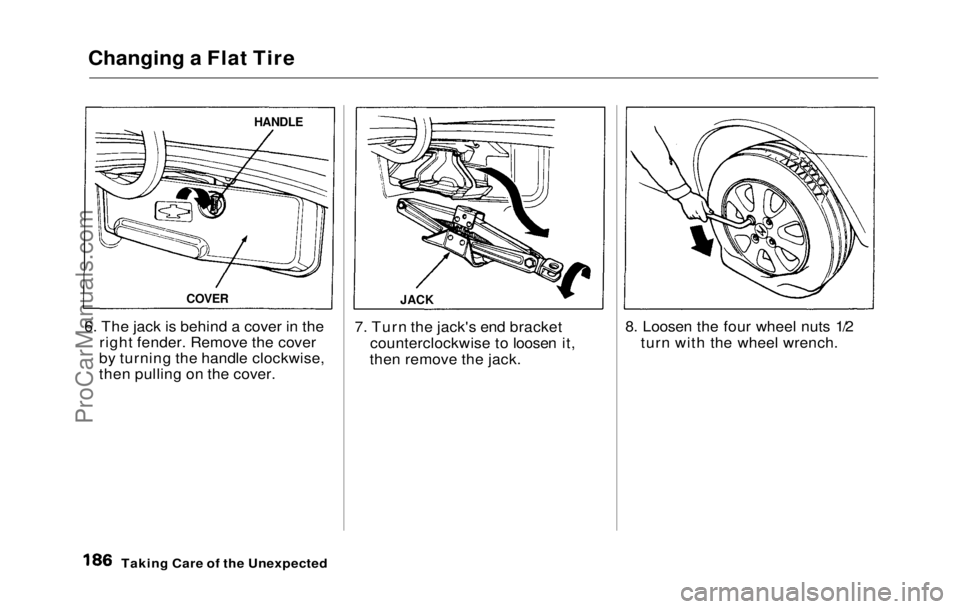
6. The jack is behind a cover in the right fender. Remove the cover
by turning the handle clockwise,
then pulling on the cover. 7. Turn the jack's end bracket
counterclockwise to loosen it,
then remove the jack. 8. Loosen the four wheel nuts 1/2
turn with the wheel wrench.
Taking Care of the Unexpected
HANDLE
COVER JACKProCarManuals.comMain Menu Table of Contents s t
Page 183 of 225
Changing a Flat Tire
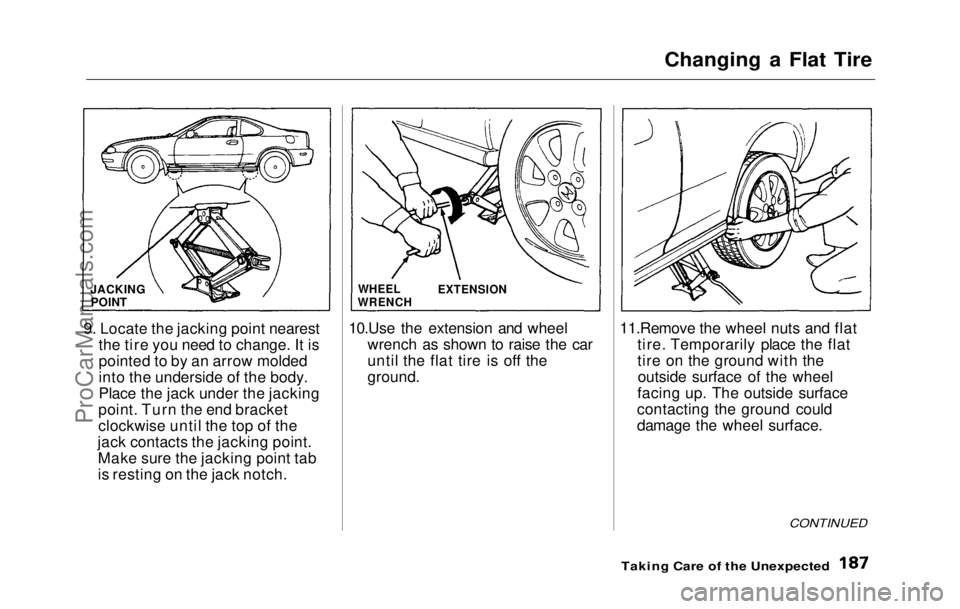
9. Locate
the jacking point nearest
the tire you need to change. It is
pointed to by an arrow molded
into the underside of the body.
Place the jack under the jacking
point. Turn the end bracket
clockwise until the top of the
jack contacts the jacking point. Make sure the jacking point tab
is resting on the jack notch. 10.Use the extension and wheel
wrench as shown to raise the car
until the flat tire is off the
ground. 11.Remove the wheel nuts and flat
tire. Temporarily place the flat
tire on the ground with theoutside surface of the wheel
facing up. The outside surface
contacting the ground could
damage the wheel surface.
Taking Care of the Unexpected
CONTINUED
EXTENSION
JACKING
POINT
WHEEL
WRENCHProCarManuals.comMain Menu Table of Contents s t
Page 184 of 225
Changing a Flat Tire
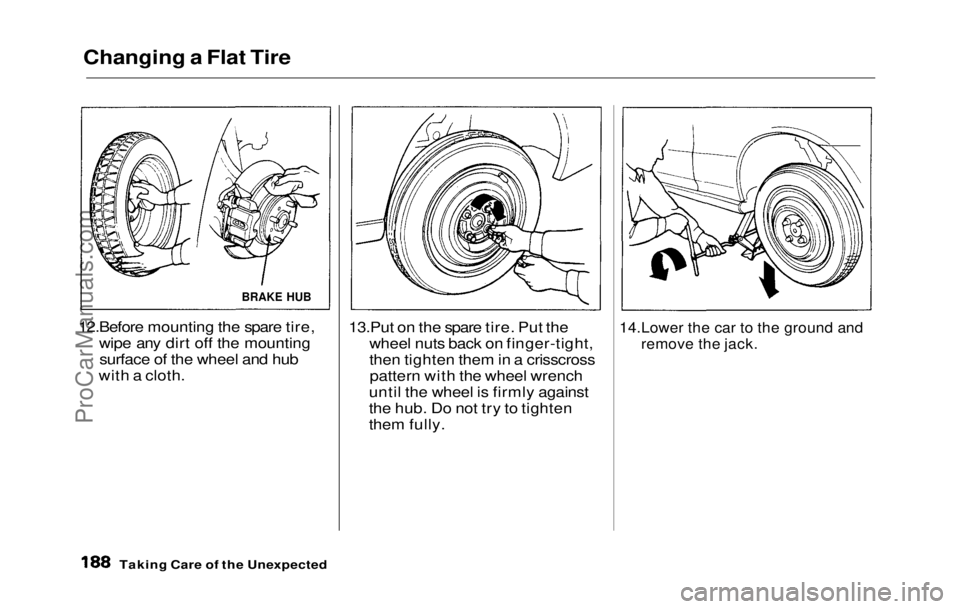
12.Before mounting
the spare tire,
wipe any dirt off the mounting
surface of the wheel and hub
with a cloth.
13.Put on
the spare tire. Put the
wheel nuts back on finger-tight,
then tighten them in a crisscross
pattern with the wheel wrench
until the wheel is firmly against
the hub. Do not try to tighten
them fully.
14.Lower th e
car to the ground and
remove the jack.
Taking Car
e
of the Unexpected
BRAKE HUBProCarManuals.comMain Menu Table of Contents s t
Page 185 of 225
Changing a Flat Tire
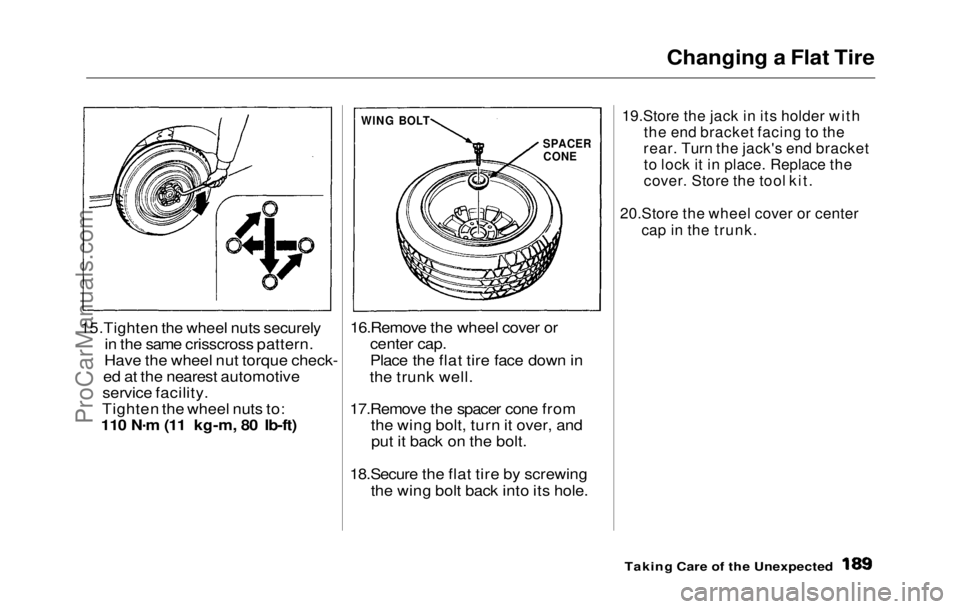
15.Tighten the
wheel nuts securely
in the same crisscross pattern.
Have the wheel nut torque check-
ed at the nearest automotive
service facility.
Tighten the wheel nuts to:
110 N .
m (1
1 kg-m, 80 Ib-ft)
16.Remove the wheel cover or
center cap.
Place the flat tire face down in
the trunk well.
17.Remove the
spacer cone from
the wing bolt, turn it over, and
put it back on the bolt.
18.Secure th e
flat tire by screwing
the wing bolt back into its hole.
19.Store th
e
jack in its holder with
the end bracket facing to the
rear. Turn the jack'
s end bracket
to lock it in place. Replace the
cover. Store the tool kit.
20.Store th e
wheel cover or center
cap in the trunk.
Taking Car
e
of the Unexpected
WING BOLT
SPACERCONEProCarManuals.comMain Menu Table of Contents s t