coolant HONDA S2000 2000 1.G User Guide
[x] Cancel search | Manufacturer: HONDA, Model Year: 2000, Model line: S2000, Model: HONDA S2000 2000 1.GPages: 273, PDF Size: 21.58 MB
Page 154 of 273
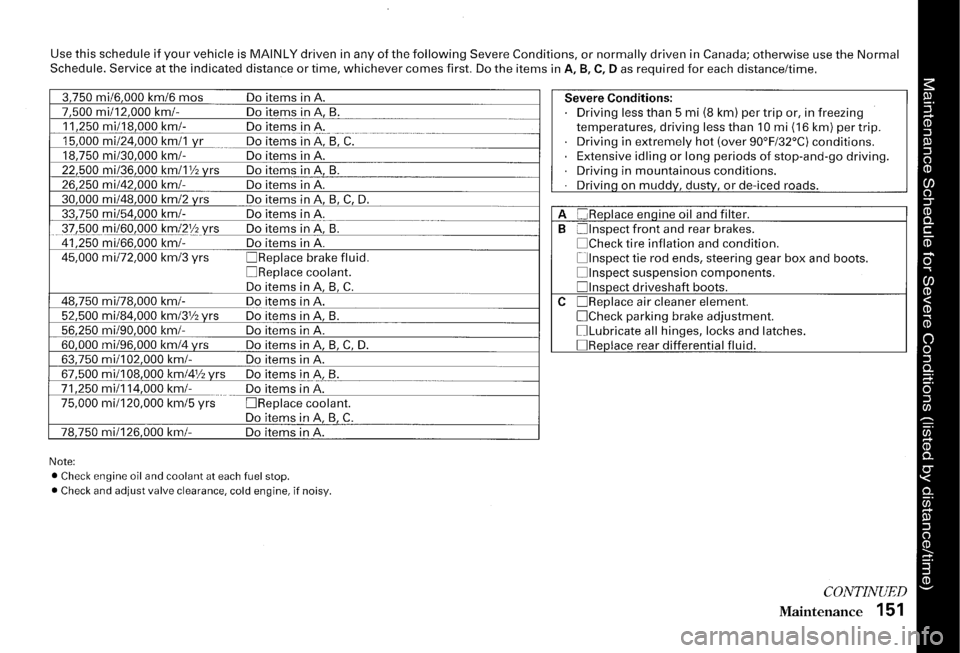
Use this schedule if your vehicle is MAINLY driven in any of the following Severe Conditions, or normally driven in Canada; otherwise use the Normal Schedule. Service at the indicated distance or time, whichever comes first. Do the items in A, B, C, D as required for each distance/time.
3,750 mi/6,000 km/6 mos Do items in A. 7,500 mi/12,000 km/- Do items in A, B. 11,250 mi/18,000 km/-
Do items in A. 15,000 mi/24,000 km/1 yr Do items in A, B, C. 18,750 mi/30,000 km/- Do items in A. 22,500 mi/36,000 km/1% yrs Do items_in_A,Jt .. ~--------· ---~~---26,250 mi/42,000 km/-Do items in A. 30,000 mi/48,000 km/2 vrs Do items in A, B, C, D. 33,750 mi/54,000 km/-
Do items in A. 37,500 mi/60,000 km/2'/z vrs
Do items in A, B. 41,250 mi/66,000 km/-
Do items in A. 45,000 mi/72,000 km/3 yrs DReplace brake fluid. DReplace coolant. Do items in A, B, C. 48,750 mi/78,000 km/- Do items in A. 52,500 mi/84,000 km/3'/z vrs Do items in A, B. 56,250 mi/90,000 km/-
Do items in A. 60,000 mi/96,000 km/4 vrs _Do items in A, B, C, D. 63,750 mi/102,000 km/-
Do items in A. 67,500 mi/108,000 km/41!2 yrs Do items in A, B. 71,250 mi/114,000 km/-
Do items in A. 75,000 mi/120,000 km/5 yrs ']Replace coolant. Do itefY!S_lll_ A,_B_,_(:, -~--~--78,750 mi/126,000 km/-
Do items in A.
Note: • Check engine oil and coolant at each fuel stop. • Check and adjust valve clearance, cold engine, if noisy.
·--~
··-
Severe Conditions:
A
B
c
Driving less than 5 mi (8 km) per trip or, in freezing
temperatures, driving less than 10 mi (16 km) per trip.
Driving in extremely hot (over 90°F/32°C) conditions.
Extensive idling or long periods of stop-and-go driving. Driving in mountainous conditions.
Drivin_gon muddy, dusty, or de-iced roads.
[]Replace enqine oil and filter. Dlnspect front and rear brakes. DC heck tire inflation and condition. Dlnspect tie rod ends, steering gear box and boots. Dlnspect suspension components. Dlnspect driveshaft boots. ORe place air cleaner element. ']Check parking brake adjustment. ']Lubricate all hinges, locks and latches. ']Replace rear differential fluid.
CONTINUED
Maintenance 151
Page 155 of 273
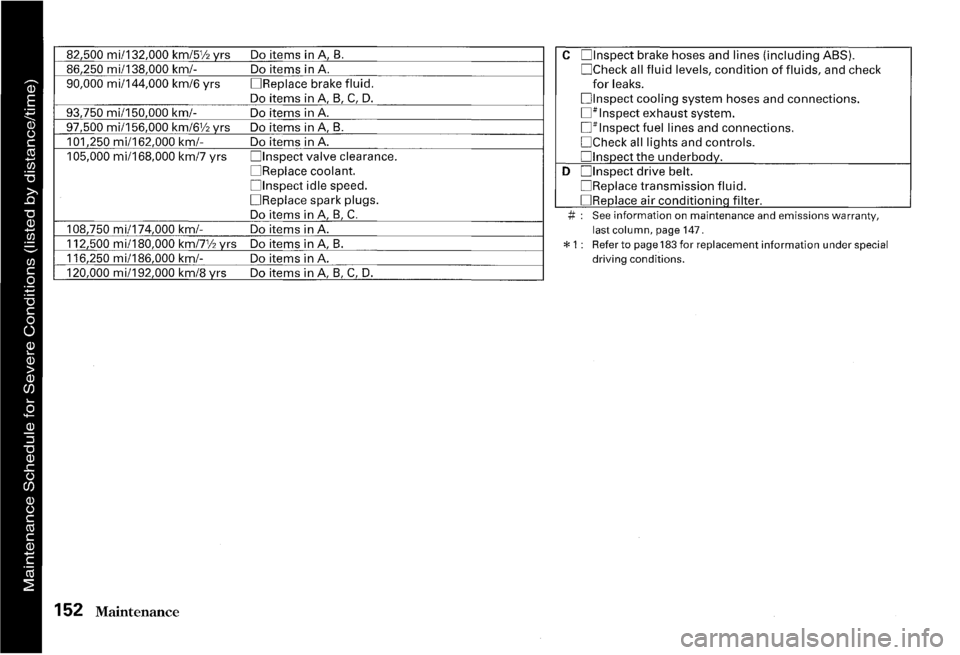
82,500 mi/132,000 km/51/z vrs Do items in A, B. 86,250 mi/138,000 km/-Do items in A. 90,000 mi/144,000 km/6 yrs ORe place brake fluid. Do items in A, B, C, D. 93,750 mi/150,000 km/-Do items in A. 97,500 mi/156,000 km/61/z yrs Do items in A. B. 101,250 mi/162,000 km/-Do items in A. 105,000 mi/168,000 km/7 yrs Dlnspect valve clearance. DReplace coolant. Dlnspect idle speed. DReplace spark plugs. Do items in A, B, C. 108,750 mi/174,000 km/-Do items in A. 112,500 mi/180,000 km/71/z yrs Do items in A, B. 116,250 mi/186,000 km/-Do items in A. 120,000 mi/192,000 km/8 vrs Do items in A, B, C D.
152 Maintenance
C Dlnspect brake hoses and lines (including ABS). DC heck all fluid levels, condition of fluids, and check for leaks. Dlnspect cooling system hoses and connections. D"lnspect exhaust system. D"lnspect fuel lines and connections. DCheck all lights and controls. Dlnspect the underbody.
D Dlnspect drive belt. DReplace transmission fluid. DReplace air conditioning filter. # : See information on maintenance and emissions warranty, last column, page 147. * 1: Refer to page183 for replacement information under special driving conditions.
Page 158 of 273
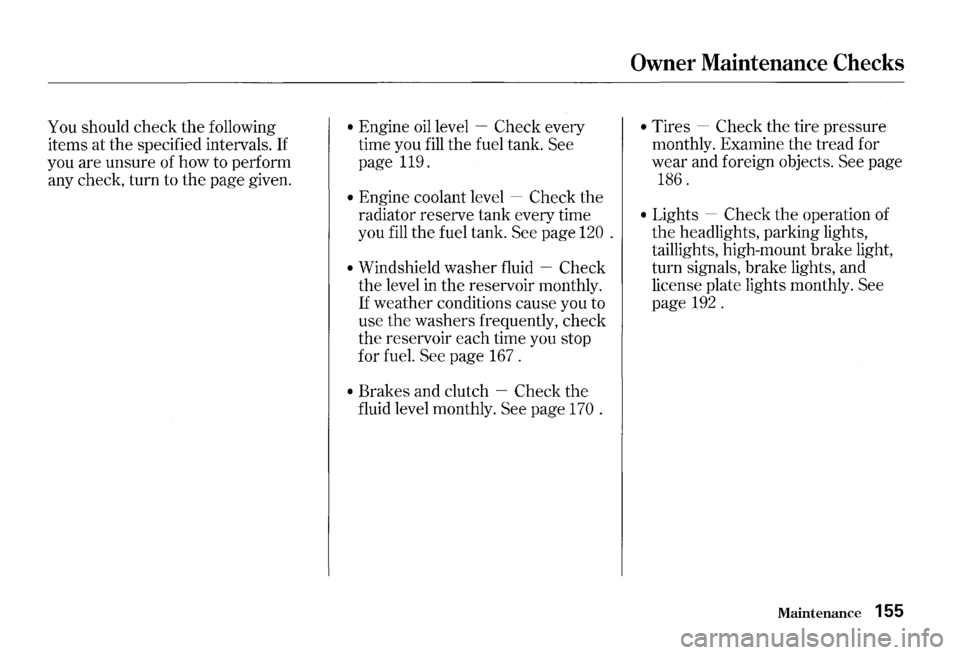
You should check the following
items at the specified intervals.
If
you are unsure of how to perform
any check, turn to the page given.
• Engine oil level -Check every
time you
fill the fuel tank. See
page 119.
• Engine coolant level -Check the
radiator reserve tank every time
you
fill the fuel tank. See page 120 .
• Windshield washer fluid -Check
the level in the reservoir monthly.
If weather conditions cause you to
use the washers frequently, check
the reservoir each time you stop
forfuel. See page 167.
• Brakes and clutch -Check the
fluid level monthly. See page
170 .
Owner Maintenance Checks
• Tires -Check the tire pressure
monthly. Examine the tread for
wear and foreign objects. See page
186.
• Lights -Check the operation of
the headlights, parking lights,
taillights, high-mount brake light,
turn signals, brake lights, and
license plate lights monthly. See
page 192.
Maintenance 155
Page 164 of 273
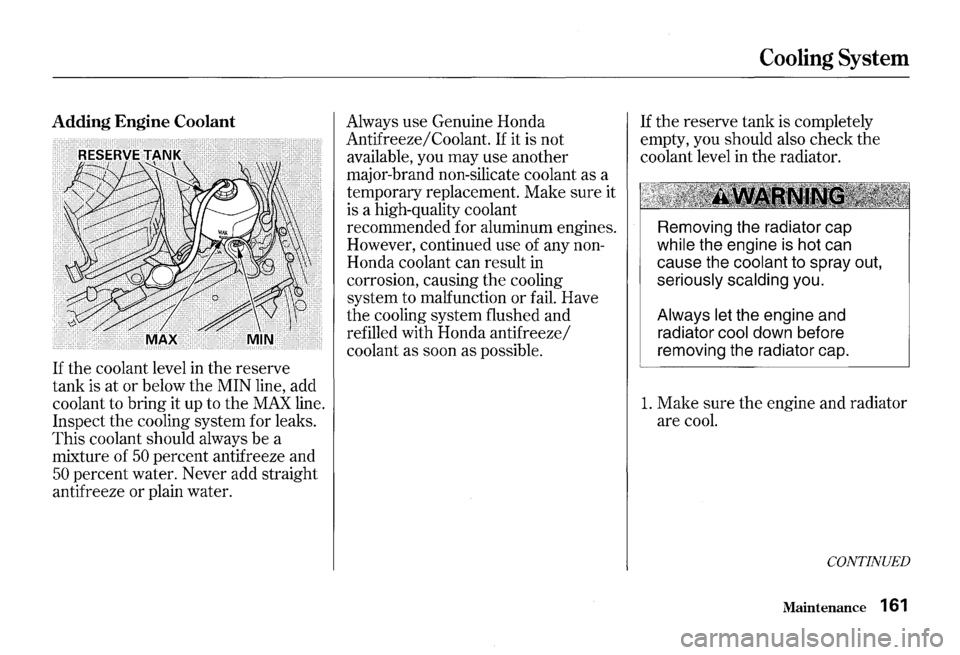
Adding Engine Coolant
If the coolant level in the reserve
tank is at or below the MIN line, add
coolant to bring it up to the
MAX line.
Inspect the cooling system for leaks.
This coolant should always be a
mixture of
50 percent antifreeze and
50 percent water. Never add straight
antifreeze
or plain water. Always
use Genuine Honda
Antifreeze/Coolant.
If it is not
available, you may use another
major-brand non-silicate coolant as a
temporary replacement. Make sure it
is a high-quality coolant
recommended for aluminum engines.
However, continued use of any non
Honda coolant can result in
corrosion, causing the cooling
system to malfunction or fail. Have
the cooling system flushed and
refilled with Honda antifreeze/
coolant as soon as possible.
Cooling System
If the reserve tank is completely
empty, you should also check the
coolant level
in the radiator.
Removing the radiator cap
while the engine is hot can
cause the
coolant to spray out,
seriously scalding you.
Always let the engine and
radiator
cool down before
removing the radiator cap.
1. Make sure the engine and radiator
are cool.
CONTINUED
Maintenance 161
Page 165 of 273
Cooling System
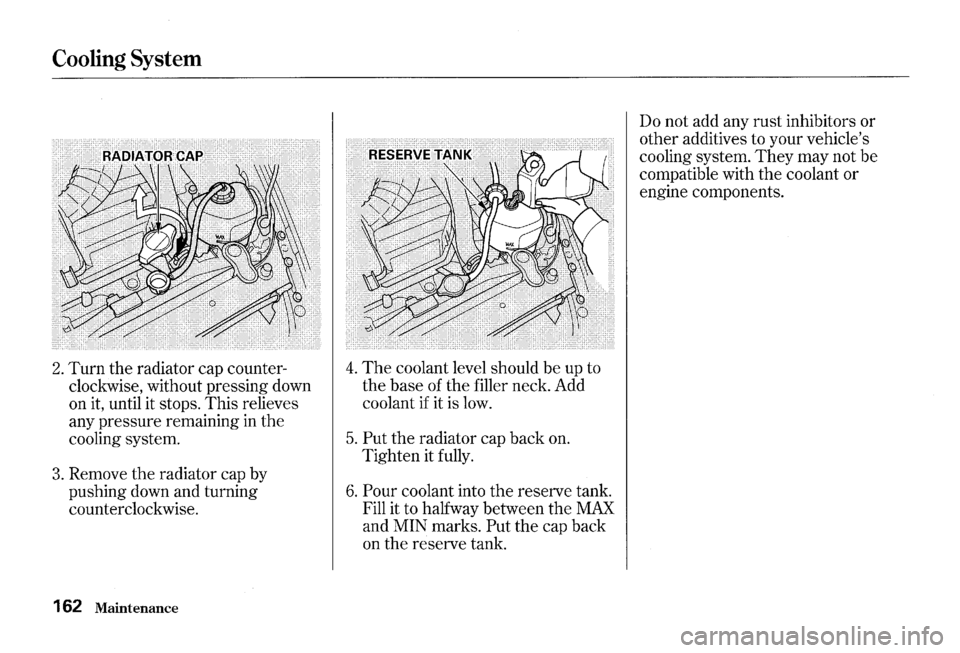
2. Turn the radiator cap counter
clockwise, without pressing down
on it, until it stops.
This relieves
any pressure remaining in the
cooling system.
3. Remove the radiator cap by
pushing down and turning
counterclockwise.
162 Maintenance
4. The coolant level should be up to
the base of the filler neck. Add
coolant
if it is low.
5. Put the radiator cap back on.
Tighten it fully.
6. Pour coolant into the reserve tank.
Fill it to halfway between the
MAX
and MIN marks. Put the cap back
on the reserve tank.
Do not add any rust inhibitors or
other additives to your vehicle's
cooling system.
They may not be
compatible with
the coolant or
engine components.
Page 166 of 273
Replacing Engine Coolant
The cooling system should be
completely drained and refilled with
new coolant according to
the time
and distance recommendations in
the maintenance schedule. Only use
Genuine Honda Antifreeze/Coolant.
Draining the coolant requires access
to
the underside of the vehicle.
Unless you have the tools and
knowledge, you should have this
maintenance done by a skilled
mechanic.
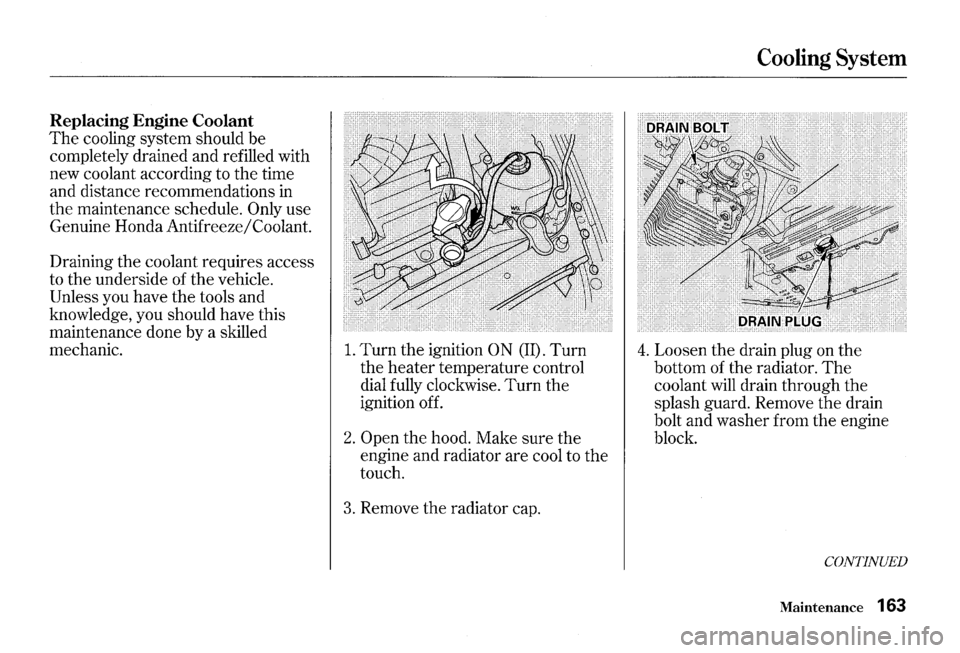
1. Turn the ignition ON (II). Turn
the heater temperature control
dial fully clockwise.
Turn the
ignition off.
2. Open the hood. Make sure the
engine and radiator are cool to the
touch.
3. Remove the radiator cap.
Cooling System
4. Loosen the drain plug on the
bottom of the radiator. The
coolant will drain through the
splash guard. Remove the drain
bolt and washer from the engine
block.
CONTINUED
Maintenance 163
Page 167 of 273
Cooling System
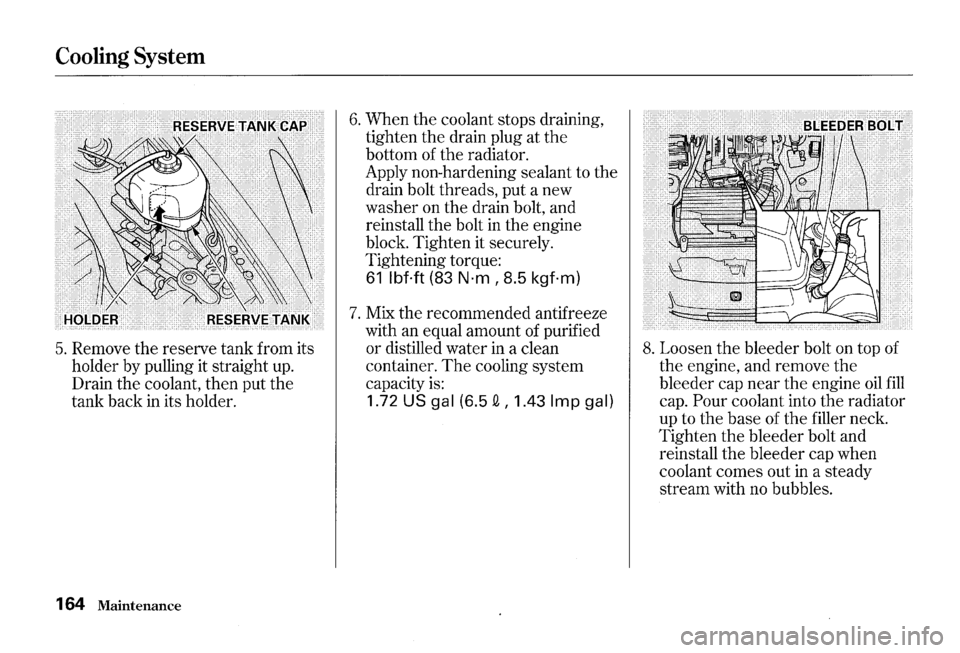
5. Remove the reserve tank from its
holder by pulling it straight
up.
Drain the coolant, then put the
tank back
in its holder.
164
Maintenance
6. When the coolant stops draining,
tighten the drain plug at
the
bottom of the radiator.
Apply non-hardening sealant to the
drain bolt threads, put a new
washer on the drain bolt, and
reinstall
the bolt in the engine
block. Tighten it securely.
Tightening torque:
61 lbf.ft (83 N·m I 8.5 kgf·m)
7. Mix the recommended antifreeze
with an equal amount of purified
or distilled water
in a clean
container.
The cooling system
capacity
is:
1.72 US gal (6.5 Q I 1.43 Imp gal)
8. Loosen the bleeder bolt on top of
the engine, and remove
the
bleeder cap near the engine oil fill
cap. Pour coolant into the radiator
up to the base of
the filler neck.
Tighten the bleeder bolt and
reinstall the bleeder cap when
coolant comes out in a steady
stream with no bubbles.
Page 168 of 273
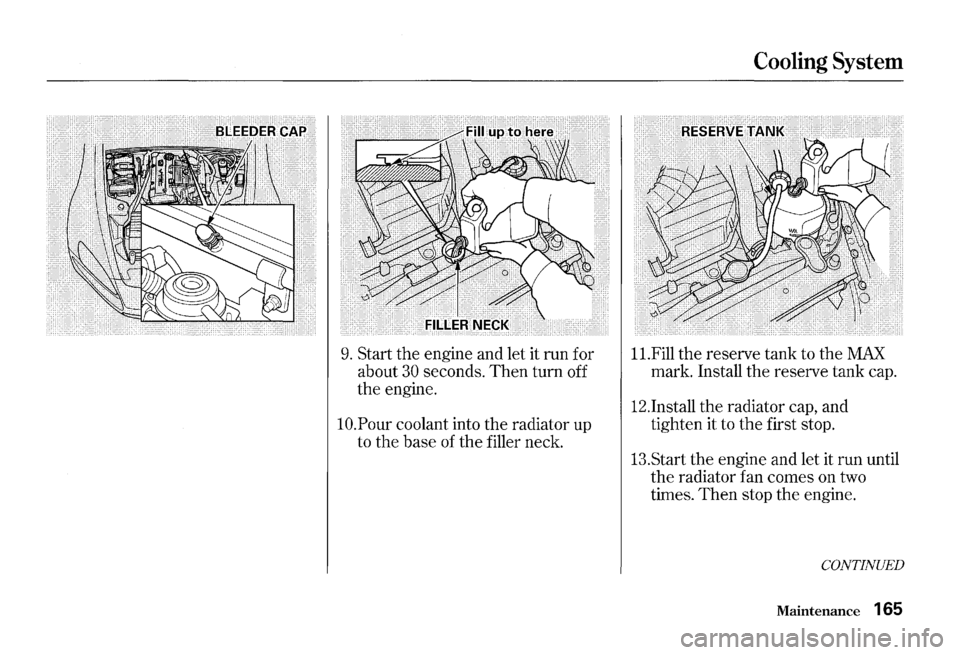
9. Start the engine and let it run for
about
30 seconds. Then turn off
the engine.
lO.Pour coolant into the radiator up
to the base of the filler neck.
Cooling System
ll.Fill the reserve tank to the MAX
mark. Install the reserve tank cap.
12.Install the radiator cap, and
tighten it to
the first stop.
13.Start the engine and let it run until
the radiator fan comes on two
times.
Then stop the engine.
CONTINUED
Maintenance 165
Page 169 of 273
Cooling System
14.Remove the radiator cap.
15.Pour coolant into the radiator up
to the base of the filler neck and
into the reserve tank up to the
MAX mark.
16.Start
the engine and hold it at
1,500 rpm until the radiator fan
comes on.
Turn off the engine.
Check the coolant level in the
radiator and add coolant
if needed.
17.Install the radiator cap, and
tighten it fully.
18.If necessary, fill the reserve tank
to the
MAX mark. Install the
reserve tank cap.
166
Maintenance
Page 198 of 273
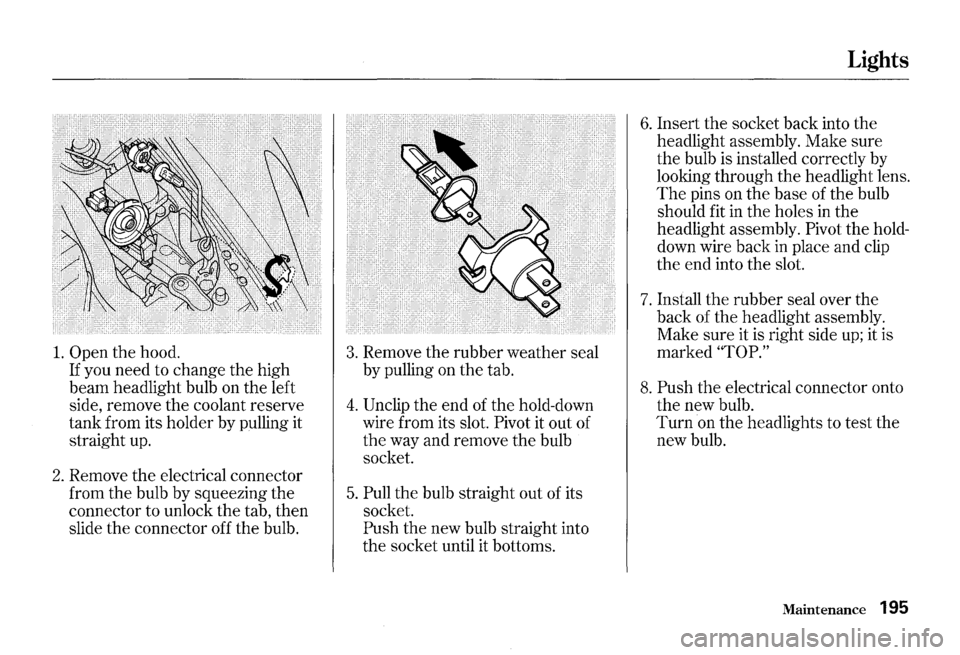
1. Open the hood.
If you need to change the high
beam headlight bulb on the left
side, remove the coolant reserve
tank from its holder by pulling it
straight up.
2. Remove the electrical connector
from
the bulb by squeezing the
connector to unlock the tab, then
slide
the connector off the bulb.
3. Remove the rubber weather seal
by pulling on the tab.
4. Unclip the end of the hold-down
wire from its slot.
Pivot it out of
the way and remove the bulb
socket.
5. Pull the bulb straight out of its
socket.
Push the new bulb straight into
the socket until it bottoms.
Lights
6. Insert the socket back into the
headlight assembly. Make sure
the bulb is installed correctly by
looking through the headlight lens.
The pins on the base of the bulb
should fit in
the holes in the
headlight assembly.
Pivot the hold
down wire back in place and clip
the end into the slot.
7. Install the rubber seal over the
back of
the headlight assembly.
Make sure it is right side
up; it is
marked
''TOP."
8. Push the electrical connector onto
the new bulb.
Turn on the headlights to test the
new bulb.
Maintenance 195