wheel HONDA S2000 2000 1.G Owner's Guide
[x] Cancel search | Manufacturer: HONDA, Model Year: 2000, Model line: S2000, Model: HONDA S2000 2000 1.GPages: 273, PDF Size: 21.58 MB
Page 194 of 273
Snow Tires
If you mount snow tires on your
Honda, make sure they are radial
tires of the same size and load range
as
the original tires. Mount snow
tires on
all four wheels to balance
your vehicle's handling in all weather
conditions. Keep
in mind the traction
provided by snow tires on dry roads
may not be as high as your vehicle's
original equipment tires. You should
drive cautiously even when the roads
are clear. Check with the tire dealer
for maximum speed recommenda
tions.
Tire Chains
Because your Honda has limited tire
clearance, mount only
SAE Class "S"
cable-type traction devices on the
rear tires.
Use traction devices only
when required by driving conditions
or local laws. Make sure they are the
correct size for your tires.
Metal link-type
"chains" should not
be used.
No matter how tight they
seem to be installed, they can come
into contact with the body and
suspension, causing serious damage.
When installing
the cables, follow
the manufacturer's instructions and
mount
them as tightly as you can.
Drive slowly with them installed.
If
you hear them coming in contact
with the body or chassis, stop and
investigate. Make sure the cables are
installed tightly, and
that they are
not contacting the brake lines
or
suspension. Remove them as soon as
you start driving on cleared roads.
Tires
NOTICE
Cables that are the wrong size or
improperly installed can damage your ·
car's brake lines, suspension, body, and
wheels. Stop driving (l they are hitting
any part
of the car.
Maintenance 191
Page 199 of 273
Lights
Replacing Front Tum Signal and
Side Marker Light Bulbs
1. If you are changing the bulb on
the driver's side, start the engine,
turn the steering wheel
all the way
to the right, and turn off the
engine.
If you are changing the
bulb on the passenger's side, turn
the steering wheel to the left.
196 Maintenance
2. Use a flat-tipped screwdriver to
remove the three holding clips
from the inner fender.
3. Pull the inner fender cover back.
4. Remove the socket from the
headlight assembly by turning it
one-quarter turn counterclockwise.
5. Pull the bulb straight out of its
socket.
6. Install the new bulb in the socket.
7. Insert the socket back into the
headlight assembly.
Turn it
clockwise to lock it
in place.
8. Test the lights to make sure the
new bulb is working.
9. Put the inner fender in place.
Install the two holding clips. Lock
each clip in place by pushing on
the center.
Page 205 of 273
Storing Your Car
If you need to park your car for an
extended period (more than one
month), there are several things you
should
do to prepare it for storage.
Proper preparation helps prevent
deterioration and makes it easier to
get your car back on the road.
If
possible, store your car indoors.
• Fill the fuel tank.
• Change the engine oil and filter
(see page 159).
• Wash and dry the exterior
completely.
• Clean the interior. Make sure the
carpeting, floor mats, etc. are
completely dry.
• Raise the convertible top cover.
• Leave the parking brake off. Put
the transmission in Reverse.
202 Maintenance
• Block the rear wheels.
• If the car is to be stored for a
longer period, it should be
supported on jackstands so the
tires are off the ground.
• Leave one window open slightly (if
the car is being stored indoors).
• Disconnect the battery.
• Support the front wiper blade
arms with a folded towel or rag so
they
do not touch the windshield.
• To minimize sticking, apply a
silicone spray lubricant to
all door
and trunk seals. Also, apply a
vehicle body wax to the painted
surfaces that mate with the door
and trunk seals.
• Cover the car with a "breathable"
cover, one made from a porous
material such as cotton.
Nonporous materials, such as
plastic sheeting, trap moisture,
which can damage
the paint.
• If possible, run the engine for a
while periodically (preferably once
a month).
If you store your car for 12 months
or longer, have your Honda dealer
perform the inspections called for
in
the 24 months/30,000 miles (48,000
km) maintenance schedule as soon
as you take it out of storage (see
page
148 ). The replacements called
for
in the maintenance schedule are
not needed unless the car has
actually reached that time or mileage.
Page 206 of 273
Appearance Care
Regular cleaning and polishing of
your Honda helps to keep it
"new"
looking. This section gives you hints
on how to clean your car and
preserve its appearance:
the paint,
brightwork, wheels and interior. Also
included are several things you can
do to help prevent corrosion.
Exterior
Care .................................. 204
Washing ...................................... 204
Waxing ........................................ 205
Aluminum Wheels ..................... 206
Paint Touch-up ........................... 206
Interior Care ................................... 207
Carpeting .................................... 207
Fabric .......................................... 207
Vinyl ............................................ 207
Leather ........................................ 207
Rear Window .............................. 207
Seat Belts .................................... 207
Windows ..................................... 208
Air Fresheners ........................... 208
Corrosion Protection ..................... 208
Body Repairs .................................. 210
Appearance Care 203
Page 209 of 273
Exterior Care
Aluminum Wheels
Clean your Acura's aluminum alloy
wheels as you
do the rest of the
exterior. Wash them with the same
solution, and rinse them thoroughly.
The wheels have a protective clear
coat that keeps the aluminum from
corroding and tarnishing.
Using
harsh chemicals, including some
commercial wheel cleaners, or stiff
brushes can damage this clear-coat.
Only use a mild detergent and soft
brush or sponge to clean the wheels.
206 Appearance Care
Paint Touch-up
Your dealer has touch-up paint to
match your car's color.
The color
code is printed on a sticker on the
driver's doorjamb.
Take this code to
your dealer so you are sure to get
the correct color. Inspect
your car frequently for chips
or scratches
in the paint. Repair
them right away to prevent corrosion
of the metal underneath.
Use the
touch-up paint only on small chips
and scratches. More extensive paint
damage should be repaired by a
professional.
Page 212 of 273
Many corrosion-preventive measures
are built into your Honda.
You can
help keep your car from corroding
by performing some simple periodic
maintenance:
• Repair chips and scratches in the
paint as soon as you discover them.
• Inspect and clean out the drain
holes
in the bottom of the doors
and body.
• Check the floor coverings for
dampness. Carpeting and floor
mats may remain damp for a long
time, especially
in winter. This
dampness can eventually cause
the floor panels to corrode.
• Use a high-pressure spray to clean
the underside of your car. This is
especially important
in areas that
use road salt
in winter. It is also a
good idea
in humid climates and
areas subject to salt air. Be careful
of the
ABS wheel sensors and
wiring
at each wheel.
• Have the corrosion-preventive
coatings on the underside of your
car inspected and repaired
periodically.
Corrosion Protection
Appearance Care 209
Page 215 of 273
Compact Spare Tire
Your car has a compact spare tire
that takes up less space.
Use this
spare tire as a temporary replace
ment only. Get your regular tire
repaired or replaced and put back on
your car as soon as you can.
Check the inflation pressure of the
compact spare tire every time you
check the other tires.
It should be
inflated
to:
60 psi (420 kPa , 4.2 kgf/cm2
)
212 Taking Care of the Unexpected
Follow these precautions whenever
you are using the compact spare tire:
• Do not exceed 50 mph (80 km/h)
under any circumstances.
• This tire gives a harsher ride and
less traction on some road sur
faces than the regular tire.
Use
greater caution while driving on
this tire.
• Do not mount snow chains on the
compact spare.
• The wheel of the compact spare
tire is designed especially to fit
your car.
Do not use your spare
tire on another vehicle unless it is
the same make and model.
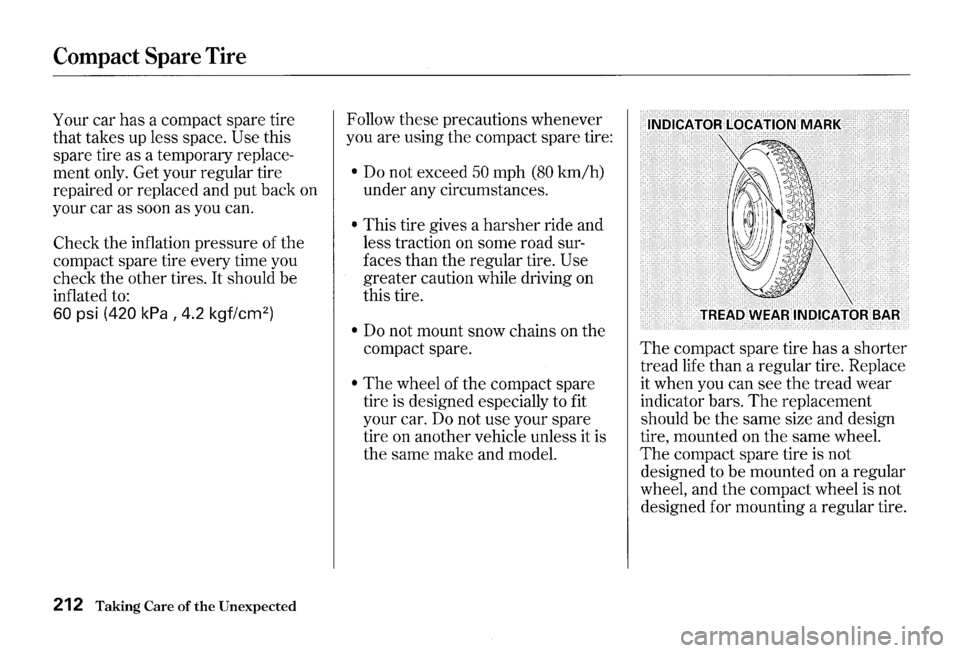
The compact spare tire has a shorter
tread life than a regular tire. Replace
it when you can see
the tread wear
indicator bars.
The replacement
should be the same size and design
tire, mounted on
the same wheel.
The compact spare tire is not
designed to be mounted on a regular
wheel, and
the compact wheel is not
designed for mounting a regular tire.
Page 216 of 273
If you have a flat tire while driving,
stop in a safe place to change it.
Stopping in traffic
or on the shoulder
of a busy road is dangerous. Drive
slowly along
the shoulder until you
get to an exit or an area to stop that
is far away from the traffic lanes.
The car can easily roll off the
jack,
seriously injuring anyone
underneath.
Follow the directions for
changing a tire
exactly, and
never get under the car when it
is supported only by the jack.
The compact spare tire is smaller
than a standard tire, which
will affect
the vehicle's handling. Drive
cautiously when this spare is
mounted on your vehicle.
The size difference may also cause
damage to
the rear differential, so do
not mount
the compact spare on the
rear. If either rear tire goes flat,
remove
the front tire on that same
side, mount
the compact spare tire
on
the front, then mount the front
tire on
the rear.
1. Park the car on firm, level, non
slippery ground away from traffic.
Put the transmission in Reverse.
Apply
the parking brake.
2. Turn on the hazard warning lights
and turn
the ignition switch to
LOCK (O). Have your passenger
get out of the car while you
change
the tire.
Changing a Flat Tire
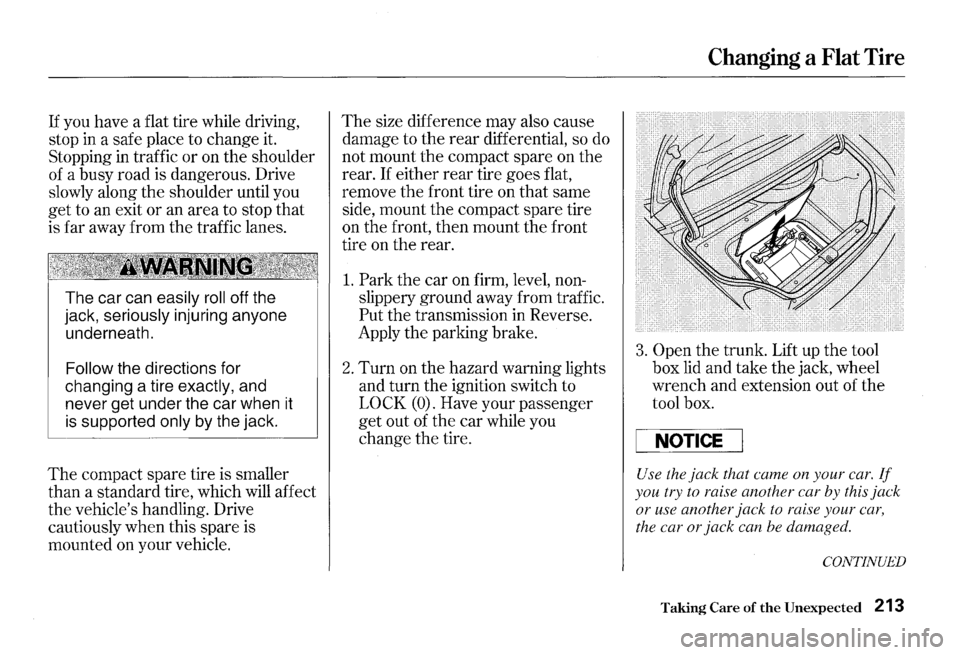
3. Open the trunk. Lift up the tool
box lid and take
the jack, wheel
wrench and extension out of
the
tool box.
NOTICE
Use the jack that came on your car. If
you try to raise another car by this jack
or use another jack to raise your car,
the car
or jack can be damaged.
CONTINUED
Taking Care of the Unexpected 213
Page 217 of 273
Changing a Flat Tire
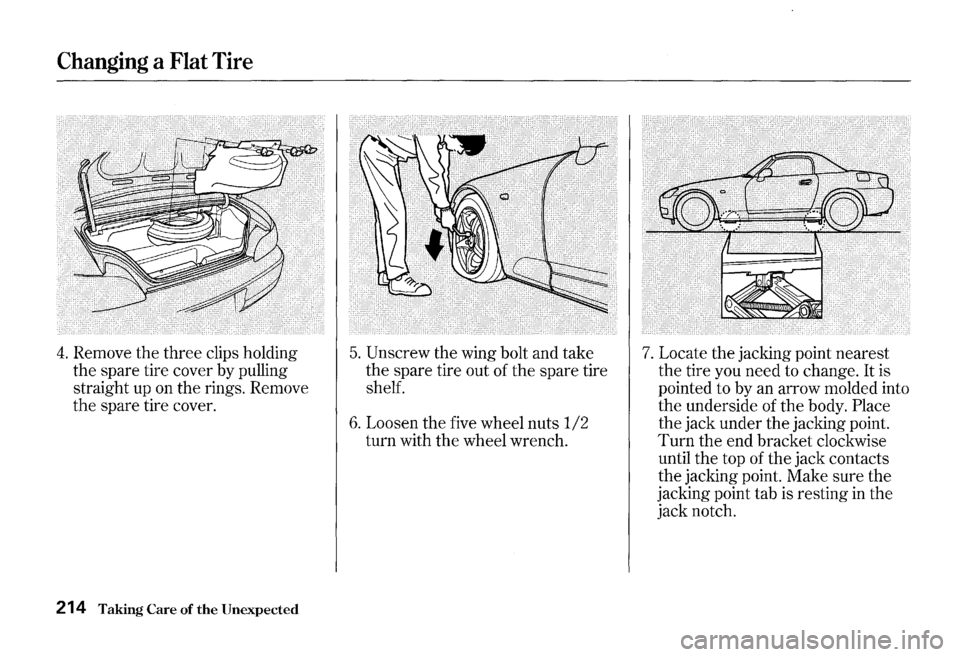
4. Remove the three clips holding
the spare tire cover by pulling
straight up on the rings. Remove
the spare tire cover.
214 Taking Care of the Unexpected
5. Unscrew the wing bolt and take
the spare tire out of the spare tire
shelf.
6. Loosen the five wheel nuts 1/2
turn with the wheel wrench.
7. Locate the jacking point nearest
the tire you need to change.
It is
pointed to by an arrow molded into
the underside of the body. Place
the jack under the jacking point.
Turn the end bracket clockwise
until the top of the jack contacts
the jacking point. Make sure the
jacking point tab is resting
in the
jack notch.
Page 218 of 273
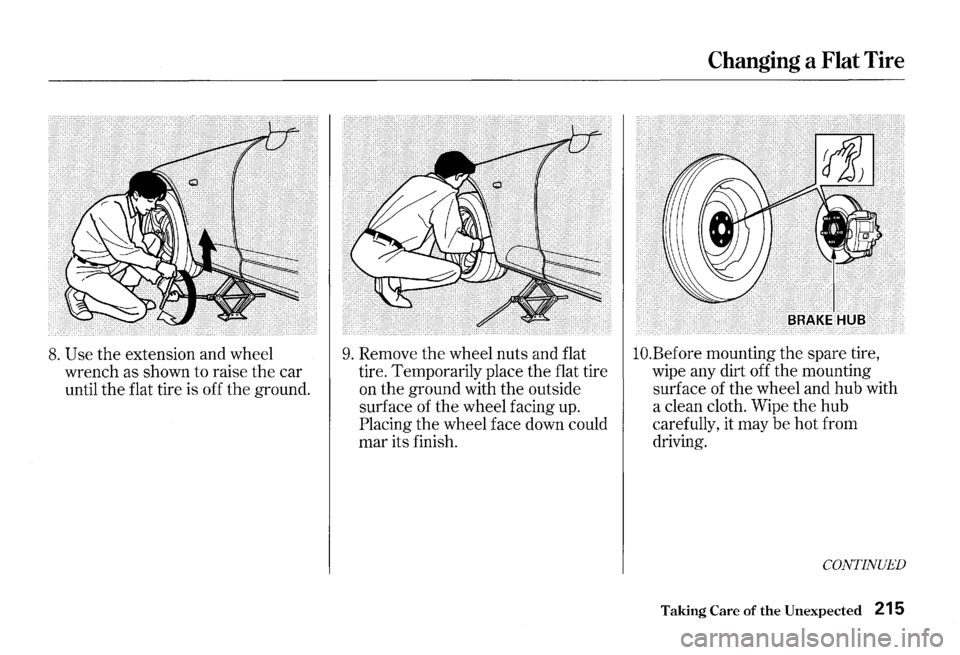
8. Use the extension and wheel
wrench as shown to raise the car
until the flat tire is off
the ground.
9. Remove the wheel nuts and flat
tire. Temporarily place the flat tire
on the ground with the outside
surface of the wheel facing
up.
Placing the wheel face down could
mar its finish.
Changing a Flat Tire
lO.Before mounting the spare tire,
wipe any dirt off the mounting
surface of the wheel and hub with
a clean cloth. Wipe the hub
carefully, it may be hot from
driving.
CONTINUED
Taking Care of the Unexpected 215