belt Hyundai Accent 2006 Owners Manual
[x] Cancel search | Manufacturer: HYUNDAI, Model Year: 2006, Model line: Accent, Model: Hyundai Accent 2006Pages: 599, PDF Size: 17.59 MB
Page 411 of 599
1CONTROLS AND EQUIPMENT
4RUNNING IN YOUR NEW HYUNDAI
B020A01FC-EAT (Petrol Engine) The longevity and performance of the vehicle are greatly affected by the careexercised during the first 1,000 miles of motoring. Because of modern manu- facturing techniques, rigid guidelinesregarding maximum road speeds have become unnecessary. However, cer- tain precautions should be observed inorder to obtain the best possible perfor- mance and useful life from the vehicle.
1) Do not race the engine without a load
(i.e revving the engine in neutral).
2) During the first 500 miles the maxi- mum engine speed should be re- stricted to 3,000 rpm and gradually increased thereafter.
3) Avoid prolonged constant speed op- eration. The internal components ofthe engine will become runin morequickly if the operation speed is var- ied during the running-in period.
4) Never allow the engine to labour. Use the gearbox freely and avoid largethrottle openings when the engine speed is below 1,500 rpm. 5) Avoid rapid acceleration and maxi-
mum throttle openings.
6) Avoid harsh braking during the first 100 miles of urban motoring or 1,000miles of motorway driving to allowthe friction facings of the brake pads and shoes to bed against the discs and drums properly.
7) No trailer towing should be under- taken during the running-in period.
B020B01FC-EAT (Diesel Engine) The longevity and performance of the vehicle are greatly affected by the care exercised during the first 1,000 miles of motoring. Because of modern manu-facturing techniques, rigid guidelines regarding maximum road speeds have become unnecessary. However, cer-tain precautions should be observed in order to obtain the best possible perfor- mance and useful life from the vehicle.AFTER ENTERING THE VEHICLE
YB020B1-E
o Ensure that all occupants fasten and
correctly adjust seat belts.
o Ensure that seat and headrestraint
positions are adjusted for optimum safety, control and comfort.
o Adjust interior and exterior rear view
mirrors.
o Verify correct operation of lamps,
horn and other electrical equipment.
o Ensure that warning lamps illumi- nate when ignition is turned on.
NOTE: Fluid levels such as engine oil, en- gine coolant, brake and windscreen washer fluid should be checked daily or at each refuelling, whichever oc-curs sooner.
Page 413 of 599
1CONTROLS AND EQUIPMENT
6
The key number should be recorded and kept in a safe place in case theneed to order further keys arises. New keys are available from any Hyundai dealer by quoting the relevant keynumber. In the interest of security, the metal tag attached to the keys which bears thekey number should be removed from the key ring after you receive your new vehicle. In addition, key numbers can-not be provided by Hyundai for security reasons. If you need additional keys or if youshould lose your keys, your authorized Hyundai dealer can make new keys.
!
B040A02Y-EAT Door Locks B040B01A-AATLocking and Unlocking Front Doors With a Key
WARNING:
o Unlocked doors can be danger- ous. Before you drive away (espe- cially if there are children in thecar), be sure that all the doors are securely closed and locked so that the doors cannot be inadvert-ently opened from the inside. This helps ensure that doors will not be opened accidentally. Also, when combined with the proper use of seat belts, locking the doors helpskeep occupants from being ejected from the car in case of an accident.
o Before opening the door, always look for and avoid oncoming traf-fic.
o In case of accident the door is unlocked automatically (Not allmodels). o The door can be locked or unlocked
with a key.
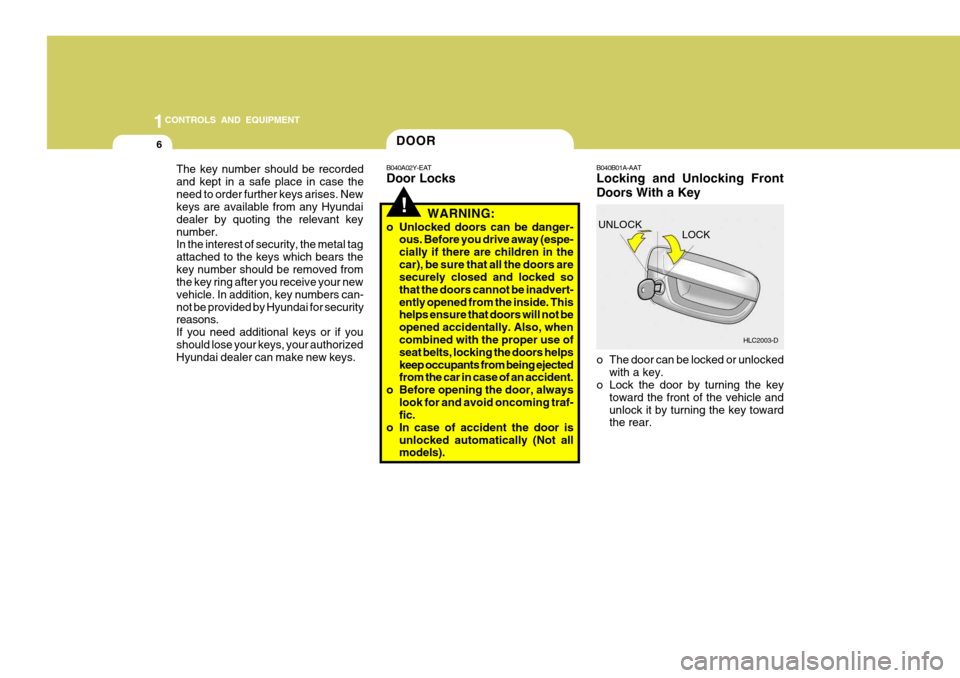
o Lock the door by turning the key
toward the front of the vehicle and unlock it by turning the key toward the rear.
UNLOCK
LOCK
HLC2003-D
DOOR
Page 420 of 599
13
1
CONTROLS AND EQUIPMENT
!
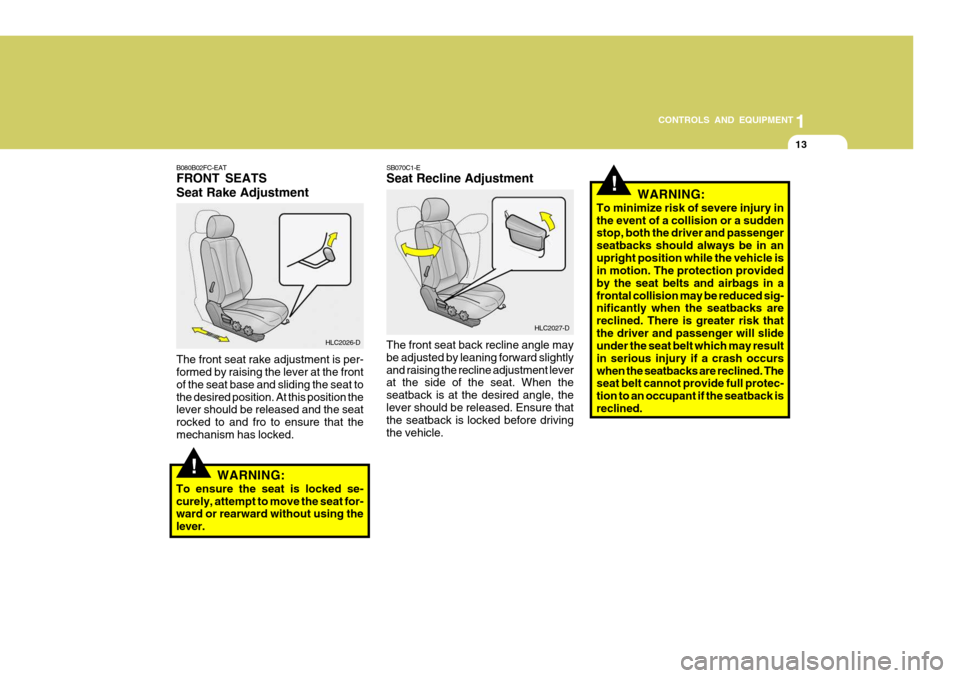
B080B02FC-EAT FRONT SEATS Seat Rake Adjustment
HLC2026-D
The front seat rake adjustment is per- formed by raising the lever at the front of the seat base and sliding the seat tothe desired position. At this position the lever should be released and the seat rocked to and fro to ensure that themechanism has locked. SB070C1-E Seat Recline Adjustment The front seat back recline angle may be adjusted by leaning forward slightlyand raising the recline adjustment lever at the side of the seat. When the seatback is at the desired angle, thelever should be released. Ensure that the seatback is locked before driving the vehicle.
HLC2027-D
WARNING:
To ensure the seat is locked se-curely, attempt to move the seat for- ward or rearward without using the lever.
!WARNING:
To minimize risk of severe injury in the event of a collision or a sudden stop, both the driver and passenger seatbacks should always be in anupright position while the vehicle is in motion. The protection provided by the seat belts and airbags in afrontal collision may be reduced sig- nificantly when the seatbacks are reclined. There is greater risk thatthe driver and passenger will slide under the seat belt which may result in serious injury if a crash occurswhen the seatbacks are reclined. The seat belt cannot provide full protec- tion to an occupant if the seatback isreclined.
Page 423 of 599
1CONTROLS AND EQUIPMENT
16
!WARNING:
o For maximum effectiveness in case of an accident, the headrest should be adjusted so the top of the head- rest is at the same height as the
top of the occupant's ears. Theuse of a cushion that holds the body away from the seatback is not recommended.
o Do not operate vehicle with the headrests removed as severe in-jury to an occupant may occur inthe event of an accident. Head- rests may provide protection against severe neck injuries whenproperly adjusted. B110A03A-EAT Folding Rear Seatbacks
B110A02A
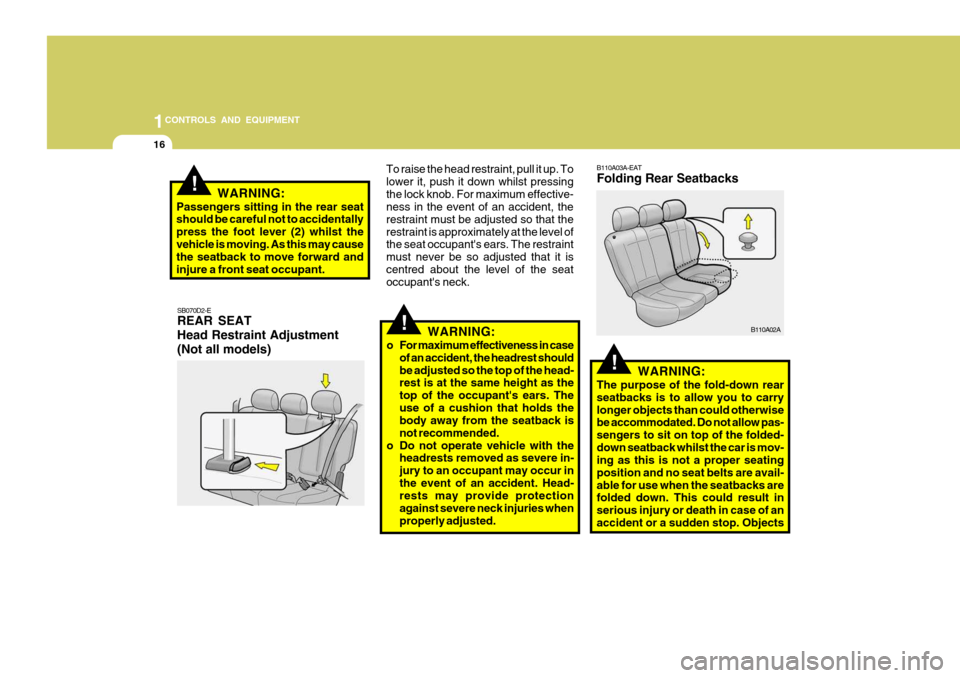
To raise the head restraint, pull it up. To lower it, push it down whilst pressingthe lock knob. For maximum effective- ness in the event of an accident, the restraint must be adjusted so that therestraint is approximately at the level of the seat occupant's ears. The restraint must never be so adjusted that it iscentred about the level of the seat occupant's neck.
!WARNING:
The purpose of the fold-down rear seatbacks is to allow you to carrylonger objects than could otherwise be accommodated. Do not allow pas- sengers to sit on top of the folded-down seatback whilst the car is mov- ing as this is not a proper seating position and no seat belts are avail-able for use when the seatbacks are folded down. This could result in serious injury or death in case of anaccident or a sudden stop. Objects
SB070D2-E REAR SEAT Head Restraint Adjustment(Not all models)
!WARNING:
Passengers sitting in the rear seat should be careful not to accidentally press the foot lever (2) whilst thevehicle is moving. As this may cause the seatback to move forward and injure a front seat occupant.
Page 424 of 599
17
1
CONTROLS AND EQUIPMENT
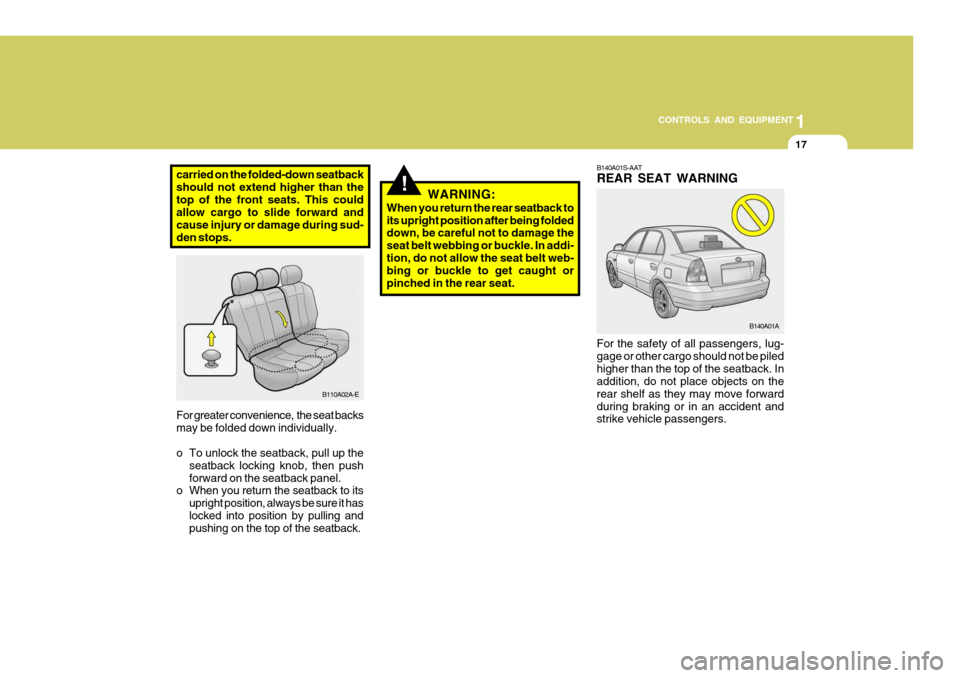
For greater convenience, the seat backs may be folded down individually.
o To unlock the seatback, pull up the
seatback locking knob, then push forward on the seatback panel.
o When you return the seatback to its
upright position, always be sure it haslocked into position by pulling and pushing on the top of the seatback. B110A02A-E
carried on the folded-down seatback should not extend higher than thetop of the front seats. This could allow cargo to slide forward and cause injury or damage during sud-den stops.
B140A01A
B140A01S-AAT REAR SEAT WARNING
For the safety of all passengers, lug- gage or other cargo should not be piledhigher than the top of the seatback. In addition, do not place objects on the rear shelf as they may move forwardduring braking or in an accident and strike vehicle passengers.
!WARNING:
When you return the rear seatback to its upright position after being folded down, be careful not to damage the seat belt webbing or buckle. In addi-tion, do not allow the seat belt web- bing or buckle to get caught or pinched in the rear seat.
Page 425 of 599
1CONTROLS AND EQUIPMENT
18
SB090E1-E Injured Persons A seat belt should be used when an injured person is being transported. Forspecific recommendations, the advice of a qualified Medical Practioner should be sought. SB090F1-E Seat Belt Occupancy The seat belts are designed to be used by one seat occupant only. The use of a seat belt by more than one person increases the levels of injury whichmay be sustained in the event of an accident. SE090G1-E Do Not Lie Down To ensure that the maximum level of protection may be afforded by the seat belt system, all passengers should besitting in an upright position throughout the journey. The seat belt will be unable to afford maximum protection if thefront seats are at or near the fully reclined position.
SB090C1-E Larger Children Larger children should occupy the rear seat and be restrained at all times. Therestraint may take the form of a special safety belt or the original factory fitted seat belt used in conjunction with anapproved booster cushion depending upon the size and weight of the child. Under no circumstances should chil-dren be allowed to travel standing, kneel- ing or lying on the seat. Never allow children to ride in the frontpassenger seat. SB090O1-E Pregnant Women The use of a seat belt is recommended for pregnant women. The seat belt should be worn as low and snugly as possible across the hips, not across the abdo-men. A qualified Medical Practitioner should be consulted for further informa- tion.SEAT BELT
SB090A1-E SEAT BELT PRECAUTIONS Seat belts should be worn at all times by all occupants front and rear. Thepossibility of injury or the severity of injuries suffered in the event of an accident will be greatly reduced by thewearing of seat belts. In addition the following recommenda- tions should be observed. SB090B1-E Babies/Small Children Babies and small children must be restrained using a restraint system spe-cifically designed for this purpose. Un- der no circumstances should a child be carried in the vehicle without the use ofa suitable restraint which meets the regulations in force in the country where the vehicle is in operation.
Page 426 of 599
19
1
CONTROLS AND EQUIPMENT
!WARNING:
Sitting in a reclined position or lying down when your vehicle is in motion can be dangerous. Even if you buckleup, your seat belts can't do their job when you're reclined. The shoulder belt can't do its jobbecause it won't be against your body. Instead, it will be in front of you. In a crash you could go into itwith great force, receiving serious neck or other injuries. The lap belt can't do its job either. Ina crash the belt could go up over your abdomen. The belt forces would be applied there, not at your strongpelvic bones. This could cause seri- ous internal injuries. For proper protection when the ve-hicle is in motion, have the seatback upright. Then sit back in the seat and wear your seat belt properly. Seepage 1-20.
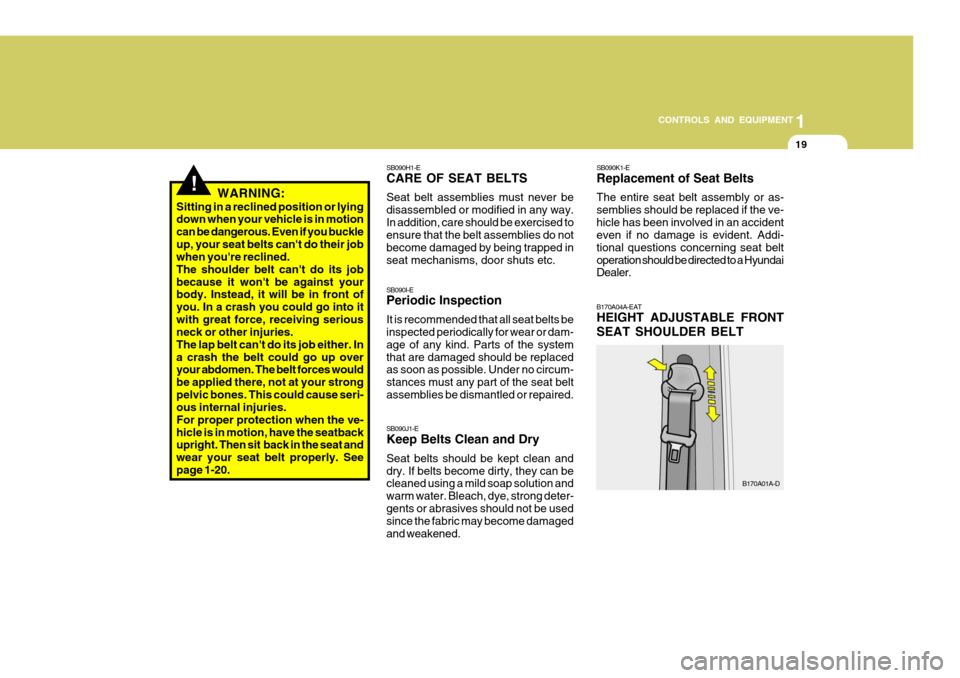
SB090K1-E Replacement of Seat Belts The entire seat belt assembly or as- semblies should be replaced if the ve-hicle has been involved in an accident even if no damage is evident. Addi- tional questions concerning seat beltoperation should be directed to a Hyundai Dealer. B170A04A-EAT HEIGHT ADJUSTABLE FRONT SEAT SHOULDER BELT
SB090H1-E CARE OF SEAT BELTS Seat belt assemblies must never be disassembled or modified in any way.In addition, care should be exercised to ensure that the belt assemblies do not become damaged by being trapped inseat mechanisms, door shuts etc. SB090I-E Periodic Inspection It is recommended that all seat belts be inspected periodically for wear or dam- age of any kind. Parts of the systemthat are damaged should be replaced as soon as possible. Under no circum- stances must any part of the seat beltassemblies be dismantled or repaired. SB090J1-E Keep Belts Clean and Dry Seat belts should be kept clean and dry. If belts become dirty, they can be cleaned using a mild soap solution and warm water. Bleach, dye, strong deter-gents or abrasives should not be used since the fabric may become damaged and weakened.
B170A01A-D
Page 427 of 599
1CONTROLS AND EQUIPMENT
20
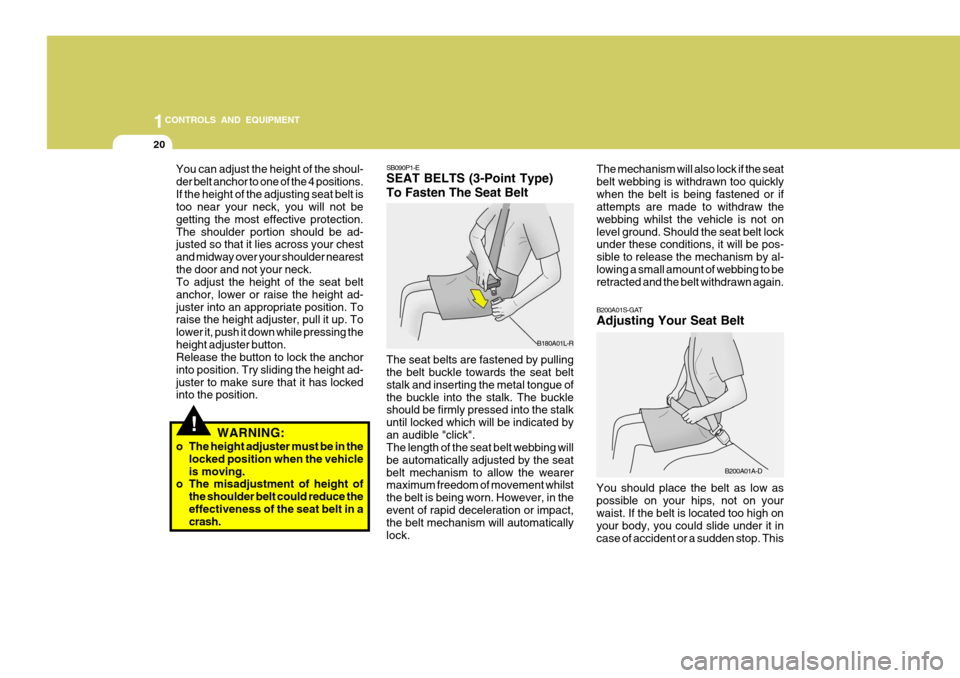
SB090P1-E SEAT BELTS (3-Point Type) To Fasten The Seat Belt The seat belts are fastened by pulling the belt buckle towards the seat belt stalk and inserting the metal tongue ofthe buckle into the stalk. The buckle should be firmly pressed into the stalk until locked which will be indicated byan audible "click". The length of the seat belt webbing will be automatically adjusted by the seatbelt mechanism to allow the wearer maximum freedom of movement whilst the belt is being worn. However, in theevent of rapid deceleration or impact, the belt mechanism will automatically lock. B180A01L-R
B200A01S-GAT Adjusting Your Seat Belt
B200A01A-D
The mechanism will also lock if the seat belt webbing is withdrawn too quicklywhen the belt is being fastened or if attempts are made to withdraw the webbing whilst the vehicle is not onlevel ground. Should the seat belt lock under these conditions, it will be pos- sible to release the mechanism by al-lowing a small amount of webbing to be retracted and the belt withdrawn again.
You should place the belt as low as possible on your hips, not on your waist. If the belt is located too high on your body, you could slide under it incase of accident or a sudden stop. This
!
You can adjust the height of the shoul- der belt anchor to one of the 4 positions.If the height of the adjusting seat belt is too near your neck, you will not be getting the most effective protection.The shoulder portion should be ad- justed so that it lies across your chest and midway over your shoulder nearestthe door and not your neck. To adjust the height of the seat belt anchor, lower or raise the height ad-juster into an appropriate position. To raise the height adjuster, pull it up. To lower it, push it down while pressing theheight adjuster button. Release the button to lock the anchor into position. Try sliding the height ad-juster to make sure that it has locked into the position. WARNING:
o The height adjuster must be in the locked position when the vehicle is moving.
o The misadjustment of height of
the shoulder belt could reduce theeffectiveness of the seat belt in a crash.
Page 428 of 599
21
1
CONTROLS AND EQUIPMENT
could result of death, serious injury or property damage. Both arms should notbe under or over the belt. Rather, one should be over and the other under, as shown in the illustration.Never wear the seat belt under the arm nearest the door.
B210A01A-AAT To Release the Seat Belt
The seat belt is released by pressing the release button in the locking buckle. When it is released, the belt should automatically draw back into the retrac-tor. If this does not happen, check the belt to be sure it is not twisted, then try again. B210A01L-R
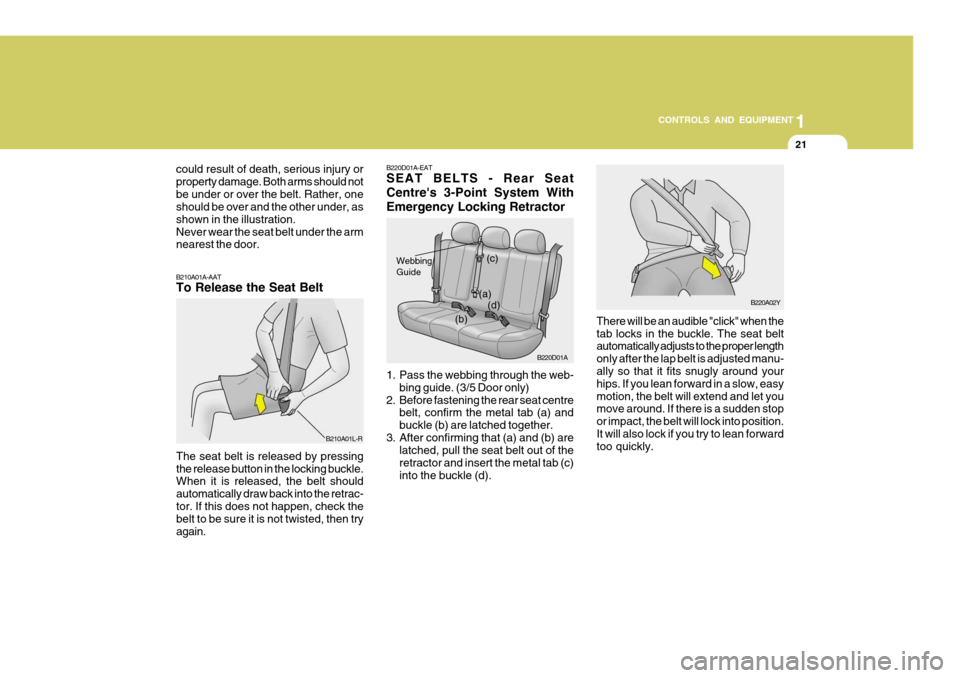
B220D01A-EAT SEAT BELTS - Rear Seat Centre's 3-Point System WithEmergency Locking Retractor
1. Pass the webbing through the web-
bing guide. (3/5 Door only)
2. Before fastening the rear seat centre belt, confirm the metal tab (a) and buckle (b) are latched together.
3. After confirming that (a) and (b) are latched, pull the seat belt out of theretractor and insert the metal tab (c)into the buckle (d). B220D01A
(a)
Webbing Guide
(c)
(d)
(b) B220A02Y
There will be an audible "click" when the tab locks in the buckle. The seat belt automatically adjusts to the proper length only after the lap belt is adjusted manu- ally so that it fits snugly around your hips. If you lean forward in a slow, easymotion, the belt will extend and let you move around. If there is a sudden stop or impact, the belt will lock into position.It will also lock if you try to lean forward too quickly.
Page 429 of 599
1CONTROLS AND EQUIPMENT
22CHILD RESTRAINT SYSTEM
B230A03A-EAT Children riding in the car should sit in the rear seat and must always be prop- erly restrained to minimize the risk of injury in an accident, sudden stop orsudden manoeuvre. According to acci- dent statistics, children are safer when properly restrained in the rear seatsthan in the front seat. Larger children should use one of the seat belts pro- vided.You are required by law to use safety restraints for children. If small children ride in your vehicle you must put themin a child restraint system (safety seat). Children could be injured or killed in a crash if their restraints are not properlysecured. For small children and babies, a child seat or infant seat must be used. Before buying a particular child restraintsystem, make sure it fits your car and seat belts, and fits your child. Follow all the instructions provided by the manu-facturer when installing the child re- straint system.
!
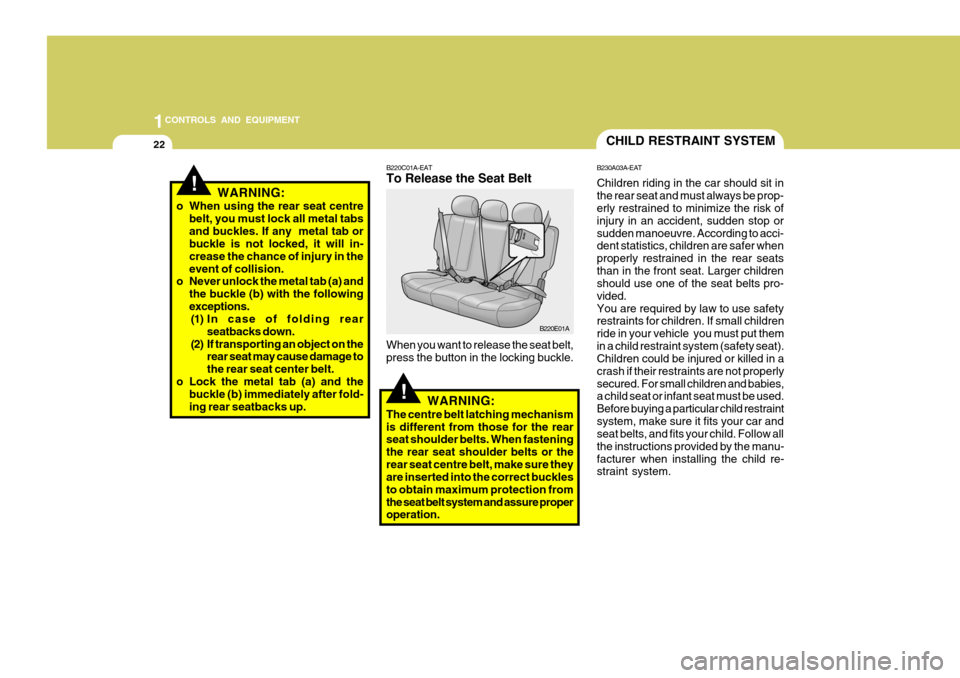
B220C01A-EAT To Release the Seat Belt
When you want to release the seat belt, press the button in the locking buckle. B220E01A
WARNING:
The centre belt latching mechanism is different from those for the rear seat shoulder belts. When fastening the rear seat shoulder belts or therear seat centre belt, make sure they are inserted into the correct buckles to obtain maximum protection fromthe seat belt system and assure proper operation.
!WARNING:
o When using the rear seat centre belt, you must lock all metal tabs and buckles. If any metal tab or buckle is not locked, it will in- crease the chance of injury in theevent of collision.
o Never unlock the metal tab (a) and
the buckle (b) with the followingexceptions.(1) In case of folding rear
seatbacks down.
(2) If transporting an object on the rear seat may cause damage tothe rear seat center belt.
o Lock the metal tab (a) and the buckle (b) immediately after fold-ing rear seatbacks up.