belt Hyundai Accent 2006 Manual Online
[x] Cancel search | Manufacturer: HYUNDAI, Model Year: 2006, Model line: Accent, Model: Hyundai Accent 2006Pages: 599, PDF Size: 17.59 MB
Page 322 of 599
1FEATURES OF YOUR HYUNDAI
40
!WARNING:
o Pre-tensioners are designed to operate only one time. After acti- vation, pre-tensioner seat belts must be replaced. All seat belts, of any type, should always be re-placed after they have been worn during a collision.
o The pre-tensioner seat belt assem- bly mechanisms become hot dur- ing activation. Do not touch thepre-tensioner seat belt assemblies for several minutes after they have been activated.
o Do not attempt to inspect or re- place the pre-tensioner seat beltsyourself. This must be done by an authorized Hyundai dealer.
o Do not strike the pre-tensioner seat belt assemblies.
o Do not attempt to service or repair the pre-tensioner seat belt system in any manner. o Improper handling of the pre-
tensioner seat belt assemblies, andfailure to heed the warnings to notstrike, modify, inspect, replace, service or repair the pre-tensioner seat belt assemblies may lead toimproper operation or inadvertent activation and serious injury.
o Always wear the seat belts when driving or riding in a motor ve- hicle.
CAUTION:
o Because the sensor that activates the SRS airbag is connected withthe pre-tensioner seat belt, the SRS airbag warning light on the instrument panel will blink for ap-proximately 6 seconds after the ignition key has been turned to the "ON" position, and then it shouldturn off.
o If the pre-tensioner seat belt is not working properly, this warning light will illuminate even if there is no malfunction of the SRS airbagsystem. If the SRS airbag warning light does not illuminate when the igni-tion key is turned to "ON", or if it remains illuminated after blinking for approximately 6 seconds, or ifit illuminates while the vehicle is being driven, please have an au- thorized Hyundai dealer inspectthe pre-tensioner seat belts and SRS airbag system as soon as possible.!
Page 323 of 599
1
FEATURES OF YOUR HYUNDAI
41DUAL-STAGE SUPPLEMENTAL RESTRAINT (AIRBAG) SYSTEM
B240A01A-AAT (If Installed)
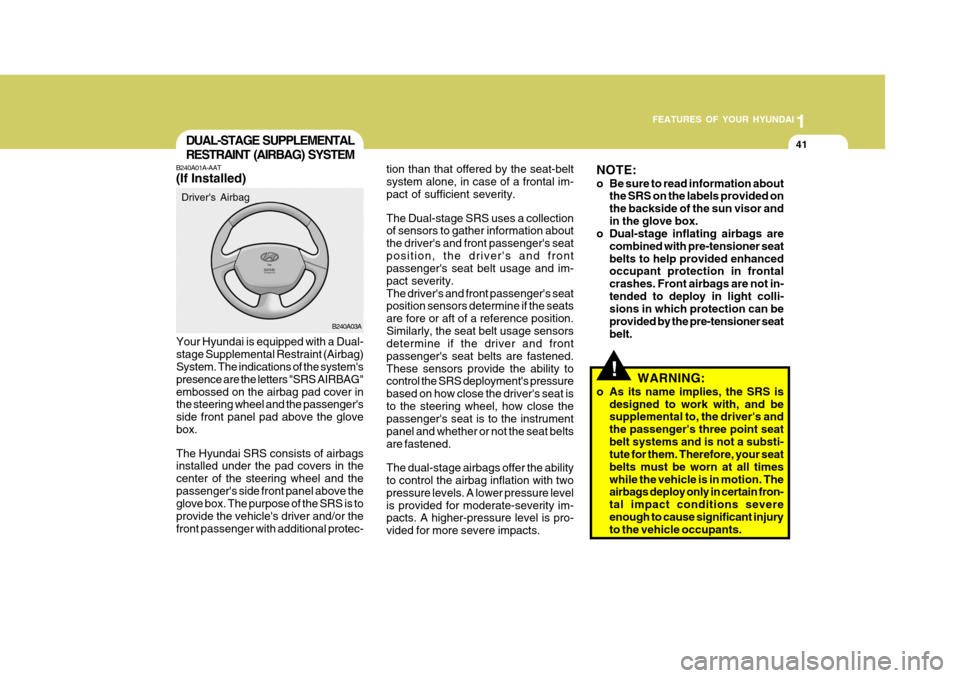
Your Hyundai is equipped with a Dual- stage Supplemental Restraint (Airbag) System. The indications of the system's presence are the letters "SRS AIRBAG"embossed on the airbag pad cover in the steering wheel and the passenger's side front panel pad above the glovebox. The Hyundai SRS consists of airbags installed under the pad covers in the center of the steering wheel and thepassenger's side front panel above the glove box. The purpose of the SRS is to provide the vehicle's driver and/or thefront passenger with additional protec- B240A03A
Driver's Airbag
!WARNING:
o As its name implies, the SRS is designed to work with, and be supplemental to, the driver's and the passenger's three point seatbelt systems and is not a substi- tute for them. Therefore, your seat belts must be worn at all timeswhile the vehicle is in motion. The airbags deploy only in certain fron- tal impact conditions severeenough to cause significant injury to the vehicle occupants.
NOTE:
o Be sure to read information about
the SRS on the labels provided on the backside of the sun visor andin the glove box.
o Dual-stage inflating airbags are
combined with pre-tensioner seatbelts to help provided enhanced occupant protection in frontal crashes. Front airbags are not in-tended to deploy in light colli- sions in which protection can be provided by the pre-tensioner seatbelt.
tion than that offered by the seat-beltsystem alone, in case of a frontal im-pact of sufficient severity. The Dual-stage SRS uses a collection of sensors to gather information about the driver's and front passenger's seatposition, the driver's and front passenger's seat belt usage and im- pact severity.The driver's and front passenger's seat position sensors determine if the seats are fore or aft of a reference position.Similarly, the seat belt usage sensors determine if the driver and front passenger's seat belts are fastened.These sensors provide the ability to control the SRS deployment's pressure based on how close the driver's seat isto the steering wheel, how close the passenger's seat is to the instrument panel and whether or not the seat beltsare fastened. The dual-stage airbags offer the ability to control the airbag inflation with two pressure levels. A lower pressure levelis provided for moderate-severity im- pacts. A higher-pressure level is pro- vided for more severe impacts.
Page 324 of 599
1FEATURES OF YOUR HYUNDAI
42
o The driver should sit back as far as
possible while still maintaining control of the vehicle. If you aresitting too close to the airbag, it can cause death or serious injury when it inflates.
o No objects should be placed over or near the airbag modules on thesteering wheel, instrument panel,and the front passenger's panel above the glove box, because any such object could cause harmif the vehicle is in a crash severe enough to cause the airbags to deploy.
o If the airbags deploy, they must be
replaced by an authorized Hyundaidealer.
o Do not tamper with or disconnect
SRS wiring, or other componentsof the SRS system. Doing so could result in injury, due to acci- dental firing of the airbags or byrendering the SRS inoperative.
o Do not install a child restraint sys-
tem in the front passenger seatposition. A child restraint system must never be placed in the front seat. The infant or child could be severely injured or killed by anairbag deployment in case of an accident.
o Do not allow children to ride in the front passenger seat. If older chil-dren (teenagers and older) must ride in the front seat, make surethey are always properly belted and that the seat is moved back as far as possible.
o For maximum safety protection in all types of crashes, all occupantsincluding the driver should alwayswear their seat belts whether or not an airbag is also provided at their seating position to minimizethe risk of severe injury or death in the event of a crash. Do not sit or lean unnecessarily close to theairbag while the vehicle is in mo- tion.
o The SRS airbag system must de- ploy very rapidly to provide pro-tection in a crash. If an occupant is out of position because of notwearing a seat belt, the airbag may forcefully contact the occupant causing serious or fatal injuries.
B240A04A
Rear impact
Side Impact Rollover
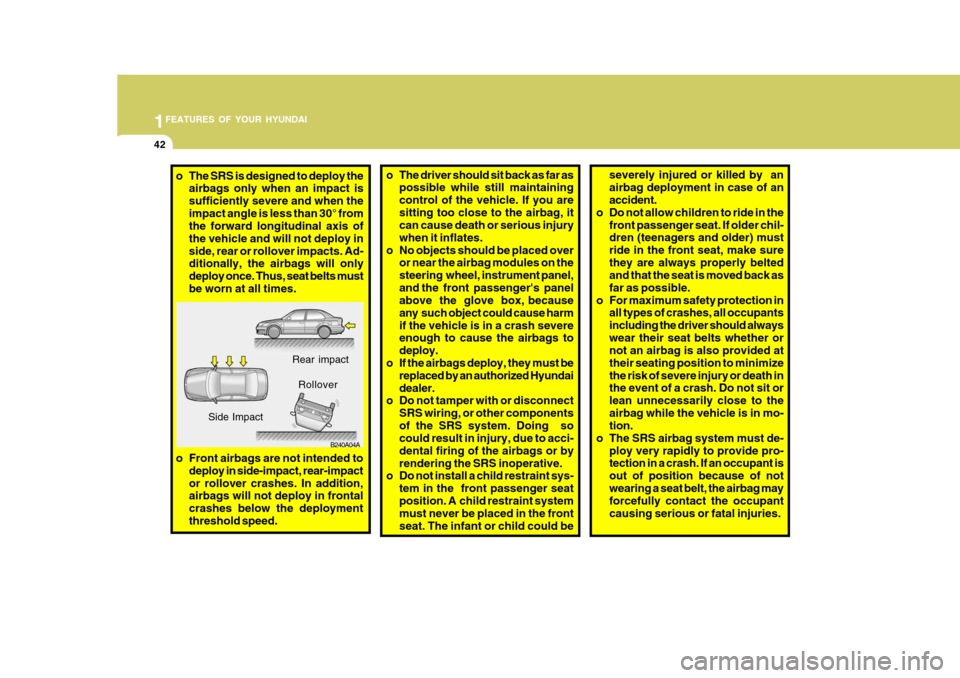
o The SRS is designed to deploy the
airbags only when an impact is sufficiently severe and when theimpact angle is less than 30° from the forward longitudinal axis of the vehicle and will not deploy inside, rear or rollover impacts. Ad- ditionally, the airbags will only deploy once. Thus, seat belts mustbe worn at all times.
o Front airbags are not intended to deploy in side-impact, rear-impactor rollover crashes. In addition, airbags will not deploy in frontal crashes below the deploymentthreshold speed.
Page 325 of 599
1
FEATURES OF YOUR HYUNDAI
43
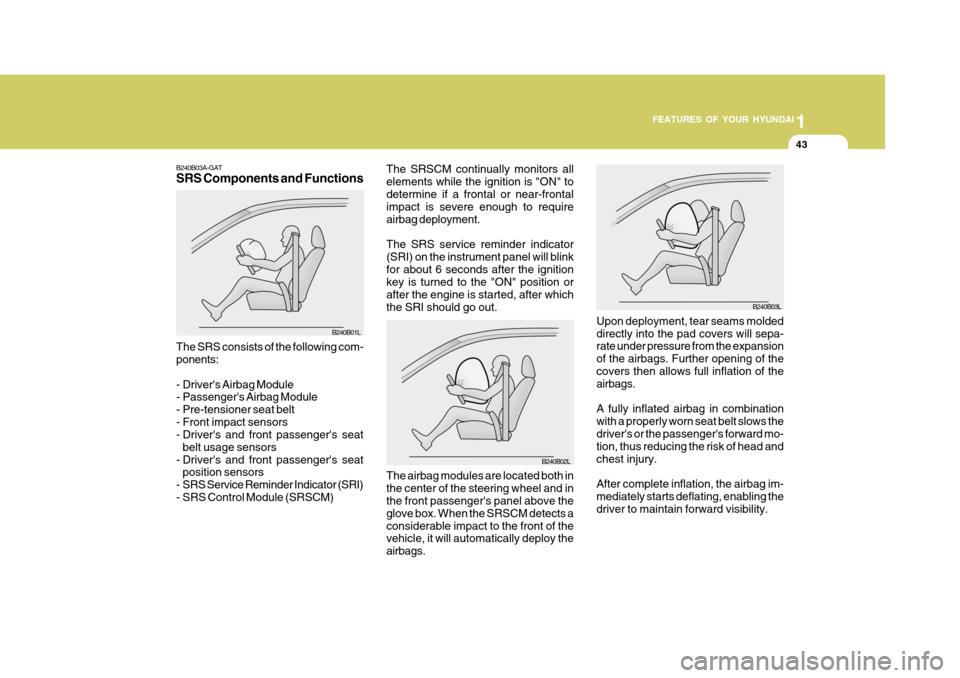
B240B03A-GAT SRS Components and Functions The SRS consists of the following com- ponents:
- Driver's Airbag Module
- Passenger's Airbag Module
- Pre-tensioner seat belt
- Front impact sensors
- Driver's and front passenger's seat belt usage sensors
- Driver's and front passenger's seat position sensors
- SRS Service Reminder Indicator (SRI)
- SRS Control Module (SRSCM)
B240B01L Upon deployment, tear seams molded directly into the pad covers will sepa- rate under pressure from the expansion of the airbags. Further opening of the covers then allows full inflation of the airbags. A fully inflated airbag in combination with a properly worn seat belt slows thedriver's or the passenger's forward mo- tion, thus reducing the risk of head and chest injury. After complete inflation, the airbag im- mediately starts deflating, enabling thedriver to maintain forward visibility.
The SRSCM continually monitors allelements while the ignition is "ON" todetermine if a frontal or near-frontal impact is severe enough to require airbag deployment. The SRS service reminder indicator (SRI) on the instrument panel will blinkfor about 6 seconds after the ignition key is turned to the "ON" position or after the engine is started, after whichthe SRI should go out. The airbag modules are located both in the center of the steering wheel and in the front passenger's panel above the glove box. When the SRSCM detects aconsiderable impact to the front of the vehicle, it will automatically deploy the airbags.
B240B02L
B240B03L
Page 327 of 599
1
FEATURES OF YOUR HYUNDAI
45SIDE IMPACT AIRBAG
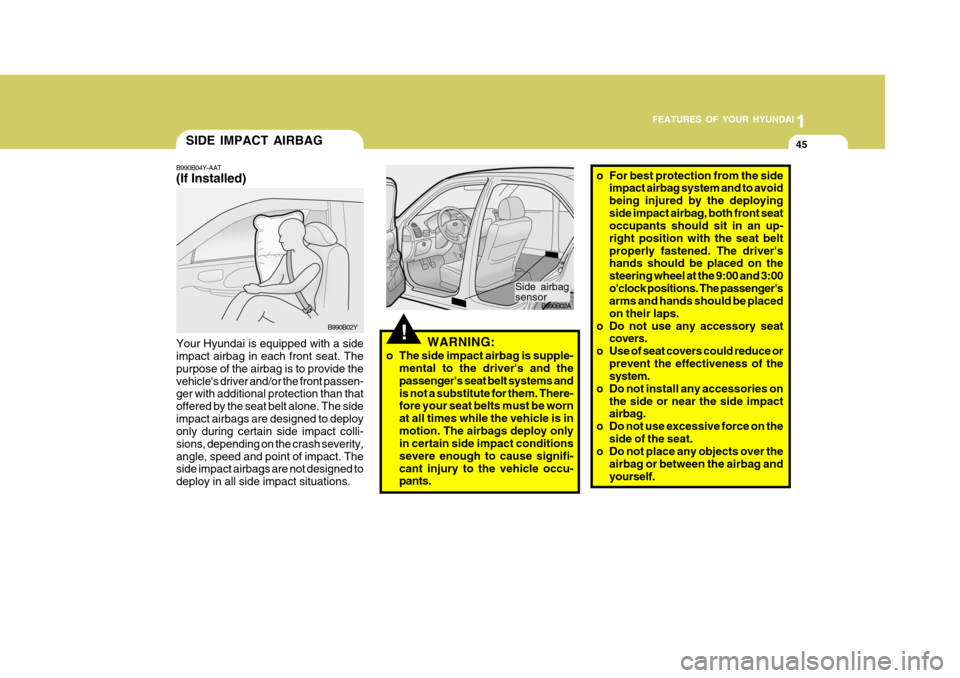
B990B04Y-AAT (If Installed) Your Hyundai is equipped with a side impact airbag in each front seat. The purpose of the airbag is to provide thevehicle's driver and/or the front passen- ger with additional protection than that offered by the seat belt alone. The sideimpact airbags are designed to deploy only during certain side impact colli- sions, depending on the crash severity,angle, speed and point of impact. The side impact airbags are not designed to deploy in all side impact situations.
B990B02Y!
o For best protection from the side impact airbag system and to avoid being injured by the deployingside impact airbag, both front seat occupants should sit in an up- right position with the seat beltproperly fastened. The driver's hands should be placed on the steering wheel at the 9:00 and 3:00o'clock positions. The passenger's arms and hands should be placed on their laps.
o Do not use any accessory seat covers.
o Use of seat covers could reduce or
prevent the effectiveness of the system.
o Do not install any accessories on
the side or near the side impactairbag.
o Do not use excessive force on the
side of the seat.
o Do not place any objects over the
airbag or between the airbag and yourself.
WARNING:
o The side impact airbag is supple- mental to the driver's and thepassenger's seat belt systems andis not a substitute for them. There- fore your seat belts must be worn at all times while the vehicle is inmotion. The airbags deploy only in certain side impact conditions severe enough to cause signifi-cant injury to the vehicle occu- pants.
B990B02A
Side airbag sensor
Page 331 of 599

1
FEATURES OF YOUR HYUNDAI
49
1. Tachometer (If Installed)
2. Turn Signal Indicator Light
3. Speedometer
4. Odometer/Trip Odometer /Trip Computer (If Installed)
5. Fuel Gauge
6. Temperature Gauge
7. SRS (Airbag) Warning Light (If Installed)
8. ABS Warning Light (If Installed)
9. Immobilizer Warning Light (If Installed)
10. Overdrive Off Indicator Light (Automatic Transaxle only) 11. High Beam Indicator Light
12. Door Ajar Warning Light
13. Parking Brake/Low Brake Fluid Level Warning Light
14. Charging System Warning Light
15. Seat Belt Warning Light (If Installed)
16. Low Oil Pressure Warning Light
17. Trip Odometer Reset Switch/
Trip Computer Reset Switch (If Installed)
18. Low Fuel Warning Light
19. Malfunction Indicator Light (MIL) (If Installed)
Page 336 of 599
1FEATURES OF YOUR HYUNDAI
54
B260J01S-GATCharging System Warning Light
The charging system warning light should come on when the ignition isturned on, then go out when the engine is running. If the light stays on while the engine is running, there is a malfunctionin the electrical charging system. If the light comes on while you are driving, stop, turn off the engine and checkunder the hood. First, make certain the generator drive belt is in place. If it is, check the tension of the belt.And then, have the system checked by your Hyundai dealer.
starts. If the light comes on at any other time, you should slow the vehicle andbring it to a complete stop in a safe location off the roadway. The brake fluid level warning light indi-cates that the brake fluid level in the brake master cylinder is low and hy- draulic brake fluid conforming to DOT 3or DOT 4 specifications should be added. After adding fluid, if no other trouble is found, the car should be immediatelyand carefully driven to a Hyundai dealer for inspection. If further trouble is expe- rienced, the vehicle should not be drivenat all but taken to a dealer by a professional towing service or some other safe method.Your Hyundai is equipped with dual- diagonal braking systems. This means you still have braking on two wheelseven if one of the dual systems should fail. With only one of the dual systems working, more than normal pedal traveland greater pedal pressure are required to stop the car. Also, the car will not stop in as short a distance with only halfof the brake system working. If the brakes fail while you are driving, shift to a lower gear for additional engine brak-ing and stop the car as soon as it is safe to do so.
CAUTION:
If the drive belt (generator belt) is loosen, broken, or mission while the vehicle is driving, there may be a serious malfunction, engine couldoverheat because this belt also drives the water pump.! B260M01A-AAT
Low Fuel Level Warning Light
The low fuel level warning light comes on when the fuel tank is approachingempty. When it comes on, you should add fuel as soon as possible. Driving with the fuel level warning light on orwith the fuel level below "E" can cause the engine to misfire and damage the catalytic converter.
B260L02HP-GAT Door Ajar Warning Light and Chime (If Installed)
The door ajar warning light warns you that a door is not completely closed and the chime warns you that the key is inthe ignition switch. NOTE : The warning chime only sounds whenever the key is in the ignition switch and the driver's side frontdoor is open simultaneously. The chime sounds until the key is re- moved from the ignition switch or the driver's side front door is closed.
Page 337 of 599

1
FEATURES OF YOUR HYUNDAI
55
B260U01TB-GAT Immobilizer Warning Light (If Installed)
This indicator light comes on for some seconds after the ignition key is turnedto the "ON" position. At this time, you can start the engine. The light goes out after the engine is running. In case thislight goes out before you start the en- gine, you must turn to the "LOCK" position and restart the engine. In casethis light blinks for five seconds when the ignition key is turned to "ON" posi- tion, this indicates that the immobilizersystem is out of order. At this time, refer to the explanation of the Limp home procedure(See page 1-6) or con-sult to the Hyundai dealer.
B260S01B-GAT Diesel Pre-heat Indicator Light-Amber(Diesel Engine)
The indicator light illuminates amber when the ignition switch is placed at the "ON" position. The engine can be startedafter the pre-heat indicator light goes off. The illuminating time varies with the water temperature, air temperature andbattery condition. NOTE: If the engine were not started within 10 seconds after the preheating is completed, turn the ignition key once more to the "LOCK" position, andthen to the "ON" position, in order to preheat again.B260N01A-AAT Malfunction Indicator Light (If installed)
This light illuminates when there is a malfunction of an exhaust gas relatedcomponent, and the system is not func- tioning properly so that the exhaust gas regulation values are not satisfied. Thislight will also illuminate when the igni- tion key is turned to the "ON" position, and then it will go out in a few seconds.If it illuminates while driving, or does not illuminate when the ignition key is turned to the "ON" position, take your car toyour nearest authorized Hyundai dealer and have the system checked.
B260E02HP-GAT Seat Belt Reminder Light and Chime (If Installed)
The seat belt reminder light blinks for 6 seconds when the ignition key is turned from the "OFF" position to "ON" or"START". If the driver's seat belt is not fastened, the warning chime will sound at the same time.
Page 339 of 599
1
FEATURES OF YOUR HYUNDAI
57
!
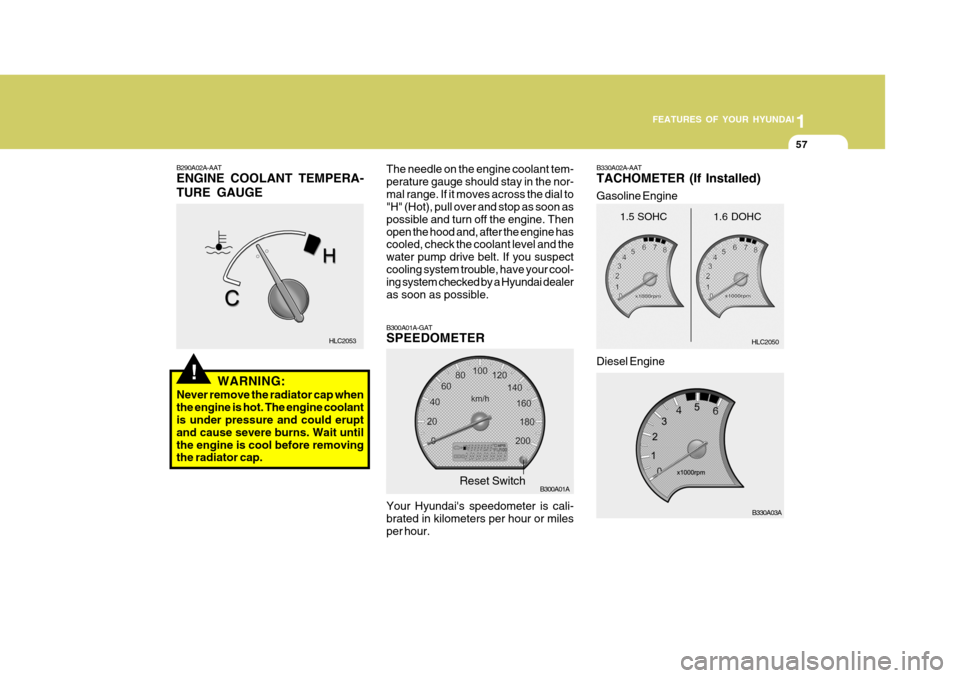
B290A02A-AAT ENGINE COOLANT TEMPERA- TURE GAUGE
WARNING:
Never remove the radiator cap when the engine is hot. The engine coolant is under pressure and could erupt and cause severe burns. Wait untilthe engine is cool before removing the radiator cap.
HLC2053 The needle on the engine coolant tem- perature gauge should stay in the nor-mal range. If it moves across the dial to "H" (Hot), pull over and stop as soon as possible and turn off the engine. Thenopen the hood and, after the engine has cooled, check the coolant level and the water pump drive belt. If you suspectcooling system trouble, have your cool- ing system checked by a Hyundai dealer as soon as possible.
B300A01A-GAT SPEEDOMETER
B300A01A
Your Hyundai's speedometer is cali- brated in kilometers per hour or miles per hour.
Reset Switch
B330A02A-AAT TACHOMETER (If Installed)
B330A03A
Diesel Engine
Gasoline Engine
HLC2050
1.5 SOHC 1.6 DOHC
Page 408 of 599
Fuel Recommendations ................................................ 1-2
Running In Your New Hyundai ..................................... 1-4
Immobilizer System ...................................................... 1-5
Door .............................................................................. 1-6Power Windows........................................................... 1-11
Seat ............................... .............................................. 1-12
Seat Belt ...................................................................... 1-18
Child Restraint System ................................................ 1-22
Supplemental Restraint (AIRBAG) System .................1-31
Instrument Cluster and Indicator Lights .......................1-38
Warning and Indicator Lights....................................... 1-42
Trip Computer .............................................................. 1-48
Multi-Function Switch .................................................. 1-51
Windscreen Wiper/Washer Switch ..............................1-52
Sunroof ........................................................................ 1-59
Mirror ........................................................................... 1-64
Bonnet Release ........................................................... 1-67
Heating and Cooling Control .......... ..............................1-72
Stereo Sound System ................................................. 1-81
Antenna ....................................................................... 1-83
CONTROLS AND EQUIPMENT
1
1