engine Hyundai Accent 2006 Owner's Manual
[x] Cancel search | Manufacturer: HYUNDAI, Model Year: 2006, Model line: Accent, Model: Hyundai Accent 2006Pages: 599, PDF Size: 17.59 MB
Page 453 of 599
1CONTROLS AND EQUIPMENT
46
!
heating cannot be readily established, the assistance of a Hyundai dealershould be sought.
WARNING:
The engine cooling system is pres-surized and removal of the radiatorcap when the engine is hot may cause hot water and steam to be ejected from the radiator resulting inburns and scalding. The radiator cap must only be removed when the en- gine has cooled. Do not add coldwater to a hot engine to avoid the possibility of engine damage. The use of plain water in the coolingsystem is not recommended since the aluminium components of the cooling system require the use of acorrosion inhibitor found in the rec- ommended Ethylene Glycol type anti freeze solutions.
INSTRUMENT CLUSTER
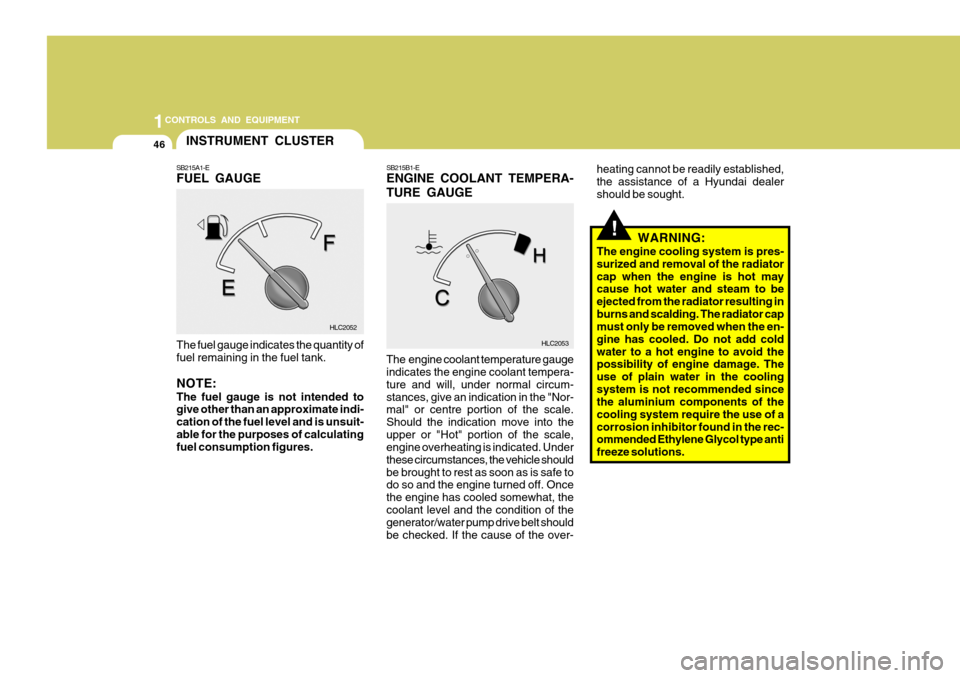
SB215B1-E ENGINE COOLANT TEMPERA- TURE GAUGE The engine coolant temperature gauge indicates the engine coolant tempera- ture and will, under normal circum-stances, give an indication in the "Nor- mal" or centre portion of the scale. Should the indication move into theupper or "Hot" portion of the scale, engine overheating is indicated. Under these circumstances, the vehicle shouldbe brought to rest as soon as is safe to do so and the engine turned off. Once the engine has cooled somewhat, thecoolant level and the condition of the generator/water pump drive belt should be checked. If the cause of the over-
The fuel gauge indicates the quantity offuel remaining in the fuel tank. NOTE: The fuel gauge is not intended to give other than an approximate indi- cation of the fuel level and is unsuit-able for the purposes of calculating fuel consumption figures.
SB215A1-E FUEL GAUGE
HLC2053
HLC2052
Page 454 of 599
47
1
CONTROLS AND EQUIPMENT
SB215C1-E SPEEDOMETER
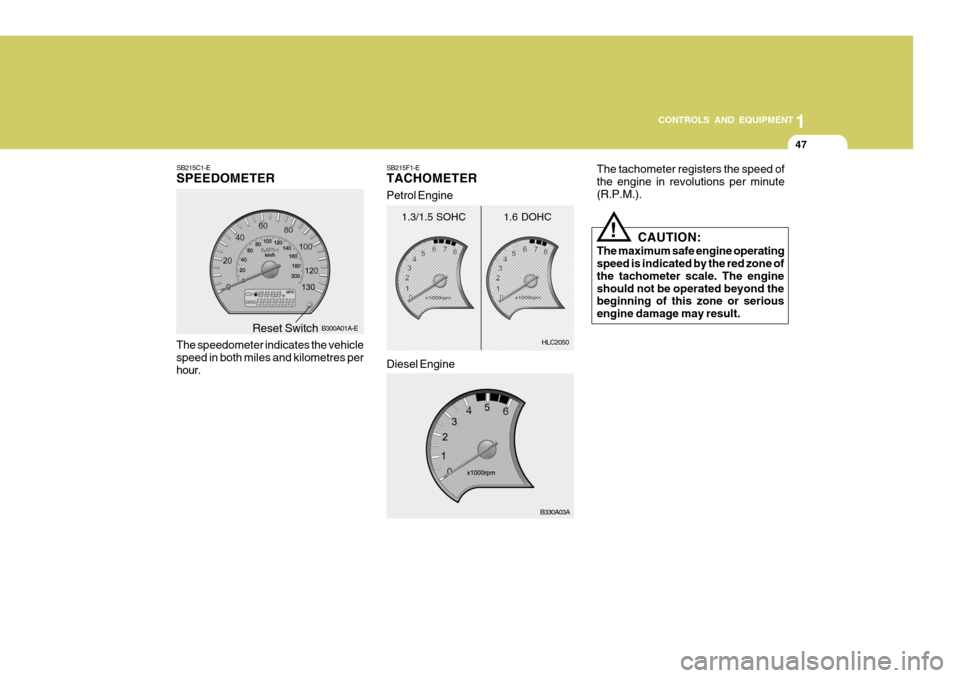
The speedometer indicates the vehicle speed in both miles and kilometres perhour. B300A01A-E
HLC2050
1.3/1.5 SOHC
B330A03A
1.6 DOHC
Diesel Engine
Petrol Engine
SB215F1-E TACHOMETER
Reset Switch The tachometer registers the speed of the engine in revolutions per minute(R.P.M.).
!
CAUTION:
The maximum safe engine operating speed is indicated by the red zone of the tachometer scale. The engineshould not be operated beyond the beginning of this zone or serious engine damage may result.
Page 459 of 599
1CONTROLS AND EQUIPMENT
52WINDSCREEN WIPER/ WASHER SWITCH
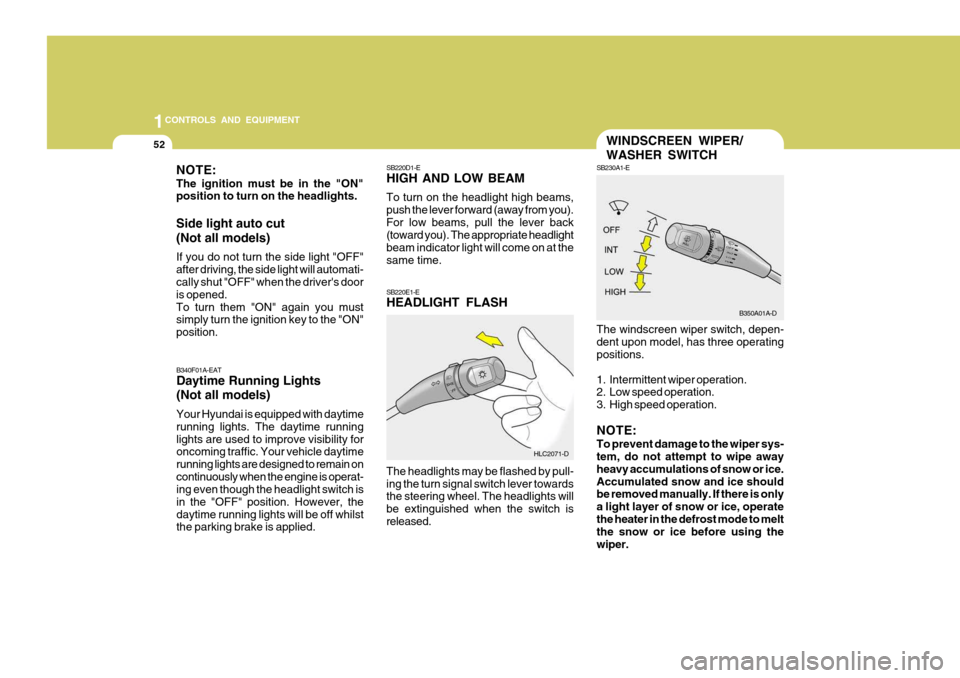
SB230A1-E The windscreen wiper switch, depen- dent upon model, has three operating positions.
1. Intermittent wiper operation.
2. Low speed operation.
3. High speed operation. NOTE: To prevent damage to the wiper sys- tem, do not attempt to wipe away heavy accumulations of snow or ice.Accumulated snow and ice should be removed manually. If there is only a light layer of snow or ice, operatethe heater in the defrost mode to melt the snow or ice before using the wiper.
NOTE: The ignition must be in the "ON" position to turn on the headlights. Side light auto cut (Not all models) If you do not turn the side light "OFF" after driving, the side light will automati- cally shut "OFF" when the driver's door is opened.To turn them "ON" again you must simply turn the ignition key to the "ON" position.
SB220D1-E HIGH AND LOW BEAM To turn on the headlight high beams, push the lever forward (away from you).For low beams, pull the lever back (toward you). The appropriate headlight beam indicator light will come on at thesame time. SB220E1-E HEADLIGHT FLASH The headlights may be flashed by pull- ing the turn signal switch lever towards the steering wheel. The headlights will be extinguished when the switch isreleased.
B340F01A-EAT Daytime Running Lights (Not all models) Your Hyundai is equipped with daytime running lights. The daytime runninglights are used to improve visibility for oncoming traffic. Your vehicle daytime running lights are designed to remain oncontinuously when the engine is operat- ing even though the headlight switch is in the "OFF" position. However, thedaytime running lights will be off whilst the parking brake is applied.
HLC2071-DB350A01A-D
Page 474 of 599
67
1
CONTROLS AND EQUIPMENT
BONNET RELEASE
CAUTION:
Make sure that the support rod has been released prior to closing the bonnet.!
B570A03A-EAT
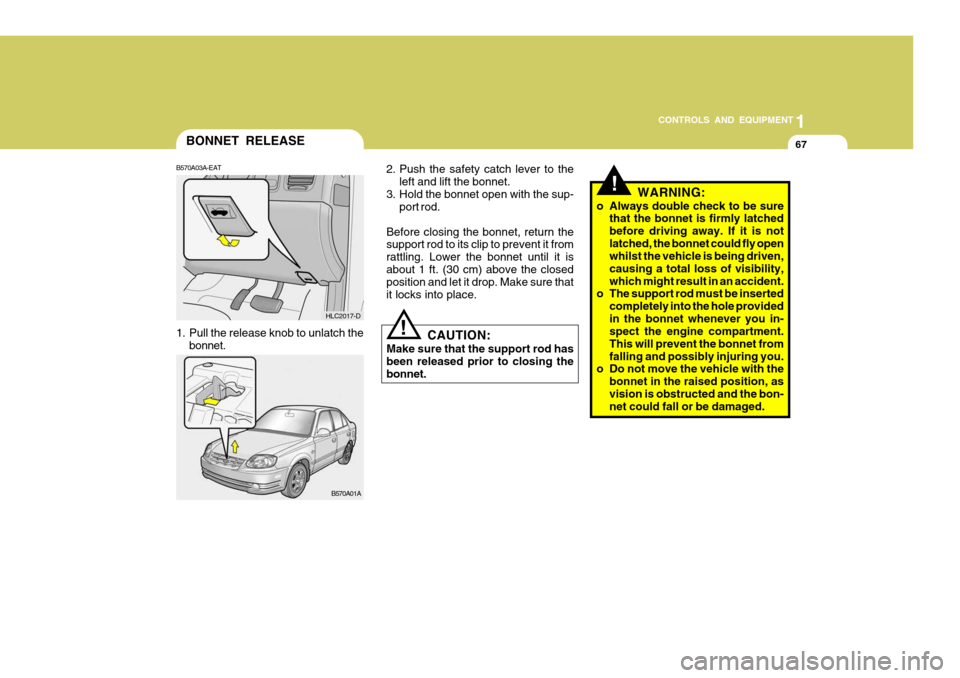
1. Pull the release knob to unlatch the
bonnet. HLC2017-D
B570A01A 2. Push the safety catch lever to the
left and lift the bonnet.
3. Hold the bonnet open with the sup- port rod.
Before closing the bonnet, return the support rod to its clip to prevent it from rattling. Lower the bonnet until it isabout 1 ft. (30 cm) above the closed position and let it drop. Make sure that it locks into place.
!WARNING:
o Always double check to be sure that the bonnet is firmly latched before driving away. If it is notlatched, the bonnet could fly open whilst the vehicle is being driven, causing a total loss of visibility,which might result in an accident.
o The support rod must be inserted
completely into the hole providedin the bonnet whenever you in- spect the engine compartment. This will prevent the bonnet fromfalling and possibly injuring you.
o Do not move the vehicle with the
bonnet in the raised position, asvision is obstructed and the bon- net could fall or be damaged.
Page 475 of 599
1CONTROLS AND EQUIPMENT
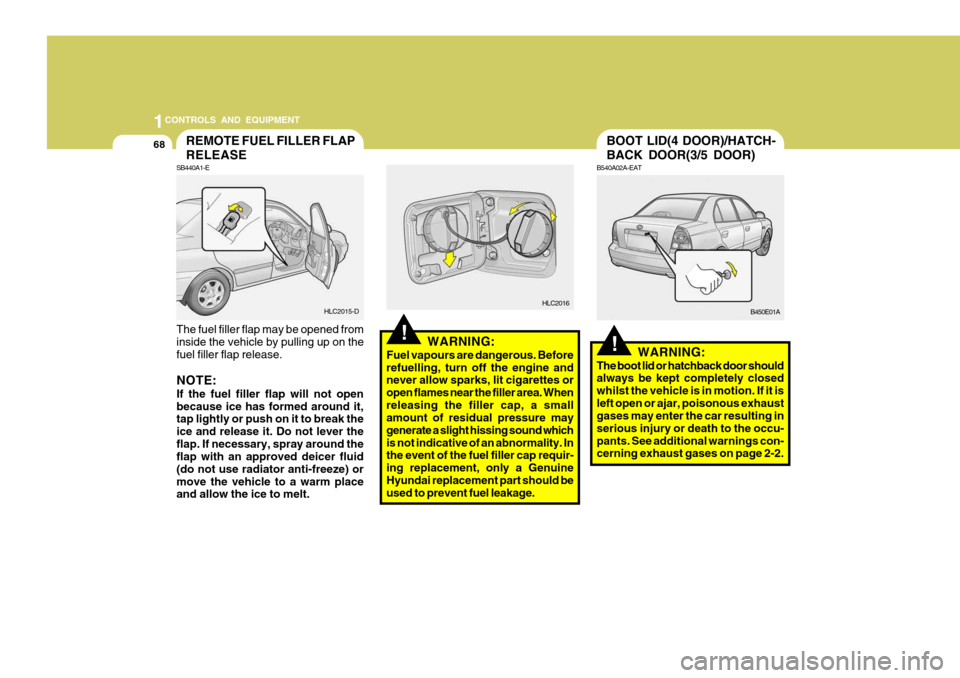
68BOOT LID(4 DOOR)/HATCH- BACK DOOR(3/5 DOOR)
!
B540A02A-EAT
B450E01A
WARNING:
The boot lid or hatchback door should always be kept completely closed whilst the vehicle is in motion. If it isleft open or ajar, poisonous exhaust gases may enter the car resulting in serious injury or death to the occu-pants. See additional warnings con- cerning exhaust gases on page 2-2.
REMOTE FUEL FILLER FLAP RELEASE
!WARNING:
Fuel vapours are dangerous. Before refuelling, turn off the engine and never allow sparks, lit cigarettes or open flames near the filler area. Whenreleasing the filler cap, a small amount of residual pressure may generate a slight hissing sound which
is not indicative of an abnormality. In the event of the fuel filler cap requir- ing replacement, only a GenuineHyundai replacement part should be used to prevent fuel leakage.
SB440A1-E
The fuel filler flap may be opened from inside the vehicle by pulling up on the fuel filler flap release. NOTE: If the fuel filler flap will not open because ice has formed around it, tap lightly or push on it to break the ice and release it. Do not lever theflap. If necessary, spray around the flap with an approved deicer fluid (do not use radiator anti-freeze) ormove the vehicle to a warm place and allow the ice to melt. HLC2016
HLC2015-D
Page 487 of 599
1CONTROLS AND EQUIPMENT
80POLLEN FILTER
B740D01A-AAT Operation Tips
o If the interior of the car is hot when you first get in, open the windows for a few minutes to expel the hot air.
o When you are using the air condi-
tioning system, keep all windowsclosed to keep hot air out.
o When moving slowly, as in heavy
traffic, shift to a lower gear. Thisincreases engine speed, which in turn increases the speed of the air conditioning compressor.
o On steep grades, turn the air condi- tioning off to avoid the possibility ofthe engine over-heating.
o During winter months or in periods when the air conditioning is not usedregularly, run the air conditioningonce every month for a few min- utes. This will help circulate the lubricants and keep your system inpeak operating condition.
!
B760A01Y
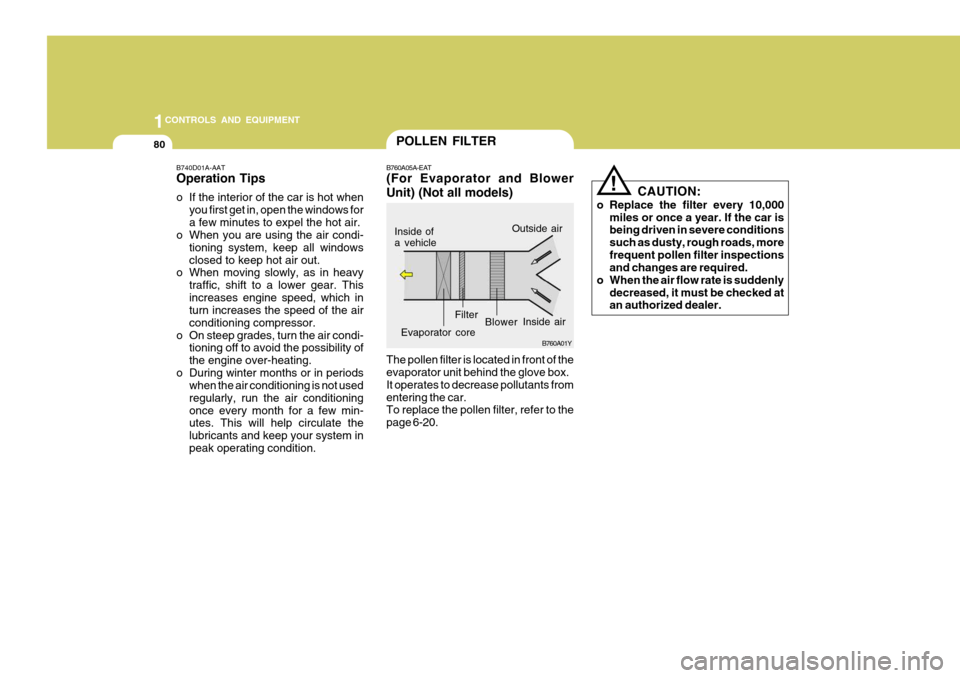
The pollen filter is located in front of the evaporator unit behind the glove box. It operates to decrease pollutants fromentering the car. To replace the pollen filter, refer to the page 6-20.
B760A05A-EAT
(For Evaporator and Blower Unit) (Not all models)
Inside of a vehicle
Evaporator core Filter
Blower Inside air CAUTION:
o Replace the filter every 10,000 miles or once a year. If the car is being driven in severe conditions such as dusty, rough roads, morefrequent pollen filter inspections and changes are required.
o When the air flow rate is suddenly
decreased, it must be checked atan authorized dealer.
Outside air
Page 488 of 599
81
1
CONTROLS AND EQUIPMENT
STEREO SOUND SYSTEM
Ionosphere
B750A02L
AM reception
Mountains
Buildings Unobstructed
area
FM radio station
B750A03L
Ionosphere
FM reception
B750A01L Obstructed area
Iron bridges
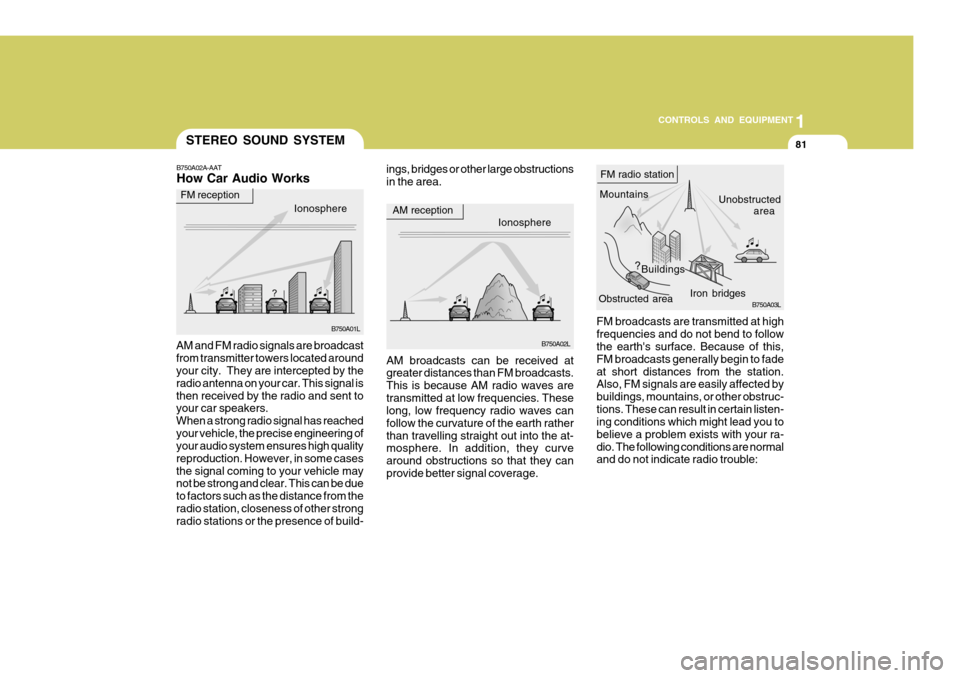
FM broadcasts are transmitted at high frequencies and do not bend to follow the earth's surface. Because of this, FM broadcasts generally begin to fadeat short distances from the station. Also, FM signals are easily affected by buildings, mountains, or other obstruc-tions. These can result in certain listen- ing conditions which might lead you to believe a problem exists with your ra-dio. The following conditions are normal and do not indicate radio trouble:
AM broadcasts can be received atgreater distances than FM broadcasts. This is because AM radio waves aretransmitted at low frequencies. These long, low frequency radio waves can follow the curvature of the earth ratherthan travelling straight out into the at- mosphere. In addition, they curve around obstructions so that they canprovide better signal coverage.
B750A02A-AAT How Car Audio Works
AM and FM radio signals are broadcast from transmitter towers located around your city. They are intercepted by the radio antenna on your car. This signal isthen received by the radio and sent to your car speakers. When a strong radio signal has reachedyour vehicle, the precise engineering of your audio system ensures high quality reproduction. However, in some casesthe signal coming to your vehicle may not be strong and clear. This can be due to factors such as the distance from theradio station, closeness of other strong radio stations or the presence of build- ings, bridges or other large obstructions in the area.
Page 491 of 599
2
Before Starting the Engine ........................................... 2-3
Key Positions ................................................................ 2-4Starting......................................................................... 2-5
Manual Transaxle ......................................................... 2-8
Automatic Transaxle .................................................. 2-10
Effective Braking ........................................................ 2-14
Anti-Lock Brake System (ABS) .................................. 2-15
Driving for Economy ................................................... 2-16
Smooth Cornering ...................................................... 2-17
Winter Motoring .......................................................... 2-17
Trailer and Caravan Towing ....................................... 2-19
DRIVING YOUR HYUNDAI
2
Page 492 of 599
2DRIVING YOUR HYUNDAI
2
!
SC020A1-E
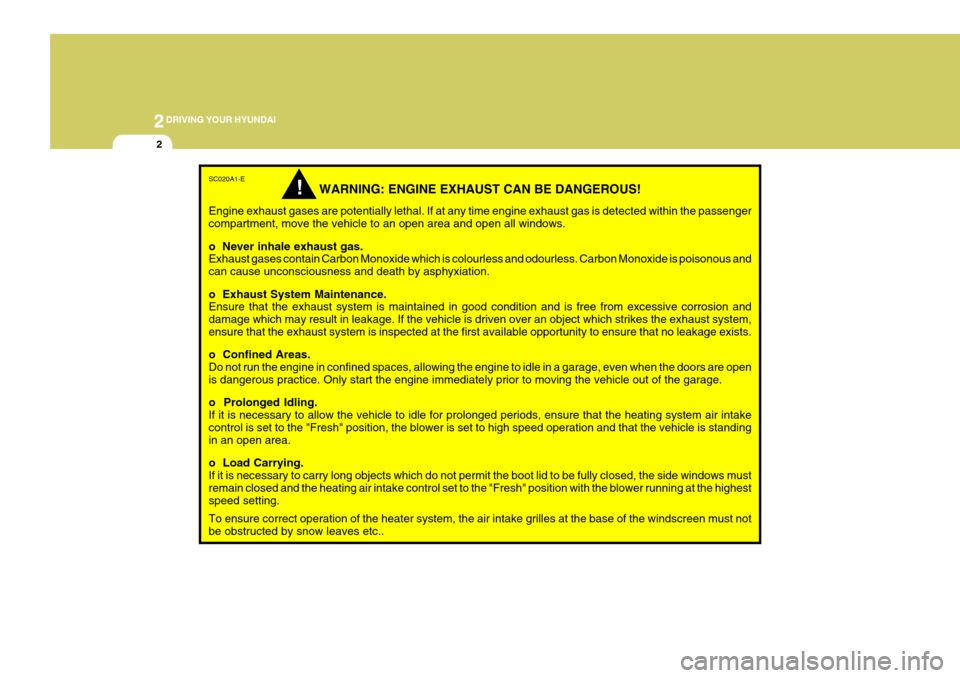
WARNING: ENGINE EXHAUST CAN BE DANGEROUS!
Engine exhaust gases are potentially lethal. If at any time engine exhaust gas is detected within the passenger compartment, move the vehicle to an open area and open all windows. o Never inhale exhaust gas. Exhaust gases contain Carbon Monoxide which is colourless and odourless. Carbon Monoxide is poisonous and can cause unconsciousness and death by asphyxiation. o Exhaust System Maintenance. Ensure that the exhaust system is maintained in good condition and is free from excessive corrosion and damage which may result in leakage. If the vehicle is driven over an object which strikes the exhaust system,ensure that the exhaust system is inspected at the first available opportunity to ensure that no leakage exists. o Confined Areas. Do not run the engine in confined spaces, allowing the engine to idle in a garage, even when the doors are openis dangerous practice. Only start the engine immediately prior to moving the vehicle out of the garage. o Prolonged Idling. If it is necessary to allow the vehicle to idle for prolonged periods, ensure that the heating system air intakecontrol is set to the "Fresh" position, the blower is set to high speed operation and that the vehicle is standing in an open area. o Load Carrying. If it is necessary to carry long objects which do not permit the boot lid to be fully closed, the side windows must remain closed and the heating air intake control set to the "Fresh" position with the blower running at the highest speed setting. To ensure correct operation of the heater system, the air intake grilles at the base of the windscreen must not be obstructed by snow leaves etc..
Page 493 of 599
2
DRIVING YOUR HYUNDAI
3TO START THE ENGINEBEFORE STARTING THE ENGINE
!
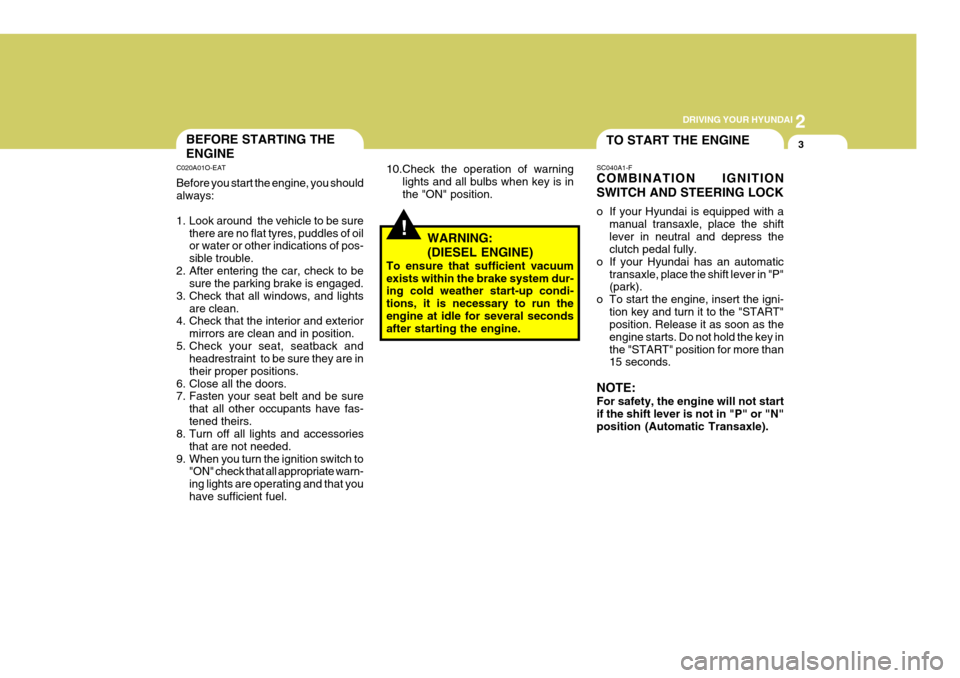
C020A01O-EAT Before you start the engine, you should always:
1. Look around the vehicle to be sure
there are no flat tyres, puddles of oil or water or other indications of pos- sible trouble.
2. After entering the car, check to be sure the parking brake is engaged.
3. Check that all windows, and lights are clean.
4. Check that the interior and exterior
mirrors are clean and in position.
5. Check your seat, seatback and headrestraint to be sure they are intheir proper positions.
6. Close all the doors.
7. Fasten your seat belt and be sure
that all other occupants have fas- tened theirs.
8. Turn off all lights and accessories
that are not needed.
9. When you turn the ignition switch to "ON" check that all appropriate warn-ing lights are operating and that youhave sufficient fuel. 10.Check the operation of warning
lights and all bulbs when key is inthe "ON" position.
WARNING: (DIESEL ENGINE)
To ensure that sufficient vacuum exists within the brake system dur- ing cold weather start-up condi- tions, it is necessary to run theengine at idle for several seconds after starting the engine. SC040A1-F COMBINATION IGNITION SWITCH AND STEERING LOCK
o If your Hyundai is equipped with a
manual transaxle, place the shift lever in neutral and depress the clutch pedal fully.
o If your Hyundai has an automatic
transaxle, place the shift lever in "P"(park).
o To start the engine, insert the igni- tion key and turn it to the "START"position. Release it as soon as the engine starts. Do not hold the key inthe "START" position for more than 15 seconds.
NOTE: For safety, the engine will not start if the shift lever is not in "P" or "N" position (Automatic Transaxle).