engine Hyundai Accent 2006 Owner's Manual
[x] Cancel search | Manufacturer: HYUNDAI, Model Year: 2006, Model line: Accent, Model: Hyundai Accent 2006Pages: 599, PDF Size: 17.59 MB
Page 583 of 599

7EMISSION CONTROL SYSTEMS
2EMISSION CONTROL SYSTEMS
SH010A1-E (Not all models) Depending upon the market for which the vehicle is destined, the emission control system will comprise one or more of the following emission con-trol devices.
1) Crankcase emission control sys-
tem
2) Evaporative emission control sys-
tem
3) Exhaust emission control system In order that the proper functioning of the emission control systems may be ensured, it is recommended that thevehicle is inspected and maintained by an authorized Hyundai dealer in accordance with the maintenanceschedule in this manual. SH010B1-E
1. Crankcase Emission
Control System
The positive crankcase ventilation
system is employed to prevent air pollution caused by blow-by gases being emitted from the crankcase byintroducing fresh air to the crankcase through the air cleaner where this mixes with blow-by gases and thenpasses through the PCV valve into the intake manifold from where it sub- sequently enters the combustionchamber and is burned.
SH010C1-E
2. Evaporative Emission
Control System
The Evaporative Emission Control
System is designed to prevent fuel vapours from escaping into the atmo- sphere through the fuel tank ventila-tion system. Canister
Fuel vapours generated inside the
fuel tank are absorbed and stored ina charcoal canister. When the engineis started, the vapours stored in the canister are drawn into the induction system through the purge control so-lenoid valve and are subsequently burned. Purge Control Solenoid Valve
The purge control solenoid valve is
controlled by the ECU; when the en- gine coolant temperature is low or the engine is idling, the purge control valve is closed and fuel vapours re- main stored in the canister. Undernormal running conditions when the engine is warm, the valve opens and the vapours are drawn into the inlettract and subsequently burned in the combustion chamber.
Page 584 of 599
7
EMISSION CONTROL SYSTEMS
3
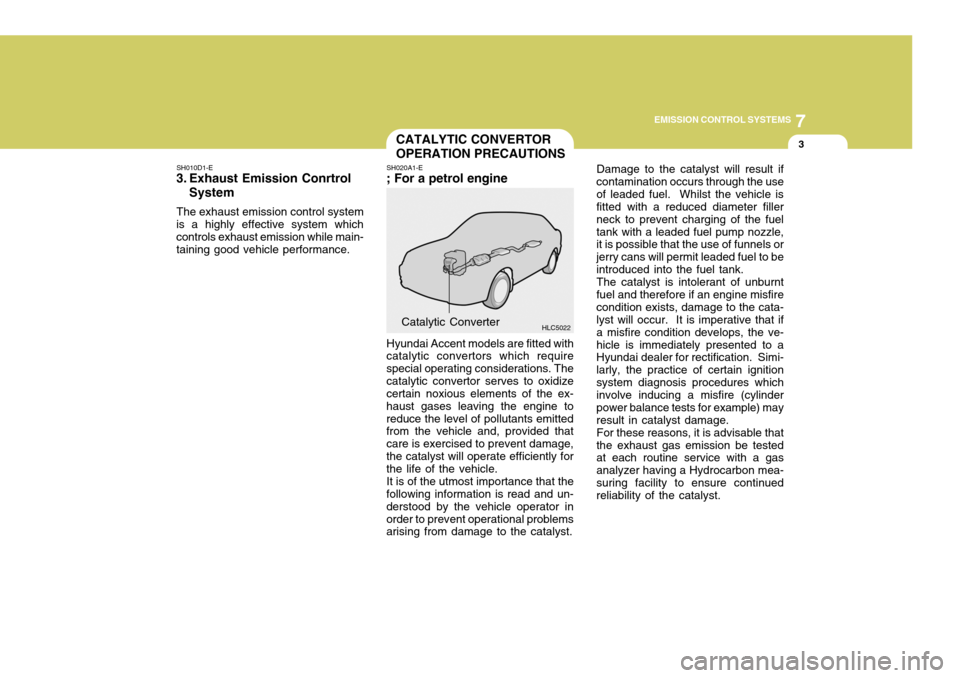
HLC5022Catalytic Converter
CATALYTIC CONVERTOR OPERATION PRECAUTIONS
SH010D1-E
3. Exhaust Emission Conrtrol
System
The exhaust emission control system
is a highly effective system which controls exhaust emission while main- taining good vehicle performance. SH020A1-E
; For a petrol engine
Hyundai Accent models are fitted with
catalytic convertors which requirespecial operating considerations. Thecatalytic convertor serves to oxidize certain noxious elements of the ex- haust gases leaving the engine toreduce the level of pollutants emitted from the vehicle and, provided that care is exercised to prevent damage,the catalyst will operate efficiently for the life of the vehicle.
It is of the utmost importance that the
following information is read and un- derstood by the vehicle operator inorder to prevent operational problems arising from damage to the catalyst. Damage to the catalyst will result if
contamination occurs through the use of leaded fuel. Whilst the vehicle is fitted with a reduced diameter filler neck to prevent charging of the fueltank with a leaded fuel pump nozzle, it is possible that the use of funnels or jerry cans will permit leaded fuel to beintroduced into the fuel tank. The catalyst is intolerant of unburnt
fuel and therefore if an engine misfirecondition exists, damage to the cata- lyst will occur. It is imperative that if a misfire condition develops, the ve-hicle is immediately presented to a Hyundai dealer for rectification. Simi- larly, the practice of certain ignitionsystem diagnosis procedures which involve inducing a misfire (cylinder power balance tests for example) mayresult in catalyst damage. For these reasons, it is advisable that
the exhaust gas emission be tested at each routine service with a gas analyzer having a Hydrocarbon mea-suring facility to ensure continued reliability of the catalyst.
Page 585 of 599

7EMISSION CONTROL SYSTEMS
4EGR SYSTEM
H020D01S-GAT
; For a diesel engine
All Hyundai vehicles are equipped with oxidation type catalytic converter to reduce the carbon monoxide, hy- drocarbons and particulate containedin the exhaust gas.
H020C01S-GAT
; For a diesel engine
This system helps control oxides ofnitrogen by recirculating a part of theexhaust gas into the engine.
Care must also be exercised to avoiddriving over road hazards or debriswhich may cause damage to the cata- lyst element.
Push or tow starting of the vehicle is to be avoided since unburnt fuel maybe enter the catalyst and result in damage. (Note, it is impossible to push or tow start a Hyundai modelequipped with fuel injection since the fuel pump safety interlock will prevent the pump from operating under theseconditions).Operation of the catalyst involvesextremely high temperatures beingattained within the catalytic conver- tor, and although the convertor is fitted with heat shields, it is importantthat the vehicle is not parked over combustible or volatile material which may result in fire.If the above precautions are not ad-hered to and the catalyst becomesinoperative, the resultant increase in core temperature will result in a "melt down" where the catalyst core willmelt and subsequently may block the exhaust system. Due to the fragile nature of the cata- lyst element, it is important that dam- age does not occur when the vehicle is raised by means of a garage jack.
Page 586 of 599
Vehicle Identification Number (VIN) .............................. 8-2
Engine Number ............................................................. 8-2
Tyre Information ............................................................ 8-3
Tyre Pressures ............................................................. 8-3
Snow Tyres .................................................................. 8-3
Tyre Chains .................................................................. 8-4
Tyre Rotation ................................................................ 8-4
Tyre Balancing .............................................................. 8-4
Tyre Replacement ........................................................ 8-5
Wheel Replacement ..................................................... 8-5
Spare Tyre and Tools ................................................... 8-5
8
CONSUMER INFORMATION
8
Page 587 of 599
8CONSUMER INFORMATION
2ENGINE NUMBERVEHICLE IDENTIFICATION NUMBER (VIN)
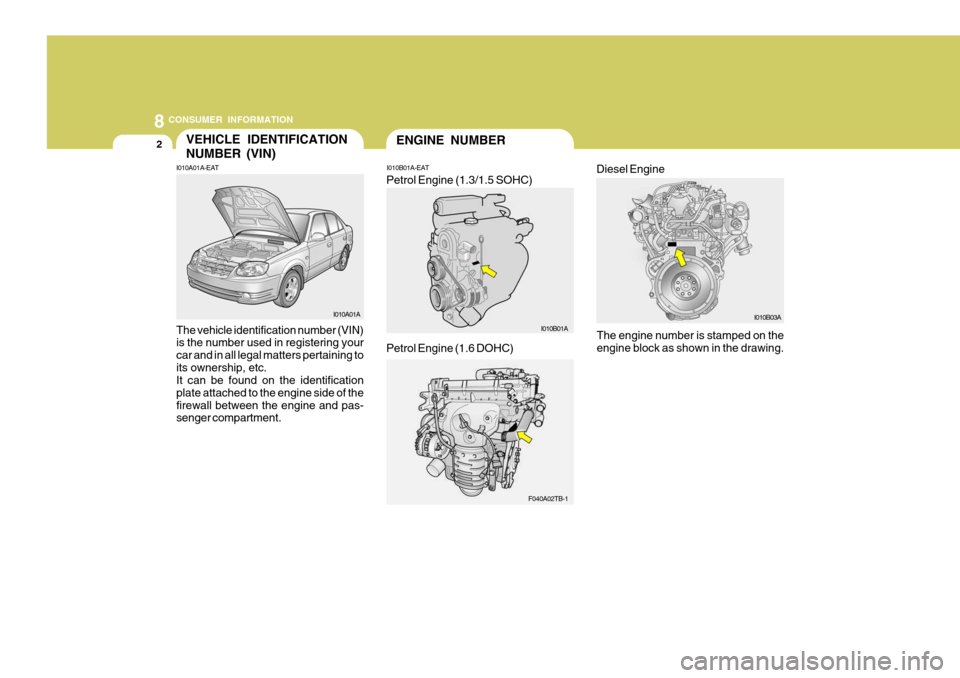
I010A01A-EAT The vehicle identification number (VIN) is the number used in registering your car and in all legal matters pertaining toits ownership, etc. It can be found on the identification plate attached to the engine side of thefirewall between the engine and pas- senger compartment. I010B01A-EAT
The engine number is stamped on the engine block as shown in the drawing.
Petrol Engine (1.3/1.5 SOHC) Petrol Engine (1.6 DOHC) Diesel Engine
I010A01A I010B01A
F040A02TB-1 I010B03A
Page 591 of 599
9
VEHICLE SPECIFICATIONS
Measurement ................................................................ 9-2
Engine ........................................................................... 9-3
Lubrication Chart .......................................................... 9-4
9
Page 593 of 599

9
VEHICLE SPECIFICATIONS
3ENGINE
1.3 MPI
71.5 x 83.5 1,341
800 ± 100
BTDC 10° ± 5° 1.5 MPI
75.5 x 83.5 1,495
4-Cylinder in-line SOHC DIESEL
1.5 TCI
3-Cylinder in-line SOHC
83 x 92
1,4931-3-2
- - -
800 ± 100
Auto control
1.6 MPI
76.5 x 87 1,599
Engine TypeBore x StrokeDisplacement (cc) Firing order/Injection order Spark plug Spark plug gap Idle speed (RPM) Ignition timing (Base)/Injection timing
J070A03A-EAT
ITEMS
4-Cylinder in-line DOHC
PETROL
1-3-4-2
NGK:BKR5ES-11
CHAMPION:RC10YC4
0.039 ~ 0.043 in. (1.0 ~ 1.1 mm)
Page 594 of 599

9VEHICLE SPECIFICATIONS
4
Oil & Grease Standard
API SJ, SL or ABOVE SAE 5W-20, 5W-30
ILSAC GF-3 or ABOVE SAE 10W-30 (ABOVE -18°C) SAE 15W-40 (ABOVE -13°C) SAE 20W-50 (ABOVE -7°C)
API CF-4 SAE 30 [32°F ~ 104°F(0°C ~ 40°C)]
or ABOVE, SAE 20W-40 [ABOVE 14°F(-10°C)]
ACEA B4 SAE 15W-40 [ABOVE 5°F(-15°C)]
or ABOVE SAE 10W-30 [-4°F ~ 104°F(-20°C ~ 40°C)] SAE 5W-30 [-13°F ~ 50°F(-25°C ~ 10°C)] SAE 0W-30 [BELOW 50°F(10°C)] *1, *2
*1. Restricted to driving condition and vehicle destination*2. Not recommended for sustained high speed vehicle operationNormal driving condition Severe driving condition HYUNDAI GENUINE PARTS MTF 75W/85 (API GL-4)Hyundai Genuine ATF S III, Diamond ATF SP III or other brands approved by Hyundai Motor Co. PSF-3 or Dexron 2DOT 3, DOT 4 or equivalent Ethylene glycol base for aluminium radiatorLUBRICATION CHART
Manual T/A Automatic T/AItem
Engine Oil Petrol Diesel
Engine Oil Consumption Transaxle Power Steering
Brake Fluid Coolant
J080A09A-EAT
Q'ty (Imp.qts)(Litre)
Drain and refill (with oil filter) : 2.9(3.3) Drain and refill (with oil filter) : 4.2(4.8) MAX. 1L / 1,500 Km MAX. 1L / 1,000 Km 1.86(2.15) 5.3(6.1) (Petrol Engine only) As required As required1.3/1.5L:4.8, 1.6L:5.2 Diesel:4.7 1.3/1.5L:5.2, 1.6L:4.8
Manual Automatic
Page 597 of 599

10
INDEX
3
Driving Economical driving ................................................. 2-16
Smooth cornering ................................................... 2-17
Winter motoring ...................................................... 2-17
E Emission Control Syst em ........................................... 7-2
Engine Before starting the engine ....................................... 2-3
Compartment ........................................................... 6-2
Coolant ..................................................................... 6-9
Coolant temperature gauge ................................... 1-46
If the engine overheats ............................................ 3-5
Number .................................................................... 8-2
Oil ............................................................................. 6-5
Starting ..................................................................... 2-5
Engine Exhaust Can Be Dangerous ........................... 2-2
FFog Light Front ....................................................................... 1-56
Rear ....................................................................... 1-56
Front Seats
Head restraint adjustment...................................... 1-14
Lumbar support adjustment ................................... 1-14
Seat cushion height adjustment............................ 1-15
Seat rake adj ustment............................................. 1-13
Seat recline adjustment .............. ...........................1-13Fuel
Capacity ................................................................... 9-2
Gauge .................................................................... 1-46
Recommendations ................................................... 1-2
Fuel Filler Lid
Remote release ...................................................... 1-68
Fuses ........................................................................ 6-24
Fuse Panel description ............................................. 6-37
G Glove Box ................................................................. 1-63
H Hazard Warning System ........................................... 1-55
Headlight Aiming Adjustment ....................................6-28
Headlight Leveling Device Syst em ...........................1-54
Heated Rear Window ................................................ 1-55
Heating and Cooling Control ..................................... 1-72
Heating and Ventilation ............................................. 1-73
Air flow control ....................................................... 1-74
Air intake control .................................................... 1-73
Bi-level heating ....................................................... 1-77
Defrost/Defogging .................................................. 1-77
Fan speed control .................................................. 1-73
Temperature control ............................................... 1-76
High-Mounted Rear Stop light.................................... 1-66
Horn .......................................................................... 1-71