stop start Hyundai Atos 2002 User Guide
[x] Cancel search | Manufacturer: HYUNDAI, Model Year: 2002, Model line: Atos, Model: Hyundai Atos 2002Pages: 249, PDF Size: 3.11 MB
Page 79 of 249
WHAT TO DO IN AN EMERGENCY
WHAT TO DO IN AN EMERGENCY WHAT TO DO IN AN EMERGENCY
WHAT TO DO IN AN EMERGENCY
WHAT TO DO IN AN EMERGENCY
3-2 2. Turn off all unnecessary lights and acces-
sories in both vehicles.
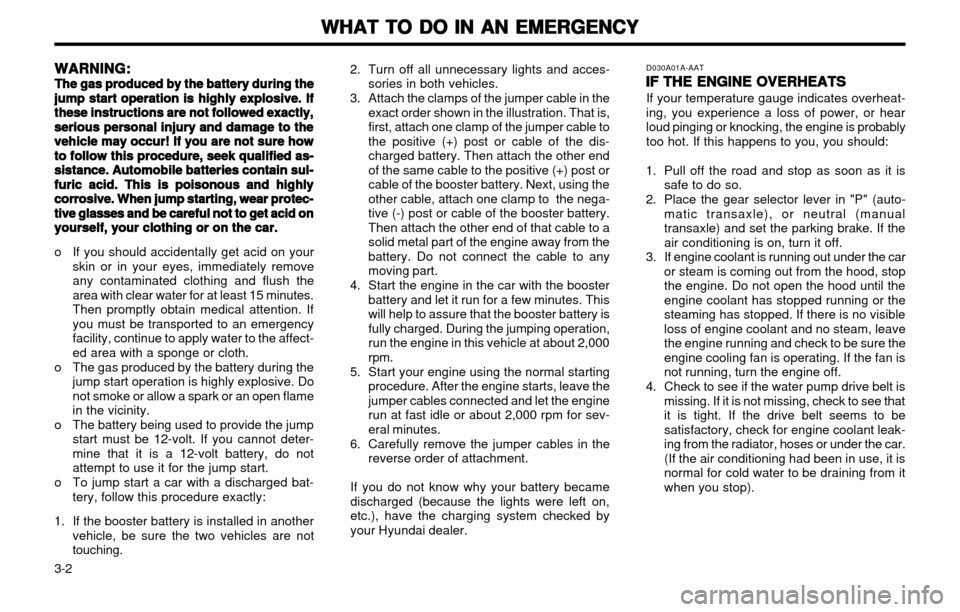
3. Attach the clamps of the jumper cable in the exact order shown in the illustration. That is, first, attach one clamp of the jumper cable tothe positive (+) post or cable of the dis-charged battery. Then attach the other endof the same cable to the positive (+) post orcable of the booster battery. Next, using theother cable, attach one clamp to the nega-tive (-) post or cable of the booster battery.Then attach the other end of that cable to asolid metal part of the engine away from thebattery. Do not connect the cable to anymoving part.
4. Start the engine in the car with the booster battery and let it run for a few minutes. Thiswill help to assure that the booster battery isfully charged. During the jumping operation,run the engine in this vehicle at about 2,000rpm.
5. Start your engine using the normal starting procedure. After the engine starts, leave thejumper cables connected and let the enginerun at fast idle or about 2,000 rpm for sev-eral minutes.
6. Carefully remove the jumper cables in the reverse order of attachment.
If you do not know why your battery becamedischarged (because the lights were left on,etc.), have the charging system checked byyour Hyundai dealer.
WARNING:
WARNING: WARNING:
WARNING:
WARNING:
The gas produced by the battery during the
The gas produced by the battery during the The gas produced by the battery during the
The gas produced by the battery during the
The gas produced by the battery during the jump start operation is highly explosive. If
jump start operation is highly explosive. If jump start operation is highly explosive. If
jump start operation is highly explosive. If
jump start operation is highly explosive. If
these instructions are not followed exactly,
these instructions are not followed exactly, these instructions are not followed exactly,
these instructions are not followed exactly,
these instructions are not followed exactly,
serious personal injury and damage to the
serious personal injury and damage to the serious personal injury and damage to the
serious personal injury and damage to the
serious personal injury and damage to the
vehicle may occur! If you are not sure how
vehicle may occur! If you are not sure how vehicle may occur! If you are not sure how
vehicle may occur! If you are not sure how
vehicle may occur! If you are not sure how
to follow this procedure, seek qualified as-
to follow this procedure, seek qualified as- to follow this procedure, seek qualified as-
to follow this procedure, seek qualified as-
to follow this procedure, seek qualified as-
sistance. Automobile batteries contain sul-
sistance. Automobile batteries contain sul- sistance. Automobile batteries contain sul-
sistance. Automobile batteries contain sul-
sistance. Automobile batteries contain sul-
furic acid. This is poisonous and highly
furic acid. This is poisonous and highly furic acid. This is poisonous and highly
furic acid. This is poisonous and highly
furic acid. This is poisonous and highly
corrosive. When jump starting, wear protec-
corrosive. When jump starting, wear protec- corrosive. When jump starting, wear protec-
corrosive. When jump starting, wear protec-
corrosive. When jump starting, wear protec-
tive glasses and be careful not to get acid on
tive glasses and be careful not to get acid on tive glasses and be careful not to get acid on
tive glasses and be careful not to get acid on
tive glasses and be careful not to get acid on
yourself, your clothing or on the car.
yourself, your clothing or on the car. yourself, your clothing or on the car.
yourself, your clothing or on the car.
yourself, your clothing or on the car.
o If you should accidentally get acid on your
skin or in your eyes, immediately remove any contaminated clothing and flush thearea with clear water for at least 15 minutes.Then promptly obtain medical attention. Ifyou must be transported to an emergencyfacility, continue to apply water to the affect-ed area with a sponge or cloth.
o The gas produced by the battery during the jump start operation is highly explosive. Donot smoke or allow a spark or an open flamein the vicinity.
o The battery being used to provide the jump start must be 12-volt. If you cannot deter-mine that it is a 12-volt battery, do notattempt to use it for the jump start.
o To jump start a car with a discharged bat- tery, follow this procedure exactly:
1. If the booster battery is installed in another vehicle, be sure the two vehicles are nottouching. D030A01A-AAT
IF THE ENGINE OVERHEATS
IF THE ENGINE OVERHEATS IF THE ENGINE OVERHEATS
IF THE ENGINE OVERHEATS
IF THE ENGINE OVERHEATS
If your temperature gauge indicates overheat-ing, you experience a loss of power, or hearloud pinging or knocking, the engine is probablytoo hot. If this happens to you, you should:
1. Pull off the road and stop as soon as it is safe to do so.
2. Place the gear selector lever in "P" (auto- matic transaxle), or neutral (manual
transaxle) and set the parking brake. If theair conditioning is on, turn it off.
3. If engine coolant is running out under the car or steam is coming out from the hood, stopthe engine. Do not open the hood until theengine coolant has stopped running or thesteaming has stopped. If there is no visibleloss of engine coolant and no steam, leavethe engine running and check to be sure theengine cooling fan is operating. If the fan isnot running, turn the engine off.
4. Check to see if the water pump drive belt is missing. If it is not missing, check to see thatit is tight. If the drive belt seems to besatisfactory, check for engine coolant leak-ing from the radiator, hoses or under the car.(If the air conditioning had been in use, it isnormal for cold water to be draining from itwhen you stop).
Page 95 of 249
VEHICLE MAINTENANCE REQUIREMENTS
VEHICLE MAINTENANCE REQUIREMENTS VEHICLE MAINTENANCE REQUIREMENTS
VEHICLE MAINTENANCE REQUIREMENTS
VEHICLE MAINTENANCE REQUIREMENTS
5- 6 F070B01A-GAT
oo
oo
o Cooling System
Cooling System Cooling System
Cooling System
Cooling System
Check the cooling system part, such as radia-
tor, coolant reservoir, hoses and connections for leakage and damage. Replace any dam-aged parts.
F070C01A-AAToo
oo
o
Engine coolant
Engine coolant Engine coolant
Engine coolant
Engine coolant
The coolant should be changed at the
intervals specified in the maintenance sched-ule.
F070D02X-GAToo
oo
o Manual transaxle oil
Manual transaxle oil Manual transaxle oil
Manual transaxle oil
Manual transaxle oil
Inspect the manual transaxle oil according to
the maintenance schedule.
NOTE:
NOTE: NOTE:
NOTE:
NOTE:
If the oil level is low, check for possible
If the oil level is low, check for possible If the oil level is low, check for possible
If the oil level is low, check for possible
If the oil level is low, check for possible leaks before adding oil. Do not overfill.
leaks before adding oil. Do not overfill. leaks before adding oil. Do not overfill.
leaks before adding oil. Do not overfill.
leaks before adding oil. Do not overfill.
F070E01X-GAToo
oo
o
Automatic transaxle fluid
Automatic transaxle fluid Automatic transaxle fluid
Automatic transaxle fluid
Automatic transaxle fluid
The fluid level should be in the "HOT" range of
the dipstick, after the engine and transaxle are at normal operating temperature. Check theAutomatic Transaxle Fluid level with the engine
running and the transaxle in neutral, with theparking brake properly applied. Use ESSO JWS-3314 when adding or changing fluid. F070F01A-AAT
oo
oo
o Brake hoses and lines
Brake hoses and lines Brake hoses and lines
Brake hoses and lines
Brake hoses and lines
Visually check for proper installation, chafing,
cracks, deterioration and any leakage. Replaceany deteriorated or damaged parts immediate-ly. F070G01A-AAT
oo
oo
o Brake fluid
Brake fluid Brake fluid
Brake fluid
Brake fluid
Check brake fluid level in the brake fluid reser- voir. The level should be between "MIN" and"MAX" marks on the side of the reservoir. Use only hydraulic brake fluid conforming to DOT 3 or DOT 4. F070H01A-AAT oo
oo
o
Rear brake drums/linings, parking
Rear brake drums/linings, parking Rear brake drums/linings, parking
Rear brake drums/linings, parking
Rear brake drums/linings, parking
brake
brake brake
brake
brake
Check the rear brake drums and linings for
scoring, burning, leaking fluid, broken parts,and excessive wear. Inspect the parking brake
system including the parking brake lever andcables. For detailed service procedures, referto the Shop Manual. F070J01A-AAT
oo
oo
o
Brake pads, calipers and rotors
Brake pads, calipers and rotors Brake pads, calipers and rotors
Brake pads, calipers and rotors
Brake pads, calipers and rotors
Check the pads for excessive wear, discs for
run out and wear, and calipers for fluid leakage. F070L01A-AAT
oo
oo
o Suspension mounting bolts
Suspension mounting bolts Suspension mounting bolts
Suspension mounting bolts
Suspension mounting bolts
Check the suspension connections for loose-ness or damage. Retighten to the specifiedtorque.
F070K01A-AAT
oo
oo
o Exhaust pipe and muffler
Exhaust pipe and muffler Exhaust pipe and muffler
Exhaust pipe and muffler
Exhaust pipe and muffler
Visually inspect the exhaust pipes, muffler andhangers for cracks, deterioration, or damage.Start the engine and listen carefully for any
exhaust gas leakage. Tighten connections orreplace parts as necessary. F070M01A-AAT oo
oo
o
Steering gear box, linkage & boots/
Steering gear box, linkage & boots/ Steering gear box, linkage & boots/
Steering gear box, linkage & boots/
Steering gear box, linkage & boots/
lower
lower lower
lower
lower arm ball joint
arm ball joint arm ball joint
arm ball joint
arm ball joint
With the vehicle stopped and engine off, check for excessive free-play in the steering wheel.Check the linkage for bends or damage. Check
the dust boots and ball joints for deterioration,
cracks, or damage. Replace any damaged parts. F070N01A-AAT oo
oo
o Power steering pump, belt and
Power steering pump, belt and Power steering pump, belt and
Power steering pump, belt and
Power steering pump, belt and
hoses
hoses hoses
hoses
hoses
Check the power steering pump and hoses for leakage and damage. Replace any damaged orleaking parts immediately. Inspect the powersteering belt for evidence of cuts, cracks, ex-
cessive wear, oiliness and proper tension. Re-place or adjust it if necessary.
Page 100 of 249
DO-IT-YOURSELF MAINTENANCE
DO-IT-YOURSELF MAINTENANCE DO-IT-YOURSELF MAINTENANCE
DO-IT-YOURSELF MAINTENANCE
DO-IT-YOURSELF MAINTENANCE
6-4 G040A03X-GAT
CHANGING THE OIL AND FILTER
CHANGING THE OIL AND FILTER CHANGING THE OIL AND FILTER
CHANGING THE OIL AND FILTER
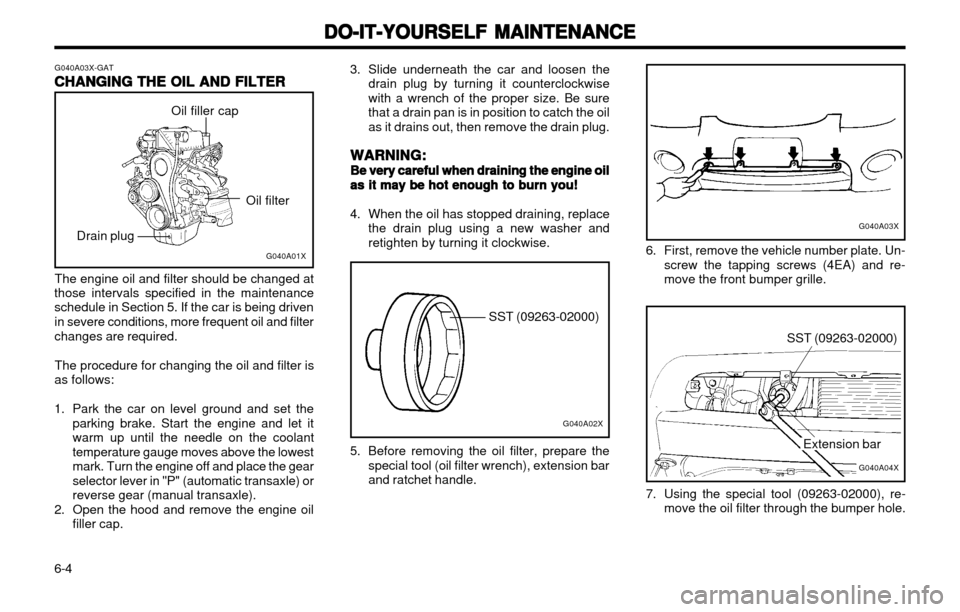
CHANGING THE OIL AND FILTER 3. Slide underneath the car and loosen the
drain plug by turning it counterclockwise with a wrench of the proper size. Be surethat a drain pan is in position to catch the oilas it drains out, then remove the drain plug.
WARNING:
WARNING: WARNING:
WARNING:
WARNING:
Be very careful when draining the engine oil
Be very careful when draining the engine oil Be very careful when draining the engine oil
Be very careful when draining the engine oil
Be very careful when draining the engine oil
as it may be hot
as it may be hot as it may be hot
as it may be hot
as it may be hot enough to burn you!
enough to burn you! enough to burn you!
enough to burn you!
enough to burn you!
4. When the oil has stopped draining, replace the drain plug using a new washer andretighten by turning it clockwise. 6. First, remove the vehicle number plate. Un-
screw the tapping screws (4EA) and re-move the front bumper grille.
Oil filler cap
Oil filter
Drain plug
The engine oil and filter should be changed at
those intervals specified in the maintenance schedule in Section 5. If the car is being driven
in severe conditions, more frequent oil and filter
changes are required.
The procedure for changing the oil and filter is
as follows:
1. Park the car on level ground and set the parking brake. Start the engine and let it warm up until the needle on the coolanttemperature gauge moves above the lowest
mark. Turn the engine off and place the gearselector lever in "P" (automatic transaxle) orreverse gear (manual transaxle).
2. Open the hood and remove the engine oil filler cap.
G040A01X
G040A02X
SST (09263-02000)
5. Before removing the oil filter, prepare the special tool (oil filter wrench), extension bar and ratchet handle.
G040A03X
SST (09263-02000)
G040A04X
Extension bar
7. Using the special tool (09263-02000), re- move the oil filter through the bumper hole.
Page 103 of 249
DO-IT-YOURSELF MAINTENANCE
DO-IT-YOURSELF MAINTENANCE DO-IT-YOURSELF MAINTENANCE
DO-IT-YOURSELF MAINTENANCE
DO-IT-YOURSELF MAINTENANCE
6-7
4. Turn the radiator cap counterclockwise with-out pressing down on it, until it stops. This relieves any pressure remaining in the cool-ing system. And remove the radiator cap bypushing down and turning counterclockwise. Now fill the radiator with clean demineral- ized or distilled water. Continue to add cleandemineralized or distilled water in small quan-tities until the fluid level stays up in theradiator neck.SSA6060A
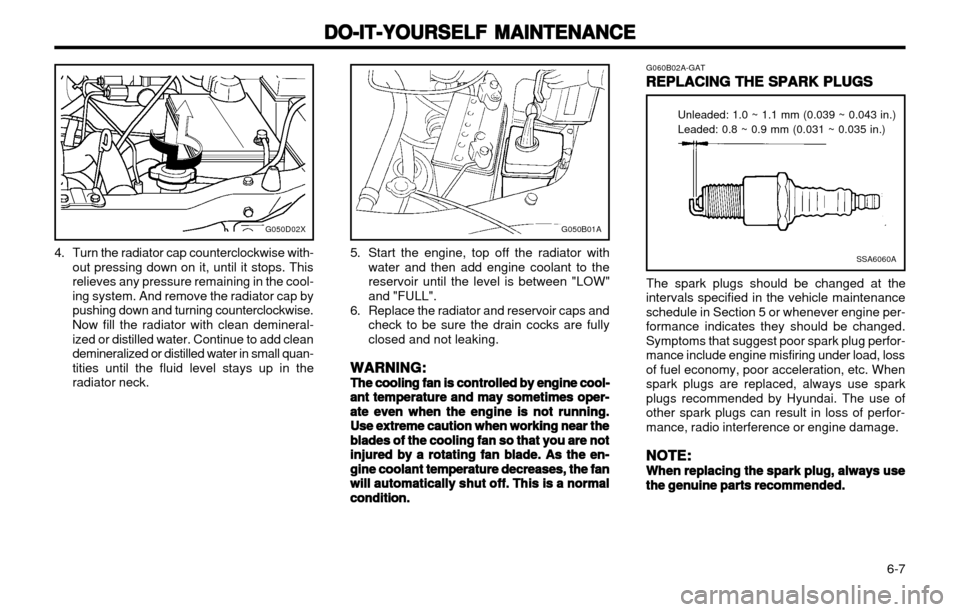
Unleaded: 1.0 ~ 1.1 mm (0.039 ~ 0.043 in.) Leaded: 0.8 ~ 0.9 mm (0.031 ~ 0.035 in.)
G060B02A-GAT
REPLACING THE SPARK PLUGS
REPLACING THE SPARK PLUGS REPLACING THE SPARK PLUGS
REPLACING THE SPARK PLUGS
REPLACING THE SPARK PLUGS
The spark plugs should be changed at the
intervals specified in the vehicle maintenance schedule in Section 5 or whenever engine per-formance indicates they should be changed.Symptoms that suggest poor spark plug perfor-mance include engine misfiring under load, lossof fuel economy, poor acceleration, etc. Whenspark plugs are replaced, always use sparkplugs recommended by Hyundai. The use ofother spark plugs can result in loss of perfor-mance, radio interference or engine damage.
NOTE:
NOTE: NOTE:
NOTE:
NOTE:
When replacing the spark plug, always use
When replacing the spark plug, always use When replacing the spark plug, always use
When replacing the spark plug, always use
When replacing the spark plug, always use the genuine parts recommended.
the genuine parts recommended. the genuine parts recommended.
the genuine parts recommended.
the genuine parts recommended.
G050D02X
5. Start the engine, top off the radiator with
water and then add engine coolant to the reservoir until the level is between "LOW"and "FULL".
6. Replace the radiator and reservoir caps and check to be sure the drain cocks are fullyclosed and not leaking.
WARNING:
WARNING: WARNING:
WARNING:
WARNING:
The cooling fan is controlled by engine cool-
The cooling fan is controlled by engine cool- The cooling fan is controlled by engine cool-
The cooling fan is controlled by engine cool-
The cooling fan is controlled by engine cool- ant temperature and may sometimes oper-
ant temperature and may sometimes oper- ant temperature and may sometimes oper-
ant temperature and may sometimes oper-
ant temperature and may sometimes oper-
ate even when the engine is not running.
ate even when the engine is not running. ate even when the engine is not running.
ate even when the engine is not running.
ate even when the engine is not running.
Use extreme caution when working near the
Use extreme caution when working near the Use extreme caution when working near the
Use extreme caution when working near the
Use extreme caution when working near the
blades of the cooling fan so that you are not
blades of the cooling fan so that you are not blades of the cooling fan so that you are not
blades of the cooling fan so that you are not
blades of the cooling fan so that you are not
injured by a rotating fan blade. As the en-
injured by a rotating fan blade. As the en- injured by a rotating fan blade. As the en-
injured by a rotating fan blade. As the en-
injured by a rotating fan blade. As the en-
gine coolant temperature decreases, the fan
gine coolant temperature decreases, the fan gine coolant temperature decreases, the fan
gine coolant temperature decreases, the fan
gine coolant temperature decreases, the fan
will automatically shut off. This is a normal
will automatically shut off. This is a normal will automatically shut off. This is a normal
will automatically shut off. This is a normal
will automatically shut off. This is a normal
condition.
condition. condition.
condition.
condition.
G050B01A
Page 112 of 249
DO-IT-YOURSELF MAINTENANCE
DO-IT-YOURSELF MAINTENANCE DO-IT-YOURSELF MAINTENANCE
DO-IT-YOURSELF MAINTENANCE
DO-IT-YOURSELF MAINTENANCE
6-16
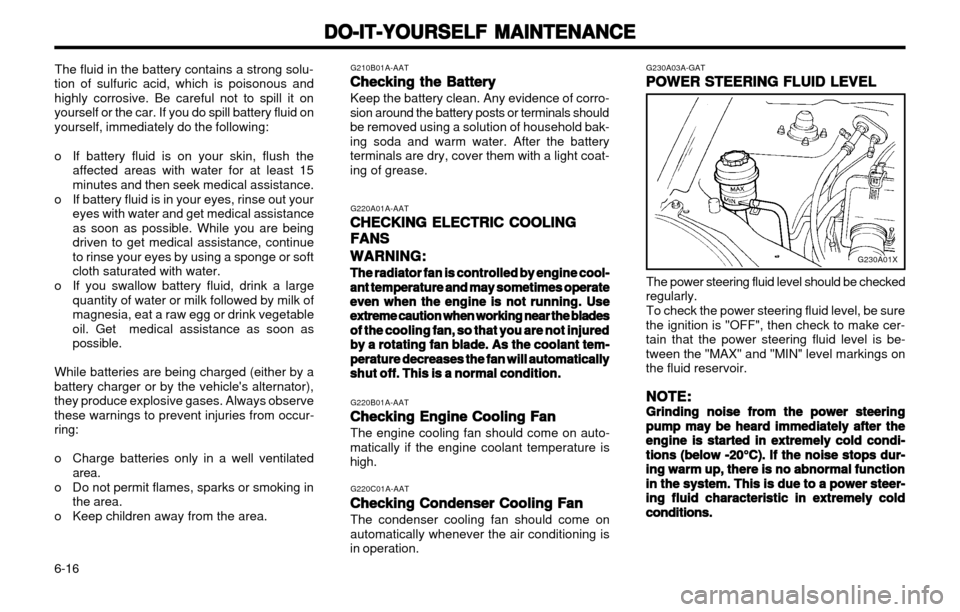
G230A03A-GAT POWER STEERING FLUID LEVEL
POWER STEERING FLUID LEVEL POWER STEERING FLUID LEVEL
POWER STEERING FLUID LEVEL
POWER STEERING FLUID LEVEL
The power steering fluid level should be checked
regularly.
To check the power steering fluid level, be sure
the ignition is "OFF", then check to make cer- tain that the power steering fluid level is be-tween the "MAX" and "MIN" level markings onthe fluid reservoir.
NOTE:
NOTE: NOTE:
NOTE:
NOTE:
Grinding noise from the power steering
Grinding noise from the power steering Grinding noise from the power steering
Grinding noise from the power steering
Grinding noise from the power steering pump may be heard immediately after the
pump may be heard immediately after the pump may be heard immediately after the
pump may be heard immediately after the
pump may be heard immediately after the
engine is started in extremely cold condi-
engine is started in extremely cold condi- engine is started in extremely cold condi-
engine is started in extremely cold condi-
engine is started in extremely cold condi-
tions (below
tions (below tions (below
tions (below
tions (below
-20°C). If the noise stops dur-
-20°C). If the noise stops dur- -20°C). If the noise stops dur-
-20°C). If the noise stops dur-
-20°C). If the noise stops dur-
ing warm up, there is no abnormal function
ing warm up, there is no abnormal function ing warm up, there is no abnormal function
ing warm up, there is no abnormal function
ing warm up, there is no abnormal function
in the system. This is due to a power steer-
in the system. This is due to a power steer- in the system. This is due to a power steer-
in the system. This is due to a power steer-
in the system. This is due to a power steer-
ing fluid characteristic in extremely cold
ing fluid characteristic in extremely cold ing fluid characteristic in extremely cold
ing fluid characteristic in extremely cold
ing fluid characteristic in extremely cold
conditions.
conditions. conditions.
conditions.
conditions.
G230A01X
The fluid in the battery contains a strong solu-
tion of sulfuric acid, which is poisonous and highly corrosive. Be careful not to spill it onyourself or the car. If you do spill battery fluid onyourself, immediately do the following:
o If battery fluid is on your skin, flush the affected areas with water for at least 15 minutes and then seek medical assistance.
o If battery fluid is in your eyes, rinse out your eyes with water and get medical assistanceas soon as possible. While you are beingdriven to get medical assistance, continueto rinse your eyes by using a sponge or softcloth saturated with water.
o If you swallow battery fluid, drink a large quantity of water or milk followed by milk ofmagnesia, eat a raw egg or drink vegetableoil. Get medical assistance as soon aspossible.
While batteries are being charged (either by abattery charger or by the vehicle's alternator),they produce explosive gases. Always observethese warnings to prevent injuries from occur-ring:
o Charge batteries only in a well ventilated area.
o Do not permit flames, sparks or smoking in the area.
o Keep children away from the area. G210B01A-AAT
Checking the Battery
Checking the Battery Checking the Battery
Checking the Battery
Checking the Battery
Keep the battery clean. Any evidence of corro-
sion around the battery posts or terminals should be removed using a solution of household bak-ing soda and warm water. After the batteryterminals are dry, cover them with a light coat-ing of grease.
G220A01A-AATCHECKING ELECTRIC COOLING
CHECKING ELECTRIC COOLING CHECKING ELECTRIC COOLING
CHECKING ELECTRIC COOLING
CHECKING ELECTRIC COOLING
FANS
FANS FANS
FANS
FANS
WARNING:
WARNING: WARNING:
WARNING:
WARNING:
The radiator fan is controlled by engine cool-
The radiator fan is controlled by engine cool- The radiator fan is controlled by engine cool-
The radiator fan is controlled by engine cool-
The radiator fan is controlled by engine cool-
ant temperature and may sometimes operate
ant temperature and may sometimes operate ant temperature and may sometimes operate
ant temperature and may sometimes operate
ant temperature and may sometimes operate
even when the engine is not running. Use
even when the engine is not running. Use even when the engine is not running. Use
even when the engine is not running. Use
even when the engine is not running. Use
extreme caution when working near the blades
extreme caution when working near the blades extreme caution when working near the blades
extreme caution when working near the blades
extreme caution when working near the blades
of the cooling fan, so that you are not injured
of the cooling fan, so that you are not injured of the cooling fan, so that you are not injured
of the cooling fan, so that you are not injured
of the cooling fan, so that you are not injured
by a rotating fan blade. As the coolant tem-
by a rotating fan blade. As the coolant tem- by a rotating fan blade. As the coolant tem-
by a rotating fan blade. As the coolant tem-
by a rotating fan blade. As the coolant tem-
perature decreases the fan will automatically
perature decreases the fan will automatically perature decreases the fan will automatically
perature decreases the fan will automatically
perature decreases the fan will automatically
shut off. This is a normal condition.
shut off. This is a normal condition. shut off. This is a normal condition.
shut off. This is a normal condition.
shut off. This is a normal condition.
G220B01A-AATChecking Engine Cooling Fan
Checking Engine Cooling Fan Checking Engine Cooling Fan
Checking Engine Cooling Fan
Checking Engine Cooling Fan
The engine cooling fan should come on auto-
matically if the engine coolant temperature ishigh.
G220C01A-AATChecking Condenser Cooling Fan
Checking Condenser Cooling Fan Checking Condenser Cooling Fan
Checking Condenser Cooling Fan
Checking Condenser Cooling Fan
The condenser cooling fan should come on
automatically whenever the air conditioning isin operation.
Page 118 of 249
EMISSION CONTROL SYSTEMS
EMISSION CONTROL SYSTEMS EMISSION CONTROL SYSTEMS
EMISSION CONTROL SYSTEMS
EMISSION CONTROL SYSTEMS
7-2 o Do not touch the catalytic converter or any
other part of the exhaust system while the engine is running as it is very hot and couldresult in burns.
o Remember that your Hyundai dealer is your best source of assistance.
H020B01A-GAT
About the Catalytic Converter
About the Catalytic Converter About the Catalytic Converter
About the Catalytic Converter
About the Catalytic Converter
Exhaust gases passing through the catalytic
converter cause it to operate at very high tem-peratures. As a result, the introduction of large
amounts of unburned gasoline may cause it to
overheat and create a fire hazard.
This can be avoided by observing the following:
o Use unleaded fuel only.
o Maintain your engine in good condition. Ex- tremely high converter temperatures can result from improper operation of the electri-cal, ignition or fuel injection systems.
o If your engine stalls, pings, knocks, or is hard to start, take your car to your Hyundaidealer as soon as possible and have thedifficulty corrected.
o Avoid driving with a very low fuel level. If you run out of gasoline, it could cause the engineto misfire and result in excessive loading of
the catalytic converter.
o Avoid idling the engine for periods longer than 10 minutes.
o Your Hyundai should not be either pushed or pulled to get it started.This can cause the catalytic converter tooverload.
o Take care not to stop your Hyundai over any combustible material such as grass, paper,leaves or rags. As these materials could
come in contact with the catalytic converterand could cause a fire.
Page 126 of 249
INDEX
INDEX INDEX
INDEX
INDEX
10-2 EE
EE
E
Emission Control System ................................................................... 7-1Engine
Before starting the engine .............................................................. 2-2
Compartment (For MFI) ................................................................. 6-1 Coolant ........................................................................................... 6-5
Coolant temperature gauge ......................................................... 1-22
If the engine overheats .................................................................. 3-2 Number .......................................................................................... 8-1
Oil .................................................................................................. 6-2
Oil consumption ............................................................................. 6-3
Starting ........................................................................................... 2-3
Engine Exhaust Can Be Dangerous ................................................... 2-1
FF
FF
F
Fan Speed Control ............................................................................ 1-34
Fog Light
Front ............................................................................................. 1-31
Rear ............................................................................................. 1-31
Front Seats Adjustable front seats .................................................................... 1-5
Adjustable headrests ..................................................................... 1-6
Adjusting seat forward and rearward ............................................. 1-5
Adjusting seatback angle ............................................................... 1-6
Fuel Capacity ......................................................................................... 9-1Gauge .......................................................................................... 1-22
Recommendations ......................................................................... 1-1 Fuel Filler Lid
Remote release ............................................................................ 1-31
Fuses ................................................................................................ 6-15
GG
GG
G
General Everyday Checks .................................................................. 6-2
HH
HH
H
Hazard Warning System ................................................................... 1-27
Headlight ........................................................................................... 6-17
Headlight Bulb Replacement ............................................................. 6-17
Headlight Leveling Device System ................................................... 1-25
Heating and Ventilation
High-mounted Rear Stoplight ............................................................ 1-28
Hood Release ................................................................................... 1-32
Horn ................................................................................................ 1-33
II
II
I
Ignition Switch ..................................................................................... 2-2
Immobilizer System ............................................................................. 1-2
Instrument Cluster and Indicator ....................................................... 1-19
Instruments and Controls .................................................................. 1-18
Interior Light ...................................................................................... 1-27
JJ
JJ
J
Jump Starting ...................................................................................... 3-1
KK
KK
K
Keys .................................................................................................. 1-2
If you lose your keys ..................................................................... 3-8
Positions ........................................................................................ 2-2
Page 155 of 249
FEATURES OF YOUR HYUNDAI
1-18 ZB110G2-E
TURN SIGNAL INDICATOR LIGHT
The blinking green arrow on the instrument panel shows the direction indicated by the turnsignals. If the arrow comes on but does notblink, blinks more rapidly than normal or doesnot blink at all, a malfunction in the turn signalsystem is indicated.
B260P02Y-AAT ABS SERVICE REMINDER INDICATOR (SRI) (Not all models)
When the key is turned to the “ON” position, the ABS light will come on and then go off in a fewseconds. If the ABS light remains on, comes on while
driving, or does not come on when the key isturned to the “ON” position, this indicates thatthere may be a problem with the ABS.
If this occurs, have your vehicle checked by
your Hyundai dealer as soon as possible. Thenormal braking system will still be operational,but without the assistance of the anti-lock brakesystem.
CAUTION: If the both ABS SRI and Parking Brake/
Brake fluid level warning lights remain "ON" or come on while driving, there may be aproblem with E.B.D (Electronic brake forcedistribution).
If this occurs, avoid sudden stops and have
your vehicle checked by your Hyundai dealeras soon as possible. SB210E1-E
OVERDRIVE OFF INDICATOR LIGHT (Not all models)
When the overdrive (4th gear) switch is turned off and the operation of overdrive (4th gear) iscancelled, the overdrive warning light (O/D OFF)will be illuminated. When the switch is at the onposition, the gearbox will operate in the normalfully automatic mode and the warning light willbe extinguished.
ZB110J2-E HIGH BEAM INDICATOR LIGHT
This light is coloured blue and should illuminate only when the headlight upper beam is on.
B260E02A-GAT SEAT BELT REMINDER LIGHT
The seat belt reminder light comes on until your seat belt is fastened when the ignition key isturned from the "OFF" position to "ON" or"START".
ZB110K2-E OIL PRESSURE WARNING LIGHT
The oil pressure warning light will illuminate when insufficient oil pressure exists for safeengine operation. The light should illuminate when the ignition is turned on and should be extinguished as soonas the engine is started.
ZB110L3-E PARKING BRAKE, BRAKE CIRCUIT FAILURE WARNING LIGHT
This light will be illuminated when the hand brake is applied and the ignition on, and shouldgo out when the hand brake is released. Thevehicle should not be driven until the handbrake has been released and the light go out. Italso will be illuminated if the brake fluid level inthe reservoir falls to the MIN. mark. If the lightilluminates while driving pull off the road ifpossible and stop immediately. Contact yournearest authorized dealer and have the systemchecked.
CAUTION: Operation of the engine with low oil pres- sure may result in serious damage to theengine. Should the oil pressure light fail to extinguish after starting or illuminate when the engine isrunning, the engine must be stopped immedi-ately. If the engine oil level is low, add a suffi-cient quantity of oil to raise the level to the fullmarking on the dip stick. Restart the engine andcheck that the warning light is extinguished.Should the light still be illuminated, stop theengine immediately and seek assistance fromthe nearest Hyundai dealer.
Page 156 of 249
FEATURES OF YOUR HYUNDAI 1-19
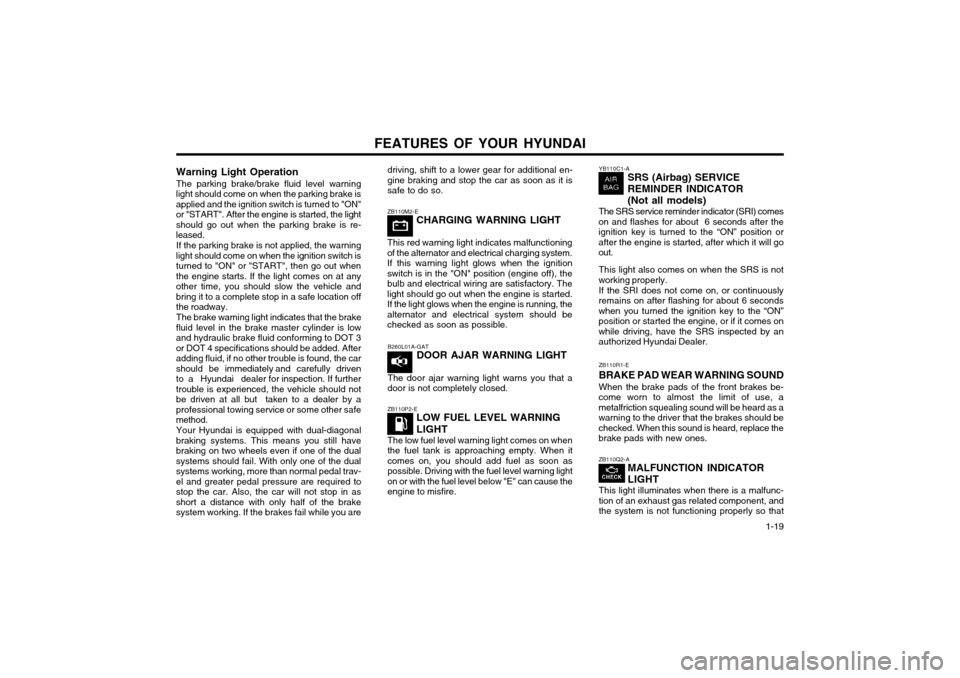
YB110C1-A
SRS (Airbag) SERVICE REMINDER INDICATOR(Not all models)
The SRS service reminder indicator (SRI) comes
on and flashes for about 6 seconds after the ignition key is turned to the “ON” position orafter the engine is started, after which it will goout.
This light also comes on when the SRS is not
working properly.
If the SRI does not come on, or continuously
remains on after flashing for about 6 secondswhen you turned the ignition key to the “ON”position or started the engine, or if it comes onwhile driving, have the SRS inspected by anauthorized Hyundai Dealer.
ZB110P2-E LOW FUEL LEVEL WARNING LIGHT
The low fuel level warning light comes on when the fuel tank is approaching empty. When itcomes on, you should add fuel as soon aspossible. Driving with the fuel level warning lighton or with the fuel level below "E" can cause theengine to misfire.
ZB110R1-E BRAKE PAD WEAR WARNING SOUNDWhen the brake pads of the front brakes be-
come worn to almost the limit of use, a metalfriction squealing sound will be heard as awarning to the driver that the brakes should bechecked. When this sound is heard, replace thebrake pads with new ones.
ZB110Q2-A MALFUNCTION INDICATOR LIGHT
This light illuminates when there is a malfunc- tion of an exhaust gas related component, andthe system is not functioning properly so that
B260L01A-GAT DOOR AJAR WARNING LIGHT
The door ajar warning light warns you that a
door is not completely closed.
ZB110M2-E CHARGING WARNING LIGHT
This red warning light indicates malfunctioning of the alternator and electrical charging system.If this warning light glows when the ignitionswitch is in the "ON" position (engine off), thebulb and electrical wiring are satisfactory. Thelight should go out when the engine is started.If the light glows when the engine is running, thealternator and electrical system should bechecked as soon as possible.
Warning Light Operation The parking brake/brake fluid level warning
light should come on when the parking brake is applied and the ignition switch is turned to "ON"or "START". After the engine is started, the lightshould go out when the parking brake is re-leased.
If the parking brake is not applied, the warning
light should come on when the ignition switch isturned to "ON" or "START", then go out whenthe engine starts. If the light comes on at anyother time, you should slow the vehicle andbring it to a complete stop in a safe location offthe roadway.
The brake warning light indicates that the brake
fluid level in the brake master cylinder is lowand hydraulic brake fluid conforming to DOT 3or DOT 4 specifications should be added. Afteradding fluid, if no other trouble is found, the carshould be immediately and carefully drivento a Hyundai dealer for inspection. If furthertrouble is experienced, the vehicle should notbe driven at all but taken to a dealer by aprofessional towing service or some other safemethod.
Your Hyundai is equipped with dual-diagonal
braking systems. This means you still havebraking on two wheels even if one of the dualsystems should fail. With only one of the dualsystems working, more than normal pedal trav-el and greater pedal pressure are required tostop the car. Also, the car will not stop in asshort a distance with only half of the brakesystem working. If the brakes fail while you are driving, shift to a lower gear for additional en-gine braking and stop the car as soon as it issafe to do so.
Page 160 of 249
FEATURES OF YOUR HYUNDAI 1-23
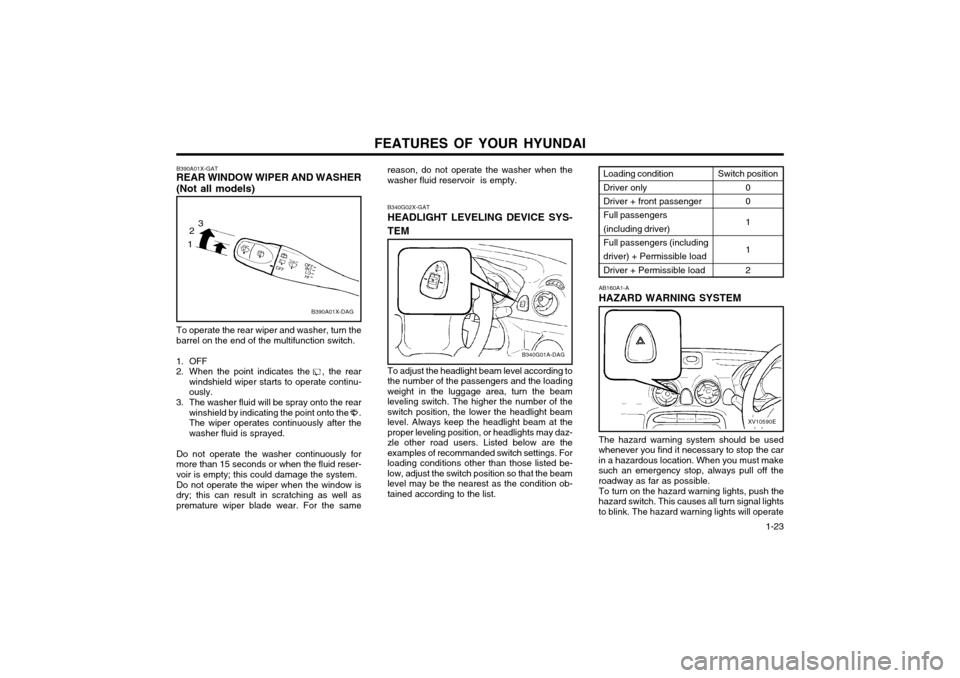
reason, do not operate the washer when the washer fluid reservoir is empty. B340G02X-GAT HEADLIGHT LEVELING DEVICE SYS- TEM To adjust the headlight beam level according to the number of the passengers and the loadingweight in the luggage area, turn the beamleveling switch. The higher the number of theswitch position, the lower the headlight beamlevel. Always keep the headlight beam at the
proper leveling position, or headlights may daz-zle other road users. Listed below are theexamples of recommanded switch settings. Forloading conditions other than those listed be-
low, adjust the switch position so that the beamlevel may be the nearest as the condition ob-tained according to the list.
B340G01A-DAG
B390A01X-GAT REAR WINDOW WIPER AND WASHER (Not all models)
B390A01X-DAG
To operate the rear wiper and washer, turn the barrel on the end of the multifunction switch.
1. OFF
2. When the point indicates the , the rear windshield wiper starts to operate continu-ously.
3. The washer fluid will be spray onto the rear winshield by indicating the point onto the .The wiper operates continuously after thewasher fluid is sprayed.
Do not operate the washer continuously formore than 15 seconds or when the fluid reser-voir is empty; this could damage the system. Do not operate the wiper when the window is dry; this can result in scratching as well aspremature wiper blade wear. For the same
1 2
3
The hazard warning system should be used
whenever you find it necessary to stop the car in a hazardous location. When you must makesuch an emergency stop, always pull off theroadway as far as possible.
To turn on the hazard warning lights, push the
hazard switch. This causes all turn signal lightsto blink. The hazard warning lights will operate AB160A1-A HAZARD WARNING SYSTEM
XV10590E
Loading condition Driver only Driver + front passenger Full passengers(including driver)Full passengers (including driver) + Permissible load Driver + Permissible load
Switch position
0 0 1 1 2