wheel Hyundai Atos 2002 Owner's Guide
[x] Cancel search | Manufacturer: HYUNDAI, Model Year: 2002, Model line: Atos, Model: Hyundai Atos 2002Pages: 249, PDF Size: 3.11 MB
Page 150 of 249
FEATURES OF YOUR HYUNDAI 1-13
B240C01X
Rear impact
Side impact Rollover
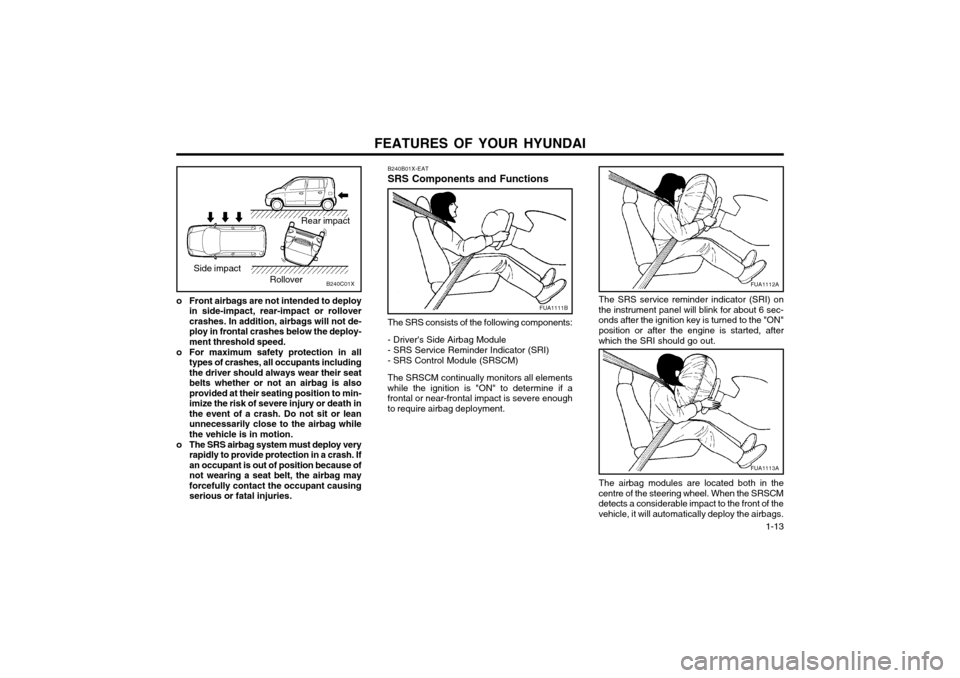
o Front airbags are not intended to deploy in side-impact, rear-impact or rollover crashes. In addition, airbags will not de-ploy in frontal crashes below the deploy-ment threshold speed.
o For maximum safety protection in all types of crashes, all occupants includingthe driver should always wear their seatbelts whether or not an airbag is alsoprovided at their seating position to min-imize the risk of severe injury or death inthe event of a crash. Do not sit or leanunnecessarily close to the airbag whilethe vehicle is in motion.
o The SRS airbag system must deploy very rapidly to provide protection in a crash. Ifan occupant is out of position because ofnot wearing a seat belt, the airbag mayforcefully contact the occupant causingserious or fatal injuries. B240B01X-EAT SRS Components and Functions The SRS consists of the following components: - Driver's Side Airbag Module - SRS Service Reminder Indicator (SRI)- SRS Control Module (SRSCM) The SRSCM continually monitors all elements
while the ignition is "ON" to determine if a frontal or near-frontal impact is severe enough
to require airbag deployment.
FUA1111B The SRS service reminder indicator (SRI) on
the instrument panel will blink for about 6 sec- onds after the ignition key is turned to the "ON"
position or after the engine is started, after
which the SRI should go out.
The airbag modules are located both in the
centre of the steering wheel. When the SRSCMdetects a considerable impact to the front of thevehicle, it will automatically deploy the airbags.
FUA1113A
FUA1112A
Page 151 of 249
FEATURES OF YOUR HYUNDAI
1-14 B240C01X-EAT SRS CareThe SRS is virtually maintenance-free and so there are no parts you can safely service byyourself. The entire SRS system must be in-spected by an authorized Hyundai dealer in 10years after the date that the car was manufac-ture. Any work on the airbag system, such as remov- ing, installing, repairing, or any work on thesteering wheel must be performed by a quali-fied Hyundai technician. Improper handling of the airbag system may result in serious personal injury. WARNING:
o Modification to SRS components or wir- ing, including the addition of any kind of badges to the pad cover or modifica-tions to the body structure, can adverse-ly affect SRS performance and lead topossible injury.
o For cleaning the horn pad, use only a soft, dry cloth or one which has beenmoistened with plain water. Solvents orcleaners could adversely affect the airbagcover and proper deployment of the sys-tem.
o No objects should be placed over or near the label identifying the airbag on thesteering wheel and instrument panel,because any such object could causeharm if the vehicle is in a crash severeenough to cause the airbag to inflate.
WARNING:
o When the SRS is activated, there may be
a loud noise and fine dust will be re- leased through out the vehicle. Theseconditions are normal and are not haz-ardous. However, the fine dust generat-ed during airbag deployment may causeskin irritation. Be sure to wash your handsand face thoroughly with lukewarm wa-ter and a mild soap after an accident inwhich the airbags were deployed.
o The SRS can function only when the ignition key is in the "ON" position. If theSRS SRI does not come on, or continu-ously remains on, after flashing for about6 seconds when the ignition key is turnedto the "ON" position, or after the engineis started, or comes on while driving, theSRS is not working properly. If this oc-curs, have your vehicle immediately in-spected by your Hyundai dealer.
o Before you replace a fuse or disconnect a battery terminal, turn the ignition key tothe "LOCK" position or remove the igni-tion key. Never remove or replace the airbag related fuse(s) when the ignition keyis in the "ON" position. Failure to heedthis warning will cause the SRS SRI toilluminate.
Upon deployment, tear seams molded directly
into the pad covers will separate under pres-sure from the expansion of the airbags. Furtheropening of the covers then allows full inflation ofthe airbags.
A fully inflated airbag in combination with a
properly worn seat belt slows the driver's for-ward motion, thus reducing the
risk of head and chest injury. After complete inflation, the airbag immediately
starts deflating, enabling the driver to maintain forward visibility.
CAUTION: When installing a container of liquid air
fresherer inside a vehicle, do not place it near the instrument cluster nor on the in-strument panel pad surface. If there is anyleakage from the air fresherer onto theseareas (instrument cluster, instrument panelpad or air ventilator), it may damage theseparts. If the liquid from the air freshererdoes leak onto these areas, wash them withwater immediately.
Page 156 of 249
FEATURES OF YOUR HYUNDAI 1-19
YB110C1-A
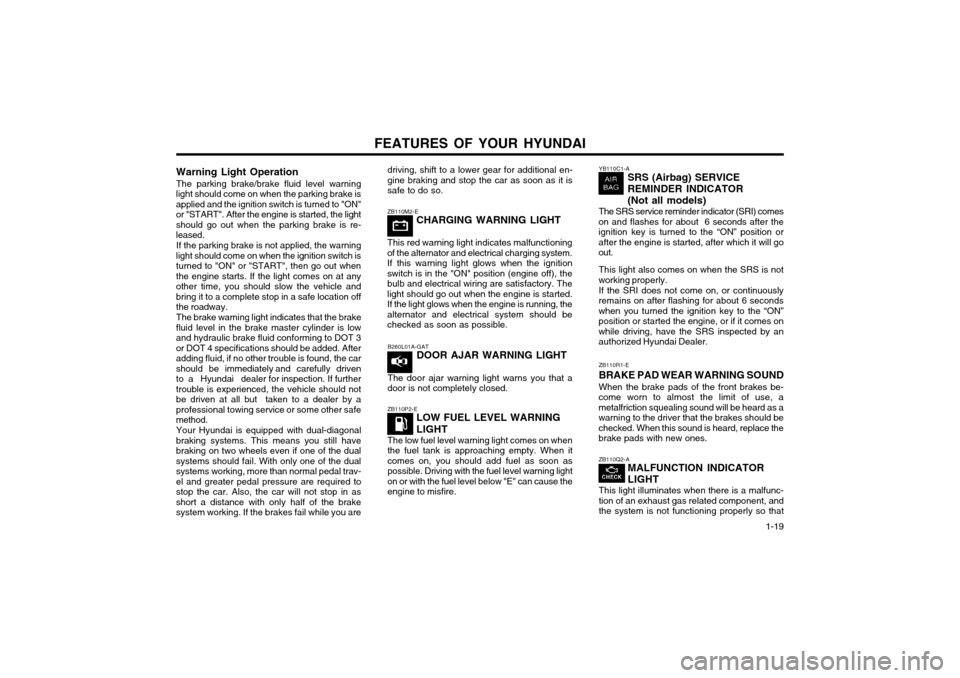
SRS (Airbag) SERVICE REMINDER INDICATOR(Not all models)
The SRS service reminder indicator (SRI) comes
on and flashes for about 6 seconds after the ignition key is turned to the “ON” position orafter the engine is started, after which it will goout.
This light also comes on when the SRS is not
working properly.
If the SRI does not come on, or continuously
remains on after flashing for about 6 secondswhen you turned the ignition key to the “ON”position or started the engine, or if it comes onwhile driving, have the SRS inspected by anauthorized Hyundai Dealer.
ZB110P2-E LOW FUEL LEVEL WARNING LIGHT
The low fuel level warning light comes on when the fuel tank is approaching empty. When itcomes on, you should add fuel as soon aspossible. Driving with the fuel level warning lighton or with the fuel level below "E" can cause theengine to misfire.
ZB110R1-E BRAKE PAD WEAR WARNING SOUNDWhen the brake pads of the front brakes be-
come worn to almost the limit of use, a metalfriction squealing sound will be heard as awarning to the driver that the brakes should bechecked. When this sound is heard, replace thebrake pads with new ones.
ZB110Q2-A MALFUNCTION INDICATOR LIGHT
This light illuminates when there is a malfunc- tion of an exhaust gas related component, andthe system is not functioning properly so that
B260L01A-GAT DOOR AJAR WARNING LIGHT
The door ajar warning light warns you that a
door is not completely closed.
ZB110M2-E CHARGING WARNING LIGHT
This red warning light indicates malfunctioning of the alternator and electrical charging system.If this warning light glows when the ignitionswitch is in the "ON" position (engine off), thebulb and electrical wiring are satisfactory. Thelight should go out when the engine is started.If the light glows when the engine is running, thealternator and electrical system should bechecked as soon as possible.
Warning Light Operation The parking brake/brake fluid level warning
light should come on when the parking brake is applied and the ignition switch is turned to "ON"or "START". After the engine is started, the lightshould go out when the parking brake is re-leased.
If the parking brake is not applied, the warning
light should come on when the ignition switch isturned to "ON" or "START", then go out whenthe engine starts. If the light comes on at anyother time, you should slow the vehicle andbring it to a complete stop in a safe location offthe roadway.
The brake warning light indicates that the brake
fluid level in the brake master cylinder is lowand hydraulic brake fluid conforming to DOT 3or DOT 4 specifications should be added. Afteradding fluid, if no other trouble is found, the carshould be immediately and carefully drivento a Hyundai dealer for inspection. If furthertrouble is experienced, the vehicle should notbe driven at all but taken to a dealer by aprofessional towing service or some other safemethod.
Your Hyundai is equipped with dual-diagonal
braking systems. This means you still havebraking on two wheels even if one of the dualsystems should fail. With only one of the dualsystems working, more than normal pedal trav-el and greater pedal pressure are required tostop the car. Also, the car will not stop in asshort a distance with only half of the brakesystem working. If the brakes fail while you are driving, shift to a lower gear for additional en-gine braking and stop the car as soon as it issafe to do so.
Page 158 of 249
FEATURES OF YOUR HYUNDAI 1-21
B340B01X-DAG
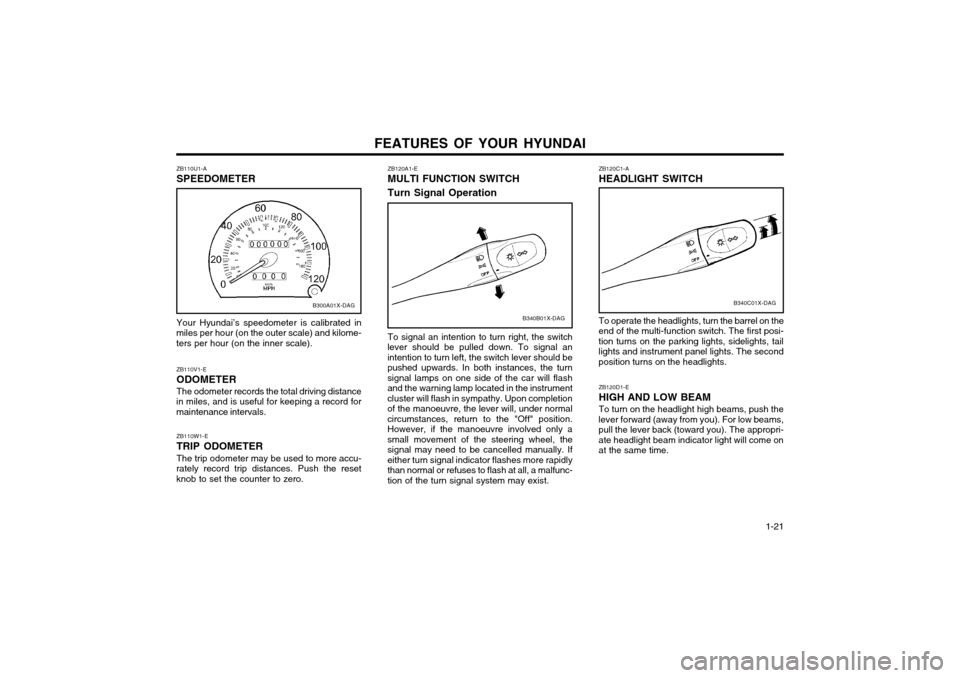
ZB120A1-E MULTI FUNCTION SWITCH Turn Signal Operation
To signal an intention to turn right, the switch
lever should be pulled down. To signal an intention to turn left, the switch lever should bepushed upwards. In both instances, the turnsignal lamps on one side of the car will flashand the warning lamp located in the instrumentcluster will flash in sympathy. Upon completionof the manoeuvre, the lever will, under normalcircumstances, return to the "Off" position.However, if the manoeuvre involved only asmall movement of the steering wheel, thesignal may need to be cancelled manually. Ifeither turn signal indicator flashes more rapidlythan normal or refuses to flash at all, a malfunc-tion of the turn signal system may exist.
ZB110U1-A SPEEDOMETER Your Hyundai’s speedometer is calibrated in
miles per hour (on the outer scale) and kilome- ters per hour (on the inner scale).
B300A01X-DAG
ZB110W1-E TRIP ODOMETER The trip odometer may be used to more accu-
rately record trip distances. Push the reset knob to set the counter to zero. ZB110V1-E ODOMETERThe odometer records the total driving distance
in miles, and is useful for keeping a record for maintenance intervals.
ZB120C1-A HEADLIGHT SWITCH
B340C01X-DAG
ZB120D1-E HIGH AND LOW BEAMTo turn on the headlight high beams, push the
lever forward (away from you). For low beams, pull the lever back (toward you). The appropri-ate headlight beam indicator light will come onat the same time.
To operate the headlights, turn the barrel on the
end of the multi-function switch. The first posi- tion turns on the parking lights, sidelights, taillights and instrument panel lights. The secondposition turns on the headlights.
Page 159 of 249
FEATURES OF YOUR HYUNDAI
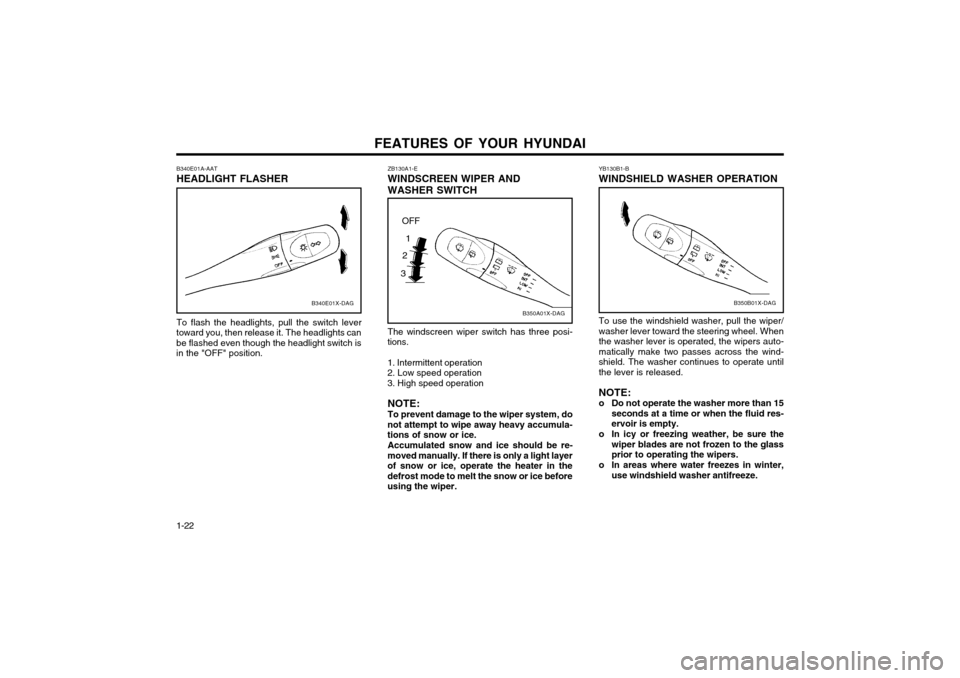
1-22 YB130B1-B WINDSHIELD WASHER OPERATION
B350B01X-DAG
To use the windshield washer, pull the wiper/ washer lever toward the steering wheel. Whenthe washer lever is operated, the wipers auto-matically make two passes across the wind-shield. The washer continues to operate untilthe lever is released. NOTE:
o Do not operate the washer more than 15 seconds at a time or when the fluid res-ervoir is empty.
o In icy or freezing weather, be sure the wiper blades are not frozen to the glassprior to operating the wipers.
o In areas where water freezes in winter, use windshield washer antifreeze.
ZB130A1-E WINDSCREEN WIPER ANDWASHER SWITCH
B350A01X-DAG
The windscreen wiper switch has three posi-
tions. 1. Intermittent operation 2. Low speed operation 3. High speed operation
NOTE:To prevent damage to the wiper system, do
not attempt to wipe away heavy accumula- tions of snow or ice.
Accumulated snow and ice should be re-
moved manually. If there is only a light layerof snow or ice, operate the heater in thedefrost mode to melt the snow or ice beforeusing the wiper.
OFF
1
2
3
B340E01A-AAT HEADLIGHT FLASHER
B340E01X-DAG
To flash the headlights, pull the switch lever
toward you, then release it. The headlights can be flashed even though the headlight switch isin the "OFF" position.
Page 169 of 249
FEATURES OF YOUR HYUNDAI
1-32
B670B02X-DAG
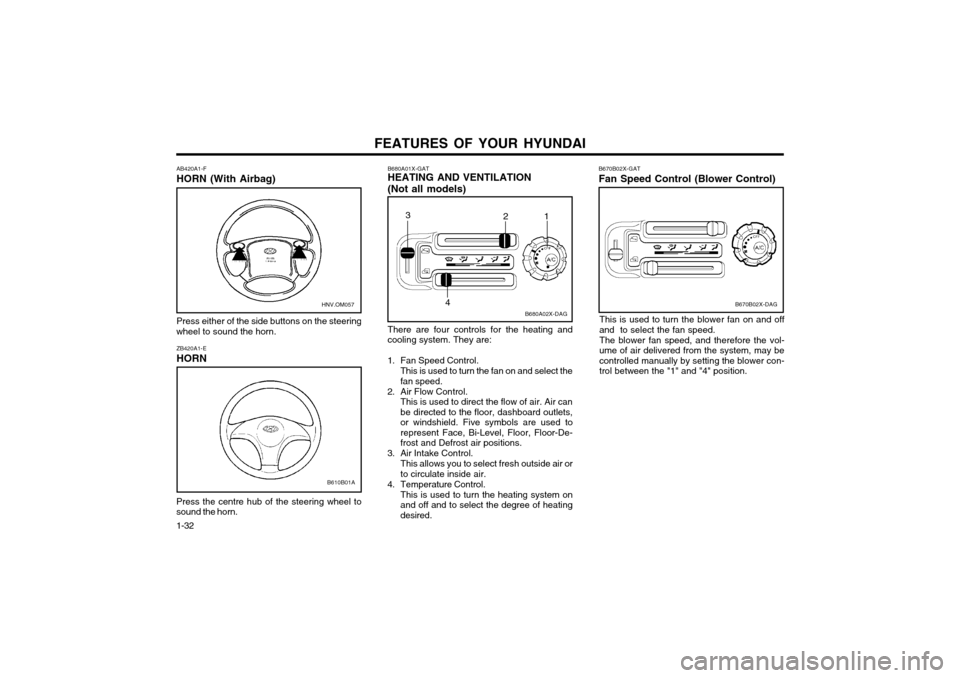
B670B02X-GAT Fan Speed Control (Blower Control)
This is used to turn the blower fan on and off
and to select the fan speed.
The blower fan speed, and therefore the vol-
ume of air delivered from the system, may be controlled manually by setting the blower con-trol between the "1" and "4" position.
B680A01X-GAT HEATING AND VENTILATION (Not all models)
B680A02X-DAG
1
2
3
4
There are four controls for the heating and cooling system. They are:
1. Fan Speed Control. This is used to turn the fan on and select thefan speed.
2. Air Flow Control. This is used to direct the flow of air. Air canbe directed to the floor, dashboard outlets,or windshield. Five symbols are used torepresent Face, Bi-Level, Floor, Floor-De-frost and Defrost air positions.
3. Air Intake Control. This allows you to select fresh outside air orto circulate inside air.
4. Temperature Control. This is used to turn the heating system onand off and to select the degree of heatingdesired.
AB420A1-F HORN (With Airbag)
HNV.OM057
Press either of the side buttons on the steering
wheel to sound the horn.
ZB420A1-E HORN
B610B01A
Press the centre hub of the steering wheel to sound the horn.
Page 191 of 249
DRIVING YOUR HYUNDAI
2- 2 C020A01A-EAT
BEFORE STARTING THE ENGINE
Before you start the engine, you should always:
o Look around the vehicle to be sure there are no flat tyres, puddles of oil or water or other indications of possible trouble.
o After entering the car, check to be sure the parking brake is engaged.
o Check that all windows, and lights are clean.
o Check that the interior and exterior mirrors are clean and in position.
o Check your seat, seatback and headrestraint to be sure they are in their proper positions.
o Lock all the doors.
o Fasten your seat belt and be sure that all other occupants have fastened theirs.
o Turn off all lights and accessories that are not needed.
o When you turn the ignition switch to "ON", check that all appropriate warning lights are operating and that you have sufficient fuel.
o Check the operation of warning lights and all bulbs when key is in the "ON" position. o To start the engine, insert the ignition key
and turn it to the "START" position. Releaseit as soon as the engine starts. Do not hold
the key in the "START" position for morethan 15 seconds.
NOTE: For safety, the engine will not start if the
shift lever is not in "P" or "N" Position (AutoT/A). ZC050A2-E
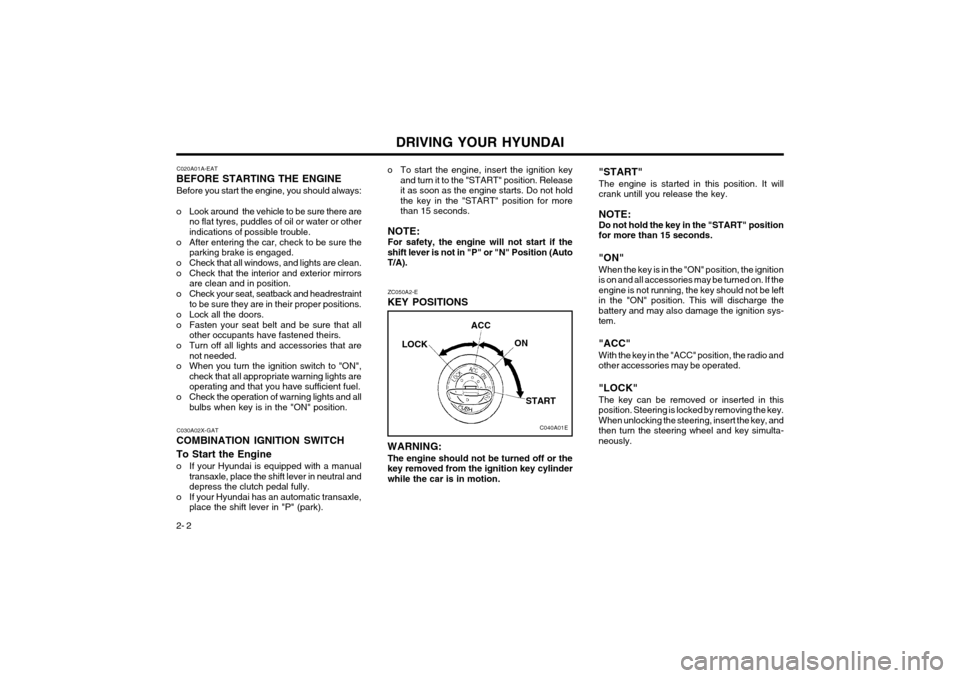
KEY POSITIONS "START"
The engine is started in this position. It will crank untill you release the key. NOTE: Do not hold the key in the "START" position for more than 15 seconds.
"ON" When the key is in the "ON" position, the ignition is on and all accessories may be turned on. If theengine is not running, the key should not be leftin the "ON" position. This will discharge thebattery and may also damage the ignition sys-tem. "ACC" With the key in the "ACC" position, the radio and other accessories may be operated. "LOCK" The key can be removed or inserted in this position. Steering is locked by removing the key.When unlocking the steering, insert the key, andthen turn the steering wheel and key simulta-neously.
C040A01E
LOCK
ACC
ON
STARTC030A02X-GAT
COMBINATION IGNITION SWITCH To Start the Engine
o If your Hyundai is equipped with a manual transaxle, place the shift lever in neutral and depress the clutch pedal fully.
o If your Hyundai has an automatic transaxle, place the shift lever in "P" (park). WARNING:
The engine should not be turned off or thekey removed from the ignition key cylinderwhile the car is in motion.
Page 194 of 249
DRIVING YOUR HYUNDAI 2- 5
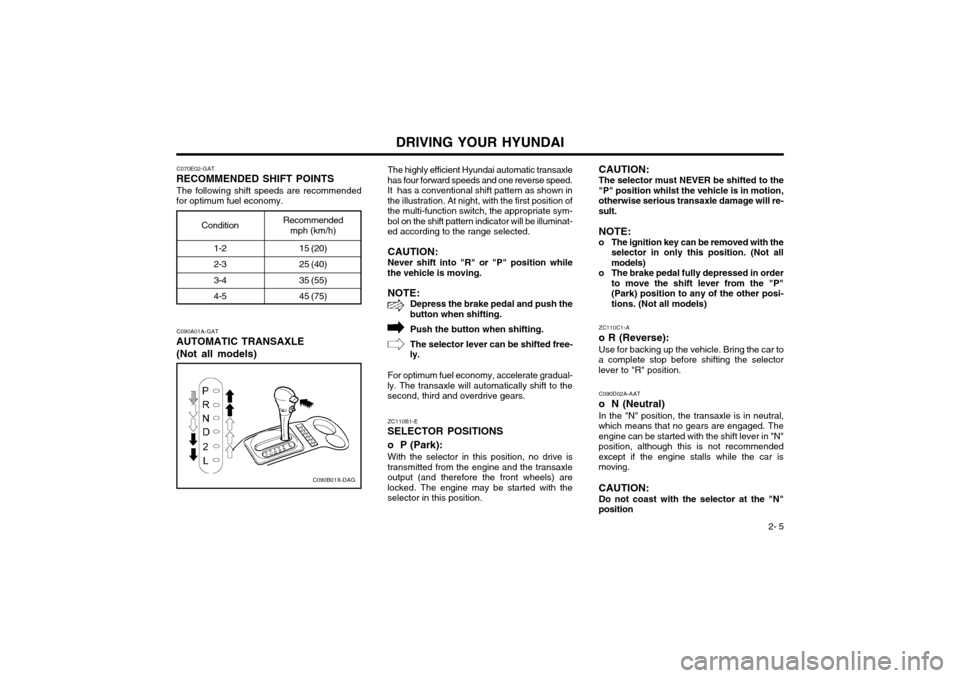
1-2 2-3 3-44-5
Recommended
mph (km/h)
C070E02-GAT
RECOMMENDED SHIFT POINTS
The following shift speeds are recommended
for optimum fuel economy.
C090A01A-GAT
AUTOMATIC TRANSAXLE
(Not all models)
C090B01X-DAG
Condition
15 (20) 25 (40) 35 (55)45 (75)The highly efficient Hyundai automatic transaxle
has four forward speeds and one reverse speed. It has a conventional shift pattern as shown inthe illustration. At night, with the first position ofthe multi-function switch, the appropriate sym-bol on the shift pattern indicator will be illuminat-ed according to the range selected.
CAUTION: Never shift into "R" or "P" position while
the vehicle is moving.
NOTE: Depress the brake pedal and push the
button when shifting.
Push the button when shifting. The selector lever can be shifted free-
ly.
For optimum fuel economy, accelerate gradual-
ly. The transaxle will automatically shift to the second, third and overdrive gears.
CAUTION: The selector must NEVER be shifted to the
"P" position whilst the vehicle is in motion, otherwise serious transaxle damage will re-sult.
NOTE:
o The ignition key can be removed with the selector in only this position. (Not allmodels)
o The brake pedal fully depressed in order to move the shift lever from the "P"(Park) position to any of the other posi-tions. (Not all models)
ZC110B1-E
SELECTOR POSITIONS o P (Park):
With the selector in this position, no drive is
transmitted from the engine and the transaxle output (and therefore the front wheels) arelocked. The engine may be started with theselector in this position. ZC110C1-A
o R (Reverse):
Use for backing up the vehicle. Bring the car to
a complete stop before shifting the selectorlever to "R" position.
C090D02A-AAT
o N (Neutral) In the "N" position, the transaxle is in neutral,
which means that no gears are engaged. Theengine can be started with the shift lever in "N"position, although this is not recommendedexcept if the engine stalls while the car ismoving. CAUTION:
Do not coast with the selector at the "N"
position
Page 196 of 249
DRIVING YOUR HYUNDAI 2- 7
o Ensure that the overdrive switch is at the
"ON" position for maximum economy.
o If rapid acceleration is required, fully de- press the accelerator pedal. In this condi- tion, the kickdown mechanism will be oper-ated and the transaxle will automaticallydownshift according to the vehicle speed.
o Do not depress the accelerator pedal with the brakes applied and the selector at the"R" "D" "2" or "L" position.
o Turn the overdrive switch on for good fuel economy and smooth driving. But if enginebraking is needed in the "D" range or ifrepeated upshifting and downshifting be-tween the 3rd and 4th gear is needed whenclimbing a gentle slope, it is recommendedthat the overdrive switch be turned off. Turnthe overdrive switch back on immediatelyafterward.
the maximum fuel economy potential of thevehicle being realized.
SC140A1-E
EFFECTIVE BRAKING Braking system performance and friction mate-
rial life are greatly affected by the driving styleadopted. The following suggestions are madeto assist in achieving the best results from thebraking system.
o Anticipate the road and conditions ahead in order that heavy braking may be avoided.
o When descending long gradients, use the engine to assist in retarding the vehicle to minimize the possibility of brake fade occur-ring.
ZC120D1-E
General Operating Instructions
o The button in the selector handle must be depressed before the selector can be moved.
o The engine may only be started when the selector is at position "P" or "N".
o Ensure that the footbrake is firmly applied when shifting from "P" or "N" to "D", "2" or "L" and vice versa.
o Always engage the parking brake when the vehicle is unattended, never use the "P"position in place of the parking brake.
o Under normal circumstances, the selector should be placed in the "D" position and thetransaxle allowed to select the most idealratio for the circumstances. In this positionmaximum fuel economy will be achieved.
o When descending steep gradients where engine braking is required, the selectorshould be placed at the "2" or "L" positiondepending upon the vehicle speed.
o When ascending steep gradients and using large throttle openings, the transaxle mayrepeatedly change between two adjacentratios. This is a normal characteristic andmay be prevented by selecting "2" or "L"depending upon the vehicle speed.
o Never move the selector to or from the "P" or "N" position with the accelerator de-pressed. o When trailer towing, ensure that the trailer
brakes function correctly and use enginebrak-ing to assist the vehicle braking system.
o Use only genuine Hyundai replacement brake pads and shoes to ensure consistentfriction characteristics and wear rates.
o After driving through deep water (e.g. fording), the brakes may become wet andperformance reduced. Always check brakeefficiency after emerging from the water anddry the brakes by lightly depressing thebrake pedal several times whilst driving slow-ly.
o Apply the parking brake only when the vehi- cle is at rest.
o Since the power assistance provided by the brake servo is derived from the engine,coast-ing with the engine turned off or tow-ing of the vehicle with the engine turned offwill result in greatly increased pedal pres-sures being re-quired to stop the vehicle.
o Do not hold the vehicle on the upgrade with the accelerator pedal. This can cause thetransmission to overheat. Always use thebrake pedal or parking brake.
YC250A1-A
ANTI-LOCK BRAKE SYSTEM
(Not all models) The Anti-Lock Brake System (ABS) is designed
to prevent wheel lock-up during sudden braking or on hazardous road surfaces. The ABS con-trol module monitors the wheel speed and con-trols the pressure applied to each brake. Thus,
Page 197 of 249
DRIVING YOUR HYUNDAI
2- 8 in emergency situations or on slick roads, ABS will increase vehicle control during braking. NOTE: During ABS operation, a slight pulsation may be felt in the brake pedal when thebrakes are applied. Also, a noise may beheard in the engine compartment while brak-ing. These conditions are normal and indi-cate that the anti-lock brake system is func-tioning properly. WARNING: Your ABS will not prevent accidents due to improper or dangerous driving maneuvers.Even though vehicle control is improvedduring emergency braking, always maintaina safe distance between you and objectsahead. Vehicle speeds should always bereduced during extreme road conditions.The braking distance for cars equipped withan anti-lock braking system may be longerthan for those without it in the followingroad conditions.
o Driving on rough, gravel or snow-cov- ered roads.
o Driving with tire chains installed.
o Driving on roads where the road surface is pitted or has different surface height.
These roads should be driven at reduced speeds. The safety features of an ABSequipped vehicle should not be tested by high speed driving or cornering. This couldendanger the safety of yourself or others.
unnecessary tire wear. Check the tire pres-sures at least once a month.
o Be sure that the wheels are aligned cor- rectly. Improper alignment can result fromhitting curbs or driving too fast over irregularsurfaces. Poor alignment causes faster tirewear and may also result in other problemsas well as greater fuel consumption.
o Keep your car in good condition. For better fuel economy and reduced maintenancecosts, maintain your car in accordance withthe maintenance schedule in Section 5. Ifyou drive your car in severe conditions,more frequent maintenance is required (seeSection 5 for details).
o Keep your car clean. For maximum service, your car should be kept clean and free ofcorrosive materials. It is especially impor-tant that mud, dirt, ice, etc. not be allowed toaccumulate on the underside of the car. Thisextra weight can result in increased fuelconsumption and also contribute to corro-sion.
o Travel lightly. Don’t carry unnecessary weight in your car. Weight is an enemy of good fueleconomy.
o Don’t let the engine idle longer than neces- sary. If you are waiting (and not in traffic),turn off your engine and restart only whenyou’re ready to go.
o Remember, your car does not require ex- tended warm-up. As soon as the engine isrunning smoothly, you can drive away. Invery cold weather, however, give your en-gine a slightly longer warm-up period.
SC150A1-F
DRIVING FOR ECONOMY You can save fuel and get more miles from yourcar if you follow these suggestions:
o Drive smoothly. Accelerate at a moderate rate. Don’t make "jack-rabbit" starts or full-throttle shifts and maintain a steady cruisingspeed. Don’t race between stoplights. Try toadjust your speed to that of the other trafficso you don’t have to change speeds unnec-essarily. Avoid heavy traffic whenever possible. Al- ways maintain a safe distance from othervehicles so you can avoid unnecessary brak-ing. This also reduces brake wear.
o Drive at a moderate speed. The faster you drive, the more fuel your car uses. Driving ata moderate speed, especially on the high-way, is one of the most effective ways toreduce fuel consumption.
o Don’t "ride" the brake or clutch pedal. This can increase fuel consumption and alsoincrease wear on these components. In ad-dition, driving with your foot resting on thebrake pedal may cause the brakes to over-heat, which reduces their effectiveness andmay lead to more serious consequences.
o Take care of your tires. Keep them inflated to the recommended pressure. Incorrect infla-tion, either too much or too little, results in