wheel Hyundai Atos 2002 Service Manual
[x] Cancel search | Manufacturer: HYUNDAI, Model Year: 2002, Model line: Atos, Model: Hyundai Atos 2002Pages: 249, PDF Size: 3.11 MB
Page 199 of 249
DRIVING YOUR HYUNDAI
2- 10 CAUTION:
o Never connect a trailer brake system di-
rectly to the vehicle brake system.
o When towing a trailer on steep grades (in excess of 12%) pay close attention to the engine coolant temperature gauge to
ensure the engine does not overheat. Ifthe needle of the coolant temperaturegauge moves across the dial towards"H" (HOT), pull over and stop as soon as
it is safe to do so, and allow the engine toidle until it cools down. You may proceed
once the engine has cooled sufficiently.
C190D01A-GAT
Safety Chains Should the hitch connection between your carand the trailer or vehicle you are towing fail, thetrailer or vehicle could wander dangerouslyacross other lanes of traffic and ultimately col-lide with another vehicle. To eliminate this po-tentially dangerous situation, safety chains, attached between your car and the trailer ortowed vehicle, are required in most provinces.
o When driving in extreme conditions, the
windscreen wiper blades may fail to clearthe screen properly due to the formation ofice upon the blade edge. It will therefore benecessary to periodically remove such iceto restore their efficiency.
o If the power operated door mirrors become frozen, attempts to adjust these may dam-age the mechanism.
o The formation of snow or ice build up inside the wheel arches may interfere with theroadwheels or steering mechanism. In suchinstances, unusual noises or an increase insteering effort may result. Therefore, ensurethat the wheelarches are checked periodi-cally and any accumulated snow or iceremoved.
o It is advisable to carry emergency equip- ment including, torch, shovel, tow rope, blan-kets etc., if a journey is to be undertaken intoareas of severe road conditions. CAUTION: Do not do any towing with your car during
its first 1,200 miles in order to allow the engine to properly break in. Failure to heedthis caution may result in serious engine ortransaxle damage.
C190B01S-AAT
Trailer Hitches Select the proper hitch and ball combination,
making sure that it's location is compatible withthat of the trailer or vehicle being towed. Use aquality non-equalizing hitch which distributesthe tongue load uniformly throughout the chas-sis.
The hitch should be bolted securely to the car
and installed by a qualified technician. DO NOTUSE A HITCH DESIGNED FOR TEMPORARY
INSTALLATION AND NEVER USE ONE THATATTACHES ONLY TO THE BUMPER.
C190A01A-EAT
TRAILER OR VEHICLE TOWING
If you are considering towing with your car, you
should first check with your Province Depart-ment of Motor Vehicles to determine their legalrequirements.
Since laws vary from province to province the
requirements for towing trailers, cars, or othertypes of vehicles or apparatus may differ. Askyour Hyundai dealer for further details beforetowing. C190C01X-GAT
Trailer Brakes If your trailer is equipped with a braking system,
make sure it conforms to federal and/or localregulations and that it is properly installed andoperating correctly. NOTE: If you tow a trailer or vehicle, your car will require more frequent maintenance due tothe additional load. See Maintenance UnderSevere Usage Conditions" on page 5-4.
Page 201 of 249
DRIVING YOUR HYUNDAI
2- 12 15. If you have to stop while going uphill, do not
hold the vehicle in place by pressing on the accelerator. This can cause the automatictransaxle to overheat. Use the parking brakeor footbrake.
NOTE: When towing, check transaxle fluid more frequently. CAUTION: If overheating should occur when towing,
(temperature gauge reads near red zone),taking the following action may reduce oreliminate the problem.
1. Turn off the air conditioner.
2. Reduce highway speed.
3. Select a lower gear when going uphill.
4. While in stop and go traffic, place the gear selection in park or neutral and idle theengine at a higher speed.
being passed by a large vehicle, keep aconstant speed and steer straight ahead. If there is too much wind buffeting, slow
down to get out of the other vehicle's airturbulence.
8. When parking your car and trailer, especial- ly on a hill, be sure to follow all the normalprecautions. Turn your front wheel into thecurb, set the parking brake firmly, and putthe transaxle in 1st or Reverse (manual) orPark (automatic). In addition, place wheelchocks at each of the trailer's tyres.
9. If the trailer has electric brakes, start your vehicle and trailer moving, and then applythe trailer brake controller by hand to be
sure the brakes are working. This lets you
check your electrical connection at the sametime.
10. During your trip, check occasionally to be sure that the load is secure, and that thelights and any trailer brakes are still working.
11. Avoid jerky starts, sudden acceleration or sudden stops.
12. Avoid sharp turns and rapid lane changes.
13. Avoid holding the brake pedal down too long or too frequently. This could cause the brakes to overheat, resulting in reduced brakingefficiency.
14. When going down a hill, shift into a lower gear and use the engine braking effect.When ascending a long grade, downshift thetransaxle to a lower gear and reduce speedto reduce chances of engine overloading
and or overheating.
WARNING:
o The tongue load should never exceed;
Auto Transaxle : 55.1 lb Manual Transaxle 9: 61.7 lb
o Maximun permissible mass of the cou- pling device (ATOS VAN only) : 44 lb
o Improperly loading your car and trailer can serious affect its steering and brak- ing performance causing a crash in which
you may be seriously injured or killed.
YC200E1-A
Trailer or Vehicle Towing Tips
1. Before towing, check hitch and safety chain connections as well as proper operation of the trailer running lights, brake lights, andturn signals.
2. Always drive your vehicle at a moderate speed (Less than 62 MPH).
3. Trailer towing requires more fuel than nor- mal conditions.
4. To maintain engine braking efficiency and electrical charging performance, do not usefifth gear (manual transaxle) or overdrive(automatic transaxle).
5. Always secure items in the trailer to prevent load shift while driving.
6. Check the condition and air pressure of all tires on the trailer and your car. Low tyrepressure can seriously affect the handling.Also check the spare tyre.
7. The vehicle/trailer combination is more af- fected by crosswind and buffeting. When
Page 204 of 249
3-3
WHAT TO DO IN AN EMERGENCY
ZD050B1-E
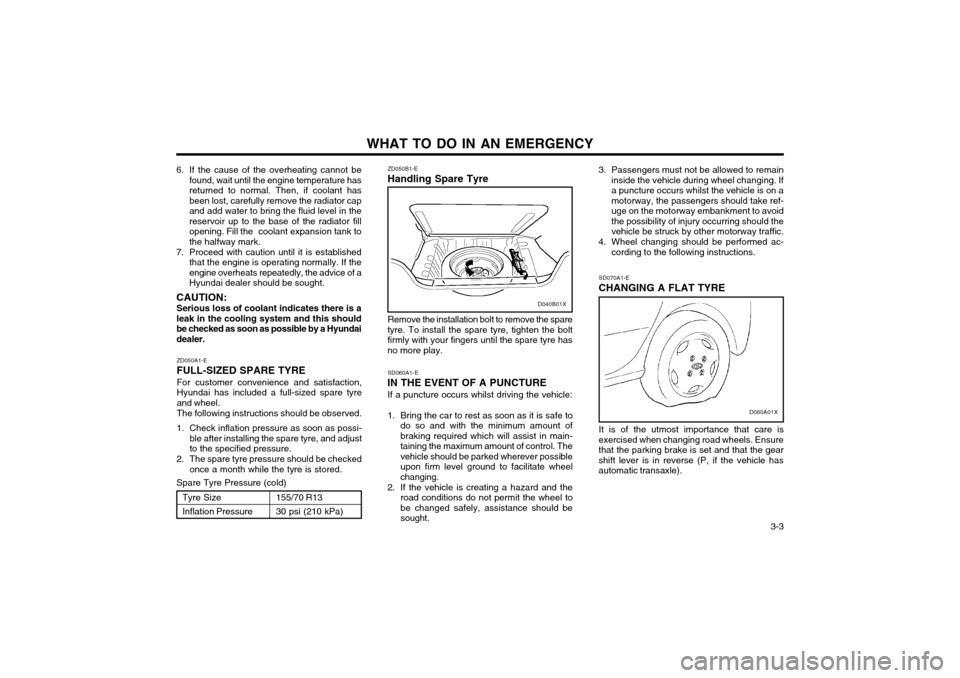
Handling Spare Tyre
6. If the cause of the overheating cannot be
found, wait until the engine temperature has returned to normal. Then, if coolant hasbeen lost, carefully remove the radiator capand add water to bring the fluid level in thereservoir up to the base of the radiator fill
opening. Fill the coolant expansion tank tothe halfway mark.
7. Proceed with caution until it is established that the engine is operating normally. If theengine overheats repeatedly, the advice of aHyundai dealer should be sought.
CAUTION: Serious loss of coolant indicates there is aleak in the cooling system and this shouldbe checked as soon as possible by a Hyundaidealer. 3. Passengers must not be allowed to remain
inside the vehicle during wheel changing. Ifa puncture occurs whilst the vehicle is on amotorway, the passengers should take ref-uge on the motorway embankment to avoidthe possibility of injury occurring should thevehicle be struck by other motorway traffic.
4. Wheel changing should be performed ac- cording to the following instructions.
ZD050A1-E
FULL-SIZED SPARE TYRE For customer convenience and satisfaction,Hyundai has included a full-sized spare tyreand wheel. The following instructions should be observed.
1. Check inflation pressure as soon as possi- ble after installing the spare tyre, and adjust to the specified pressure.
2. The spare tyre pressure should be checked once a month while the tyre is stored.
Spare Tyre Pressure (cold)
D040B01X
Remove the installation bolt to remove the spare
tyre. To install the spare tyre, tighten the bolt firmly with your fingers until the spare tyre hasno more play.
SD060A1-E
IN THE EVENT OF A PUNCTURE
If a puncture occurs whilst driving the vehicle:
1. Bring the car to rest as soon as it is safe to do so and with the minimum amount ofbraking required which will assist in main-taining the maximum amount of control. Thevehicle should be parked wherever possibleupon firm level ground to facilitate wheelchanging.
2. If the vehicle is creating a hazard and the road conditions do not permit the wheel tobe changed safely, assistance should besought. SD070A1-E
CHANGING A FLAT TYRE
D060A01X
It is of the utmost importance that care is
exercised when changing road wheels. Ensure that the parking brake is set and that the gearshift lever is in reverse (P, if the vehicle hasautomatic transaxle).
Tyre Size Inflation Pressure 155/70 R1330 psi (210 kPa)
Page 205 of 249
WHAT TO DO IN AN EMERGENCY
3-4 SD070B1-E
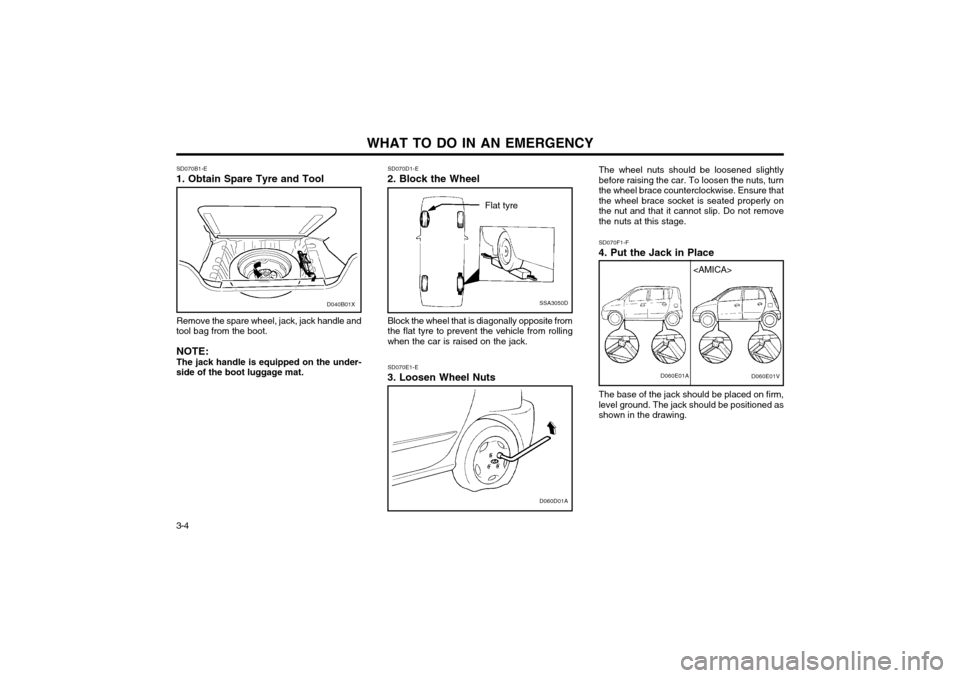
1. Obtain Spare Tyre and Tool
Remove the spare wheel, jack, jack handle and
tool bag from the boot.
NOTE: The jack handle is equipped on the under-
side of the boot luggage mat.
SSA3050D
Flat tyre
SD070D1-E
2. Block the Wheel
Block the wheel that is diagonally opposite from the flat tyre to prevent the vehicle from rollingwhen the car is raised on the jack.
D060D01A
SD070E1-E
3. Loosen Wheel Nuts The wheel nuts should be loosened slightly before raising the car. To loosen the nuts, turnthe wheel brace counterclockwise. Ensure thatthe wheel brace socket is seated properly onthe nut and that it cannot slip. Do not removethe nuts at this stage. SD070F1-F
4. Put the Jack in Place
The base of the jack should be placed on firm, level ground. The jack should be positioned asshown in the drawing.D060E01A
D040B01X
Page 206 of 249
3-5
WHAT TO DO IN AN EMERGENCY
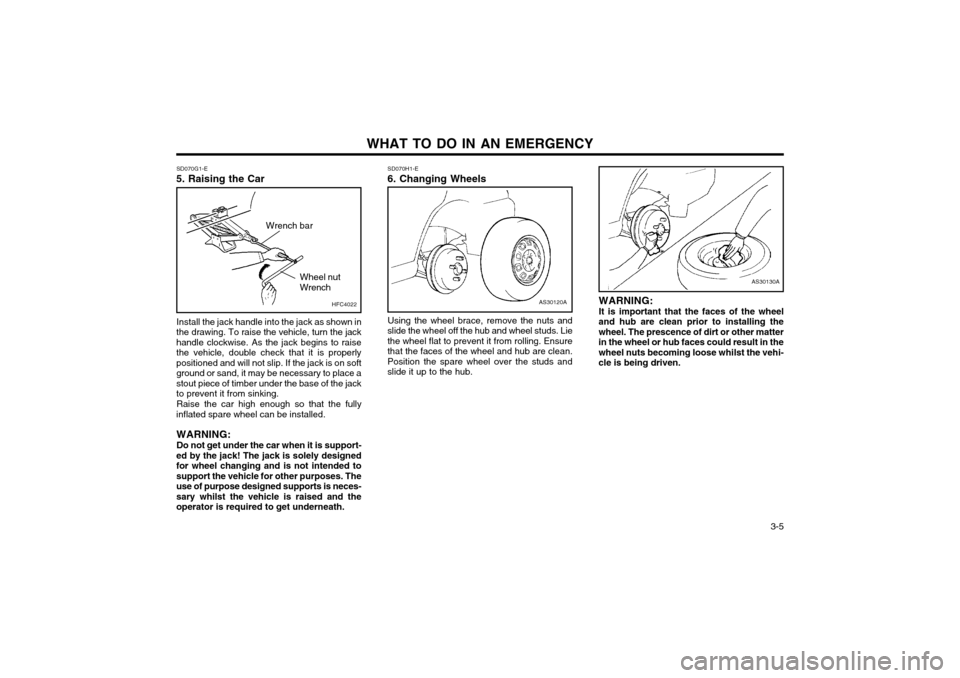
SD070G1-E
5. Raising the Car
AS30120A
SD070H1-E 6. Changing Wheels
Using the wheel brace, remove the nuts and
slide the wheel off the hub and wheel studs. Lie the wheel flat to prevent it from rolling. Ensurethat the faces of the wheel and hub are clean.Position the spare wheel over the studs andslide it up to the hub.
Install the jack handle into the jack as shown in
the drawing. To raise the vehicle, turn the jackhandle clockwise. As the jack begins to raisethe vehicle, double check that it is properlypositioned and will not slip. If the jack is on softground or sand, it may be necessary to place astout piece of timber under the base of the jackto prevent it from sinking.
Raise the car high enough so that the fully
inflated spare wheel can be installed.
WARNING: Do not get under the car when it is support-
ed by the jack! The jack is solely designed for wheel changing and is not intended tosupport the vehicle for other purposes. Theuse of purpose designed supports is neces-sary whilst the vehicle is raised and theoperator is required to get underneath. WARNING: It is important that the faces of the wheel
and hub are clean prior to installing the wheel. The prescence of dirt or other matterin the wheel or hub faces could result in thewheel nuts becoming loose whilst the vehi-cle is being driven.
AS30130A
HFC4022
Wrench bar
Wheel nut Wrench
Page 207 of 249
WHAT TO DO IN AN EMERGENCY
3-6 SD070I1-E
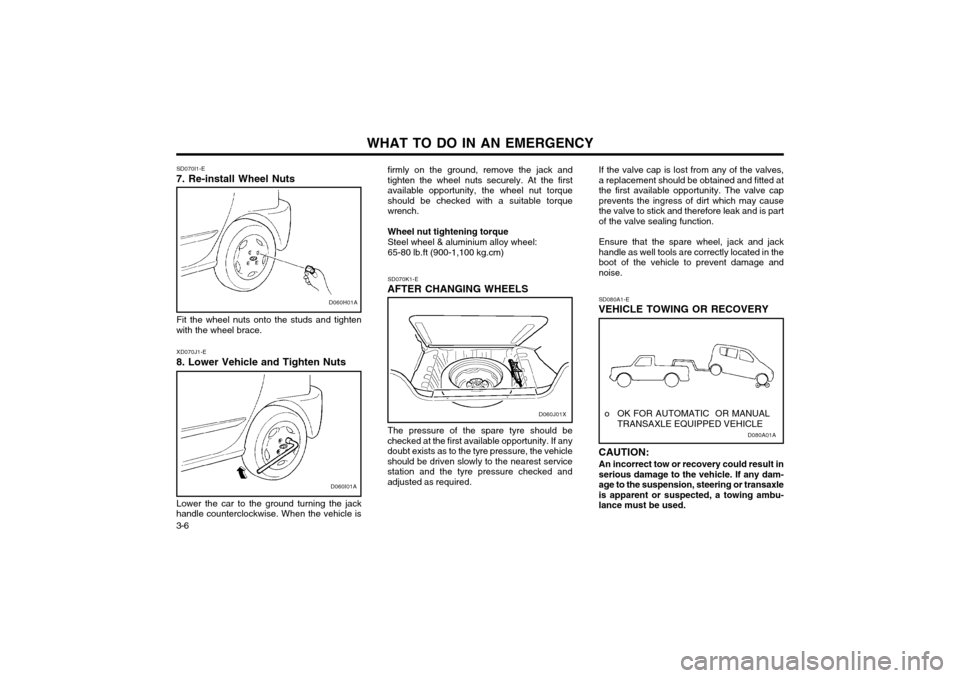
7. Re-install Wheel Nuts
D060H01A
Fit the wheel nuts onto the studs and tighten
with the wheel brace.
D060I01A
XD070J1-E
8. Lower Vehicle and Tighten Nuts
Lower the car to the ground turning the jack
handle counterclockwise. When the vehicle is firmly on the ground, remove the jack and tighten the wheel nuts securely. At the firstavailable opportunity, the wheel nut torqueshould be checked with a suitable torquewrench. Wheel nut tightening torque Steel wheel & aluminium alloy wheel:65-80 lb.ft (900-1,100 kg.cm) SD070K1-E
AFTER CHANGING WHEELS
The pressure of the spare tyre should be
checked at the first available opportunity. If any doubt exists as to the tyre pressure, the vehicleshould be driven slowly to the nearest servicestation and the tyre pressure checked andadjusted as required. If the valve cap is lost from any of the valves,a replacement should be obtained and fitted atthe first available opportunity. The valve capprevents the ingress of dirt which may causethe valve to stick and therefore leak and is partof the valve sealing function. Ensure that the spare wheel, jack and jack handle as well tools are correctly located in theboot of the vehicle to prevent damage andnoise.
D080A01A
o OK FOR AUTOMATIC OR MANUAL
TRANSAXLE EQUIPPED VEHICLE
SD080A1-E
VEHICLE TOWING OR RECOVERY CAUTION:
An incorrect tow or recovery could result in serious damage to the vehicle. If any dam-age to the suspension, steering or transaxleis apparent or suspected, a towing ambu-lance must be used.D060J01X
Page 208 of 249
3-7
WHAT TO DO IN AN EMERGENCY
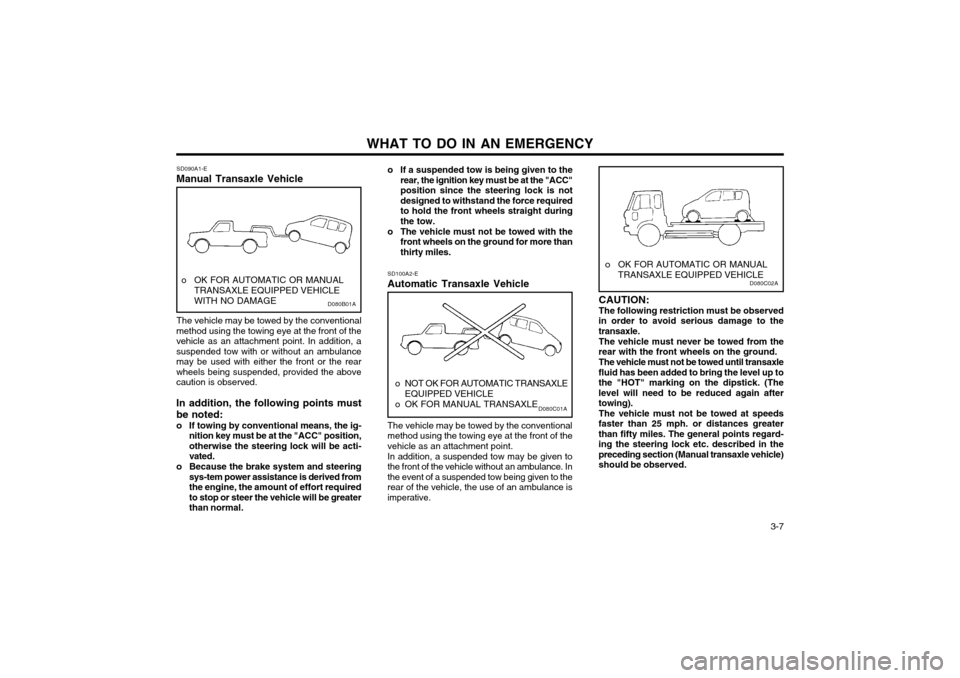
SD090A1-E
Manual Transaxle Vehicle o If a suspended tow is being given to the
rear, the ignition key must be at the "ACC" position since the steering lock is notdesigned to withstand the force requiredto hold the front wheels straight duringthe tow.
o The vehicle must not be towed with the front wheels on the ground for more thanthirty miles.
D080B01A
o OK FOR AUTOMATIC OR MANUAL
TRANSAXLE EQUIPPED VEHICLE WITH NO DAMAGE
The vehicle may be towed by the conventional
method using the towing eye at the front of the vehicle as an attachment point. In addition, asuspended tow with or without an ambulancemay be used with either the front or the rearwheels being suspended, provided the abovecaution is observed. In addition, the following points must be noted:
o If towing by conventional means, the ig- nition key must be at the "ACC" position, otherwise the steering lock will be acti-vated.
o Because the brake system and steering sys-tem power assistance is derived fromthe engine, the amount of effort requiredto stop or steer the vehicle will be greaterthan normal. SD100A2-E Automatic Transaxle Vehicle
D080C01A
o NOT OK FOR AUTOMATIC TRANSAXLE
EQUIPPED VEHICLE
o OK FOR MANUAL TRANSAXLE
The vehicle may be towed by the conventional method using the towing eye at the front of thevehicle as an attachment point. In addition, a suspended tow may be given to the front of the vehicle without an ambulance. Inthe event of a suspended tow being given to therear of the vehicle, the use of an ambulance isimperative.
D080C02A
o OK FOR AUTOMATIC OR MANUAL TRANSAXLE EQUIPPED VEHICLE
CAUTION: The following restriction must be observed
in order to avoid serious damage to the transaxle.
The vehicle must never be towed from the
rear with the front wheels on the ground.
The vehicle must not be towed until transaxle
fluid has been added to bring the level up tothe "HOT" marking on the dipstick. (Thelevel will need to be reduced again aftertowing). The vehicle must not be towed at speeds
faster than 25 mph. or distances greaterthan fifty miles. The general points regard-ing the steering lock etc. described in thepreceding section (Manual transaxle vehicle)should be observed.
Page 209 of 249
WHAT TO DO IN AN EMERGENCY
3-8 D080D01X-GAT
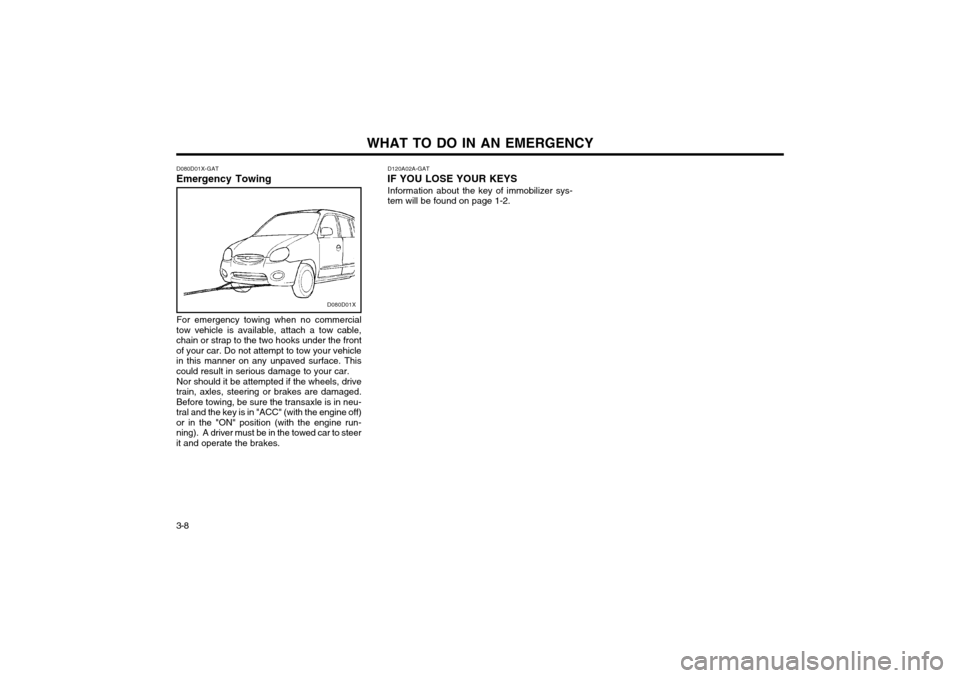
Emergency Towing
D080D01X
For emergency towing when no commercial
tow vehicle is available, attach a tow cable,
chain or strap to the two hooks under the frontof your car. Do not attempt to tow your vehicle
in this manner on any unpaved surface. Thiscould result in serious damage to your car.
Nor should it be attempted if the wheels, drive
train, axles, steering or brakes are damaged.Before towing, be sure the transaxle is in neu-
tral and the key is in "ACC" (with the engine off)or in the "ON" position (with the engine run-ning). A driver must be in the towed car to steer
it and operate the brakes. D120A02A-GAT
IF YOU LOSE YOUR KEYS
Information about the key of immobilizer sys-tem will be found on page 1-2.
Page 210 of 249
CORROSION PREVENTION & APPEARANCE CARE 4-1
moved. Should any damage to or deterioration of the underbody coating be apparent, the ad-vice of a Hyundai dealer regarding the use of acompatible repair material should be sought.
NOTE: The underbody should never be steam
cleaned since the underbody coating may be removed by this process.
During the interim period between power wash-
ing the underbody, the more vulnerable areassuch as wheelarches should be hosed off,particularly during the winter season to preventprolonged contact of road salt with the body. Ensure that the various drain points located at
bottom of the door panels are kept clear, toprevent water becoming trapped within the cavi-ties. Wherever possible, the parking of thevehicle in a confined, poorly ventilated location(e.g.) garage should be avoided when the vehi-cle is wet or covered with snow or ice. Underthese conditions, the internal cavities of thevehicle will remain damp for long periods oftime which encourage corrosion. Parking thevehicle where good ventilation exists is prefer-able.
ZE020B1-E
Underbody Coatings Every Hyundai passenger car receives a full
underbody and cavity injection treatment duringproduction. In order that this treatment mayretain maximum effectiveness, it is recommend-ed that the underbody receives a power washand a thorough inspection after each winterseason. In so doing any accumulations of mud,which act as moisture traps and combine withroad salts to accelerate corrosion, will be re-
ZE000A1-E
4. CORROSION PRE-
VENTION & AP- PEARANCE CARE
ZE020A1-E
APPEARANCE CARE In using the most advanced design and con-
struction practices, every Hyundai is built to retain its original factory finish for many years.However, long term durability is also greatlydependant upon maintaining the various pro-tection systems and coatings used in manufac- ture since constant exposure to the elements will eventually result in their breakdown andloss of effectiveness. The following sugges-tions are made to assist in the maintenance ofthe vehicle bodywork.
ZE020C1-E
Interior During the winter period, it is possible that the
carpet within the passenger compartment maybecome wet. The carpet should not be allowedto remain in this condition for prolonged periods JE050A1-E
VALETING
Regular cleaning of the exterior paintwork serves
two important functios. Firstly, the removal ofabrasive dirt and contaminants will maintain thelustre of the paintwork and will preventdiscolouration and dulling due to prolonged con-tact.
Secondly, the presence of damage through
impact or abrasion will be apparent allowingearly rectification to be made thus preventingcorrosion from becoming established andspreading beneath the paint film. To avoid "wa-ter spotting" the vehicle should not be washedin direct sunlight particularly in the case ofvehicles having dark body colours. The heatfrom the sun rays is absorbed by the paint filmincreasing the surface temperature. This actioncauses water used for washing to evaporatequickly leaving behind the deposits from thewater and the shampoo used. Use only a shampoo intended for the purpose
and ensure that the body work is thoroughlywetted to soften the dirt film prior to attemptingto remove this.
After removing the dirt film with a soft sponge,
the body work should be thoroughly rinsed andthen dried with a good quality ch mois leather toprevent streaking or spotting of the paint work.
since the carpet may begin to create mustysmells and promote internal corrosion of thefloorpan.
4
Page 211 of 249
CORROSION PREVENTION & APPEARANCE CARE
4-2 Household detergents, solvents and abrasive
cleaning materials should not be used in order ot avoid damaging the paint film.
Plastic wheel covers should be cleaned using a
sponge and water. Cast alloy wheels should becleaned using a mild soap or neutral detergent.Abrasive compounds must not be used since inthe event of these damaging the lacquer coat-ing, oxidisation of the aluminium wheel willoccur, spoiling the appearance.
The use of an a toothbrush will facilitate clean-
ing between the wheel "spokes". JE080A1-E
BUMPER MAINTENANCE
The special material from which the bumpersare manufactured warrants special attention topreserve the appearance of thebumpers. Avoidcontact with battery electrolyte or brake fluidand ensure that accidental spillages are imme-diately flushed with water. Do not use abrasive cleaning materials which may damage the bumpers. Avoid subjecting the bumpers to high tempera- tures such as may be encountered in high bakepaing ovens.
JE060A1-E
STAIN/SPOT REMOVAL Should tree sap, dead insects or tar prove to be
difficult to remove from the paint film, turpentineor a proprietary paint cutting compound may beused. Ensure that the area to be cleaned is notrubbed intensively to prevent breaking throughthe colour coat and exposing the under coat.
JE070A1-E
POLISHING The exterior paint work should be polished with
a proprietary wax polish when water no longercollects in bead form on the paint work. Theinstructions of the product manufacturer shouldbe adhered to. JE090A1-E
ACCIDENT REPAIRS In the event of the body work sustaining dam-age, the following points should be noted priorto repairs being undertaken. If body panels are replaced or repaired, anti corrosion treatment must be applied to therepair area. The product used must be compat-ible with those used in manufacture. It is recom-mended that repairs are entrusted to a Hyundaidealer to ensure that replacement parts usedare of the same high quality as those used inmanufacture of the vehicle and that the correctrepair methods and materials will ensure ade-quate levels of corrosion protection and thecontinued validity of the Anti Perforation War-ranty. JE100A1-E
SEAT BELTS
Seat belts should be cleaned only with a mildsoap solution. Strong detergents, solvens orbleaches may damage the belt webbing andtherefore reduce the effectiveness of the belt.Belts which display signs of fraying, wear of cutshould be replaced. JE110A1-E
INTERIOR VALETING
The soft trim and carpets should be maintained with the regular use of a vacuum cleaner. Heavysoiling should be removed with a dry cleaningagent recommended for this purpose followingthe instructions of the product manufacturer.Paint thinner, solvents or other such cleaningmaterials should not be used since damage tothe upholstery may result. JE120A1-E
WINDOWS
A proprietary glass cleaner should be used to clean the inside of the windows. However, therear heated windscreen must only be cleanedusing a light horizontal cleaning action. Careshould be exercised to avoid the use of abra-sive cleaners or contact with items of jewellerywhich may damage the heating elements.