check engine Hyundai Atos 2002 Workshop Manual
[x] Cancel search | Manufacturer: HYUNDAI, Model Year: 2002, Model line: Atos, Model: Hyundai Atos 2002Pages: 249, PDF Size: 3.11 MB
Page 198 of 249
DRIVING YOUR HYUNDAI 2- 9
ZC170C1-E
Anti-freeze/Corrosion inhibitor The cooling system must always contain an
Ethylene-Glycol based anti-freeze solution. The system is filled during manufacture with solu-tion of the correct strength which should bechecked before the onset of winter and adjust-ed or changed as required.
NOTE: The anti-freeze solution contains a corro-
sion inhibitor to prevent degradation of the aluminum castings contained within theengine. Therefore, never, drain the systemand refill with water only.
In addition, anti-freeze solution must ALWAYS
be used in vehicles fitted with air conditioning,to prevent the heater matrix from freezing andsubsequently bursting with the refrigeration sys-tem in use. ZC170B1-E
Electrical System
Winter conditions impose severe demands upon
vehicle electrical systems, particularly the charg-ing circuit. The battery condition and perfor-mance along with the alternator performanceand drive belt condition should be checked priorto the onset of winter.
o Don’t "lug" or "over-rev" the engine. Lugging
is driving too slowly in too high a gearresulting in the engine bucking. If this hap-pens to you, shift to a lower gear. Over-revving is racing the engine beyond its safe limit. This can be avoided by shifting atthe recommended speeds.
o Use your air conditioning sparingly. The air conditioning system is operated by the en-gine power so your fuel economy is reducedwhen you use it.
SC160A1-F
SMOOTH CORNERING Avoid braking or gear changing in corners,
especially when roads are wet. Ideally, cornersshould always be taken under gentle accelera-tion. If you follow these suggestions, tire wearwill be held to a minimum.
SC170A1-E
WINTER MOTORING The onset of winter conditions subject motor
vehicles to greater operating demands. There-fore, the following suggestions will assist inmaintaining peak performance and reliabilityduring these periods: ZC170D1-E
Door Locks
Should the door lock mechanism become fro-
zen, a proprietary lock de-icer should be used.Alternatively, warming the door key may thawthe door lock. However, the key should behandled carefully to avoid burning the fingers.
Never attempt to thaw a frozen door lock using
hot water, since the water will eventually freezeand compound the problem.
NOTE:The proper temperature for using the immo-
bilizer key is from -40°F to 176°F(from -40°Cto 80°C). If you heat the immobilizer keyover 176°F(80°C) to open the frozen lock, itmay cause damage to the transponder in itshead.
ZC170E1-E
Windscreen Washers & Wipers The windscreen washer bottle should be filled
with a solution of water and a proprietary winterscreen wash additive. The windscreen wipersshould not be used it the blades are frozen tothe windscreen or if they are covered withsnow, before this is removed.
NOTE: Never allow undiluted screen washer fluid
additive to spill upon the paintwork or use engine coolant anti-freeze since damage tothe paintwork may result.
Page 199 of 249
DRIVING YOUR HYUNDAI
2- 10 CAUTION:
o Never connect a trailer brake system di-
rectly to the vehicle brake system.
o When towing a trailer on steep grades (in excess of 12%) pay close attention to the engine coolant temperature gauge to
ensure the engine does not overheat. Ifthe needle of the coolant temperaturegauge moves across the dial towards"H" (HOT), pull over and stop as soon as
it is safe to do so, and allow the engine toidle until it cools down. You may proceed
once the engine has cooled sufficiently.
C190D01A-GAT
Safety Chains Should the hitch connection between your carand the trailer or vehicle you are towing fail, thetrailer or vehicle could wander dangerouslyacross other lanes of traffic and ultimately col-lide with another vehicle. To eliminate this po-tentially dangerous situation, safety chains, attached between your car and the trailer ortowed vehicle, are required in most provinces.
o When driving in extreme conditions, the
windscreen wiper blades may fail to clearthe screen properly due to the formation ofice upon the blade edge. It will therefore benecessary to periodically remove such iceto restore their efficiency.
o If the power operated door mirrors become frozen, attempts to adjust these may dam-age the mechanism.
o The formation of snow or ice build up inside the wheel arches may interfere with theroadwheels or steering mechanism. In suchinstances, unusual noises or an increase insteering effort may result. Therefore, ensurethat the wheelarches are checked periodi-cally and any accumulated snow or iceremoved.
o It is advisable to carry emergency equip- ment including, torch, shovel, tow rope, blan-kets etc., if a journey is to be undertaken intoareas of severe road conditions. CAUTION: Do not do any towing with your car during
its first 1,200 miles in order to allow the engine to properly break in. Failure to heedthis caution may result in serious engine ortransaxle damage.
C190B01S-AAT
Trailer Hitches Select the proper hitch and ball combination,
making sure that it's location is compatible withthat of the trailer or vehicle being towed. Use aquality non-equalizing hitch which distributesthe tongue load uniformly throughout the chas-sis.
The hitch should be bolted securely to the car
and installed by a qualified technician. DO NOTUSE A HITCH DESIGNED FOR TEMPORARY
INSTALLATION AND NEVER USE ONE THATATTACHES ONLY TO THE BUMPER.
C190A01A-EAT
TRAILER OR VEHICLE TOWING
If you are considering towing with your car, you
should first check with your Province Depart-ment of Motor Vehicles to determine their legalrequirements.
Since laws vary from province to province the
requirements for towing trailers, cars, or othertypes of vehicles or apparatus may differ. Askyour Hyundai dealer for further details beforetowing. C190C01X-GAT
Trailer Brakes If your trailer is equipped with a braking system,
make sure it conforms to federal and/or localregulations and that it is properly installed andoperating correctly. NOTE: If you tow a trailer or vehicle, your car will require more frequent maintenance due tothe additional load. See Maintenance UnderSevere Usage Conditions" on page 5-4.
Page 201 of 249
DRIVING YOUR HYUNDAI
2- 12 15. If you have to stop while going uphill, do not
hold the vehicle in place by pressing on the accelerator. This can cause the automatictransaxle to overheat. Use the parking brakeor footbrake.
NOTE: When towing, check transaxle fluid more frequently. CAUTION: If overheating should occur when towing,
(temperature gauge reads near red zone),taking the following action may reduce oreliminate the problem.
1. Turn off the air conditioner.
2. Reduce highway speed.
3. Select a lower gear when going uphill.
4. While in stop and go traffic, place the gear selection in park or neutral and idle theengine at a higher speed.
being passed by a large vehicle, keep aconstant speed and steer straight ahead. If there is too much wind buffeting, slow
down to get out of the other vehicle's airturbulence.
8. When parking your car and trailer, especial- ly on a hill, be sure to follow all the normalprecautions. Turn your front wheel into thecurb, set the parking brake firmly, and putthe transaxle in 1st or Reverse (manual) orPark (automatic). In addition, place wheelchocks at each of the trailer's tyres.
9. If the trailer has electric brakes, start your vehicle and trailer moving, and then applythe trailer brake controller by hand to be
sure the brakes are working. This lets you
check your electrical connection at the sametime.
10. During your trip, check occasionally to be sure that the load is secure, and that thelights and any trailer brakes are still working.
11. Avoid jerky starts, sudden acceleration or sudden stops.
12. Avoid sharp turns and rapid lane changes.
13. Avoid holding the brake pedal down too long or too frequently. This could cause the brakes to overheat, resulting in reduced brakingefficiency.
14. When going down a hill, shift into a lower gear and use the engine braking effect.When ascending a long grade, downshift thetransaxle to a lower gear and reduce speedto reduce chances of engine overloading
and or overheating.
WARNING:
o The tongue load should never exceed;
Auto Transaxle : 55.1 lb Manual Transaxle 9: 61.7 lb
o Maximun permissible mass of the cou- pling device (ATOS VAN only) : 44 lb
o Improperly loading your car and trailer can serious affect its steering and brak- ing performance causing a crash in which
you may be seriously injured or killed.
YC200E1-A
Trailer or Vehicle Towing Tips
1. Before towing, check hitch and safety chain connections as well as proper operation of the trailer running lights, brake lights, andturn signals.
2. Always drive your vehicle at a moderate speed (Less than 62 MPH).
3. Trailer towing requires more fuel than nor- mal conditions.
4. To maintain engine braking efficiency and electrical charging performance, do not usefifth gear (manual transaxle) or overdrive(automatic transaxle).
5. Always secure items in the trailer to prevent load shift while driving.
6. Check the condition and air pressure of all tires on the trailer and your car. Low tyrepressure can seriously affect the handling.Also check the spare tyre.
7. The vehicle/trailer combination is more af- fected by crosswind and buffeting. When
Page 202 of 249
3-1
WHAT TO DO IN AN EMERGENCY
fitted with automatic transaxle ensure that the transaxle selector is at the "P" or"N"position.
2. Check the battery terminals and connec- tions to ensure that these are clean and alsotight.
3. If the ignition warning lamps dim when the engine is cranked and the battery terminalshave been checked, a discharged battery isindicated.
4. Do not attempt to push or tow start the vehicle, refer to "Jump Starting" for informa-tion regarding engine starting when the bat-tery is discharged.
DD020A1-E
IF THE ENGINE WILL NOT START Seek assistance from the nearest Hyundai
dealer with regard to the method of ignition andfuel system diagnosis.
CAUTION: If the engine refuses to start, no attempt
should be made to push or tow start the vehicle. Vehicles with automatic transaxleor fuel injection will not be able to be startedin this manner since no drive is transmittedthrough the automatic transaxle whilst theengine is not running, and in the case of fuelinjected derivatives, the fuel pump will notoperate under tow start conditions. In addi-tion, if the vehicle is equipped with an ex-haust catalyst, damage to the catalyst mayresult if the vehicle is tow started. ZD000A1-E
3. WHAT TO DO IN AN
EMERGENCY
DD020B1-E
IF THE ENGINE CANNOT BE
CRANKED
1. If the vehicle is fitted with manual transaxle ensure that the clutch pedal is depressedwhilst cranking the engine. If the vehicle is ZD020C2-D
If Engine Turns Over Normally but Does Not Start AD020D1-A
If Engine Stalls While Driving
1. Reduce your speed gradually, keeping a straight line. Move cautiously off the road to a safe place.
2. Turn on your emergency flashers.
3. Try starting the engine again. If your vehicle will not start, see “IF THE ENGINE WILL NOT START”
DD030A1-E
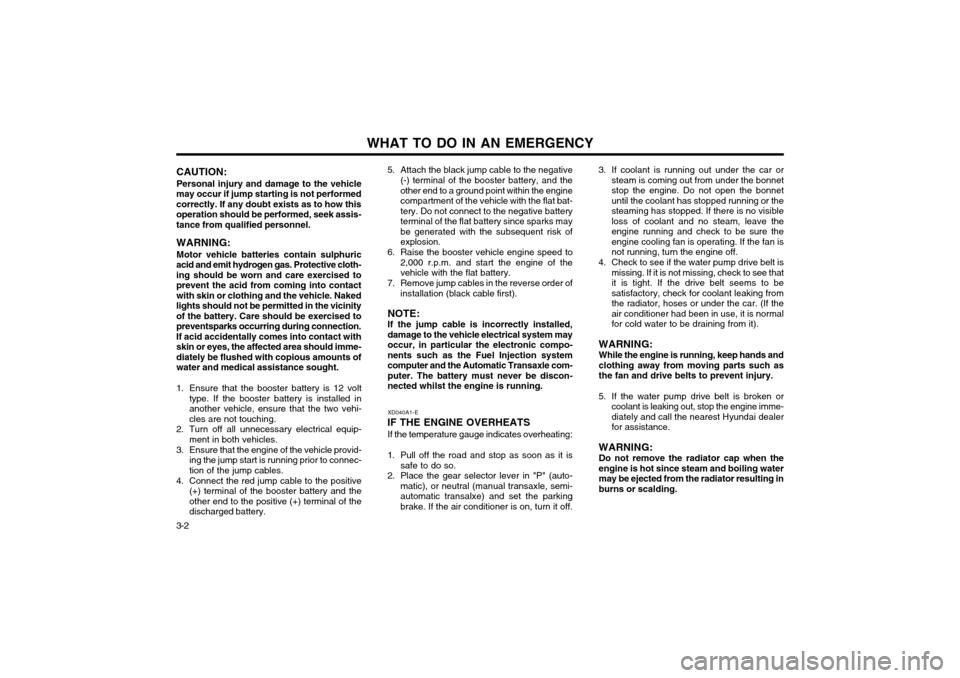
JUMP STARTING
1. Check fuel level.
2. Check all connectors at coil and spark plugs.
Re-connect any that may be disconnected or loose.
3. Check fuel line in the engine room.
4. If engine still refuses to start, call a Hyundai dealer or seek other qualified assistance.
AX30030A
Negative to the enginenot to the battery
Positive to positive
Dead battery Booster battery
D010C01X-1Spark plug
3
Page 203 of 249
WHAT TO DO IN AN EMERGENCY
3-2 3. If coolant is running out under the car or
steam is coming out from under the bonnet stop the engine. Do not open the bonnetuntil the coolant has stopped running or thesteaming has stopped. If there is no visibleloss of coolant and no steam, leave theengine running and check to be sure theengine cooling fan is operating. If the fan isnot running, turn the engine off.
4. Check to see if the water pump drive belt is missing. If it is not missing, check to see thatit is tight. If the drive belt seems to besatisfactory, check for coolant leaking fromthe radiator, hoses or under the car. (If theair conditioner had been in use, it is normalfor cold water to be draining from it).
WARNING: While the engine is running, keep hands andclothing away from moving parts such asthe fan and drive belts to prevent injury.
5. If the water pump drive belt is broken or coolant is leaking out, stop the engine imme-diately and call the nearest Hyundai dealerfor assistance.
WARNING: Do not remove the radiator cap when theengine is hot since steam and boiling watermay be ejected from the radiator resulting inburns or scalding.
CAUTION:
Personal injury and damage to the vehicle
may occur if jump starting is not performedcorrectly. If any doubt exists as to how thisoperation should be performed, seek assis-tance from qualified personnel. WARNING:
Motor vehicle batteries contain sulphuric
acid and emit hydrogen gas. Protective cloth- ing should be worn and care exercised toprevent the acid from coming into contactwith skin or clothing and the vehicle. Nakedlights should not be permitted in the vicinityof the battery. Care should be exercised topreventsparks occurring during connection.If acid accidentally comes into contact withskin or eyes, the affected area should imme-diately be flushed with copious amounts ofwater and medical assistance sought.
1. Ensure that the booster battery is 12 volt type. If the booster battery is installed in another vehicle, ensure that the two vehi-cles are not touching.
2. Turn off all unnecessary electrical equip- ment in both vehicles.
3. Ensure that the engine of the vehicle provid- ing the jump start is running prior to connec-tion of the jump cables.
4. Connect the red jump cable to the positive (+) terminal of the booster battery and theother end to the positive (+) terminal of thedischarged battery. 5. Attach the black jump cable to the negative
(-) terminal of the booster battery, and theother end to a ground point within the enginecompartment of the vehicle with the flat bat-tery. Do not connect to the negative batteryterminal of the flat battery since sparks maybe generated with the subsequent risk ofexplosion.
6. Raise the booster vehicle engine speed to 2,000 r.p.m. and start the engine of thevehicle with the flat battery.
7. Remove jump cables in the reverse order of installation (black cable first).
NOTE: If the jump cable is incorrectly installed, damage to the vehicle electrical system mayoccur, in particular the electronic compo-nents such as the Fuel Injection systemcomputer and the Automatic Transaxle com-puter. The battery must never be discon-nected whilst the engine is running. XD040A1-E
IF THE ENGINE OVERHEATS If the temperature gauge indicates overheating:
1. Pull off the road and stop as soon as it is safe to do so.
2. Place the gear selector lever in "P" (auto- matic), or neutral (manual transaxle, semi- automatic transalxe) and set the parkingbrake. If the air conditioner is on, turn it off.
Page 204 of 249
3-3
WHAT TO DO IN AN EMERGENCY
ZD050B1-E
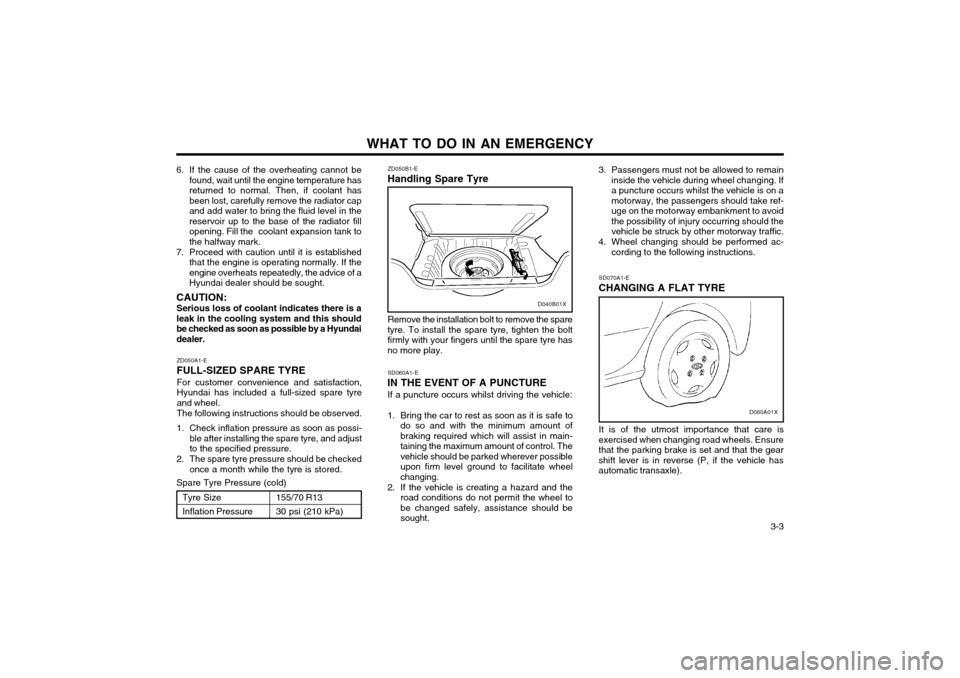
Handling Spare Tyre
6. If the cause of the overheating cannot be
found, wait until the engine temperature has returned to normal. Then, if coolant hasbeen lost, carefully remove the radiator capand add water to bring the fluid level in thereservoir up to the base of the radiator fill
opening. Fill the coolant expansion tank tothe halfway mark.
7. Proceed with caution until it is established that the engine is operating normally. If theengine overheats repeatedly, the advice of aHyundai dealer should be sought.
CAUTION: Serious loss of coolant indicates there is aleak in the cooling system and this shouldbe checked as soon as possible by a Hyundaidealer. 3. Passengers must not be allowed to remain
inside the vehicle during wheel changing. Ifa puncture occurs whilst the vehicle is on amotorway, the passengers should take ref-uge on the motorway embankment to avoidthe possibility of injury occurring should thevehicle be struck by other motorway traffic.
4. Wheel changing should be performed ac- cording to the following instructions.
ZD050A1-E
FULL-SIZED SPARE TYRE For customer convenience and satisfaction,Hyundai has included a full-sized spare tyreand wheel. The following instructions should be observed.
1. Check inflation pressure as soon as possi- ble after installing the spare tyre, and adjust to the specified pressure.
2. The spare tyre pressure should be checked once a month while the tyre is stored.
Spare Tyre Pressure (cold)
D040B01X
Remove the installation bolt to remove the spare
tyre. To install the spare tyre, tighten the bolt firmly with your fingers until the spare tyre hasno more play.
SD060A1-E
IN THE EVENT OF A PUNCTURE
If a puncture occurs whilst driving the vehicle:
1. Bring the car to rest as soon as it is safe to do so and with the minimum amount ofbraking required which will assist in main-taining the maximum amount of control. Thevehicle should be parked wherever possibleupon firm level ground to facilitate wheelchanging.
2. If the vehicle is creating a hazard and the road conditions do not permit the wheel tobe changed safely, assistance should besought. SD070A1-E
CHANGING A FLAT TYRE
D060A01X
It is of the utmost importance that care is
exercised when changing road wheels. Ensure that the parking brake is set and that the gearshift lever is in reverse (P, if the vehicle hasautomatic transaxle).
Tyre Size Inflation Pressure 155/70 R1330 psi (210 kPa)
Page 212 of 249
VEHICLE MAINTENANCE REQUIREMENTS 5-1
NOTE: The inspection and testing of certain elec-
tronic fuel injection/engine management and automatic transmission control systems re-quire specialised electronic equipment spe-cifically designed for Hyundai vehicles. Theuse of general purpose electrical test equip-ment may result in damage to the controlunit microprocessors. be sure these are equivalent to the quality ofthe original Hyundai parts. Your Service Pass-port provides further information about yourwarranty coverage.
DF020F1-E SERVICE HISTORYIt is important that all scheduled maintenance
services are recorded in the warranty and ser- vice passport to ensure that proof of mainte-nance is available when warranty service isrequired.
DF020A1-E MAINTENANCE AND SERVICING REQUIREMENTS To ensure the continued reliability and safety of
the vehicle, certain routine maintenance opera-tions are required at specific mileage or timeintervals.
It is the responsibility of the vehicle owner to
ensure that the maintenance schedules shownin both this Owners Manual and the Warrantyand Service Passport are adhered to.
The new vehicle warranty may be invalidated if
the routine maintenance operations are notperformed in line with the recommendationsoutlined and the safety and durability of thevehicle adversely affected.
It is recommended that all maintenance opera-
tions with the exception of the daily operatingchecks are entrusted to a Hyundai dealer toensure that the latest repair and maintenanceprocedures and specialized servicing tools areemployed. In addition, the use of genuineHyundai replacement parts will ensure that thevehicle safety and performance will not becompromised. ZF010A1-A
5. VEHICLE MAINTE-
NANCE REQUIRE- MENTS
SF020C1-B Specified Scheduled ProceduresThese are the procedures such as inspections,
adjustments and replacements that are listed in the maintenance charts starting on page 5-2.These procedures must be performed at theintervals shown in the maintenance scheduleto assure that your warranty remains in effect.Although it is strongly recommended that theybe performed by the factory-trained or distribu-tor-trained technicians at your Hyundai dealer,these procedures may be performed at anyqualified service facility.
It is suggested that genuine Hyundai service
parts be used for any required repairs or re-placements. Other parts of equivalent qualitysuch as engine oil, engine coolant, manual orauto transaxle oil, brake fluid and so on whichare not supplied by Hyundai Motor Company orits distributor may be used without affectingyour warranty coverage but you should always
5
Page 214 of 249
VEHICLE MAINTENANCE REQUIREMENTS 5-3
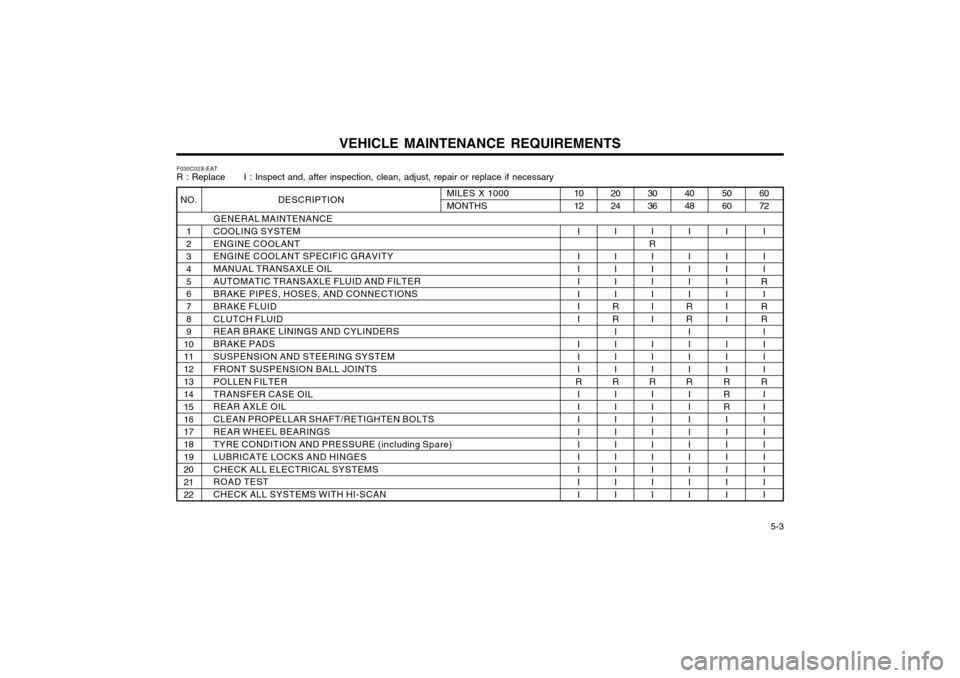
F030C02X-EAT R : Replace I : Inspect and, after inspection, clean, adjust, repair or replace if necessary
DESCRIPTION
GENERAL MAINTENANCE COOLING SYSTEMENGINE COOLANT ENGINE COOLANT SPECIFIC GRAVITY MANUAL TRANSAXLE OILAUTOMATIC TRANSAXLE FLUID AND FILTER BRAKE PIPES, HOSES, AND CONNECTIONS BRAKE FLUIDCLUTCH FLUID REAR BRAKE LININGS AND CYLINDERS BRAKE PADSSUSPENSION AND STEERING SYSTEM FRONT SUSPENSION BALL JOINTS POLLEN FILTERTRANSFER CASE OIL REAR AXLE OIL CLEAN PROPELLAR SHAFT/RETIGHTEN BOLTSREAR WHEEL BEARINGS TYRE CONDITION AND PRESSURE (incl uding Spare)
LUBRICATE LOCKS AND HINGES CHECK ALL ELECTRICAL SYSTEMS ROAD TEST CHECK ALL SYSTEMS WITH HI-SCAN
60 72
I I I
R I
R R
I I II
R
II I II I II I
50 60
I I I II I I I II
RRR III I II I
40 48
I I I II
RR
I I II
R
II I II I II I
30 36
I
R I I II I I I II
R
II I II I II I
20 24
I I I II
RR
I I II
R
II I II I II I
10 12
I I I II I I I II
R
II I II I II I
MILES X 1000 MONTHSNO.
1 2 3 45 6 78 9
1011 1213 14 1516 17 1819 20 2122
Page 216 of 249
VEHICLE MAINTENANCE REQUIREMENTS 5-5
F060A01A-AAT EXPLANATION OF SCHEDULED MAIN-
TENANCE ITEMS
F060M01A-AAT
o Engine oil and filterThe engine oil and filter should be changed at
the intervals specified in the maintenance sched- ule. If the car is being driven in severe condi-tions, more frequent oil and filter changes arerequired.
F060B01A-AAT
o Drive belts Inspect all drive belts for evidence of cuts,
cracks, excessive wear or oil saturation and replace if necessary. Drive belts should be checked periodically for proper tension andadjusted as necessary.
F060C01A-AAT
o Fuel filterA clogged filter can limit the speed at which the
vehicle may be driven, damage the emission system and cause hard starting. If an exces-sive amount of foreign matter accumulates in
the fuel tank, the filter may require replacementmore frequently.
After installing a new filter, run the engine for
several minutes, and check for leaks at theconnections. F060D01A-AAT
o Fuel lines, fuel hoses and connec-
tions
Check the fuel lines, fuel hoses and connec-
tions for leakage and damage. Replace anydamaged or leaking parts immediately.
F060E01A-AAT
o Timing beltInspect all parts related to the timing belt for
damage and deformation. Replace any dam- aged parts immediately.
F060G01A-AAT
o Vapour hose and fuel filler capThe vapor hose and fuel filler cap should be
inspected at those intervals specified in the maintenance schedule. Make sure that a new
vapour hose or fuel filler cap is correctly re-placed.
F060F01A-AAT
o Vacuum, crankcase
ventilation hoses
Inspect the surface of hoses for evidence of
heat and/or mechanical damage. Hard andbrittle rubber, cracking, tears, cuts, abrasions,and excessive swelling indicate deterioration.Particular attention should be paid to examine
those hose surfaces nearest to high heat sourc-
es, such as the exhaust manifold. Inspect the hose routing to assure that the
hoses do not come in contact with any heatsource, sharp edges or moving component
which might cause heat damage or mechanicalwear. Inspect all hose connections, such as
clamps and couplings, to make sure they aresecure, and that no leaks are present. Hoses
should be replaced immediately if there is any
evidence of deterioration or damage.
F060H01A-AAT
o Air cleaner filter A Genuine Hyundai air cleaner filter is recom-
mended when filter is replaced.
F060J01A-AAT
o Spark plugsMake sure to install new spark plugs of the
correct heat range.
F060N01X-GAT
o Valve clearances Incorrect valve clearance will not only result in
unsteady engine operation, but will also cause excessive noise and reduced engine perfor-mance. Inspect valve clearance and adjust asrequired while the engine is hot.
Valve-to-rocker arm clearance Intake valves ..... 0.008 in. (0.2 mm)Exhaust valves .... 0.010 in. (0.25 mm)
Page 217 of 249
VEHICLE MAINTENANCE REQUIREMENTS
5-6 F070B01A-GAT
o Cooling SystemCheck the cooling system part, such as radia-
tor, coolant reservoir, hoses and connections for leakage and damage. Replace any dam-aged parts.
F070C01A-AAT
o Engine coolant The coolant should be changed at the intervals
specified in the maintenance schedule.
F070D01X-GAT
o Manual or semi-automatic transaxle
oil
Inspect the manual or semi-automatic transaxle
oil according to the maintenance schedule.
NOTE: If the oil level is low, check for possible
leaks before adding oil. Do not overfill.
F070E01X-AAT
o Automatic transaxle fluidThe fluid level should be in the “HOT” range of
the dipstick, after engine and transaxle are at
normal operating temperature. Check the Auto-matic Transaxle Fluid level with the engine
running and the transaxle in neutral, with theparking brake properly applied. Use ESSOJWS3314 when adding or changing fluid. F070F01A-AAT o Brake hoses and linesVisually check for proper installation, chafing, cracks, deterioration and any leakage. Replaceany deteriorated or damaged parts immediate-ly. F070G02A-AAT
o Brake fluid Check brake fluid level in the brake fluid reser- voir. The level should be between "MIN" and"MAX" marks on the side of the reservoir. Use only hydraulic brake fluid conforming to DOT 3 or DOT 4. F070H01A-AAT
o Rear brake drums/linings, parking
brake
Check the rear brake drums and linings for
scoring, burning, leaking fluid, broken parts,and excessive wear. Inspect the parking brake
system including the parking brake lever andcables. For detailed service procedures, referto the Shop Manual. F070J01A-AAT
o Brake pads, calipers and rotorsCheck the pads for excessive wear, discs for run out and wear, and calipers for fluid leakage. F070K01A-AAT
o Exhaust pipe and mufflerVisually inspect the exhaust pipes, muffler and hangers for cracks, deterioration, or damage.Start the engine and listen carefully for any
exhaust gas leakage. Tighten connections orreplace parts as necessary. F070L01A-AAT
o Suspension mounting bolts Check the suspension connections for loose- ness or damage. Retighten to the specifiedtorque. F070M01A-AAT
o Steering gear box, linkage & boots/
lower arm ball joint
With the vehicle stopped and engine off, check for excessive free-play in the steering wheel.Check the linkage for bends or damage. Check
the dust boots and ball joints for deterioration,cracks, or damage. Replace any damagedparts. F070N01A-AAT
o Power steering pump, belt and hos-
es
Check the power steering pump and hoses for leakage and damage. Replace any damagedor leaking parts immediately. Inspect the powersteering belt for evidence of cuts, cracks, ex-cessive wear, oiliness and proper tension.Replace or adjust it if necessary.