height Hyundai Azera 2006 User Guide
[x] Cancel search | Manufacturer: HYUNDAI, Model Year: 2006, Model line: Azera, Model: Hyundai Azera 2006Pages: 307, PDF Size: 12.62 MB
Page 191 of 307
2
DRIVING YOUR HYUNDAI
11
ANTI-LOCK BRAKE SYS-
TEM (ABS)C120A01TG-AAT(If Installed)The Anti-Lock Brake System (ABS) is de-
signed to prevent wheel lock-up during
sudden braking or on hazardous road
surfaces. The ABS control module moni-
tors the wheel speed and controls the
pressure applied to each brake. Thus, in
emergency situations or on slick roads,
ABS will increase vehicle control during
braking.NOTE:o A click sound may be heard in the
engine compartment when the ve-
hicle begins to move after the engine
is started. These conditions are nor-
mal and indicate that the anti-lock
brake system is functioning properly.
o During ABS operation, a pulsation may
be felt in the brake pedal when the
brakes are applied. Also, a noise may
be heard in the engine compartment
while braking. These conditions are
normal and indicate that the anti-lock
brake system is functioning properly.
!
WARNING:
ABS will not prevent accidents due to
improper or dangerous driving maneu-
vers. Even though vehicle control is
improved during emergency braking,
always maintain a safe distance between
you and objects ahead. Vehicle speeds
should always be reduced during ex-
treme road conditions.
The braking distance for cars equipped
with an anti-lock braking system may be
longer than for those without it in the
following road conditions.
During these conditions the vehicle
should be driven at reduced speeds:
o Rough, gravel or snow-covered
roads.
o With tire chains installed.
o On roads where the road surface is
pitted or has different surface height.
The safety features of an ABS equipped
vehicle should not be tested by high
speed driving or cornering. This could
endanger the safety of yourself or oth-
ers.
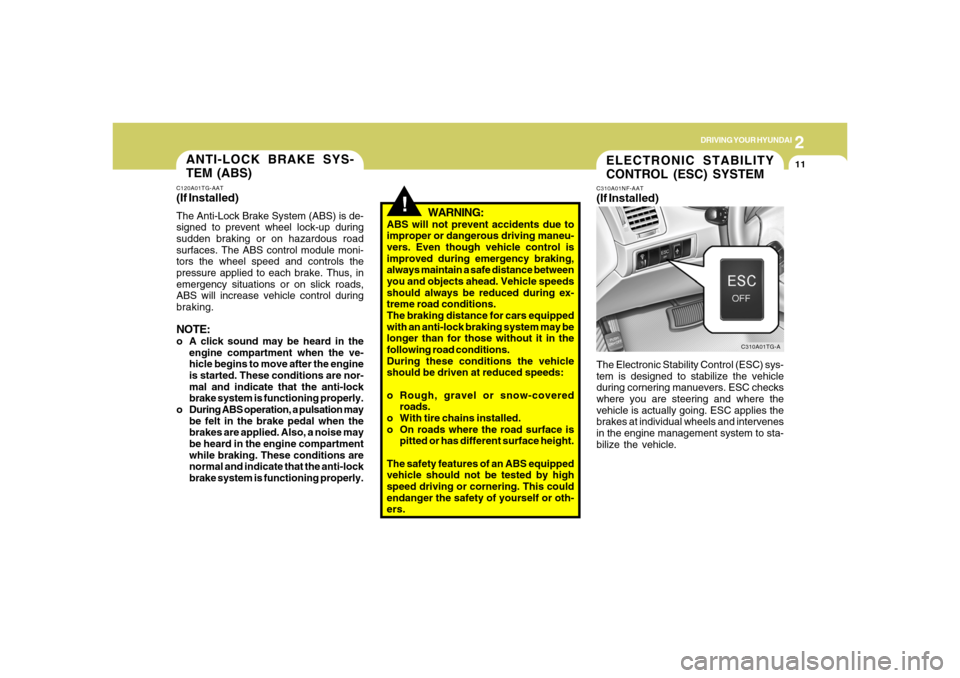
ELECTRONIC STABILITY
CONTROL (ESC) SYSTEMC310A01NF-AAT(If Installed)The Electronic Stability Control (ESC) sys-
tem is designed to stabilize the vehicle
during cornering manuevers. ESC checks
where you are steering and where the
vehicle is actually going. ESC applies the
brakes at individual wheels and intervenes
in the engine management system to sta-
bilize the vehicle.
C310A01TG-A
Page 193 of 307
2
DRIVING YOUR HYUNDAI
13
!
C310D01NF-AATIndicators and WarningThe indicators should illuminate when the
ignition key is turned to ON or START but
should go out after three seconds.
If the indicators do not illuminate, or the
ESC or ESC-OFF indicator does not go out
after 3 seconds, have the vehicle checked
by an authorized dealer.
Should there be any unusual operation of
the device while driving, the ESC-OFF
indicator illuminates as a warning.
If the ESC-OFF indicator illuminates, drive
your car to a safe place and stop the
engine.
Then, start the engine again to check if the
ESC-OFF indicator goes out.
If the indicator remains lit even after the
engine has been started, have your car
checked by an authorized Hyundai dealer. o Rough, gravel or snow-covered
roads.
o With tire chains installed.
o On roads where the road surface is
pitted or has different surface height.
The safety features of ESC equipped
vehicle should not be tested by high
speed driving or cornering. This could
endanger the safety of yourself or oth-
ers.
WARNING:
!GOOD BRAKING PRAC-
TICESC130A01A-AAT
WARNING:
Nothing should be carried on top of the
shelf panel behind the rear seat. If there
were an accident or a sudden stop, such
objects could move forward and cause
damage to the vehicle or injure the occu-
pants.
o After being parked, check to be sure the
parking brake is not engaged and that
the parking brake indicator light is out
before driving away.
o Driving through water may get the
brakes wet. They can also get wet when
the car is washed. Wet brakes can be
dangerous! Your car will not stop as
quickly if the brakes are wet. Wet brakes
may cause the car to pull to one side. To
dry the brakes, apply the brakes lightly
until the braking action returns to nor-
mal, taking care to keep the car under
control at all times. If the braking action
does not return to normal, stop as soon
as it is safe to do so and call your
Hyundai dealer for assistance.
Page 283 of 307

8
CONSUMER INFORMATION, REPORTING SAFETY DEFECTS & BINDING ARBITRATION OF WARRANTY CLAIMS6
o V: Speed Rating. The speed rating
denotes the speed at which a tire is
designed to be driven for extended
periods of time. The ratings range
from "A" to "Z" (98 to 186 MPH).
3. TIN (Tire Identification Number) for
new tire (example: DOT XX XX XXX
XXXX)
o DOT: Abbreviation for the "Depart-
ment of Transportation". The sym-
bol can be placed above, below or
to the left or right of the Tire Iden-
tification Number. It indicates the
tire is in compliance with the U.S.
Department of Transportation Mo-
tor Vehicle Safety Standards.
o 1st two-digit code: Manufacturer's
identification mark
o 2nd two-digit code: Tire size
o 3rd three-digit code: Tire type code
(Optional)
o 4th four-digit code: Date of Manu-
factureo Four numbers represent the week
and year the tire was built. For
example, the numbers 3105 means
the 31st week of 2005.
4. Tire ply composition and material
The number of layers or plies of
rubbercoated fabric in the tire. Tire
manufacturers also must indicate
the materials in the tire, which in-
clude steel, nylon, polyester, and
others. The letter "R" means radial
ply construction; the letter "D" means
diagonal or bias ply construction;
and the letter "B" means belted-bias
ply construction.
5. Maximum permissible inflation
pressure
This number is the greatest amount
of air pressure that should be put in
the tire. Do not exceed the maximum
permissible inflation pressure. Refer
to the Tire and Loading Information
label for recommended inflation pres-
sure. 1. Manufacturer or Brand name
o Manufacturer or Brand name is
shown.
2. Tire size
(example: P225/60R16 97V)
o The "P" indicates the tire is de-
signed for passenger vehicles.
o Three-digit number (225): This num-
ber gives the width in millimeters
of the tire from sidewall edge to
sidewall edge.
o Two-digit number (60): This num-
ber, known as the aspect ratio,
gives the tire's ratio of height to
width.
o R: The "R" stands for radial.
o Two-digit number (16): This num-
ber is the wheel or rim diameter in
inches.
o Two digit number (97): This num-
ber is the tire's load index. It is a
measurement of how much weight
each tire can support.
Page 284 of 307

8
CONSUMER INFORMATION, REPORTING SAFETY DEFECTS & BINDING ARBITRATION OF WARRANTY CLAIMS
7
6. Maximum load rating
This number indicates the maximum
load in kilograms and pounds that
can be carried by the tire. When
replacing the tires on the vehicle,
always use a tire that has the same
load rating as the factory installed
tire.
7. Uniform Tire Quality Grading
(UTQG):
Tire manufacturers are required to
grade tires based on three perfor-
mance factors: treadwear, traction
and temperature resistance. For more
information, see Uniform Tire Qual-
ity Grading on page 8-14.
I030D01JM-AATTIRE TERMINOLOGY AND DEFINI-
TIONS
Air Pressure: The amount of air inside
the tire pressing outward on the tire. Air
pressure is expressed in pounds per
square inch (psi) or kilopascal (kPa).
Accessory Weight: This means the
combined weight of optional accesso-
ries. Some examples of optional ac-
cessories are, automatic transmission,
power seats, and air conditioning.
Aspect Ratio: The relationship of a
tire's height to its width.
Belt: A rubber coated layer of cords that
is located between the plies and the
tread. Cords may be made from steel or
other reinforcing materials.
Bead: The tire bead contains steel
wires wrapped by steel cords that hold
the tire onto the rim.
Bias Ply Tire: A pneumatic tire in which
the plies are laid at alternate angles
less than 90 degrees to the centerline of
the tread.Cold Tire Pressure: The amount of air
pressure in a tire, measured in pounds
per square inch (psi) or kilopascals
(kPa) before a tire has built up heat from
driving.
Curb Weight: This means the weight of
a motor vehicle with standard and op-
tional equipment including the maxi-
mum capacity of fuel, oil and coolant,
but without passengers and cargo.
DOT Markings: A code molded into the
sidewall of a tire signifying that the tire
is in compliance with the U.S. Depart-
ment of Transportation motor vehicle
safety standards. The DOT code in-
cludes the Tire Identification Number
(TIN), an alphanumeric designator which
can also identify the tire manufacturer,
production plant, brand and date of
production.
GVWR: Gross Vehicle Weight Rating
GAWR FRT: Gross Axle Weight Rating
for the front Axle.
GAWR RR: Gross Axle Weight Rating
for the rear axle.
Page 296 of 307

9
VEHICLE SPECIFICATIONS2
J010A01TG-AATMEASUREMENTJ060A01TG-AATFUEL SYSTEMJ020A01TG-AATPOWER STEERING
J030A01TG-AATTIREBattery
AlternatorJ040A01TG-AATELECTRICAL
in.(mm)
Fuel tank capacity
19.8 U.S.gal (16.4 Imp.gal, 75 liter)CMF80AH
130A (13.5V)
J050A01TG-AATBRAKE
Dual hydraulic with brake booster
Ventilated disc
Solid disc
Cable operated on rear wheel Type
Front brake type
Rear brake type
Parking brake
Type
Wheel free play
Rack stroke
Oil pump typeRack and pinion
0 ~ 1.18 in. (0 ~ 30 mm)
5.74 in. (146 mm)
Vane type
192.7 (4895)
72.8 (1850)
58.6 (1490)
109.4 (2780)
62.2 (1580)
61.6 (1565) Overall length
Overall width
Overall height
Wheel base
Wheel tread
Front
Rear
Standard
Option
P225/60R16
P235/55R17
J035A01TG-AATSPARE TIREStandard
Option
Temporary (T125/80D16)
Full size
Page 302 of 307

10
INDEX
4
Front Seats
Active headrests .............................................................1-21
Adjustable headrests ......................................................1-20
Adjusting seat forward and rearward ............................1-19
Adjusting seatback angle ...............................................1-19
Seat cushion height adjustment ................................... 1-22
Seat warmer ....................................................................1-24
Fuel
Capacity............................................................................ 9-2
Gauge..............................................................................1-74
Recommendations............................................................ 1-2
Fuel Filler Lid
Remote release ............................................................1-111
Fuse Panel Description .....................................................6-33
Fuses..................................................................................6-19
G
General Checks ................................................................... 6-3
Glove Box ...........................................................................1-96
H
Hazard Warning System ....................................................1-86
Headlight
Replacement...................................................................6-25
Switch..............................................................................1-81Heating and Cooling Control ..........................................1-122
Air flow control ............................................................. 1-129
Air intake control switch ...............................................1-127
Air quality control system .............................................1-127
Defrosting/Defogging....................................................1-133
Dual temperature control ..............................................1-129
Fan speed control switch .............................................1-126
High-Mounted Rear Stop Light .......................................1-110
Homelink Mirror ................................................................1-101
Hood Release ..................................................................1-113
Horn..................................................................................1-116
I
Ignition Switch ...................................................................... 2-4
Immobilizer System .............................................................. 1-3
Instrument Cluster and Indicator Lights ............................1-62
Instrument Panel Light Control (Rheostat) .......................1-87
Integrated Memory System ................................................1-22
Interior Light .......................................................................1-94
J
Jump Starting ....................................................................... 3-3
K
Key ........................................................................................ 1-4
If you lose your keys ......................................................3-14
Positions............................................................................ 2-4