brake Hyundai Coupe 2002 Owner's Guide
[x] Cancel search | Manufacturer: HYUNDAI, Model Year: 2002, Model line: Coupe, Model: Hyundai Coupe 2002Pages: 140, PDF Size: 1.45 MB
Page 90 of 140
IN CASE OF EMERGENCY
3-2 4. Check to see if the water pump drive belt is
missing. If it is not missing, check to see that it is tight. If the drive belt seems to be satisfac- tory, check for coolant leaking from the radia- tor, hoses or under the car. (If the air condi- tioning had been in use, it is normal for cold water to be draining from it).
WARNING: Whilst the engine is running, keep hands and clothing away from moving parts such as the fan and drive belts to prevent injury.
5. If the water pump drive belt is broken or coolant is leaking out, stop the engine imme- diately and call the nearest Hyundai dealer for assistance.
WARNING:Do not remove the radiator cap when the engine is hot since steam and boiling water may be ejected from the radiator resulting in burns or scalding.
6. If the cause of the overheating cannot be found, wait until the engine temperature has returned to normal. Then, if coolant has been lost, carefully remove the radiator cap and add water to bring the fluid level in the reser- voir up to the base of the radiator fill opening. Fill the coolant expansion tank to the halfway mark.
WARNING: Motor vehicle batteries contain sulphuric acid and emit hydrogen gas. Protective clothing should be worn and care exercised to prevent the acid from coming into contact with skin or clothing and the vehicle. Naked lights should not be permitted in the vicinity of the battery. Care should be exercised to prevent sparks occurring during connection. If acid acciden- tally comes into contact with skin or eyes, the affected area should immediately be flushed with copious amounts of water and medical assistance sought.
1. Ensure that the booster battery is 12 volt type.
If the booster battery is installed in another vehicle, ensure that the two vehicles are not touching.
2. Turn off all unnecessary electrical equipment in both vehicles.
3. Ensure that the engine of the vehicle provid- ing the jump start is running prior to connec- tion of the jump cables.
4. Connect the red jump cable to the positive (+)
terminal of the booster battery and the other end to the positive (+) terminal of the dis- charged battery.
5. Attach the black jump cable to the negative
(-) terminal of the booster battery, and the other end to a ground point within the engine compartment of the vehicle with the flat bat- tery. Do not connect to the negative battery terminal of the flat battery since sparks may be generated with the subsequent risk of explosion. 6. Raise the booster vehicle engine speed to
2,000 r.p.m. and start the engine of the vehi- cle with the flat battery.
7. Remove jump cables in the reverse order of installation (black cable first).
CAUTION: If the jump cable is incorrectly installed, dam- age to the vehicle electrical system may oc- cur, in particular the electronic components such as the Fuel Injection system computer and the Automatic Transmission computer. The battery must never be disconnected whilst the engine is running. SD040A1-E IF THE ENGINE OVERHEATSIf the temperature gauge indicates overheating:
1. Pull off the road and stop as soon as it is safe to do so.
2. Place the gear selector lever in "P" (auto- matic), or neutral (manual transaxle) and set the parking brake. If the air conditioning is on, turn it off.
3. If coolant is running out under the car or steam is coming out from under the bonnet stop the engine. Do not open the bonnet until the cool-ant has stopped running or the steam- ing has stopped. If there is no visible loss of coolant and no steam, leave the engine run- ning and check to be sure the engine cooling fan is operating. If the fan is not running, turn the engine off.
Page 91 of 140
3-3
IN CASE OF EMERGENCY
SD060A1-E IN THE EVENT OF A PUNCTURE If a puncture occurs whilst driving the vehicle:
1. Bring the car to rest as soon as it is safe to do so and with the minimum amount ofbraking required which will assist in main- taining the maximum amount of control. The vehicle should be parked wherever possible upon firm level ground to facilitate wheel changing.
2. If the vehicle is creating a hazard and the road conditions do not permit the wheel to bechanged safely, assistance should be sought.
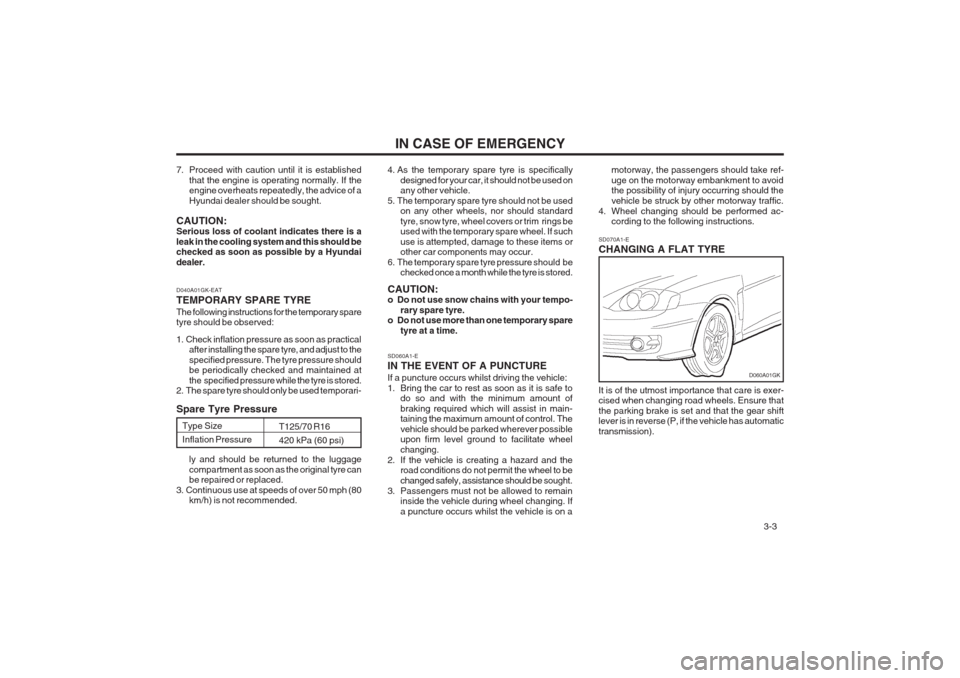
3. Passengers must not be allowed to remain inside the vehicle during wheel changing. Ifa puncture occurs whilst the vehicle is on a SD070A1-E CHANGING A FLAT TYRE
7. Proceed with caution until it is established
that the engine is operating normally. If the engine overheats repeatedly, the advice of a Hyundai dealer should be sought.
CAUTION: Serious loss of coolant indicates there is a leak in the cooling system and this should be checked as soon as possible by a Hyundai dealer.
It is of the utmost importance that care is exer- cised when changing road wheels. Ensure that the parking brake is set and that the gear shift lever is in reverse (P, if the vehicle has automatic transmission).
D040A01GK-EAT TEMPORARY SPARE TYREThe following instructions for the temporary spare tyre should be observed:
1. Check inflation pressure as soon as practical
after installing the spare tyre, and adjust to the specified pressure. The tyre pressure should be periodically checked and maintained at the specified pressure while the tyre is stored.
2. The spare tyre should only be used temporari-
ly and should be returned to the luggagecompartment as soon as the original tyre can be repaired or replaced.
3. Continuous use at speeds of over 50 mph (80 km/h) is not recommended. 4. As the temporary spare tyre is specifically
designed for your car, it should not be used onany other vehicle.
5. The temporary spare tyre should not be used on any other wheels, nor should standard tyre, snow tyre, wheel covers or trim rings be used with the temporary spare wheel. If such use is attempted, damage to these items or other car components may occur.
6. The temporary spare tyre pressure should be checked once a month while the tyre is stored.
CAUTION:
o Do not use snow chains with your tempo- rary spare tyre.
o Do not use more than one temporary spare
tyre at a time.
Spare Tyre Pressure
Type Size Inflation Pressure T125/70 R16420 kPa (60 psi)
motorway, the passengers should take ref- uge on the motorway embankment to avoid the possibility of injury occurring should the vehicle be struck by other motorway traffic.
4. Wheel changing should be performed ac- cording to the following instructions.
D060A01GK
Page 96 of 140
IN CASE OF EMERGENCY
3-8 since the steering lock is not designed to withstand the force required to hold the front wheels straight during the tow.
o The vehicle must not be towed with the front wheels on the ground for more than thirty miles.
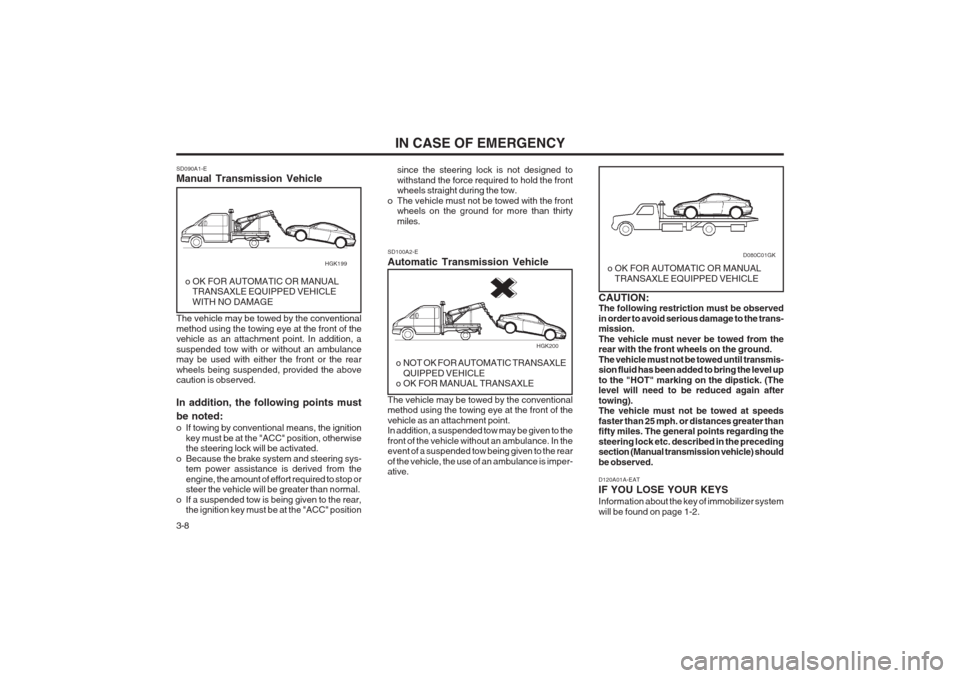
SD100A2-E Automatic Transmission Vehicle
o NOT OK FOR AUTOMATIC TRANSAXLE QUIPPED VEHICLE
o OK FOR MANUAL TRANSAXLE
The vehicle may be towed by the conventional method using the towing eye at the front of the vehicle as an attachment point. In addition, a suspended tow may be given to the front of the vehicle without an ambulance. In the event of a suspended tow being given to the rear of the vehicle, the use of an ambulance is imper- ative.
o OK FOR AUTOMATIC OR MANUAL
TRANSAXLE EQUIPPED VEHICLE
CAUTION: The following restriction must be observed in order to avoid serious damage to the trans- mission. The vehicle must never be towed from the rear with the front wheels on the ground. The vehicle must not be towed until transmis- sion fluid has been added to bring the level up to the "HOT" marking on the dipstick. (The level will need to be reduced again after towing). The vehicle must not be towed at speeds faster than 25 mph. or distances greater than fifty miles. The general points regarding the steering lock etc. described in the preceding section (Manual transmission vehicle) should be observed. D120A01A-EAT IF YOU LOSE YOUR KEYS Information about the key of immobilizer system will be found on page 1-2.
SD090A1-E Manual Transmission Vehicle
o OK FOR AUTOMATIC OR MANUAL
TRANSAXLE EQUIPPED VEHICLE WITH NO DAMAGE
The vehicle may be towed by the conventionalmethod using the towing eye at the front of the vehicle as an attachment point. In addition, a suspended tow with or without an ambulance may be used with either the front or the rear wheels being suspended, provided the above caution is observed. In addition, the following points must be noted:
o If towing by conventional means, the ignition key must be at the "ACC" position, otherwise the steering lock will be activated.
o Because the brake system and steering sys- tem power assistance is derived from the engine, the amount of effort required to stop or steer the vehicle will be greater than normal.
o If a suspended tow is being given to the rear, the ignition key must be at the "ACC" position HGK200
D080C01GK
HGK199
Page 98 of 140
APPEARANCE CARE
4-2
oxidization of the aluminium wheel will occur, spoiling the appearance. The use of an a toothbrush will facilitate cleaning between the wheel "spokes". SE040B1-E STAIN/SPOT REMOVALShould tree sap, dead insects or tar prove to be difficult to remove from the paint film, turpentine or a proprietary paint cutting compound may be used. Ensure that the area to be cleaned is not rubbed intensively to prevent breaking through the colour coat and exposing the under coat. SE040C1-E POLISHING The exterior paint work should be polished with a proprietary wax polish when water no longer collects in bead form on the paint work. The instructions of the product manufacturer should be adhered to. SE040E1-E BUMPER MAINTENANCEThe special material from which the bumpers are manufactured warrants special attention to pre- serve the appearance of the bumpers. Avoid contact with battery electrolyte or brake fluid and ensure that accidental spillages are immediately flushed with water. Do not use abrasive cleaning materials which may damage the bumpers.
SE040F1-E ACCIDENT REPAIRS In the event of the body work sustaining damage, the following points should be noted prior to repairs being undertaken. If body panels are replaced or repaired, anti corrosion treatment must be applied to the repair area. The product used must be compatible with those used in manufacture. It is recommended that repairs are entrusted to a Hyundai dealer to ensure that replacement parts used are of the same high quality as those used in manufacture of the vehicle and that the correct repair methods and materials will ensure adequate levels of corrosion protection and the continued validity of the Anti Perforation Warranty. SE050A1-E INTERIOR During the winter period, it is possible that the passenger compartment flooring may become wet from damp footwear or quantities of snow adhering to footwear. The carpet should not be allowed to remain in this condition since the carpet may begin to create musty smells and will promote corrosion of the floor pan in addition to the carpet and under felt beginning to rot.SE050C1-E INTERIOR VALETING The soft trim and carpets should be maintained with the regular use of a vacuum cleaner. Heavy soiling should be removed with a dry cleaning agent recommended for this purpose following the instructions of the product manufacturer. Paint thinner, solvents or other such cleaning materials should not be used since damage to the upholstery may result. SE050D1-E SEAT BELTSSeat belts should be cleaned only with a mild soap solution. Strong detergents, solvens or bleaches may damage the belt webbing and therefore reduce the effectiveness of the belt. Belts which display signs of fraying, wear of cut should be replaced. SE050E1-E WINDOWS A proprietary glass cleaner should be used to clean the inside of the windows. However, the rear heated windscreen must only be cleaned using a light horizontal cleaning action. Care should be exercised to avoid the use of abrasive cleaners or contact with items of jewellery which may damage the heating elements.
Avoid subjecting the bumpers to high tempera- tures such as may be encountered in high bake paint ovens.
Page 99 of 140
VEHICLE MAINTENANCE REQUIREMENTS 5-1
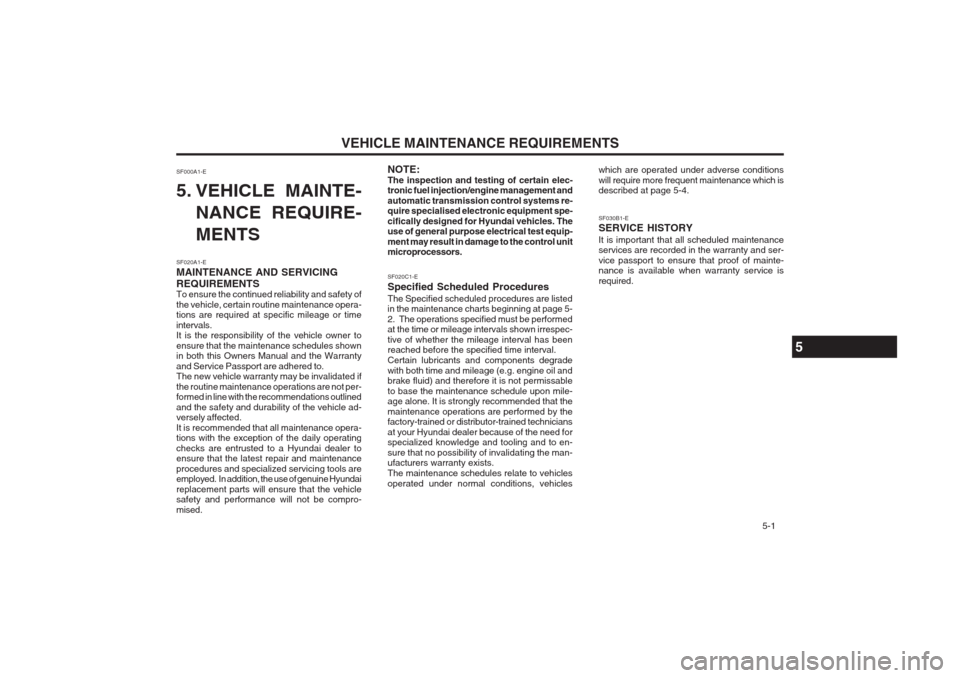
SF020A1-E MAINTENANCE AND SERVICINGREQUIREMENTS To ensure the continued reliability and safety of the vehicle, certain routine maintenance opera- tions are required at specific mileage or time intervals. It is the responsibility of the vehicle owner to ensure that the maintenance schedules shown in both this Owners Manual and the Warranty and Service Passport are adhered to. The new vehicle warranty may be invalidated if the routine maintenance operations are not per- formed in line with the recommendations outlined and the safety and durability of the vehicle ad- versely affected. It is recommended that all maintenance opera- tions with the exception of the daily operating checks are entrusted to a Hyundai dealer to ensure that the latest repair and maintenance procedures and specialized servicing tools are employed. In addition, the use of genuine Hyundai replacement parts will ensure that the vehicle safety and performance will not be compro- mised.
SF000A1-E
5. VEHICLE MAINTE-
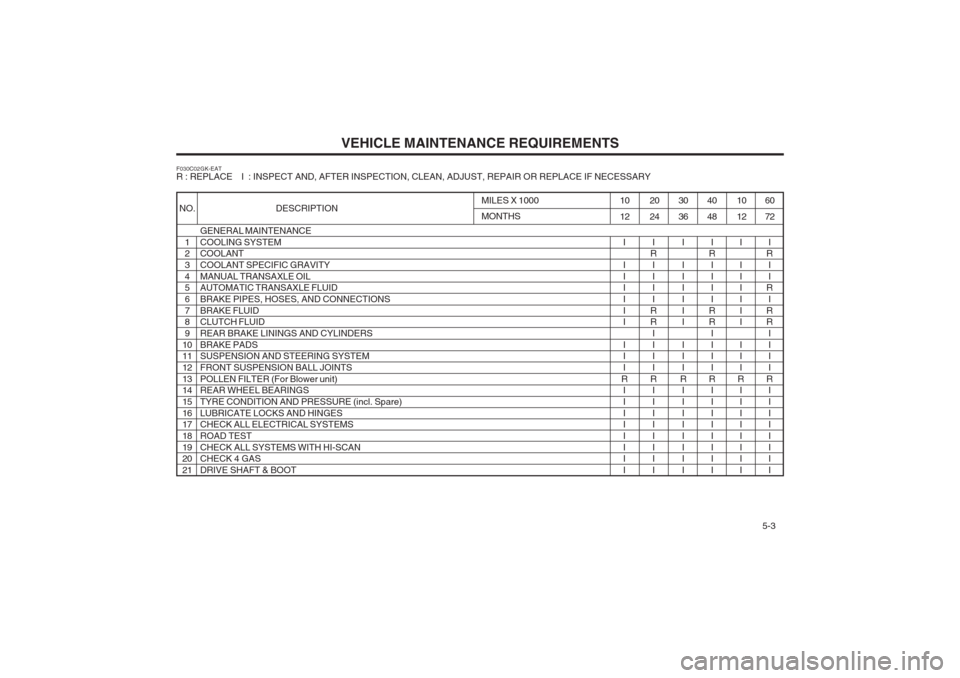
NANCE REQUIRE- MENTS NOTE: The inspection and testing of certain elec- tronic fuel injection/engine management and automatic transmission control systems re- quire specialised electronic equipment spe- cifically designed for Hyundai vehicles. The use of general purpose electrical test equip- ment may result in damage to the control unit microprocessors. SF020C1-E Specified Scheduled ProceduresThe Specified scheduled procedures are listed in the maintenance charts beginning at page 5- 2. The operations specified must be performed at the time or mileage intervals shown irrespec- tive of whether the mileage interval has been reached before the specified time interval. Certain lubricants and components degradewith both time and mileage (e.g. engine oil and brake fluid) and therefore it is not permissable to base the maintenance schedule upon mile- age alone. It is strongly recommended that the maintenance operations are performed by the factory-trained or distributor-trained technicians at your Hyundai dealer because of the need for specialized knowledge and tooling and to en- sure that no possibility of invalidating the man- ufacturers warranty exists. The maintenance schedules relate to vehiclesoperated under normal conditions, vehicles which are operated under adverse conditionswill require more frequent maintenance which is described at page 5-4. SF030B1-E SERVICE HISTORY It is important that all scheduled maintenance services are recorded in the warranty and ser- vice passport to ensure that proof of mainte- nance is available when warranty service is required.
5
Page 101 of 140
VEHICLE MAINTENANCE REQUIREMENTS 5-3
I I I I II I I I I
R III I II I I
F030C02GK-EAT R : REPLACE I : INSPECT AND, AFTER INSPECTION, CLEAN, ADJUST, REPAIR OR REPLACE IF NECESSARY
GENERAL MAINTENANCE COOLING SYSTEM COOLANT COOLANT SPECIFIC GRAVITYMANUAL TRANSAXLE OIL AUTOMATIC TRANSAXLE FLUID BRAKE PIPES, HOSES, AND CONNECTIONSBRAKE FLUID CLUTCH FLUID REAR BRAKE LININGS AND CYLINDERSBRAKE PADS SUSPENSION AND STEERING SYSTEM FRONT SUSPENSION BALL JOINTSPOLLEN FILTER (For Blower unit) REAR WHEEL BEARINGS TYRE CONDITION AND PRESSURE (incl. Spare)LUBRICATE LOCKS AND HINGES CHECK ALL ELECTRICAL SYSTEMS ROAD TESTCHECK ALL SYSTEMS WITH HI-SCAN CHECK 4 GAS DRIVE SHAFT & BOOT
MILES X 1000 MONTHS
NO. DESCRIPTION
1 2 34 5 67 8 9
10 11 1213 14 1516 17 1819 20 21I I I I II I I I I
R III I II I I
10 12 202430364048 10126072
I
R
I I I I
R R I I I I
R III I II I II
R
I I I I
R R I I I I
R III I II I I I I I I II I I I I
R III I II I I I
R
II
R
I
R R I I I I
R III I II I I
Page 102 of 140
VEHICLE MAINTENANCE REQUIREMENTS
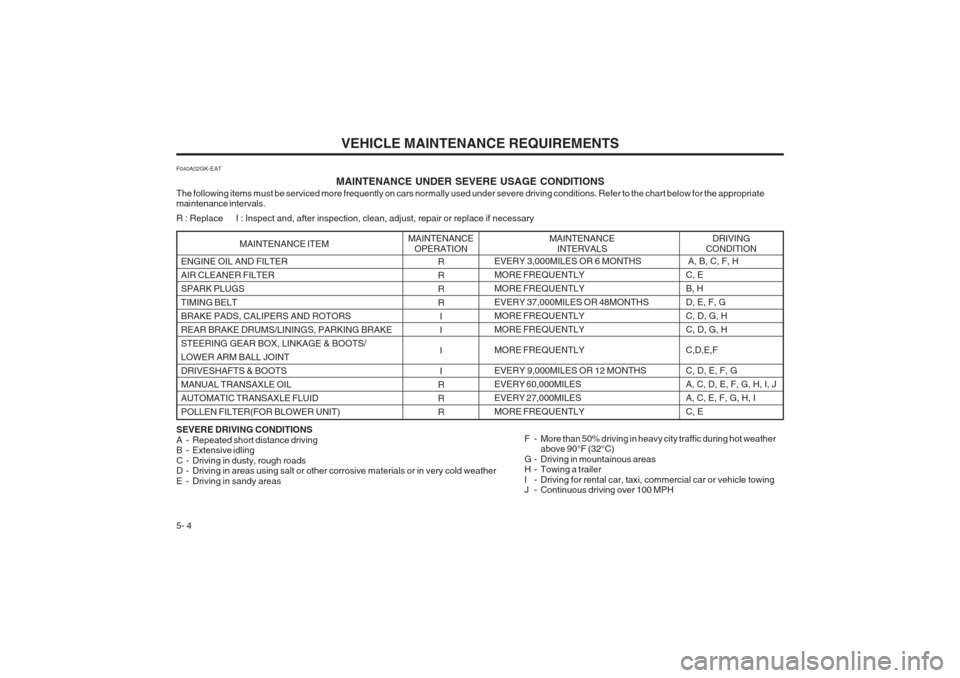
5- 4 MAINTENANCE UNDER SEVERE USAGE CONDITIONS
The following items must be serviced more frequently on cars normally used under severe driving conditions. Refer to the chart below for the appropriate maintenance intervals. R : Replace I : Inspect and, after inspection, clean, adjust, repair or replace if necessary
F040A02GK-EAT
DRIVING
CONDITION
R RRR
II II
R RR
MAINTENANCE ITEM MAINTENANCE
OPERATION MAINTENANCE
INTERVALS
ENGINE OIL AND FILTER AIR CLEANER FILTERSPARK PLUGSTIMING BELTBRAKE PADS, CALIPERS AND ROTORSREAR BRAKE DRUMS/LININGS, PARKING BRAKESTEERING GEAR BOX, LINKAGE & BOOTS/LOWER ARM BALL JOINTDRIVESHAFTS & BOOTSMANUAL TRANSAXLE OILAUTOMATIC TRANSAXLE FLUIDPOLLEN FILTER(FOR BLOWER UNIT) EVERY 3,000MILES OR 6 MONTHSMORE FREQUENTLYMORE FREQUENTLYEVERY 37,000MILES OR 48MONTHSMORE FREQUENTLYMORE FREQUENTLY MORE FREQUENTLYEVERY 9,000MILES OR 12 MONTHS EVERY 60,000MILESEVERY 27,000MILESMORE FREQUENTLY
A, B, C, F, HC, EB, HD, E, F, GC, D, G, HC, D, G, H C,D,E,FC, D, E, F, G A, C, D, E, F, G, H, I, JA, C, E, F, G, H, IC, E
SEVERE DRIVING CONDITIONS
A - Repeated short distance driving
B - Extensive idling
C - Driving in dusty, rough roads
D - Driving in areas using salt or other corrosive materials or in very cold weather
E - Driving in sandy areas F - More than 50% driving in heavy city traffic during hot weather
above 90°F (32°C)
G - Driving in mountainous areas
H - Towing a trailer
I - Driving for rental car, taxi, commercial car or vehicle towing
J - Continuous driving over 100 MPH
Page 104 of 140
VEHICLE MAINTENANCE REQUIREMENTS
5- 6
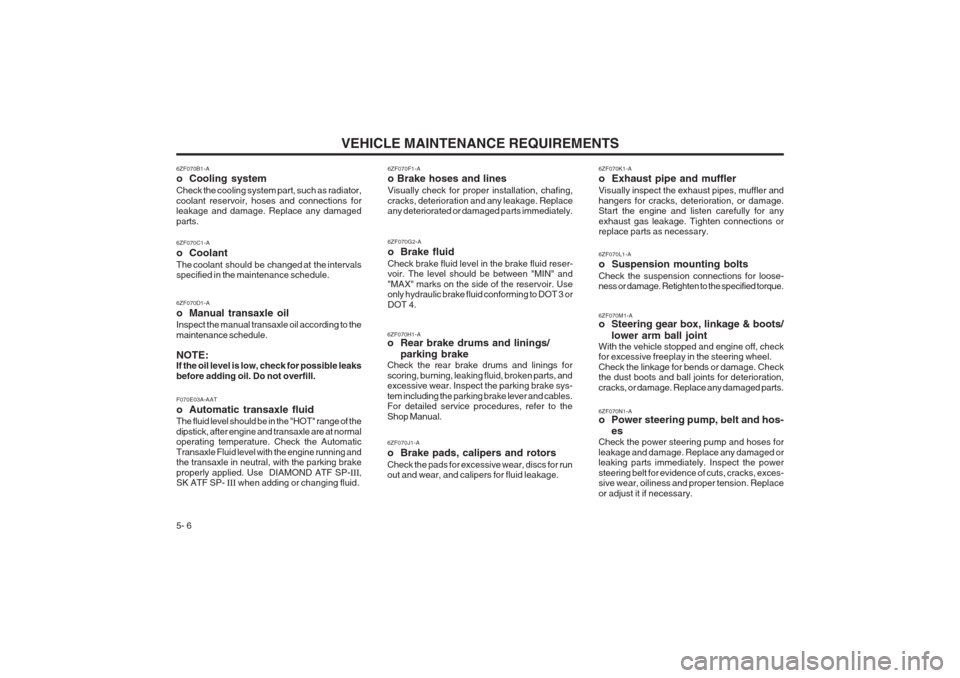
6ZF070D1-A
o Manual transaxle oil Inspect the manual transaxle oil according to the maintenance schedule. NOTE: If the oil level is low, check for possible leaks before adding oil. Do not overfill.
6ZF070H1-A
o Rear brake drums and linings/
parking brake
Check the rear brake drums and linings for scoring, burning, leaking fluid, broken parts, and excessive wear. Inspect the parking brake sys- tem including the parking brake lever and cables. For detailed service procedures, refer to the Shop Manual. 6ZF070J1-A
o Brake pads, calipers and rotorsCheck the pads for excessive wear, discs for run out and wear, and calipers for fluid leakage. 6ZF070K1-A
o Exhaust pipe and muffler Visually inspect the exhaust pipes, muffler and hangers for cracks, deterioration, or damage. Start the engine and listen carefully for any exhaust gas leakage. Tighten connections or replace parts as necessary. 6ZF070L1-A
o Suspension mounting bolts Check the suspension connections for loose- ness or damage. Retighten to the specified torque.
F070E03A-AAT
o Automatic transaxle fluid The fluid level should be in the "HOT" range of the dipstick, after engine and transaxle are at normal operating temperature. Check the Automatic Transaxle Fluid level with the engine running and the transaxle in neutral, with the parking brake properly applied. Use DIAMOND ATF SP- III,
SK ATF SP- III when adding or changing fluid. 6ZF070M1-A
o Steering gear box, linkage & boots/
lower arm ball joint
With the vehicle stopped and engine off, check for excessive freeplay in the steering wheel. Check the linkage for bends or damage. Check the dust boots and ball joints for deterioration, cracks, or damage. Replace any damaged parts. 6ZF070N1-A
o Power steering pump, belt and hos-
es
Check the power steering pump and hoses for leakage and damage. Replace any damaged or leaking parts immediately. Inspect the power steering belt for evidence of cuts, cracks, exces- sive wear, oiliness and proper tension. Replace or adjust it if necessary.
6ZF070F1-A o Brake hoses and lines Visually check for proper installation, chafing, cracks, deterioration and any leakage. Replace any deteriorated or damaged parts immediately. 6ZF070G2-A
o Brake fluidCheck brake fluid level in the brake fluid reser- voir. The level should be between "MIN" and "MAX" marks on the side of the reservoir. Use only hydraulic brake fluid conforming to DOT 3 or DOT 4.
6ZF070B1-A
o Cooling system Check the cooling system part, such as radiator, coolant reservoir, hoses and connections for leakage and damage. Replace any damaged parts. 6ZF070C1-A
o CoolantThe coolant should be changed at the intervals specified in the maintenance schedule.
Page 106 of 140
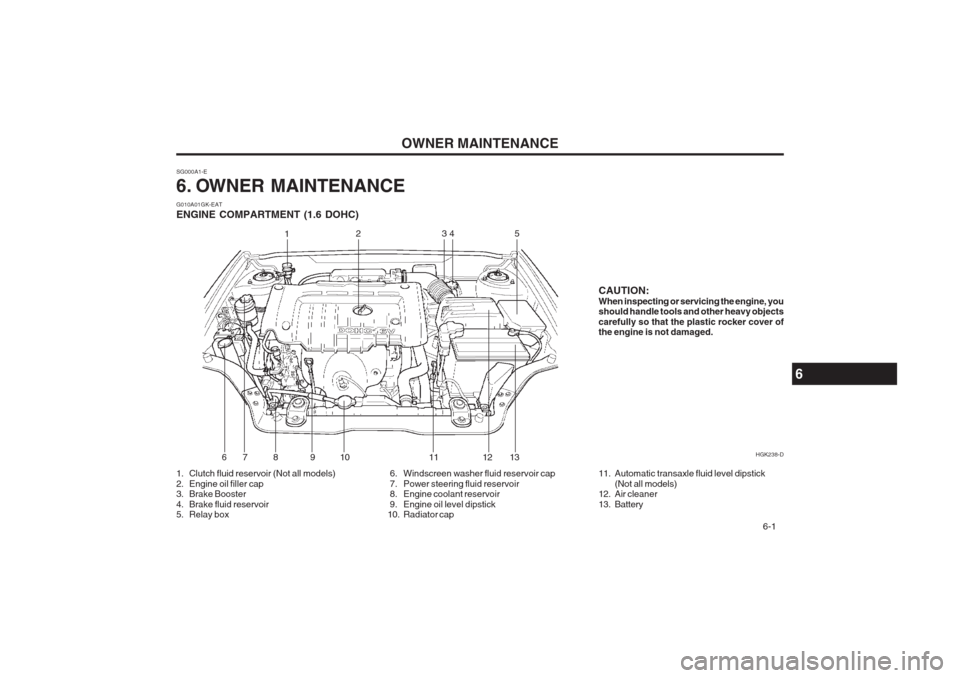
OWNER MAINTENANCE 6-1
CAUTION: When inspecting or servicing the engine, you should handle tools and other heavy objects carefully so that the plastic rocker cover of the engine is not damaged.
SG000A1-E
6. OWNER MAINTENANCE
6
G010A01GK-EAT ENGINE COMPARTMENT (1.6 DOHC)
1. Clutch fluid reservoir (Not all models)
2. Engine oil filler cap
3. Brake Booster
4. Brake fluid reservoir
5. Relay box
6. Windscreen washer fluid reservoir cap
7. Power steering fluid reservoir
8. Engine coolant reservoir
9. Engine oil level dipstick
10. Radiator cap11. Automatic transaxle fluid level dipstick
(Not all models)
12. Air cleaner
13. Battery HGK238-D
1
23
45
6 7 8 9 10 11 12 13
Page 107 of 140
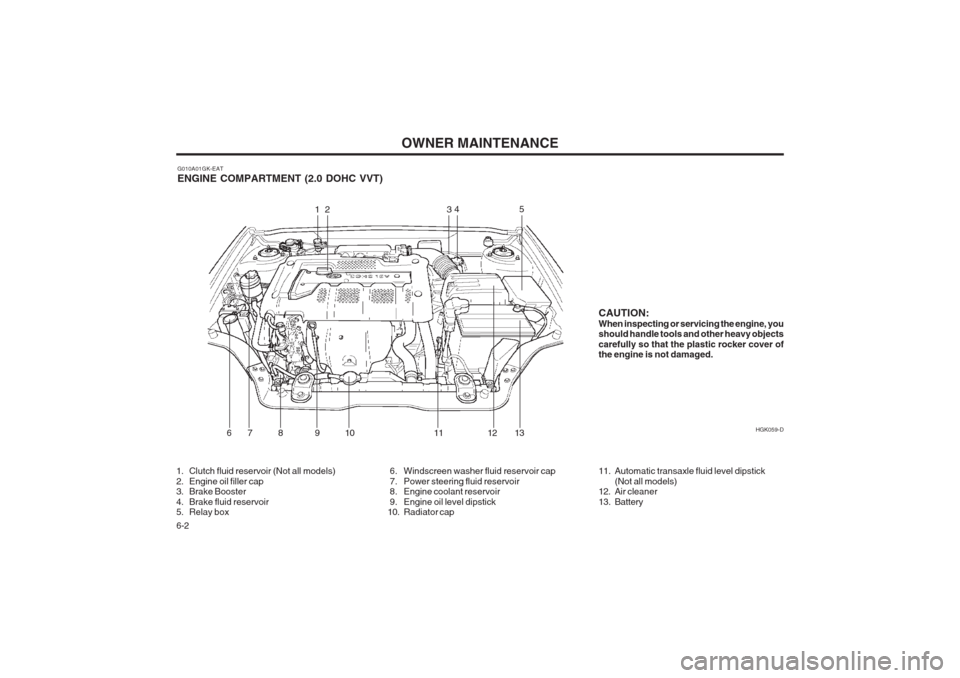
OWNER MAINTENANCE
6-2
G010A01GK-EAT ENGINE COMPARTMENT (2.0 DOHC VVT) HGK059-D
CAUTION: When inspecting or servicing the engine, you should handle tools and other heavy objects carefully so that the plastic rocker cover of the engine is not damaged.
1. Clutch fluid reservoir (Not all models)
2. Engine oil filler cap
3. Brake Booster
4. Brake fluid reservoir
5. Relay box 6. Windscreen washer fluid reservoir cap
7. Power steering fluid reservoir
8. Engine coolant reservoir
9. Engine oil level dipstick
10. Radiator cap11. Automatic transaxle fluid level dipstick
(Not all models)
12. Air cleaner
13. Battery
12 3 45
6 7 8 9 10 11 12 13