radiator cap Hyundai Coupe 2003 User Guide
[x] Cancel search | Manufacturer: HYUNDAI, Model Year: 2003, Model line: Coupe, Model: Hyundai Coupe 2003Pages: 310, PDF Size: 2.87 MB
Page 206 of 310

CONTROLS AND EQUIPMENT
1- 30 SB215F1-E TACHOMETER
SB215B1-E ENGINE COOLANT TEMPERATURE GAUGE engine is hot may cause hot water and steam to be ejected from the radiator resulting inburns and scalding. The radiator cap mustonly be removed when the engine has cooled.Do not add cold water to a hot engine to avoidthe possibility of engine damage. The use ofplain water in the cooling system is not rec-ommended since the aluminium componentsof the cooling system require the use of acorrosion inhibitor found in the recommendedEthylene Glycol type anti freeze solutions.
The engine coolant temperature gauge indicatesthe engine coolant temperature and will, undernormal circumstances, give an indication in the"Normal" or centre portion of the scale. Shouldthe indication move into the upper or "Hot" por-tion of the scale, engine overheating is indicated.Under these circumstances, the vehicle shouldbe brought to rest as soon as is safe to do so andthe engine turned off. Once the engine has cooledsomewhat, the coolant level and the condition ofthe generator/water pump drive belt should bechecked. If the cause of the overheating cannotbe readily established, the assistance of aHyundai dealer should be sought. WARNING: The engine cooling system is pressurizedand removal of the radiator cap when the The tachometer registers the speed of the enginein revolutions per minute (R.P.M.). CAUTION: The maximum safe engine operating speed isindicated by the white zone of the tachometerscale. The engine should not be operatedbeyond the beginning of this zone or seriousengine damage may result.
SB215C1-E SPEEDOMETER
The speedometer indicates the vehicle speed in both miles and kilometres per hour.
HGK132HGK131A
HGK130B
Page 222 of 310

CONTROLS AND EQUIPMENT
1- 46 SB450A2-E HATCHBACK DOOR Remote Hatchback door Release The hatchback door may be opened by pulling the lever to release the lock. The hatchback doorshould be closed by depressing the lid firmly untilthe latch engages. Ensure that hatchback door issecurely latched before setting the vehicle inmotion. WARNING: The hatchback door should always be closedwhilst the vehicle is in motion to preventexhaust gases from being drawn into thepassenger compartment.
HGK103-D
SB440A1-E REMOTE FUEL FILLER LID RELEASE (Not all models) The fuel filler lid may be opened from inside the vehicle by pulling up on the fuel filler lid release. NOTE: If the fuel filler lid will not open because icehas formed around it, tap lightly or push onthe lid to break the ice and release the lid. Donot lever the lid. If necessary, spray aroundthe lid with an approved de-icer fluid (do notuse radiator anti-freeze) or move the vehicleto a warm place and allow the ice to melt.
HGK105-D
HGK124
WARNING: Fuel vapours are dangerous. Before refuel- ling, turn off the engine and never allowsparks, lit cigarettes or open flames near thefiller area. When releasing the filler cap, asmall amount of residual pressure may gen-erate a slight hissing sound which is notindicative of an abnormality. In the event ofthe fuel filler cap requiring replacement, onlya Genuine Hyundai replacement part shouldbe used to prevent fuel leakage.
Page 260 of 310

IN CASE OF EMERGENCY
3-2 4. Check to see if the water pump drive belt is
missing. If it is not missing, check to see that it is tight. If the drive belt seems to be satisfac-tory, check for coolant leaking from the radia-tor, hoses or under the car. (If the air condi-tioning had been in use, it is normal for coldwater to be draining from it).
WARNING:Whilst the engine is running, keep hands andclothing away from moving parts such as thefan and drive belts to prevent injury.
5. If the water pump drive belt is broken or coolant is leaking out, stop the engine imme- diately and call the nearest Hyundai dealerfor assistance.
WARNING:Do not remove the radiator cap when theengine is hot since steam and boiling watermay be ejected from the radiator resulting inburns or scalding.
6. If the cause of the overheating cannot be found, wait until the engine temperature has returned to normal. Then, if coolant has beenlost, carefully remove the radiator cap andadd water to bring the fluid level in the reser-voir up to the base of the radiator fill opening.Fill the coolant expansion tank to the halfwaymark.
WARNING:Motor vehicle batteries contain sulphuric acidand emit hydrogen gas. Protective clothingshould be worn and care exercised to preventthe acid from coming into contact with skin orclothing and the vehicle. Naked lights shouldnot be permitted in the vicinity of the battery.Care should be exercised to prevent sparksoccurring during connection. If acid acciden-tally comes into contact with skin or eyes, theaffected area should immediately be flushedwith copious amounts of water and medicalassistance sought.
1. Ensure that the booster battery is 12 volt type.
If the booster battery is installed in another vehicle, ensure that the two vehicles are nottouching.
2. Turn off all unnecessary electrical equipment in both vehicles.
3. Ensure that the engine of the vehicle provid- ing the jump start is running prior to connec-tion of the jump cables.
4. Connect the red jump cable to the positive (+) terminal of the booster battery and the otherend to the positive (+) terminal of the dis-charged battery.
5. Attach the black jump cable to the negative (-) terminal of the booster battery, and theother end to a ground point within the enginecompartment of the vehicle with the flat bat-tery. Do not connect to the negative batteryterminal of the flat battery since sparks maybe generated with the subsequent risk ofexplosion. 6. Raise the booster vehicle engine speed to
2,000 r.p.m. and start the engine of the vehi-cle with the flat battery.
7. Remove jump cables in the reverse order of installation (black cable first).
CAUTION:If the jump cable is incorrectly installed, dam-age to the vehicle electrical system may oc-cur, in particular the electronic componentssuch as the Fuel Injection system computerand the Automatic Transaxle computer. Thebattery must never be disconnected whilstthe engine is running. SD040A1-E IF THE ENGINE OVERHEATSIf the temperature gauge indicates overheating:
1. Pull off the road and stop as soon as it is safe to do so.
2. Place the gear selector lever in "P" (auto- matic), or neutral (manual transaxle) and set the parking brake. If the air conditioning is on,turn it off.
3. If coolant is running out under the car or steam is coming out from under the bonnetstop the engine. Do not open the bonnet untilthe coolant has stopped running or the steam-ing has stopped. If there is no visible loss ofcoolant and no steam, leave the engine run-ning and check to be sure the engine coolingfan is operating.If the fan is not running, turn the engine off.
Page 276 of 310

OWNER MAINTENANCE 6-1
CAUTION: When inspecting or servicing the engine, youshould handle tools and other heavy objectscarefully so that the plastic rocker cover ofthe engine is not damaged.
SG000A1-E
6. OWNER MAINTENANCE
6
G010A01GK-EAT ENGINE COMPARTMENT (1.6 DOHC)
1. Clutch fluid reservoir (Not all models)
2. Engine oil filler cap
3. Brake Booster
4. Brake fluid reservoir
5. Relay box
6. Windscreen washer fluid reservoir cap
7. Power steering fluid reservoir
8. Engine coolant reservoir
9. Engine oil level dipstick
10. Radiator cap11. Automatic transaxle fluid level dipstick
(Not all models)
12. Air cleaner
13. Battery HGK238-D
1
2
345
6 7 8 9 10 11 12 13
Page 277 of 310

OWNER MAINTENANCE
6-2
G010A01GK-EAT ENGINE COMPARTMENT (2.0 DOHC CVVT) HGK059-D
CAUTION: When inspecting or servicing the engine, youshould handle tools and other heavy objectscarefully so that the plastic rocker cover ofthe engine is not damaged.
1. Clutch fluid reservoir (Not all models)
2. Engine oil filler cap
3. Brake Booster
4. Brake fluid reservoir
5. Relay box 6. Windscreen washer fluid reservoir cap
7. Power steering fluid reservoir
8. Engine coolant reservoir
9. Engine oil level dipstick
10. Radiator cap11. Automatic transaxle fluid level dipstick
(Not all models)
12. Air cleaner
13. Battery
1 23
45
6 7 8 9 10 11 12 13
Page 278 of 310

OWNER MAINTENANCE 6-3
G010B01GK-EAT ENGINE COMPARTMENT (2.7 V6) HGK209-D
1. Power steering fluid reservoir
2. Clutch fluid reservoir (Not all models)
3. Brake Booster
4. Brake fluid reservoir
5. Air filter element 6. Relay box
7. Windscreen washer fluid reservoir cap
8. Engine coolant reservoir
9. Engine oil level dipstick
10. Radiator cap11. Engine oil filler cap
12. Automatic transaxle fluid level dipstick
(Not all medels)
13. Battery
1 23 45
7 8 9 10 11 126
13CAUTION: When inspecting or servicing the engine, youshould handle tools and other heavy objectscarefully so that the plastic rocker cover ofthe engine is not damaged.
Page 282 of 310

OWNER MAINTENANCE 6-7
ways wash thoroughly after any contact. Keep used oils out of reach of children. It is illegalto pollute drains, water courses and soil. Useonly authorized waste collection facilitiesincluding civic amenity sites and garages forthe disposal of used oil and oil filters. If indoubt, contact the local authority for dis-posal instructions. SG050A1-E ENGINE COOLANT CHECKING AND REPLACING WARNING: Do not remove the radiator cap when the engine is hot, since the system is pressurizedand coolant may be ejected from the radiatorresulting in scalding. SG050B1-E Coolant recommendations
Only ethylene glycol based coolant with a corro- sion inhibitor suited to aluminium alloy enginecomponents should be used in the cooling sys-tem. No further additives or inhibitors should beused. The coolant specific gravity should bechecked as prescribed in the maintenance sched-ule to ensure adequate frost and corrosion pro-tection. In addition, the engine coolant must bereplaced at the specified interval since the corro-sion inhibitor properties deteriorate with time.It is important to note that whilst an increase in theconcentration of anti freeze gives an increase inthe level of frost protection, a solution which is inexcess of 65% anti freeze will result in reducedfrost protection and engine overheating. There-fore the recommended concentration of 50%should not be exceeded for general use.The use of methanol based anti freeze com-pounds may result in engine overheating and willinvalidate the vehicle warranty. NOTE: It is imperative that vehicles fitted with an airconditioning system have a coolant concen-tration of the recommended strength at alltimes. The use of the air conditioning systemwhen the cooling system is filled with wateronly will result in the heater matrix freezingand subsequently bursting.SG050C1-E Engine Coolant LevelThe engine coolant level may be observed through the side of the plastic coolant reservoir(expansion tank) when the engine is cold. If thelevel is below the "LOW" mark, add coolant of thecorrect concentration until the level is betweenthe "LOW" and "Full" marks. If the level fallsbelow the "LOW" mark on a regular basis despitebeing topped up, consult a Hyundai dealer. SG050D1-E To Change the Engine CoolantThe engine coolant should be changed at those intervals specified in the vehicle maintenanceschedule in Section 5. NOTE: Care should be taken to ensure that coolantis not allowed to spill onto the paintworksince the finish may become damaged. Ifcoolant spillage occurs, the affected areashould be rinsed thoroughly with water.
1. Park the vehicle on level ground and ensure
that the parking brake is firmly applied, and the engine allowed to cool.DO NOT ATTEMPT THIS OPERATIONWHILST THE ENGINE IS HOT SINCEBURN-ING OR SCALDING MAY RESULT.
2. Prepare a suitable receptacle to collect the displaced coolant and position this under theradiator drain tap.
HGK187
Page 283 of 310
OWNER MAINTENANCE
6-8 CAUTION: Sparking plugs must only be cleaned usingpurpose designed equipment. Wire brushingmay damage the centre electrode insulatorcausing mis-firing to occur. Only the correctgrade of sparking plug should be used. Useof an incorrect grade may result in seriousengine damage.
3. With the heater temperature control set to the
"HOT" position, remove the radiator cap andopen the radiator drain tap.
4. When the engine coolant has drained com- pletely, close the drain tap ensuring that thisis not over tightened.
5. Prepare a suitable quantity of new engine coolant (refer to section 9) and pour this intothe radiator.
6. Start the engine with the radiator cap still removed and continue to add coolant as thelevel decreases as air is expelled from thesystem. When the level remains constant,replace the radiator cap and replenish thecoolant reservoir.
7. When the engine is hot, check to ensure that no coolant leaks are present.
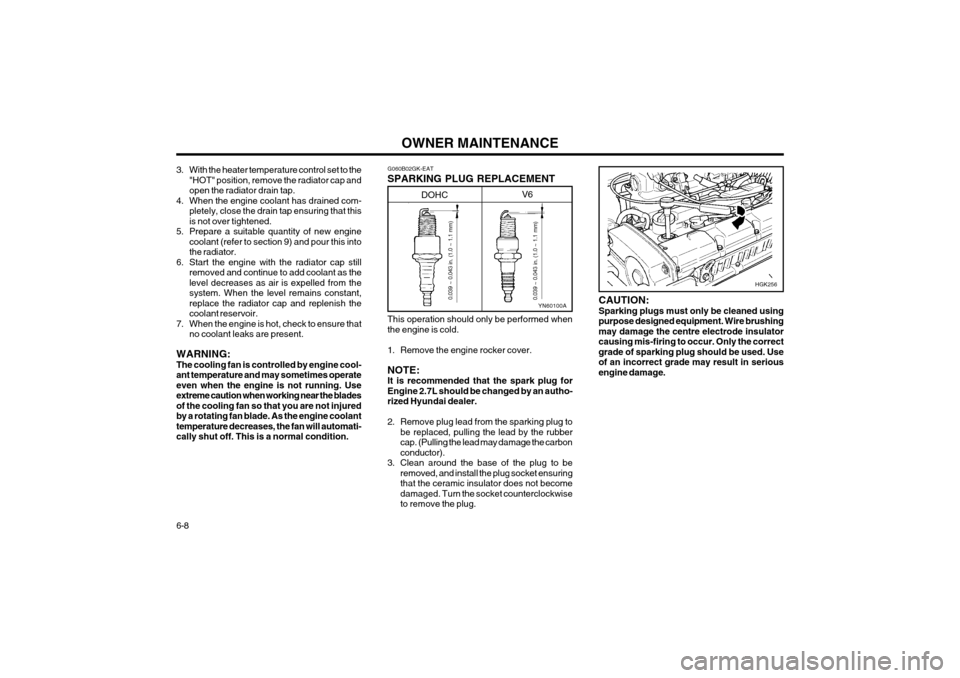
WARNING:The cooling fan is controlled by engine cool-ant temperature and may sometimes operateeven when the engine is not running. Useextreme caution when working near the bladesof the cooling fan so that you are not injuredby a rotating fan blade. As the engine coolanttemperature decreases, the fan will automati-cally shut off. This is a normal condition. G060B02GK-EAT SPARKING PLUG REPLACEMENT This operation should only be performed when the engine is cold.
1. Remove the engine rocker cover.NOTE: It is recommended that the spark plug forEngine 2.7L should be changed by an autho-rized Hyundai dealer.
2. Remove plug lead from the sparking plug to
be replaced, pulling the lead by the rubber cap. (Pulling the lead may damage the carbonconductor).
3. Clean around the base of the plug to be removed, and install the plug socket ensuringthat the ceramic insulator does not becomedamaged. Turn the socket counterclockwiseto remove the plug.
YN60100A0.039 ~ 0.043 in. (1.0 ~ 1.1 mm)
0.039 ~ 0.043 in. (1.0 ~ 1.1 mm)
DOHC V6
HGK256