brake Hyundai Coupe 2003 Owner's Guide
[x] Cancel search | Manufacturer: HYUNDAI, Model Year: 2003, Model line: Coupe, Model: Hyundai Coupe 2003Pages: 310, PDF Size: 2.87 MB
Page 108 of 310

DRIVING YOUR HYUNDAI 2- 13
C170A01A-AAT HIGHER SPEED MOTORING Pre-Trip Inspections 1. Tires: Adjust the tire inflation pressures to specifica-tion. Low tire inflation pressures will result inoverheating and possible failure of the tires.Avoid using worn or damaged tires which mayresult in reduced traction or tire failure. NOTE: Never exceed the maximum tire inflation pres-sure shown on the tires. 2. Fuel, engine coolant and engine oil: High speed travel consumes more fuel thanurban motoring. Do not forget to check bothengine coolant and engine oil. 3. Drive belt: A loose or damaged drive belt may result inoverheating of the engine. C180A01A-AAT USE OF LIGHTS Check your lights regularly for correct operation and always keep them clean. When driving dur-ing the day in conditions of poor visibility, it ishelpful to drive with headlights on low beam. Thisenables you to be seen as well as to see.
C160I01A-AAT Don't Let Your Parking Brake FreezeUnder some conditions your parking brake can freeze in the engaged position. This is most likelyto happen when there is an accumulation of snowor ice around or near the rear brakes or if thebrakes are wet. If there is a risk the parking brakemay freeze, apply it only temporarily while youput the gear selector lever in "P" (automatic) or infirst or reverse gear (manual transaxle) andblock the rear wheels so the car cannot roll. Thenrelease the parking brake. C160K01A-AAT Carry Emergency Equipment Depending on the severity of the weather where you drive your car, you should carry appropriateemergency equipment. Some of the items youmay want to carry include tire chains, tow strapsor chains, flashlight, emergency flares, sand, ashovel, jumper cables, a window scraper, gloves,ground cloth, coveralls, a blanket, etc.
C160J01A-AAT Don't Let Ice and Snow Accumulate Underneath Under some conditions, snow and ice can build up under the fenders and interfere with the steer-ing. When driving in severe winter conditionswhere this may happen, you should periodicallycheck underneath the car to be sure the move-ment of the front wheels and the steering compo-nents is not obstructed.
C190B01S-AAT Trailer Hitches Select the proper hitch and ball combination, making sure that it's location is compatible withthat of the trailer or vehicle being towed.Use a quality non-equalizing hitch which distrib-utes the tongue load uniformly throughout thechassis. The hitch should be bolted securely to the car and installed by a qualified technician. DO NOTUSE A HITCH DESIGNED FOR TEMPORARYINSTALLATION AND NEVER USE ONE THATATTACHES ONLY TO THE BUMPER.
C190A01A-GAT TRAILER OR VEHICLE TOWINGIf you are considering towing with your car, you should first check with your Province Depart-ment of Motor Vehicles to determine their legalrequirements.Since laws vary from province to province, therequirements for towing trailers, cars, other typesof vehicles, or apparatus may differ. Ask yourHyundai dealer for further details before towing. CAUTION Do not do any towing with your car during itsfirst 2,000 km (1,200 miles) in order to allowthe engine to properly break in. Failure toheed this caution may result in serious en-gine or transaxle damage.
Page 109 of 310

DRIVING YOUR HYUNDAI
2- 14 2. The total gross vehicle weight with trailer
must not exceed the Gross Vehicle Weight Rating (GVWR) shown on the vehicle iden-tification plate (see page 8-1). The totalgross vehicle weight is the combinedweight of the vehicle, driver, all passen-
gers and their luggage, cargo, hitch, trailertongue load and other optional equip-ment.
3. The front or rear axle weight must not exceed the Gross Axle Weight Rating(GAWR) shown on the vehicle identifica-tion plate (see page 8-1). It is possible thatyour towing package does not exceed theGVWR but exceeds the GAWR. Improper
trailer loading and/or too much luggage inthe trunk can overload the rear axle. Re-distribute the load and check the axleweight again.
SSA2200DGross Axle Weight Gross Vehicle Weight
C190C02Y-GAT Trailer BrakesIf your trailer is equipped with a braking system, make sure it conforms to federal and/or localregulations and that it is properly installed andoperating correctly. NOTE: If you tow a trailer or vehicle, your car willrequire more frequent maintenance due tothe additional load. See "Maintenance UnderSevere Usage Conditions" on page 5-4. CAUTION:
o Never connect a trailer brake system di-
rectly to the vehicle brake system.
o When towing a trailer on steep grades (in excess of 12%) pay close attention to theengine coolant temperature gauge to en-
sure the engine does not overheat. If theneedle of the coolant temperature gauge
moves across the dial towards "H" (HOT),pull over and stop as soon as it is safe todo so, and allow the engine to idle until itcools down. You may proceed once theengine has cooled sufficiently.
C190D01A-GAT Safety Chains Should the hitch connection between your car and the trailer or vehicle you are towing fail, thetrailer or vehicle could wander dangerously acrossother lanes of traffic and ultimately collide with another vehicle. To eliminate this potentially dan-gerous situation, safety chains, attached be-tween your car and the trailer or towed vehicle,are required in most provinces. C190E01GK-GAT Trailer Weight Limit
Tongue load Total trailer weightSSA2200B
Tongue loads can be increased or decreased by redistributing the load in the trailer. This can be
verified by checking the total weight of the loadedtrailer and then checking the load on the tongue. NOTE:
1. Never load the trailer with more weight in the back than in the front. About 60% ofthe trailer load should be in the front halfon the trailer and the remaining 40% in therear.
Page 110 of 310

DRIVING YOUR HYUNDAI 2- 15
Maximum
Towable Weight Trailer550
1,200 1,400
CAUTION: The following specifications are recom-
mended when towing a trailer. The loadedtrailer weight cannot safely exceed the val-ues in the following chart.
kg
With Brake Type1.6 L
2.0/2.7 L
4. The maximum permissible static vertical
load on the coupling device:
WARNING: Improperly loading your car and trailer can
seriously affect its steering and braking per-formance causing a crash which you may be
serious injury or death.Without Brake Type
Coupling point
HGK260
1.6 L
2.0/2.7 L 50 kg 60 kg
View from below the vehicle
5. The maximum permissible overhang of
the coupling point : 990 mm.
C190F01A-GAT Trailer or Vehicle Towing Tips
1. Before towing, check hitch and safety chainconnections as well as proper operation of the trailer running lights, brake lights, and turnsignals.
2. Always drive your vehicle at a moderate speed (Less than 100 km/H).
3. Trailer towing requires more fuel than normal conditions.
4. To maintain engine braking efficiency and electrical charging performance, do not usefifth gear (manual transaxle) or overdrive(automatic transaxle).
5. Always secure items in the trailer to prevent load shift while driving.
6. Check the condition and air pressure of all tires on the trailer and your car. Low tirepressure can seriously affect the handling.Also check the spare tire.
7. The vehicle/trailer combination is more af- fected by crosswind and buffeting.When being passed by a large vehicle, keepa constant speed and steer straight ahead. Ifthere is too much wind buffeting, slow down toget out of the other vehicle's air turbulence.
8. When parking your car and trailer, especially on a hill, be sure to follow all the normalprecautions. Turn your front wheel into thecurb, set the parking brake firmly, and put thetransmission in 1st or Reverse (manual) orPark (automatic). In addition, place wheelchocks at each of the trailer's tires.
Page 111 of 310

DRIVING YOUR HYUNDAI
2- 16
9. If the trailer has electric brakes, start your
vehicle and trailer moving, and then apply the trailer brake controller by hand to be sure thebrakes are working. This lets you check yourelectrical connection at the same time.
10. During your trip, check occasionally to be sure that the load is secure, and that thelights and any trailer brakes are still working.
11. Avoid jerky starts, sudden acceleration or sudden stops.
12. Avoid sharp turns and rapid lane changes.
13. Avoid holding the brake pedal down too long or too frequently. This could cause the brakesto overheat, resulting in reduced braking effi-ciency.
14. When going down a hill, shift into a lower gear and use the engine braking effect.When ascending a long grade, downshift thetransmission to a lower gear and reducespeed to reduce chances of engine overload-ing and/or overheating.
15. If you have to stop while going uphill, do not hold the vehicle in place by pressing on theaccelerator. This can cause the automatictransmission to overheat. Use the parkingbrake or footbrake. NOTE:When towing check transaxle fluid more fre-quently. CAUTION: If overheating should occur when towing,(temperature gauge reads near red zone),taking the following action may reduce oreliminate the problem.
1. Turn off the air conditioner.
2. Reduce highway speed.
3. Select a lower gear when going uphill.
4. While in stop and go traffic, place the gear
selector in park or neutral and idle theengine at a higher speed.
Page 112 of 310

WHAT TO DO IN AN EMERGENCY 3-1
3. WHAT TO DO IN AN
EMERGENCY
D010A01A-AAT IF THE ENGINE WILL NOT START WARNING: If the engine will not start, do not push or pullthe car to start it. This could result in acollision or cause other damage. In addition,push or pull starting may cause the catalyticconverter to be overloaded and create a firehazard. D010B02A-AAT If Engine Doesn't Turn Over or Turns Over Slowly
D010B01GK
1. If your car has an automatic transaxle, be sure the gear selector lever is in "N" or "P" and the emergency brake is set. 2. Check the battery connections to be sure
they are clean and tight.
3. Turn on the interior light. If the light dims or goes out when you operate the starter, thebattery is discharged.
4. Check the starter connections to be sure they are securely tightened.
5. Do not push or pull the vehicle to start it. See instructions for "Jump Starting" on the follow-ing pages.
D010C01A-AAT If Engine Turns Over Normally but Does Not Start
1 Check fuel level.
2 With the key in the off position, Check all connectors at ignition coils and spark plugs.Reconnect any that may be disconnected orloose.
3 Check the fuel line in the engine compart- ment.
4 If engine still refuses to start, call a Hyundai dealer or seek other qualified assistance.
D010D01A-AAT If Engine Stalls While Driving
1. Reduce your speed gradually, keeping a straight line. Move cautiously off the road to a safe place.
2. Turn on your emergency flashers.
3. Try to start the engine again. If your vehicle will not start, contact a Hyundai dealer or seekother qualified assistance. D020A02A-AAT JUMP STARTING
HGK184
Battery
WARNING: The gas produced by the battery during thejump-start operation is highly explosive. Ifthese instructions are not followed exactly,serious personal injury and damage to thevehicle may occur! If you are not sure how tofollow this procedure, seek qualified assis-
3
HGK184A
DOHC
V6Battery
Page 113 of 310

WHAT TO DO IN AN EMERGENCY
3-2
tance. Automobile batteries contain sulfuric acid. This is poisonous and highly corrosive.When jump starting, wear protective glassesand be careful not to get acid on yourself,your clothing or on the car.
o If you should accidentally get acid on your
skin or in your eyes, immediately remove any contaminated clothing and flush the area withclear water for at least 15 minutes. Thenpromptly obtain medical attention. If you mustbe transported to an emergency facility, con-tinue to apply water to the affected area witha sponge or cloth.
o The gas produced by the battery during the jump-start operation is highly explosive. Donot smoke or allow a spark or open flame inthe vicinity.
o The battery being used to provide the jump start must be 12-volt. If you cannot determinethat it is a 12-volt battery, do not attempt touse it for the jump start.
o To jump start a car with a discharged battery, follow this procedure exactly:
1. If the booster battery is installed in another vehicle, be sure the two vehicles are nottouching.
2. Turn off all unnecessary lights and acces- sories in both vehicles. 3. Attach the clamps of the jumper cable in the
exact location shown on the previous page.First, attach one clamp of the jumper cable tothe positive (+) post or cable of the dis-charged battery. Then attach the other end ofthe same cable to the positive (+) post orcable of the booster battery. Next, using theother cable, attach one clamp to the negative(-) post or cable of the booster battery. Thenattach the other end of that cable to a solidmetal part of the engine away from thebattery. Do not connect the cable to anymoving part.
4. Start the engine in the car with the booster battery and let it run for a few minutes. Thiswill help to assure that the booster battery isfully charged. During the jumping operation,run the engine in this vehicle at about 2000rpm.
5. Start the engine in the car with the discharged battery using the normal starting procedure.After the engine starts, leave the jumpercables connected and let the engine run atfast idle or about 2000 rpm for several min-utes.
6. Carefully remove the jumper cables in the reverse order of attachment.
If you do not know why your battery becamedischarged (because the lights were left on,etc.), have the charging system checked by yourHyundai dealer. D030A02A-AAT IF THE ENGINE OVERHEATSIf your temperature gauge indicates overheating, you experience a loss of power, or hear loudpinging or knocking, the engine is probably toohot. If this happens to you, you should:
1. Pull off the road and stop as soon as it is safe
to do so.
2. Place the gear selector lever in "P" (auto- matic), or neutral (manual transaxle) and set the parking brake. If the air conditioning is on,turn it off.
3. If engine coolant is running out under the car or steam is coming out from the hood, stopthe engine. Do not open the hood until theengine coolant has stopped running or thesteaming has stopped. If there is no visibleloss of engine coolant and no steam, leavethe engine running and check to be sure theengine cooling fan is operating. If the fan isnot running, turn the engine off.
4. Check to see if the water pump drive belt is missing. If it is not missing, check to see thatit is tight. If the drive belt seems to be satis-factory, check for engine coolant leaking fromthe radiator, hoses or under the car. (If the airconditioning had been in use, it is normal forcold water to be draining from it when youstop).
WARNING:While the engine is running, keep hair, hands,and clothing away from moving parts such asthe fan and drive belts to prevent injury.
Page 115 of 310
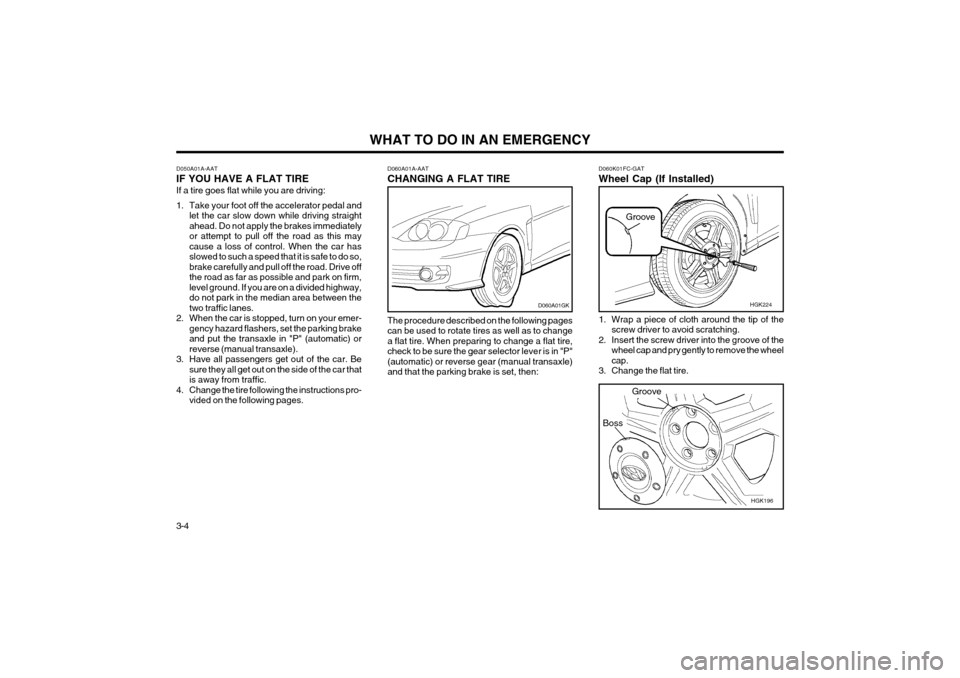
WHAT TO DO IN AN EMERGENCY
3-4
Boss
D060A01A-AAT CHANGING A FLAT TIRE The procedure described on the following pages can be used to rotate tires as well as to changea flat tire. When preparing to change a flat tire,check to be sure the gear selector lever is in "P"(automatic) or reverse gear (manual transaxle)and that the parking brake is set, then:
D060A01GK
D050A01A-AAT IF YOU HAVE A FLAT TIREIf a tire goes flat while you are driving:
1. Take your foot off the accelerator pedal and
let the car slow down while driving straight ahead. Do not apply the brakes immediatelyor attempt to pull off the road as this maycause a loss of control. When the car hasslowed to such a speed that it is safe to do so,brake carefully and pull off the road. Drive offthe road as far as possible and park on firm,level ground. If you are on a divided highway,do not park in the median area between thetwo traffic lanes.
2. When the car is stopped, turn on your emer- gency hazard flashers, set the parking brakeand put the transaxle in "P" (automatic) orreverse (manual transaxle).
3. Have all passengers get out of the car. Be sure they all get out on the side of the car thatis away from traffic.
4. Change the tire following the instructions pro- vided on the following pages.
D060K01FC-GAT Wheel Cap (If Installed)
HGK196
1. Wrap a piece of cloth around the tip of the
screw driver to avoid scratching.
2. Insert the screw driver into the groove of the wheel cap and pry gently to remove the wheel cap.
3. Change the flat tire. HGK224
Groove
Groove
Page 119 of 310

WHAT TO DO IN AN EMERGENCY
3-8 D080A02A-GAT IF YOUR CAR MUST BE TOWED CAUTION: Your car can be damaged if towed incorrect-ly! If your car has to be towed, it should be done by your Hyundai dealer or a commercial tow truckservice. This will help assure that your car is notdamaged in towing. Also, professionals are gen-erally aware of local laws governing towing. Inany case, rather than risk damage to your car, itis suggested that you show this information to thetow truck operator. Be sure that a safety chainsystem is used and that all local laws are ob-served.
D080B01A-AAT Towing a Car with a Manual Transaxle
o If the car is being towed with the rear wheels
on the ground, be sure the parking brake is released.
o If the car is being towed with the front wheels on the ground, be sure that the transaxle is inneutral. Also, be sure that the ignition key is inthe "ACC" position. This is necessary toprevent damage to the steering lock mecha-nism, which is not designed to hold the frontwheels straight while the car is being towed.
o If any of the loaded wheels or suspension components are damaged, a towing dollymust be used.
o OK FOR AUTOMATIC OR MANUAL
TRANSAXLE EQUIPPED VEHICLE o OK FOR AUTOMATIC OR MANUAL
TRANSAXLE EQUIPPED VEHICLEWITH NO DAMAGE
D080A01GKHGK199
D060J01FC-GAT After Changing Wheels If you have a tire gauge, remove the valve cap and check the air pressure. If the pressure islower than recommended, drive slowly to thenearest service station and inflate to the correctpressure. If it is too high, adjust it until it is correct.Always reinstall the valve cap after checking oradjusting tire pressure. If the cap is not replaced,air may leak from the tire. If you lose a valve cap,buy another and install it as soon as possible.After you have changed wheels, always securethe flat tire in its place in the luggage compart-ment and return the jack and tools to their properstorage locations.
HGK195
Page 120 of 310

WHAT TO DO IN AN EMERGENCY 3-9
D080C02A-GAT Towing a Car With an Automatic Transaxle CAUTION: A car with an automatic transaxle should never be towed from the rear with the frontwheels on the ground. This can cause seri-ous damage to the transaxle. If the car mustbe towed from the rear, a towing dolly mustbe used under the front wheels. If the car is being towed with the rear wheels on the ground, be sure the parking brake is re-leased.
o NOT OK FOR AUTOMATIC TRANSAXLE
EQUIPPED VEHICLE
o OK FOR MANUAL TRANSAXLE
D080D02A-AAT Emergency Towing For emergency towing when no commercial tow vehicle is available, attach a tow cable, chain orstrap to one of the towing hooks under the front/rear of your car. Do not attempt to tow yourvehicle in this manner on any unpaved surface.This could result in serious damage to your car.Nor should towing be attempted if the wheels,drive train, axles, steering or brakes are dam-aged. Before towing, be sure the transaxle is inneutral and the key is in "ACC" (with the engineoff) or in the "ON" position (with the enginerunning). A driver must be in the towed car tosteer it and operate the brakes. CAUTION:
o If the car is being towed with all four
wheels on the ground, it can be towedonly from the front. Be sure that thetransaxle is in neutral. Do not tow at speedsgreater than 50 km/h (30 mph) and formore than 25 km (15 miles).
o Be sure the steering is unlocked by plac- ing the key in the "ACC" position. A drivermust be in the towed vehicle to operatethe steering and brakes
o OK FOR AUTOMATIC OR MANUAL
TRANSAXLE EQUIPPED VEHICLE
HGK200
D080C01GK
HGK188
NOTE: Before towing, check the level of the transaxlefluid. If it is below the "HOT" range on thedipstick, add fluid. If you cannot add fluid, atowing dolly must be used.
Page 124 of 310

CORROSION PREVENTION AND APPEARANCE CARE 4-3
E030D01A-AAT When to Wax AgainYou should polish and wax the car again when water no longer beads on a clean surface butspreads out over a larger area. E030E01A-AAT Maintaining BumpersSpecial precautions must be observed to pre- serve the appearance of the bumpers on yourHyundai. They are:
o Be careful not to spill battery electrolyte or
hydraulic brake fluid on the bumpers. If you do, wash it off immediately with clear water.
o Be gentle when cleaning the bumper sur- faces. They are made of soft plastic and thesurface can be damaged if mistreated. Do notuse abrasive cleaners. Use warm water andmild soap or car-washing solution.
o Do not expose the bumpers to high tem- peratures. For example, if you have your carrepainted, do not leave the bumpers on thecar if the car is going to be placed in a high-temperature paint booth. E040A01A-AAT CLEANING THE INTERIOR To Clean the Vinyl Upholstery To clean the vinyl upholstery, first remove loose dirt and dust with a vacuum cleaner. Then applya solution of mild soap or detergent and waterusing a clean sponge or soft cloth. Allow this tostay on the surface to loosen the dirt, then wipewith a clean damp sponge or cloth. If all the dirtstains are not removed, repeat this procedureuntil the upholstery is clean. Do not use gasoline,solvent, paint thinner or other strong cleaners.
E030B01A-AAT Spot CleaningDon't use gasoline, strong solvents or corrosive cleaning agents. These can damage the finish ofthe car. To remove road tar, use turpentine on aclean, soft cloth. Be gentle.To remove dead insects or tree sap, use warmwater and mild soap or car-washing solution.Soak the spot and rub gently. If the paint has lostits luster, use a commercial car-cleaning polish. E030C01A-AAT Polishing and Waxing Always wash and dry the car before polishing or waxing or using a combination cleaner and wax.Use a good quality commercial product andfollow the manufacturer's directions on the con-tainer. Polish and wax the bright trim pieces aswell as the paint. E040B01A-AAT To Clean the Leather Upholstery (If Installed) In the normal course of use, leather upholstered surfaces will, like any material, pick-up dust anddirt. This dust and dirt must be cleaned off or itmay work into the surface of the leather, causingdamage. Fine leather needs care, and should be cleaned when necessary. Washing leather thoroughlywith soap and water will keep your leather lus-trous, beautiful and ensure you have many yearsof wear.Take a piece of cheese cloth and using any mildsoap and lukewarm water, work up a good lather.Thoroughly wash the leather. Wipe clean with aslightly damp cloth and dry with soft cloth. Do thisas often as the leather becomes soiled.
sure that the outlets and the underside of thedoors are open. Paint damage can be caused bysmall accumulation of tar, industrial precipita-tion, tree resin, insects and bird droppings, whennot removed immediately. If water alone is notstrong enough to remove the accumulated dirt,use a mild car washing solution. Be sure to rinsethe surface after washing to remove the solution.Never allow the solution to dry on the paintedsurfaces.