ecu Hyundai Coupe 2003 Owner's Guide
[x] Cancel search | Manufacturer: HYUNDAI, Model Year: 2003, Model line: Coupe, Model: Hyundai Coupe 2003Pages: 310, PDF Size: 2.87 MB
Page 155 of 310

DO-IT-YOURSELF MAINTENANCE 6-23
G200C01GK-GAT
FUSE PANEL DESCRIPTION Engine Compartment
HGK205-EPROTECTED COMPONENTS
Generator Generator Condenser Fan Radiator FanEngine Control, ECM. ATM ControlIgnition, Start RelayABSABS Blower InjectorO 2 Sensor, ECM
DRL
Front Fog Light TCM, ECM
Horn. A/ConditionerHead Light (High)Head Light (LOW)
FUSE RATING
120A50A30A 30A 30A30A30A30A30A 15A 10A15A15A10A15A 15A 15A
DESCRIPTION
BATTBATT
COND RADECU
IGN
ABS 1ABS 2
BLOWER INJ
SNSR DRL
F/FOG ECU
HORN,A/CON H/LP (H1)
H/LP (LO)
NOTE:
Not all fuse panel descriptions in this manual may be applicable to your vehicle. It is accurate at the time of printing. When you inspect the fuse
box on your vehicle, refer to the fuse box label.
If installed
Page 156 of 310

DO-IT-YOURSELF MAINTENANCE
6-24 DESCRIPTION
IG COIL
AMP
B/UP LAMP
A/BAG IND
A/BAG
HTD MIR HAZARD
R/WIPER TAIL-RH
F/WIPER
A/C SW
RR DEFOG STOP
TAIL-LH
A/CON ECU
CLUSTER
ROOM LP
P/WINDOW T/GATE
IGN
RR FOG C/LIGHT
S/ROOF S/HTR ABS
AUDIO
G200D01GK-GAT
Inner Panel
HGK204-E
PROTECTED COMPONENTS
Ignition Coil, ECM
AMP. Multi Gauge Unit B/Up LampAir Bag Indicator Air Bag Outside Mirror DefrosterHazard Warning Light Rear Window Wiper
Tail LightFront Window Wiper A/Conditioner Rear Window DefrosterStop Light
Tail Light A/Conditioner ECM, Multi Gauge Unit, TCMCluster Map Light, Clock, Audio Power WindowTail Gate Open A/Con, A.Q.S Sensor Rear FogC/Lighter, Outside Mirror Sunroof Seat WarmerABS. TCS Audio, Clock
FUSERATING
20A20A 10A10A 15A 10A10A 15A 10A20A 10A 30A15A 10A 10A10A 10A 10A30A 15A 10A10A 15A 15A20A 10A 10A
Page 178 of 310

CONTROLS AND EQUIPMENT
1- 2 B040A02Y-EAT DOOR LOCKS WARNING:
o Unlocked doors can be dangerous. Before
you drive away (especially if there are chil-dren in the car), be sure that all the doorsare securely closed and locked so that thedoors cannot be inadvertently opened fromthe inside. This helps ensure that doorswill not be opened accidentally. Also, whencombined with the proper use of seat belts,locking the doors helps keep occupantsfrom being ejected from the car in case ofan accident.
o Before opening the door, always look for and avoid oncoming traffic.
o In case of accident the door is unlocked automatically (Not all models).
B880B03A-GAT Keys
All of the locks fitted to the vehicle are operated by the same key. However, since it is possible tolock the doors without the use of the key, careshould be exercised to ensure that the key doesnot become locked inside the vehicle by mistake. NOTE: If you make your own duplicate key, you willnot be able to cancel the system or start theengine. AX10020A-1B880C02A-GAT Key Numbers
AX10030A-1
The vehicle key number is recorded upon a metal tag attached to the keys when the vehicleis first delivered to you.The key number should be recorded and kept ina safe place in case the need to order furtherkeys arises. New keys are available from anyHyundai dealer by quoting the relevant key num-ber.In the interest of security, the metal tag attachedto the keys which bears the key number shouldbe removed from the key ring after you receiveyour new vehicle. In addition, key numbers can-not be provided by Hyundai for security reasons.If you need additional keys or if you should loseyour keys, your authorized Hyundai dealer canmake new keys.
B880A01A-GAT IMMOBILIZER SYSTEMThe immobiliser system is an anti-theft device, designed to deter automobile theft.
Page 183 of 310
CONTROLS AND EQUIPMENT1- 7
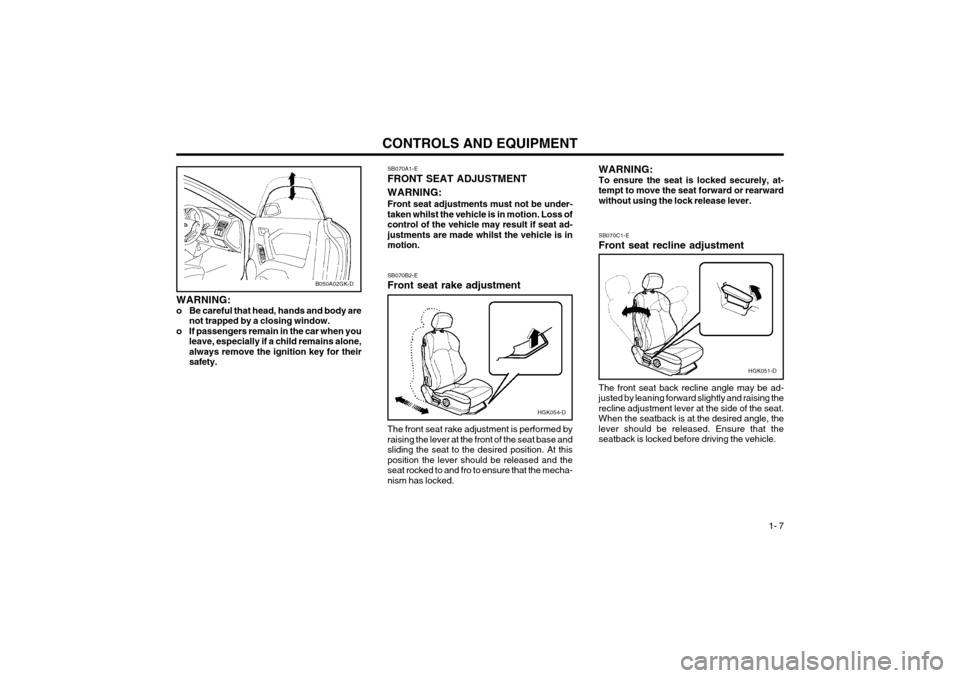
SB070A1-E FRONT SEAT ADJUSTMENT WARNING: Front seat adjustments must not be under- taken whilst the vehicle is in motion. Loss ofcontrol of the vehicle may result if seat ad-justments are made whilst the vehicle is inmotion. SB070B2-E Front seat rake adjustment The front seat rake adjustment is performed by raising the lever at the front of the seat base andsliding the seat to the desired position. At thisposition the lever should be released and theseat rocked to and fro to ensure that the mecha-nism has locked.
B050A02GK-D
WARNING:
o Be careful that head, hands and body are
not trapped by a closing window.
o If passengers remain in the car when you leave, especially if a child remains alone,always remove the ignition key for theirsafety.
HGK054-D
SB070C1-E Front seat recline adjustment The front seat back recline angle may be ad- justed by leaning forward slightly and raising therecline adjustment lever at the side of the seat.When the seatback is at the desired angle, thelever should be released. Ensure that theseatback is locked before driving the vehicle.
HGK051-D
WARNING: To ensure the seat is locked securely, at-tempt to move the seat forward or rearwardwithout using the lock release lever.
Page 186 of 310
CONTROLS AND EQUIPMENT
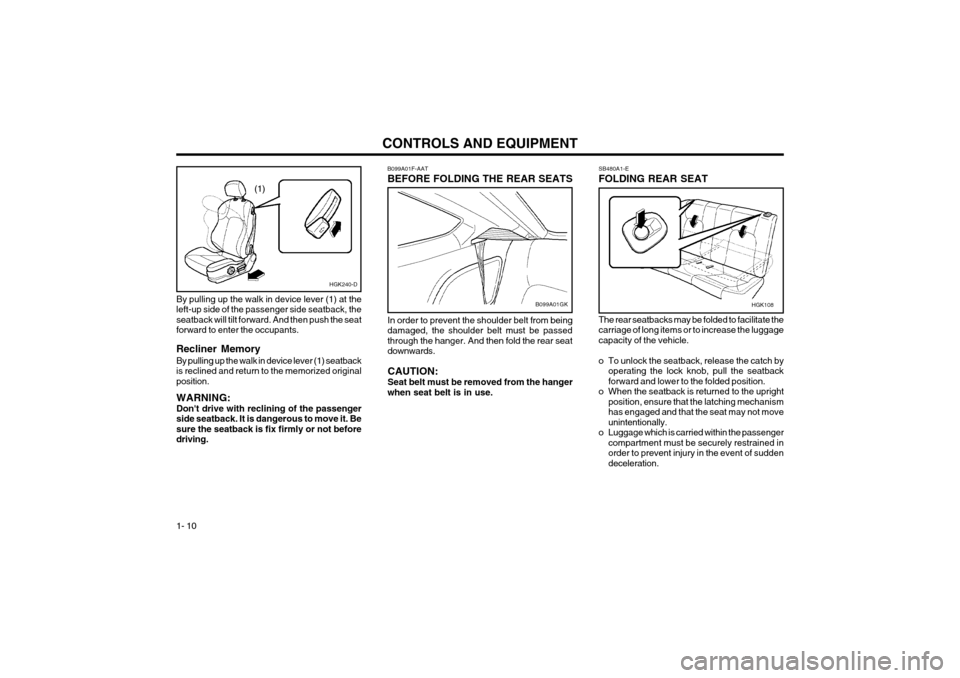
1- 10 SB480A1-E FOLDING REAR SEAT The rear seatbacks may be folded to facilitate the carriage of long items or to increase the luggagecapacity of the vehicle.
o To unlock the seatback, release the catch by
operating the lock knob, pull the seatback forward and lower to the folded position.
o When the seatback is returned to the upright position, ensure that the latching mechanismhas engaged and that the seat may not moveunintentionally.
o Luggage which is carried within the passenger compartment must be securely restrained inorder to prevent injury in the event of suddendeceleration.
HGK108
B099A01F-AAT BEFORE FOLDING THE REAR SEATS
In order to prevent the shoulder belt from being
damaged, the shoulder belt must be passed through the hanger. And then fold the rear seat downwards. CAUTION: Seat belt must be removed from the hanger
when seat belt is in use.
HGK240-D
(1)
By pulling up the walk in device lever (1) at the left-up side of the passenger side seatback, theseatback will tilt forward. And then push the seatforward to enter the occupants. Recliner Memory By pulling up the walk in device lever (1) seatback is reclined and return to the memorized originalposition. WARNING: Don't drive with reclining of the passengerside seatback. It is dangerous to move it. Besure the seatback is fix firmly or not beforedriving.
B099A01GK
Page 187 of 310

CONTROLS AND EQUIPMENT1- 11
SB090E1-E Injured Persons A seat belt should be used when an injured person is being transported. For specific recom-mendations, the advice of a qualified MedicalPractioner should be sought.
WARNING: The folding rear seats are intended to allow the carriage of longer objects than couldotherwise be accommodated. Do not allowpassengers to sit on top of the folded-downseatback whilst the car is in motion since thefolded seat does not provide a suitable sittingfacility and no seat belts are available for use.Objects carried on the folded seatback shouldnot extend higher than the top of the frontseats and must be securely restrained toprevent injury or damage during sudden de-celeration.
SB090A1-E SEAT BELT PRECAUTIONSSeat belts should be worn at all times by all occupants front and rear. The possibility of injuryor the severity of injuries suffered in the event ofan accident will be greatly reduced by the wear-ing of seat belts.In addition the following recommendations shouldbe observed. SB090B1-E Babies/Small Children Babies and small children must be restrained using a restraint system specifically designed forthis purpose. Under no circumstances should achild be carried in the vehicle without the use ofa suitable restraint which meets the regulationsin force in the country where the vehicle is inoperation. SB090C1-E Larger Children Larger children should occupy the rear seat and be restrained at all times. The restraint may takethe form of a special safety belt or the originalfactory fitted seat belt used in conjunction with anapproved booster cushion depending upon thesize and weight of the child. Under no circum-stances should children be allowed to travelstanding, kneeling or lying on the seat.Never allow children to ride in the front passen-ger seat.SB090O1-E Pregnant WomenThe use of a seat belt is recommended for pregnant women. The seat belt should be wornas low and snugly as possible across the hips,not across the abdomen. A qualified MedicalPractitioner should be consulted for further infor-mation.
SB500A1-E REAR PARCEL SHELF Large or heavy items must not be placed upon the rear parcel shelf to prevent the possibility ofinjury arising from such items in the event ofimpact.
B140A01GK
SB090F1-E Seat Belt OccupancyThe seat belts are designed to be used by one seat occupant only. The use of a seat belt bymore than one person increases the levels ofinjury which may be sustained in the event of anaccident. SE090G1-E Do Not Lie Down To ensure that the maximum level of protection may be afforded by the seat belt system, allpassengers should be sitting in an upright posi-tion throughout the journey. The seat belt will beunable to afford maximum protection if the frontseats are at or near the fully reclined position.
Page 188 of 310

CONTROLS AND EQUIPMENT
1- 12
SB090H1-E CARE OF SEAT BELTSSeat belt assemblies must never be disassembled or modified in any way. In addition, care shouldbe exercised to ensure that the belt assembliesdo not become damaged by being trapped in seatmechanisms, door shuts etc. SB090I-E Periodic Inspection It is recommended that all seat belts be inspected periodically for wear or damage of any kind.Parts of the system that are damaged should bereplaced as soon as possible. Under no circum-stances must any part of the seat belt assem-blies be dismantled or repaired. SB090J1-E Keep Belts Clean and Dry Seat belts should be kept clean and dry. If belts become dirty, they can be cleaned using a mildsoap solution and warm water. Bleach, dye,strong detergents or abrasives should not beused since the fabric may become damaged andweakened.
SB090K1-E Replacement of Seat BeltsThe entire seat belt assembly or assemblies should be replaced if the vehicle has been in-volved in an accident even if no damage isevident. Additional questions concerning seatbelt operation should be directed to a HyundaiDealer. SB090O1-F FRONT SEATBELT PIVOT HEIGHT AD- JUSTMENT (Not all models)
attempt to adjust the height of the upper anchor- age point while the vehicle is moving.If you are any doubt as to the method of adjust-ment or the optimum height position for your frontseat belt always contact your nearest HyundaiDealer. WARNING:
o The height adjuster must be in the locked
position when the vehicle is moving.
o The misadjustment of height of the shoul- der belt could reduce the effectiveness ofthe seat belt in a crash.
HGK109
The location of the upper anchorage point can be set (for greater belt comfort and security) to anyone of five preset positions. To adjust the seatbelt pivot push the knob upward or downward tothe required setting, ensuring that it engages oneof the preset positions (on releasing the knob).The height adjuster must always be locked intoposition while the vehicle is stationary. Do not
Page 190 of 310

CONTROLS AND EQUIPMENT
1- 14 shoulder belt must always be positioned as low as possible on the child's hips andas snug as possible.
o If the seat belt will not properly fit the child, Hyundai recommends the use of anapproved booster seat in the rear seat inorder to raise the child's seating height sothat the seat belt will properly fit the child.
o Never allow a child to stand up or kneel on the seat.
o Never use an infant carrier or child safety seat that "hooks" over a seatback; it maynot provide adequate security in an acci-dent.
o Never allow a child to be held in a person's arms while they are in a moving vehicle, asthis could result in serious injury to thechild in the event of an accident or asudden stop. Holding a child in a movingvehicle does not provide the child withany means of protection during an acci-dent, even if the person holding the childis wearing a seat belt.
o If the child restraint seat is not anchored properly, the risk of a child being seri-ously injured or killed in a collision greatlyincreases.
WARNING:
o A child restraint system must be placed in
the rear seat. Never install a child or infantseat on the front passenger's seat.Should an accident occur and cause thepassenger side airbag to deploy, it couldseverely injure or kill an infant or childseated in an infant or child seat. Thus, onlyuse a child restraint in the rear seat of yourvehicle.
o Since a safety belt or child restraint sys- tem can become very hot if it is left in aclosed vehicle, be sure to check the seatcover and buckles before placing a childthere.
o When the child restraint system is not in use, store it in the boot or fasten it with asafety belt so that it will not be thrownforward in the case of a sudden stop or anaccident.
o Children who are too large to be in a child restraint should sit in the rear seat and berestrained with the available lap/shoulderbelts. Never allow children to ride in thefront passenger seat.
o Always make sure that the shoulder belt portion of the outboard lap/shoulder beltis positioned midway over the shoulder,never across the neck or behind the back.Moving the child closer to the center of thevehicle may help provide a good shoulderbelt fit. The lap belt portion of the lap/
B230A02GK-EAT CHILD RESTRAINT SYSTEMChildren riding in the car should sit in the rear seat and must always be properly restrained tominimize the risk of injury in an accident, suddenstop or sudden maneuver. According to accidentstatistics, children are safer when properly re-strained in the rear seats than in the front seat.Larger children not in a child restraint should useone of the seat belts provided.You are required by law to use safety restraintsfor children. If small children ride in your vehicleyou must put them in a child restraint system(safety seat).Children could be injured or killed in a crash iftheir restraints are not properly secured. Forsmall children and babies, a child seat or infantseat must be used. Before buying a particularchild restraint system, make sure it fits your carseat and seat belts, and fits your child. Follow allthe instructions provided by the manufacturerwhen installing the child restraint system.
Page 191 of 310
CONTROLS AND EQUIPMENT1- 15
B230G01A-GAT Installation on the Outboard Rear Seats
B230G01GK
On outboard rear seats
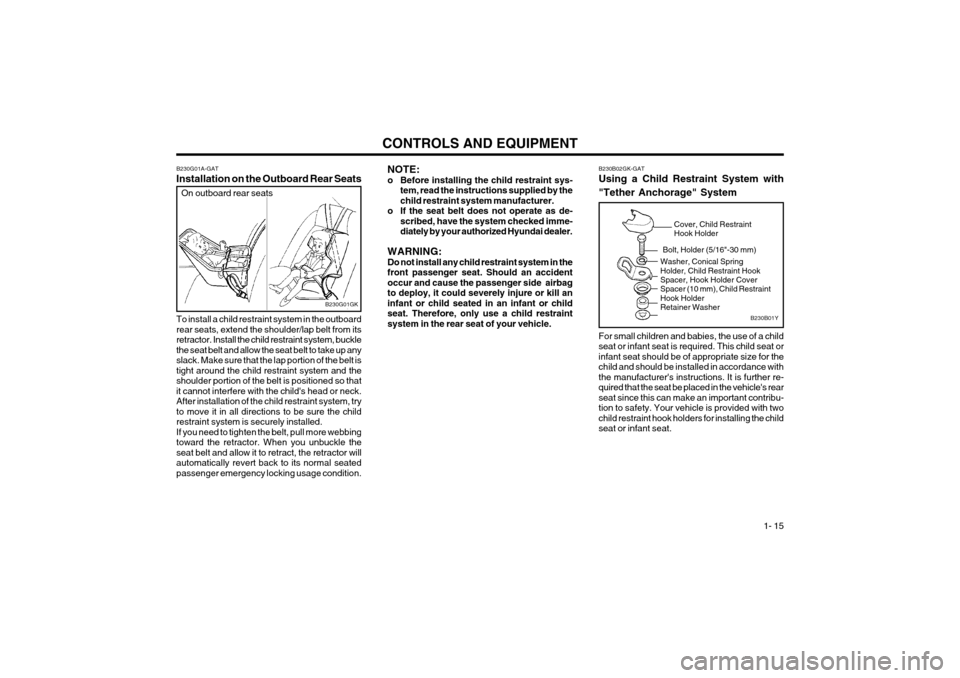
To install a child restraint system in the outboard rear seats, extend the shoulder/lap belt from itsretractor. Install the child restraint system, bucklethe seat belt and allow the seat belt to take up anyslack. Make sure that the lap portion of the belt istight around the child restraint system and theshoulder portion of the belt is positioned so thatit cannot interfere with the child's head or neck.After installation of the child restraint system, tryto move it in all directions to be sure the childrestraint system is securely installed.If you need to tighten the belt, pull more webbingtoward the retractor. When you unbuckle theseat belt and allow it to retract, the retractor willautomatically revert back to its normal seatedpassenger emergency locking usage condition. NOTE:
o Before installing the child restraint sys-
tem, read the instructions supplied by thechild restraint system manufacturer.
o If the seat belt does not operate as de- scribed, have the system checked imme-diately by your authorized Hyundai dealer.
WARNING:Do not install any child restraint system in thefront passenger seat. Should an accidentoccur and cause the passenger side airbagto deploy, it could severely injure or kill aninfant or child seated in an infant or childseat. Therefore, only use a child restraintsystem in the rear seat of your vehicle. B230B02GK-GAT Using a Child Restraint System with "Tether Anchorage" System For small children and babies, the use of a child seat or infant seat is required. This child seat orinfant seat should be of appropriate size for thechild and should be installed in accordance withthe manufacturer's instructions. It is further re-quired that the seat be placed in the vehicle's rearseat since this can make an important contribu-tion to safety. Your vehicle is provided with twochild restraint hook holders for installing the childseat or infant seat.
B230B01Y
Cover, Child Restraint Hook Holder
Bolt, Holder (5/16"-30 mm)
Washer, Conical Spring Holder, Child Restraint HookSpacer, Hook Holder Cover Spacer (10 mm), Child Restraint Hook HolderRetainer Washer
Page 192 of 310

CONTROLS AND EQUIPMENT
1- 16
B230E01GK
Back panel
Front of Vehicle
Tether strap hook
B230C02GK-GAT Securing a Child Restraint System with "Tether Anchorage" System Two child restraint hook holders are located on the vertical back panel.
Load Space Cover
1. Route the child restraint seat strap over the
seatback. For vehicles with adjustable headrests, routethe tether strap under the headrest and be-tween the headrest posts, otherwise routethe tether strap over the top of the seatback.
2. Remove the load space cover.
3. Connect the tether strap hook to the child restraint hook holder and tighten to securethe seat. B230C04A-EAT Securing a Child Restraint System with "ISOFIX" System and "Tether Anchor-age" System
B230F01GK
ISOFIX is a standardised method of fitting child seats that eliminates the need to use the stan-dard adult seat belt to secure the seat in thevehicle. This enables a much more secure andpositive location with the added benefit of easierand quicker installation. An ISOFIX-seat can only be installed if it has vehicle-specific approval in accordance with therequirements of ECE-R44. For your Hyundai,the Hyundai ISOFIX GR1 / Hyundai Duo / RömerISOFIX GR1 and the Römer Duo ISOFIX / BritaxDuo ISOFIX is approved according to the re-quirement ECE-R44. This seat has been testedextensively by Hyundai and is recommended foryour Hyundai.