belt Hyundai Coupe 2003 Service Manual
[x] Cancel search | Manufacturer: HYUNDAI, Model Year: 2003, Model line: Coupe, Model: Hyundai Coupe 2003Pages: 310, PDF Size: 2.87 MB
Page 186 of 310
CONTROLS AND EQUIPMENT
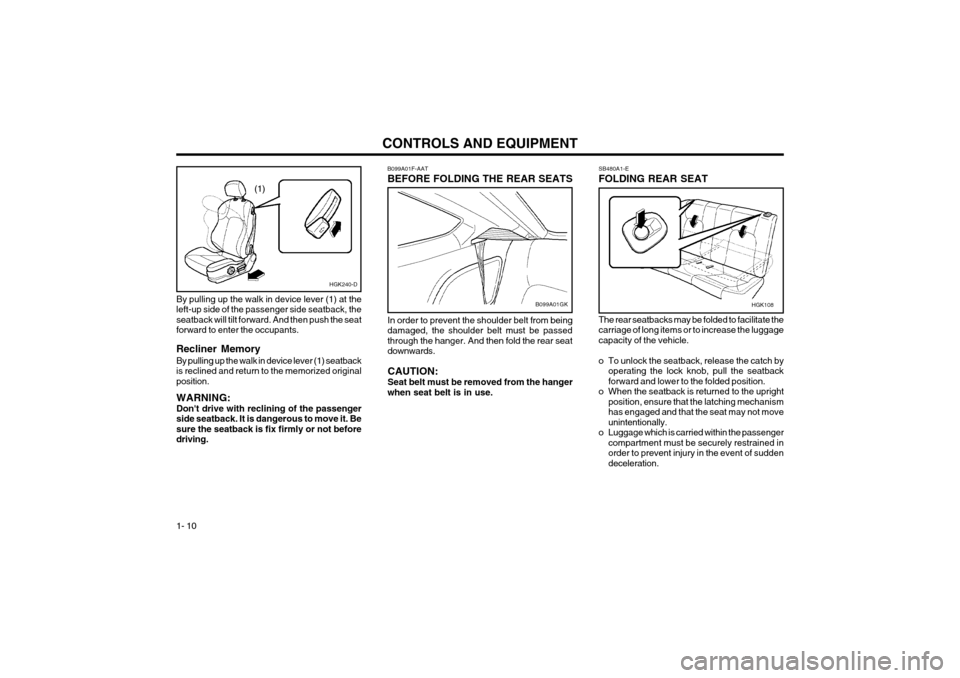
1- 10 SB480A1-E FOLDING REAR SEAT The rear seatbacks may be folded to facilitate the carriage of long items or to increase the luggagecapacity of the vehicle.
o To unlock the seatback, release the catch by
operating the lock knob, pull the seatback forward and lower to the folded position.
o When the seatback is returned to the upright position, ensure that the latching mechanismhas engaged and that the seat may not moveunintentionally.
o Luggage which is carried within the passenger compartment must be securely restrained inorder to prevent injury in the event of suddendeceleration.
HGK108
B099A01F-AAT BEFORE FOLDING THE REAR SEATS
In order to prevent the shoulder belt from being
damaged, the shoulder belt must be passed through the hanger. And then fold the rear seat downwards. CAUTION: Seat belt must be removed from the hanger
when seat belt is in use.
HGK240-D
(1)
By pulling up the walk in device lever (1) at the left-up side of the passenger side seatback, theseatback will tilt forward. And then push the seatforward to enter the occupants. Recliner Memory By pulling up the walk in device lever (1) seatback is reclined and return to the memorized originalposition. WARNING: Don't drive with reclining of the passengerside seatback. It is dangerous to move it. Besure the seatback is fix firmly or not beforedriving.
B099A01GK
Page 187 of 310

CONTROLS AND EQUIPMENT1- 11
SB090E1-E Injured Persons A seat belt should be used when an injured person is being transported. For specific recom-mendations, the advice of a qualified MedicalPractioner should be sought.
WARNING: The folding rear seats are intended to allow the carriage of longer objects than couldotherwise be accommodated. Do not allowpassengers to sit on top of the folded-downseatback whilst the car is in motion since thefolded seat does not provide a suitable sittingfacility and no seat belts are available for use.Objects carried on the folded seatback shouldnot extend higher than the top of the frontseats and must be securely restrained toprevent injury or damage during sudden de-celeration.
SB090A1-E SEAT BELT PRECAUTIONSSeat belts should be worn at all times by all occupants front and rear. The possibility of injuryor the severity of injuries suffered in the event ofan accident will be greatly reduced by the wear-ing of seat belts.In addition the following recommendations shouldbe observed. SB090B1-E Babies/Small Children Babies and small children must be restrained using a restraint system specifically designed forthis purpose. Under no circumstances should achild be carried in the vehicle without the use ofa suitable restraint which meets the regulationsin force in the country where the vehicle is inoperation. SB090C1-E Larger Children Larger children should occupy the rear seat and be restrained at all times. The restraint may takethe form of a special safety belt or the originalfactory fitted seat belt used in conjunction with anapproved booster cushion depending upon thesize and weight of the child. Under no circum-stances should children be allowed to travelstanding, kneeling or lying on the seat.Never allow children to ride in the front passen-ger seat.SB090O1-E Pregnant WomenThe use of a seat belt is recommended for pregnant women. The seat belt should be wornas low and snugly as possible across the hips,not across the abdomen. A qualified MedicalPractitioner should be consulted for further infor-mation.
SB500A1-E REAR PARCEL SHELF Large or heavy items must not be placed upon the rear parcel shelf to prevent the possibility ofinjury arising from such items in the event ofimpact.
B140A01GK
SB090F1-E Seat Belt OccupancyThe seat belts are designed to be used by one seat occupant only. The use of a seat belt bymore than one person increases the levels ofinjury which may be sustained in the event of anaccident. SE090G1-E Do Not Lie Down To ensure that the maximum level of protection may be afforded by the seat belt system, allpassengers should be sitting in an upright posi-tion throughout the journey. The seat belt will beunable to afford maximum protection if the frontseats are at or near the fully reclined position.
Page 188 of 310

CONTROLS AND EQUIPMENT
1- 12
SB090H1-E CARE OF SEAT BELTSSeat belt assemblies must never be disassembled or modified in any way. In addition, care shouldbe exercised to ensure that the belt assembliesdo not become damaged by being trapped in seatmechanisms, door shuts etc. SB090I-E Periodic Inspection It is recommended that all seat belts be inspected periodically for wear or damage of any kind.Parts of the system that are damaged should bereplaced as soon as possible. Under no circum-stances must any part of the seat belt assem-blies be dismantled or repaired. SB090J1-E Keep Belts Clean and Dry Seat belts should be kept clean and dry. If belts become dirty, they can be cleaned using a mildsoap solution and warm water. Bleach, dye,strong detergents or abrasives should not beused since the fabric may become damaged andweakened.
SB090K1-E Replacement of Seat BeltsThe entire seat belt assembly or assemblies should be replaced if the vehicle has been in-volved in an accident even if no damage isevident. Additional questions concerning seatbelt operation should be directed to a HyundaiDealer. SB090O1-F FRONT SEATBELT PIVOT HEIGHT AD- JUSTMENT (Not all models)
attempt to adjust the height of the upper anchor- age point while the vehicle is moving.If you are any doubt as to the method of adjust-ment or the optimum height position for your frontseat belt always contact your nearest HyundaiDealer. WARNING:
o The height adjuster must be in the locked
position when the vehicle is moving.
o The misadjustment of height of the shoul- der belt could reduce the effectiveness ofthe seat belt in a crash.
HGK109
The location of the upper anchorage point can be set (for greater belt comfort and security) to anyone of five preset positions. To adjust the seatbelt pivot push the knob upward or downward tothe required setting, ensuring that it engages oneof the preset positions (on releasing the knob).The height adjuster must always be locked intoposition while the vehicle is stationary. Do not
Page 189 of 310
CONTROLS AND EQUIPMENT1- 13
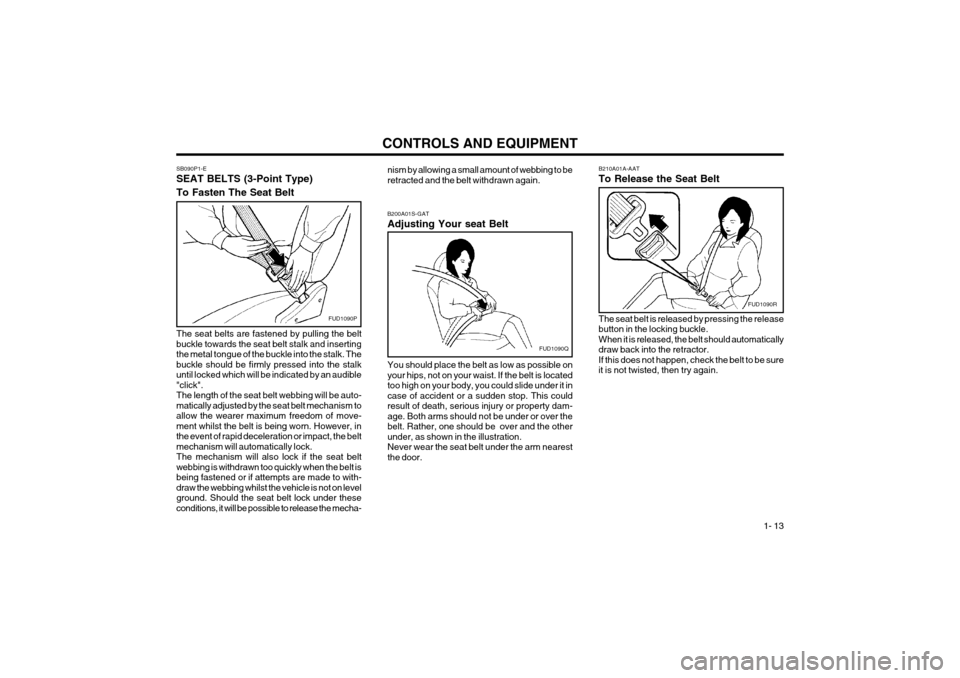
B210A01A-AAT To Release the Seat Belt
FUD1090R
The seat belt is released by pressing the release button in the locking buckle.When it is released, the belt should automaticallydraw back into the retractor.If this does not happen, check the belt to be sureit is not twisted, then try again.
SB090P1-E SEAT BELTS (3-Point Type) To Fasten The Seat Belt
B200A01S-GAT Adjusting Your seat BeltFUD1090P
The seat belts are fastened by pulling the belt buckle towards the seat belt stalk and insertingthe metal tongue of the buckle into the stalk. Thebuckle should be firmly pressed into the stalkuntil locked which will be indicated by an audible"click".The length of the seat belt webbing will be auto-matically adjusted by the seat belt mechanism toallow the wearer maximum freedom of move-ment whilst the belt is being worn. However, inthe event of rapid deceleration or impact, the beltmechanism will automatically lock.The mechanism will also lock if the seat beltwebbing is withdrawn too quickly when the belt isbeing fastened or if attempts are made to with-draw the webbing whilst the vehicle is not on levelground. Should the seat belt lock under theseconditions, it will be possible to release the mecha-
FUD1090Q
You should place the belt as low as possible on your hips, not on your waist. If the belt is locatedtoo high on your body, you could slide under it incase of accident or a sudden stop. This couldresult of death, serious injury or property dam-age. Both arms should not be under or over thebelt. Rather, one should be over and the otherunder, as shown in the illustration.Never wear the seat belt under the arm nearestthe door.
nism by allowing a small amount of webbing to beretracted and the belt withdrawn again.
Page 190 of 310

CONTROLS AND EQUIPMENT
1- 14 shoulder belt must always be positioned as low as possible on the child's hips andas snug as possible.
o If the seat belt will not properly fit the child, Hyundai recommends the use of anapproved booster seat in the rear seat inorder to raise the child's seating height sothat the seat belt will properly fit the child.
o Never allow a child to stand up or kneel on the seat.
o Never use an infant carrier or child safety seat that "hooks" over a seatback; it maynot provide adequate security in an acci-dent.
o Never allow a child to be held in a person's arms while they are in a moving vehicle, asthis could result in serious injury to thechild in the event of an accident or asudden stop. Holding a child in a movingvehicle does not provide the child withany means of protection during an acci-dent, even if the person holding the childis wearing a seat belt.
o If the child restraint seat is not anchored properly, the risk of a child being seri-ously injured or killed in a collision greatlyincreases.
WARNING:
o A child restraint system must be placed in
the rear seat. Never install a child or infantseat on the front passenger's seat.Should an accident occur and cause thepassenger side airbag to deploy, it couldseverely injure or kill an infant or childseated in an infant or child seat. Thus, onlyuse a child restraint in the rear seat of yourvehicle.
o Since a safety belt or child restraint sys- tem can become very hot if it is left in aclosed vehicle, be sure to check the seatcover and buckles before placing a childthere.
o When the child restraint system is not in use, store it in the boot or fasten it with asafety belt so that it will not be thrownforward in the case of a sudden stop or anaccident.
o Children who are too large to be in a child restraint should sit in the rear seat and berestrained with the available lap/shoulderbelts. Never allow children to ride in thefront passenger seat.
o Always make sure that the shoulder belt portion of the outboard lap/shoulder beltis positioned midway over the shoulder,never across the neck or behind the back.Moving the child closer to the center of thevehicle may help provide a good shoulderbelt fit. The lap belt portion of the lap/
B230A02GK-EAT CHILD RESTRAINT SYSTEMChildren riding in the car should sit in the rear seat and must always be properly restrained tominimize the risk of injury in an accident, suddenstop or sudden maneuver. According to accidentstatistics, children are safer when properly re-strained in the rear seats than in the front seat.Larger children not in a child restraint should useone of the seat belts provided.You are required by law to use safety restraintsfor children. If small children ride in your vehicleyou must put them in a child restraint system(safety seat).Children could be injured or killed in a crash iftheir restraints are not properly secured. Forsmall children and babies, a child seat or infantseat must be used. Before buying a particularchild restraint system, make sure it fits your carseat and seat belts, and fits your child. Follow allthe instructions provided by the manufacturerwhen installing the child restraint system.
Page 191 of 310
CONTROLS AND EQUIPMENT1- 15
B230G01A-GAT Installation on the Outboard Rear Seats
B230G01GK
On outboard rear seats
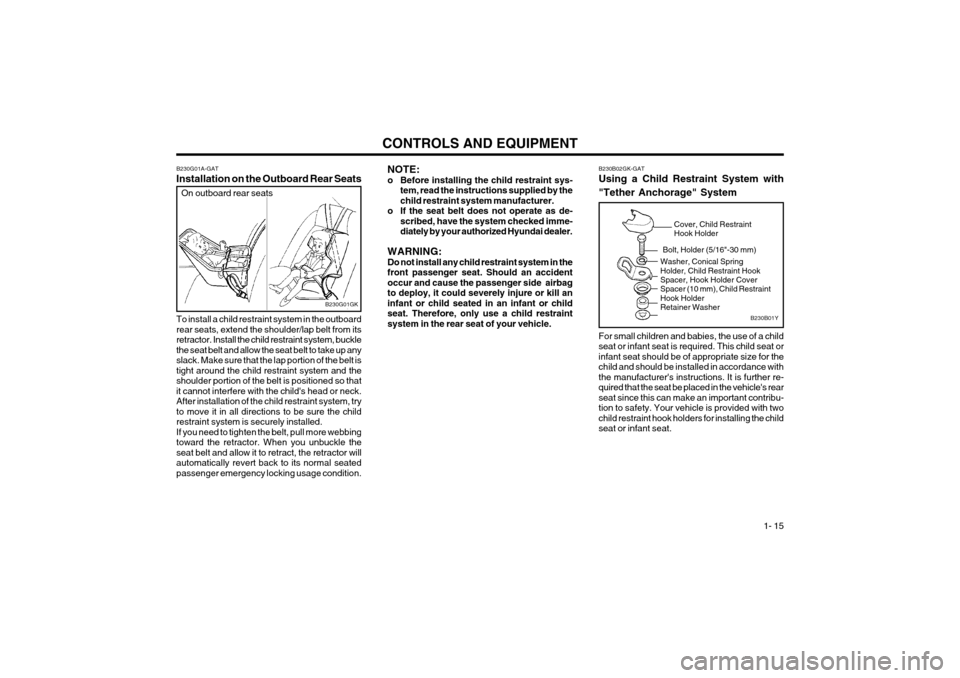
To install a child restraint system in the outboard rear seats, extend the shoulder/lap belt from itsretractor. Install the child restraint system, bucklethe seat belt and allow the seat belt to take up anyslack. Make sure that the lap portion of the belt istight around the child restraint system and theshoulder portion of the belt is positioned so thatit cannot interfere with the child's head or neck.After installation of the child restraint system, tryto move it in all directions to be sure the childrestraint system is securely installed.If you need to tighten the belt, pull more webbingtoward the retractor. When you unbuckle theseat belt and allow it to retract, the retractor willautomatically revert back to its normal seatedpassenger emergency locking usage condition. NOTE:
o Before installing the child restraint sys-
tem, read the instructions supplied by thechild restraint system manufacturer.
o If the seat belt does not operate as de- scribed, have the system checked imme-diately by your authorized Hyundai dealer.
WARNING:Do not install any child restraint system in thefront passenger seat. Should an accidentoccur and cause the passenger side airbagto deploy, it could severely injure or kill aninfant or child seated in an infant or childseat. Therefore, only use a child restraintsystem in the rear seat of your vehicle. B230B02GK-GAT Using a Child Restraint System with "Tether Anchorage" System For small children and babies, the use of a child seat or infant seat is required. This child seat orinfant seat should be of appropriate size for thechild and should be installed in accordance withthe manufacturer's instructions. It is further re-quired that the seat be placed in the vehicle's rearseat since this can make an important contribu-tion to safety. Your vehicle is provided with twochild restraint hook holders for installing the childseat or infant seat.
B230B01Y
Cover, Child Restraint Hook Holder
Bolt, Holder (5/16"-30 mm)
Washer, Conical Spring Holder, Child Restraint HookSpacer, Hook Holder Cover Spacer (10 mm), Child Restraint Hook HolderRetainer Washer
Page 192 of 310

CONTROLS AND EQUIPMENT
1- 16
B230E01GK
Back panel
Front of Vehicle
Tether strap hook
B230C02GK-GAT Securing a Child Restraint System with "Tether Anchorage" System Two child restraint hook holders are located on the vertical back panel.
Load Space Cover
1. Route the child restraint seat strap over the
seatback. For vehicles with adjustable headrests, routethe tether strap under the headrest and be-tween the headrest posts, otherwise routethe tether strap over the top of the seatback.
2. Remove the load space cover.
3. Connect the tether strap hook to the child restraint hook holder and tighten to securethe seat. B230C04A-EAT Securing a Child Restraint System with "ISOFIX" System and "Tether Anchor-age" System
B230F01GK
ISOFIX is a standardised method of fitting child seats that eliminates the need to use the stan-dard adult seat belt to secure the seat in thevehicle. This enables a much more secure andpositive location with the added benefit of easierand quicker installation. An ISOFIX-seat can only be installed if it has vehicle-specific approval in accordance with therequirements of ECE-R44. For your Hyundai,the Hyundai ISOFIX GR1 / Hyundai Duo / RömerISOFIX GR1 and the Römer Duo ISOFIX / BritaxDuo ISOFIX is approved according to the re-quirement ECE-R44. This seat has been testedextensively by Hyundai and is recommended foryour Hyundai.
Page 193 of 310
CONTROLS AND EQUIPMENT1- 17
NOTE: At present, this seat is the only one comply-ing with that provision. In case that othermanufacturers will furnish proof of a respec-tive certification, Hyundai is going to evalu-ate this seat carefully and will give a recom-mendation provided that seat complies to thelaw. Please ask your Hyundai dealer in thisrespect.
B230D02GK
ISOFIX AnchorISOFIX Anchor
Position
Indicator
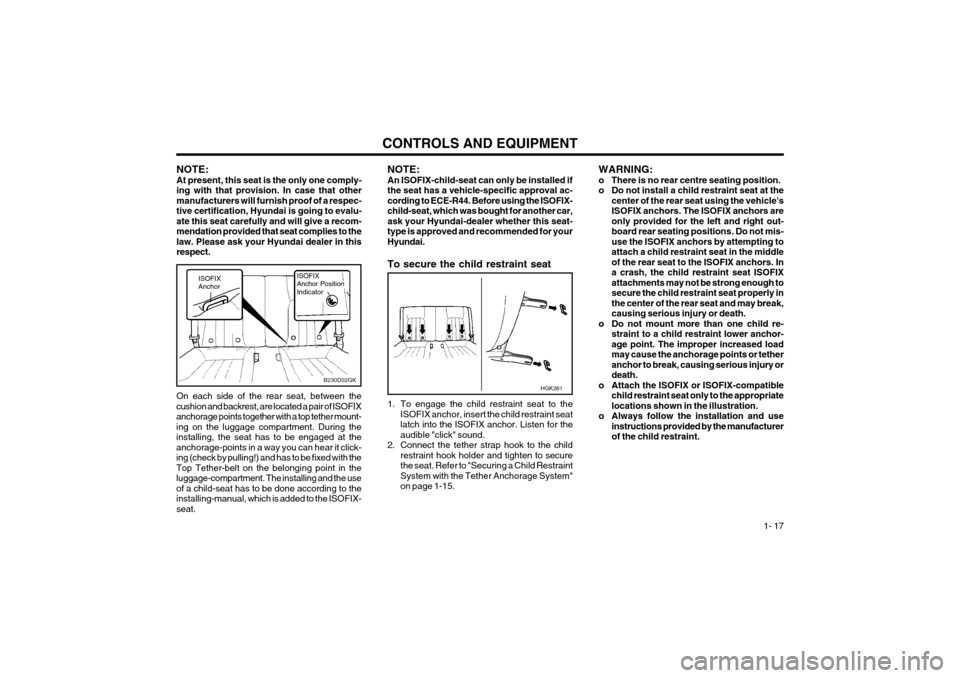
On each side of the rear seat, between the cushion and backrest, are located a pair of ISOFIXanchorage points together with a top tether mount-ing on the luggage compartment. During theinstalling, the seat has to be engaged at theanchorage-points in a way you can hear it click-ing (check by pulling!) and has to be fixed with theTop Tether-belt on the belonging point in theluggage-compartment. The installing and the useof a child-seat has to be done according to theinstalling-manual, which is added to the ISOFIX-seat. NOTE:An ISOFIX-child-seat can only be installed ifthe seat has a vehicle-specific approval ac-cording to ECE-R44. Before using the ISOFIX-child-seat, which was bought for another car,ask your Hyundai-dealer whether this seat-type is approved and recommended for yourHyundai. To secure the child restraint seat
1. To engage the child restraint seat to the
ISOFIX anchor, insert the child restraint seat latch into the ISOFIX anchor. Listen for theaudible "click" sound.
2. Connect the tether strap hook to the child restraint hook holder and tighten to securethe seat. Refer to "Securing a Child RestraintSystem with the Tether Anchorage System"on page 1-15.
HGK261 WARNING:
o There is no rear centre seating position.
o Do not install a child restraint seat at the
center of the rear seat using the vehicle'sISOFIX anchors. The ISOFIX anchors areonly provided for the left and right out-board rear seating positions. Do not mis-use the ISOFIX anchors by attempting toattach a child restraint seat in the middleof the rear seat to the ISOFIX anchors. Ina crash, the child restraint seat ISOFIXattachments may not be strong enough tosecure the child restraint seat properly inthe center of the rear seat and may break,causing serious injury or death.
o Do not mount more than one child re- straint to a child restraint lower anchor-age point. The improper increased loadmay cause the anchorage points or tetheranchor to break, causing serious injury ordeath.
o Attach the ISOFIX or ISOFIX-compatible child restraint seat only to the appropriatelocations shown in the illustration.
o Always follow the installation and use instructions provided by the manufacturerof the child restraint.
Page 194 of 310

CONTROLS AND EQUIPMENT
1- 18 B180B01GK-GAT Pre-tensioner Seat Belt (Not all models)Your Hyundai vehicle is equipped with driver's and front passenger's pre-tensioner seat belts.The purpose of the pre-tensioner is to make surethat the seat belts fit tightly against the occu-pant's body in certain frontal collisions.The pre-tensioner seat belts can be activatedalone or, where the frontal collision is severeenough, together with the airbags. When the vehicle stops suddenly, or if the occu- pant tries to lean forward too quickly, the seat beltretractor will lock into position. In certain frontal
B180B01S-D
B230H03GK-EAT Child Seat Restraint Suitability For Seat Position Use child safety seats that have been officially approved and are appropriate for your children.
Age Group
Seating Position
0 : Up to 10 kg (0 ~ 9 months)0+ : Up to 13 kg(0 ~ 2 years)I : 9kg to 18kg(9 months ~4 years)II & III : 15kg to 36kg(4 ~ 12 years)
U : Suitable for "universal" category restraints
approved for use in this mass group
UF : Suitable for forward-facing "universal" cat- egory restraints approved for use in this mass group
L1 : Suitable for "Römer ISOFIX GR1" approved for use in this mass group(Approval No: E1 R44-03301133)
X : Seat position not suitable for children in this mass group
N/A : No seating position is provided The seat belt pre-tensioner system consistsmainly of the following components. Their locations are shown in the illustration.
1. SRS airbag warning light
2. Seat belt pre-tensioner assembly
3. SRS control module WARNING: To obtain maximum benefit from a pre-tensioner seat belt:
1. The seat belt must be worn correctly.
2. The seat belt must be adjusted to the
correct position.
B180B01GK-D
Driver's side airbag
1
2
3Passenger's side airbag
N/A N/A N/A N/A
Rear
Center
Rear
Outboard
X X
L1 X
1st
Passenger
XX X X NOTE: This vehicle is equipped with thether anchor-age and ISOFIX system to supply most suit-able safety. we recommend to buy a childrestraint system to use thether anchorageand ISOFIX system.
collisions, the pre-tensioner will activate and pullthe seat belt into tighter contact against theoccupant's body.
Page 195 of 310

CONTROLS AND EQUIPMENT1- 19
B240A01GK
Driver's Airbag
B240A01GK-GAT SUPPLEMENTAL RESTRAINT (AIRBAG) SYSTEM (SRS)(Not all models) Your Hyundai is equipped with a Supplemental Restraint (Airbag) System. The indications of thesystem's presence are the letters "SRS AIRBAG" embossed on the ornament in the steeringwheel and the passenger's side front panel padabove the glove box. The Hyundai SRS consists of airbags installed under the pad covers in the center of the steeringwheel and the passenger's side front panel abovethe glove box. The purpose of the SRS is toprovide the vehicle's driver and/or the front pas-senger with additional protection than that of-fered by the seat belt system alone, in case of afrontal impact of sufficient severity.
NOTE:
o Both the driver's and front passenger's
pre-tensioner seat belts will be activatedin certain frontal collisions. The pre-tensioner seat belts can be activated aloneor, where the frontal collision is severeenough, together with the airbags.
o When the pre-tensioner seat belts are ac- tivated, a loud noise may be heard and finedust, which may appear to be smoke, maybe visible in the passenger compartment.These are normal operating conditionsand are not hazardous.
o Although it is harmless, the fine dust may cause skin irritation and should not bebreathed for prolonged periods. Wash yourhands and face thoroughly after an acci-dent in which the pre-tensioner seat beltswere activated.
CAUTION:
o The control module that activates the SRS airbag controls the pre-tensioner seat beltalso.
o If there is some function in the pre- tensioner seat belt circuit, the warninglight will illuminate even if there is nomalfunction in the SRS airbag system. Ifthe SRS airbag warning light does notilluminate or illuminates continuouslywhen the ignition key is turned to "ON", orif it remains illuminated after blinking forapproximately 6 seconds, or if it illumi-nates while the vehicle is being driven, please have an authorized Hyundai dealerinspect the pre-tensioner seat belts and orSRS airbag system as soon as possible.
WARNING:
o Pre-tensioners are designed to operate only one time. After activation, pre-tensioner seat belts must be replaced. Allseat belts, of any type, should always bereplaced after they have been worn duringa collision.
o The pre-tensioner seat belt assembly mechanisms become hot during activa-tion. Do not touch the pre-tensioner seatbelt assemblies for several minutes afterthey have been activated.
o Do not attempt to inspect or replace the pre-tensioner seat belts yourself. Thismust be done by an authorized Hyundaidealer.
o Do not strike the pre-tensioner seat belt assemblies.
o Do not attempt to service or repair the pre- tensioner seat belt system in any manner.
o Improper handling of the pre-tensioner seat belt assemblies, and failure to heedthe warnings to not strike, modify, in-spect, replace, service or repair the pre-tensioner seat belt assemblies may leadto improper operation or inadvertent acti-vation and serious injury.
o Always wear seat belts when driving or riding in a motor vehicle.