warning light Hyundai Coupe 2003 Workshop Manual
[x] Cancel search | Manufacturer: HYUNDAI, Model Year: 2003, Model line: Coupe, Model: Hyundai Coupe 2003Pages: 310, PDF Size: 2.87 MB
Page 263 of 310

3-5
IN CASE OF EMERGENCY
SD070E1-E 3. Loosen Wheel Nuts The wheel nuts should be loosened slightly be- fore raising the car. To loosen the nuts, turn thewheel brace counterclockwise. Ensure that thewheel brace socket is seated properly on the nutand that it cannot slip. Do not remove the nuts atthis stage. SD070F1-F 4. Put the Jack in Place The base of the jack should be placed on firm, level ground. The jack should be positioned asshown in the drawing.
HGK193HGK186
D060F02E-EAT 5. Raising the Car After inserting a bar into the wheel nut wrench, install the bar into the jack as shown in the draw-ing. To raise the vehicle, turn the wheel nut wrenchclockwise. As the jack begins to raise the vehicle,double check that it is properly positioned and will
not slip. If the jack is on soft ground or sand, placea board, brick, flat stone or other object under thebase of the jack to keep it from sinking.Raise the car high enough so that the fully inflatedspare tire can be installed. To do this, you will needmore ground clearance than is required to removethe flat
tyre.
WARNING:Do not get under the car when it is supportedby the jack! This is very dangerous as the jackcould fall and cause serious injury or death.No one should stay in the car while the jack isbeing used.
HFC4022
Wrench bar
Wheel nut wrench
Page 264 of 310

IN CASE OF EMERGENCY
3-6
HGK232
D060H02Y-EAT 7. Reinstall Wheel Nuts To reinstall the wheel hold it on the studs put the wheel nuts on the studs and tighten them fingertight. The nuts should be installed with their smalldiameter ends directed inward. Jiggle the tyre tobe sure it is completely seated, then tighten thenuts as much as possible with your fingers again.
WARNING:Wheels and wheel cover may have sharpedges. Handle them carefully to avoid pos-sible severe injury. Before putting the wheel into place, be sure that there is nothing on the hub or wheel(such as mud, tar, gravel, etc.) that interfereswith the wheel from fitting solidly against thehub. If there is, remove it. If there is not goodcontact on the mounting surface between thewheel and hub, the wheel nuts could comeloose and cause the loss of a wheel. Loss ofa wheel may result in loss of control of thevehicle. This may cause serious injury ordeath.
STA3071H
D060G02Y-EAT 6. Changing Wheels Loosen the wheel nuts and remove them with your fingers. Slide the wheel off the studs and layit flat so it cannot roll away. To put the wheel onthe hub, pick up the spare tyre, line up the holeswith the studs and slide the wheel onto them. Ifthis is difficult, tip the wheel slightly and get thetop hole in the wheel lined up with the top stud.Then jiggle the wheel back and forth until thewheel can be slid over the other studs.
D060H01GK
Page 279 of 310

OWNER MAINTENANCE
6-4
SG020B1-E DAILY OPERATING CHECKSThe following items should be checked on a daily basis or whenever the vehicle is refuelled, which-ever occurs sooner.
o Engine oil level.
o Engine coolant level.
o Power steering fluid level.
o Brake fluid level.
o Windscreen washer fluid level.
o Battery condition.
o Tyre condition and pressures.
o Operation and cleanliness of all lighting equip-
ment.
o Windscreen wiper and washer operation.
o Horn operation.
o Warning lamp operation.
o Adjustment and cleanliness of mirrors.
o Seat and seat belt adjustment and operation.
o Fluid leakage. The vehicle must not be driven if the daily oper- ating checks indicate that any item of equipmentrelated to the safety or roadworthiness of thevehicle is not functioning correctly. SG030A1-E ENGINE OILThe correct engine oil level is of paramount importance. An excessively high or low oil levelmay result in irreparable damage being sus-tained by the engine. The engine oil level must bechecked on a daily basis or whenever the vehicleis refuelled, whichever occurs sooner.In addition, it is imperative that only an approvedgrade and specification of oil is used to avoid thepossibility of serious engine damage and prema-ture wear. The use of "budget price" oil is a falseeconomy that must be avoided if the maximumreliability and useful life is to be obtained from thevehicle.
SG030B02GK-E Recommended Oil A multi grade oil having a specification which meets A.P.I. specification of SH, SG or above isrecommended. The oil viscosity should be se-lected according to the operating environment ofthe engine by means of the table shown below.The engine oil recommendations are complete inthemselves and the use of additives is neitherrequired nor recommended. The use of engineoil additives may result in invalidation of thevehicle warranty.
SSA6030B°C °F
-25-13 20W-40 20W-50
15W-40 15W-50
10W-30
10W-40 10W-50
5W-40
5W-30
5W-2040
104
20 68
1050
032
-15 5 -10-14
1.6 DOHC 2.7 L V6
Page 287 of 310

OWNER MAINTENANCE
6-12 SG120A1-E BRAKE SYSTEM CHECKING CAUTION: Correct operation of the braking system is essential to the safe operation of the vehicleand therefore, any maintenance operationsother than those listed below should be en-trusted to a Hyundai dealer. SG120C2-E Brake Fluid Recommendations Only brake fluid conforming to DOT 3 or DOT 4 specifications or higher may be used in thebraking system. Care should be taken to ob-serve the instructions and precautions printedupon the container. SG120D1-E Brake Fluid LevelThe fluid level in the brake fluid reservoir should be checked periodically. The level should bebetween the "MIN" and "MAX" marks on the sideof the reservoir. If the level is at or below the"MIN" mark, fluid should be added having care-fully cleaned the area surrounding the reservoircap to ensure that dirt is not allowed to enter thesystem. It should be borne in mind that the brakefluid level will decrease slightly as the frictionlinings of the pads and shoes become worn andthat this is a normal condition.
higher mark. If additional fluid is required, thisshould be poured into the transaxle through thedipstick tube with the aid of a suitable funnel. WARNING: The cooling fan is controlled by engine cool-ant temperature and may sometimes operateeven when the engine is not running. Useextreme caution when working near the bladesof the cooling fan so that you are not injuredby a rotating fan blade. As the engine coolanttemperature decreases, the fan will automati-cally shut off. This is a normal condition.
CAUTION:The automatic transaxle unit is a precisionengineered assembly and correct operationis dependant upon the exclusion of dirt andlint from the unit. Therefore, it is imperativethat only lint free cloth (eg nylon) is used forwiping the dipstick and that the area aroundthe dipstick is thoroughly clean prior to levelchecking or adding fluid. Fluid Capacity The total fluid capacity of the transaxle unit is 7.8 litres.
HGK174-D
Fluid level should be within this range
HGK249
ÎÎ
Page 292 of 310

OWNER MAINTENANCE 6-17
SG200B2-E INDIVIDUAL CIRCUIT FUSES The fuse box containing the individual circuit fuses is located on the lower portion of thedashboard adjacent to the bonnet release. Thefuse box cover is removed by pushing lightly andthen releasing the lid. A fuse rating grid will befound on the reverse side of the cover. In theevent of fuse failure, the fuse should be replacedwith one of equivalent rating. A fuse removal toolis provided within the fuse box to facilitate re-placement.In the event of a replacement fuse failing shortlyafter installation a malfunction within the circuitprotected by that fuse is indicated. The circuitshould be checked by a Hyundai dealer at thefirst available opportunity.
AXA6201B
WARNING: The use of replacement fuses having a higherrating than specified or other means of con-necting the circuit will create a potential firehazard. NOTE: See page 6-22 for the fuse panel descriptions. SG210A1-E BATTERY MAINTENANCE WARNING: Motor vehicle batteries contain sulphuric acid which is corrosive and poisonous. Hydrogengas is emitted from the battery which is ex-plosive when combined with oxygen. Thefollowing precautions must be strictly ob-served to avoid personal injury or damage tothe vehicle.
HGK185-D
SG220A1-E ELECTRIC COOLING FANS WARNING: The cooling fan is controlled by engine cool-ant temperature and may sometimes operateeven when the engine is not running. Useextreme caution when working near the bladesof the cooling fan so that you are not injuredby a rotating fan blade. As the engine coolanttemperature decreases, the fan will automati-cally shut off. This is a normal condition.
o If battery electrolyte is spilled onto skin or into
eyes, the effected area must be flushed withcopious amounts of water and medical assis-tance sought.
o If battery electrolyte is ingested, copious amounts of water or milk followed by an ant-acid (raw egg or milk of magnesia) must bedrunk. Vomiting should not be induced andmedical assistance must be sought.
o Batteries must only be charged in well venti- lated areas from which naked lights or sourcesof sparks are excluded.
o Ensure that children, pets or other unautho- rized persons are kept away from batteries.
o Do not allow anything to bridge the positive (+) and negative (-) terminals of the battery.
o Never invert the battery. The battery fitted during production is of the "Maintenance Free" type.
Page 294 of 310
OWNER MAINTENANCE 6-19
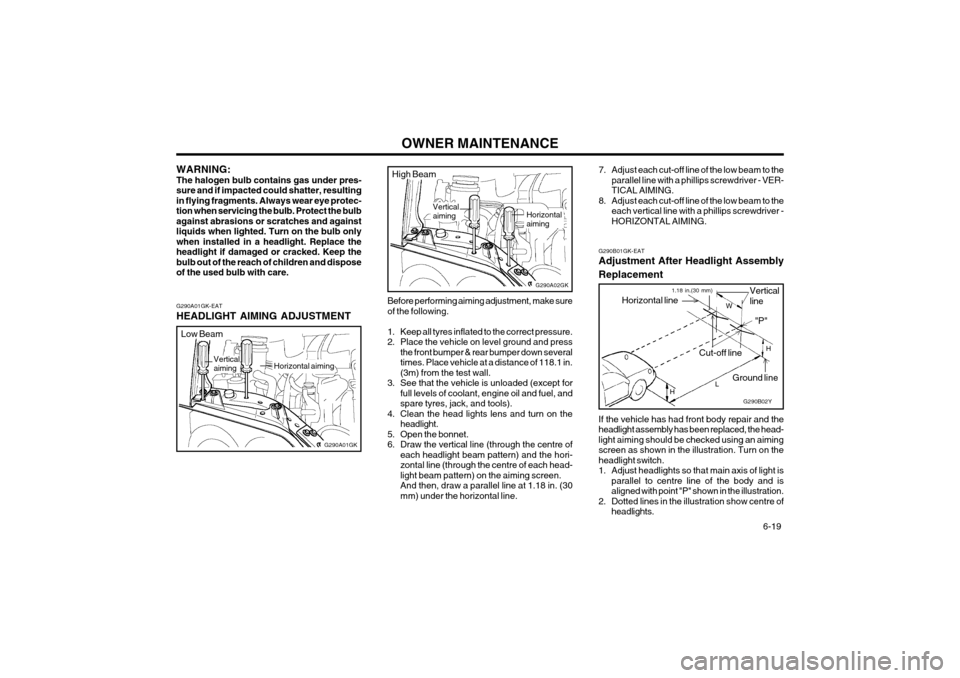
G290A01GK-EAT HEADLIGHT AIMING ADJUSTMENT
Before performing aiming adjustment, make sure of the following.
1. Keep all tyres inflated to the correct pressure.
2. Place the vehicle on level ground and press
the front bumper & rear bumper down severaltimes. Place vehicle at a distance of 118.1 in.(3m) from the test wall.
3. See that the vehicle is unloaded (except for full levels of coolant, engine oil and fuel, andspare tyres, jack, and tools).
4. Clean the head lights lens and turn on the headlight.
5. Open the bonnet.
6. Draw the vertical line (through the centre of each headlight beam pattern) and the hori-zontal line (through the centre of each head-light beam pattern) on the aiming screen.And then, draw a parallel line at 1.18 in. (30mm) under the horizontal line.
WARNING:The halogen bulb contains gas under pres-sure and if impacted could shatter, resultingin flying fragments. Always wear eye protec-tion when servicing the bulb. Protect the bulbagainst abrasions or scratches and againstliquids when lighted. Turn on the bulb onlywhen installed in a headlight. Replace theheadlight if damaged or cracked. Keep thebulb out of the reach of children and disposeof the used bulb with care.
Vertical aiming
G290A01GK
Horizontal aiming
Low Beam
Vertical aiming
G290A02GK
Horizontal aiming
High Beam
7. Adjust each cut-off line of the low beam to the
parallel line with a phillips screwdriver - VER- TICAL AIMING.
8. Adjust each cut-off line of the low beam to the each vertical line with a phillips screwdriver -HORIZONTAL AIMING.
G290B01GK-EAT Adjustment After Headlight Assembly Replacement
G290B02Y
Vertical line
Cut-off line Ground line
Horizontal line
LW
H
H "P"1.18 in.(30 mm)
If the vehicle has had front body repair and the headlight assembly has been replaced, the head-light aiming should be checked using an aimingscreen as shown in the illustration. Turn on theheadlight switch.
1. Adjust headlights so that main axis of light is parallel to centre line of the body and isaligned with point "P" shown in the illustration.
2. Dotted lines in the illustration show centre of headlights.
Page 296 of 310

OWNER MAINTENANCE 6-21
Wattage
55/55 105
51 21 55
G280A02GK-EAT
Part Name
Head Light (High/Low) Map Light Front Position Light Front Fog Light (Not all models)Front Turn Signal Light Front Door Edge Warning Light Luggage Compartment Light
No.
12 3 45 6 7 No.
8 9
10 11 12 13 Part Name
High Mounted Without spoiler
Stop LIght With spoilerRear Turn Signal Light
Combination Sto p/Tail Light
Back-up Light
License Plate Light Rear Fog Light (Not all models)Wattage
2.4 (LED) 3.5 (LED) 21
21/5
215
21
5111213346
HGK035A
1182
(High) (Low)
109
7
Page 298 of 310

OWNER MAINTENANCE 6-23
DESCRIPTION
IG COIL
AMP
B/UP LAMP
A/BAG IND A/BAG
HTD MIR
HAZARD
R/WIPER
TAIL-RH
F/WIPER A/C SW
RR DEFOG STOP
TAIL-LH
A/CON ECU
CLUSTER
ROOM LP
P/WINDOW T/GATE IGN
RR FOG
C/LIGHT S/ROOF
S/HTR ABS
AUDIO
G200D01GK-GAT Inner Panel
HGK204-E
PROTECTED COMPONENTS
Ignition Coil, ECM
AMP. Multi Gauge Unit B/Up Lamp Air Bag Indicator Air Bag Outside Mirror Defroster Hazard Warning LightRear Window WiperTaillightFront Window WiperA/ConditionerRear Window Defroster Stop Light Tail lightA/ConditionerECM, Multi Gauge Unit, TCMClusterMap Light, Clock, Audio Power Window Hatchback door OpenA/Con, A.Q.S Sensor Rear Fog C/Lighter, Outside MirrorSunroof Seat Warmer ABS. TCS Audio, Clock
FUSERATING
20A20A 10A 10A 15A10A 10A 15A10A20A10A30A15A 10A 10A10A10A 10A 30A 15A10A 10A 15A15A20A 10A 10A
Page 308 of 310

INDEX
10-2 E EFFECTIVE BRAKING
....................................................................... 2-8
ELECTRIC COOLING FANS ........................................................... 6-17
EMISSION CONTROL SYSTEMS ..................................................... 7-1
ENGINE COMPARTMENT ................................................................. 6-1
ENGINE COOLANT CHECKING AND REPLACI NG ........................ 6-7
ENGINE COOLANT TEMPERATURE GUAGE ...............................1-30
ENGINE OIL AND FILTER REPLACEMENT .................................... 6-6
ENGINE OIL CONSUMPTION ........................................................... 6-6
ENGINE OIL REPLENISHMENT ............ ........................................... 6-5
ENGINE OIL ....................................................................................... 6-4EXTERIOR REAR VIEW MIRROR .................................................. 1-42
FFOLDING REAR SEAT .................................................................... 1-10
FRONT ASHTRAY ........................................................................... 1-38
FRONT DOOR EDGE WARNING LAMP ........................................1-45
FRONT FOG LIGHT SWITCH ......................................................... 1-44
FRONT SEAT ADJUSTMENT ........................................................... 1-7
FRONT SEAT BELT PIVOT HEIGHT ADJUSTMENT ....................1-12
FUEL ECONOMY ............................................................................... 2-3
FUEL GAUGE .................................................................................. 1-29
FUEL RECOMMENDATIONS ........... ................................................. 1-1
FUSE PANEL DESCRIPTION ......................................................... 6-22
FUSIBLE LINKS ............................................................................... 6-16G
GLOVE BOX .....................................................................................
1-41
HHATCHBACK DOOR ........................................................................ 1-46
HATCHBACK DOOR WIPER AND WASHER ................................1-36
HAZARD WARNING SYSTEM ........................................................ 1-36
HEADLIGHT BULB ........................................................................... 6-18
HEADLIGHT AIMING ADJUSTMENT ..............................................6-18
HEADLIGHT LEVELING DEVICE SYSTEM ....................................1-38
HEAD RESTRAINT ADJUSTMENT ................................................... 1-8
HEATED REAR WINDOW ......... ...................................................... 1-36
HEATING AND COO LING CONTROL ............................................ 1-51
ROTARY TYPE ................................................................. 1-52 ~ 1-56
AUTOMATIC TYPE ........................................................... 1-57 ~ 1-62
HORN ............................................................................................... 1-48
IIF THE ENGINE CANNOT BE CRANKED ........................................ 3-1
IF THE ENGINE OVERHEATS .......................................................... 3-2
IF THE ENGINE WILL NOT START .................................................. 3-1
IF THE EVENT OF A PUNCTURE .................................................... 3-3
IMMOBILIZER SYSTEM ..................................................................... 1-2INDIVIDUAL CIRCUIT FUSES ......................................................... 6-17
INSTRUMENT CLUSTER AND INDICATORS ................................1-26