warning light Hyundai Coupe 2003 Service Manual
[x] Cancel search | Manufacturer: HYUNDAI, Model Year: 2003, Model line: Coupe, Model: Hyundai Coupe 2003Pages: 310, PDF Size: 2.87 MB
Page 215 of 310
CONTROLS AND EQUIPMENT1- 39
Loading conditionSwitch position
Driver only Driver + front passengerFull passengers (including driver) Full passengers (including driver) + full boot loading (or light trailerloading) Driver + full boot loading (or maximum trailer loading)0 01 2 3
FB330A1-E SUNROOF (Not all models)The electrically operated sunroof may be used only whilst the ignition switch is at the "ON"position.When the sunroof is opened, the wind deflectorwill automatically rise to the upper position andwill automatically retract when the sunroof isclosed. B460A01Y-AAT Sun shadeHGK029
Your HYUNDAI is equipped with a sliding sun- shade which you can manually adjust to let inlight with the sunroof closed, or to block sunlight. WARNING: Never adjust the sunshade while driving.
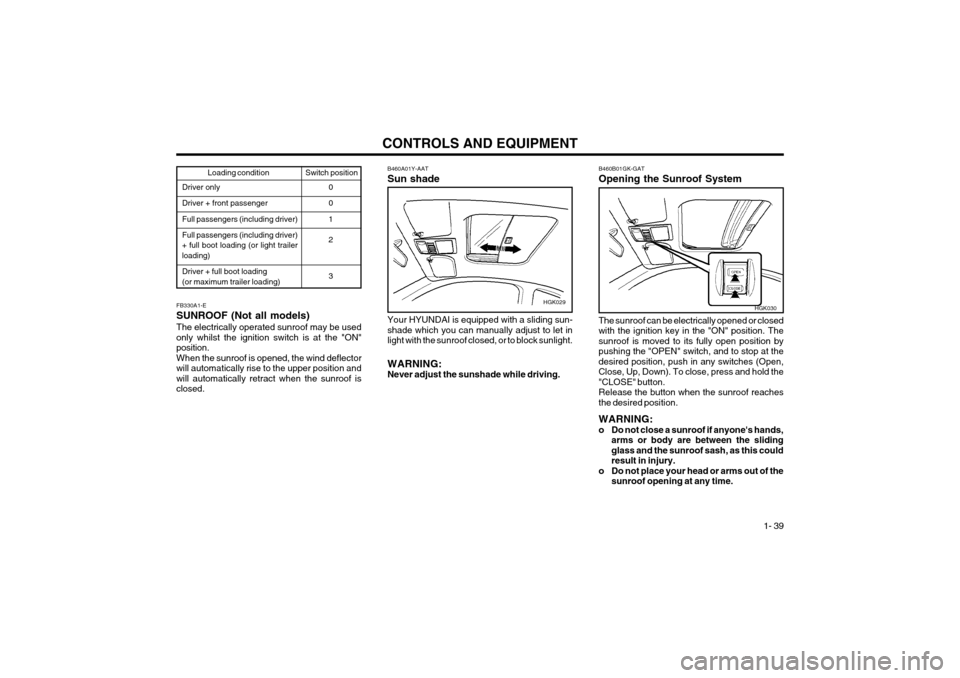
B460B01GK-GAT Opening the Sunroof System
HGK030
The sunroof can be electrically opened or closed with the ignition key in the "ON" position. Thesunroof is moved to its fully open position by
pushing the "OPEN" switch, and to stop at thedesired position, push in any switches (Open,Close, Up, Down). To close, press and hold the"CLOSE" button.Release the button when the sunroof reachesthe desired position. WARNING:
o Do not close a sunroof if anyone's hands, arms or body are between the slidingglass and the sunroof sash, as this couldresult in injury.
o Do not place your head or arms out of the sunroof opening at any time.
Page 217 of 310

CONTROLS AND EQUIPMENT1- 41
FB340B1-F SPECTACLE CASE (Not all models) The spectacle case is located on the front over- head console.Push the end of cover to open or close thespectacle case. WARNING: Do not open the spectacle case while the vehicle is moving.The rear view mirror of the vehicle can beblocked.
B480A01GK-GAT MAP LIGHT
HGK034
(1) Push in the map light switch to turn the driver side light.
(2) In the "DOOR" position, the interior courtesy light comes on when any door is opened regardless of the ignition key position. Thelight goes out gradually 6 seconds after thedoor is closed.
(3) Push in the map light switch to turn the passenger side light.(1) (2) (3)HGK036
B500A01A-EAT GLOVE BOX WARNING: To avoid the possibility of injury, the glove box lid must be kept closed whilst the vehicleis in motion.
o To open the glove box, pull the glove box
release lever.
HGK147-D
Page 219 of 310

CONTROLS AND EQUIPMENT1- 43
SB380A1-E PARKING BRAKE The parking brake must always be set when the vehicle is to be left unattended. When the parking brake is applied, and the ignition key is at the "ON" position, the parking brake warning lampwill be illuminated. Before driving the vehicle, theparking brake must be fully released and thewarning lamp extinguished.
o To set the parking brake, apply the foot brake
and pull the parking brake lever up with the button depressed. Release the button whenthe brake is fully applied.
o To release the parking brake, apply the foot brake and pull up the parking brake leverslightly. Depress the button and lower thelever.
SB370A1-E INTERIOR REAR VIEW MIRROR The interior mirror is of the day/night type to enable the glare of headlamps from followingvehicles to be eliminated during night time driv-ing.The tab located at the bottom of the mirror shouldbe set to the position nearest the windscreen fornormal day time driving, and flipped towards therear of the vehicle to eliminate glare during nighttime driving. To adjust the field of vision, themirror may be moved by hand upon the mount-ing. NOTE: The mirror should always be adjusted prior tosetting the vehicle in motion.
B520A01GK
B520B01O-GAT DAY/NIGHT REAR VIEW MIRROR (Electric type) (Not all models) The electric type day/night inside rearview mirror automatically controls the glare of headlights ofthe car behind you. Adjust the rearview mirror tothe desired position.
B520B01GK
Sensor
HGK178
Page 222 of 310

CONTROLS AND EQUIPMENT
1- 46 SB450A2-E HATCHBACK DOOR Remote Hatchback door Release The hatchback door may be opened by pulling the lever to release the lock. The hatchback doorshould be closed by depressing the lid firmly untilthe latch engages. Ensure that hatchback door issecurely latched before setting the vehicle inmotion. WARNING: The hatchback door should always be closedwhilst the vehicle is in motion to preventexhaust gases from being drawn into thepassenger compartment.
HGK103-D
SB440A1-E REMOTE FUEL FILLER LID RELEASE (Not all models) The fuel filler lid may be opened from inside the vehicle by pulling up on the fuel filler lid release. NOTE: If the fuel filler lid will not open because icehas formed around it, tap lightly or push onthe lid to break the ice and release the lid. Donot lever the lid. If necessary, spray aroundthe lid with an approved de-icer fluid (do notuse radiator anti-freeze) or move the vehicleto a warm place and allow the ice to melt.
HGK105-D
HGK124
WARNING: Fuel vapours are dangerous. Before refuel- ling, turn off the engine and never allowsparks, lit cigarettes or open flames near thefiller area. When releasing the filler cap, asmall amount of residual pressure may gen-erate a slight hissing sound which is notindicative of an abnormality. In the event ofthe fuel filler cap requiring replacement, onlya Genuine Hyundai replacement part shouldbe used to prevent fuel leakage.
Page 225 of 310

CONTROLS AND EQUIPMENT1- 49
SB700A1-E CRUISE CONTROL (Not all models) The cruise control system provides automatic speed control for your comfort when driving onfreeways, tollroads, or other noncongested high-ways.This is designed to function above approximately25 mph (40 km/h).
B660A01GK
Main switch
B660B01GK
B660B01E-AAT To Set the Cruise Speed
1. Push in the cruise control main switch on the
end of the barrel. The "CRUISE" indicator light in the instrument cluster will be illumi-nated. This turns the system on.
2. Accelerate to the desired cruising speed above 25 mph (40 km/h).
3. Push the control switch downward to "SET (COAST)" and release it.
4. Remove your foot from the accelerator pedal and the desired speed will automatically bemaintained.
5. To increase speed, depress the accelerator pedal enough for the vehicle to exceed thepreset speed. When you remove your footfrom the accelerator pedal, the vehicle willreturn to the speed you have set.
B660C01GK
B660C01E-AAT To Cancel the Cruise Speed Do one of the followings:
o Pull the control switch toward steering wheelto "CANCEL" position.
o Depress the brake pedal.
o Depress the clutch pedal (Manual transaxle).
o Shift the selector lever in "N" position (Auto- matic transaxle).
o Decrease the vehicle speed lower than mem- orized speed by 12 mph (20 km/h).
o Decrease the vehicle speed approximately to less than 25 mph (40 km/h).
o Release the main switch.
WARNING:To avoid accidental cruise control engage-ment, keep the cruise control main switch offwhen not using the cruise control.
Page 245 of 310

DRIVING YOUR HYUNDAI
2- 2 SC030A1-E
BEFORE STARTING THE ENGINE
Before you start the engine, you should always:
1. Look around the vehicle to be sure there are no flat tires, puddles of oil or water or other indications of possible trouble.
2. After entering the car, check to be sure the parking brake is engaged.
3. Check that all windows, and lights are clean.
4. Check that the interior and exterior mirrors are clean and in position.
5. Check your seat, seatback and head re- straint to be sure they are in their properpositions.
6. Close all the doors.
7. Fasten your seat belt and be sure that all other occupants have fastened theirs.
8. Turn off all lights and accessories that are not needed.
9. When you turn the ignition switch to "ON' check that all appropriate warning lights are operating and that you have sufficient fuel.
10.Check the operation of warning lights and all bulbs when key is in the "ON" position. o To start the engine, insert the ignition key
and turn it to the "START" position. Releaseit as soon as the engine starts. Do not holdthe key in the "START" position for more that15 seconds.
NOTE: For safety, the engine will not start if the shift lever is not in "P" or "N" Position (AutoT/A).
SC040A1-F
COMBINATION IGNITION SWITCH AND STEERING LOCK To Start the Engine
o If your Hyundai is equipped with a manual
transaxle, place the shift lever in neutral and depress the clutch pedal fully.
o If your Hyundai has an automatic transaxle, place the shift lever in "P" (park). SC050A2-E
KEY POSITIONS WARNING:
The engine must never be turned off and the key removed from the ignition key cylinderwhilst the vehicle is in motion since thesteering lock will operate and control of thevehicle will be lost. "START"
The engine is started in this position. It willcrank until you release the key. NOTE: Do not hold the key in the "START" position for more than 15 seconds.
"ON" When the key is at the "ON" position, the ignition and all accessories are available for use. If theengine is not running, the key should not be leftat this position since the battery will becomedischarged and damage to the ignition systemmay also result. For information regarding en-gine starting, refer to "STARTING THE EN-GINE". "ACC" When the ignition key is at the "ACC" position, the radio and other accessories may be used. "LOCK" The ignition key may only be inserted or removed at this position.
C040A01E
LOCK
ACC
ON
START
Page 251 of 310

DRIVING YOUR HYUNDAI
2- 8 when you are driving down a long hill, slow down and shift to a lower gear. When you dothis, engine braking will help slow the car.
o Slow down before shifting to a lower gear. Otherwise, the lower gear may not be en-gaged.
o Always use the parking brake. Do not de- pend on placing the transaxle in "P" to keepthe car from moving.
o Exercise extreme caution when driving on a slippery surface. Be especially careful whenbraking, accelerating or shifting gears. On aslippery surface, an abrupt change in vehi-cle speed can cause the drive wheels tolose traction and the vehicle to go out ofcontrol.
WARNING:
o Avoid high cornering speeds.
o Do not make quick steering wheel move- ments, such as sharp lane changes or fast, sharp turns.
o Always wear your seat belts. In a collision crash, un unbelted personis significantly more likely to die than aperson wearing a seatbelt.
o The risk of rollover is greatly increased if you lose control of your vehicle at high-way speeds.
o Loss of control often occurs if two or more wheels drop off the roadway andthe driver oversteers to reenter the road-way. o In the event your vehicle leaves the road-
way, do not steer sharply. Instead, slowdown before pulling back into the travellanes.
o Never exceed posted speed limits. SC140A1-E EFFECTIVE BRAKING Braking system performance and friction mate- rial life are greatly affected by the driving styleadopted. The following suggestions are made toassist in achieving the best results from thebraking system.
o Anticipate the road and conditions ahead in order that heavy braking may be avoided.
o When descending long gradients, use the engine to assist in retarding the vehicle to minimize the possibility of brake fade occur-ring.
o When trailer towing, ensure that the trailer brakes function correctly and use enginebraking to assist the vehicle braking system.
o Use only genuine Hyundai replacement brake pads and shoes to ensure consistentfriction characteristics and wear rates.
o After driving through deep water (e.g. fording), the brakes may become wet andperformance reduced. Always check brakeefficiency after emerging from the water anddry the brakes by lightly depressing thebrake pedal several times whilst driving slow-ly.
C090I01L-GAT
CAUTION:
o Shift into "R" and "P" position only when the vehicle has completely stopped.
o Do not accelerate the engine in reverse or any of the forward positions with the brakes applied.
o Always apply the footbrake when shift- ing from "P" or "N", to "R", "D"position.
o Do not use the "P" (Park) position in place of the parking brake. Always setthe parking brake, shift the transaxle into"P" (Park) position and turn off the igni-tion when you leave the vehicle, evenmomentarily. Never leave the vehicleunattended while the engine is running.
o Check the automatic transaxle fluid level regularly, and add fluid as necessary.
C090N02O-AAT
Good Driving Practices
o Never move the gear selector lever from "P" or "N" to any other position with the acceler- ator pedal depressed.
o Never move the gear selector lever into "P" when the vehicle is in motion.
o Be sure the car is completely stopped be- fore you attempt to shift into "R".
o Never take the car out of gear and coast down a hill. This may be extremely hazard-ous. Always leave the car in gear whenmoving.
o Do not "ride" the brakes. This can cause them to overheat and malfunction. Instead,
Page 252 of 310

DRIVING YOUR HYUNDAI 2- 9
o Apply the parking brake only when the vehi-
cle is at rest.
o Since the power assistance provided by the brake servo is derived from the engine, coasting with the engine turned off or towingof the vehicle with the engine turned off willresult in greatly increased pedal pressuresbeing required to stop the vehicle.
o Do not hold the vehicle on the upgrade with the accelerator pedal. This can cause thetransaxle to overheat. Always use the brakepedal or parking brake.
SC140B1-E
ANTI-LOCK BRAKE SYSTEM (Not all models)
The Anti-Lock Brake System (ABS) is designed
to prevent wheel lock-up during sudden braking or on hazardous road surfaces. The ABS con-trol module monitors the wheel speed and con-trols the pressure applied to each brake. Thus,in emergency situations or on slick roads, ABSwill increase vehicle control during braking.
NOTE: During ABS operation, a slight pulsation
may be felt in the brake pedal when the brakes are applied. Also, a noise may beheard in the engine compartment while brak-ing. These conditions are normal and indi-cate that the anti-lock brake system is func-tioning properly. WARNING: ABS will not prevent accidents due to im-
proper or dangerous driving manoeuvres. Even though vehicle control is improvedduring emergency braking, always maintaina safe distance between you and objectsahead. Vehicle speeds should always bereduced during extreme road conditions.
The braking distance for cars equipped with
an anti-lock braking system may be longerthan for those without it in the followingroad conditions.
o Rough, gravel or snow-covered roads.
o With tire chains installed.
o On roads where the road surface is pit- ted or has different surface height.
These roads should be driven at reduced
speeds. The safety features of an ABS equipped vehicle should not be tested byhigh speed driving or cornering. This couldendanger the safety of yourself or others. C300A03Y-EAT
TRACTION CONTROL SYSTEM (TCS) (Not all models)
HGK156A-D
On slippery road surfaces, the traction control system (TCS) limits the drive wheels from spin-ning excessively, thus helping the car to accel-erate. It also provides sufficient driving forceand steering performance as the car turns ataccelerated speeds.
SLIP Control Limits the drive wheels from spinning exces-sively during starting or while making accelerat-ed turns on slippery roads to avoid losing thedriving force of the front wheels.
Driving hints TCS does not actively apply brakes. Be sure todecelerate the car sufficiently before enteringcurves.
Page 253 of 310

DRIVING YOUR HYUNDAI
2- 10 C310D01O-AAT
Indicators and Warning The indicators should illuminate when the igni-
tion key is turned to ON or START but should go out after three seconds.
If the indicators do not illuminate, or the TCS or
TCS-OFF indicator does not go out after 3seconds, have it checked by an authorizeddealer.
Should there be any unusual conditions in the
device while driving, TCS-OFF indicator illumi-nates as a warning.
If TCS-OFF indicator illuminates, pull your car
to a safe place and stop the engine. Then, start the engine again to check if the
TCS-OFF indicator goes out.
If the indicator remains lit even after the engine
has been started, have your car checked by anauthorized Hyundai dealer. effect of brake control and indicates noth-ing unusual.
3) When the engine starts, a click is heard from the engine compartment; however,this is only the sound of traction controlbeing checked.
4) When moving out of the mud or fresh snow, pressing the accelerator pedal maynot cause the engine speed to increasedue to TCS operation. NOTE:
1) When the TCS-OFF indicator illuminates,
traction control is automatically deacti- vated for safety.
2) This warning function is not provided when the driver selects the TCS-OFFmode.
SC150A1-F DRIVING FOR ECONOMY You can save fuel and get more miles from your car if you follow these suggestions:
o Drive smoothly. Accelerate at a moderate rate. Don't make "jack-rabbit" starts or full- throttle shifts and maintain a steady cruisingspeed. Don't race between stoplights. Try toadjust your speed to that of the other trafficso you don't have to change speeds unnec-essarily. Avoid heavy traffic whenever possible. Al- ways maintain a safe distance from othervehicles so you can avoid unnecessary brak-ing. This also reduces brake wear.
o Drive at a moderate speed. The faster you drive, the more fuel your car uses. Driving ata moderate speed, especially on the high-way, is one of the most effective ways toreduce fuel consumption.
o Don't "ride" the brake or clutch pedal. This can increase fuel consumption and alsoincrease wear on these components. In ad-dition, driving with your foot resting on thebrake pedal may cause the brakes to over-
C310B01O-AAT
TCS ON/OFF Mode When the TCS is running, the TCS indicator
light in the instrument cluster will blink. If you turn the system off by pressing the TCS
switch, the TCS-OFF indicator light will comeon and stay on. In the TCS-OFF mode, theSLIP control will be deactivated. Adjust youdriving accordingly. To turn the system backon, press the switch again. The TCS-OFF indi-cator light should go off.
NOTE:
1) The TCS mode will automatically be turned ON after the engine is turned offand restarted.
2) When the traction control system is op- erating properly, you can feel a slightpulsation in the vehicle. This is only the
CAUTION: When the TCS indicator blinks, SLIP control
has been activated. It also means that the road is slippery or your car is acceleratingexcessively. In this situation, gently releasefoot pressure from the accelerator pedaland maintain moderate speed.
WARNING: Traction control is only a driving aid; all
normal precautions for driving in inclement weather and on slippery road surfacesshould be observed.
Page 260 of 310

IN CASE OF EMERGENCY
3-2 4. Check to see if the water pump drive belt is
missing. If it is not missing, check to see that it is tight. If the drive belt seems to be satisfac-tory, check for coolant leaking from the radia-tor, hoses or under the car. (If the air condi-tioning had been in use, it is normal for coldwater to be draining from it).
WARNING:Whilst the engine is running, keep hands andclothing away from moving parts such as thefan and drive belts to prevent injury.
5. If the water pump drive belt is broken or coolant is leaking out, stop the engine imme- diately and call the nearest Hyundai dealerfor assistance.
WARNING:Do not remove the radiator cap when theengine is hot since steam and boiling watermay be ejected from the radiator resulting inburns or scalding.
6. If the cause of the overheating cannot be found, wait until the engine temperature has returned to normal. Then, if coolant has beenlost, carefully remove the radiator cap andadd water to bring the fluid level in the reser-voir up to the base of the radiator fill opening.Fill the coolant expansion tank to the halfwaymark.
WARNING:Motor vehicle batteries contain sulphuric acidand emit hydrogen gas. Protective clothingshould be worn and care exercised to preventthe acid from coming into contact with skin orclothing and the vehicle. Naked lights shouldnot be permitted in the vicinity of the battery.Care should be exercised to prevent sparksoccurring during connection. If acid acciden-tally comes into contact with skin or eyes, theaffected area should immediately be flushedwith copious amounts of water and medicalassistance sought.
1. Ensure that the booster battery is 12 volt type.
If the booster battery is installed in another vehicle, ensure that the two vehicles are nottouching.
2. Turn off all unnecessary electrical equipment in both vehicles.
3. Ensure that the engine of the vehicle provid- ing the jump start is running prior to connec-tion of the jump cables.
4. Connect the red jump cable to the positive (+) terminal of the booster battery and the otherend to the positive (+) terminal of the dis-charged battery.
5. Attach the black jump cable to the negative (-) terminal of the booster battery, and theother end to a ground point within the enginecompartment of the vehicle with the flat bat-tery. Do not connect to the negative batteryterminal of the flat battery since sparks maybe generated with the subsequent risk ofexplosion. 6. Raise the booster vehicle engine speed to
2,000 r.p.m. and start the engine of the vehi-cle with the flat battery.
7. Remove jump cables in the reverse order of installation (black cable first).
CAUTION:If the jump cable is incorrectly installed, dam-age to the vehicle electrical system may oc-cur, in particular the electronic componentssuch as the Fuel Injection system computerand the Automatic Transaxle computer. Thebattery must never be disconnected whilstthe engine is running. SD040A1-E IF THE ENGINE OVERHEATSIf the temperature gauge indicates overheating:
1. Pull off the road and stop as soon as it is safe to do so.
2. Place the gear selector lever in "P" (auto- matic), or neutral (manual transaxle) and set the parking brake. If the air conditioning is on,turn it off.
3. If coolant is running out under the car or steam is coming out from under the bonnetstop the engine. Do not open the bonnet untilthe coolant has stopped running or the steam-ing has stopped. If there is no visible loss ofcoolant and no steam, leave the engine run-ning and check to be sure the engine coolingfan is operating.If the fan is not running, turn the engine off.