engine coolant Hyundai Coupe 2004 Owner's Guide
[x] Cancel search | Manufacturer: HYUNDAI, Model Year: 2004, Model line: Coupe, Model: Hyundai Coupe 2004Pages: 389, PDF Size: 10.22 MB
Page 152 of 389

DO-IT-YOURSELF MAINTENANCE
6-20 G260A02A-AAT
REPLACING LIGHT BULBS
Before attempting to replace a headlight bulb, be sure the switch is turned to the "OFF"position. The next paragraph shows how to reach head- light bulbs so they may be changed. Be sure toreplace the burned-out bulb with one of thesame number and wattage rating. CAUTION: Keep the lamps out of contact with petro-leum products such as oil, gasoline etc. G270A02A-GAT HEADLIGHT BULB Replacement instructions:
HGK225
1. Allow the bulb to cool. Wear eye protection.
2. Always grasp the bulb by its plastic base, avoid touching the glass.High Beam Low Beam
Turn signal Light
G240A01A-AAT POWER STEERING HOSES It is suggested that you check the power steer- ing hose connections for fluid leakage daily.The power steering hoses should be replaced ifthere is severe surface cracking, pulling, scuff-ing or worn spots. Deterioration of the hosecould cause premature failure. G250A01A-AAT
FOR MORE INFORMATION ABOUT YOUR HYUNDAI
If you desire additional information about main- taining and servicing your Hyundai, you maypurchase a factory Shop Manual at your Hyundaidealer's parts department. This is the samemanual used by dealership technicians andwhile it is highly technical it can be useful inobtaining a better understanding of your carand how it works.
G230A03A-GAT
POWER STEERING FLUID LEVEL
The power steering fluid level should be checked
regularly.
To check the power steering fluid level, be sure
the ignition is "OFF", then check to make cer-tain that the power steering fluid level is be-tween the "MAX" and "MIN" level markings onthe fluid reservoir.
NOTE: Grinding noise from the power steering
pump may be heard immediately after the engine is started in extremely cold condi-tions (below - 20°F). If the noise stops dur-
HGK214
G220C01A-AAT
Checking Condenser Cooling Fan
The condenser coolant fan should come on
automatically whenever the air conditioning is in operation. ing warm up, there is no abnormal functionin the system. It is due to a power steeringfluid characteristic in extremely cold condi-tions. Recommended Fluid Use PSF-3 type fluid NOTE: Do not start the engine when the power steering oil reservoir is empty.
Page 153 of 389
DO-IT-YOURSELF MAINTENANCE 6-21
G290A02GK-GAT
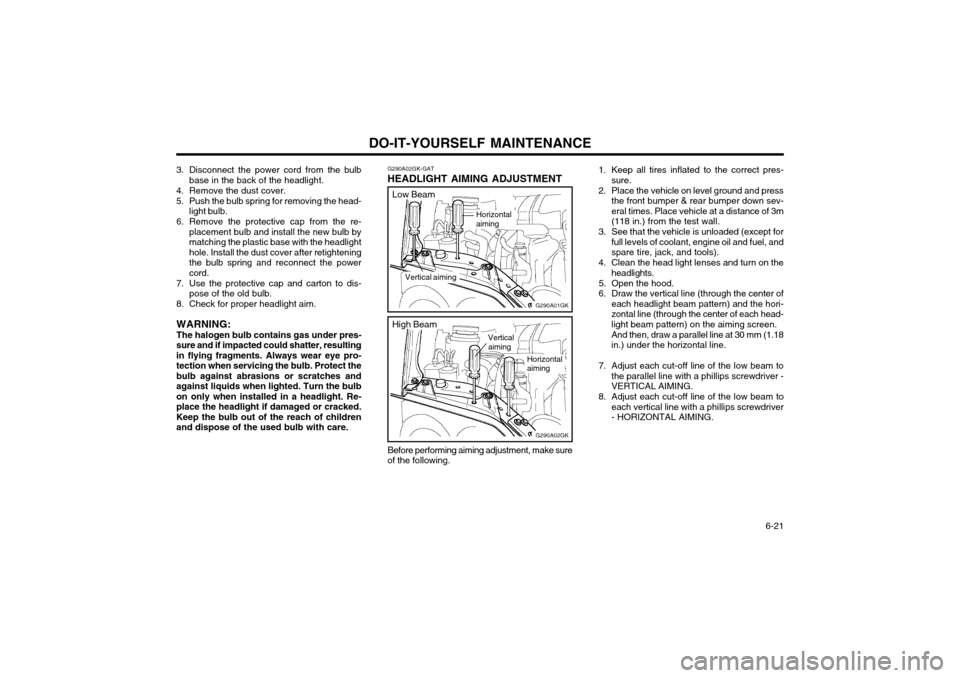
HEADLIGHT AIMING ADJUSTMENT
Horizontal aiming
G290A01GK
Vertical aiming
3. Disconnect the power cord from the bulb
base in the back of the headlight.
4. Remove the dust cover.
5. Push the bulb spring for removing the head- light bulb.
6. Remove the protective cap from the re- placement bulb and install the new bulb by matching the plastic base with the headlighthole. Install the dust cover after retighteningthe bulb spring and reconnect the powercord.
7. Use the protective cap and carton to dis- pose of the old bulb.
8. Check for proper headlight aim.
WARNING: The halogen bulb contains gas under pres-
sure and if impacted could shatter, resulting in flying fragments. Always wear eye pro-tection when servicing the bulb. Protect thebulb against abrasions or scratches andagainst liquids when lighted. Turn the bulbon only when installed in a headlight. Re-place the headlight if damaged or cracked.Keep the bulb out of the reach of childrenand dispose of the used bulb with care.
Before performing aiming adjustment, make sure
of the following.
Low Beam
G290A02GK
Vertical aiming
High Beam
Horizontal aiming1. Keep all tires inflated to the correct pres-
sure.
2. Place the vehicle on level ground and press the front bumper & rear bumper down sev- eral times. Place vehicle at a distance of 3m(118 in.) from the test wall.
3. See that the vehicle is unloaded (except for full levels of coolant, engine oil and fuel, andspare tire, jack, and tools).
4. Clean the head light lenses and turn on the headlights.
5. Open the hood.
6. Draw the vertical line (through the center of each headlight beam pattern) and the hori-zontal line (through the center of each head-light beam pattern) on the aiming screen. And then, draw a parallel line at 30 mm (1.18 in.) under the horizontal line.
7. Adjust each cut-off line of the low beam to the parallel line with a phillips screwdriver -VERTICAL AIMING.
8. Adjust each cut-off line of the low beam to each vertical line with a phillips screwdriver- HORIZONTAL AIMING.
Page 158 of 389

EMISSION CONTROL SYSTEMS 7-1
7. EMISSION
CONTROL SYSTEMS
H010B01F-GAT
1. Crankcase Emission Control Sys-
tem
The positive crankcase ventilation system is
employed to prevent air pollution caused by H010A01A-GAT
EMISSION CONTROL SYSTEMS (If Installed)
Your Hyundai is equipped with an emission
control system to meet all requirements of the Emission prohibition rules of your province.
There are three emission control systems which
are as follows.
(1) Crankcase emission control system (2) Evaporative emission control system(3) Exhaust emission control system In order to assure the proper function of the
emission control systems, it is recommended that you have your car inspected and main-tained by an authorized Hyundai dealer in ac-cordance with the maintenance schedule in thismanual. H010C01F-GAT
2. Evaporative Emission Control Sys-
tem (If Installed)
The evaporative emission control system is
designed to prevent fuel vapors from escapinginto the atmosphere. Canister
While the engine is inoperative, fuel vapors
generated inside the fuel tank are absorbed and stored in the canister. When the engine is
running, the fuel vapors absorbed in the canis-ter are drawn into the induction system throughthe purge control solenoid valve. Purge Control Solenoid Valve
The purge control solenoid valve is controlled
by the ECM; when the engine coolant tempera- ture is low, and during idling, it closes, so that
evaporated fuel is not taken into the engine.After engine warm-up, during ordinary driving, itopens so as to introduce evaporated fuel to theengine. H010D01A-AAT
3. Exhaust Emission Control System
The exhaust emission control system is a high-
ly effective system which controls exhaust emis-sions while maintaining good vehicleperformace.
H020A01A-GAT
CATALYTIC CONVERTER (If Installed)
Catalytic Converter
SSA7020A
The catalytic converter is part of the exhaust
emission control system. Its purpose is to re- move certain engine emission products fromthe engine's exhaust. It looks something like amuffler and is located underneath the car in theexhaust system.
blow-by gases being emitted from the crank-
case. This system supplies fresh air to the
crankcase through the air cleaner. Inside thecrankcase, the fresh air mixes with blow-bygases, then passes through the PCV valve intothe induction system.
7
Page 165 of 389

VEHICLE SPECIFICATIONS 9-3
Oil & Grease Standard
1.6L / 2.7L API SG or SAE 20W-40, 20W-50 (ABOVE -10°C)
ABOVE SAE 15W-40, 15W-50 (ABOVE -15°C) SAE 10W-30 (-25°C ~ 40°C) SAE 10W-40, 10W-50 (ABOVE -25°C)SAE 5W-20 *1, *2 (BELOW -10°C) SAE 5W-30 *1 (BELOW 10°C) SAE 5W-40 *1 (BELOW 20°C)
2.0L API SH or SAE 15W- 40 (ABOVE -10°C)
ABOVE, SAE 10W-30 (-25°C ~ 40°C)
ILSAC GF-1 SAE 10W-40 (ABOVE -25°C)
or ABOVE SAE 5W-20 (BELOW -10°C) *1, *2
SAE 5W-30 (BELOW 10°C) *1SAE 5W-40 (BELOW 20°C) *1
*1. Restricted to driving condition and vehicle destination*2. Not recommended for sustained high speed vehicle operationNormal driving condition Severe driving condition HYUNDAI GENUINE PARTS MTF 75W/90 (API GL-4)DIAMOND ATF SP- III or SK ATF SP- III
PSF-3DOT 3 or DOT 4 equivalent Ethylene glycol base for aluminium radiator
J080A03GK-GAT
LUBRICATION CHART
Item
Engine Oil Engine Oil Consumption TransaxlePower Steering Brake Fluid CoolantQ'ty (liter) (us.qts., Imp.qts.)
Engine Oil: 1.6 L : 3.3 (3.5, 2.9)2.0 L : 3.85 (4.07, 3.39) 2.7 L : 4.5 (4.76, 4.0) Oil Pan: 1.6 L : 3.0 (3.17, 2.64) (MAX)
2.0 (2.11, 1.76) (MIN)
2.0 L : 3.55 (3.75, 3.12) (MAX) 2.6 (2.75, 3.3) (MIN)
2.7 L : 4.2 (4.44, 3.7) (MAX) 3.4 (3.59, 3) (MIN)
Oil Filter : 0.3 (0.32, 0.26) MAX. 1L / 1500 Km MAX. 1L / 1000 Km5 speed:2.15(2.27, 1.86) 6 speed:2.2(2.32, 1.94)
7.8 (8.2, 6.9) As requiredAs required 1.6L/2.0L : 7.0 (7.4, 6.2) 2.7L : 8.0 (8.5, 7.0)
Manual Auto
Page 167 of 389

INDEX
10-2
Driving
Economical driving ....................................................................... 2-11
Smooth cornering ......................................................................... 2-11
Winter driving ................................................................................ 2-11
E Emissions Control Systems ................................................................ 7-1
Engine Before starting the engine .............................................................. 2-2
Changing the oil and filter .............................................................. 6-6
Compartment .................................................................................. 6-1
Coolant ........................................................................................... 6-7
Coolant temperature gauge .......................................................... 1-29
If the engine overheats ................................................................... 3-2
Number ........................................................................................... 8-1
Oil .................................................................................................. 6-4 Oil consumption .............................................................................. 6-6
Starting ........................................................................................... 2-3
Engine Exhaust Can Be Dangerous ................................................... 2-1
FFog Li ght ........................................................................................... 1-43
Front Seats Adjustable front seats ..................................................................... 1-8
Adjustable headrests ...................................................................... 1-8Adjusting seat forward and rearward ............................................. 1-8
Adjusting seatback angle ...................... ......................................... 1-8
Lumbar support control ............... ................................................... 1-9
Seat cushion height adjustment ..................................................... 1-9
Seat warm er ................................................................................... 1-9
Fuel
Capacity .......................................................................................... 9-1
Gauge ........................................................................................... 1-28
Recommendations .......................................................................... 1-1 Fuel Filler Lid
Remote release ............................................................................ 1-45
Fuse Panel Description .......................................................... 6-23 ~ 6-24
Fuses ................................................................................................ 6-17
GGeneral Everyday Checks .................................................................. 6-4
Glove box .......................................................................................... 1-41
HHazard Warn ing System ................................................................... 1-36
Headlight Bulb ................................................................................... 6-20
Headlight Leveling Device System ................................................... 1-38
Heating and Cooling Control Rotary type ........................................................................ 1-51 ~ 1-56
Automatic type ................................................................... 1-57 ~ 1-62
High-mounted rear stoplight .............................................................. 1-44
Hood Release ................................................................................... 1-44
Horn ................................................................................................ 1-47
IIgnition Switch ..................................................................................... 2-2
Immobilizer System ............................................................................. 1-2
Infinity Sound System (B260) ........................................................... 1-80
Anti-Theft Device .......................................................................... 1-81
General operation ......................................................................... 1-81
Radio operation ............................................................................ 1-82
CD operation ................................................................................ 1-83
Instrument Cluster and Indicator ....................................................... 1-26
Instrument Panel Light Control (Rheostat) .......................................1-37
Instruments and Controls .................................................................. 1-25
Intermittent Wiper .............................................................................. 1-35
Page 183 of 389
1
CONTROLS AND EQUIPMENT
3RUNNING IN YOUR NEW HYUNDAI
B020A01S-EAT The longevity and performance of the vehicle are greatly affected by the care exercised during the first 1,000 miles of motoring. Because of modern manu-facturing techniques, rigid guidelines regarding maximum road speeds have become unnecessary. However, cer-tain precautions should be observed in order to obtain the best possible per- formance and useful life from the ve-hicle.
1) Do not race the engine without a
load (i.e revving the engine in neu- tral).
2) During the first 500 miles the maxi- mum engine speed should be re-stricted to 3,000 rpm and gradually increased thereafter.
3) Avoid prolonged constant speed operation. The internal componentsof the engine will become morequickly run in if the operation speed is varied during the running in pe- riod.
4) Never allow the engine to labour. Use the gearbox freely and avoidlarge throttle openings when theengine speed is below 1,500 rpm.BEFORE ENTERING THE VEHICLEAFTER ENTERING THE VEHICLE
YB020A1-E
o Ensure that all windows, mirrors
and lamps are clean.
o Check condition of all tyres.
o Ensure that no fluid leaks are evi-
dent.
o Ensure that the area around the vehicle is clear before driving off. YB020B1-E
o Ensure that all occupants fasten
and correctly adjust seat belts.
o Ensure that seat and headrestraint positions are adjusted for optimum safety, control and comfort.
o Adjust interior and exterior rear view mirrors.
o Verify correct operation of lamps, horn and other electrical equipment.
o Ensure that warning lamps illumi-
nate when ignition is turned on.
NOTE: Fluid levels such as engine oil, en- gine coolant, brake and windscreenwasher fluid should be checked daily or at each refuelling, which- ever occurs sooner.
Page 224 of 389
1CONTROLS AND EQUIPMENT
44
!
INSTRUMENT CLUSTER
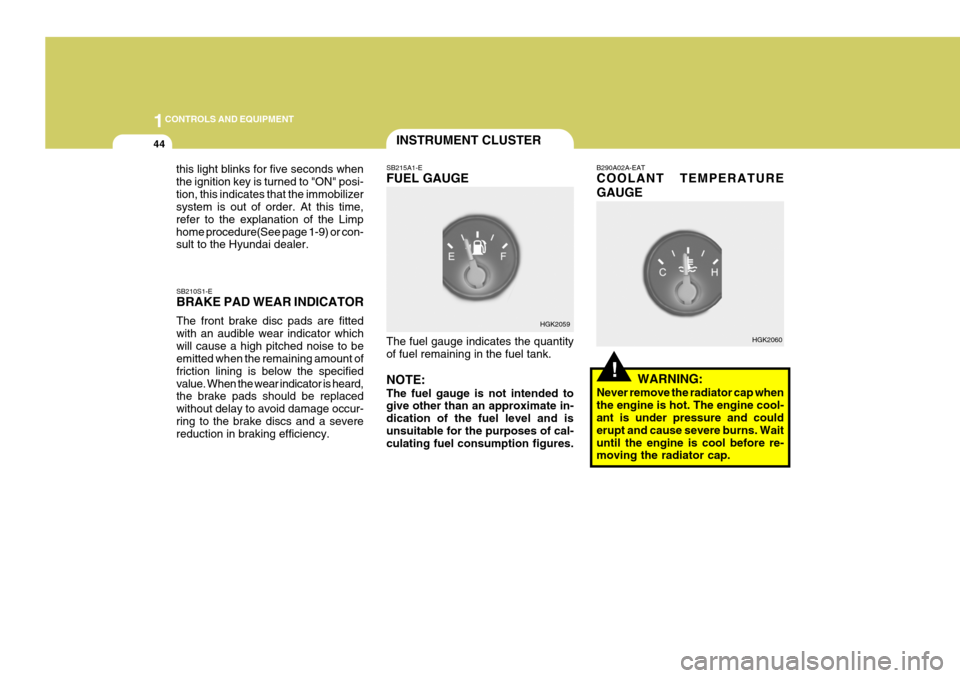
SB210S1-E BRAKE PAD WEAR INDICATOR The front brake disc pads are fitted with an audible wear indicator whichwill cause a high pitched noise to be emitted when the remaining amount of friction lining is below the specifiedvalue. When the wear indicator is heard, the brake pads should be replaced without delay to avoid damage occur-ring to the brake discs and a severe reduction in braking efficiency. SB215A1-E FUEL GAUGE The fuel gauge indicates the quantity of fuel remaining in the fuel tank. NOTE: The fuel gauge is not intended to give other than an approximate in- dication of the fuel level and isunsuitable for the purposes of cal- culating fuel consumption figures. B290A02A-EAT COOLANT TEMPERATURE GAUGE
WARNING:
Never remove the radiator cap when the engine is hot. The engine cool- ant is under pressure and could erupt and cause severe burns. Waituntil the engine is cool before re- moving the radiator cap.
HGK2059
HGK2060
this light blinks for five seconds when the ignition key is turned to "ON" posi-tion, this indicates that the immobilizer system is out of order. At this time, refer to the explanation of the Limphome procedure(See page 1-9) or con- sult to the Hyundai dealer.
Page 225 of 389
1
CONTROLS AND EQUIPMENT
45
!
The needle on the engine coolant tem- perature gauge should stay in the nor-mal range. If it moves across the dial to "H" (HOT), pull over and stop as soon as possible and turn off the engine.Then open the bonnet and check the coolant level and the water pump drive belt. If you suspect cooling systemtrouble, have your cooling system checked by Hyundai dealer as soon as possible.
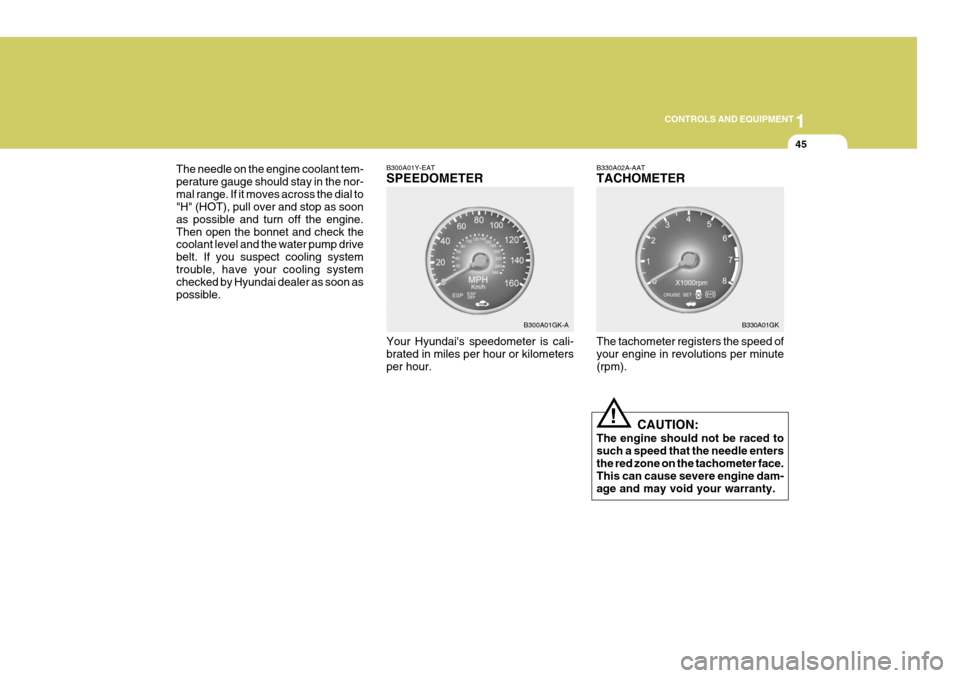
B300A01Y-EAT SPEEDOMETER Your Hyundai's speedometer is cali- brated in miles per hour or kilometers per hour.B330A02A-AAT TACHOMETER The tachometer registers the speed of your engine in revolutions per minute (rpm).
CAUTION:
The engine should not be raced tosuch a speed that the needle entersthe red zone on the tachometer face. This can cause severe engine dam- age and may void your warranty.
B300A01GK-A
B330A01GK
Page 295 of 389
2
DRIVING YOUR HYUNDAI
19
C190E01L
CAUTION:
o Never connect a trailer brake sys- tem directly to the vehicle brake system.
o When towing a trailer on steep grades (in excess of 12%) payclose attention to the engine cool-ant temperature gauge to ensure the engine does not overheat. If the needle of the coolant tem-perature gauge moves across the dial towards "H" (HOT), pull over and stop as soon as it is safe todo so, and allow the engine to idle until it cools down. You may proceed once the engine hascooled sufficiently.
! YC200D2-E Safety Cables Should the hitch connection between your car and the trailer or vehicle youare towing fail, the trailer or vehicle could wander dangerously across other lanes of traffic and ultimately leave theroadway. To eliminate this potentially dangerous situation, safety cables, at- tached between your car and the traileror towed vehicle, are required.
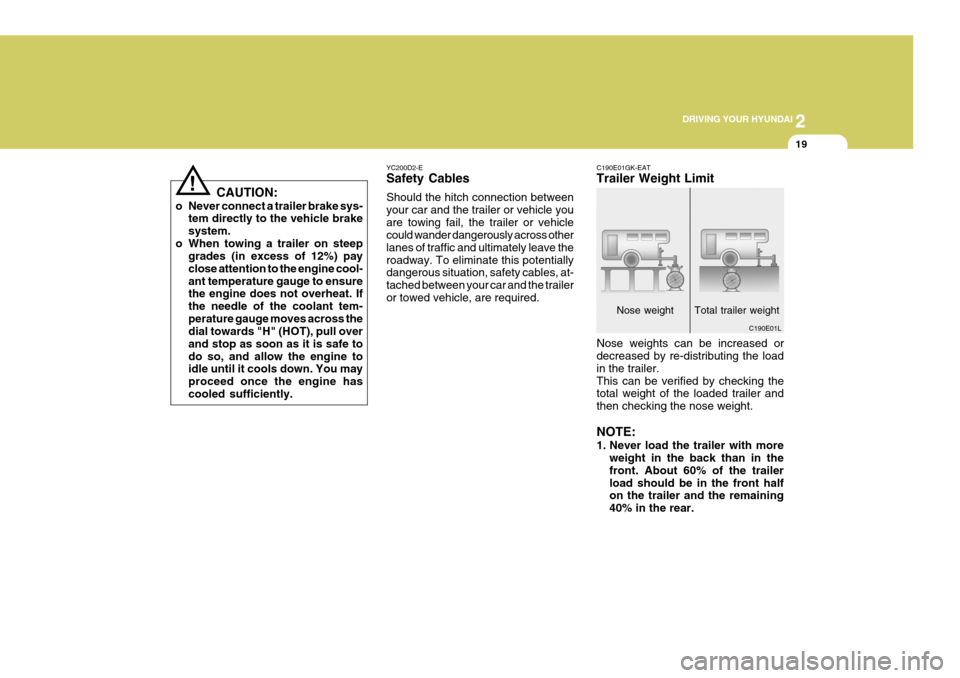
Nose weight Total trailer weight
C190E01GK-EAT Trailer Weight Limit Nose weights can be increased or decreased by re-distributing the load in the trailer.This can be verified by checking the total weight of the loaded trailer and then checking the nose weight. NOTE:
1. Never load the trailer with more
weight in the back than in the front. About 60% of the trailerload should be in the front half on the trailer and the remaining 40% in the rear.
Page 302 of 389
3 IN CASE OF EMERGENCY
4
7. Swithc "ON" the main beam
headlamps before carefully remov- ing the jumper cables have been removed, switch "OFF" the main beam geadlamps. SD040A2-E If the temperature gauge indicates overheating:
1. Pull off the road and stop as soon as
it is safe to do so.
2. Place the gear selector lever in "P"
(automatic), or neutral (manual transaxle) and set the parking brake. If the air conditioning is on, turn it off.
3. If coolant is running out under the car or steam is coming out fromunder the bonnet stop the engine. Do not open the bonnet until thecoolant has stopped running or the steaming has stopped. If there is no visible loss of coolant and no steam,leave the engine running and check to be sure the engine cooling fan is operating.If the fan is not running, turn the engine off.
4. Check to see if the water pump drive belt is missing. If it is not missing,check to see that it is tight. If the drive belt seems to be satisfac-tory,check for coolant leaking from the radiator, hoses or under the car. (If the air conditioning had been in use,it is normal for cold water to be draining from it).
IF THE ENGINE OVERHEATS
1. Ensure that the booster battery is 12 volt type. If the booster battery is installed in another vehicle, ensure that the two vehicles are not touch- ing.
2. Turn off all unnecessary electrical equipment in both vehicles.
3. Ensure that the engine of the ve- hicle providing the jump start is run- ning prior to connection of the jump cables.
4. Connect the red jump cable to the positive (+) terminal of the boosterbattery and the other end to thepositive (+) terminal of the dis- charged battery.
5. Attach the black jump cable to the negative (-) terminal of thebooster battery, and the other end to a ground point within the enginecompartment of the vehicle with the flat battery. Do not connect to the negative battery terminal of the flatbattery since sparks may be gener- ated with the subsequent risk of explosion.
6. Raise the booster vehicle engine speed to 2,000 r.p.m. and start theengine of the vehicle with the flatbattery. CAUTION:
If the jump cable is incorrectly in-stalled, damage to the vehicle elec-trical system may occur, in particu- lar the electronic components such as the Fuel Injection system com- puter and the Automatic Transaxle computer. The battery must neverbe disconnected whilst the engine is running.
!