warning light Hyundai Coupe 2006 Repair Manual
[x] Cancel search | Manufacturer: HYUNDAI, Model Year: 2006, Model line: Coupe, Model: Hyundai Coupe 2006Pages: 483, PDF Size: 12.73 MB
Page 386 of 483
2DRIVING YOUR HYUNDAI
14
!o If your vehicle becomes stuck in
snow, mud, sand, etc., then you may attempt to rock the vehicle free by moving it forward and back-ward. Do not attempt this proce- dure if people or objects are any- where near the vehicle. During therocking operation the vehicle may suddenly move forward of back- ward as it becomes unstuck, caus-ing injury or damage to nearby people or objects.
WARNING:
o Avoid high cornering speeds.
o Do not make quick steering wheel movements, such as sharp lane changes or fast, sharp turns.
o Always wear your seat belts. In a collision crash, an unbeltedperson is significantly more likely to die than a person wearing aseatbelt.
o The risk of rollover is greatly in-
creased if you lose control of yourvehicle at motorway speeds.
o Loss of control often occurs if two
or more wheels drop off the road-way and the driver oversteers to reenter the roadway.
o In the event your vehicle leaves
the roadway, do not steer sharply.Instead, slow down before pulling back into the travel lanes.
o Never exceed posted speed limits.
ANTI-LOCK BRAKE SYSTEM (ABS)
C120A01FC-EAT (Not all models) The Anti-Lock Brake System (ABS) is designed to prevent wheel lock-up dur-ing sudden braking or on hazardous road surfaces. The ABS control module monitors the wheel speed and controlsthe pressure applied to each brake. Thus, in emergency situations or on slick roads, ABS will increase vehiclecontrol during braking. NOTE:
o A click sound may be heard in the
engine compartment when the ve- hicle begins to move after the en- gine is started. These conditionsare normal and indicate that the anti-lock brake system (Electronic Stability Program) is functioningproperly.
o During ABS (ESP) operation, a
slight pulsation may be felt in thebrake pedal when the brakes are applied. Also, a noise may be heard in the engine compartment whilstbraking. These conditions are nor- mal and indicate that the anti-lock brake system (Electronic StabilityProgram) is functioning properly.
gkfluk-2.p65 12/26/2006, 5:19 PM
14
Page 388 of 483
2DRIVING YOUR HYUNDAI
16EFFECTIVE BRAKING
SC140A2-E Braking system performance and fric- tion material life are greatly affected by the driving style adopted. The following suggestions are made to assist inachieving the best results from the braking system.
o Anticipate the road and conditions ahead in order that heavy braking may be avoided.
o When descending long gradients, use the engine to assist in retarding thevehicle to minimise the possibility ofbrake fade occurring.
o When trailer towing, ensure that the
trailer brakes function correctly anduse engine braking to assist the vehicle braking system.
o Use only genuine Hyundai replace- ment brake pads and shoes to en-sure consistent friction characteris- tics and wear rates.
o After driving through deep water (e.g. fording), the brakes may becomewet and performance reduced. Al-ways check brake efficiency after emerging from the water and dry the brakes by lightly depressing the brakepedal several times whilst driving slowly.
C310B01JM-AAT ESP ON/OFF Mode When the ESP is operating, the ESP indicator in the instrument cluster willblink. If you turn the system off by pressing the ESP switch, the ESP-OFF indica-tor will come on and stay on. In the ESP-OFF mode, the stability control will be deactivated. Adjust your drivingaccordingly. To turn the system back on, press the switch again. The ESP- OFF indicator should go off. NOTE: The ESP mode will automatically be turned ON after the engine is turnedoff and restarted.
C310D02JM-EAT Indicators and Warning The indicators should illuminate when the ignition key is turned ON or STARTbut should go out after approximately 3 seconds. If the indicators do not illuminate, or theESP-OFF indicator does not go out after approximately 3 seconds, have the vehicle checked by a Hyundaiauthorised repairer. Should there be any unusual conditions in the device whilst driving, ESP-OFF indicator illuminates as a warning. If ESP-OFF indicator illuminates, pullyour car to a safe place and stop the engine. Then, start the engine again to check ifthe ESP-OFF indicator goes out. If the indicator remains lit even after the engine has been started, have your car checked by a Hyundai authorised re- pairer.
gkfluk-2.p65
12/26/2006, 5:19 PM
16
Page 399 of 483
3 IN CASE OF EMERGENCY
2IF THE ENGINE WILL NOT START
!
SD020A1-E Seek assistance from the nearest Hyundai authorised repairer with regard to the method of ignition and fuel sys- tem diagnosis.
WARNING:
If the engine refuses to start, noattempt should be made to push ortow start the vehicle. Vehicles with automatic transaxle or fuel injec- tion will not be able to be started in this manner since no drive is trans- mitted through the automatictransaxle whilst the engine is not running, and in the case of fuel injected derivatives, the fuel pumpwill not operate under tow start conditions. In addition, if the ve- hicle is equipped with an exhaustcatalyst, damage to the catalyst may result if the vehicle is tow started. SD020B1-E If the Engine Cannot be Cranked
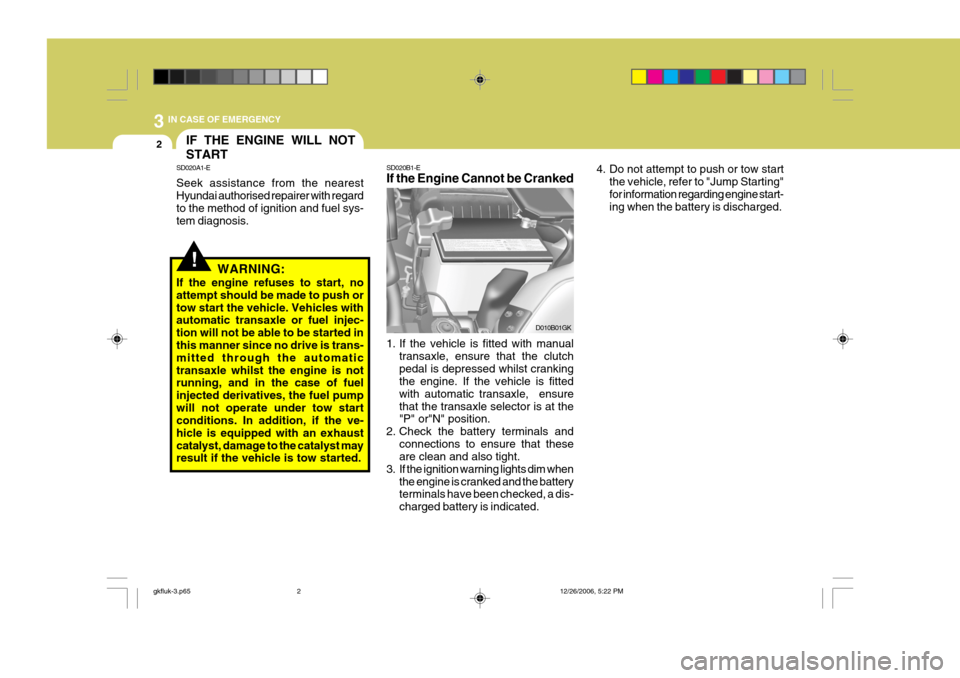
1. If the vehicle is fitted with manual
transaxle, ensure that the clutch pedal is depressed whilst cranking the engine. If the vehicle is fitted with automatic transaxle, ensurethat the transaxle selector is at the "P" or"N" position.
2. Check the battery terminals and connections to ensure that theseare clean and also tight.
3. If the ignition warning lights dim when the engine is cranked and the batteryterminals have been checked, a dis- charged battery is indicated. D010B01GK
4. Do not attempt to push or tow start
the vehicle, refer to "Jump Starting"for information regarding engine start- ing when the battery is discharged.
gkfluk-3.p65 12/26/2006, 5:22 PM
2
Page 400 of 483
3
IN CASE OF EMERGENCY
3
!
!
D010C01A-EAT If Engine Turns Over Normally but Does Not Start
1. Check fuel level.
2. With the key in the off position,
Check all connectors at ignition coils and spark plugs. Reconnect any that may be disconnected or loose.
3. Check the fuel line in the engine room.
4. If engine still refuses to start, call a Hyundai authorised repairer or seek other qualified assistance.
D010D01A-EAT If Engine Stalls While Driving
1. Reduce your speed gradually, keep- ing a straight line. Move cautiously off the road to a safe place.
2. Turn on your hazard lights.
3. Try to start the engine again. If your vehicle will not start, contact aHyundai authorised repairer or seekother qualified assistance. SD030A2-E
CAUTION:
Personal injury and damage to thevehicle may occur if jump startingis not performed correctly. If any doubt exists as to how this opera- tion should be performed, seek as-sistance from qualified personnel.
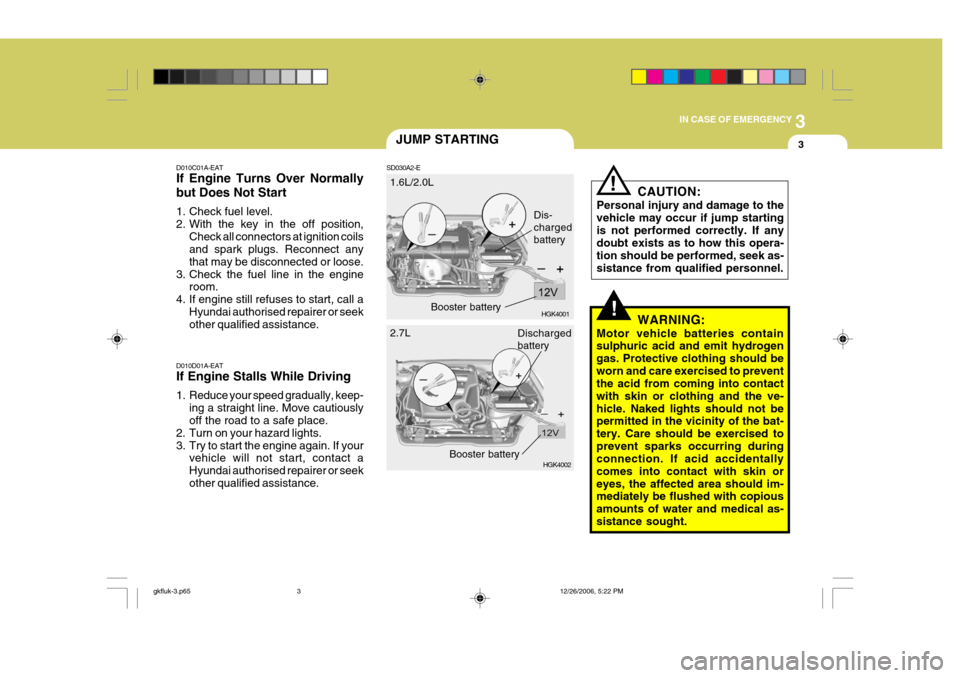
JUMP STARTING
WARNING:
Motor vehicle batteries contain sulphuric acid and emit hydrogen gas. Protective clothing should beworn and care exercised to prevent the acid from coming into contact with skin or clothing and the ve-hicle. Naked lights should not be permitted in the vicinity of the bat- tery. Care should be exercised toprevent sparks occurring during connection. If acid accidentally comes into contact with skin oreyes, the affected area should im- mediately be flushed with copious amounts of water and medical as-sistance sought.
1.6L/2.0L
HGK4001
HGK4002
Dis- chargedbattery
2.7L Booster battery
Discharged battery
Booster battery
gkfluk-3.p65 12/26/2006, 5:22 PM
3
Page 406 of 483
3
IN CASE OF EMERGENCY
9
D060F01MC
Wheel nut wrench
SD070G1-E 5. Raising the Car
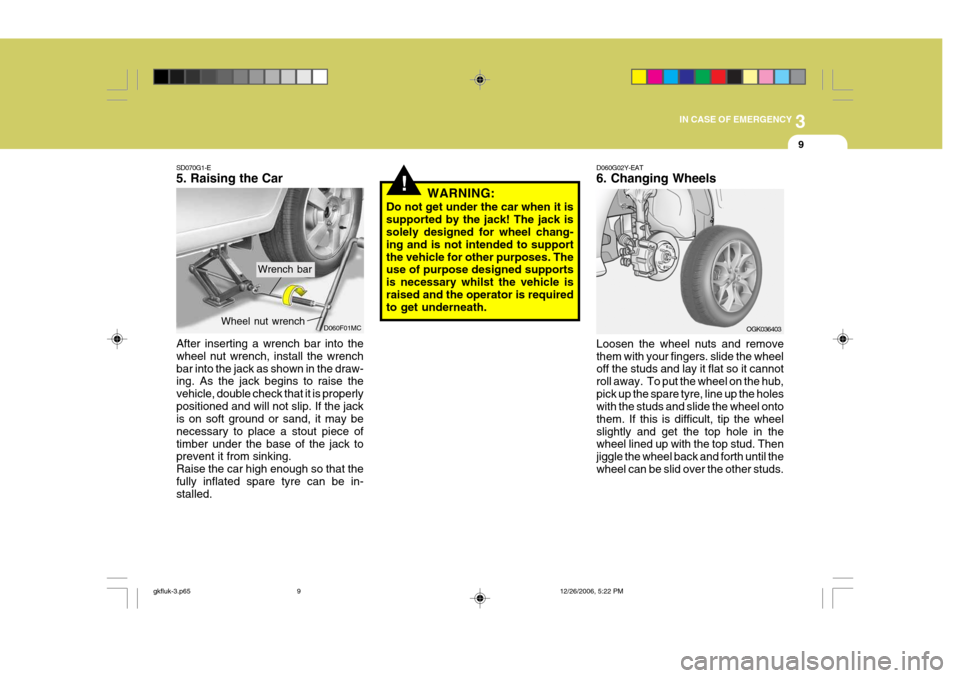
After inserting a wrench bar into the wheel nut wrench, install the wrenchbar into the jack as shown in the draw- ing. As the jack begins to raise the vehicle, double check that it is properlypositioned and will not slip. If the jack is on soft ground or sand, it may be necessary to place a stout piece oftimber under the base of the jack to prevent it from sinking. Raise the car high enough so that thefully inflated spare tyre can be in- stalled.
Wrench bar
!WARNING:
Do not get under the car when it is supported by the jack! The jack is solely designed for wheel chang- ing and is not intended to supportthe vehicle for other purposes. The use of purpose designed supports is necessary whilst the vehicle israised and the operator is required to get underneath.
Loosen the wheel nuts and remove them with your fingers. slide the wheel off the studs and lay it flat so it cannot roll away. To put the wheel on the hub,pick up the spare tyre, line up the holes with the studs and slide the wheel onto them. If this is difficult, tip the wheelslightly and get the top hole in the wheel lined up with the top stud. Then jiggle the wheel back and forth until thewheel can be slid over the other studs.
OGK036403
D060G02Y-EAT 6. Changing Wheels
gkfluk-3.p65
12/26/2006, 5:22 PM
9
Page 432 of 483
6
OWNER MAINTENANCE
5
SG020B1-E The following items should be checked on a daily basis or whenever the vehicle is refuelled, whichever occurssooner.
o Engine oil level.
o Engine coolant level.
o Power steering fluid level.
o Brake fluid level.
o Windscreen washer fluid level.
o Battery condition.
o Tyre condition and pressures.
o Operation and cleanliness of all lighting equipment.
o Windscreen wiper and washer op-
eration.
o Horn operation.
o Warning lamp operation.
o Adjustment and cleanliness of mir- rors.
o Seat and seat belt adjustment and operation.
o Fluid leakage.
The vehicle must not be driven if the daily operating checks indicate that any item of equipment related to the safety or roadworthiness of the ve-hicle is not functioning correctly. DAILY OPERATING CHECKS
MAINTENANCE PRECAU- TIONS
!
G020D01TG-EAT Improper or incomplete service may result in problems. This section gives instructions only for the maintenanceitems that are easy to perform.Several procedures should be done byHyundai authorised repairer. NOTE: Improper owner maintenance dur- ing the warranty period may affectwarranty coverage.
WARNING:
o Performing maintenance work on a vehicle can be dangerous. You can be seriously injured whilst performing some maintenanceprocedures. If you lack sufficient knowledge and experience or the proper tools and equipment to dothe work, have it done by Hyundai authorised repairer.
o Working under the bonnet with the engine running is dangerous. It becomes even more dangerouswhen you wear jewellery or loose clothing. These can become en- tangled in moving parts and re-sult in injury. Therefore, if you must run the engine whilst work- ing under the bonnet, make cer-tain that you remove all jewellery (especially rings, bracelets, watches, and necklaces) and allneckties, scarves, and similar loose clothing before getting near the engine or cooling fans.
gkfluk-6.p65 12/26/2006, 5:24 PM
5
Page 443 of 483
6OWNER MAINTENANCE
16
HGK5012
SG120D1-E
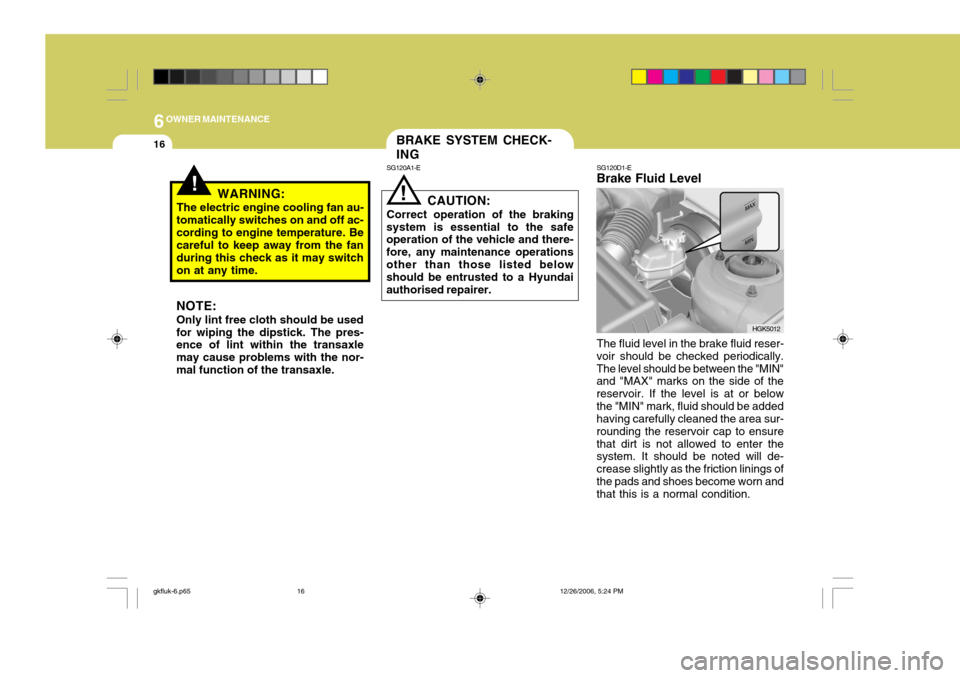
Brake Fluid Level
!
SG120A1-E BRAKE SYSTEM CHECK- ING
CAUTION:
Correct operation of the braking
system is essential to the safe operation of the vehicle and there- fore, any maintenance operationsother than those listed below should be entrusted to a Hyundai authorised repairer.
!WARNING:
The electric engine cooling fan au-
tomatically switches on and off ac- cording to engine temperature. Be careful to keep away from the fan during this check as it may switchon at any time.
NOTE: Only lint free cloth should be used for wiping the dipstick. The pres- ence of lint within the transaxle may cause problems with the nor- mal function of the transaxle. The fluid level in the brake fluid reser-
voir should be checked periodically. The level should be between the "MIN" and "MAX" marks on the side of the reservoir. If the level is at or belowthe "MIN" mark, fluid should be added having carefully cleaned the area sur- rounding the reservoir cap to ensurethat dirt is not allowed to enter the system. It should be noted will de- crease slightly as the friction linings ofthe pads and shoes become worn and that this is a normal condition.
gkfluk-6.p65 12/26/2006, 5:24 PM
16
Page 447 of 483
6OWNER MAINTENANCE
20
!
G200A01E
FUSIBLE LINKS
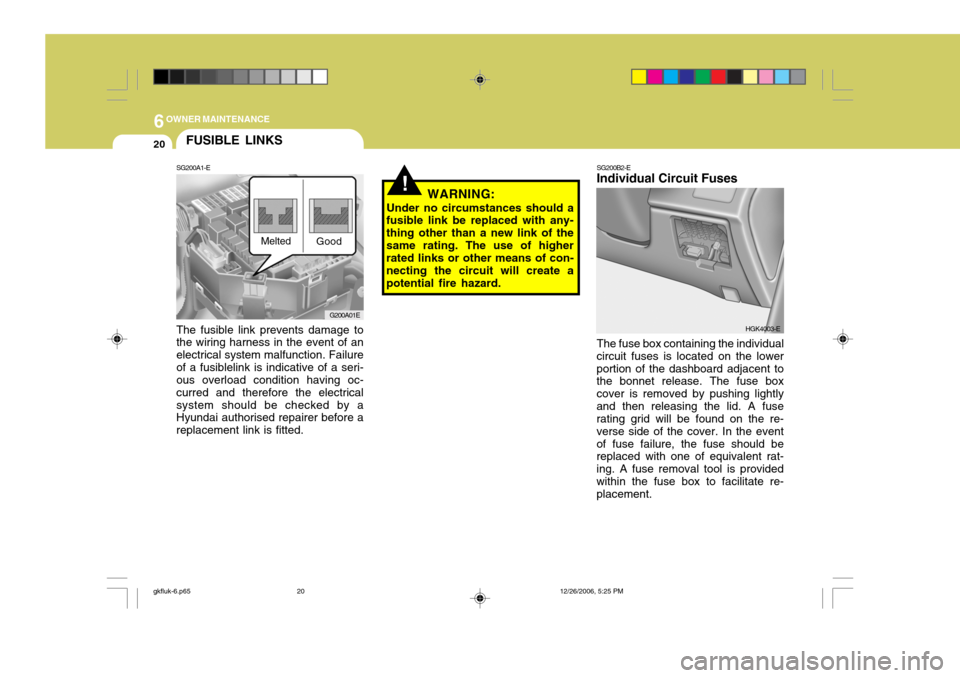
SG200A1-E The fusible link prevents damage to the wiring harness in the event of an electrical system malfunction. Failureof a fusiblelink is indicative of a seri- ous overload condition having oc- curred and therefore the electricalsystem should be checked by a Hyundai authorised repairer before a replacement link is fitted. WARNING:
Under no circumstances should a
fusible link be replaced with any-thing other than a new link of thesame rating. The use of higher rated links or other means of con- necting the circuit will create apotential fire hazard.
Melted SG200B2-E
Individual Circuit Fuses
The fuse box containing the individual
circuit fuses is located on the lowerportion of the dashboard adjacent to the bonnet release. The fuse box cover is removed by pushing lightlyand then releasing the lid. A fuse rating grid will be found on the re- verse side of the cover. In the eventof fuse failure, the fuse should be replaced with one of equivalent rat- ing. A fuse removal tool is providedwithin the fuse box to facilitate re- placement.
Good
HGK4003-E
gkfluk-6.p6512/26/2006, 5:25 PM
20
Page 449 of 483
6OWNER MAINTENANCE
22
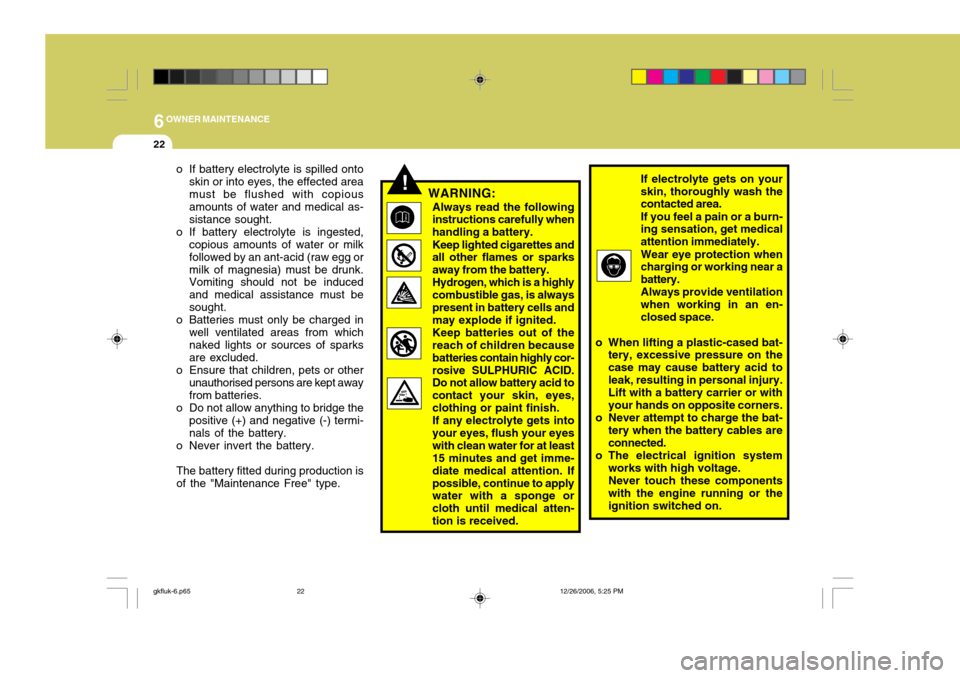
o If battery electrolyte is spilled ontoskin or into eyes, the effected area must be flushed with copious amounts of water and medical as- sistance sought.
o If battery electrolyte is ingested, copious amounts of water or milkfollowed by an ant-acid (raw egg ormilk of magnesia) must be drunk. Vomiting should not be induced and medical assistance must besought.
o Batteries must only be charged in well ventilated areas from which naked lights or sources of sparks are excluded.
o Ensure that children, pets or other unauthorised persons are kept awayfrom batteries.
o Do not allow anything to bridge the
positive (+) and negative (-) termi-nals of the battery.
o Never invert the battery.
The battery fitted during production isof the "Maintenance Free" type.
If electrolyte gets on your skin, thoroughly wash the contacted area. If you feel a pain or a burn- ing sensation, get medical attention immediately. Wear eye protection when charging or working near a battery.Always provide ventilationwhen working in an en-closed space.
o When lifting a plastic-cased bat- tery, excessive pressure on thecase may cause battery acid toleak, resulting in personal injury. Lift with a battery carrier or with your hands on opposite corners.
o Never attempt to charge the bat- tery when the battery cables areconnected.
o The electrical ignition system works with high voltage.Never touch these componentswith the engine running or theignition switched on.!WARNING:
Always read the following instructions carefully when handling a battery. Keep lighted cigarettes and all other flames or sparks away from the battery.Hydrogen, which is a highlycombustible gas, is alwayspresent in battery cells and may explode if ignited. Keep batteries out of the reach of children because
batteries contain highly cor-rosive SULPHURIC ACID. Do not allow battery acid to
contact your skin, eyes,
clothing or paint finish.If any electrolyte gets intoyour eyes, flush your eyeswith clean water for at least 15 minutes and get imme- diate medical attention. Ifpossible, continue to apply water with a sponge or cloth until medical atten-tion is received.
gkfluk-6.p65 12/26/2006, 5:25 PM
22
Page 454 of 483
6
OWNER MAINTENANCE
27
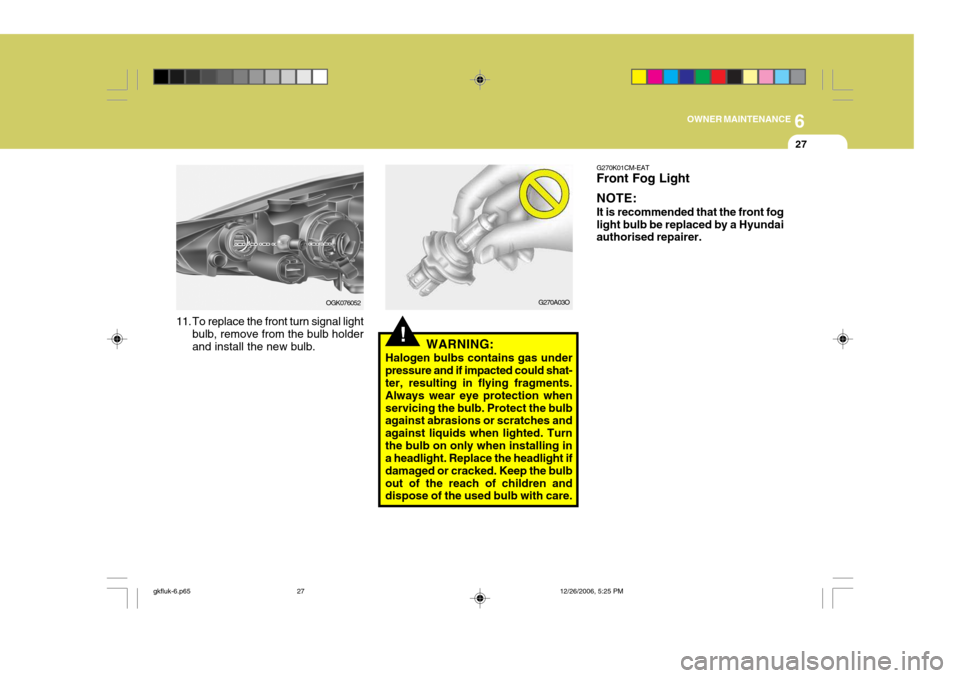
!WARNING:
Halogen bulbs contains gas under pressure and if impacted could shat- ter, resulting in flying fragments. Always wear eye protection whenservicing the bulb. Protect the bulb against abrasions or scratches and against liquids when lighted. Turnthe bulb on only when installing in a headlight. Replace the headlight if damaged or cracked. Keep the bulbout of the reach of children and dispose of the used bulb with care.
11. To replace the front turn signal light
bulb, remove from the bulb holderand install the new bulb. OGK076052
G270A03OG270K01CM-EAT Front Fog Light NOTE: It is recommended that the front fog light bulb be replaced by a Hyundai authorised repairer.
gkfluk-6.p65
12/26/2006, 5:25 PM
27