warning light Hyundai Creta 2016 Repair Manual
[x] Cancel search | Manufacturer: HYUNDAI, Model Year: 2016, Model line: Creta, Model: Hyundai Creta 2016Pages: 512, PDF Size: 11.54 MB
Page 354 of 512
Good braking practices Wet brakes can be dangerous! The
brakes may get wet if the vehicle is
driven through standing water or if it
is washed. Your vehicle will not stop
as quickly if the brakes are wet. Wet
brakes may cause the vehicle to pull
to one side.
To dry the brakes, apply the brakes
lightly until the braking action returns
to normal, taking care to keep the
vehicle under control at all times. If
the braking action does not return to
normal, stop as soon as it is safe to
do so and we recommend that you
call an authorized HYUNDAI dealer
for assistance.
DO NOT drive with your foot resting
on the brake pedal. Even light, but
constant pedal pressure can result in
the brakes overheating, brake wear,
and possibly even brake failure. If a tire goes flat while you are driv
ing, apply the brakes gently and
keep the vehicle pointed straight
ahead while you slow down. When
you are moving slowly enough for it
to be safe to do so, pull off the road
and stop in a safe location.
Keep your foot firmly on the brake
pedal when the vehicle is stopped to
prevent the vehicle from rolling for
ward.
5-42
Driving your vehicle
Whenever leaving the vehicle or
parking, always come to a com
plete stop and continue to depress
the brake pedal. Move the shift
lever into the 1st gear (for manual
transaxle vehicle) or P (Park, for
automatic transaxle vehicle) posi
tion, then apply the parking brake,
and place the ignition switch in the
LOCK/OFF position.
Vehicles parked with the parking
brake not applied or not fully
engaged may roll inadvertently
and may cause injury to the driver
and others. ALWAYS apply the
parking brake before exiting the
vehicle.
WARNING
Page 355 of 512
5-43
Driving your vehicle
5
Cruise Control Operation
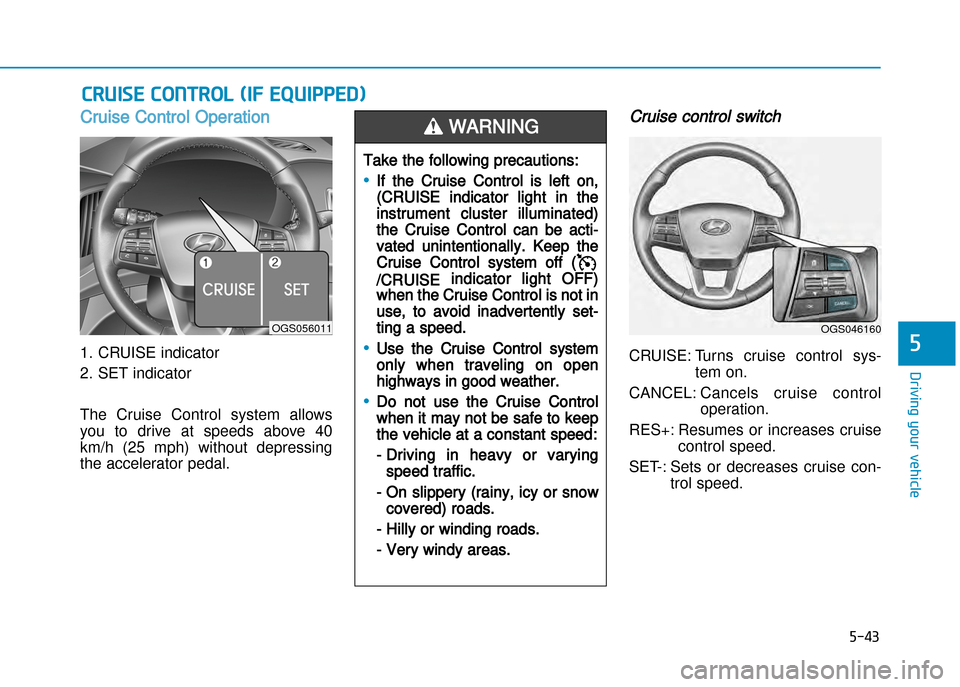
1. CRUISE indicator
2. SET indicator
The Cruise Control system allows
you to drive at speeds above 40
km/h (25 mph) without depressing
the accelerator pedal.
Cruise control switch
CRUISE: Turns cruise control system on.
CANCEL: Cancels cruise control operation.
RES+: Resumes or increases cruise control speed.
SET: Sets or decreases cruise con trol speed.
CRUISE CONTROL (IF EqUIppED)
OGS056011
Take the following precautions:
•If the Cruise Control is left on,
(CRUISE indicator light in the
instrument cluster illuminated)
the Cruise Control can be acti
vated unintentionally. Keep the
Cruise Control system off (
/CRUISEindicator light OFF)
when the Cruise Control is not in
use, to avoid inadvertently set
ting a speed.
•Use the Cruise Control system
only when traveling on open
highways in good weather.
•Do not use the Cruise Control
when it may not be safe to keep
the vehicle at a constant speed:
Driving in heavy or varying
speed traffic.
On slippery (rainy, icy or snow
covered) roads.
Hilly or winding roads.
Very windy areas.
WARNING
OGS046160
Page 360 of 512
5-48
Driving your vehicle
SpECIAL DRIVING CONDITIONS
Hazardous driving conditions
When hazardous driving conditions
are encountered such as water,
snow, ice, mud or sand:
Drive cautiously and allow extra dis
tance for braking.
Avoid sudden movements in braking
or steering.
If stuck in snow, mud, or sand, use
second gear. Accelerate slowly to
avoid spinning the drive wheels.
Use sand, rock salt, or other nonslip
material under the drive wheels to
provide traction when stalled in ice,
snow, or mud.
Rocking the vehicle
If it is necessary to rock the vehicle
to free it from snow, sand, or mud,
first turn the steering wheel right and
left to clear the area around your
front wheels. Then, shift back and
forth between 1st and R (Reverse,
for manual transaxle vehicle) or R
(Reverse) and a forward gear (for
automatic transaxle vehicle). Try to
avoid spinning the wheels, and do
not race the engine.
To prevent transaxle wear, wait until
the wheels stop spinning before
shifting gears. Release the accelera
tor pedal while shifting, and press
lightly on the accelerator pedal while
the transaxle is in gear. Slowly spin
ning the wheels in forward and
reverse directions causes a rocking
motion that may free the vehicle.
Downshifting with an automatic
transaxle, while driving on slippery
surfaces can cause an accident.
The sudden change in tire speed
could cause the tires to skid. Be
careful when downshifting on slip
pery surfaces.
WARNING
If the vehicle is stuck and exces
sive wheel spin occurs, the tem
perature in the tires can increase
very quickly. If the tires become
damaged, a tire blow out or tire
explosion can occur. This condi
tion is dangerous you and others
may be injured. Do not attempt
this procedure if people or objects
are anywhere near the vehicle.
If you attempt to free the vehicle,
the vehicle can overheat quickly,
possibly causing an engine com
partment fire or other damage. Try
to avoid spinning the wheels as
much as possible to prevent over
heating of either the tires or the
engine. DO NOT allow the vehicle
to spin the wheels above 35 mph
(56 km/h).
WARNING
Page 364 of 512
5-52
Driving your vehicle
Snow or icy conditions
You need to keep sufficient distance
between your vehicle and the vehicle
in front of you.
Apply the brakes gently. Speeding,
rapid acceleration, sudden brake
applications, and sharp turns are
potentially very hazardous practices.
During deceleration, use engine
braking to the fullest extent. Sudden
brake applications on snowy or icy
roads may cause the vehicle to skid.
To drive your vehicle in deep snow, it
may be necessary to use snow tires
or to install tire chains on your tires.
Always carry emergency equipment.
Some of the items you may want to
carry include tire chains, tow straps
or chains, a flashlight, emergency
flares, sand, a shovel, jumper cables,
a window scraper, gloves, ground
cloth, coveralls, a blanket, etc.
Snow tires
If you mount snow tires on your vehi
cle, make sure to use radial tires of
the same size and load range as the
original tires. Mount snow tires on all
four wheels to balance your vehicle’s
handling in all weather conditions.
The traction provided by snow tires
on dry roads may not be as high as
your vehicle's original equipmenttires. Check with the tire dealer for
maximum speed recommendations.
Information
Do not install studded tires without
first checking local and municipal reg
ulations for possible restrictions
against their use.i
WINTER DRIVING
Snow tires should be equivalent in
size and type to the vehicle's stan
dard tires. Otherwise, the safety
and handling of your vehicle may
be adversely affected.
WARNING
Page 370 of 512
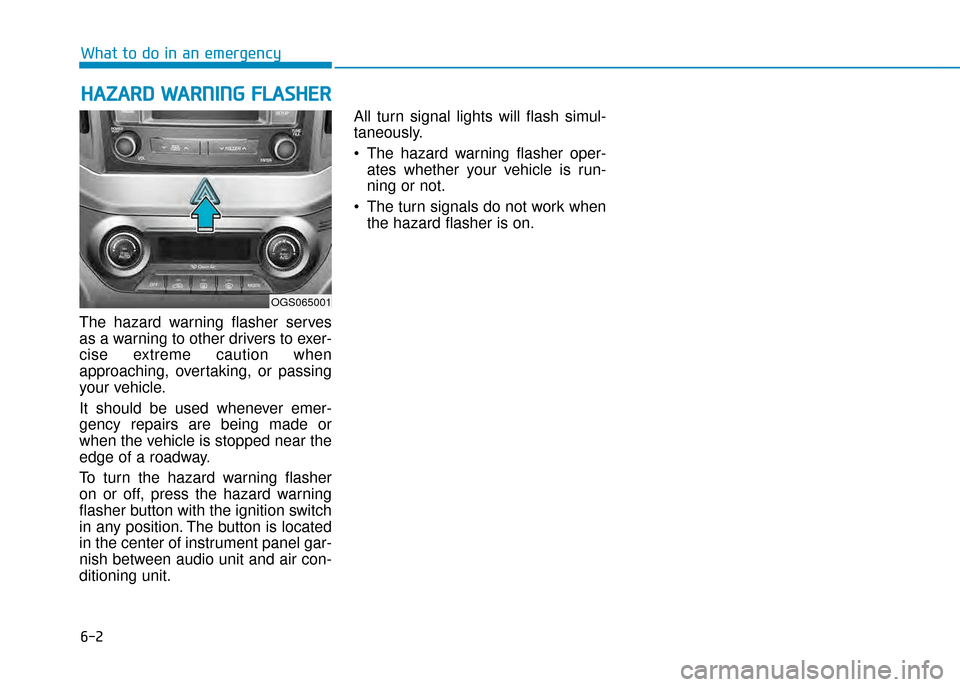
The hazard warning flasher serves
as a warning to other drivers to exer
cise extreme caution when
approaching, overtaking, or passing
your vehicle.
It should be used whenever emer
gency repairs are being made or
when the vehicle is stopped near the
edge of a roadway.
To turn the hazard warning flasher
on or off, press the hazard warning
flasher button with the ignition switch
in any position. The button is located
in the center of instrument panel gar
nish between audio unit and air con
ditioning unit. All turn signal lights will flash simul
taneously.
• The hazard warning flasher oper
ates whether your vehicle is run
ning or not.
• The turn signals do not work when the hazard flasher is on.
HAZARD WARNING FLASHER
6-2
What to do in an emergency
OGS065001
Page 372 of 512
IF THE ENGINE WILL NOT START
If the engine doesn't turn over or
turns over slowly
• Be sure the shift lever is in N(Neutral) or P (Park) if it is an auto
matic transaxle vehicle. The engine
starts only when the shift lever is in
N (Neutral) or P (Park).
• Check the battery connections to be sure they are clean and tight.
• Turn on the interior light. If the light dims or goes out when you operate
the starter, the battery is drained.
Do not push or pull the vehicle to
start it. This could cause damage to
your vehicle.
See instructions for "Jump Starting"
provided in this chapter.
If the engine turns over normally
but doesn't start
• Check the fuel level and add fuel if necessary.
If the engine still does not start, we
recommend that you call an author
ized HYUNDAI dealer for assistance.
6-4
What to do in an emergency
Push or pull starting the vehicle
may cause the catalytic converter
to overload which can lead to
damage to the emission control
system.
WARNING
Page 382 of 512
6-14
What to do in an emergency
You may not be able to identify a low
tire by simply looking at it. Always
use a good quality tire pressure
gauge to measure the tire's inflation
pressure. Please note that a tire that
is hot (from being driven) will have a
higher pressure measurement than a
tire that is cold.
A cold tire means the vehicle has
been sitting for 3 hours and driven for
less than 1 mile (1.6 km) in that 3
hour period.
Allow the tire to cool before measur
ing the inflation pressure. Always be
sure the tire is cold before inflating to
the recommended pressure.
TPMS
•The TPMS cannot alert you to
severe and sudden tire damage
caused by external factors such
as nails or road debris.
•If you feel any vehicle instability,
immediately take your foot off
the accelerator, apply the
brakes gradually and with light
force, and slowly move to a safe
position off the road.
WARNING
Protecting TPMS
Tampering with, modifying, or dis
abling the Tire Pressure
Monitoring System (TPMS) com
ponents may interfere with the
system's ability to warn the driver
of low tire pressure conditions
and/or TPMS malfunctions.
Tampering with, modifying, or dis
abling the Tire Pressure
Monitoring System (TPMS) com
ponents may void the warranty for
that portion of the vehicle.
WARNING
We recommend that you use the
tire sealant approved by
HYUNDAI if your vehicle is
equipped with a Tire Pressure
Monitoring System. The liquid
sealant can damage the tire pres
sure sensors.
CAUTION
Page 402 of 512
7-8
Maintenance
OWNER MAINTENANCE
The following lists are vehicle checks
and inspections that should be per
formed at the frequencies indicated
to help ensure safe, dependable
operation of your vehicle.
Any adverse conditions should be
brought to the attention of your deal
er as soon as possible.
These Owner Maintenance Checks
are generally not covered by war
ranties and you may be charged for
labor, parts and lubricants used. Owner maintenance schedule
When you stop for fuel:
• Check the engine oil level.
• Check the coolant level in coolantreservoir.
• Check the windshield washer fluid level.
• Look for low or underinflated tires.
• Check the radiator and condenser. Check if the front of the radiator
and condenser are clean and not
blocked with leaves, dirt or insectsetc.
If any of the above par ts areextremely dirty or you are not sure
of their condition, we recommend
that you contact an authorized
HYUNDAI dealer.
While operating your vehicle:
• Note any changes in the sound of the exhaust or any smell of
exhaust fumes in the vehicle.
• Check for vibrations in the steering wheel. Notice any increased steer
ing effort or looseness in the steer
ing wheel, or change in its straight
ahead position.
• Notice if your vehicle constantly turns slightly or "pulls" to one side
when traveling on smooth, levelroad.
• When stopping, listen and check for unusual sounds, pulling to one
side, increased brake pedal travel
or "hardtopush" brake pedal.
• If any slipping or changes in the operation of your transaxle occurs,
check the transaxle fluid level.
• Check automatic transaxle P (Park) function.
• Check the parking brake.
• Check for fluid leaks under your vehicle (water dripping from the air
conditioning system during or after
use is normal).
Be careful when checking your
engine coolant level when the
engine is hot. Scalding hot coolant
and steam may blow out under
pressure. This could cause burns
or other serious injury.
WARNING
Page 403 of 512
7-9
7
Maintenance
At least monthly:
• Check the coolant level in theengine coolant reservoir.
• Check the operation of all exterior lights, including the stoplights, turn
signals and hazard warning flash
ers.
• Check the inflation pressures of all tires including the spare.
At least twice a year
(i.e., every Spring and Fall):
• Check the radiator, heater and airconditioning hoses for leaks or
damage.
• Check the windshield washer spray and wiper operation. Clean
wiper blades with clean cloth
dampened with washer fluid.
• Check the headlight alignment.
• Check the muffler, exhaust pipes, shields and clamps.
• Check the lap/shoulder belts for wear and function.
• Check for worn tires and loose wheel lug nuts.
At least once a year:
• Clean the body and door drainholes.
• Lubricate the door hinges and checks, and hood hinges.
• Lubricate the door and hood locks and latches.
• Lubricate the door rubber weather strips.
• Check the air conditioning system.
• Inspect and lubricate automatic transaxle linkage and controls.
• Clean the battery and terminals.
• Check the brake/clutch fluid level.
Page 434 of 512
7-40
Maintenance
FuEl FIlTER (FOR dIESEl)
Draining water from fuel filter
The fuel filter for diesel engine plays
an important role of separating water
from fuel and accumulating the water
in its bottom.
If water accumulates in the fuel filter,
the warning light comes on when the
ignition switch is in the ON position.If this warning light turned
on, we recommend that the
system be serviced by an
authorized HYUNDAI dealer.
If the water accumulated in the fuel
filter is not drained at proper times,
damages to the major parts such as
the fuel system can be caused by
water permeation in the fuel filter.
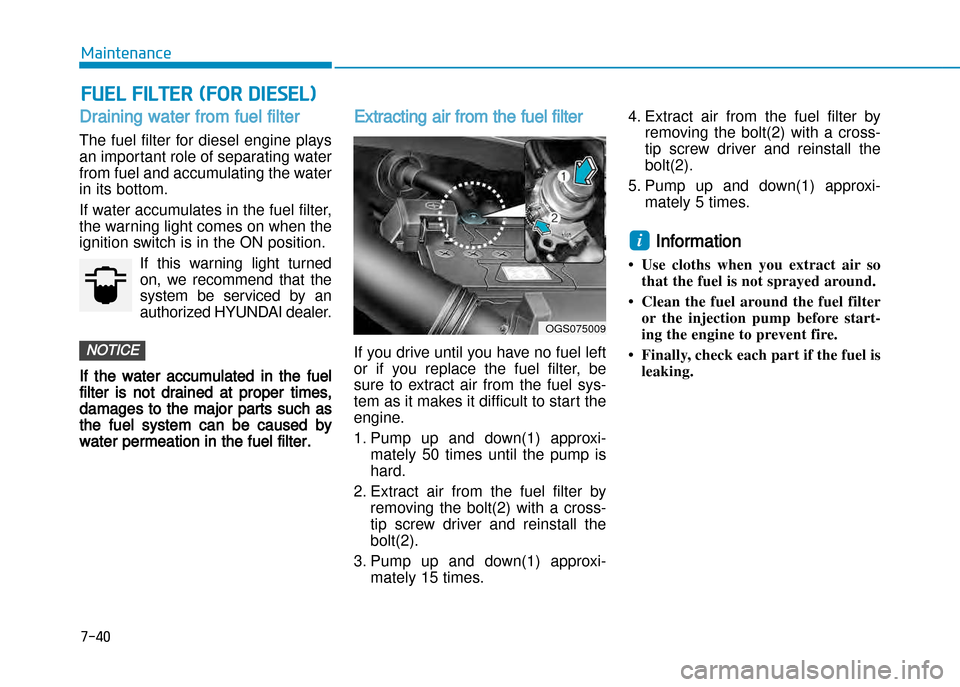
Extracting air from the fuel filter
If you drive until you have no fuel left
or if you replace the fuel filter, be
sure to extract air from the fuel sys
tem as it makes it difficult to start the
engine.
1. Pump up and down(1) approxi mately 50 times until the pump is
hard.
2. Extract air from the fuel filter by removing the bolt(2) with a cross
tip screw driver and reinstall thebolt(2).
3. Pump up and down(1) approxi mately 15 times. 4. Extract air from the fuel filter by
removing the bolt(2) with a cross
tip screw driver and reinstall thebolt(2).
5. Pump up and down(1) approxi mately 5 times.
Information
• Use cloths when you extract air so that the fuel is not sprayed around.
• Clean the fuel around the fuel filter or the injection pump before start
ing the engine to prevent fire.
• Finally, check each part if the fuel is leaking.i
NOTICE
OGS075009