manual transaxle Hyundai Elantra 2003 User Guide
[x] Cancel search | Manufacturer: HYUNDAI, Model Year: 2003, Model line: Elantra, Model: Hyundai Elantra 2003Pages: 172, PDF Size: 2.82 MB
Page 115 of 172
DRIVING YOUR HYUNDAI DRIVING YOUR HYUNDAIDRIVING YOUR HYUNDAI DRIVING YOUR HYUNDAI
DRIVING YOUR HYUNDAI
2- 1415. If you have to stop while going uphill, do not
hold the vehicle in place by pressing on the
accelerator. This can cause the automatic
transaxle to overheat. Use the parking brake
or footbrake.
NOTE: NOTE:NOTE: NOTE:
NOTE:When towing check transaxle fluid more fre- When towing check transaxle fluid more fre-When towing check transaxle fluid more fre- When towing check transaxle fluid more fre-
When towing check transaxle fluid more fre-
quently. quently.quently. quently.
quently.
CAUTION: CAUTION:CAUTION: CAUTION:
CAUTION:If overheating should occur when towing, If overheating should occur when towing,If overheating should occur when towing, If overheating should occur when towing,
If overheating should occur when towing,
(the temperature gauge reads near red zone), (the temperature gauge reads near red zone),(the temperature gauge reads near red zone), (the temperature gauge reads near red zone),
(the temperature gauge reads near red zone),
taking the following action may reduce or taking the following action may reduce ortaking the following action may reduce or taking the following action may reduce or
taking the following action may reduce or
eliminate the problem. eliminate the problem.eliminate the problem. eliminate the problem.
eliminate the problem.
1. 1.1. 1.
1.
Turn off the air conditioner. Turn off the air conditioner.Turn off the air conditioner. Turn off the air conditioner.
Turn off the air conditioner.
2. 2.2. 2.
2.
Reduce highway speed. Reduce highway speed.Reduce highway speed. Reduce highway speed.
Reduce highway speed.
3. 3.3. 3.
3.
Select a lower gear when going uphill. Select a lower gear when going uphill.Select a lower gear when going uphill. Select a lower gear when going uphill.
Select a lower gear when going uphill.
4. 4.4. 4.
4.
While in stop and go traffic, place the gear While in stop and go traffic, place the gearWhile in stop and go traffic, place the gear While in stop and go traffic, place the gear
While in stop and go traffic, place the gear
selector in park or neutral and idle the selector in park or neutral and idle theselector in park or neutral and idle the selector in park or neutral and idle the
selector in park or neutral and idle the
engine at a higher speed. engine at a higher speed.engine at a higher speed. engine at a higher speed.
engine at a higher speed. 7. The vehicle/trailer combination is more af-
fected by crosswind and buffeting.
When being passed by a large vehicle, keep
a constant speed and steer straight ahead. If
there is too much wind buffeting slow down to
get out of the other vehicle's air turbulence.
8. When parking your car and trailer, especially
on a hill, be sure to follow all the normal
precautions. Turn your front wheel into the
curb, set the parking brake firmly, and put the
transaxle in 1st or Reverse (manual) or Park
(automatic). In addition, place wheel chocks
at each of the trailer's tires.
9. If the trailer has electric brakes, start your
vehicle and trailer moving, and then apply the
trailer brake controller by hand to be sure the
brakes are working. This lets you check your
electrical connection at the same time.
10. During your trip, occasionally check to be
sure that the load is secure, and that the
lights and any trailer brakes are still working.
11. Avoid jerky starts, sudden acceleration or
sudden stops.
12. Avoid sharp turns and rapid lane changes.
13. Avoid holding the brake pedal down too long
or too frequently. This could cause the brakes
to overheat, resulting in reduced braking effi-
ciency.
14. When going down a hill, shift into a lower gear
and use the engine braking effect.
When ascending a long grade, downshift the
transaxle to a lower gear and reduce speed to
reduce chances of engine overloading and/or
overheating.
Page 117 of 172

WHAT TO DO IN AN EMERGENCY WHAT TO DO IN AN EMERGENCYWHAT TO DO IN AN EMERGENCY WHAT TO DO IN AN EMERGENCY
WHAT TO DO IN AN EMERGENCY
3-2
WARNING: WARNING:WARNING: WARNING:
WARNING:The gas produced by the battery during the The gas produced by the battery during theThe gas produced by the battery during the The gas produced by the battery during the
The gas produced by the battery during the
jump-start operation is highly explosive. If jump-start operation is highly explosive. Ifjump-start operation is highly explosive. If jump-start operation is highly explosive. If
jump-start operation is highly explosive. If
these instructions are not followed exactly, these instructions are not followed exactly,these instructions are not followed exactly, these instructions are not followed exactly,
these instructions are not followed exactly,
serious personal injury and damage to the serious personal injury and damage to theserious personal injury and damage to the serious personal injury and damage to the
serious personal injury and damage to the
vehicle may occur! If you are not sure how to vehicle may occur! If you are not sure how tovehicle may occur! If you are not sure how to vehicle may occur! If you are not sure how to
vehicle may occur! If you are not sure how to
follow this procedure, seek qualified assis- follow this procedure, seek qualified assis-follow this procedure, seek qualified assis- follow this procedure, seek qualified assis-
follow this procedure, seek qualified assis-
tance. Automobile batteries contain sulfuric tance. Automobile batteries contain sulfurictance. Automobile batteries contain sulfuric tance. Automobile batteries contain sulfuric
tance. Automobile batteries contain sulfuric
acid. This is poisonous and highly corrosive. acid. This is poisonous and highly corrosive.acid. This is poisonous and highly corrosive. acid. This is poisonous and highly corrosive.
acid. This is poisonous and highly corrosive.
When jump starting, wear protective glasses When jump starting, wear protective glassesWhen jump starting, wear protective glasses When jump starting, wear protective glasses
When jump starting, wear protective glasses
and be careful not to get acid on yourself, and be careful not to get acid on yourself,and be careful not to get acid on yourself, and be careful not to get acid on yourself,
and be careful not to get acid on yourself,
your clothing or on the car. your clothing or on the car.your clothing or on the car. your clothing or on the car.
your clothing or on the car.
o If you should accidentally get acid on your
skin or in your eyes, immediately remove any
contaminated clothing and flush the area with
clear water for at least 15 minutes. Then
promptly obtain medical attention. If you must
be transported to an emergency facility, con-
tinue to apply water to the affected area with
a sponge or cloth.
o The gas produced by the battery during the
jump-start operation is highly explosive. Do
not smoke or allow a spark or an open flame
in the vicinity.
o The battery being used to provide the jump
start must be 12-volt. If you cannot determine
that it is a 12-volt battery, do not attempt to
use it for the jump start.
o To jump start a car with a discharged battery,
follow this procedure exactly:1. If the booster battery is installed in another
vehicle, be sure the two vehicles are not
touching.
2. Turn off all unnecessary lights and acces-
sories in both vehicles.
3. Attach the clamps of the jumper cable in the
exact location shown in the illustration. First,
attach one clamp of the jumper cable to the
positive (+) post or cable of the discharged
battery. Then attach the other end of the
same cable to the positive (+) post or cable
of the booster battery. Next, using the other
cable, attach one clamp to the negative (-)
post or cable of the booster battery. Then
attach the other end of that cable to a solid
metal part of the engine away from the
battery. Do not connect the cable to any
moving part.
4. Start the engine in the car with the booster
battery and let it run for a few minutes. This
will help to assure that the booster battery is
fully charged. During the jumping operation,
run the engine in this vehicle at about 2,000
rpm.
5. Start the engine in the car with the discharged
battery using the normal starting procedure.
After the engine starts, leave the jumper
cables connected and let the engine run at
fast idle or about 2,000 rpm for several min-
utes.
6. Carefully remove the jumper cables in the
reverse order of attachment.
If you do not know why your battery became
discharged (because the lights were left on,
D030A01A-AAT
IF THE ENGINE OVERHEATS IF THE ENGINE OVERHEATSIF THE ENGINE OVERHEATS IF THE ENGINE OVERHEATS
IF THE ENGINE OVERHEATSIf your temperature gauge indicates overheating,
you experience a loss of power, or hear loud
pinging or knocking and the engine is probably
too hot. If this happens and, you should:
1. Pull off the road and stop as soon as it is safe
to do so.
2. Place the gear selector lever in "P" (auto-
matic), or neutral (manual transaxle) and set
the parking brake. If the air conditioning is on,
turn it off.
3. If engine coolant is running out under the car
or steam is coming out from the hood, stop
the engine. Do not open the hood until the
engine coolant has stopped running or the
steaming has stopped. If there is no visible
loss of engine coolant and no steam, leave
the engine running and check to be sure the
engine cooling fan is operating. If the fan is
not running, turn the engine off.
4. Check to see if the water pump drive belt is
missing. If it is not missing, check to see that
it is tight. If the drive belt seems to be satis-
factory, check for engine coolant leaking from
the radiator, hoses or under the car. (If the air
conditioning had been in use, it is normal for
cold water to be draining from it when you
stop).
etc.), have the charging system checked by your
Hyundai dealer.
Page 119 of 172
WHAT TO DO IN AN EMERGENCY WHAT TO DO IN AN EMERGENCYWHAT TO DO IN AN EMERGENCY WHAT TO DO IN AN EMERGENCY
WHAT TO DO IN AN EMERGENCY
3-4cause a loss of control. When the car has
slowed to such a speed that it is safe to do so,
brake carefully and pull off the road. Drive off
the road as far as possible and park on firm,
level ground. If you are on a divided highway,
do not park in the median area between the
two traffic lanes.
2. When the car is stopped, turn on your emer-
gency hazard flashers, set the parking brake
and put the transaxle in "P" (automatic) or
reverse (manual transaxle).
3. Have all passengers get out of the car. Be
sure they all get out on the side of the car that
is away from traffic.
4. Change the tire following the instructions pro-
vided on the following pages.
D060A01A-AAT
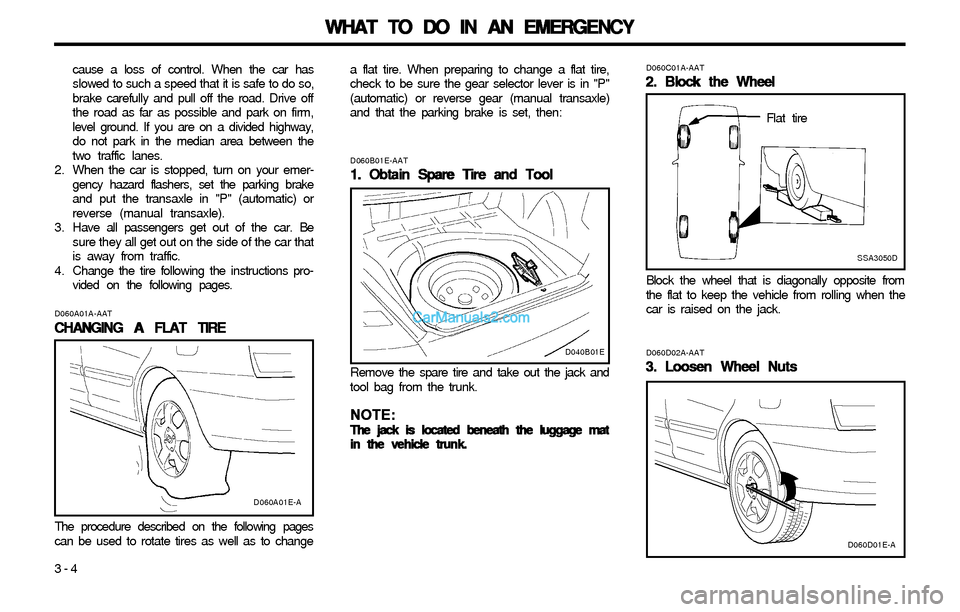
CHANGING A FLAT TIRE CHANGING A FLAT TIRECHANGING A FLAT TIRE CHANGING A FLAT TIRE
CHANGING A FLAT TIRE
The procedure described on the following pages
can be used to rotate tires as well as to changea flat tire. When preparing to change a flat tire,
check to be sure the gear selector lever is in "P"
(automatic) or reverse gear (manual transaxle)
and that the parking brake is set, then:
Remove the spare tire and take out the jack and
tool bag from the trunk.
NOTE: NOTE:NOTE: NOTE:
NOTE:The jack is located beneath the luggage mat The jack is located beneath the luggage matThe jack is located beneath the luggage mat The jack is located beneath the luggage mat
The jack is located beneath the luggage mat
in the vehicle trunk. in the vehicle trunk.in the vehicle trunk. in the vehicle trunk.
in the vehicle trunk.
D060B01E-AAT
1. Obtain Spare Tire and Tool 1. Obtain Spare Tire and Tool1. Obtain Spare Tire and Tool 1. Obtain Spare Tire and Tool
1. Obtain Spare Tire and Tool
D060C01A-AAT
2. Block the Wheel 2. Block the Wheel2. Block the Wheel 2. Block the Wheel
2. Block the Wheel
Block the wheel that is diagonally opposite from
the flat to keep the vehicle from rolling when the
car is raised on the jack.
Flat tire
SSA3050D
D060D02A-AAT
3. Loosen Wheel Nuts 3. Loosen Wheel Nuts3. Loosen Wheel Nuts 3. Loosen Wheel Nuts
3. Loosen Wheel Nuts
D060D01E-A
D060A01E-A
D040B01E
Page 122 of 172
WHAT TO DO IN AN EMERGENCY WHAT TO DO IN AN EMERGENCYWHAT TO DO IN AN EMERGENCY WHAT TO DO IN AN EMERGENCY
WHAT TO DO IN AN EMERGENCY
3-7
D060J01E-AAT
After Changing Wheels After Changing WheelsAfter Changing Wheels After Changing Wheels
After Changing Wheels
If you have a tire gauge, remove the valve cap
and check the air pressure. If the pressure is
lower than recommended, drive slowly to the
nearest service station and inflate to the correct
pressure. If it is too high, adjust it until it is correct.
Always reinstall the valve cap after checking or
adjusting tire pressure. If the cap is not replaced,
air may leak from the tire. If you lose a valve cap,
buy another and install it as soon as possible.
After you have changed wheels, always secure
the flat tire in its place in the trunk and return the
jack and tools to their proper storage locations.
D080A01A-AAT
IF YOUR CAR MUST BE TOWED IF YOUR CAR MUST BE TOWEDIF YOUR CAR MUST BE TOWED IF YOUR CAR MUST BE TOWED
IF YOUR CAR MUST BE TOWED
CAUTION: CAUTION:CAUTION: CAUTION:
CAUTION:
Your car can be damaged if towed incor- Your car can be damaged if towed incor-Your car can be damaged if towed incor- Your car can be damaged if towed incor-
Your car can be damaged if towed incor-
rectly! rectly!rectly! rectly!
rectly!
If your car has to be towed, it should be done by
your Hyundai dealer or a commercial tow truck
service. This will help assure that your car is not
damaged in towing. Also, professionals are gen-
erally aware of state and local laws governing
towing. In any case, rather than risk damage to
your car, it is suggested that you show this
information to the tow truck operator. Be sure that
a safety chain system is used and that all state
and local laws are observed.
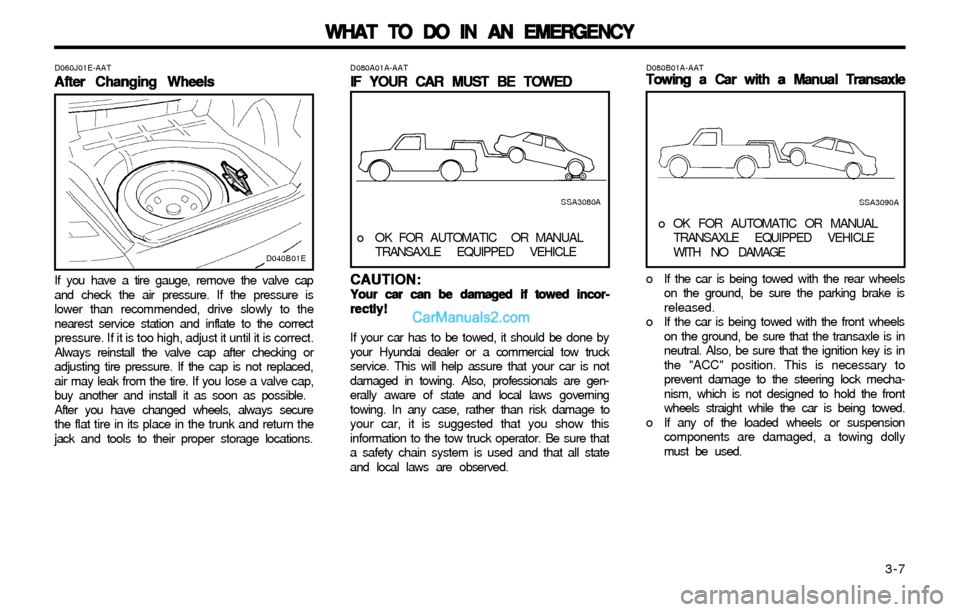
D080B01A-AATTowing a Car with a Manual Transaxle Towing a Car with a Manual TransaxleTowing a Car with a Manual Transaxle Towing a Car with a Manual Transaxle
Towing a Car with a Manual Transaxle
o If the car is being towed with the rear wheels
on the ground, be sure the parking brake is
released.
o If the car is being towed with the front wheels
on the ground, be sure that the transaxle is in
neutral. Also, be sure that the ignition key is in
the "ACC" position. This is necessary to
prevent damage to the steering lock mecha-
nism, which is not designed to hold the front
wheels straight while the car is being towed.
o If any of the loaded wheels or suspension
components are damaged, a towing dolly
must be used.
o OK FOR AUTOMATIC OR MANUAL
TRANSAXLE EQUIPPED VEHICLE
SSA3080A
o OK FOR AUTOMATIC OR MANUAL
TRANSAXLE EQUIPPED VEHICLE
WITH NO DAMAGE
SSA3090A
D040B01E
Page 123 of 172

WHAT TO DO IN AN EMERGENCY WHAT TO DO IN AN EMERGENCYWHAT TO DO IN AN EMERGENCY WHAT TO DO IN AN EMERGENCY
WHAT TO DO IN AN EMERGENCY
3-8
D080C02A-AATTowing a Car with an Automatic Towing a Car with an AutomaticTowing a Car with an Automatic Towing a Car with an Automatic
Towing a Car with an Automatic
Transaxle TransaxleTransaxle Transaxle
Transaxle
CAUTION: CAUTION:CAUTION: CAUTION:
CAUTION:
A car with an automatic transaxle should A car with an automatic transaxle shouldA car with an automatic transaxle should A car with an automatic transaxle should
A car with an automatic transaxle should
never be towed from the rear with the front never be towed from the rear with the frontnever be towed from the rear with the front never be towed from the rear with the front
never be towed from the rear with the front
wheels on the ground. This can cause seri- wheels on the ground. This can cause seri-wheels on the ground. This can cause seri- wheels on the ground. This can cause seri-
wheels on the ground. This can cause seri-
ous damage to the transaxle. If the car must ous damage to the transaxle. If the car mustous damage to the transaxle. If the car must ous damage to the transaxle. If the car must
ous damage to the transaxle. If the car must
be towed from the rear, a towing dolly must be towed from the rear, a towing dolly mustbe towed from the rear, a towing dolly must be towed from the rear, a towing dolly must
be towed from the rear, a towing dolly must
be used under the front wheels. be used under the front wheels.be used under the front wheels. be used under the front wheels.
be used under the front wheels.
If the car is being towed with the rear wheels on
the ground, be sure the parking brake is re-
leased.
o NOT OK FOR AUTOMATIC TRANSAXLE
EQUIPPED VEHICLE
o OK FOR MANUAL TRANSAXLE
SSA3100A o OK FOR AUTOMATIC OR MANUAL
TRANSAXLE EQUIPPED VEHICLE
SSA3101AD080D02A-AAT
Emergency Towing Emergency TowingEmergency Towing Emergency Towing
Emergency Towing
For emergency towing when no commercial tow
vehicle is available, attach a tow cable, chain or
strap to one of the tie-down hooks under the front
of your car. Do not attempt to tow your vehicle in
this manner on any unpaved surface. This could
result in serious damage to your car.
Nor should towing be attempted if the wheels,
drive train, axles, steering or brakes are dam-
aged. Before towing, be sure the transaxle is in
neutral and the key is in "ACC" (with the engine
off) or in the "ON" position (with the engine
running). A driver must be in the towed car to
steer it and operate the brakes.
D080D01ENOTE: NOTE:NOTE: NOTE:
NOTE:Before towing, check the level of the tran- Before towing, check the level of the tran-Before towing, check the level of the tran- Before towing, check the level of the tran-
Before towing, check the level of the tran-
saxle fluid. If it is below the "HOT" mark on saxle fluid. If it is below the "HOT" mark onsaxle fluid. If it is below the "HOT" mark on saxle fluid. If it is below the "HOT" mark on
saxle fluid. If it is below the "HOT" mark on
the dipstick, add fluid. If you cannot add fluid, the dipstick, add fluid. If you cannot add fluid,the dipstick, add fluid. If you cannot add fluid, the dipstick, add fluid. If you cannot add fluid,
the dipstick, add fluid. If you cannot add fluid,
a towing dolly must be used as described a towing dolly must be used as describeda towing dolly must be used as described a towing dolly must be used as described
a towing dolly must be used as described
above. above.above. above.
above.
Page 129 of 172

VEHICLE MAINTENANCE REQUIREMENTS VEHICLE MAINTENANCE REQUIREMENTSVEHICLE MAINTENANCE REQUIREMENTS VEHICLE MAINTENANCE REQUIREMENTS
VEHICLE MAINTENANCE REQUIREMENTS
5-1
F010C01A-AAT
Specified Scheduled Procedures Specified Scheduled ProceduresSpecified Scheduled Procedures Specified Scheduled Procedures
Specified Scheduled ProceduresThese are the procedures such as inspec-
tions, adjustments and replacements that are
listed in the maintenance charts starting on
page 5-3. These procedures must be per-
formed at the intervals shown in the mainte-
nance schedule to assure that your warranty
remains in effect. Although it is strongly rec-
ommended that they be performed by the
trained technicians at your Hyundai dealer,
these procedures may be performed at any
qualified service facility.
It is suggested that genuine Hyundai service
parts be used for any required repairs or
replacements. Other parts of equivalent qual-
ity such as engine oil, engine coolant, manual
or auto transaxle oil, brake fluid and so on
which are not supplied by Hyundai Motor
Company or its distributor may be used with-
out affecting your warranty coverage but you
should always be sure these are equivalent to
the quality of the original Hyundai parts. Your
Owner's Handbook provides further informa-
tion about your warranty coverage.
5. 5.5. 5.
5.
VEHICLE VEHICLEVEHICLE VEHICLE
VEHICLE
MAINTENANCE MAINTENANCEMAINTENANCE MAINTENANCE
MAINTENANCE
REQUIREMENTS REQUIREMENTSREQUIREMENTS REQUIREMENTS
REQUIREMENTSF010E01A-AAT
Do-It-Yourself Maintenance Do-It-Yourself MaintenanceDo-It-Yourself Maintenance Do-It-Yourself Maintenance
Do-It-Yourself MaintenanceIf you are mechanically inclined, own a few tools
that are required and want to take the time to do
so, you can inspect and service a number of
items. For more information about doing it
yourself, see Section 6.
F010D01A-AAT
General Checks General ChecksGeneral Checks General Checks
General ChecksThese are the regular checks you should
perform when you drive your Hyundai or you
fill the fuel tank. A list of these items will be
found on page 6-3.
F010A01A-AAT
MAINTENANCE INTERVALS MAINTENANCE INTERVALSMAINTENANCE INTERVALS MAINTENANCE INTERVALS
MAINTENANCE INTERVALS
Service Requirements Service RequirementsService Requirements Service Requirements
Service Requirements
To ensure that you receive the greatest num-
ber of miles of satisfying operation from your
Hyundai, certain maintenance procedures
must be performed. Although careful design
and engineering have reduced these to a
minimum, those that are required are of the
utmost importance.
It is your responsibility to have these mainte-
nance procedures performed to comply with
the terms of the warranties covering your new
Hyundai. The Owner's Handbook supplied
with your new vehicle provides further infor-
mation about these warranties.
F010B01A-AAT
Maintenance Requirements Maintenance RequirementsMaintenance Requirements Maintenance Requirements
Maintenance RequirementsThe maintenance required for your Hyundai
can be divided into three main areas:
o Specified scheduled procedures
o General checks
o Do-it-yourself maintenance
F010F01A-AAT
A Few Tips A Few TipsA Few Tips A Few Tips
A Few Tipso Whenever you have your Hyundai ser-
viced, keep copies of the service records
in your glovebox. This will help assure you
can document the required procedures
being performed to keep your warranties
in effect. This is especially important when
service is not performed by an authorized
Hyundai dealer.
o If you choose to do your own maintenance
and repairs, you may find it helpful to have
an official Hyundai Shop Manual. A copy of
this publication may be purchased at your
Hyundai dealer's parts department.
5 55 5
5
Page 132 of 172
VEHICLE MAINTENANCE REQUIREMENTS VEHICLE MAINTENANCE REQUIREMENTSVEHICLE MAINTENANCE REQUIREMENTS VEHICLE MAINTENANCE REQUIREMENTS
VEHICLE MAINTENANCE REQUIREMENTS
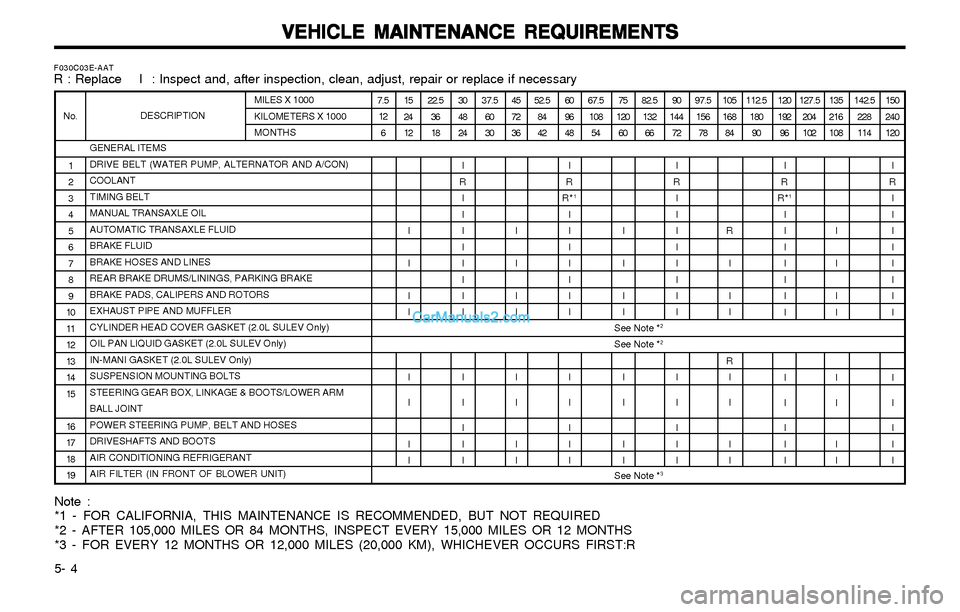
5- 4 Note :
*1 - FOR CALIFORNIA, THIS MAINTENANCE IS RECOMMENDED, BUT NOT REQUIRED
*2 - AFTER 105,000 MILES OR 84 MONTHS, INSPECT EVERY 15,000 MILES OR 12 MONTHS
*3 - FOR EVERY 12 MONTHS OR 12,000 MILES (20,000 KM), WHICHEVER OCCURS FIRST:R
See Note *3
F030C03E-AATR : Replace I : Inspect and, after inspection, clean, adjust, repair or replace if necessary
GENERAL ITEMS
DRIVE BELT (WATER PUMP, ALTERNATOR AND A/CON)
COOLANT
TIMING BELT
MANUAL TRANSAXLE OIL
AUTOMATIC TRANSAXLE FLUID
BRAKE FLUID
BRAKE HOSES AND LINES
REAR BRAKE DRUMS/LININGS, PARKING BRAKE
BRAKE PADS, CALIPERS AND ROTORS
EXHAUST PIPE AND MUFFLER
CYLINDER HEAD COVER GASKET (2.0L SULEV Only)
OIL PAN LIQUID GASKET (2.0L SULEV Only)
IN-MANI GASKET (2.0L SULEV Only)
SUSPENSION MOUNTING BOLTS
STEERING GEAR BOX, LINKAGE & BOOTS/LOWER ARM
BALL JOINT
POWER STEERING PUMP, BELT AND HOSES
DRIVESHAFTS AND BOOTS
AIR CONDITIONING REFRIGERANT
AIR FILTER (IN FRONT OF BLOWER UNIT) 1
2
3
4
5
6
7
8
9
10
11
12
13
14
15
16
17
18
19 No.DESCRIPTIONMILES X 1000
KILOMETERS X 1000
MONTHS7.5
12
615
24
12
I
I
I
I
I
I
I
I22.5
36
1830
48
24
I
R
I
I
I
I
I
I
I
I
I
I
I
I
I37.5
60
3045
72
36
I
I
I
I
I
I
I
I52.5
84
4260
96
48
I
R
R*
1
I
I
I
I
I
I
I
I
I
I
I
I67.5
108
5475
120
60
I
I
I
I
I
I
I
I82.5
132
6690
144
72
I
R
I
I
I
I
I
I
I
I
I
I
I
I
I97.5
156
78105
168
84
R
I
I
I
R
I
I
I
I112.5
180
90120
192
96
I
R
R*
1
I
I
I
I
I
I
I
I
I
I
I
I127.5
204
102135
216
108
I
I
I
I
I
I
I
I142.5
228
114150
240
120
I
R
I
I
I
I
I
I
I
I
I
I
I
I
I
See Note *2
See Note *2
Page 133 of 172
VEHICLE MAINTENANCE REQUIREMENTS VEHICLE MAINTENANCE REQUIREMENTSVEHICLE MAINTENANCE REQUIREMENTS VEHICLE MAINTENANCE REQUIREMENTS
VEHICLE MAINTENANCE REQUIREMENTS
5-5
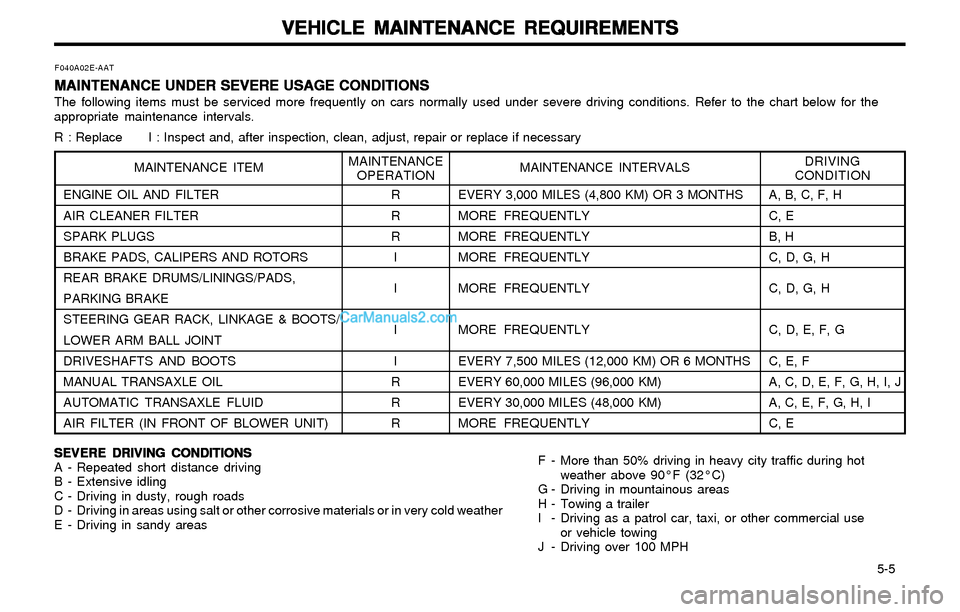
MAINTENANCE UNDER SEVERE USAGE CONDITIONS MAINTENANCE UNDER SEVERE USAGE CONDITIONSMAINTENANCE UNDER SEVERE USAGE CONDITIONS MAINTENANCE UNDER SEVERE USAGE CONDITIONS
MAINTENANCE UNDER SEVERE USAGE CONDITIONSThe following items must be serviced more frequently on cars normally used under severe driving conditions. Refer to the chart below for the
appropriate maintenance intervals.
R : Replace I : Inspect and, after inspection, clean, adjust, repair or replace if necessary
F040A02E-AAT
MAINTENANCE ITEM
F - More than 50% driving in heavy city traffic during hot
weather above 90°F (32°C)
G - Driving in mountainous areas
H - Towing a trailer
I - Driving as a patrol car, taxi, or other commercial use
or vehicle towing
J - Driving over 100 MPH SEVERE DRIVING CONDITIONS SEVERE DRIVING CONDITIONSSEVERE DRIVING CONDITIONS SEVERE DRIVING CONDITIONS
SEVERE DRIVING CONDITIONS
A - Repeated short distance driving
B - Extensive idling
C - Driving in dusty, rough roads
D - Driving in areas using salt or other corrosive materials or in very cold weather
E - Driving in sandy areasMAINTENANCE INTERVALS
ENGINE OIL AND FILTER
AIR CLEANER FILTER
SPARK PLUGS
BRAKE PADS, CALIPERS AND ROTORS
REAR BRAKE DRUMS/LININGS/PADS,
PARKING BRAKE
STEERING GEAR RACK, LINKAGE & BOOTS/
LOWER ARM BALL JOINT
DRIVESHAFTS AND BOOTS
MANUAL TRANSAXLE OIL
AUTOMATIC TRANSAXLE FLUID
AIR FILTER (IN FRONT OF BLOWER UNIT)R
R
R
I
I
I
I
R
R
REVERY 3,000 MILES (4,800 KM) OR 3 MONTHS
MORE FREQUENTLY
MORE FREQUENTLY
MORE FREQUENTLY
MORE FREQUENTLY
MORE FREQUENTLY
EVERY 7,500 MILES (12,000 KM) OR 6 MONTHS
EVERY 60,000 MILES (96,000 KM)
EVERY 30,000 MILES (48,000 KM)
MORE FREQUENTLY MAINTENANCE
OPERATION
A, B, C, F, H
C, E
B, H
C, D, G, H
C, D, G, H
C, D, E, F, G
C, E, F
A, C, D, E, F, G, H, I, J
A, C, E, F, G, H, I
C, EDRIVING
CONDITION
Page 135 of 172
VEHICLE MAINTENANCE REQUIREMENTS VEHICLE MAINTENANCE REQUIREMENTSVEHICLE MAINTENANCE REQUIREMENTS VEHICLE MAINTENANCE REQUIREMENTS
VEHICLE MAINTENANCE REQUIREMENTS
5-7
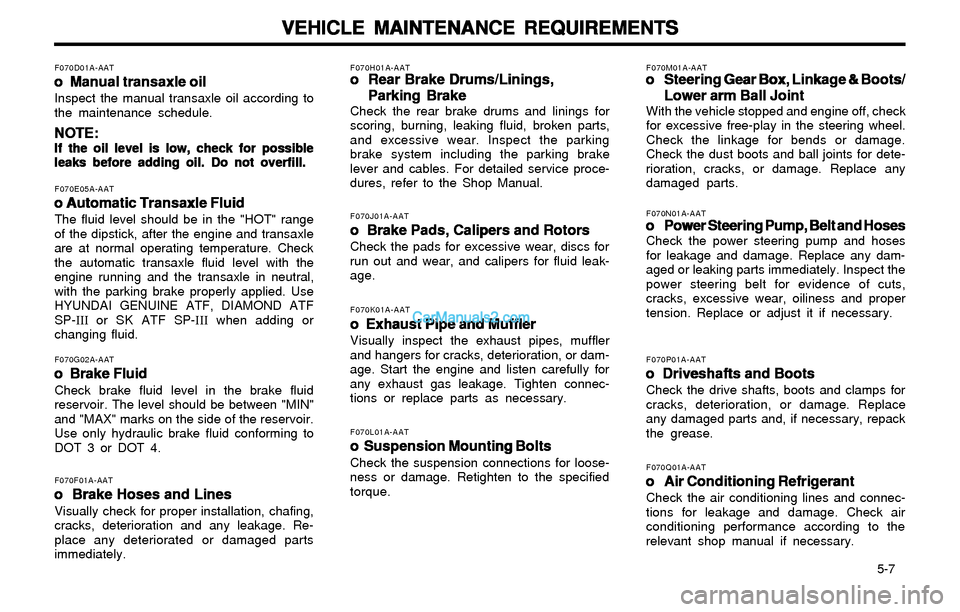
F070E05A-AAT
o Automatic Transaxle Fluid o Automatic Transaxle Fluido Automatic Transaxle Fluid o Automatic Transaxle Fluid
o Automatic Transaxle FluidThe fluid level should be in the "HOT" range
of the dipstick, after the engine and transaxle
are at normal operating temperature. Check
the automatic transaxle fluid level with the
engine running and the transaxle in neutral,
with the parking brake properly applied. Use
HYUNDAI GENUINE ATF, DIAMOND ATF
SP-III or SK ATF SP-III when adding or
changing fluid.
F070F01A-AAT
o oo o
o
Brake Hoses and Lines Brake Hoses and LinesBrake Hoses and Lines Brake Hoses and Lines
Brake Hoses and LinesVisually check for proper installation, chafing,
cracks, deterioration and any leakage. Re-
place any deteriorated or damaged parts
immediately.
F070G02A-AAT
o Brake Fluid o Brake Fluido Brake Fluid o Brake Fluid
o Brake FluidCheck brake fluid level in the brake fluid
reservoir. The level should be between "MIN"
and "MAX" marks on the side of the reservoir.
Use only hydraulic brake fluid conforming to
DOT 3 or DOT 4.
F070D01A-AAT
o Manual transaxle oil o Manual transaxle oilo Manual transaxle oil o Manual transaxle oil
o Manual transaxle oilInspect the manual transaxle oil according to
the maintenance schedule.
NOTE: NOTE:NOTE: NOTE:
NOTE:If the oil level is low, check for possible If the oil level is low, check for possibleIf the oil level is low, check for possible If the oil level is low, check for possible
If the oil level is low, check for possible
leaks before adding oil. Do not overfill. leaks before adding oil. Do not overfill.leaks before adding oil. Do not overfill. leaks before adding oil. Do not overfill.
leaks before adding oil. Do not overfill.
F070H01A-AATo oo o
o
Rear Brake Drums/Linings, Rear Brake Drums/Linings,Rear Brake Drums/Linings, Rear Brake Drums/Linings,
Rear Brake Drums/Linings,
Parking Brake Parking BrakeParking Brake Parking Brake
Parking Brake
Check the rear brake drums and linings for
scoring, burning, leaking fluid, broken parts,
and excessive wear. Inspect the parking
brake system including the parking brake
lever and cables. For detailed service proce-
dures, refer to the Shop Manual.
F070J01A-AAT
o Brake Pads, Calipers and Rotors o Brake Pads, Calipers and Rotorso Brake Pads, Calipers and Rotors o Brake Pads, Calipers and Rotors
o Brake Pads, Calipers and RotorsCheck the pads for excessive wear, discs for
run out and wear, and calipers for fluid leak-
age.
F070K01A-AAT
o Exhaust Pipe and Muffler o Exhaust Pipe and Mufflero Exhaust Pipe and Muffler o Exhaust Pipe and Muffler
o Exhaust Pipe and MufflerVisually inspect the exhaust pipes, muffler
and hangers for cracks, deterioration, or dam-
age. Start the engine and listen carefully for
any exhaust gas leakage. Tighten connec-
tions or replace parts as necessary.
F070L01A-AAT
o Suspension Mounting Bolts o Suspension Mounting Boltso Suspension Mounting Bolts o Suspension Mounting Bolts
o Suspension Mounting BoltsCheck the suspension connections for loose-
ness or damage. Retighten to the specified
torque.
F070N01A-AATo oo o
o
Power Steering Pump, Belt and Hoses Power Steering Pump, Belt and HosesPower Steering Pump, Belt and Hoses Power Steering Pump, Belt and Hoses
Power Steering Pump, Belt and HosesCheck the power steering pump and hoses
for leakage and damage. Replace any dam-
aged or leaking parts immediately. Inspect the
power steering belt for evidence of cuts,
cracks, excessive wear, oiliness and proper
tension. Replace or adjust it if necessary.
F070P01A-AAT
o Driveshafts and Boots o Driveshafts and Bootso Driveshafts and Boots o Driveshafts and Boots
o Driveshafts and BootsCheck the drive shafts, boots and clamps for
cracks, deterioration, or damage. Replace
any damaged parts and, if necessary, repack
the grease.
F070Q01A-AAT
o oo o
o
Air Conditioning Refrigerant Air Conditioning RefrigerantAir Conditioning Refrigerant Air Conditioning Refrigerant
Air Conditioning RefrigerantCheck the air conditioning lines and connec-
tions for leakage and damage. Check air
conditioning performance according to the
relevant shop manual if necessary.
F070M01A-AATo oo o
o
Steering Gear Box, Linkage & Boots/ Steering Gear Box, Linkage & Boots/Steering Gear Box, Linkage & Boots/ Steering Gear Box, Linkage & Boots/
Steering Gear Box, Linkage & Boots/
Lower arm Ball Joint Lower arm Ball JointLower arm Ball Joint Lower arm Ball Joint
Lower arm Ball Joint
With the vehicle stopped and engine off, check
for excessive free-play in the steering wheel.
Check the linkage for bends or damage.
Check the dust boots and ball joints for dete-
rioration, cracks, or damage. Replace any
damaged parts.
Page 139 of 172
DO-IT-YOURSELF MAINTENANCE DO-IT-YOURSELF MAINTENANCEDO-IT-YOURSELF MAINTENANCE DO-IT-YOURSELF MAINTENANCE
DO-IT-YOURSELF MAINTENANCE
6-3
G020B01A-AAT
Vehicle Exterior Vehicle ExteriorVehicle Exterior Vehicle Exterior
Vehicle ExteriorThe following should be checked monthly:
o Overall appearance and condition
o Wheel condition and wheel nut torque
o Exhaust system condition
o Light condition and operation
o Windshield glass condition
o Wiper blade condition
o Paint condition and body corrosion
o Fluid leaks
o Door and hood lock condition
o Tire pressure and condition (including spare
tire)
G020C01A-AAT
Vehicle Interior Vehicle InteriorVehicle Interior Vehicle Interior
Vehicle InteriorThe following should be checked each time
when the vehicle is driven:
o Lights operation
o Windshield wiper operation
o Horn operation
o Defroster, heating system operation (and air
conditioning, if installed)
o Steering operation and condition
o Mirror condition and operation
o Turn signal operation
o Accelerator pedal operation
o Brake operation, including parking brake
o Manual transaxle operation, including clutch
operation
o Automatic transaxle operation, including
"Park" mechanism operation
o Seat control condition and operation
o Seat belt condition and operation
o Sunvisor operation
If you notice anything that does not operate
correctly or appears to be functioning incorrect-
ly, inspect it carefully and seek assistance from
your Hyundai dealer if service is needed.
G030A01A-AAT
CHECKING THE ENGINE OIL CHECKING THE ENGINE OILCHECKING THE ENGINE OIL CHECKING THE ENGINE OIL
CHECKING THE ENGINE OILEngine oil is essential to the performance and
service of the engine. It is suggested that you
check the oil level at least once a week in
normal use and more often if you are on a trip
or driving in severe conditions.
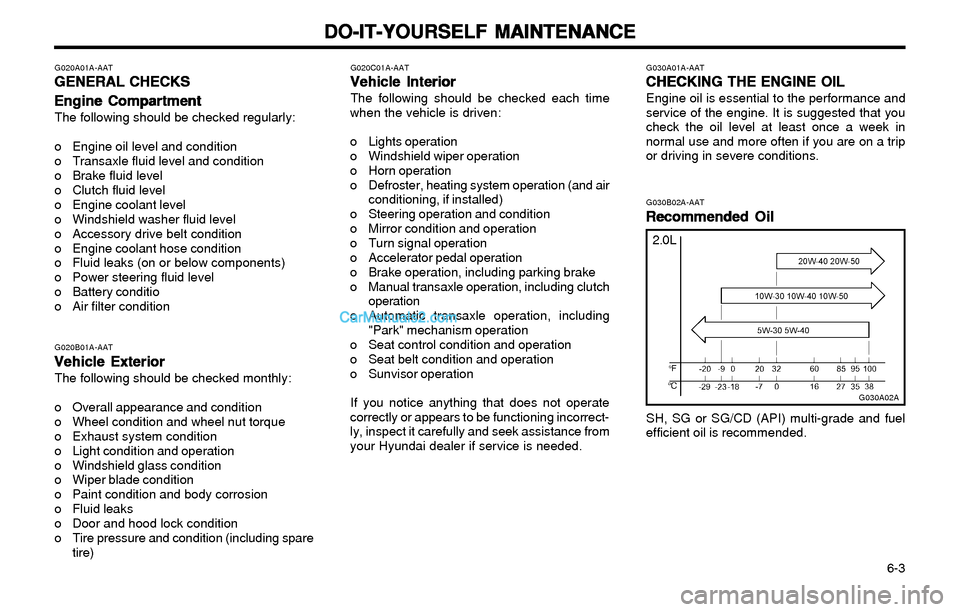
G030B02A-AAT
Recommended Oil Recommended OilRecommended Oil Recommended Oil
Recommended Oil
G030A02A
2.0L
SH, SG or SG/CD (API) multi-grade and fuel
efficient oil is recommended.
G020A01A-AAT
GENERAL CHECKS GENERAL CHECKSGENERAL CHECKS GENERAL CHECKS
GENERAL CHECKS
Engine Compartment Engine CompartmentEngine Compartment Engine Compartment
Engine Compartment
The following should be checked regularly:
o Engine oil level and condition
o Transaxle fluid level and condition
o Brake fluid level
o Clutch fluid level
o Engine coolant level
o Windshield washer fluid level
o Accessory drive belt condition
o Engine coolant hose condition
o Fluid leaks (on or below components)
o Power steering fluid level
o Battery conditio
o Air filter condition