Tires and wheels Hyundai Elantra 2006 Owner's Manual
[x] Cancel search | Manufacturer: HYUNDAI, Model Year: 2006, Model line: Elantra, Model: Hyundai Elantra 2006Pages: 277, PDF Size: 10.18 MB
Page 171 of 277

2 DRIVING YOUR HYUNDAI
18
components. In addition, driving with your foot resting on the brake pedalmay cause the brakes to overheat, which reduces their effectiveness and may lead to more serious con-sequences.
o Take care of your tires. Keep them
inflated to the recommended pres-sure. Incorrect inflation, either too much or too little, results in unnec- essary tire wear. Check the tire pres-sures at least once a month.
o Be sure that the wheels are aligned
correctly. Improper alignment canresult from hitting curbs or driving too fast over irregular surfaces. Poor alignment causes faster tire wearand may also result in other prob- lems as well as greater fuel con- sumption.
o Keep your car in good condition. For better fuel economy and reducedmaintenance costs, maintain yourcar in accordance with the mainte- nance schedule in Section 5. If you drive your car in severe conditions,more frequent maintenance is re- quired (see Section 5 for details). o Keep your car clean. For maximum
service, your Hyundai should be kept clean and free of corrosive materials. It is especially important that mud, dirt, ice, etc. not be al-lowed to accumulate on the under- side of the car. This extra weight can result in increased fuel con-sumption and also contribute to cor- rosion.
o Travel lightly. Don't carry unneces- sary weight in your car. Weight re-duces fuel economy.
o Don't let the engine idle longer than necessary. If you are waiting (andnot in traffic), turn off your engine and restart only when you're readyto go.
o Remember, your Hyundai does not
require extended warm-up. As soonas the engine is running smoothly, you can drive away. In very cold weather, however, give your enginea slightly longer warm-up period.
o Don't "lug" or "over-rev" the engine.
Lugging is driving too slowly in toohigh a gear resulting in the engine bucking. If this happens, shift to a lower gear. Over-revving is racingthe engine beyond its safe limit. This can be avoided by shifting atthe recommended speeds.
o Use your air conditioning sparingly. The air conditioning system is oper-ated by engine power so your fueleconomy is reduced when you use it.
Page 174 of 277

2
DRIVING YOUR HYUNDAI
21
C160I01A-AAT Don't Let Your Parking Brake Freeze Under some conditions your parking brake can freeze in the engaged posi-tion. This is most likely to happen when there is an accumulation of snow or ice around or near the rear brakes orif the brakes are wet. If there is a risk the parking brake may freeze, apply it only temporarily while you put the gearselector lever in "P" (automatic) or in first or reverse gear (manual transaxle) and block the rear wheels so the carcannot roll. Then release the parking brake. C160J01A-AAT Don't Let Ice and Snow Accumu- late Underneath Under some conditions, snow and ice can build up under the fenders andinterfere with the steering. When driv- ing in severe winter conditions where this may happen, you should periodi-cally check underneath the car to be sure the movement of the front wheels and the steering components is notobstructed. C160K01A-AAT Carry Emergency Equipment Depending on the severity of the weather where you drive your car, you should carry appropriate emergency equipment. Some of the items youmay want to carry include tire chains, tow straps or chains, flashlight, emer- gency flares, sand, a shovel, jumpercables, a window scraper, gloves, ground cloth, coveralls, a blanket, etc. C170A01A-AAT HIGHER SPEED MOTORING Pre-Trip Inspections 1. Tires: Adjust the tire inflation pressures tospecification. Low tire inflation pres- sures will result in overheating and possible failure of the tires.Avoid using worn or damaged tires which may result in reduced traction or tire failure. NOTE: Never exceed the maximum tire in- flation pressure shown on the tires. 2. Fuel, engine coolant and engine oil: High speed travel consumes more fuel than urban motoring. Do not forget tocheck both engine coolant and engine oil. 3. Drive belt: A loose or damaged drive belt may result in overheating of the engine.
Page 196 of 277

44CORROSION PREVENTION AND APPEARANCE CARE
4WASHING AND WAXING
E030A01A-AAT Washing Your Hyundai Never wash your car when the surface is hot from being in the sun. Alwayswash your car in the shade. Wash your car frequently. Dirt is abra- sive and can scratch the paint if it is not removed. Air pollution or acid rain may damage the paint and trim throughchemical action if pollutants are al- lowed to remain in contact with the surface. If you live near the ocean or inan area where road salts or dust con- trol chemicals are used, you should pay particular attention to the under-side of the car. Start by rinsing the car to remove dust and loose dirt. In win- ter, or if you have driven through mudor muddy water, be sure to thoroughly clean the underside as well. Use a hard direct stream of water to removeaccumulated mud or corrosive materi- als. Use a good quality car-washing solution and follow the manufacturer'sdirections on the package. These are available at your Hyundai dealer or auto parts outlet. Don't use strong house-hold detergents, gasoline, strong sol- vents or abrasive cleaning powders asthese may damage the finish.Use a clean sponge or cloth, rinse it frequently and don't damage the finish by rubbing too hard. For stubborn spots,dampen them frequently and remove them a little at a time. To clean whitewall tires, use a stiffbrush or soapy steel-wool scouring pad. To clean plastic wheel covers, use aclean sponge or soft cloth and water. To clean cast aluminum alloy wheels, use a mild soap or neutral detergent. Do not use abrasive cleaners. Protect the bare-metal surfaces by cleaning,polishing and waxing. Because alumi- num is subject to corrosion, be sure to give aluminum alloy wheels specialattention in winter. If you drive on salted roads, clean the wheels thor- oughly afterwards. After washing, be sure to rinse thor- oughly. If soapy water dries on thefinish, streaking will result. When the weather is warm and the
humidity low, you may find it necessary to rinse each section immediately afterwashing to avoid streaking. After rinsing, dry the car using a damp chamois or soft, absorbent cloth. The reason for drying the car is to remove water from the car so it will dry withoutwater spots. Don't rub, this can dam- age the finish. If you find any nicks or scratches in the paint, use touch-up paint to cover them to prevent corrosion. To protectthe paintwork of the car against corro- sion, you must clean your Hyundai (at least once a month). Give special at-tention to the removal of salt, mud and other substances on the underside of the splashboards of the car. Makesure that the outlets and the underside of the doors are open. Paint damage can be caused by small accumulationof tar, industrial precipitation, tree resin, insects and bird droppings, when not removed immediately. If water alone isnot strong enough to remove the accu- mulated dirt, use a mild car washing solution. Be sure to rinse the surface
Page 265 of 277
8CONSUMER INFORMATION
4
!
I050A02E-GAT TIRE CHAINS Tire chains, if necessary should be installed on the front wheels. Be sure that the chains are installed in accor- dance with the manufacturer's instruc-tions.To minimize tire and chain wear, donot continue to use tire chains when they are no longer needed.
WARNING:
o When driving on roads covered with snow or ice, drive at less than 30 km/h (20 mph).
o Use the SAE "S" class or wire &
plastic chains.
o If you have noise caused by chains contacting the body, re-tighten the chain to avoid con- tact with the vehicle body.
o To prevent body damage, re- tighten the chains after driving0.5 ~ 1 km.
I040A01S-GAT SNOW TIRES If you equip your car with snow tires, they should be the same size and have the same load capacity as the original tires. Snow tires should beinstalled on all four wheels; other- wise, poor handling may result. Snow tires should carry 28 kPa (4 psi) more air pressure than the pres- sure recommended for the standardtires on the tire label on, or up to the maximum pressure shown on the tire sidewall whichever is less. Do not drive faster than 120 km/h (75 mph) when your car is equipped with snow tires.
CAUTION:
Always observe the following:
o Check pressures when the tires are cold. That is, after the car has been parked for at least three hours and hasn't been drivenmore than 1.6 km or one mile since starting up.
o Check the pressure of your spare tire each time you check the pressure of other tires.
!
Page 266 of 277
8
CONSUMER INFORMATION
5
!
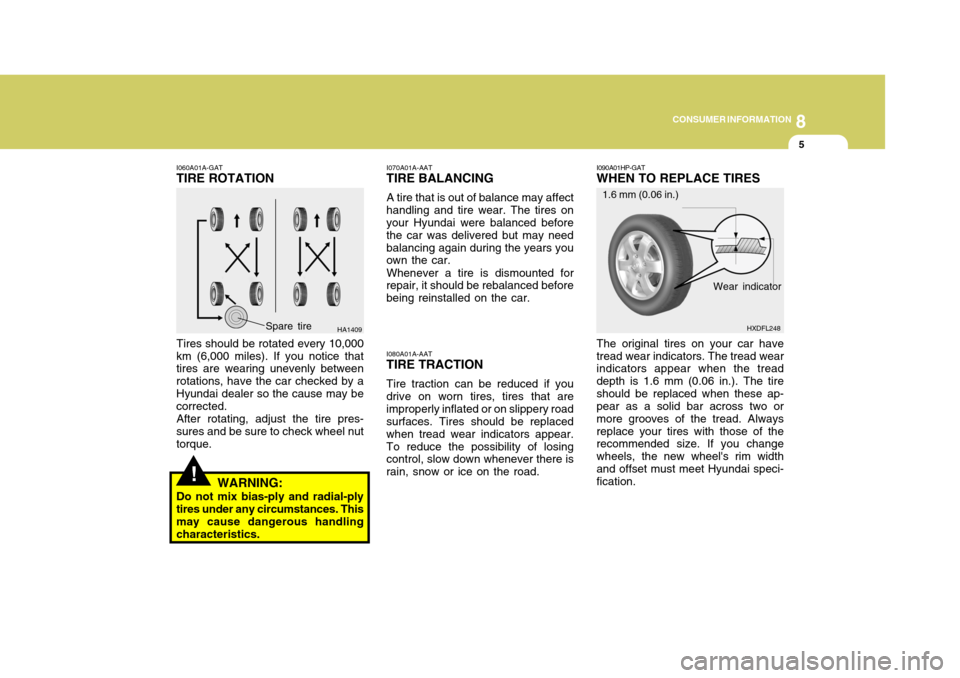
I060A01A-GAT TIRE ROTATION
Tires should be rotated every 10,000
km (6,000 miles). If you notice that tires are wearing unevenly between rotations, have the car checked by aHyundai dealer so the cause may be corrected.
After rotating, adjust the tire pres-
sures and be sure to check wheel nut torque. HA1409
Spare tire
WARNING:
Do not mix bias-ply and radial-ply tires under any circumstances. This may cause dangerous handlingcharacteristics. I070A01A-AAT
TIRE BALANCING
A tire that is out of balance may affect
handling and tire wear. The tires on your Hyundai were balanced before the car was delivered but may needbalancing again during the years you own the car.
Whenever a tire is dismounted for
repair, it should be rebalanced before being reinstalled on the car. I080A01A-AAT TIRE TRACTION Tire traction can be reduced if you drive on worn tires, tires that areimproperly inflated or on slippery road surfaces. Tires should be replaced when tread wear indicators appear.To reduce the possibility of losing control, slow down whenever there is rain, snow or ice on the road.
I090A01HP-GAT WHEN TO REPLACE TIRES
Wear indicator
1.6 mm (0.06 in.)
HXDFL248
The original tires on your car have tread wear indicators. The tread wear indicators appear when the tread depth is 1.6 mm (0.06 in.). The tireshould be replaced when these ap- pear as a solid bar across two or more grooves of the tread. Alwaysreplace your tires with those of the recommended size. If you change wheels, the new wheel's rim widthand offset must meet Hyundai speci- fication.