fuel cap Hyundai Elantra 2009 Инструкция по эксплуатации (in Russian)
[x] Cancel search | Manufacturer: HYUNDAI, Model Year: 2009, Model line: Elantra, Model: Hyundai Elantra 2009Pages: 308, PDF Size: 15.03 MB
Page 258 of 308
733
Maintenance
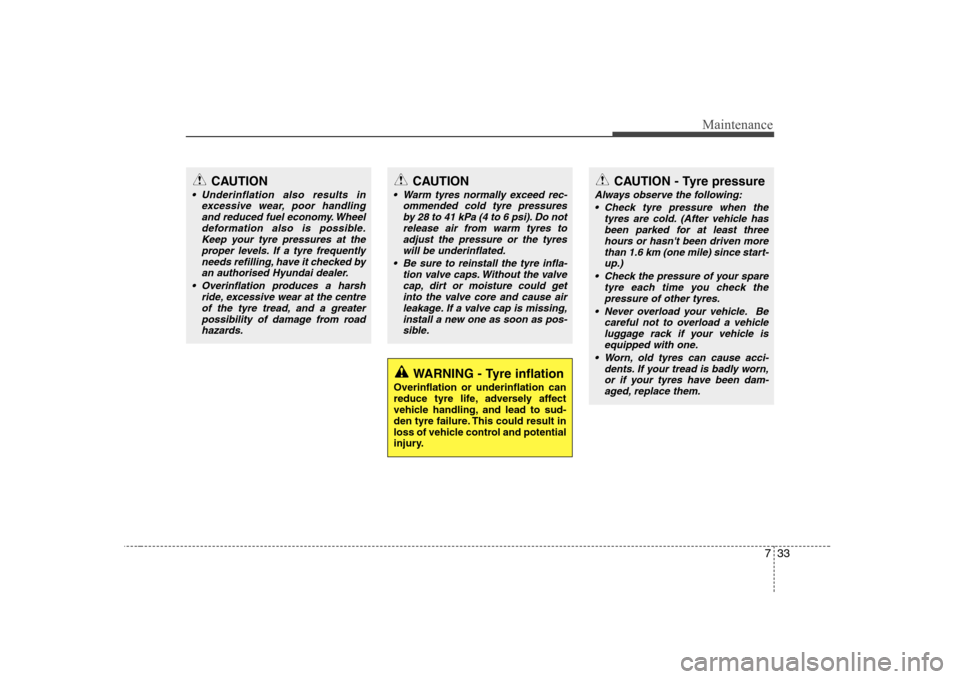
WARNING - Tyre inflation
Overinflation or underinflation can
reduce tyre life, adversely affect
vehicle handling, and lead to sud-
den tyre failure. This could result in
loss of vehicle control and potential
injury.
CAUTION - Tyre pressure
Always observe the following:
Check tyre pressure when the tyres are cold. (After vehicle hasbeen parked for at least threehours or hasn't been driven more
than 1.6 km (one mile) since start- up.)
Check the pressure of your spare tyre each time you check thepressure of other tyres.
Never overload your vehicle. Be careful not to overload a vehicleluggage rack if your vehicle is equipped with one.
Worn, old tyres can cause acci- dents. If your tread is badly worn,or if your tyres have been dam- aged, replace them.
CAUTION
Underinflation also results in
excessive wear, poor handlingand reduced fuel economy. Wheeldeformation also is possible.
Keep your tyre pressures at theproper levels. If a tyre frequentlyneeds refilling, have it checked byan authorised Hyundai dealer.
Overinflation produces a harsh ride, excessive wear at the centreof the tyre tread, and a greaterpossibility of damage from road
hazards.
CAUTION
Warm tyres normally exceed rec- ommended cold tyre pressuresby 28 to 41 kPa (4 to 6 psi). Do notrelease air from warm tyres to
adjust the pressure or the tyres will be underinflated.
Be sure to reinstall the tyre infla- tion valve caps. Without the valvecap, dirt or moisture could get
into the valve core and cause air leakage. If a valve cap is missing,install a new one as soon as pos-
sible.
Page 287 of 308
Maintenance
62
7
EMISSION CONTROL SYSTEM
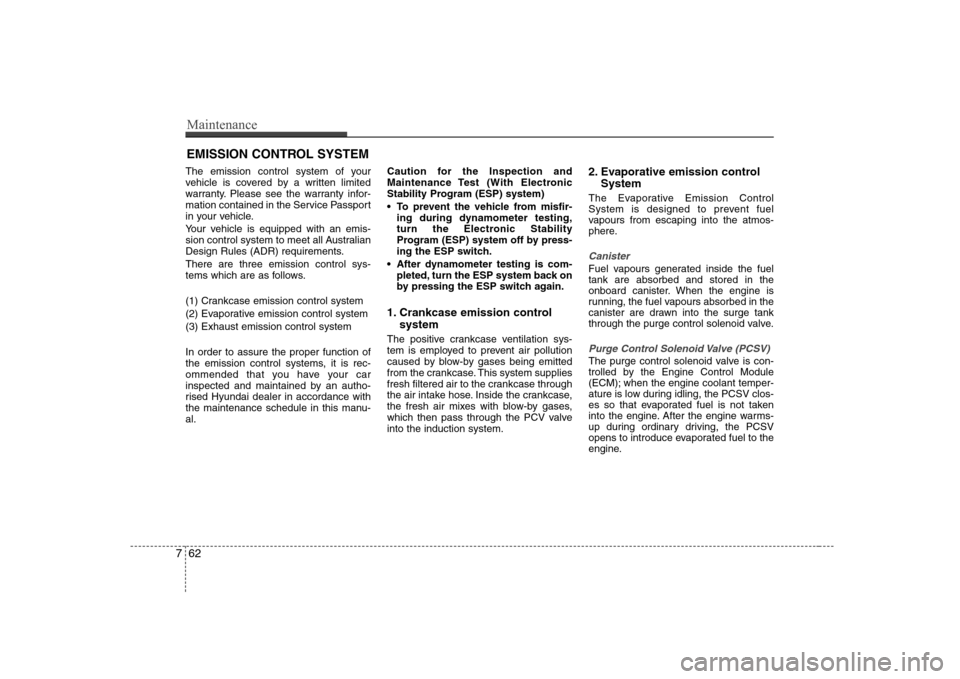
The emission control system of your
vehicle is covered by a written limited
warranty. Please see the warranty infor-
mation contained in the Service Passport
in your vehicle.
Your vehicle is equipped with an emis-
sion control system to meet all Australian
Design Rules (ADR) requirements. There are three emission control sys-
tems which are as follows.
(1) Crankcase emission control system
(2) Evaporative emission control system(3) Exhaust emission control system In order to assure the proper function of
the emission control systems, it is rec-
ommended that you have your car
inspected and maintained by an autho-
rised Hyundai dealer in accordance with
the maintenance schedule in this manu-al. Caution for the Inspection and
Maintenance Test (With Electronic
Stability Program (ESP) system)
To prevent the vehicle from misfir-
ing during dynamometer testing,
turn the Electronic Stability
Program (ESP) system off by press-
ing the ESP switch.
After dynamometer testing is com- pleted, turn the ESP system back on
by pressing the ESP switch again.
1. Crankcase emission control system
The positive crankcase ventilation sys-
tem is employed to prevent air pollution
caused by blow-by gases being emitted
from the crankcase. This system supplies
fresh filtered air to the crankcase through
the air intake hose. Inside the crankcase,
the fresh air mixes with blow-by gases,
which then pass through the PCV valveinto the induction system. 2. Evaporative emission control
System
The Evaporative Emission Control
System is designed to prevent fuel
vapours from escaping into the atmos-
phere.
Canister
Fuel vapours generated inside the fuel tank are absorbed and stored in the
onboard canister. When the engine is
running, the fuel vapours absorbed in the
canister are drawn into the surge tank
through the purge control solenoid valve.
Purge Control Solenoid Valve (PCSV)
The purge control solenoid valve is con-
trolled by the Engine Control Module
(ECM); when the engine coolant temper-
ature is low during idling, the PCSV clos-
es so that evaporated fuel is not taken
into the engine. After the engine warms-
up during ordinary driving, the PCSV
opens to introduce evaporated fuel to the
engine.
Page 293 of 308
Specifications & Consumer information
4
8
RECOMMENDED LUBRICANTS AND CAPACITIES
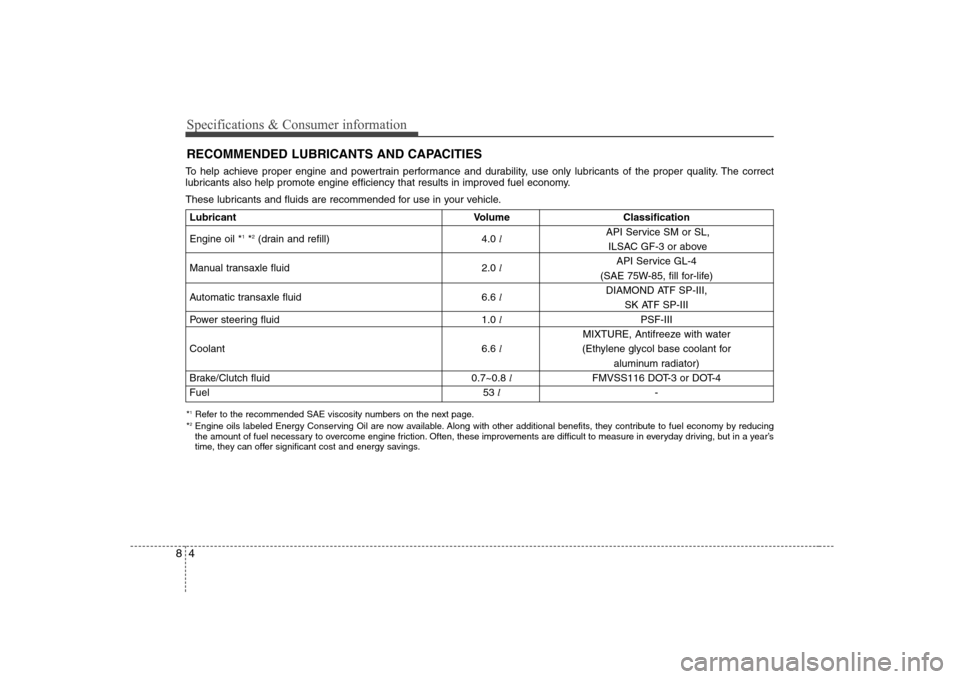
To help achieve proper engine and powertrain performance and durability, use only lubricants of the proper quality. The correct
lubricants also help promote engine efficiency that results in improved fuel economy.
These lubricants and fluids are recommended for use in your vehicle.
* 1
Refer to the recommended SAE viscosity numbers on the next page.
* 2
Engine oils labeled Energy Conserving Oil are now available. Along with other additional benefits, they contribute to fuel econo my by reducing
the amount of fuel necessary to overcome engine friction. Often, these improvements are difficult to measure in everyday driving, but in a year’s
time, they can offer significant cost and energy savings.
Lubricant Volume Classification
Engine oil * 1
*2
(drain and refill) 4.0 l
Manual transaxle fluid 2.0 l API Service GL-4
(SAE 75W-85, fill for-life)
Automatic transaxle fluid 6.6 l DIAMOND ATF SP-III,
SK ATF SP-III
Power steering fluid 1.0 l PSF-III
MIXTURE, Antifreeze with water
Coolant 6.6 l (Ethylene glycol base coolant for
aluminum radiator)
Brake/Clutch fluid 0.7~0.8 l FMVSS116 DOT-3 or DOT-4
Fuel 53 l -
API Service SM or SL,
ILSAC GF-3 or above