brake Hyundai Elantra 2009 Инструкция по эксплуатации (in Russian)
[x] Cancel search | Manufacturer: HYUNDAI, Model Year: 2009, Model line: Elantra, Model: Hyundai Elantra 2009Pages: 308, PDF Size: 15.03 MB
Page 244 of 308
719
Maintenance
BRAKE AND CLUTCH (IF EQUIPPED) FLUID
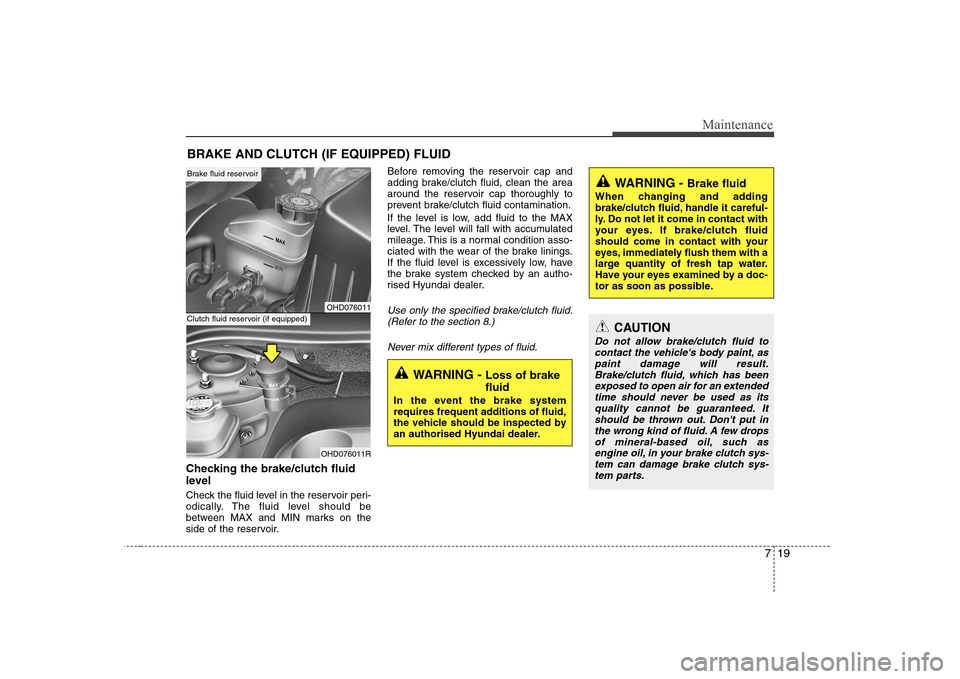
Checking the brake/clutch fluid
level
Check the fluid level in the reservoir peri-
odically. The fluid level should be
between MAX and MIN marks on the
side of the reservoir. Before removing the reservoir cap and
adding brake/clutch fluid, clean the area
around the reservoir cap thoroughly to
prevent brake/clutch fluid contamination.
If the level is low, add fluid to the MAX
level. The level will fall with accumulated
mileage. This is a normal condition asso-
ciated with the wear of the brake linings.
If the fluid level is excessively low, have
the brake system checked by an autho-
rised Hyundai dealer.
Use only the specified brake/clutch fluid.
(Refer to the section 8.)
Never mix different types of fluid.
WARNING - Brake fluid
When changing and adding
brake/clutch fluid, handle it careful-
ly. Do not let it come in contact with
your eyes. If brake/clutch fluid
should come in contact with your
eyes, immediately flush them with a
large quantity of fresh tap water.
Have your eyes examined by a doc-
tor as soon as possible.
WARNING - Loss of brake fluid
In the event the brake system
requires frequent additions of fluid,
the vehicle should be inspected by
an authorised Hyundai dealer.
CAUTION
Do not allow brake/clutch fluid to contact the vehicle's body paint, as paint damage will result.
Brake/clutch fluid, which has been exposed to open air for an extendedtime should never be used as itsquality cannot be guaranteed. Itshould be thrown out. Don't put in
the wrong kind of fluid. A few dropsof mineral-based oil, such as engine oil, in your brake clutch sys-tem can damage brake clutch sys-
tem parts.
OHD076011
OHD076011R
Brake fluid reservoir
Clutch fluid reservoir (if equipped)
Page 245 of 308
Maintenance
20
7
AUTOMATIC TRANSAXLE FLUID (IF EQUIPPED)
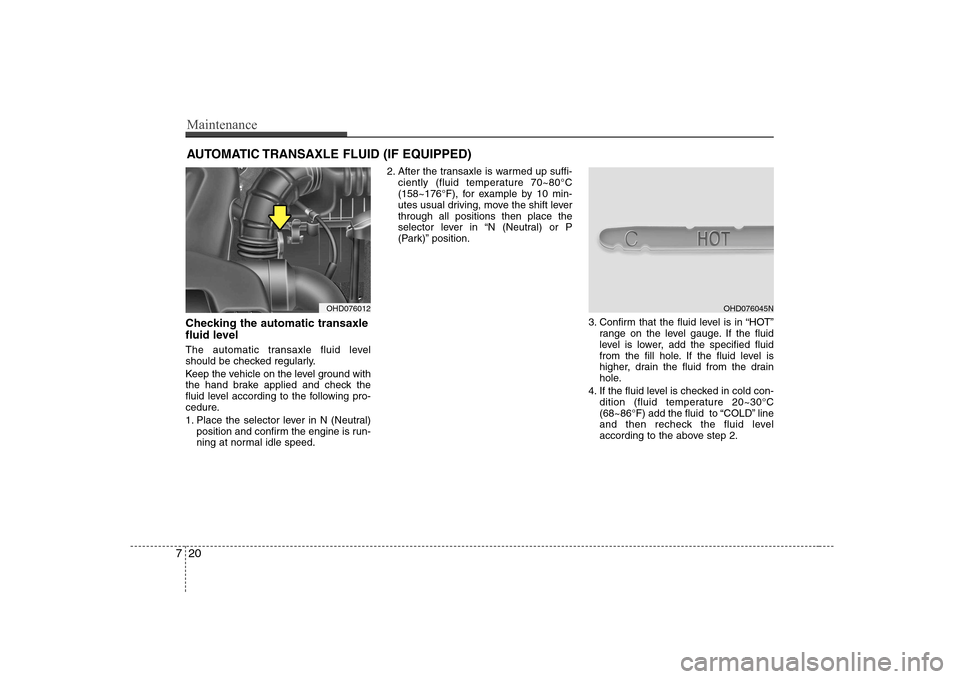
Checking the automatic transaxle
fluid level
The automatic transaxle fluid level
should be checked regularly.
Keep the vehicle on the level ground with
the hand brake applied and check the
fluid level according to the following pro-
cedure.
1. Place the selector lever in N (Neutral) position and confirm the engine is run-
ning at normal idle speed. 2. After the transaxle is warmed up suffi-
ciently (fluid temperature 70~80°C
(158~176°F), for example by 10 min-
utes usual driving, move the shift leverthrough all positions then place the
selector lever in “N (Neutral) or P
(Park)” position.
3. Confirm that the fluid level is in “HOT”range on the level gauge. If the fluid
level is lower, add the specified fluid
from the fill hole. If the fluid level is
higher, drain the fluid from the drain
hole.
4. If the fluid level is checked in cold con- dition (fluid temperature 20~30°C
(68~86°F) add the fluid to “COLD” line
and then recheck the fluid level
according to the above step 2.
OHD076012OHD076045N
Page 246 of 308

721
Maintenance
✽✽NOTICE
“COLD” scale is for reference only and
should NOT be used to determinetransaxle fluid level. ✽
✽
NOTICE
New automatic transaxle fluid should be
red. The red dye is added so the assem-bly plant can identify it as automatic
transaxle fluid and distinguish it from
engine oil or antifreeze. The red dye,
which is not an indicator of fluid quali-
ty, is not permanent. As the vehicle isdriven, the automatic transaxle fluid
will begin to look darker. The color may
eventually appear light brown.
Therefore, have an authorised Hyundai
dealer change the automatic transaxlefluid according to the ScheduledMaintenance at the beginning of thissection.
Use only the specified automatic
transaxle fluid. (Refer to the section 8.)
Changing the automatic transaxle fluid
Have automatic transaxle fluid changed
by an authorised Hyundai dealer accord-ing to the Maintenance Schedule at thebeginning of this section.
WARNING - Transaxle fluid
The transaxle fluid level should be
checked when the engine is at nor-
mal operating temperature. This
means that the engine, radiator,
radiator hose and exhaust system
etc., are very hot. Exercise great
care not to burn yourself during
this procedure.
WARNING - Hand brake
To avoid sudden movement of the
vehicle, apply hand brake and
depress the brake pedal before
moving the shift lever.
CAUTION
Low fluid level causes transaxle slippage. Overfilling can causefoaming, loss of fluid and transaxle malfunction.
The use of a non-specified fluid could result in transaxle malfunc-tion and failure.
Page 247 of 308
Maintenance
22
7
WASHER FLUID
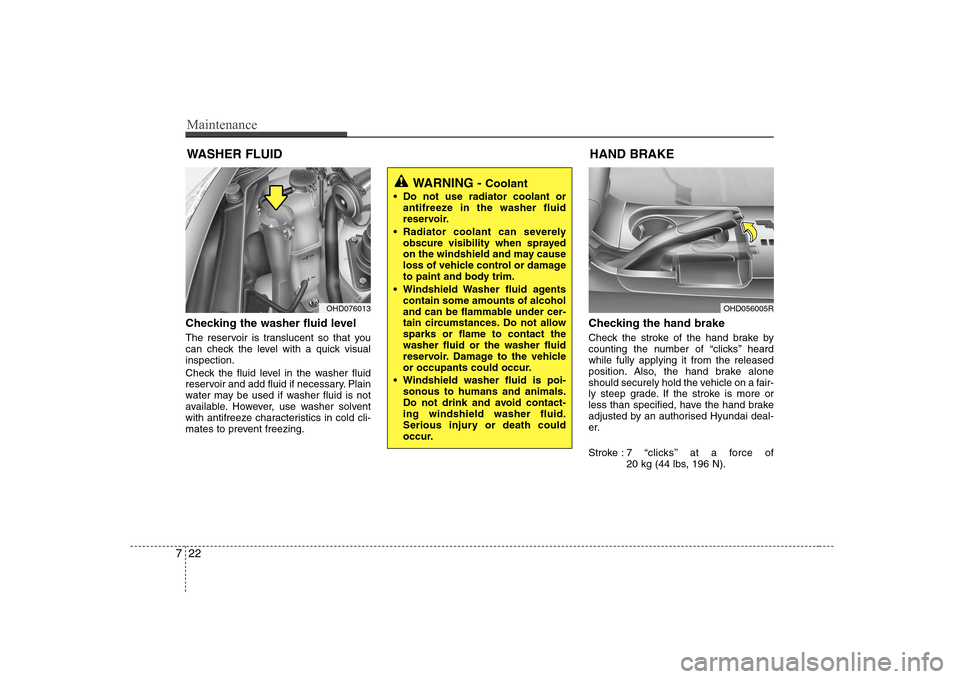
Checking the washer fluid level
The reservoir is translucent so that you
can check the level with a quick visualinspection.
Check the fluid level in the washer fluid
reservoir and add fluid if necessary. Plain
water may be used if washer fluid is not
available. However, use washer solvent
with antifreeze characteristics in cold cli-
mates to prevent freezing. Checking the hand brake
Check the stroke of the hand brake by
counting the number of “clicks’’ heardwhile fully applying it from the released
position. Also, the hand brake alone
should securely hold the vehicle on a fair-
ly steep grade. If the stroke is more or
less than specified, have the hand brake
adjusted by an authorised Hyundai deal-
er.
Stroke : 7
“clicks’’ at a force of
20 kg (44 lbs, 196 N).
WARNING - Coolant
Do not use radiator coolant or antifreeze in the washer fluid
reservoir.
Radiator coolant can severely obscure visibility when sprayed
on the windshield and may cause
loss of vehicle control or damage
to paint and body trim.
Windshield Washer fluid agents contain some amounts of alcohol
and can be flammable under cer-
tain circumstances. Do not allowsparks or flame to contact thewasher fluid or the washer fluid
reservoir. Damage to the vehicle
or occupants could occur.
Windshield washer fluid is poi- sonous to humans and animals.
Do not drink and avoid contact-ing windshield washer fluid.
Serious injury or death could
occur.
OHD076013OHD056005R
HAND BRAKE
Page 260 of 308
735
Maintenance
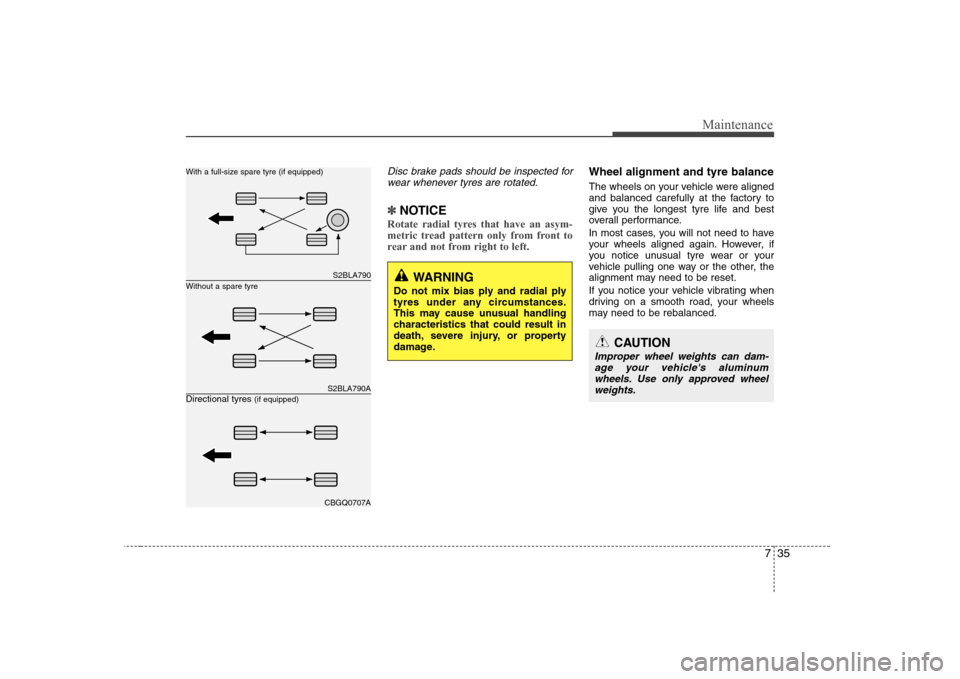
Disc brake pads should be inspected forwear whenever tyres are rotated.
✽✽NOTICE
Rotate radial tyres that have an asym-
metric tread pattern only from front to
rear and not from right to left.
Wheel alignment and tyre balance
The wheels on your vehicle were aligned
and balanced carefully at the factory to
give you the longest tyre life and best
overall performance.
In most cases, you will not need to have
your wheels aligned again. However, if
you notice unusual tyre wear or your
vehicle pulling one way or the other, the
alignment may need to be reset.
If you notice your vehicle vibrating when
driving on a smooth road, your wheels
may need to be rebalanced.
WARNING
Do not mix bias ply and radial ply
tyres under any circumstances.
This may cause unusual handling
characteristics that could result in
death, severe injury, or property
damage.S2BLA790
S2BLA790A
CBGQ0707A
Without a spare tyre
With a full-size spare tyre (if equipped) Directional tyres
(if equipped)
CAUTION
Improper wheel weights can dam-
age your vehicle's aluminumwheels. Use only approved wheel
weights.
Page 261 of 308
Maintenance
36
7
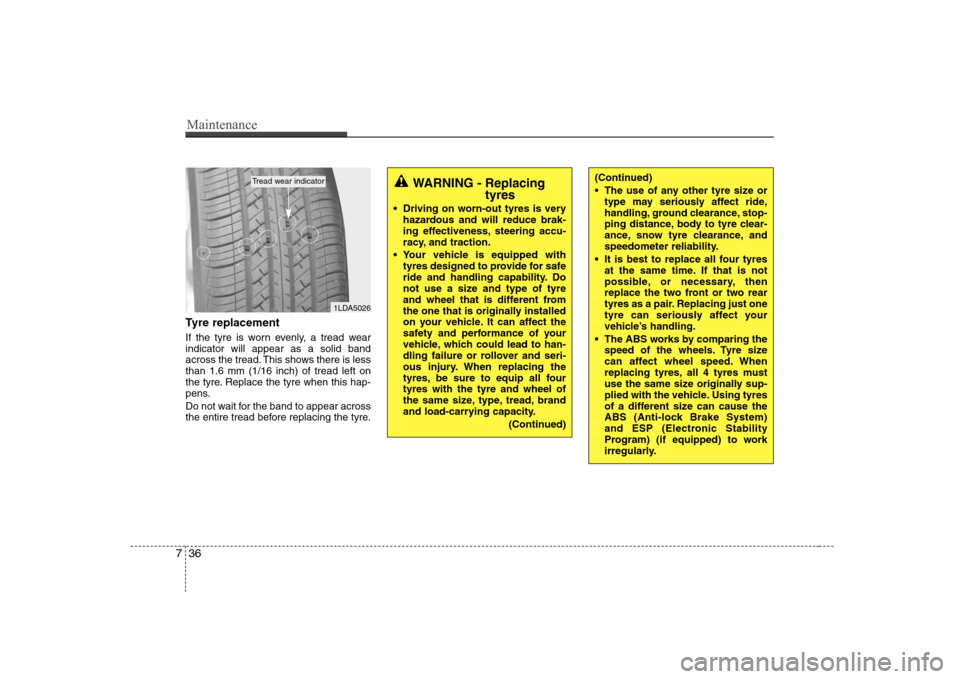
Tyre replacement
If the tyre is worn evenly, a tread wear indicator will appear as a solid band
across the tread. This shows there is lessthan 1.6 mm (1/16 inch) of tread left on
the tyre. Replace the tyre when this hap-
pens.
Do not wait for the band to appear across
the entire tread before replacing the tyre.
WARNING - Replacing
tyres
Driving on worn-out tyres is very hazardous and will reduce brak-
ing effectiveness, steering accu-
racy, and traction.
Your vehicle is equipped with tyres designed to provide for safe
ride and handling capability. Do
not use a size and type of tyre
and wheel that is different from
the one that is originally installed
on your vehicle. It can affect the
safety and performance of your
vehicle, which could lead to han-
dling failure or rollover and seri-
ous injury. When replacing the
tyres, be sure to equip all fourtyres with the tyre and wheel of
the same size, type, tread, brand
and load-carrying capacity.
(Continued)
1LDA5026
Tread wear indicator(Continued)
The use of any other tyre size ortype may seriously affect ride,
handling, ground clearance, stop-
ping distance, body to tyre clear-
ance, snow tyre clearance, and
speedometer reliability.
It is best to replace all four tyres at the same time. If that is not
possible, or necessary, then
replace the two front or two rear
tyres as a pair. Replacing just one
tyre can seriously affect your
vehicle’s handling.
The ABS works by comparing the speed of the wheels. Tyre size
can affect wheel speed. When
replacing tyres, all 4 tyres must
use the same size originally sup-
plied with the vehicle. Using tyres
of a different size can cause the
ABS (Anti-lock Brake System)
and ESP (Electronic Stability
Program) (if equipped) to work
irregularly.
Page 275 of 308
Maintenance
50
7
LIGHT BULBS
Use only the bulbs of the specified
wattage.
All bulbs are available from your Hyundaidealers Parts Department.
✽✽ NOTICE
After heavy, driving rain or washing, headlight and taillight lenses could
appear frosty. This condition is caused by
the temperature difference between the
lamp inside and outside. This is similar
to the condensation on your windows
inside your vehicle during the rain and
doesn’t indicate a problem with your
vehicle. If the water leaks into the lamp
bulb circuitry, have the vehicle checked
by an authorised Hyundai dealer.WARNING - Working on
the lights
Prior to working on the light, firmly
apply the hand brake, ensure that
the ignition switch is turned to the
“LOCK” position and turn off the
lights to avoid sudden movement
of the vehicle and burning your fin-
gers or receiving an electric shock.
CAUTION
Be sure to replace the burned-out bulb with one of the same wattage rating. Otherwise, it may cause
damage to the fuse or electricwiring system.
CAUTION
If you don’t have necessary tools,
the correct bulbs and the expertise,consult an authorised Hyundai dealer. In many cases, it is difficult
to replace vehicle light bulbsbecause other parts of the vehicle must be removed before you can get to the bulb. This is especially
true if you have to remove the head- light assembly to
get to the bulb(s).
Removing/installingthe headlight
assembly can result in damage to the vehicle.
Page 281 of 308
Maintenance
56
7
APPEARANCE CARE
Exterior care
Exterior general caution
It is very important to follow the label
directions when using any chemical
cleaner or polish. Read all warning andcaution statements that appear on thelabel.
Finish maintenance
Washing
To help protect your vehicle’s finish from
rust and deterioration, wash it thoroughlyand frequently at least once a month with
lukewarm or cold water.
If you use your vehicle for off-road driv-
ing, you should wash it after each off-
road trip. Pay special attention to the
removal of any accumulation of salt, dirt,
mud, and other foreign materials. Make
sure the drain holes in the lower edges of
the doors and rocker panels are keptclear and clean. Insects, tar, tree sap, bird droppings,
industrial pollution and similar deposits
can damage your vehicle’s finish if not
removed immediately.
Even prompt washing with plain water
may not completely remove all these
deposits. A mild soap, safe for use on
painted surfaces, may be used.
After washing, rinse the vehicle thor-
oughly with lukewarm or cold water. Do
not allow soap to dry on the finish.
WARNING -
Wet brakes
After washing the vehicle, test the
brakes while driving slowly to see if
they have been affected by water. If
braking performance is impaired,
dry the brakes by applying them
lightly while maintaining a slow for-
ward speed.
CAUTION
Do not use strong soap, chemical detergents or hot water, and do not
wash the vehicle in direct sunlight or when the body of the vehicle is warm.CAUTION
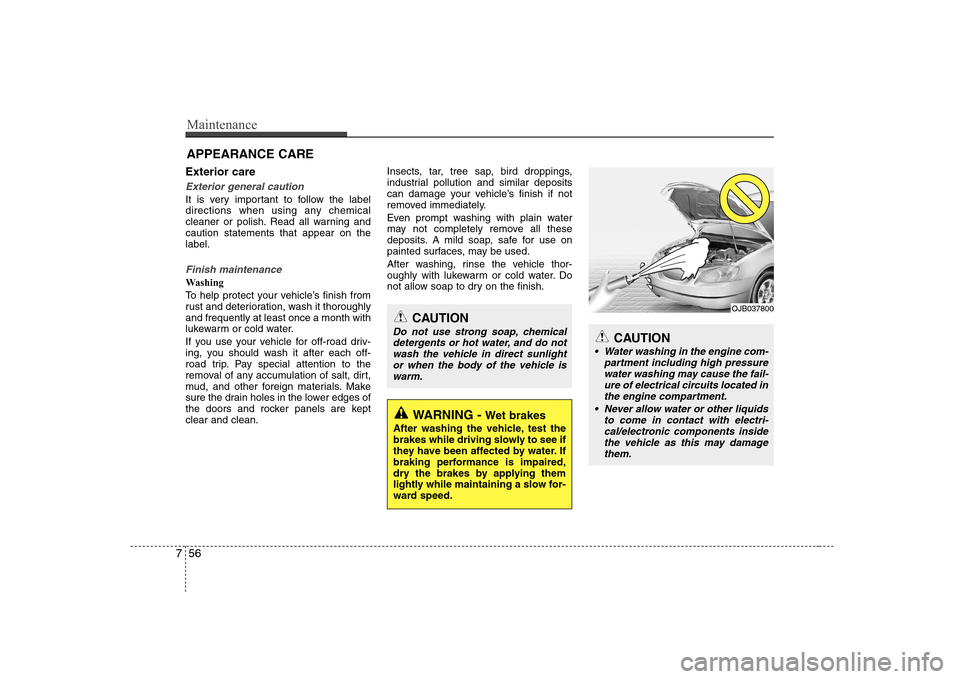
Water washing in the engine com-
partment including high pressurewater washing may cause the fail- ure of electrical circuits located inthe engine compartment.
Never allow water or other liquids to come in contact with electri-cal/electronic components insidethe vehicle as this may damage them.
OJB037800
Page 283 of 308
Maintenance
58
7
Underbody maintenance
Corrosive materials used for ice and
snow removal and dust control may col-
lect on the underbody. If these materials
are not removed, accelerated rusting can
occur on underbody parts such as the
fuel lines, frame, floor pan and exhaust
system, even though they have been
treated with rust protection.
Thoroughly flush the vehicle underbody
and wheel openings with lukewarm or
cold water once a month, after off-road
driving and at the end of each winter. Payspecial attention to these areas because
it is difficult to see all the mud and dirt. It
will do more harm than good to wet down
the road grime without removing it. The
lower edges of doors, rocker panels, and
frame members have drain holes that
should not be allowed to clog with dirt;
trapped water in these areas can cause
rusting.
Aluminum wheel maintenance
The aluminum wheels are coated with a
clear protective finish.
Do not use any abrasive cleaner, pol-
ishing compound, solvent, or wire
brushes on aluminum wheels. They
may scratch or damage the finish.
Use only a mild soap or neutral deter- gent, and rinse thoroughly with water.
Also, be sure to clean the wheels after
driving on salted roads. This helps pre-
vent corrosion.
Avoid washing the wheels with high- speed car wash brushes.
Do not use any acid detergent. It may damage and corrode the aluminum
wheels coated with a clear protectivefinish.WARNING
After washing the vehicle, test the
brakes while driving slowly to see if
they have been affected by water. If
braking performance is impaired,
dry the brakes by applying them
lightly while maintaining a slow for-
ward speed.
Page 293 of 308
Specifications & Consumer information
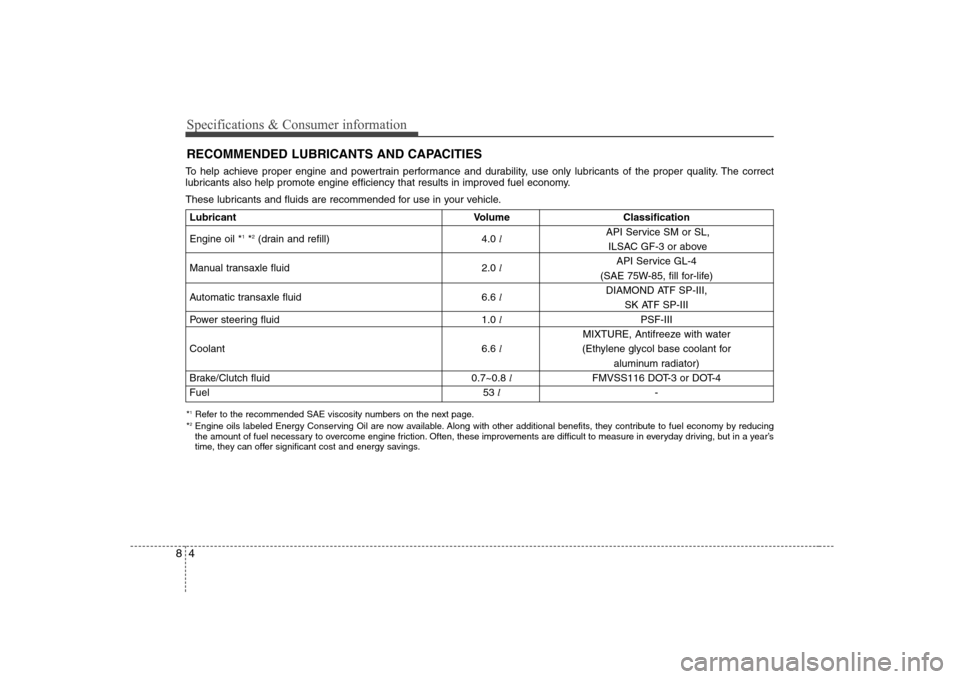
4
8
RECOMMENDED LUBRICANTS AND CAPACITIES
To help achieve proper engine and powertrain performance and durability, use only lubricants of the proper quality. The correct
lubricants also help promote engine efficiency that results in improved fuel economy.
These lubricants and fluids are recommended for use in your vehicle.
* 1
Refer to the recommended SAE viscosity numbers on the next page.
* 2
Engine oils labeled Energy Conserving Oil are now available. Along with other additional benefits, they contribute to fuel econo my by reducing
the amount of fuel necessary to overcome engine friction. Often, these improvements are difficult to measure in everyday driving, but in a year’s
time, they can offer significant cost and energy savings.
Lubricant Volume Classification
Engine oil * 1
*2
(drain and refill) 4.0 l
Manual transaxle fluid 2.0 l API Service GL-4
(SAE 75W-85, fill for-life)
Automatic transaxle fluid 6.6 l DIAMOND ATF SP-III,
SK ATF SP-III
Power steering fluid 1.0 l PSF-III
MIXTURE, Antifreeze with water
Coolant 6.6 l (Ethylene glycol base coolant for
aluminum radiator)
Brake/Clutch fluid 0.7~0.8 l FMVSS116 DOT-3 or DOT-4
Fuel 53 l -
API Service SM or SL,
ILSAC GF-3 or above