maintenance Hyundai Elantra 2009 Инструкция по эксплуатации (in Russian)
[x] Cancel search | Manufacturer: HYUNDAI, Model Year: 2009, Model line: Elantra, Model: Hyundai Elantra 2009Pages: 308, PDF Size: 15.03 MB
Page 287 of 308
Maintenance
62
7
EMISSION CONTROL SYSTEM
The emission control system of your
vehicle is covered by a written limited
warranty. Please see the warranty infor-
mation contained in the Service Passport
in your vehicle.
Your vehicle is equipped with an emis-
sion control system to meet all Australian
Design Rules (ADR) requirements. There are three emission control sys-
tems which are as follows.
(1) Crankcase emission control system
(2) Evaporative emission control system(3) Exhaust emission control system In order to assure the proper function of
the emission control systems, it is rec-
ommended that you have your car
inspected and maintained by an autho-
rised Hyundai dealer in accordance with
the maintenance schedule in this manu-al. Caution for the Inspection and
Maintenance Test (With Electronic
Stability Program (ESP) system)
To prevent the vehicle from misfir-
ing during dynamometer testing,
turn the Electronic Stability
Program (ESP) system off by press-
ing the ESP switch.
After dynamometer testing is com- pleted, turn the ESP system back on
by pressing the ESP switch again.
1. Crankcase emission control system
The positive crankcase ventilation sys-
tem is employed to prevent air pollution
caused by blow-by gases being emitted
from the crankcase. This system supplies
fresh filtered air to the crankcase through
the air intake hose. Inside the crankcase,
the fresh air mixes with blow-by gases,
which then pass through the PCV valveinto the induction system. 2. Evaporative emission control
System
The Evaporative Emission Control
System is designed to prevent fuel
vapours from escaping into the atmos-
phere.
Canister
Fuel vapours generated inside the fuel tank are absorbed and stored in the
onboard canister. When the engine is
running, the fuel vapours absorbed in the
canister are drawn into the surge tank
through the purge control solenoid valve.
Purge Control Solenoid Valve (PCSV)
The purge control solenoid valve is con-
trolled by the Engine Control Module
(ECM); when the engine coolant temper-
ature is low during idling, the PCSV clos-
es so that evaporated fuel is not taken
into the engine. After the engine warms-
up during ordinary driving, the PCSV
opens to introduce evaporated fuel to the
engine.
Page 288 of 308
763
Maintenance
3. Exhaust emission control system
The Exhaust Emission Control System is
a highly effective system which controls
exhaust emissions while maintaining
good vehicle performance.
Vehicle modifications
This vehicle should not be modified.
Modification of your vehicle could affect
its performance, safety or durability and
may even violate governmental safety
and emissions regulations.
In addition, damage or performance
problems resulting from any modification
may not be covered under warranty.
Engine exhaust gas precautions (car- bon monoxide)
Carbon monoxide can be present with other exhaust fumes. Therefore, if you
smell exhaust fumes of any kind inside
your vehicle, have it inspected and
repaired immediately. If you ever sus-
pect exhaust fumes are coming into
your vehicle, drive it only with all the
windows fully open. Have your vehicle
checked and repaired immediately. Do not operate the engine in confined
or closed areas (such as garages) any
more than what is necessary to move
the vehicle in or out of the area.
When the vehicle is stopped in an open area for more than a short time
with the engine running, adjust the
ventilation system (as needed) to draw
outside air into the vehicle.
Never sit in a parked or stopped vehi- cle for any extended time with the
engine running.
When the engine stalls or fails to start, excessive attempts to restart the
engine may cause damage to theemission control system. Operating precautions for catalyt-
ic converters (if equipped)
Your vehicle is equipped with a catalytic
converter emission control device.
Therefore, the following precautions
must be observed:
Use only UNLEADED FUEL for petrol
engine.
Do not operate the vehicle when there are signs of engine malfunction, such
as misfire or a noticeable loss of per-
formance.
Do not misuse or abuse the engine. Examples of misuse are coasting withthe ignition off and descending steep
grades in gear with the ignition off.
WARNING - Exhaust
Engine exhaust gases contain car-
bon monoxide (CO). Though
colourless and odourless, it is dan-
gerous and could be lethal if
inhaled. Follow the instructions
following to avoid CO poisoning.
WARNING - Fire
A hot exhaust system can ignite
flammable items under your vehi-
cle. Do not park, idle, or drive the
vehicle over or near flammable
objects, such as dry grass, paper,
leaves, etc.
Page 289 of 308
Maintenance
64
7
Do not operate the engine at high idle
speed for extended periods (5 minutes or more).
Do not modify or tamper with any part of the engine or emission control sys-
tem. All inspections and adjustments
must be made by an authorised
Hyundai dealer.
Avoid driving with a very low fuel level. If you run out of petrol, it could causethe engine to misfire and result in
excessive loading of the catalytic con-
verter.
Failure to observe these precautionscould result in damage to the catalytic
converter and to your vehicle.
Additionally, such actions could void your
warranties.
Page 298 of 308
F1
OWNER'S MANUAL Operation MaintenanceSpecifications
All information in this Owner's Manual is current at the time of publication.
However, in line with the Hyundai policy of continual product improvement,
the right to amend or change specifications without prior notice or obliga-
tion to incorporate such amendments or changes into vehicles already pro-
duced, is reserved.
This manual applies to all current Hyundai models and includes descrip-
tions and explanations of optional as well as standard equipment. As a
result, you may find material in this manual that does not apply to your spe-
cific vehicle.
Page 301 of 308
F4FOREWORD
Thank you for choosing Hyundai. We are pleased to welcome you to the growing number of discriminating people who drive
Hyundai. The advanced engineering and high-quality construction of each Hyundai we build is something of which we're veryproud.
Your Owner's Manual will introduce you to the features and operation of your new Hyundai. It is suggested that you read it care-
fully because the information it contains can contribute greatly to the satisfaction you receive from your new car.
The manufacturer also recommends that all service and maintenance on your car be performed by an authorised Hyundai deal-
er. Hyundai dealers are prepared to provide high-quality service, maintenance and any other assistance that may be required. HYUNDAI MOTOR COMPANY
Note : If for any reason in the future you should sell your Hyundai, please leave this manual in the vehicle for the new owner's use.
Copyright 2009 Hyundai Motor Company. All rights reserved. No part of this publication may be reproduced, stored in any retrieva l
system or transmitted in any form or by any means without the prior written permission of Hyundai Motor Company.
CAUTION
Severe engine and transaxle damage may result from the use of poor quality fuels and lubricants that do not meet Hyundai specifications. You must always use high quality fuels and lubricants that meet the specifications listed on Page 8-4 in the Vehicle Specifications section of the Owner's Manual.
Page 304 of 308
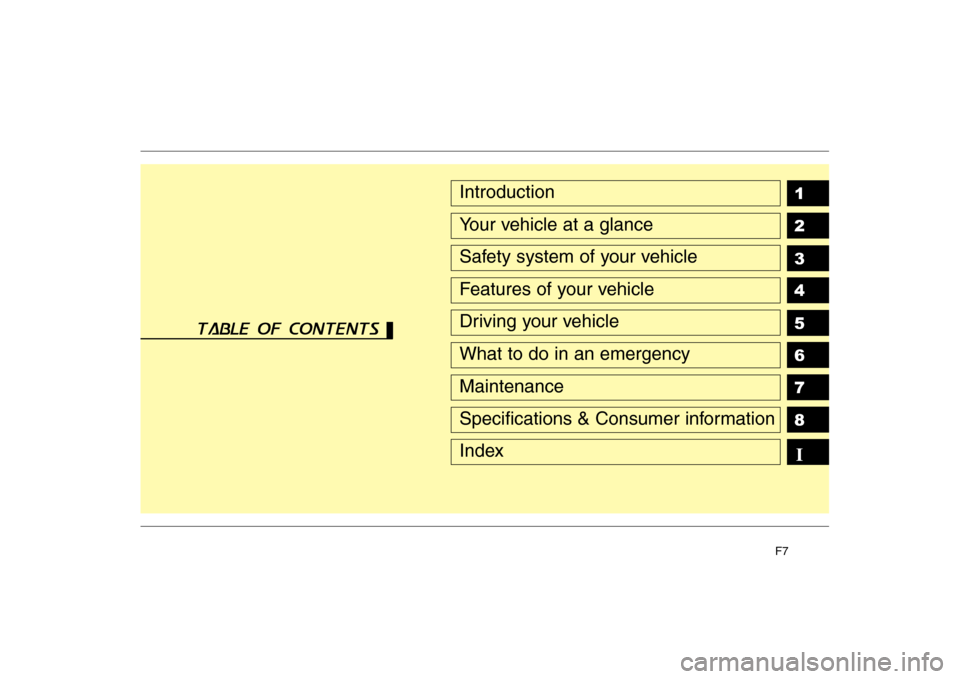
F7
1 2 3 4 5 6 78IIntroduction
Your vehicle at a glance
Safety system of your vehicle
Features of your vehicle
Driving your vehicle
What to do in an emergency
Maintenance
Specifications & Consumer information
Index
table of contents
Page 306 of 308
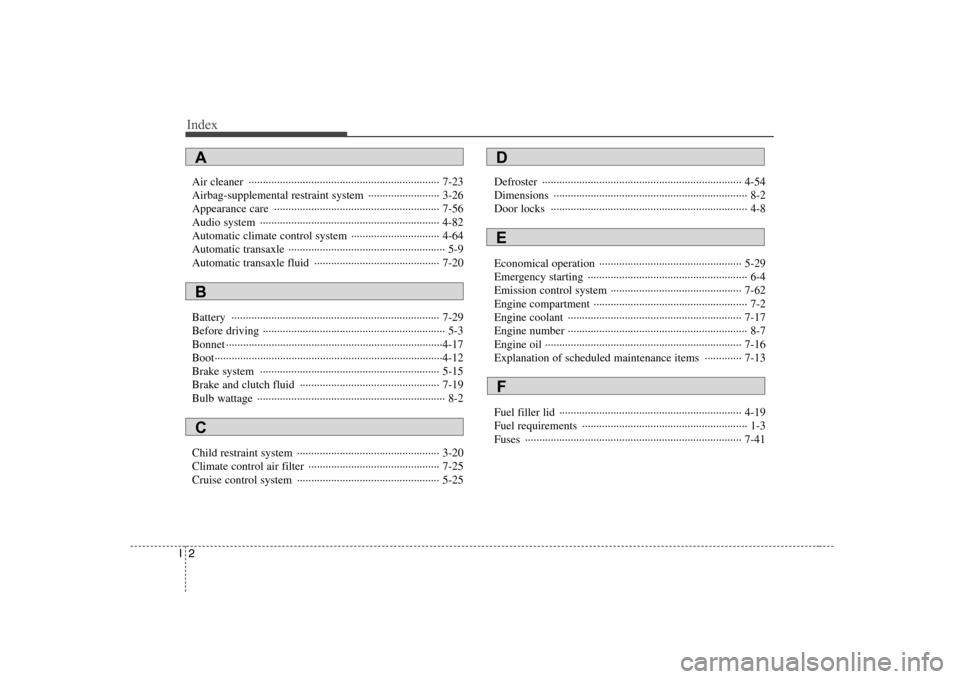
Index
2I
Air cleaner ··································································· 7-23
Airbag-supplemental restraint system ························· 3-26
Appearance care ·························································· 7-56
Audio system ······························································· 4-82
Automatic climate control system ······························· 4-64
Automatic transaxle ······················································· 5-9
Automatic transaxle fluid ············································ 7-20
Battery ········································································· 7-29
Before driving ································································ 5-3
Bonnet ············································································4-17
Boot················································································4-12
Brake system ······························································· 5-15
Brake and clutch fluid ················································· 7-19
Bulb wattage ·································································· 8-2
Child restraint system ·················································· 3-20
Climate control air filter ·············································· 7-25
Cruise control system ·················································· 5-25Defroster ······································································ 4-54
Dimensions ···································································· 8-2
Door locks ····································································· 4-8
Economical operation ·················································· 5-29
Emergency starting ························································ 6-4
Emission control system ·············································· 7-62
Engine compartment ······················································ 7-2
Engine coolant ····························································· 7-17
Engine number ······························································· 8-7
Engine oil ····································································· 7-16
Explanation of scheduled maintenance items ············· 7-13
Fuel filler lid ································································ 4-19
Fuel requirements ·························································· 1-3
Fuses ············································································ 7-41
A
B
C
D
E
F
Page 307 of 308
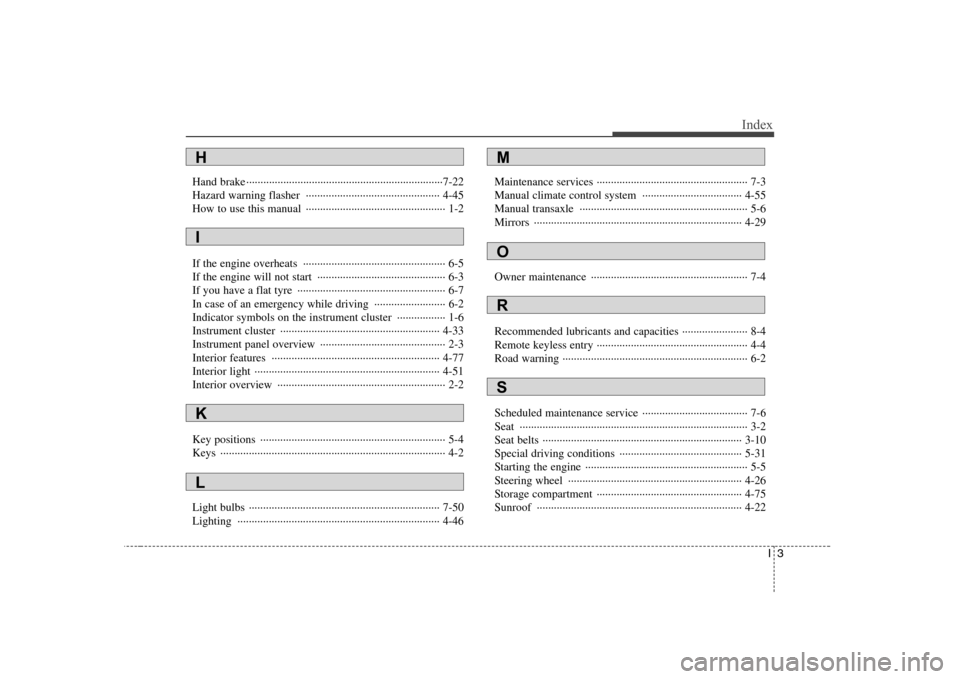
I3
Index
Hand brake ·····································································7-22
Hazard warning flasher ··············································· 4-45
How to use this manual ················································· 1-2
If the engine overheats ·················································· 6-5
If the engine will not start ············································· 6-3
If you have a flat tyre ···················································· 6-7
In case of an emergency while driving ························· 6-2
Indicator symbols on the instrument cluster ················· 1-6
Instrument cluster ························································ 4-33
Instrument panel overview ············································ 2-3
Interior features ··························································· 4-77
Interior light ································································· 4-51
Interior overview ··························································· 2-2
Key positions ································································· 5-4
Keys ··············································································· 4-2
Light bulbs ··································································· 7-50
Lighting ······································································· 4-46 Maintenance services ····················································· 7-3
Manual climate control system ··································· 4-55
Manual transaxle ··························································· 5-6
Mirrors ········································································· 4-29
Owner maintenance ······················································· 7-4
Recommended lubricants and capacities ······················· 8-4
Remote keyless entry ····················································· 4-4
Road warning ································································· 6-2
Scheduled maintenance service ····································· 7-6
Seat ················································································ 3-2
Seat belts ······································································ 3-10
Special driving conditions ··········································· 5-31
Starting the engine ························································· 5-5
Steering wheel ····························································· 4-26
Storage compartment ··················································· 4-75
Sunroof ········································································ 4-22
H
I
K
L
M
O
R
S